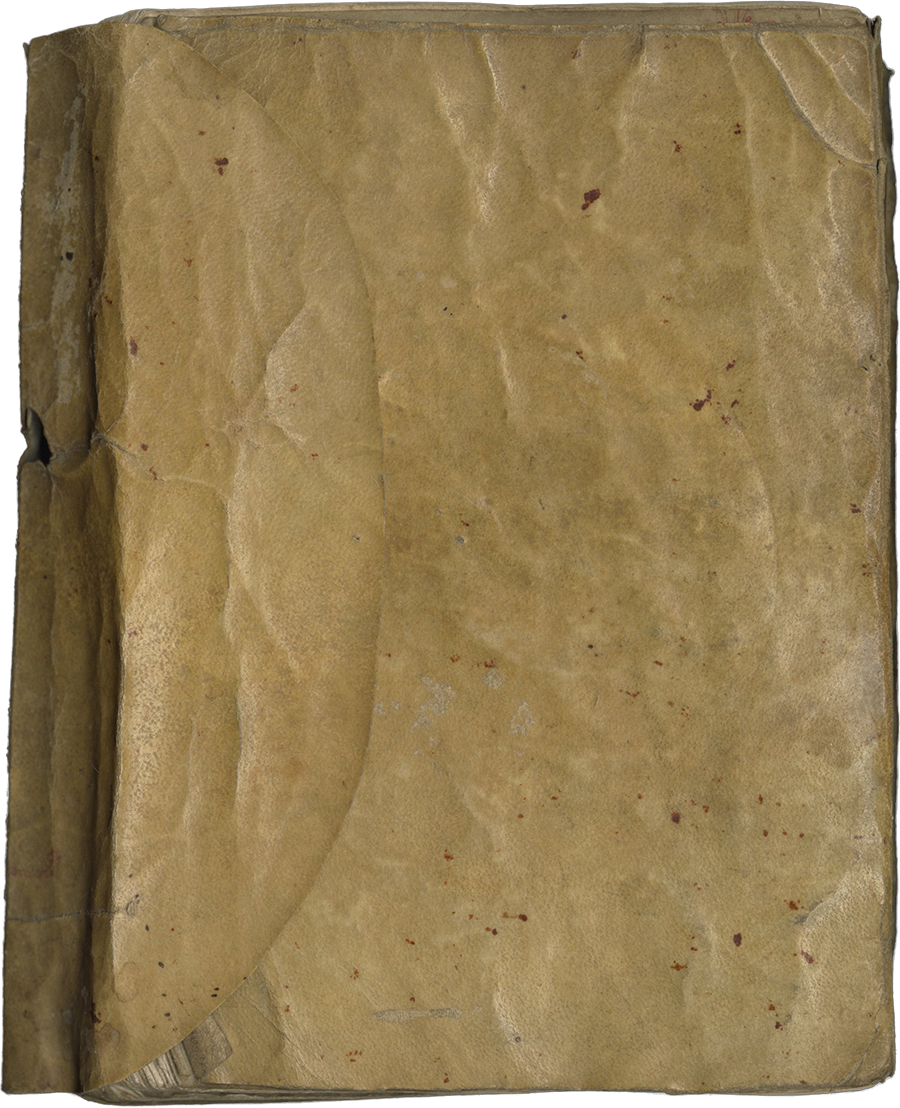
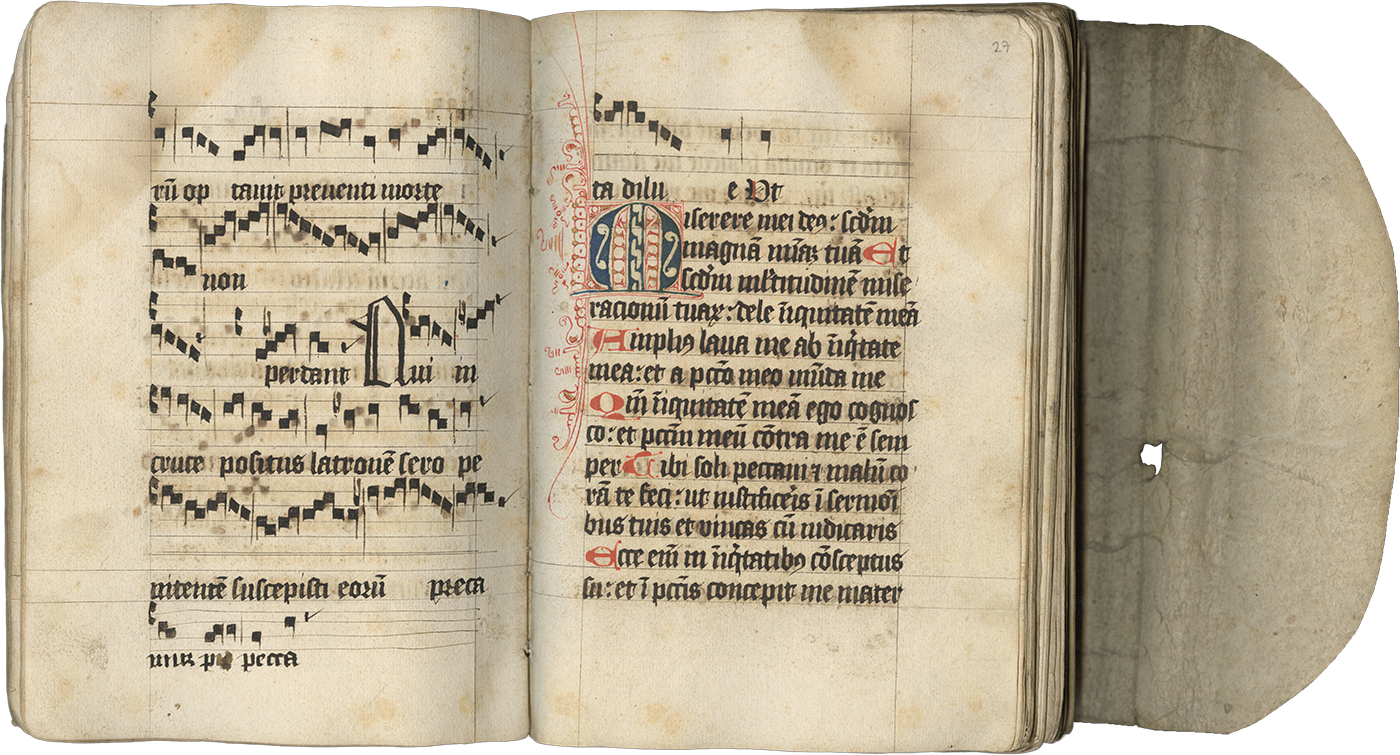
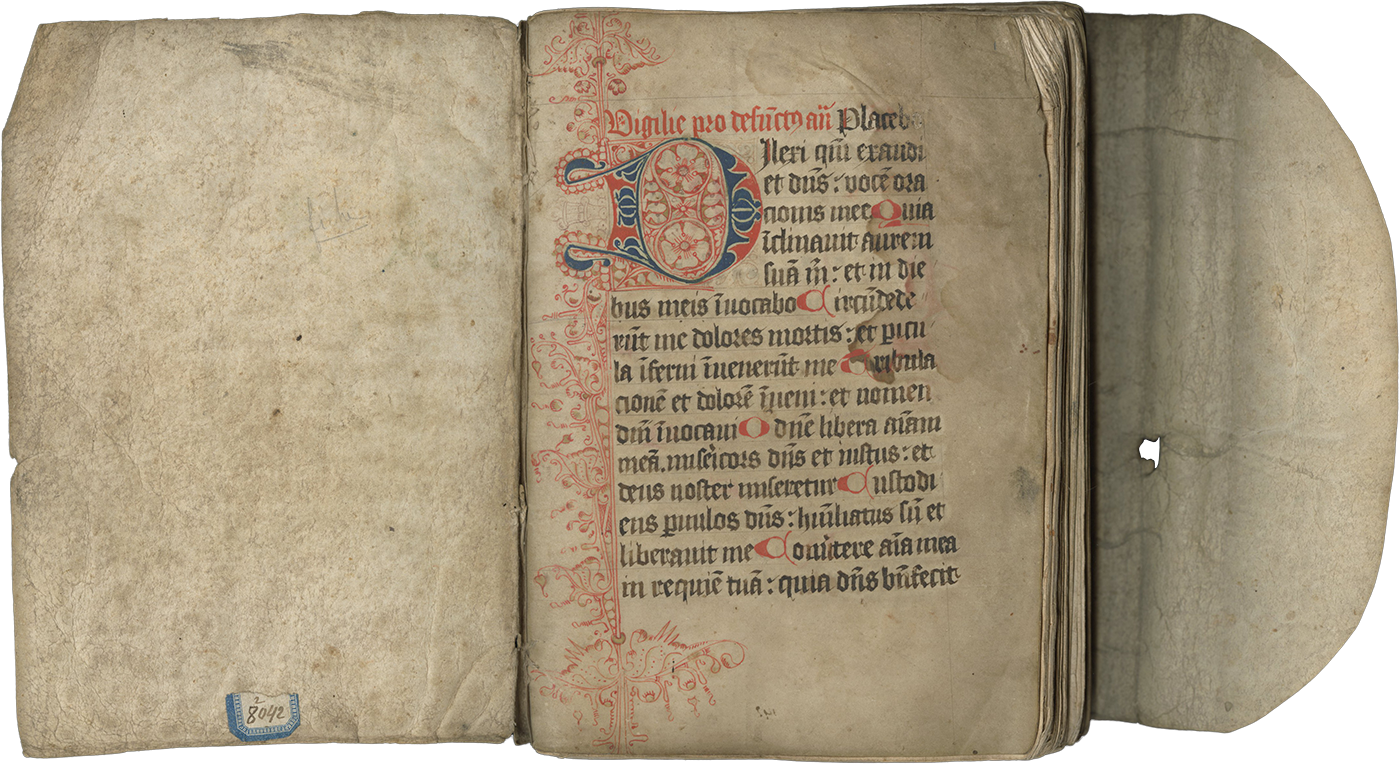
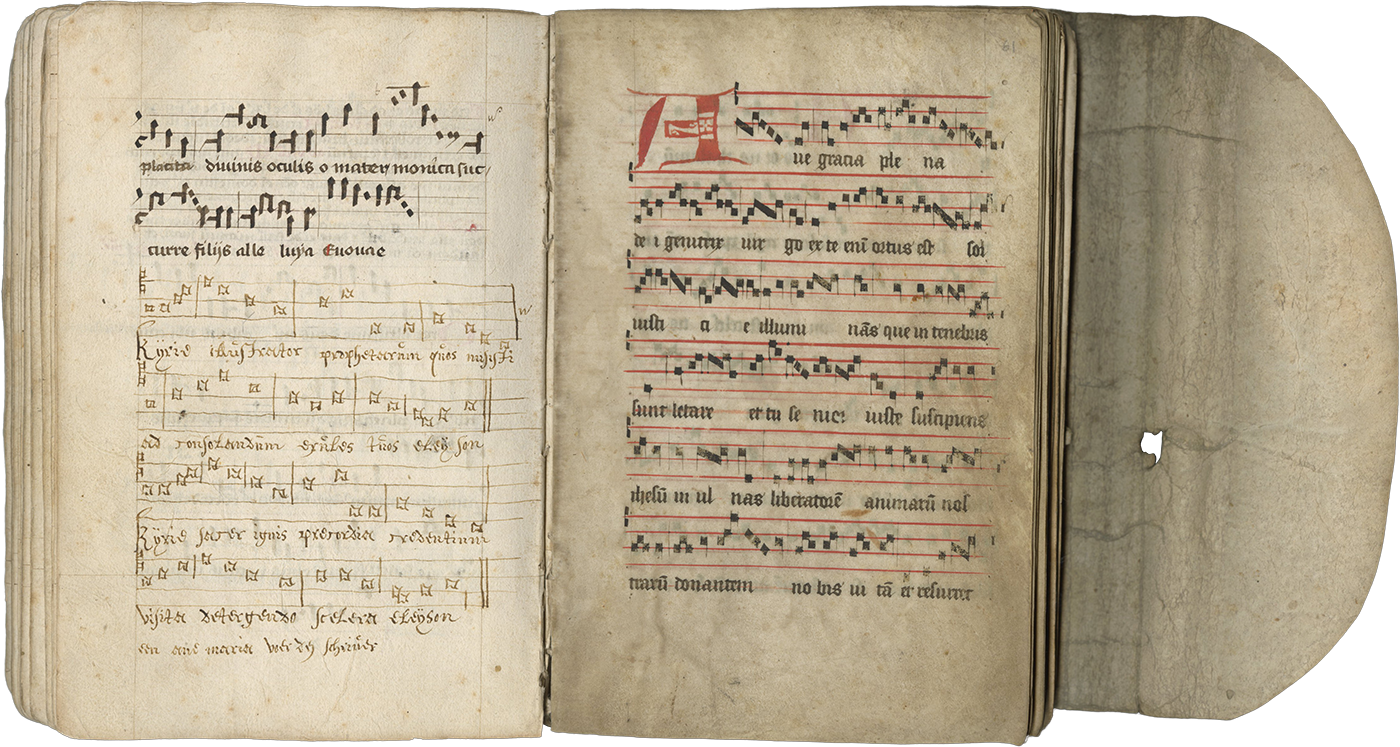
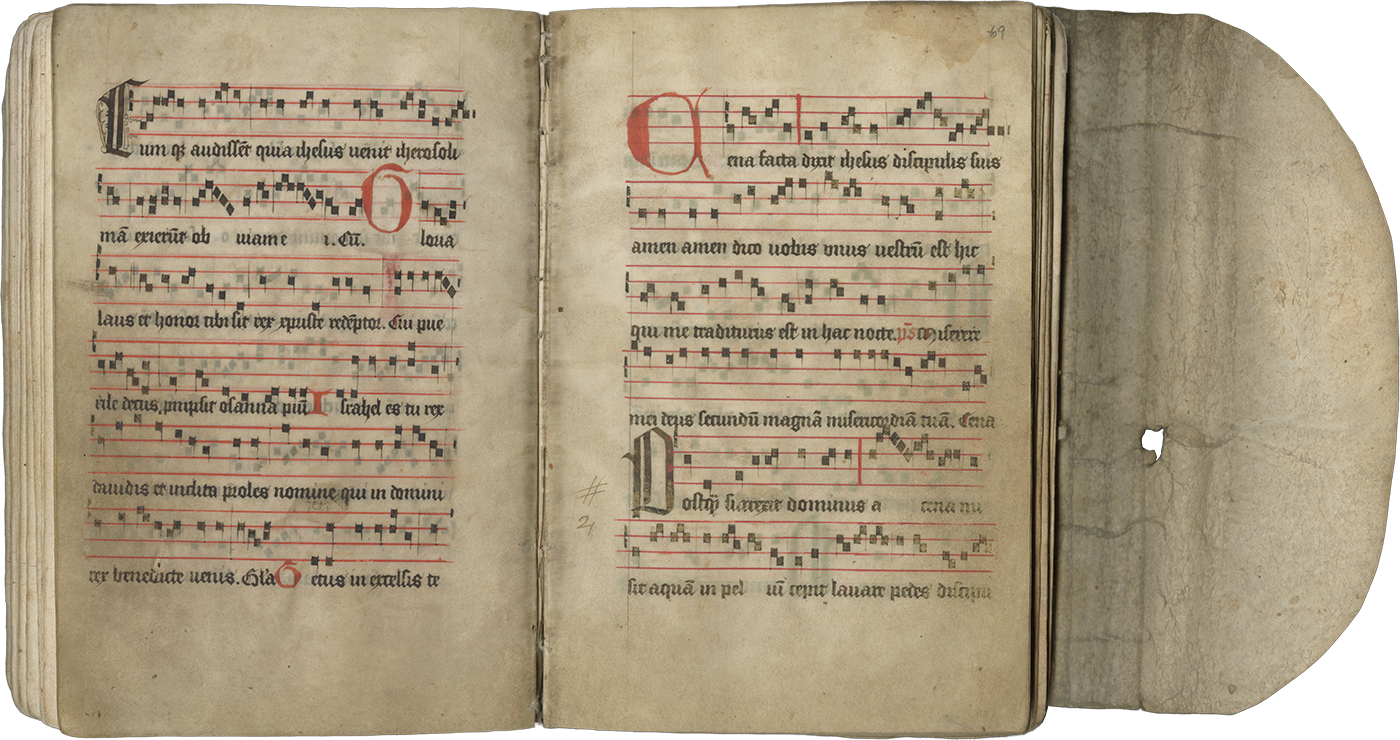
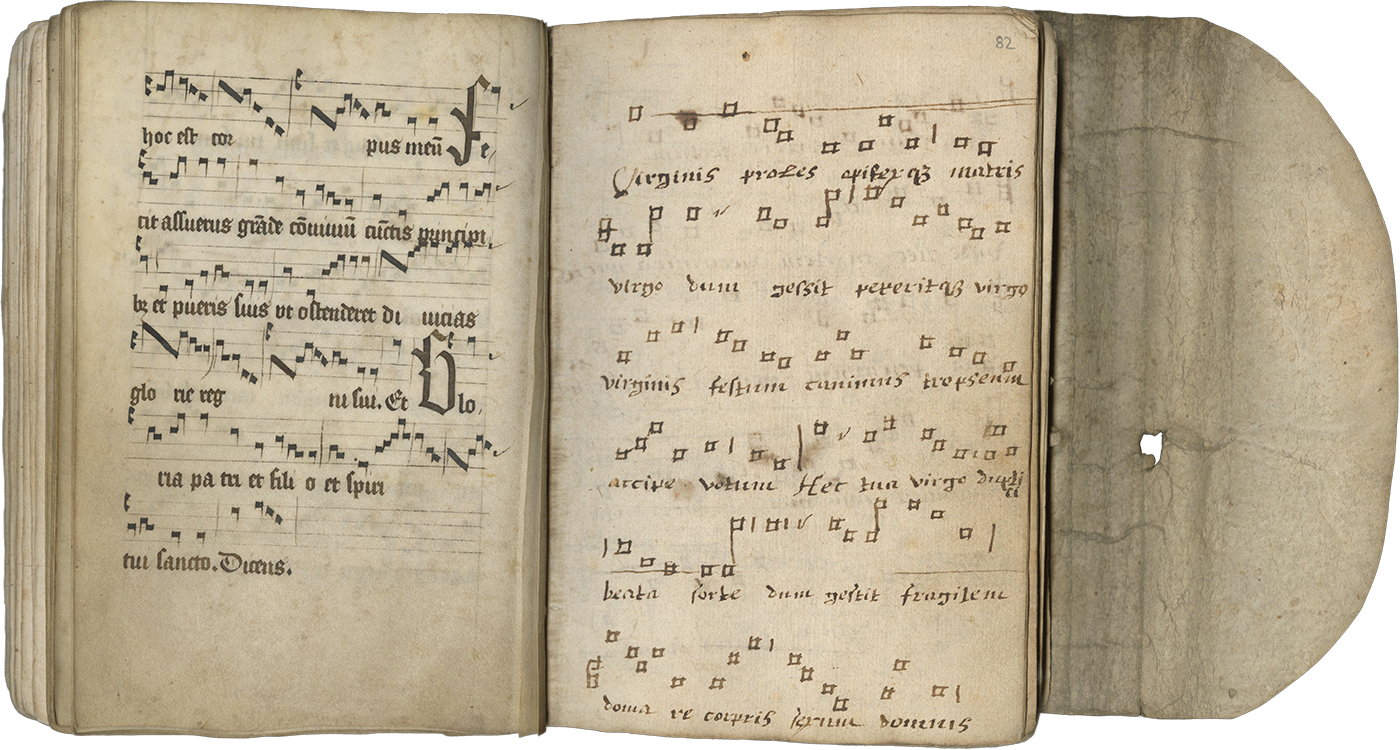
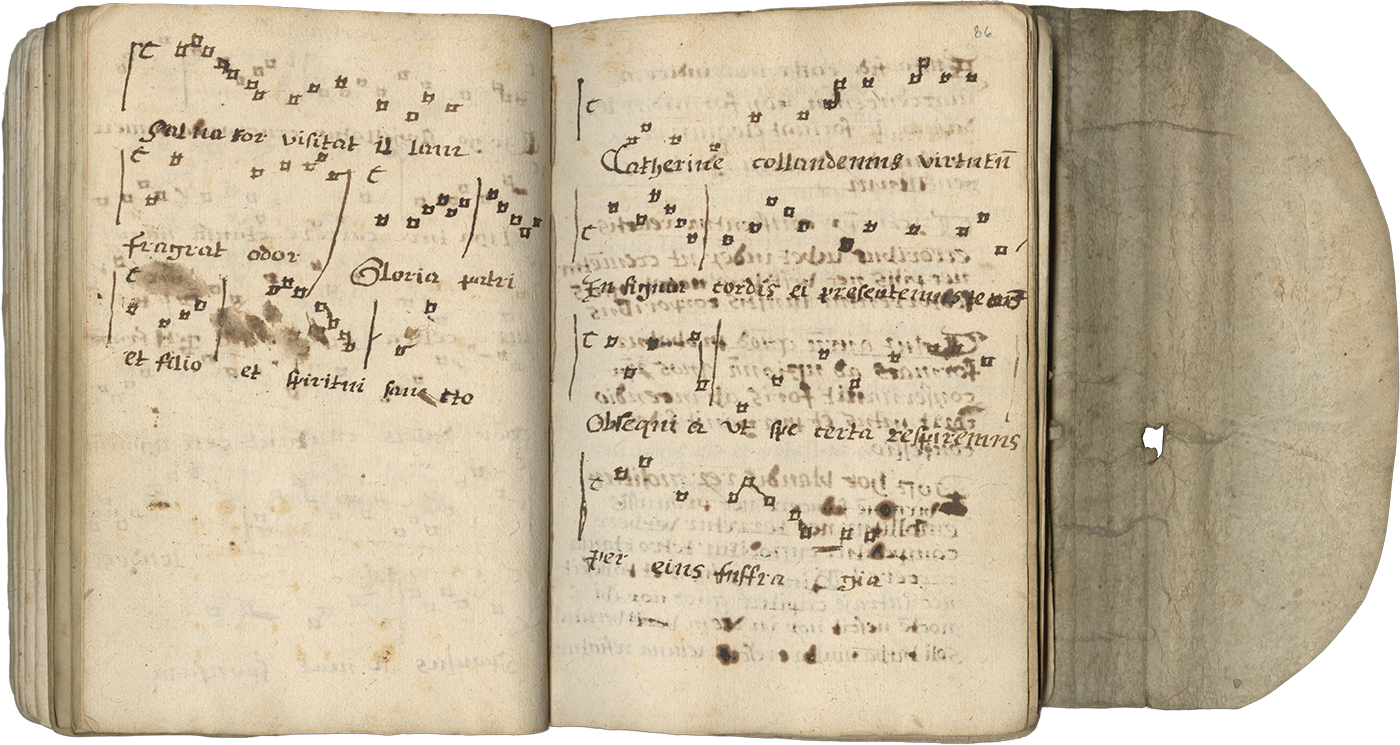
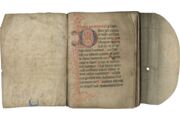
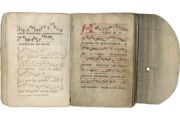
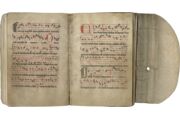
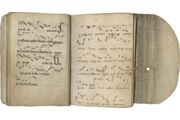
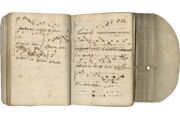
155 folios on parchment and paper, the parchment leaves are ff. 1 and 61-81 (quires x-xii), the paper has five different watermarks: 1) Main aux quatre doigts serrés, le pouce seul écarté, dégénérescence de la main au naturel, similar to Briquet 11462 (Cologne 1518), 2) Licorne, similar to Briquet 10034 (Troyes 1505), 3) Lettre P gothique à fleuron à quatre feuille, p simple à long jambage bifurqué (similar to Briquet 8589, Utrecht 1447), 4) Boeuf ailé, Symbole de l'évangéliste St-Luc (no comparison found), 5) Tête de Boeuf avec yeux et nez, à fleuron à quatre feuille (no exact match in Briquet; see the full series Briquet 14096-1442), modern foliation in pencil, 1-155, lacking 17 leaves, nine of which result in loss of text (collation: i6 ii12 [-12, lacking one leaf after f. 17, without loss of text] iii12 [-2, -11, lacking one leaf after f. 18, and one leaf after f. 26, without loss of text] iv6 [-6, lacking one leaf after f. 32, without loss of text] v8 vi10 [-2, -6, -7, -8, lacking one leaf after f. 41, and three leaves after f. 44, with loss of text] vii8 viii8 [-2, -3, -4, -5, -6, lacking five leaves after f. 55, with loss of text] ix4 [-1, lacking one leaf after f. 57, without loss of text] x-xi8 xii8 [-6, -7, -8, lacking three leaves after f. 81, without loss of text] xiii8 [-8, lacking one leaf after f. 88, without loss of text] xiv-xvi12 xvii2 xviii8 xix16 xx5), no signatures or catchwords, ruled in brown ink in a single column (justification 130 x 82 mm), except on ff. 55-57v which are ruled in brown ink in two columns (justification 144 x 92 mm), ff. 1-53v and 61-81v are written in Gothic script (textualis) in dark brown ink in a single column on 16 lines and music written in square notation on four-line staves, on ff. 1-53v the staves are dark brown and rastrum c. 16-17 mm, accommodating five lines of text and music per page, on ff. 61-81v the staves are red, with a rastrum of 13 mm, accommodating six lines of text and music per page, ff. 55-57 are written in a smaller Gothic textualis in brown ink, in two columns on 24 lines, ff. 58-60v and ff. 89-end are written in Gothic hybrid script in brown ink, in a single column of 6-8 lines of text and music, with music in Hufnagel notation on four-line brown staves and a rastrum of 8 mm, the sections clearly added later, on ff. 53v-54v, 60v, and 82-86, are written in a prickly cursive script in brown ink, in a single column of 5-7 lines of text and music, the music is in hollow square notation on four-line brown staves, rubrics in red, capitals touched in red, cadel initials in the music highlighted in red, 1-3-line initials in red, several decorated with areas left in reserve, one 3-line initial in blue, decorated with areas left in reserve and red penwork ornamentation highlighted with yellow wash, extends into the margin (f. 27), the manuscript opens with a 5-line puzzle initial, decorated with red and lilac penwork ornamentation with yellow-wash highlights filling the initial and extending into the margins (f. 1), the manuscript shows water damage, ink corrosion resulting in holes, tears, stains, and signs of use, but remains in overall good working condition. Early limp parchment envelope binding, stained and worn but otherwise in good condition. Dimensions 198 x 128 mm.
Unusual music manuscript, probably Dutch, and assembled in a limp vellum wallet-style binding. It brings together the liturgical life of canonesses (?) in an Augustinian community: offices for the dead and the sick, the feasts of St. Anne and St. Monica, and chants for the liturgical year. Made from both parchment and paper stock, its script, notation (both square and Hufnagel), and ruling change throughout suggesting a volume built up over time, and perhaps even across multiple communities, rather than copied as a single unit.
Provenance
1. The particular combination of contents suggests that the manuscript may have been made for Augustinian canonesses. The litanies copied on ff. 50-53v follow the Augustinian use of the Windesheim Congregation. The confessors occur in the characteristic Windesheim order: Augustine, Martin, Sylvester, Gregory (Leo being omitted), Ambrose, and Jerome; the virgins are likewise headed by Mary Magdalene (cf. Korteweg 2013, p. 241). The inclusion of Willibrord in the Litany is also significant (f. 51v). This saint occurs in both Utrecht and Windesheim calendars and litanies, the Windesheim calendar being based on that of Utrecht. The inclusion of the antiphons associated with Monica (ff. 58-60v) further supports an Augustinian context. The inclusion of an Office of St. Anne suggests a particular veneration of the Virgin’s mother and may indicate that the manuscript was made for a convent dedicated to her, or that the convent was in the process of updating its liturgical books following the official addition of Anne’s feast to the liturgy in 1481. Anne’s relics were held in the Rhineland.
At the same time, the coexistence of square and Hufnagel notation, together with a liturgical variant known in the diocese of Cologne, may suggest a locale in the eastern Low Countries, or indeed, Westphalia, as does a fragmentary contemporary inscription in Dutch (or perhaps low German), occurs on f. 57v (see below). The watermarks of the different paper stocks support a date in the early sixteenth century.
2. A small library label with a blue ground, inscribed in pencil “2 / 8042,” is attached to the front pastedown.
3. Booksellers’ marks are inscribed in pencil on the end flyleaf: “P.22.2 27 P zee”.
Text
ff. 1-46, Office of the Dead, with chants and music in square notation, rubric, “Vigilie pro defunctus antiphona,” incipit, “Placebo. Dilexi quim exaudi et dominus”; f. 46v, ruled, otherwise blank;
ff. 47-50, Rite of anointing the sick (Ordo infirmorum / extreme unction), beginning imperfectly, incipit, “[Per istam sanctam unctionem et suam piissimam] misericordiam indulgeat tibi Deus quidquid deliquisti per visum. Et similiter dicat quidquid deliquisti per auditum, per odoratum, per gustum, per tactum, per cogitatum, per gressum, semper repetendo: Per istam unctionem. Antiphona. Intret oratio nostra in conspectu tuo; inclina aurem tuam ad preces nostras, Domine....”;
ff. 50-53v, Litany, following the use of Windesheim, followed by prayers;
ff. 53v-54v, contemporary addition: Kyrie Magne Deus potentiae, with music in hollow square notation (Cantus Index ah47099a; see Online Resources), incipit, “Kyrie magne deus potentie, Liberator hominis transgressoris mandati, Eleison...”
ff. 55-57v, Proper Office of St. Anne, without musical notation, beginning with the Matins Invitatory, incipit, “Diem festum Anne sancte celebrans cum gloria, militans cum trimphante iubilet ecclesia...”; f. 57v, ruled, otherwise blank; at the lower margin, a contemporary inscription repeats twice a phrase that is difficult to decipher but appears to include the Dutch words “dencken” (“to think”) and “mijn” (“my, mine”);
ff. 58-60v, antiphons for the Proper Office of St. Monica, with music in Hufnagel notation, incipit, “Post mortem mariti egressa est sancta monica ab agris propriis quorere filium quem periculis atque laboribus multis et apud doctos quorebat et indoctos alleluya...” (Cantus ID 206557, antiphon for the feast of St. Monica, 4 May, belonging to the unusually extensive proper Office narrating Monica’s life and her pursuit of Augustine); a rubric on f. 60 gives directions for distributing the chants and texts specifically assigned to Monica’s feast through the Hours, “Ad primas et ad alias horas...responsum...vigilia sanctae Monicae ... versus Ora pro ... Accinxit fortitudine lumbos suos...”, incipit, “O rex altissime, deus mirabilis, tibi canentibus esto placabilis...” (Cantus ID 206563, the proper St. Monica antiphon used at Vespers);
ff. 61-81v, on parchment, antiphons with square musical notation for the Purification of the Virgin, incipit “Ave gracia plena, dei genitrix virgo, ex te enim ortus est sol iusticie, illuminans que in tenebris sunt...” (Cantus ID 200456), and for the Easter season, including Palm Sunday (f. 63-74) and Easter (f. 74-76), with material for the choir during the procession (f. 76-81);
ff. 82-87, antiphons for the Virgin and St. Catherine (ff. 85-87), with music in hollow square notation without staves; ff. 87v-88v, blank;
ff. 89-155v, antiphons and hymns for the liturgical year (Temporale, Sanctorale, and Common of Saints), with music in Hufnagel notation; the section begins with the Advent hymn “Conditor alme syderum, eterna lux credencium, christe, redemptor omnium, exaudi preces supplicum...” (Cantus ID 008284); it continues with material for the Nativity (f. 92-95v), Epiphany (f. 96r-v), Purification (f. 96v-155v) Lent through Passiontide, Passiontide through the Ascension, Pentecost, the Nativity of John the Baptist, Peter and Paul, Mary Magdalene, Laurence, the Assumption, St. Augustin, Michael the Archangel, Elisabeth of Hungary, the Dedication of a Church, and the Common of the Apostles, Martyrs, Confessors, and Virgins.
The movement known as the Devotio Moderna originated in Deventer, in the Low Countries along the IJssel River, through the work of Geert Grote (1340–1384) and his followers. It emphasized inner spiritual development and a return to the manner of life associated with the early Church. Alongside communities of lay men and women, known as the Brethren and Sisters of the Common Life, a monastic branch emerged shortly after Grote’s death with the foundation of Windesheim, near Zwolle, in 1386.
Further foundations followed, and in 1395 the Chapter of Windesheim was established. Its communities lived according to the Rule of St Augustine. By the end of the fifteenth century, the chapter comprised as many as 100 monasteries reaching across the Low Countries and into present-day Germany, including regions within the diocese of Cologne, although only thirteen were communities for women. During the fifteenth and sixteenth centuries, however, numerous women’s convents adopted the Windesheim liturgy without formally joining the chapter. Others became affiliated with related but independent federations, including the Chapters of Sion and Venlo (cf. Scheepsma 2004).
In addition to the Office of Saint Anne, the manuscript contains chants for the liturgical year and liturgical materials associated with the care of the sick, dying, and dead. Particularly noteworthy is the version of the anointing formula on ff. 47-50, which has a close and unusually specific parallel in a Cologne liturgical source and aids in identifying likely locations of the Windesheim (or Windesheim-affiliated) community. The standard formula in the Rituale Romanum lists the bodily senses in the sequence per visum ... per auditum ... per odoratum ... per gustum [et locutionem] ... per tactum ... per gressum. In the present manuscript, however, the usual list of external senses (sight, hearing, smell, taste, touch, and walking (gressum)) is expanded to include the mental faculty of thought, cogitatum. The anointing is thus presented as removing sins committed both through the senses and through thought. Medieval variants express the same idea in other ways, for example per cogitationes et affectus or per illicitas cogitationes. An almost identical formula containing cogitatum, however, is recorded in the Cologne liturgical tradition. The Usuarium database of medieval and early-modern liturgical sources records the following indexed text in a Ritual printed Cologne in 1562: “Per istam unctionem et per suam piissimam misericordiam indulgeat tibi Dominus quicquid peccasti per visum auditum gustum odoratum cogitatum tactum incessum” (cf. “Usuarium” in Online Resources).
The manuscript may be compared with a Diurnal probably made for an Augustinian convent of the Windesheim Congregation around 1450-1475, Les Enluminures, TM 242 (see Online Resources). The manuscript includes Willibrord in its calendar alongside Augustine and Monica, while its Office of the Dead corresponds to Utrecht and Windesheim usage. A further comparison may be made with the near-contemporary Windesheim Diurnal, Cornell University Library, Archives 8799 Bd. Ms. 1 tiny (see Online Resources).
The manuscript is particularly interesting as a composite volume that may well reflect production by a variety of members of the conventual community, or even across communities, over time. The support changes from parchment to paper; the paper itself comes from several sources, represented by five different watermarks; and the ruling, scripts, scribes, musical rastra, and notation likewise change throughout the book. Additions were made in previously blank spaces, further demonstrating that the volume continued to develop after its principal sections had been copied. The coexistence of square and Hufnagel notation is especially noteworthy. By this period, square notation was dominant across Western Europe, and Hufnagel notation continued only in German-speaking regions. Its persistence in extensive notated sections in this manuscript is therefore a significant feature of the book’s musical and regional character.
Overall, this is a compelling manuscript that brings together liturgy, music, material evidence, and the devotional life of a women’s community at the beginning of the sixteenth century. Its composite structure preserves evidence of multiple stages of production and use, while its Windesheim affiliations, Augustinian saints, Office of St. Anne, and distinctive liturgical texts provide important clues to its institutional setting.
Literature
Gerritsen-Geywitz, G. Het Utrechtse draakje en zijn entourage, Utrecht, 2017.
Harper, J. The Forms and Orders of Western Liturgy from the Tenth to the Eighteenth Century, Oxford, 1991.
Kohl, W., E. Persoons, and A.G. Weiler (eds.) Monasticon Windeshemense, Archives et bibliothèques de Belgique=Archief- en bibliotheekwezen in België, Numéro special, 4 vols., Brussels, 1976-1984.
Korteweg, A. “Books of Hours from Northern Netherlands Reconsidered: The Use of Utrecht and Windersheim and Geert Grote’s Role as a Translator,” in Books of Hours Reconsidered, eds. S. Hindman and J. Marrow, London, 2013, pp. 235-277.
Post, R. R. The Modern Devotion: Confrontation with Reformation and Humanism, Leiden, 1968.
Scheepsma, W. translated from the Dutch by D. F. Johnson. Medieval Religious Women in the Low Countries, Woodbridge, Suffolk, and Rochester, N.Y., 2004.
Van Engen, J. H. Sisters and Brothers of the Common Life: The Devotio Moderna and the World of the Later Middle Ages, Philadelphia, 2008.
Online Resources
Agenda Coloniensis, 1562, in USUARIUM:
https://usuarium.elte.hu/book/315/view
Cantus Index:
https://cantusindex.org/id/ah47099a
Conditor alme siderum aeterna lux in Cantus Database:
https://cantusdatabase.org/chant/270099
Chapter of Venlo:
https://wwwextern.ubn.ru.nl/soeterbeeck/mon/poster02.php
Ithaca, Cornell University Library, Archives 8799 Bd. Ms. 1 tiny, Les Enluminures, TM 1085: https://catalog.library.cornell.edu/catalog/15434438 full description
https://www.textmanuscripts.com/medieval/diurnal-use-of-windesheim-182286
Les Enluminures, TM 242:
https://www.textmanuscripts.com/medieval/diurnal-illuminated-60530
“Windesheim” in Catholic Encyclopedia:
www.newadvent.org/cathen/15651a.htm
TM 1498