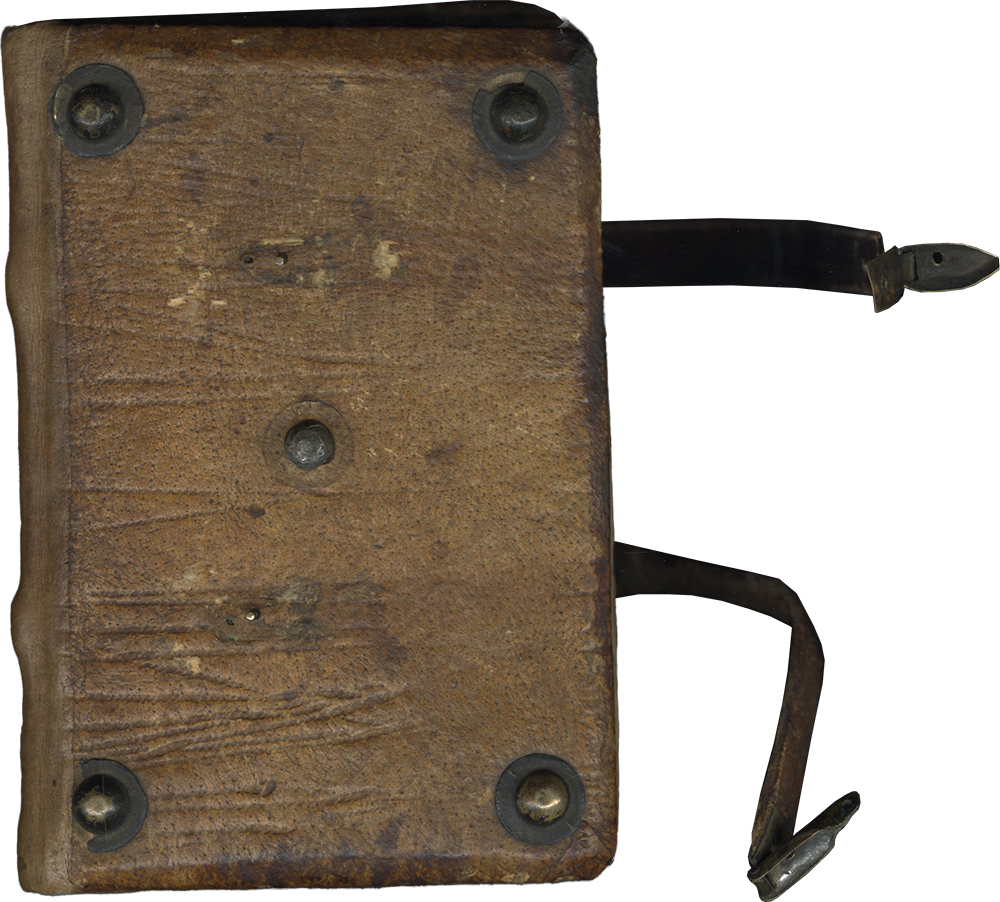
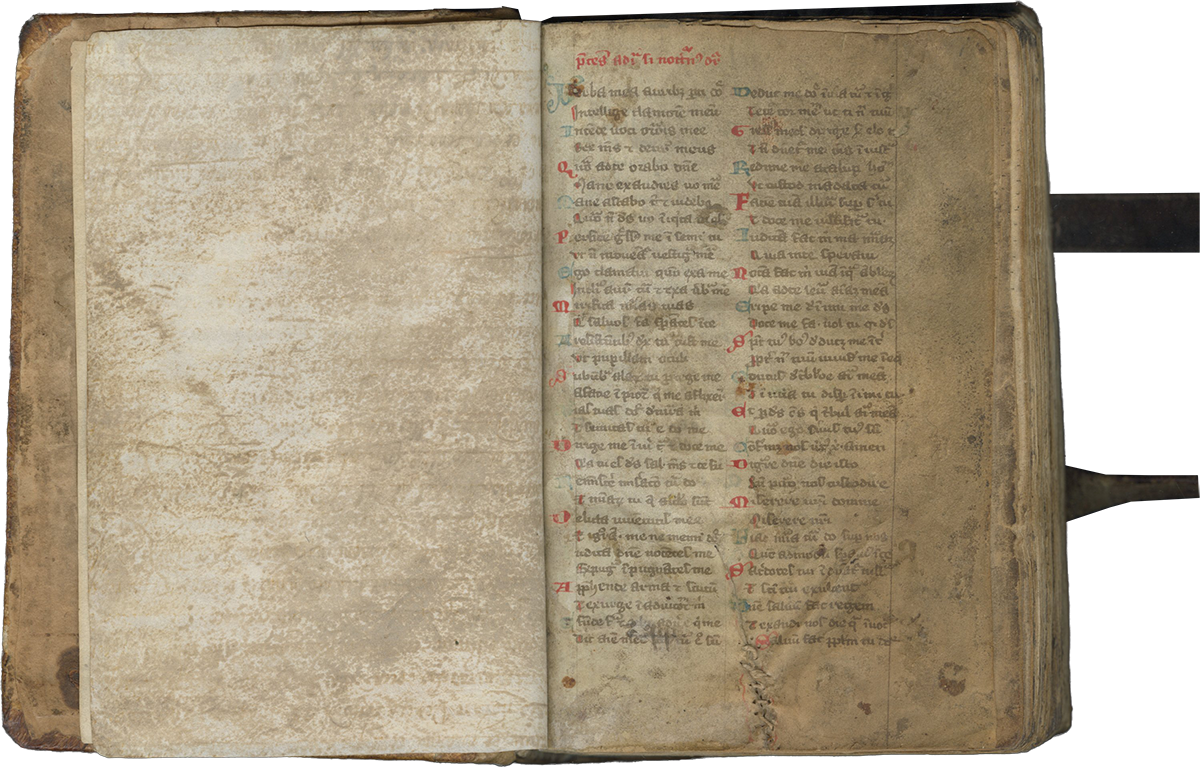
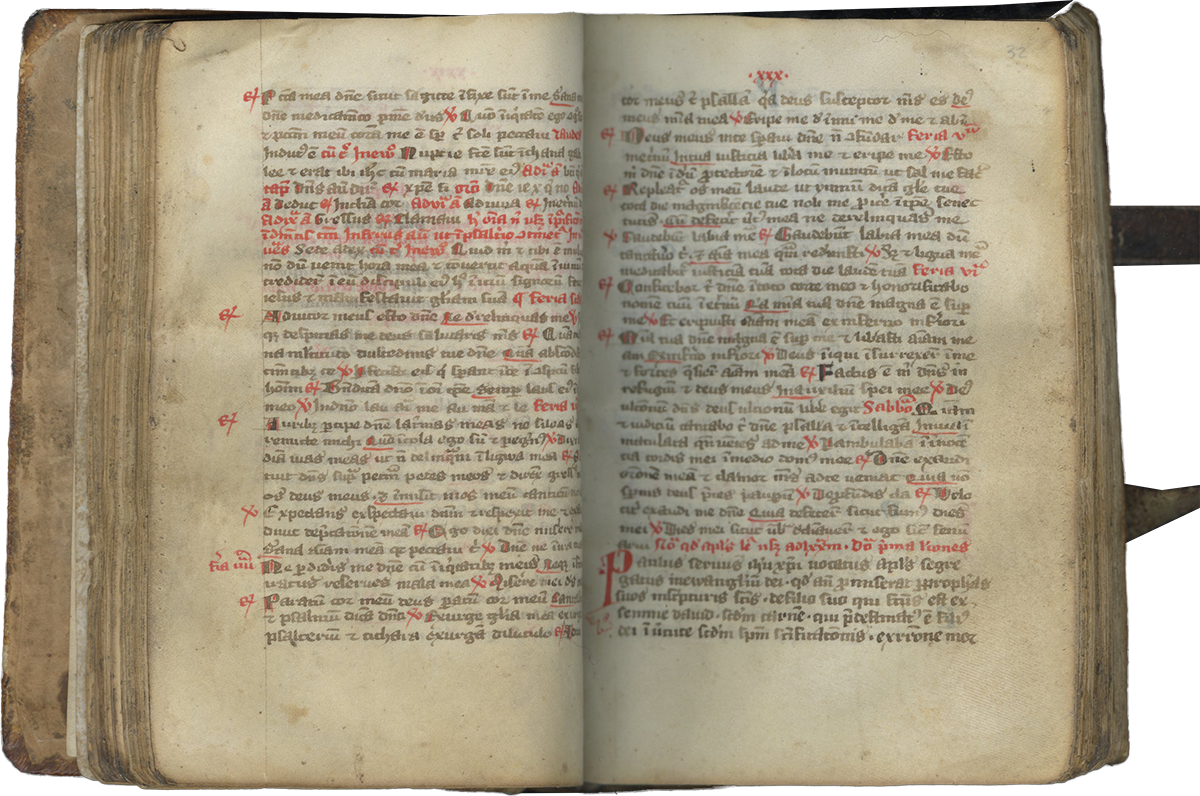
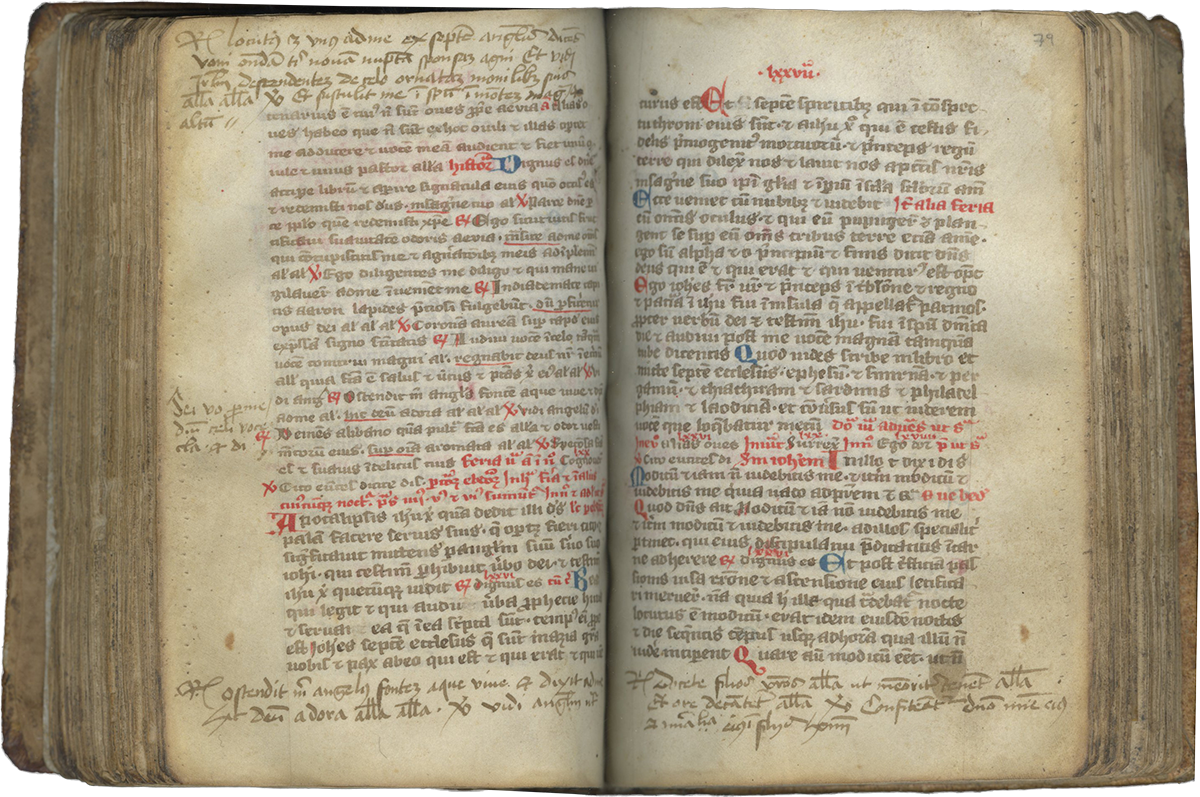
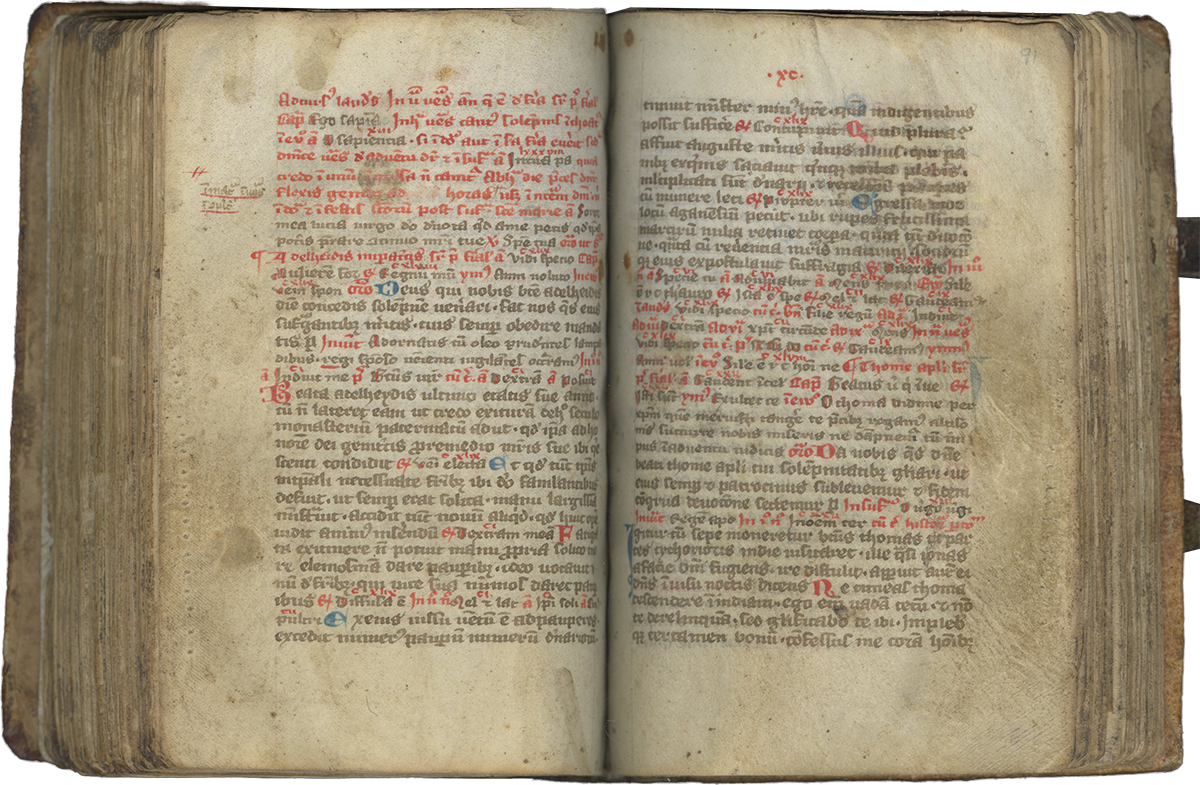
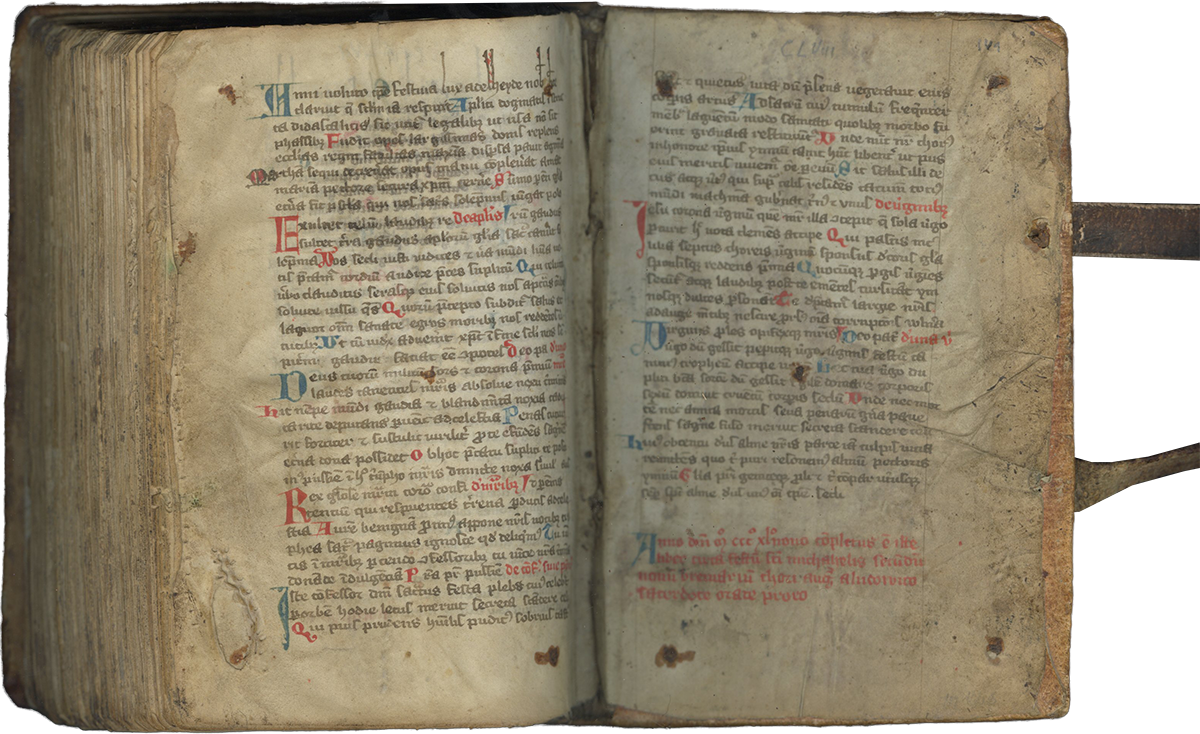
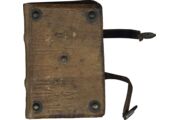
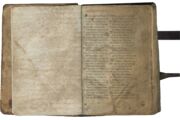
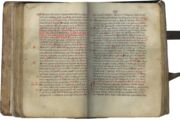
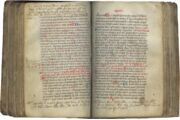
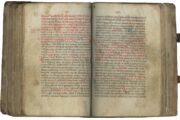
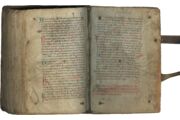
i (paper) + i (parchment) + 150 folios on parchment (last leaf pasted to the back cover), first two leaves and last four leaves unfoliated, original foliation in red Roman numerals (i-cliiii [154], with errors, e.g. jump from cxxix to cxl), modern foliation in pencil used here, 1-149 (including 83bis), complete (collation i2 ii-xix8 xx4), original quire signatures in Roman numerals at the lower margin of final versos, ii-xviii (the first quire of 8 unsigned), with occasional Arabic numerals at the inner lower recto, no catchwords, ruled in brown ink (justification 111 x 67 mm), pricking visible in outer margins, written in brown ink in Gothic textualis in a single column on 32 lines (ff. 1-2v in two columns), rubrics in red, majuscules touched in red, 1-2-line initials alternating in red and blue, elongated marginal initials (notably “I” and “P”) occasionally ornamented with reserved parchment motifs, larger initials (3-line) planned but never executed (see e.g. ff. 3, 85v); signs of use, stains, medieval repairs, occasional defects in parchment (holes, short leaves), edges worn and darkened, but overall well preserved. In its original binding of pig skin over beveled wooden boards, with metal bosses (partially preserved), two clasp fastenings (one detached), and spine with two raised bands, front pastedown from a discarded fourteenth-century legal or scholastic manuscript, front joint and spine restored, binding largely contemporary and in excellent condition. Dimensions 155 x 107 mm.
Exceptionally rare, precisely dated and signed medieval manuscript, completed in the year 1349, at the height of the Black Death, and preserving its original binding. Such securely localized and datable Breviaries are uncommon; rarer still is the scribe’s own colophon naming the priest Ludwig and situating the book within the Augustinian liturgical reforms of the later Middle Ages. Binding, provenance, script, and content combine to make this an excellent example of a medieval monastic codex.
Provenance
1. The scribe concluded the manuscript with the following colophon: “Anno domini M° ccc° xl°nono completus est iste liber circa festum sancti michahelis secundum novum breviarium chori augustinensium a ludowico sacerdote orare pro eo” (In the year of our Lord 1349, this book was completed around the feast of Saint Michael according to the new Augustinian choir breviary by the priest Ludwig. Pray for him; f. 149, pasted to the back cover). Localization to Bavaria is supported by the Sanctorale, including the feasts of St. Erhard of Regensburg (Bavaria, 8 Jan, f. 98v), St. Alto of Altomünster, an eighth-century Benedictine abbot in Bavaria (9 Feb, f. 110v), St. Walburga, abbess of the double monastery of Heidenheim am Hahnenkamm in Bavaria (25 Feb, f. 120), and St. Adelheid, Holy Roman Empress and wife of Otto the Great (16 Dec, f. 90v). The prominence accorded to the cult of St. Nicolas (ff. 87v-89, 148) may offer an additional indication of the manuscript’s intended use, particularly in light of the importance of the saint within the Augustinian canonical communities in Bavaria, notably the Provostry of St. Nicholas, Passau (see below).
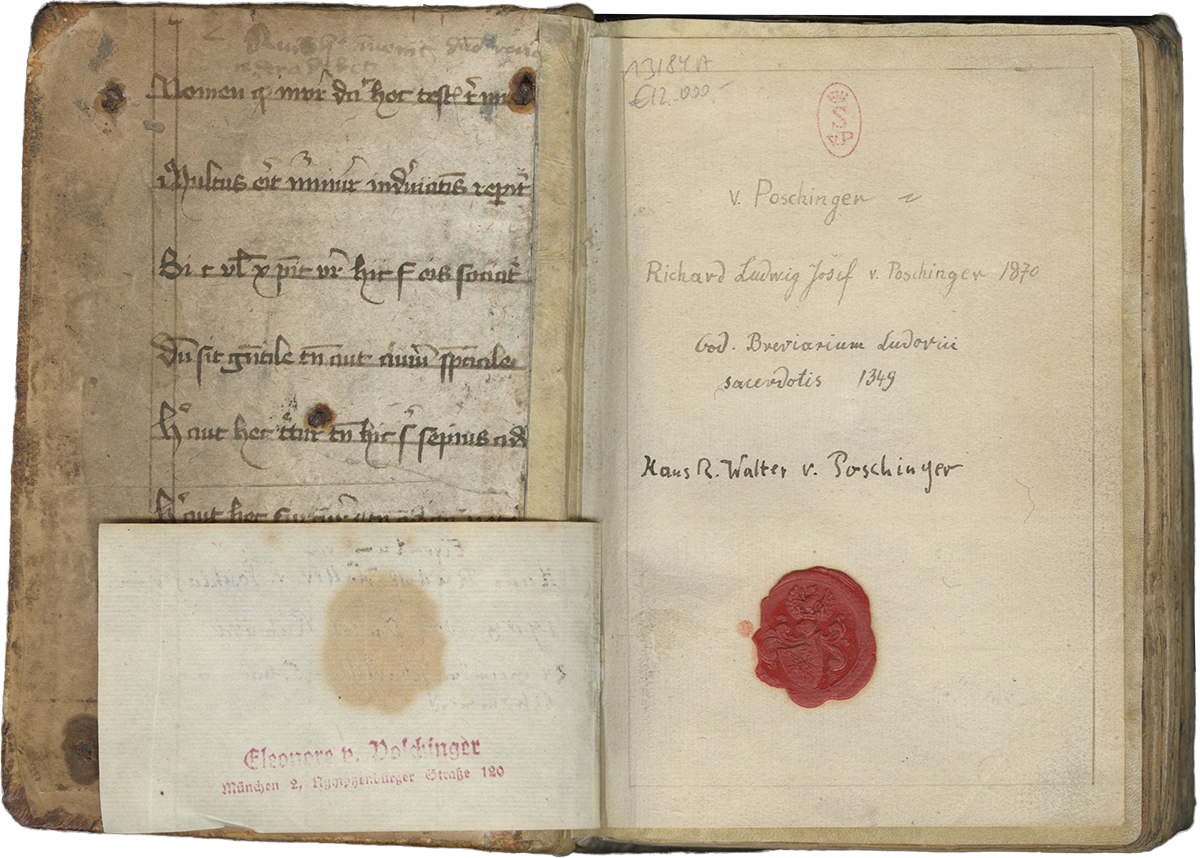
Contemporary marginal annotations and a manicule attest to active use. The binding appears original. The pastedown derives from a scholastic or notarial text, containing formulaic phrases such as “Nomen... Domini hoc testatur,” and “Hoc notum,” suggesting writing instruction or legal training material.
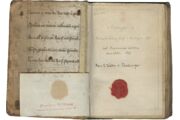
2. In the nineteenth and twentieth century in the collection of the Bavarian Poschinger family, including Richard Ludwig Josef von Poschinger (1839–1915), landscape painter (see Online Resources), whose ownership inscription, stamp and wax seal with coat of arms appear on the front flyleaf.
3. Gift of Richard von Poschinger to his nephew, Hans Rudolf Walter von Poschinger, on his birthday 5 May 1908, as detailed in Hans’ inscription on the half page pasted to the front flyleaf.
4. Sold at Zisska & Kistner, Auction 9 (1987).
5. Private German collection.
Text
(the description follows the modern foliation)
ff. 1-2v, “Preces,” short liturgical invocations for use in Advent offices;
ff. 3-85, Temporale, from the first Sunday in Advent to Pentecost Eve;
ff. 85v-123, Sanctorale, from the office for St. Saturnis (29 November) to Pentecost; includes the feasts of St. Barbara (4 Dec, f. 87v), St. Nicolas (6 Dec, ff. 87v-89), the Immaculate Conception (8 Dec, f. 89v, officially introduced only in the late fifteenth century), St. Adelheid, Empress and wife of Otto the Great (16 Dec, f. 90v), St. Erhard of Regensburg (Bavaria, 8 Jan, f. 98v), St. Agnes (21 Jan, ff. 102, 106, octave), St. Emerentiane of Rome (23 Jan, f. 104), St. Polycarp of Smyrna (23 Feb, f. 106), St. Brigid of Ireland (1 Feb, f. 106), St. Dorothea of Caesarea (f. 110v), St. Alto of Altomünster (9 Feb, f. 110v), St. Scholastica (10 Feb, f. 110, sister of St. Benedict), St. Valentine (14 Feb, f. 111), St. Juliana of Nicomedia (16 Feb, f. 111), St. Walburga (25 Feb, f. 120), St. Gordian (10 May, f. 122), and St. Pancras of Rome (12 May, f. 122v);
ff. 123v-143, Common of Saints, with the lessons, prayers and chants common to the various classes of saints in their offices;
ff. 143v-149, Hymnal, incipit, “In prima dominica Adventus ymnus ad vesperas,” beginning with the hymn at Vespers on the first Sunday in Advent, and followed by the hymns for other Advent Sundays, then for the feasts of St. Stephen, St. John the Evangelist, Holy Innocents, Epiphany, the Purification of the Virgin, Septuagesima Sunday, and so forth through feasts in Lent and Easter, then the Invention of the Cross, Ascension, St. Nicholas “Plaudat letitia lux hodierna” (f. 148), St. Adelheid “Anni voluto tempore festiva lux Adelheyde...” (f. 148v), and ending with hymns for apostles, martyrs, confessors, pontiffs and virgins in the Common of Saints;
This compact Breviarium novum chori Augustinensium, completed in 1349, belongs to a broader wave of thirteenth– and fourteenth-century efforts among the Augustinian Canons to standardize and streamline the liturgy. Its small format, modest decoration, and economical use of parchment mark it as a practical working book intended for daily recitation in choir, rather than for display. The explicit colophon naming the priest Ludwig and dating the manuscript to the feast of St Michael 1349 provides a rare and valuable point of localization and context.
The contents, Temporale, Sanctorale, Commune Sanctorum, and hymnal for the winter half of the year, reflect typical late medieval Breviary organization. The inclusion of Bavarian saints such as Saint Alto, Saint Erhard of Regensburg, and Saint Walburga, firmly situates the manuscript within southern German ecclesiastical milieu. By contrast, the presence of Adelheid of Italy reflects a wider imperial devotional culture associated with the Ottonian legacy.
Particularly striking is the prominence accorded to St. Nicholas, whose feast, octave, translation, and hymn are all included. This emphasis suggests production for a community under his patronage. Given the manuscript’s Bavarian context, the most plausible setting is the Provostry of St. Nicholas, Passau, a major house of Augustinian Canons founded in the eleventh century and a significant center of learning and reform. The inclusion of a hymn for St. Stephen, patron of Passau Cathedral, further supports this association.
The abbey of St. Nicholas was itself a product of reform, founded under Bishop Altmann as part of efforts to renew the clerical life according to ideals of apostolic poverty. It soon became an important center of canonical movement in Bavaria. In 1348, an earthquake destroyed much of the monastic complex, leaving only the Romanesque crypt intact. The production of this manuscript in the following year is therefore especially evocative, standing as a testament to the resilience of liturgical life in the face of both natural disaster and the wider devastation of the Black Death.
The Augustinian Canons of Passau were active producers of manuscripts, and after the secularization of 1803, a substantial portion of their library, now numbering over two hundred books, entered the Bayerische Staatsbibliothek in Munich (see Halm et al. in Literature below). Within this context, the present manuscript can be understood as part of a vibrant tradition of liturgical production in late medieval Bavaria. Its worn condition and annotations further attest to its long and continuous use as a functional book of prayer.
Literature
Backmund, N. Die Chorherrenorden und ihre Stifte in Bayern: Augustinerchorherren, Prämonstratenser, Chorherren von Hl. Geist, Antoniter, Passau, 1966.
Bauer, H. and A. Klöster in Bayern: Eine Kunst- und Kulturgeschichte der Klöster in Oberbayern, Niederbayern und der Oberpfalz, Munich, 1985.
Elm, K. Reformbemühungen und Observanzbestrebungen im spätmittelalterlichen Ordenswesen, Berlin, 1989.
Halm, K, Thomas, G. M., Meyer, W., Keinz, F. Catalogus codicum latinorum Bibliothecae Regiae Monacensis, Tomus 2, Pars 3, Munich, 1878, pp. 45-64, Codices latini ecclesiae collegiatae Lateranensis ad S. Nicolaum prope Passavium, MSS 16001-16232.
Harper, J. The Forms and Orders of Western Liturgy from the Tenth to the Eighteenth Century: A Historical Introduction and Guide for Students and Musicians, Oxford, 1991.
Hughes, A., Medieval Manuscripts for Mass and Office, Toronto, 1982.
Leroquais, V. Les bréviaires manuscrits des bibliothèques publiques de France, 5 vols, Paris, 1934.
Palazzo, É., A History of Liturgical Books from the Beginning to the Thirteenth Century, Collegeville, 1998.
“Passau. Augustinerchorherrenstift St. Nikola” in Mittelalterliche Bibliothekskataloge. Deutschlands und der Schweiz...Bistümer Passau und Regensburg, Munich, 1977, pp. 47-56.
Röhm, J. B. Das Historische Alter der Diözese Passau in ihrem gegenwärtigen Umfange, Passau, 1880.
Van Dijk, S. Sources of the Modern Roman Liturgy: The Ordinals of Haymo of Faversham and Related Documents (1243-1307), 2 vols, Leiden, 1963.
Online Resources
St. Nikolaus, Passau in Klöster in Bayern:
https://hdbg.eu/kloster/index.php/detail/geschichte?id=KS0307
Provostry of St. Nicholas, Passau (Wikipedia):
https://en.wikipedia.org/wiki/Provostry_of_St._Nicholas,_Passau
Lebigue, J.-B. “Initiation to Liturgical Manuscripts”:
https://cel.archives-ouvertes.fr/cel-00194063/document
Richard von Poschinger:
https://de.wikipedia.org/wiki/Richard_von_Poschinger
TM 1450