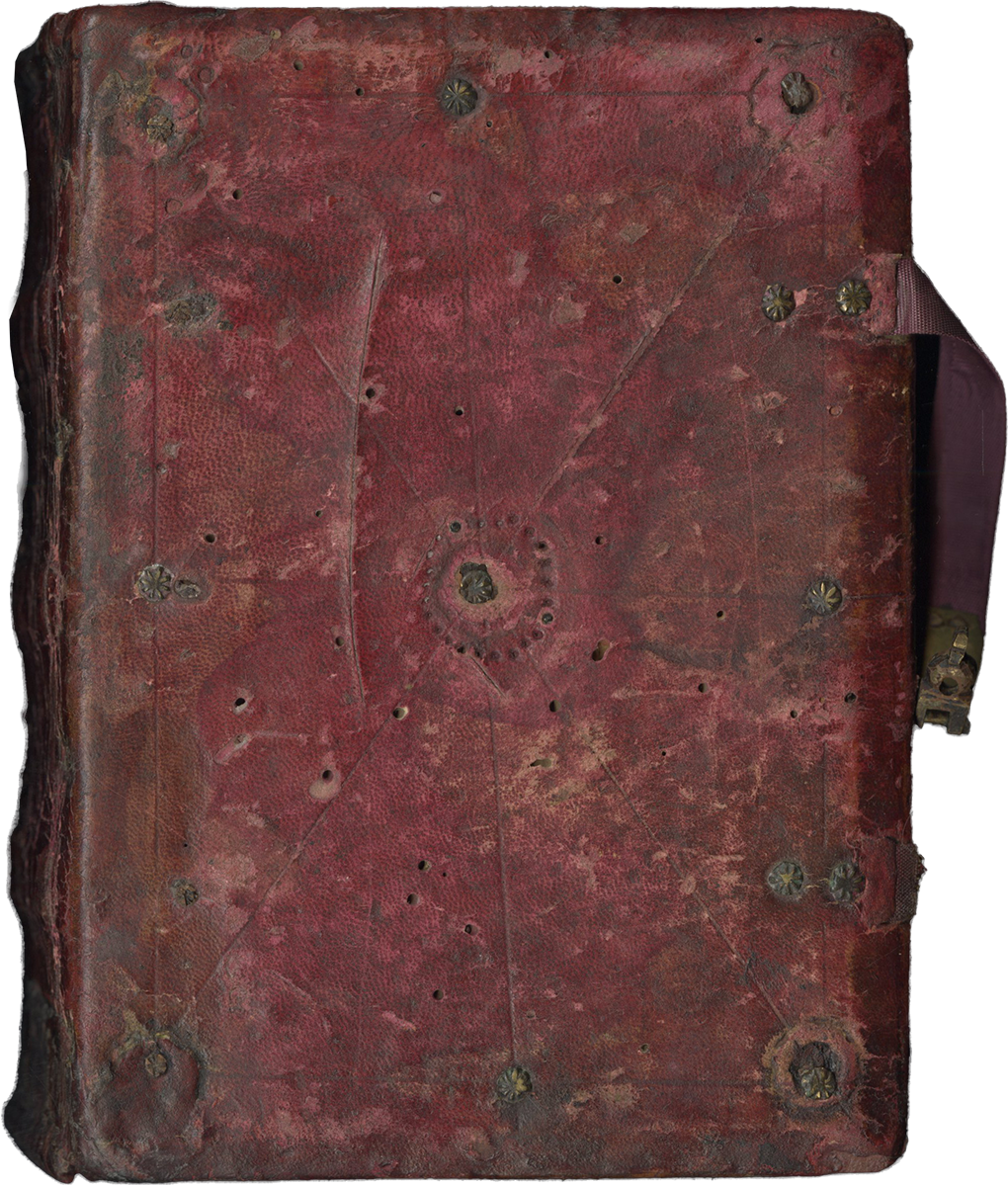
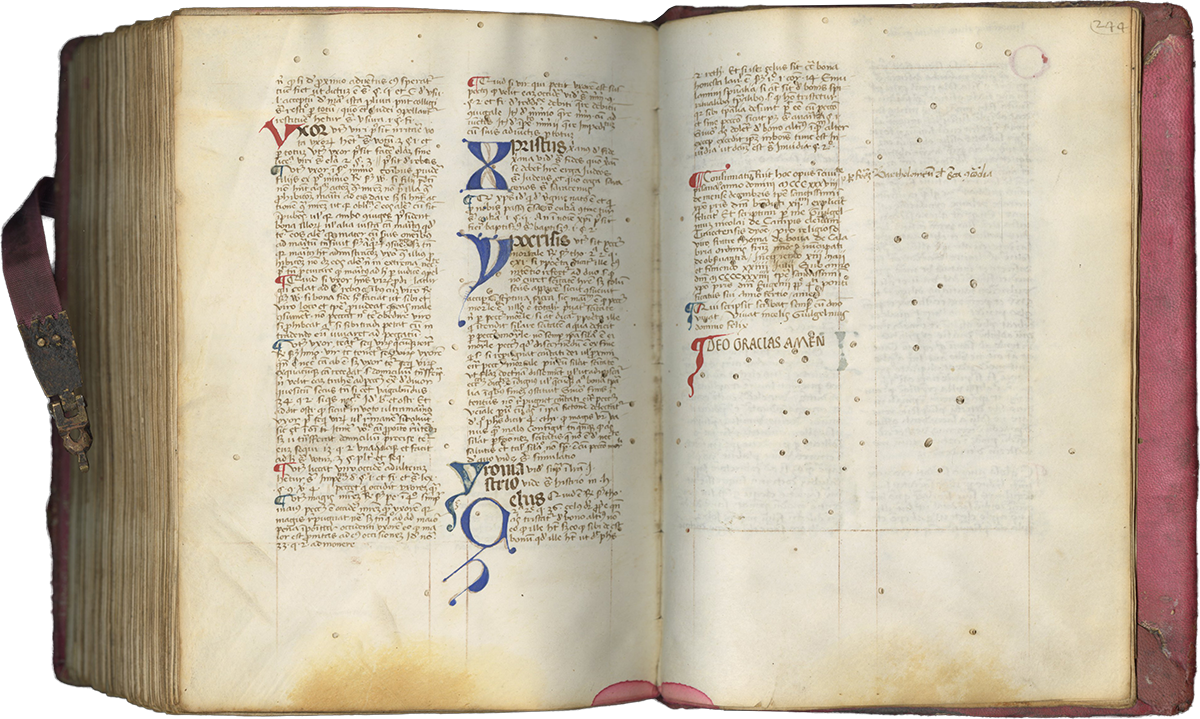
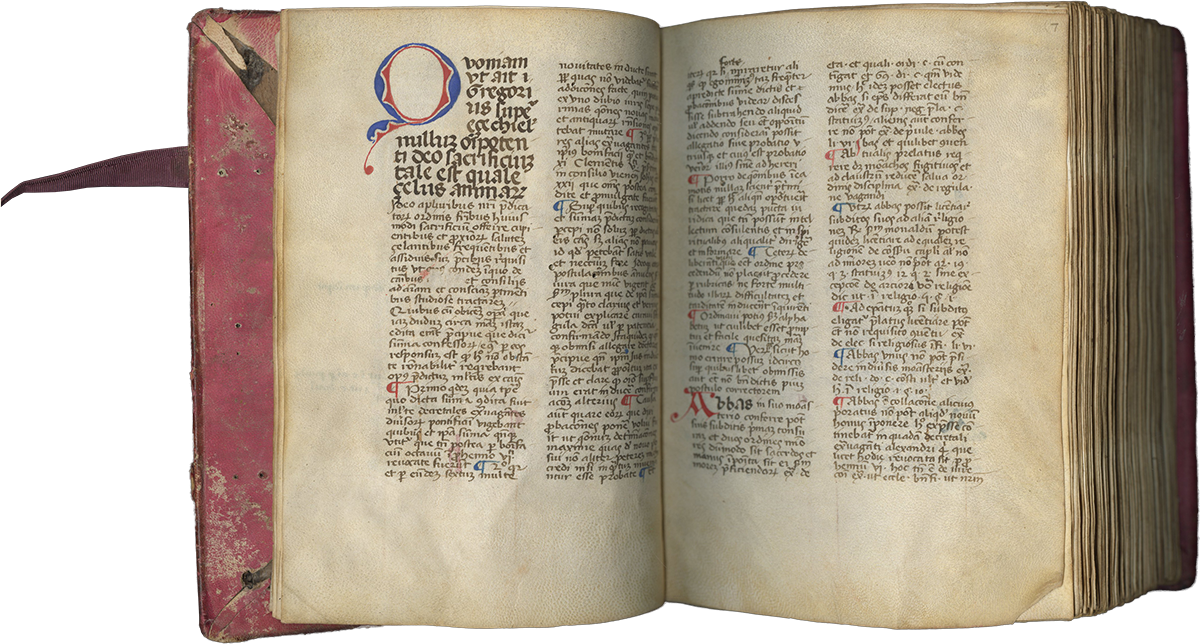
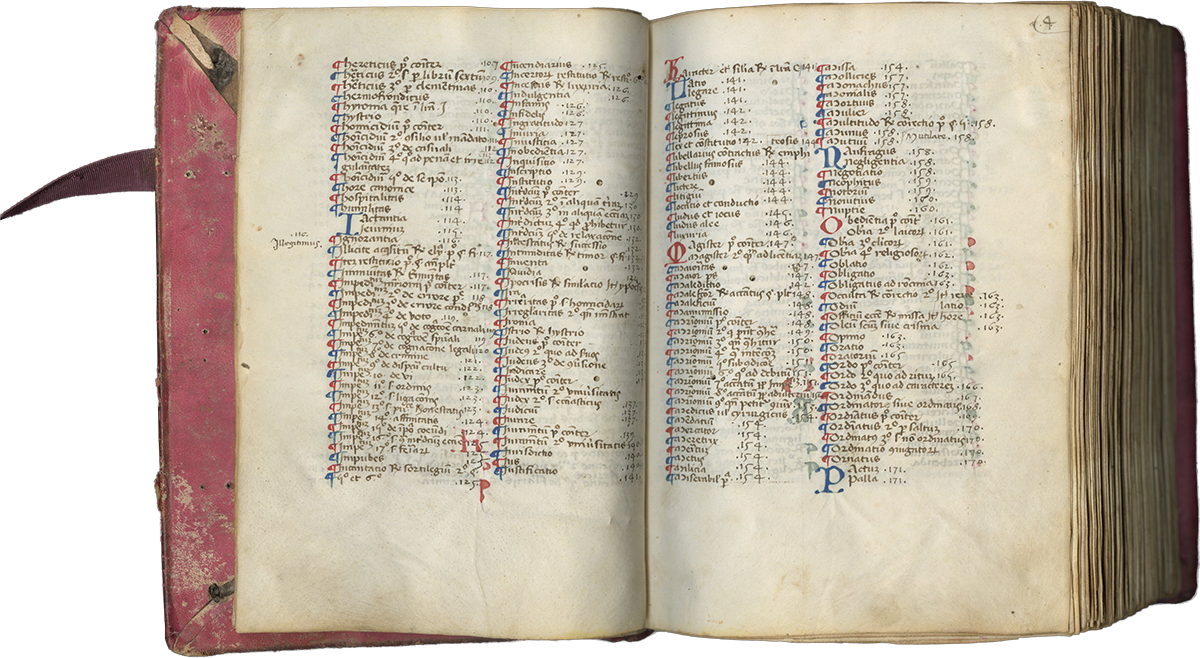
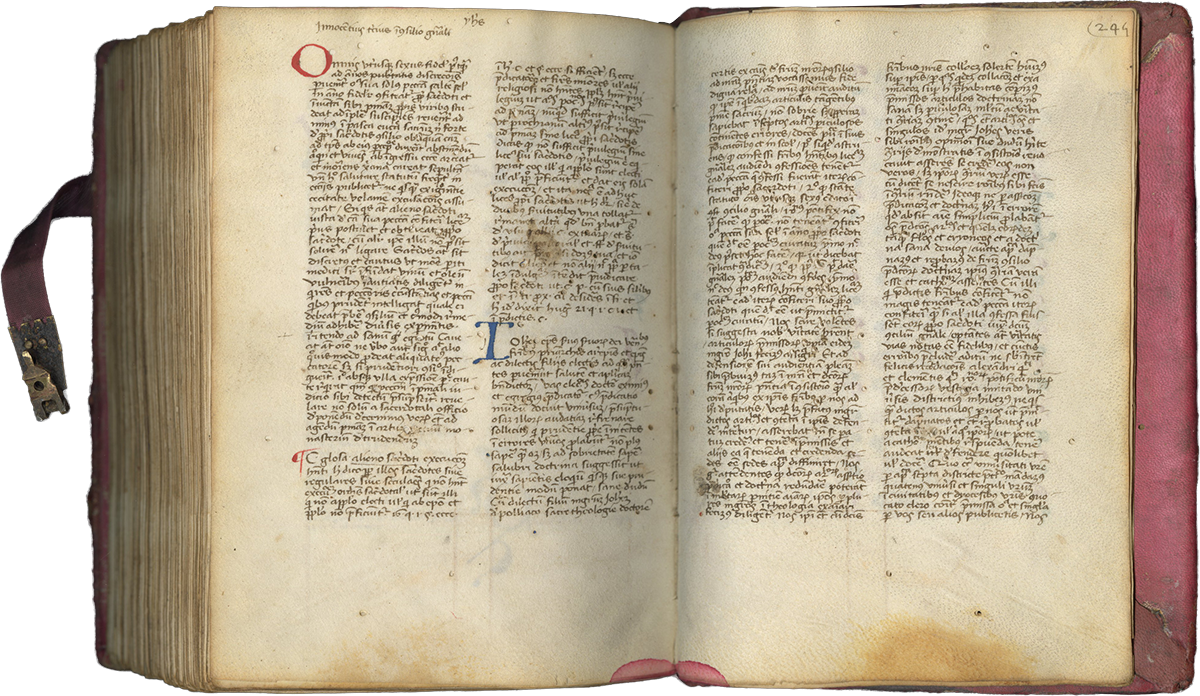
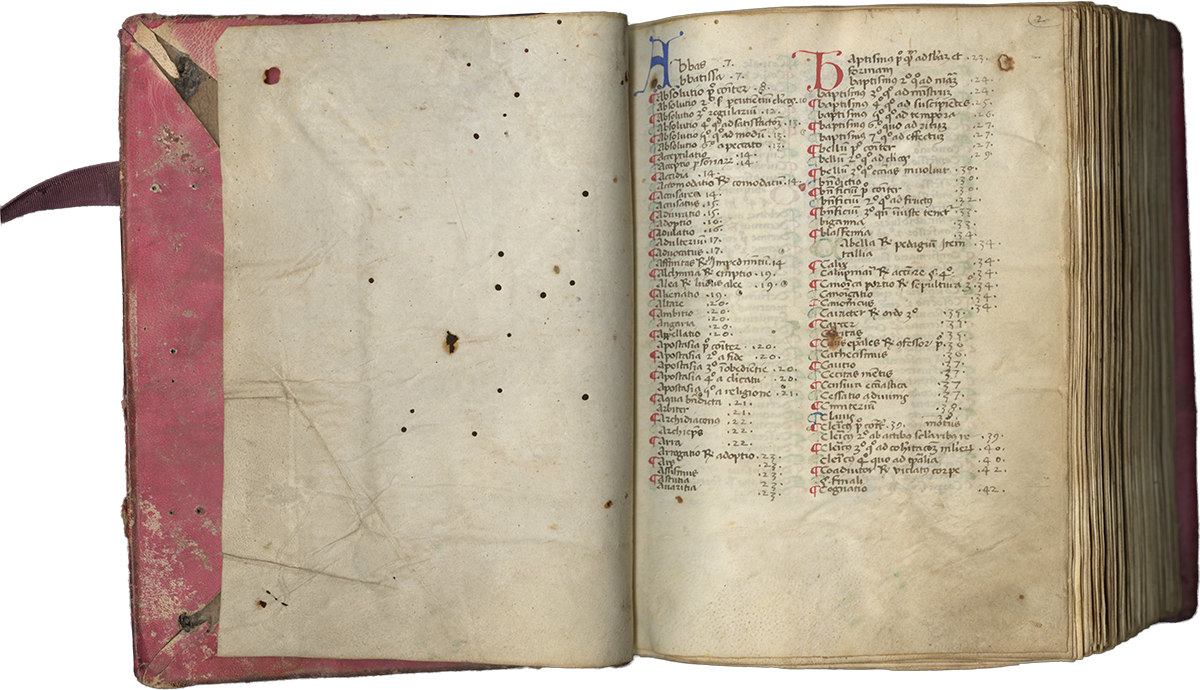
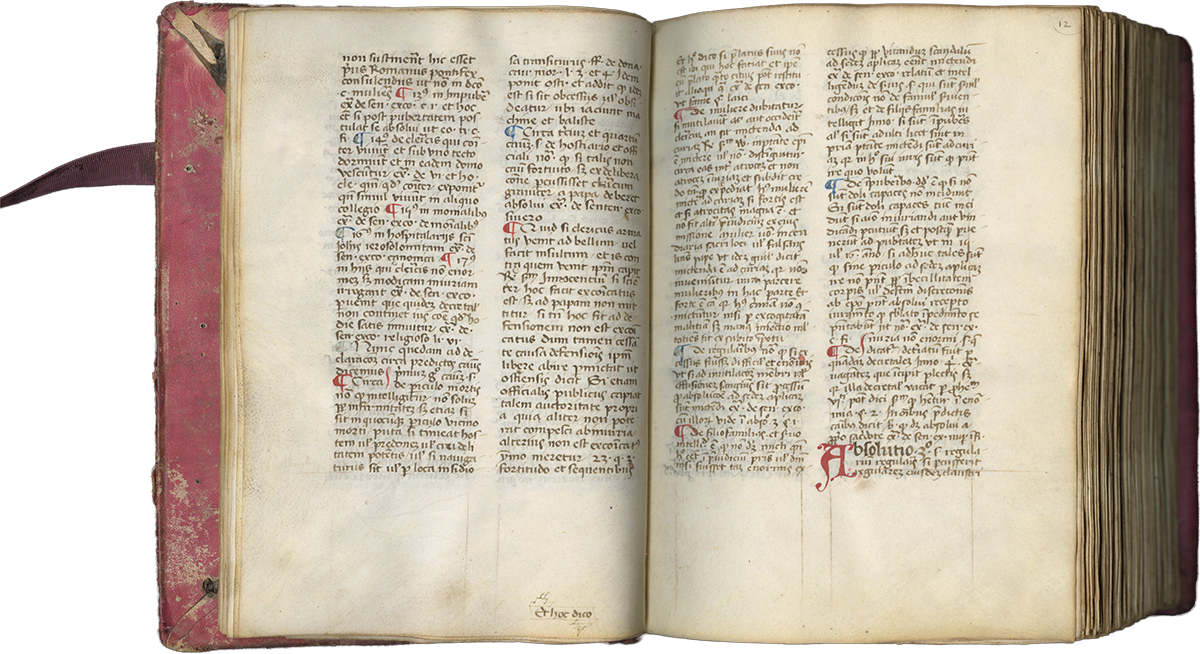
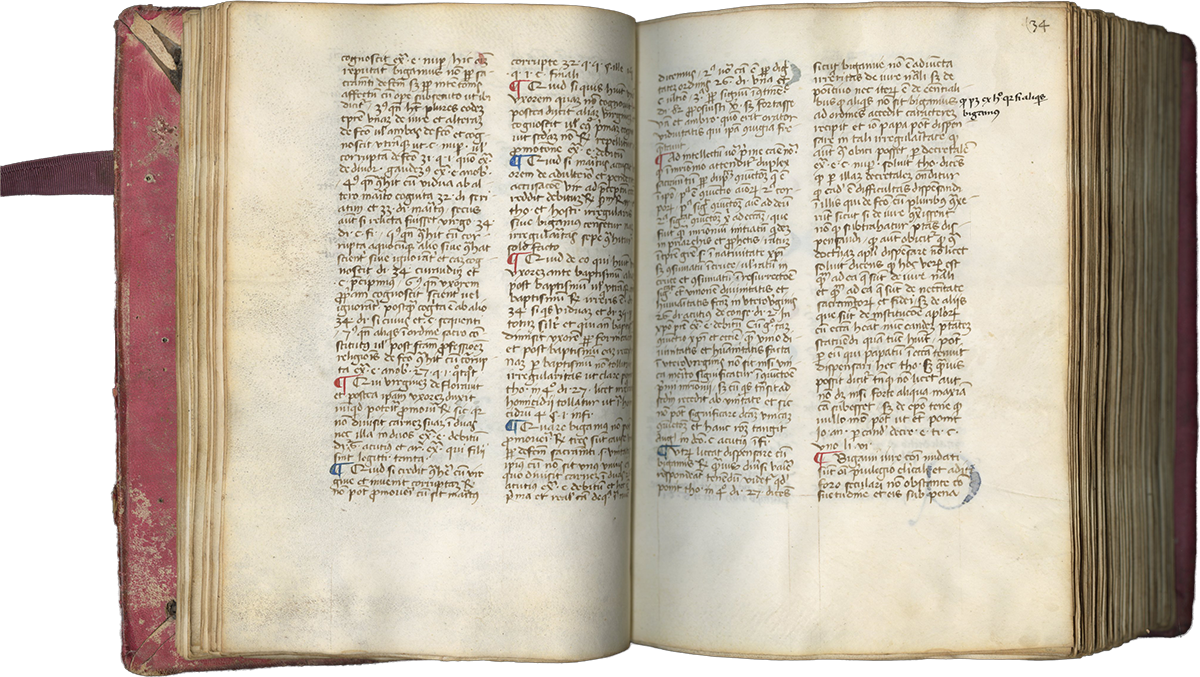
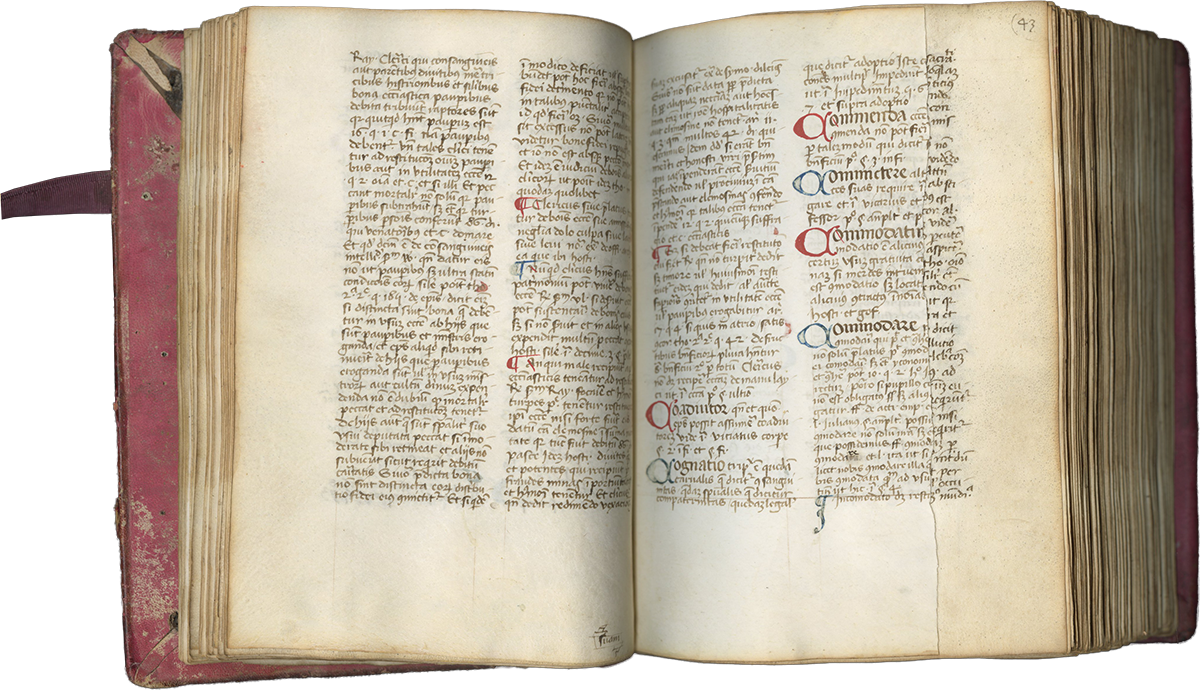
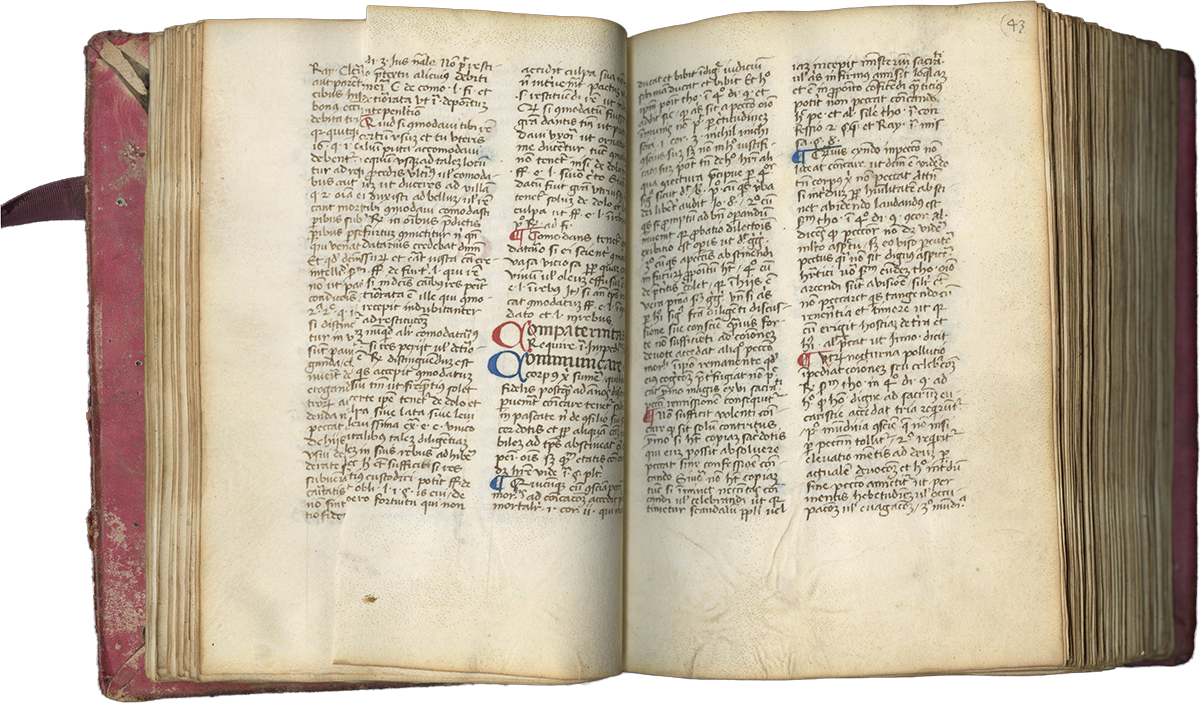
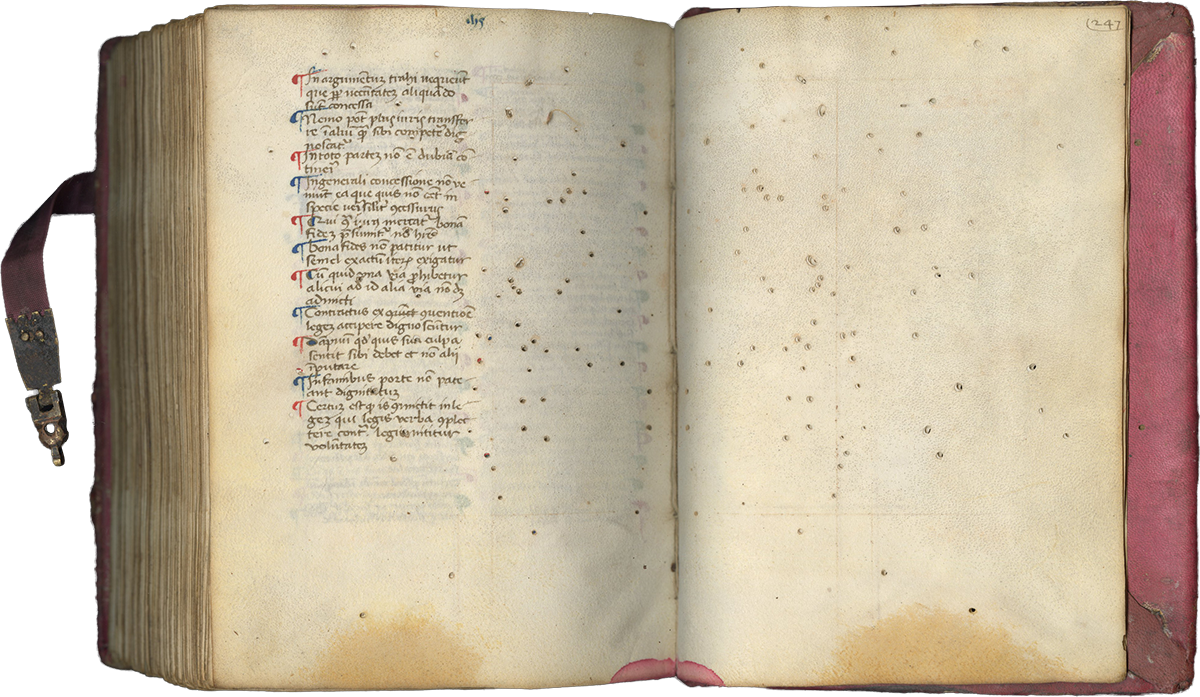
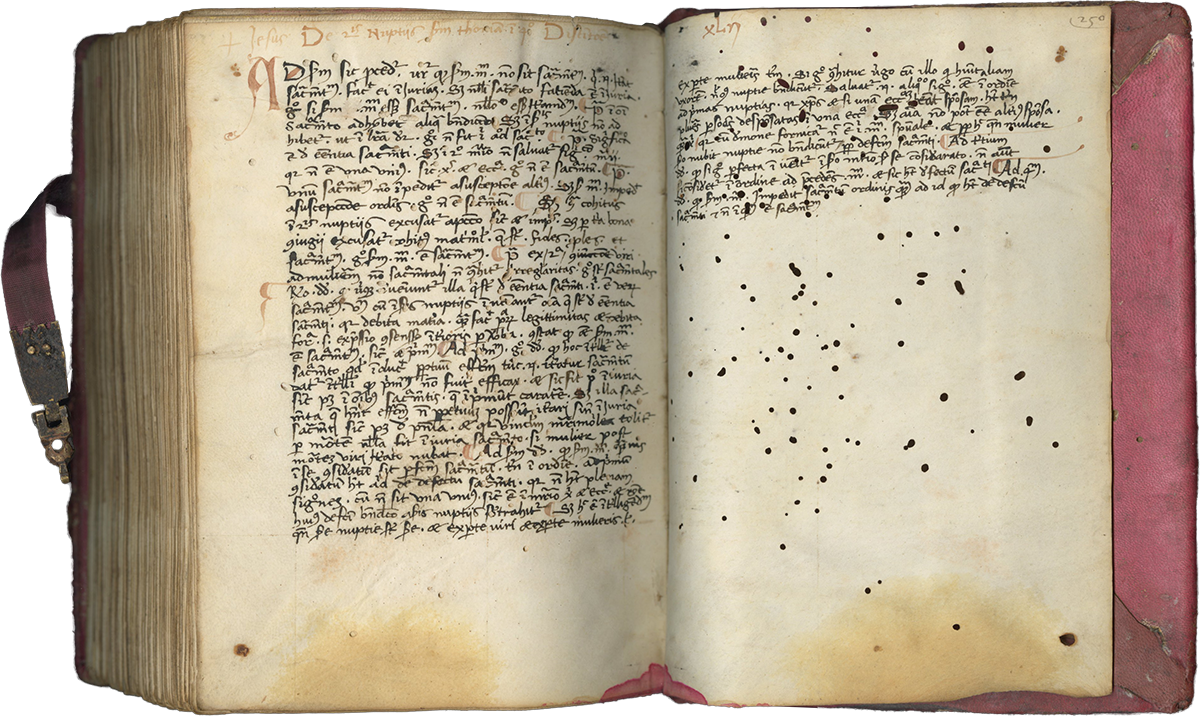
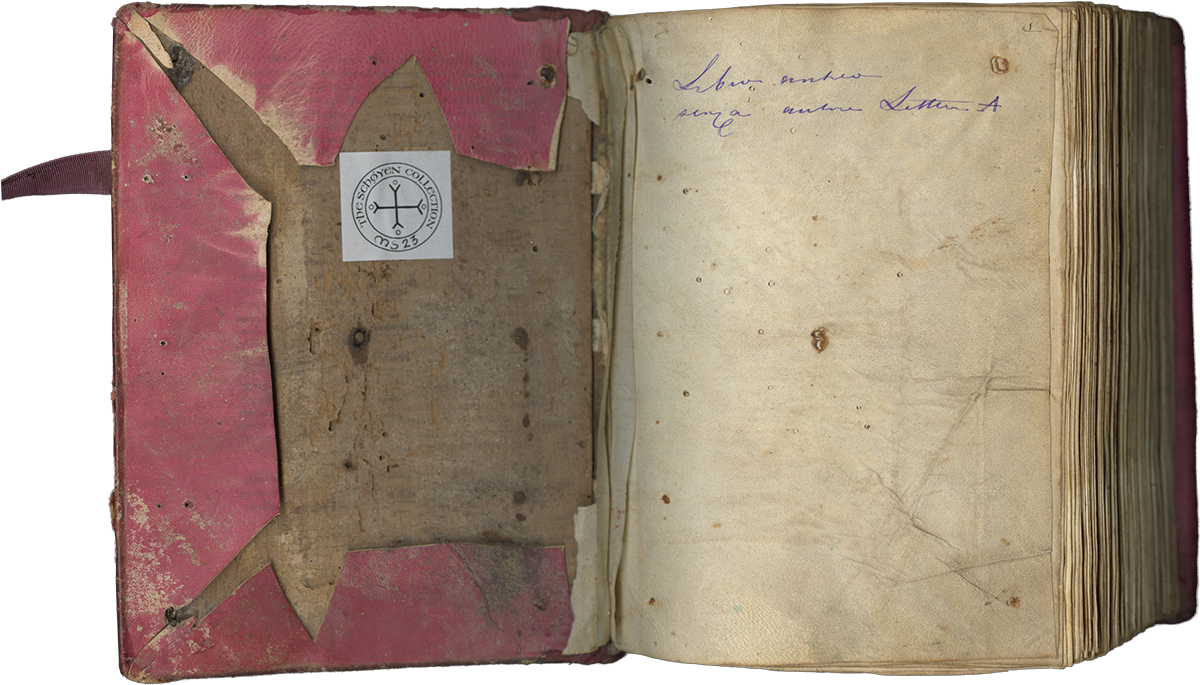
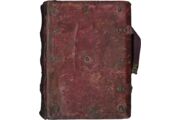
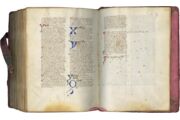
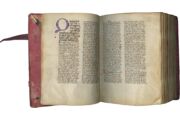
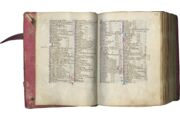
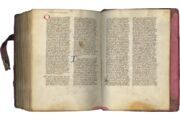
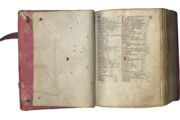
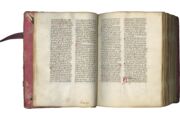
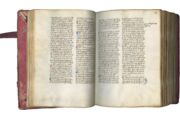
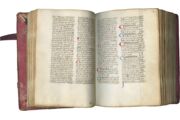
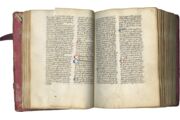
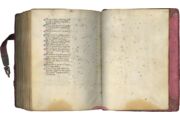
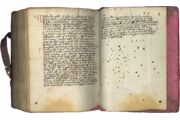
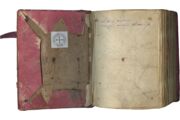
i + 241 parchment leaves, with contemporary foliation 1-250, used here, including the front flyleaf but omitting 201-202 and repeating 184 and 203, (collation: i9(lacking 8), ii4(lacking 3-8), iii-xviii10, xix9(lacking 1), xx-xxiv10, xxv9(10, blank, cancelled)), catchwords throughout, ruled in brown ink in two columns of 37-45 lines (justification 129 x 94mm), copied in an early hybrida script with incipits/headwords in a larger textualis rotunda, one-line paraphs in red or blue, two-line initials in red or blue, one puzzle initial in red and blue (f. 6v), the outer margin of f. 42 excised with slight loss of text, a few stains and signs of use, slight worming at ends, but generally sound and with ample margins. Contemporary binding sewn on three red leather thongs laced into wood boards covered with red, blind-ruled leather, marks from bosses in center and corners of each cover, small star-headed bosses around each cover and securing the straps of two strap-and-pin fastenings (worn and wormed, one strap modern, conserved by John Smart in 1987). Dimensions 185 × 133 mm.
The Summa de casibus conscientiae provided a single, practical manual for confessors by applying an important new tool: alphabetization. The fresh accessibility of sins from A to Z launched the Summa across Europe. Despite remaining in hundreds of copies, the Summa has never been critically edited or the subject of a thorough study. This copy offers a further mystery in providing two different scribal colophons: but which man actually copied the manuscript, and where?
Provenance
1. Despite an apparent wealth of information about the production of the manuscript, it remains mysterious. A long scribal colophon records that the work was composed at Pisa by Bartolomeo in December 1338, and that this copy was written by the cleric William Nicholas de Campis, of the diocese of Utrecht, for the Observantist Franciscan friar Thomas de Bova of Calabria, and he tells us that he started on 13 May and finished on 24 July 1434 (“written by me, William Nicholas de Campis, clerk of the diocese of Utrecht, for the pious brother, Observantist Franciscan friar Thomas de Bova of Calabria...1434”; “scriptum per me Guilgelmum Nicolai de Campis clericum Traiectensis dyocesis, pro religioso viro fratre Thome de Bova de Calabria ordinis fratrum minorum nuncupati de observantia […] MCCCCxxxiiij” f. 244). William apparently came from Kampen, near Zwolle in the large diocese of Utrecht, but the scribe copied in both a hybrida that displays the roundness of Italian textualis rotunda in the first quire or so and employed a rotunda proper for rubrics. He also used an Italian form of z, written as ç on ff. 5v, 243v, 245v (Derolez, 2003, p. 108). The scribe also prefers to write out “et” and only occasionally employs a tironian sign, uncrossed, all marks of an Italian script.
Brother William Nicholas followed his colophon with a version of a common scribal verse, “He who wrote this writes: live always with the Lord/ Live in heaven William, fortunate in the Lord” (“Qui scripsit scribat semper cum domino vivat, Vivat in celis Guilgelmus domino felix”). Nicholas’s two inscriptions raise potential links to several other manuscripts that offer more complications than they do solutions to the production of this volume. The verse, and the unusual spelling of “Guilgelmus” appears also in the copy of the Summa de casibus conscientiae at Berkeley, University of California Law Library, MS Robbins 135, f. 211. MS Robbins 135 is copied in a rotunda script, and both ink and pigment decoration is likewise Italian. Further complicating matters, a “brother William Nicholas, monk of Amsterdam” copied parts of Utrecht, University of Utrecht, MSS 3. F. 13 (colophon on f. 227v) and 2. C. 12 (colophon on f. 304). (It may be worth noting that in the key to the abbreviations used in the present volume, the scribe uses both “Wilhelmus” (abbreviated “W”) and “Guilgelmus” (abbreviated “Guil”) (f. 6).)
Both Utrecht manuscripts are copied in a northern hybrida, though MS 2. C. 12 features a rounder hand than MS 3. F. 13. None of these scripts matches the very small, clear hybrida displayed in the present manuscript. While the dates ascribed to these other volumes vary from the later fourteenth century to 1500, they were attributed very tentatively: there is no internal reason the three could not have been copied within a decade or two of 1434. If any of these manuscripts was also copied by the Brother William Nicholas of Kampen who may have written the present volume, then he was proficient in multiple scripts, and in scripts both northern and southern. While evidence of such broad expertise is not common, other Dutch copyists which similar skills are known, such as Theodoric Werken, who wrote in a hybrida heavily influenced by semi-textualis, not unlike the Utrecht scribes, a formal, northern European textualis formata, and Italian humanist scripts that he learned after he was already a working scribe (Rundle, 2019, pp. 124-142 and Online Resources).
Whether Nicholas copied the present volume in the Netherlands, or in Italy (or at all) is not clear, and genetic analysis of the parchment might shed light on this question. Further research might also uncover the textual relationship between the present manuscript and MS Robbins 135.
2. The added documents concerning confession are in a different ink but seem to be in the same hand as the Summa, and these reference Brother Francis Zena (“frater franciscus zena,” f. 245v), adding a further wrinkle to identifying provenance. It is worth considering whether Zena was the scribe of the whole of the present manuscript and that he copied a whole exemplar, including its colophons, written by Nicholas (perhaps written in the northern scripts used in the Utrecht volumes) for de Bova. Such copying earlier scribal colophons is not unknown and the practice tangles identifying provenance.
3. Unidentified Italian/Swiss owner, with their inscription, “Libro antico senza autore, Littera A,” f. 1.
4. Schøyen Collection, MS 23, purchase at Sotheby’s 23 June 1987, lot 80 (described as southern Italian).
Text
ff. 2-244, Bartholomew da San Concordio, Summa de casibus conscientiae, ff.2-5v an alphabetical list of contents, folio references added, from “Abbas .7.’, to ‘Zelus .143.”; ff. 5v-6, notes, incipit “Quesisti carissime cum dixerim in prologo summe de casibus conscientie […]” and a version of the usual explanation on the abbreviations used for sources, incipit, “Iste sunt declarationes de breviatatibus ponitis in summa, Ac Accursius, Al Albertus, Ala Alanus…Deo gratias amen”; f. 6v-7r, prologue, incipit, “Quoniam ut ait Gregorius super Ezechielem…bene dictus pius postulo correctorem”; ff. 7-244r, main text, “Abbas in suo monasterio conferre potest suis subditis…tunc est invidia ut dictum est supra invidia para secundo,” f. 1rv blank;
f. 244v-245v; the decree of Innocent III at the Fourth Lateran Council, that required Confession of all adult Christians at least once a year, followed by a gloss, incipit, “Innocentius tercius in consilio generale. Omnis utriusque sexus […]”;
ff. 244v-246v, a list of the chapters of Pope John XXII’s 1321 Bull “Vas electionis,” confirming the power of the pope and bishops to grant to mendicants the right to hear confession; the Regulae Iuris (maxims of Canon Law), incipit, “Beneficium ecclesiasticum non potest licite […] contra legis nititur voluntatem,” f. 245v, blank;
ff. 249v-250, (added) Thomas Aquinas, Summa theologica, quaestio 63, article 2, on whether a second marriage is a sacrament, incipit, “Ad secundum sic proceditur. videtur quod secundum matrimonium non sit sacramentum,” f. 250v, blank.
Bartholomaeus de San Concordio (c. 1260-1347) Bartholomaeus was born c. 1260 in San Concordio, a small town near Pisa, where he spent most of his life (Segre, 1964). In 1277, he entered the Dominican order and went on to study law and theology, first in Bologne and then later Paris. Returning to Italy, he taught in several Dominican schools (Todi, Rome, Florence, Arezzo, and Pistoia) and from 1312 records show that he was based primarily in Pisa, where he died in 1347. Bartholomaeus was the author of several works, in both Latin and the Italian vernacular, which ranged widely in their topics, including a translation of Sallust’s Catilina and Jugurtha, a commentary on Geoffrey of Vinsauf’s Poetria nova, a compendium of moral philosophy, a treatise on orthography, and a chronicle of Pisa’s Santa Caterina d’Alessandria. The Summa de casibus conscientiae is his best-known and most important work.
When the church formalized the requirement of confession at least once a year for all its members in the Fourth Lateran Council of 1215, it created a powerful impetus for the creation of new penitential guidebooks to assist priests in hearing confession. Therefore, many different Summae confessorum arose during the first half of the thirteenth century, but the most influential for Bartolomeo’s Summa were Raymund of Peñafort’s Summa de penitentia (c. 1225, second edition 1234) and John of Freiburg’s Summa confessorum (c. 1297-8). Leonard Boyle remarked that Raymund’s Summa dominated Dominican education, and, as the thirteenth century goes on, that the Summae “get fatter and fatter” as more material was added (Boyle, 1982, p. 228).
Bartholomeo’s Summa de casibus conscientiae is an adaptation and updating of John’s work, alphabetizing the earlier work for ease of consultation and providing also an alphabetical table of contents. The Summa packaged canon law material accessibly and therefore provided a practical confession manual, an important guide for priests and confessors. For example, the headword Ebrietas (Drunkenness), asks first whether it is a mortal sin and then follows a threefold response taken from Aquinas’s Summa theologiae; another question poses the problem of giving wine to the sick as a remedy and whether that involves the sin of drunkenness, and so on. A confessor using this manual would thus be able to determine whether the penitent had in fact committed a sin, what was the gravity of the sin, and, after taking into consideration “the willingness and ability of the penitent to sustain the penance enjoined,” would decide upon a suitable penance, usually a mixture of “prayers, alms, fasts, and corporal disciplines” (Goering, 2004, p. 198).
The Summa de casibus conscientiae, was very popular in the Middle Ages. Nearly 600 copies are known (Kaeppeli, 1970, I, no. 436, Bloomfield et al., 1979, no. 5052, Neddermeyer, 1998, vol. II, p. 729). It was also among the first books printed in Europe (Italy, 1473) and it was printed seven times before 1500 (GW 33450, IGI 1267). In addition, the text was translated into German, Spanish, and Italian, surviving in those languages in both manuscript and print (Kaeppeli, 1970). Surprisingly, there is as yet no modern critical edition, which would allow scholars to systematically trace the medieval interest in the work, its use in monasteries and schools, and to identify its early owners.
Literature
Bloomfield, M. W., B.-G. Guyot, D. R. Howard, T. B. Kabealo, eds. Incipits of Latin Works on the Virtues and Vices, 1100-1500 A.D., Cambridge, Mass., 1979.
Boyle, Leonard. “Summae confessorum,” in Les genres littéraires dans les sources théologiques et philosophiques médiévales. Définition, critique et exploitation, Louvain-la-Neuve, 1982, pp. 227-37.
Craun, Edwin. “The Imperatives of Denunciatio: Disclosing Others’ Sins to Disciplinary Authorities,” in The Culture of Inquisition in Medieval England, ed. Mary C. Flannery and Katie L. Walter, Cambridge, 2013, pp. 30-44.
Goering, Joseph. “The Internal Forum and the Literature of Penance and Confession,” Traditio 59 (2004), pp. 175-227.
Gesamtkatalog der Wiegendrucke, Stuttgart and New York, 1968-2008, vol. 3 (1968), nos. 3450-3456.
Giunti, Chiara. “Bartholomaeus de Sancto Concordio,” Compendium auctorum latinorum Medii Aevi (500-1500), Florence, 2004, pp. 63-65.
Häuptli, Bruno. “Bartholomäus von San Concordio,” Biographisch-Bibliographisches Kirchenlexicon, Hamm, Traugott Bautz, 2006, vol. 26, cols. 127-131.
Kaeppeli, Thomas. Scriptores ordinis praedicatorum Medii Aevi, Rome, 1970, vol. I, pp. 157-168.
Michaud-Quantin. Sommes de casuistique et manuels de confession au moyen âge (XII-XVI siècles), Louvain, 1962, pp. 60-66.
Neddermeyer, U. Von der Handschrift zum gedruckten Buch, 2 vols, Wiesbaden, 1998.
Rundle, David. The Renaissance Reform of the Book and Britain, Cambridge, 2019.
Segre, Cesare. “Bartolomeo da San Concordio (Bartolomeo Pisano),” Dizionario Biographico degli Italiani, Rome, 1964, pp. 768-770. https://www.treccani.it/enciclopedia/bartolomeo-da-san-concordio_%28Dizionario Biografico%29/
Online Resources
Berkeley, University of California Law Library, MS Robbins 135, samples digitized here: https://digicoll.lib.berkeley.edu/record/229783?v=uv&ln=en#?xywh=-1%2C-1202%2C3408%2C5619&cv=3
Dolezalek, G. R., PI. Manuscripta juridica, Max-Planck-Institut für Rechtsgeschichte und Rechtstheorie, (listing 47 manuscripts) https://manuscripts.rg.mpg.de/search/
Oxford, Balliol College, MSA 238A, example of Theodoric Werken’s hybrida, https://www.flickr.com/photos/balliolarchivist/7740984396/in/album-72157630973129908/
San Marino, Huntington Library, MS HM 142, f. 60v, example of Theodoric Werken’s textualis, https://hdl.huntington.org/digital/collection/p15150coll7/id/19276
Summa Pisana in FAMA: Œuvres latines médiévales à succès (IRHT, CNRS) http://fama.irht.cnrs.fr/oeuvre/268395
Utrecht, University of Utrecht, MS 2 C. 12 https://objects.library.uu.nl/reader/1874-325705
Utrecht, University of Utrecht, MS 3. F. 13 https://objects.library.uu.nl/reader/1874-327670