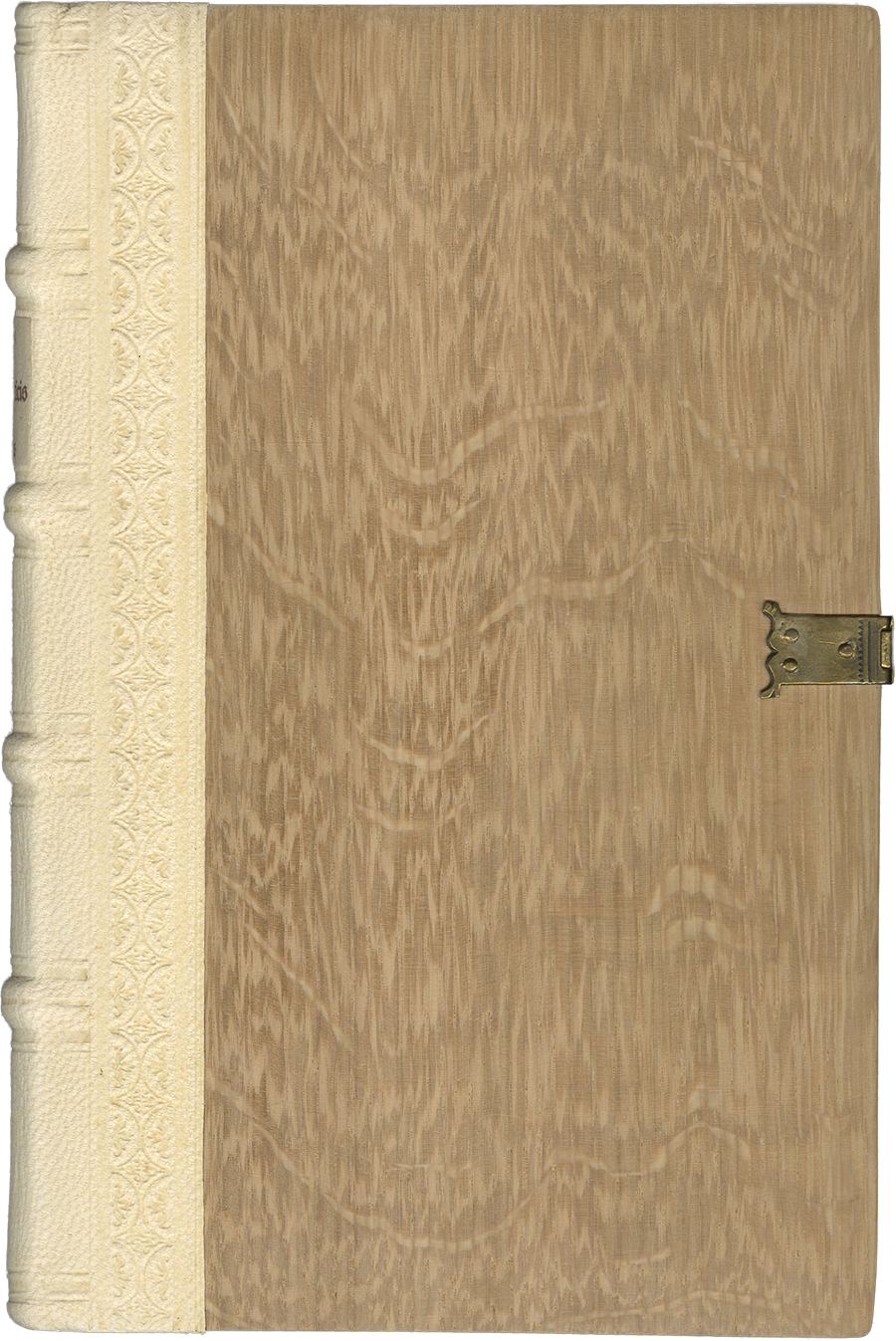
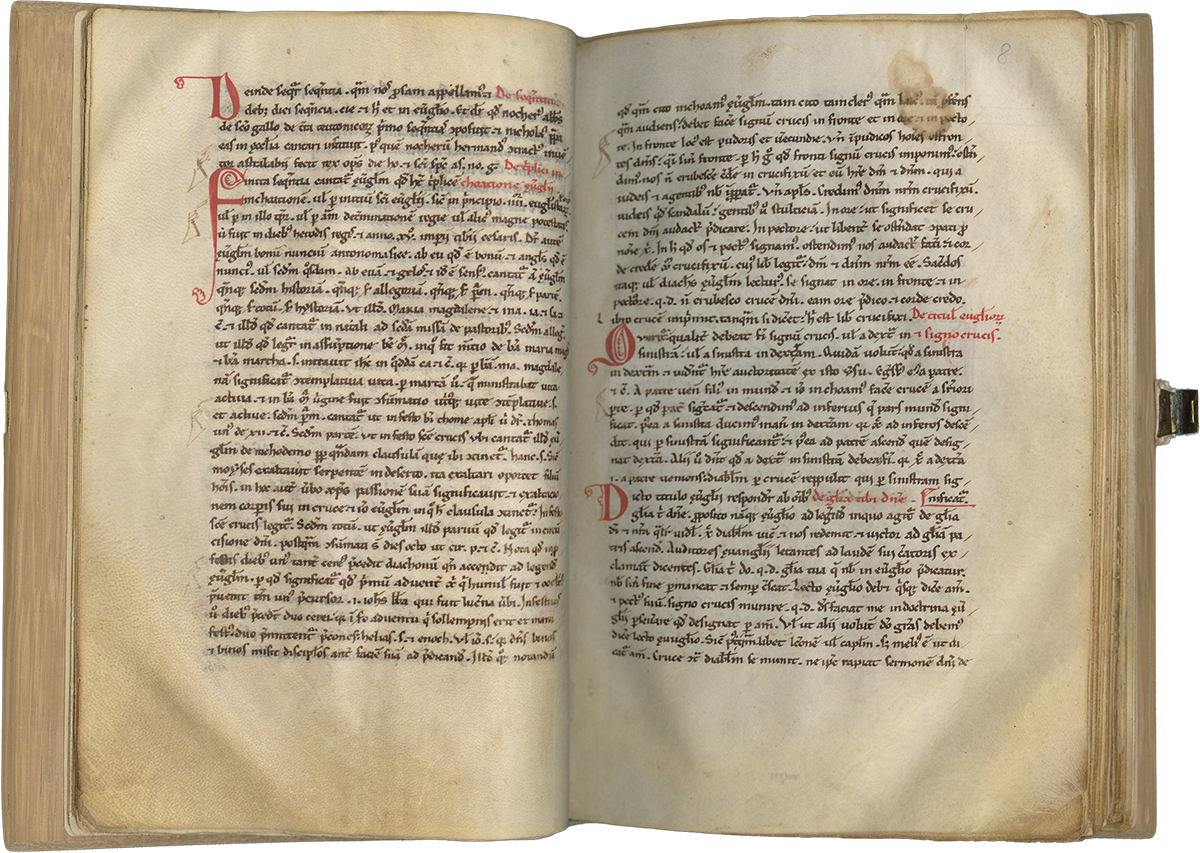
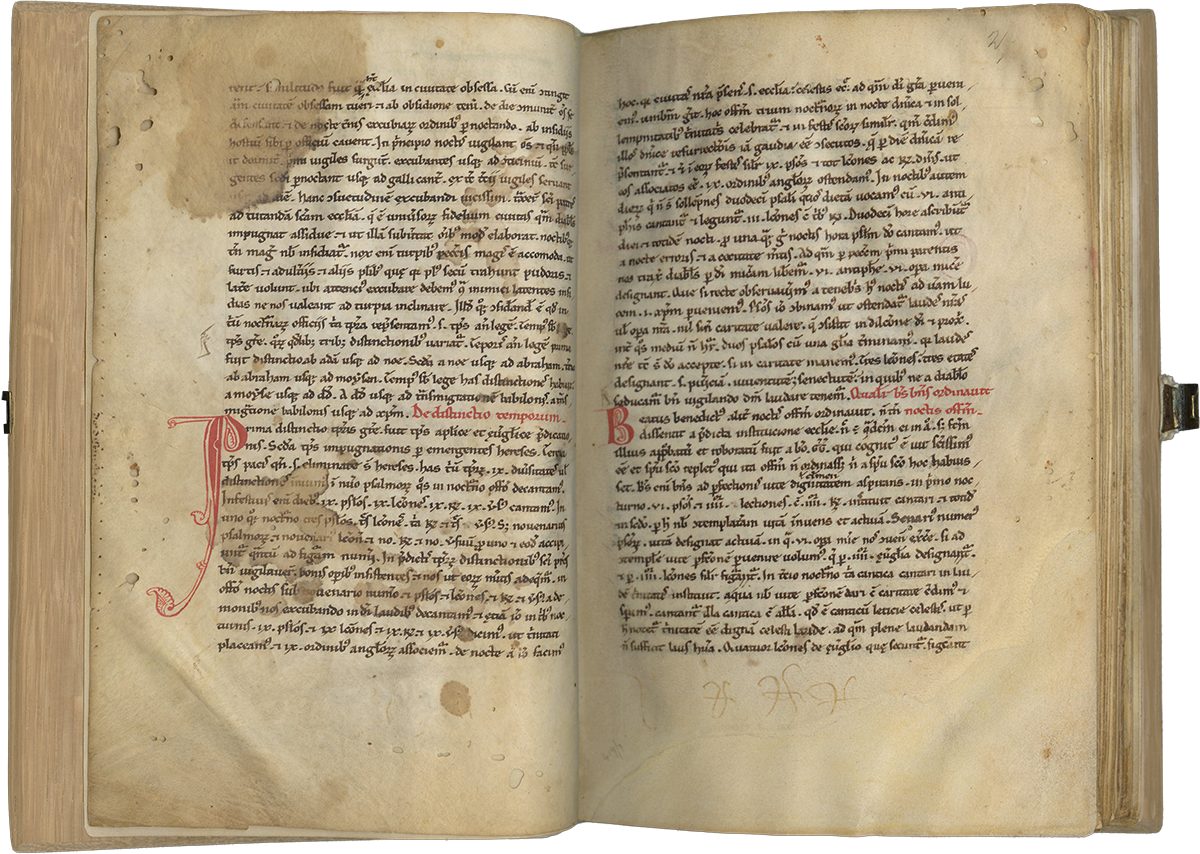
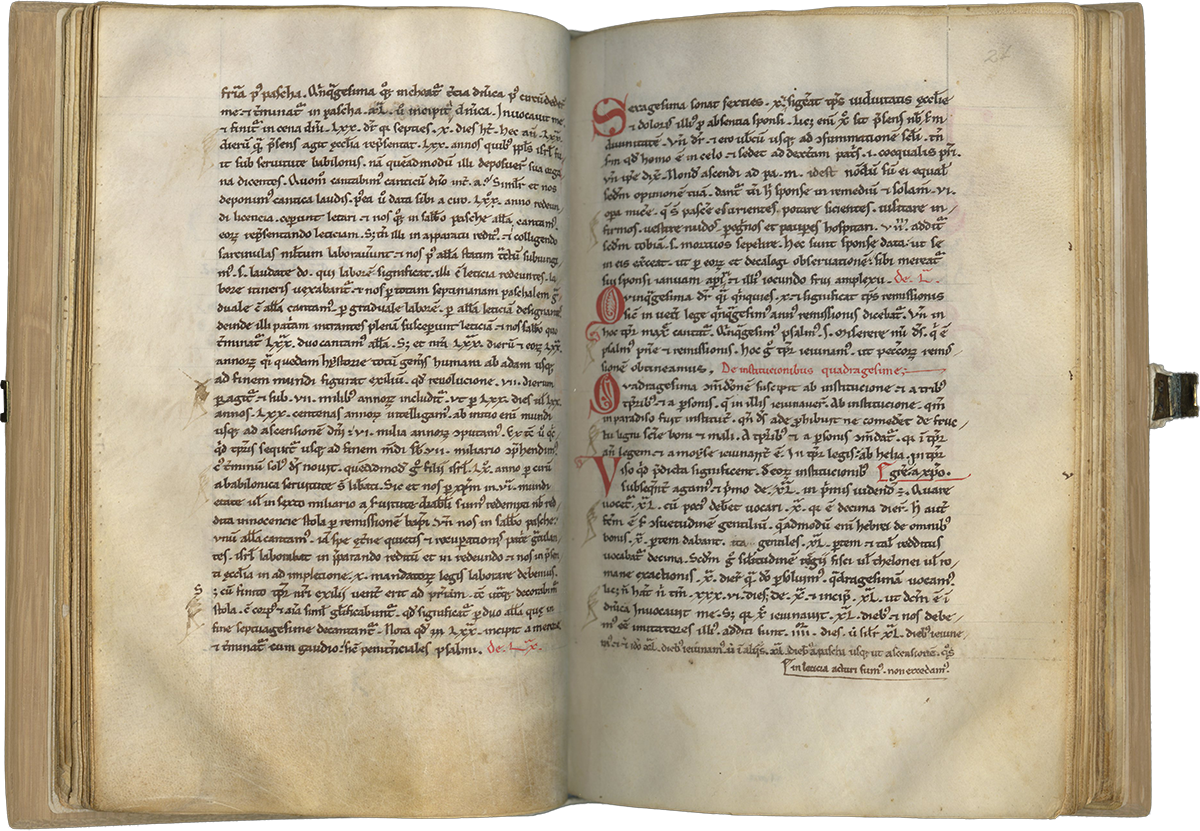
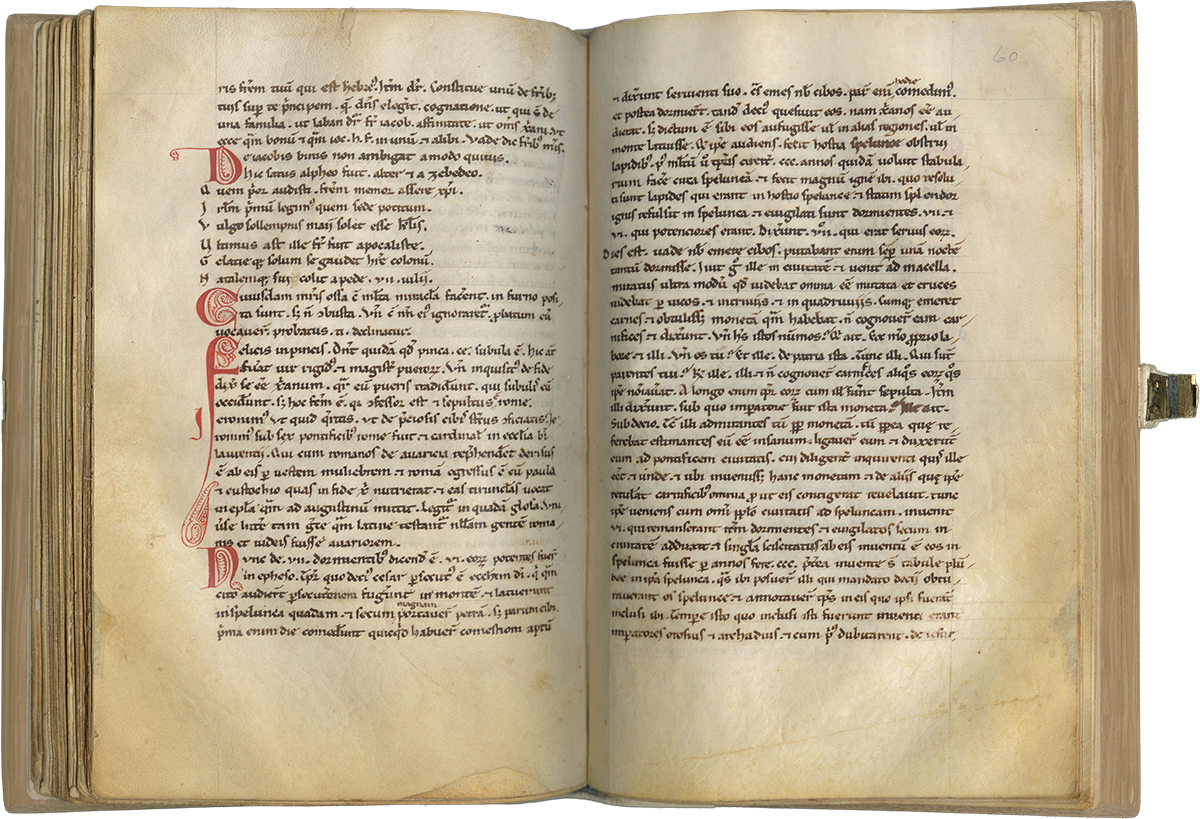
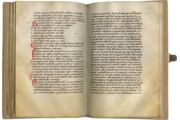
i (modern parchment)+70+ i (modern parchment), foliated in pencil in upper right corner, incomplete, catchwords, (collation: i-viii8 ix6-1,+4, 6), single column, ruled in dark ink when not erased, pricking, 32 lines (justification 151 x 94 mm), copied in a small, heavily abbreviated praegothica, glosses within red boxes, rubrics in red, one- and 2-line red initials, instructions to rubricator or finding aids on some outer margins, mostly trimmed (see ff. 14, 22, 26 for examples), bottom corner of f. 2 torn away, first leaf discolored, small stains throughout, otherwise in good condition. Modern wood boards and binding. Dimensions 210 x 135 mm.
Primary source of information on pastoral care and the liturgy of the twelfth century, providing an important glimpse into daily religious ritual before the important pastoral reforms of the thirteenth century. This copy of John Beleth’s Summa ecclesiasticis officiis can be localized to a monastery in northern Spain in the thirteenth century, increasing its rarity. The two texts preserved here were once part of an anthology that also included the work of Hugh of St. Victor (now Toronto, Fisher Library).
Provenance
1. The script is Spanish, and of the early thirteenth century. It features a range of typically Mediterranean and Iberian forms, including a strong preference for the Mediterranean tironian sign, the Mediterranean trailing-s, and the Iberian long-i (Derolez, 2003, pp. 62, 64, 67). At the same time, the script is clearly transitional, featuring heavy abbreviation and both earlier and later d-forms. Whilst parts of Europe had already transitioned to a standardized textualis script by 1200, Spain and the Mediterranean had not, but did so over the course of the thirteenth century (Derolez, 2003, p. 72). A now-detached part of this manuscript, Toronto, Thomas Fisher Rare Book Library, MS 03369, bears a later inscription on f. 18 locating it at the Benedictine monastery of San Salvador, in Oña, in the province of Burgos in northern Spain, and a late thirteenth-century catalogue from that monastery lists a copy of Beleth’s work, increasing the chances that this manuscript was made for San Salvador, or arrived there from elsewhere in Spain early in its history (Antolín, 1913, vol. 3, p. 267; Beer, 1894, p. 370; see Online Resources).
2. Several later medieval hands on f. 1, “institutiones sanctae mari[e] ecclesi[e].//.,” “Michael archangele,” and “E. Ioh[annes] beleth,” and many manicules and marginal notes, some erased, throughout.
3. Comte Paul Durrieu (1855-1925), esteemed medieval art historian and curator of the Musée du Louvre known for his work on fifteenth-century illuminated manuscripts, including the Turin Hours, the Très Belles Heures of Jean de Berry, and the Rohan Hours, some of the best known Books of Hours of the late Middle Ages. Durrieu was also an astute collector of illuminated manuscripts (Schoenberg Database of Manuscripts MS 14170).
4. Librairie Paul Jammes, founded by Paul Jammes (1890-1983) (SDBM MS 14170).
5. Bruce Ferrini (1949-2010), Akron, Ohion, a prominent manuscript dealer.
6. Joseph Pope (1921-2010) of Toronto, an investment banker and prominent collector of medieval manuscript, bought the manuscript from Ferrini in May 1989 and dismembered it in the late 1990s into at least two volumes, Bergendal MS 124 (now Toronto, Fisher Library MS 03369), and the present manuscript Bergendal MS 92 (Pope, 1999; Stoneman, 1997, p. 201).
7. Sotheby’s, London, Western Manuscripts and Miniatures, 5 July 2011, Lot 64 (see Online Resources).
8. Private Continental Collection.
Text
ff. 1-65v, Johannes Beleth, Summa de ecclesiasticis officiis, acephalous and incomplete, incipit, “divinum officium celebrandum...ideo Christum, quia Christus Deus superbus eis videbatur”;
Johannes Beleth (fl. 1135-82)’s Summa de ecclesiasticis officiis, an early manual of Christian liturgy, is now one of our principal sources for the liturgical practices of the twelfth century (Douteil, 1976). In this copy the text begins in the early lines of Chapter 20, then ends before the final lines of Chapter 164, and lacks the final chapter, 165, entirely.
ff. 66-70v, Richard of Wedinghausen, Expositio canonis missae, acephalous, incipit “in aqua quae mundat et lavat... in tertio vero est differentia.”
Wedinghausen, also known as Richard von Arnsberg, was a Premonstratensian who died in 1190 and was beatified in recognition of his writing. Nevertheless, only two of his works remain today, and this one, his commentary on the mass, is often misattributed to Hugh of St. Victor.
This manuscript offers a substantial remnant of an expansive pastoral anthology developed for the use of priests in ministering to their flocks. Johannes Beleth (fl. 1135-82) was a French liturgist and theologian. He was recorded at Tiron in 1135, and studied at Chartres about the same time, probably later teaching theology in Paris. He is last recorded at Amiens in 1182, and most probably died there soon after. His Summa de ecclesiasticis officiis, perhaps written in 1162, is a remarkably early manual of Christian liturgy and is now one of our principal sources for the liturgical practices of the twelfth century. Beleth’s Summa outlined the duties of both clergy and laymen, describes worship during the divine office, mass, processions, and fasting and does so using a structure derived from the liturgical year. The Summa de ecclesiasticis officiis remains in 180 preserved manuscripts (Douteil, 1976, pp. 267-6*).
The second text in the current volume provides an early copy of Richard of Wedinghausen (d. 1190)’s Expositio canonis missae. The tendency to misattribute the work to Hugh of St. Victor can be seen in the original anthology of which this volume used to be a part, where the text following Wedinghausen’s was St. Victor’s In Salomonis Ecclesiasten Homiliae (Toronto, Fisher Library, MS 03369). It seems likely that the Spanish monks believed that the Expositio was St. Victor’s work too. The present manuscript would have been copied just after Wedinghausen’s lifetime, and this offers unusual proof of the speed of manuscript transmission, with the Expositio moving from Arnsberg, Westphalia, to the Iberian Peninsula within decades. The need for quality pastoral guides in this period was acute and motivated the transmission of such works across Europe.
Literature
Douteil, H., ed. Summa de ecclesiasticis officiis: Textus. Indices, Turnhout, 1976.
Pope, Joseph. One Hundred and Twenty-Five Manuscripts: the Bergendal Collection, Notre Dame, IN, 1999.
Roman, Natalie, “Paul Durrieu (1855–1925): Art Collecting and Scholarly Expertise,” in The Pre-Modern Manuscript Trade and its Consequences, ca. 1890–1945, eds. Laura Cleaver, Danielle Magnusson, Hannah Morcos, and Angeline Rais, pp. 305-320, Arc Humanities Press, 2025
Van de Perre, D. “Die älteste Klostergesetzgebungen von Prémontré, Oigny, Cîteaux, Klosterrath und Arrouaise und ihre Beziehungen zueinander,” Analecta Praemonstratensia 76 (2000), pp. 29-69.
Online Resources
Antolín, Guillermo. Catalogo de los códices latinos de la Real biblioteca del Escorial, Madrid, 1910-1923, vol. 3, p. 467 https://archive.org/details/catalogodeloscod0003pgui/page/466/mode/2up
ARCA, Collection Particulière, CP 426 https://arca.irht.cnrs.fr/ark:/63955/md569306wr80
Beer, Rudolf. Handschriftenschätze Spaniens, Vienna, 1894. https://archive.org/details/gri_33125014505255
Corpus Thomisticum, Richardi de Wedinghausen, Expositio missae https://www.corpusthomisticum.org/xem.html
Schoenberg Database of Manuscripts https://sdbm.library.upenn.edu/manuscripts/14170
Sotheby’s Western Manuscripts and Miniatures, 5 July 2011, Lot 64 https://www.sothebys.com/en/auctions/2011/western-manuscripts-and-miniatures.html?locale=en
Stoneman, William. “A Summary Guide to the Medieval and Later Manuscripts in the Bergendal Collection,” in A Distinct Voice: Studies in Honour of Leonard E. Boyle, O. P., ed. Jacqueline Brown and William Stoneman, Notre Dame, IN, 1997, pp. 163-206. https://archive.org/details/distinctvoicemed0000unse
TM 1463