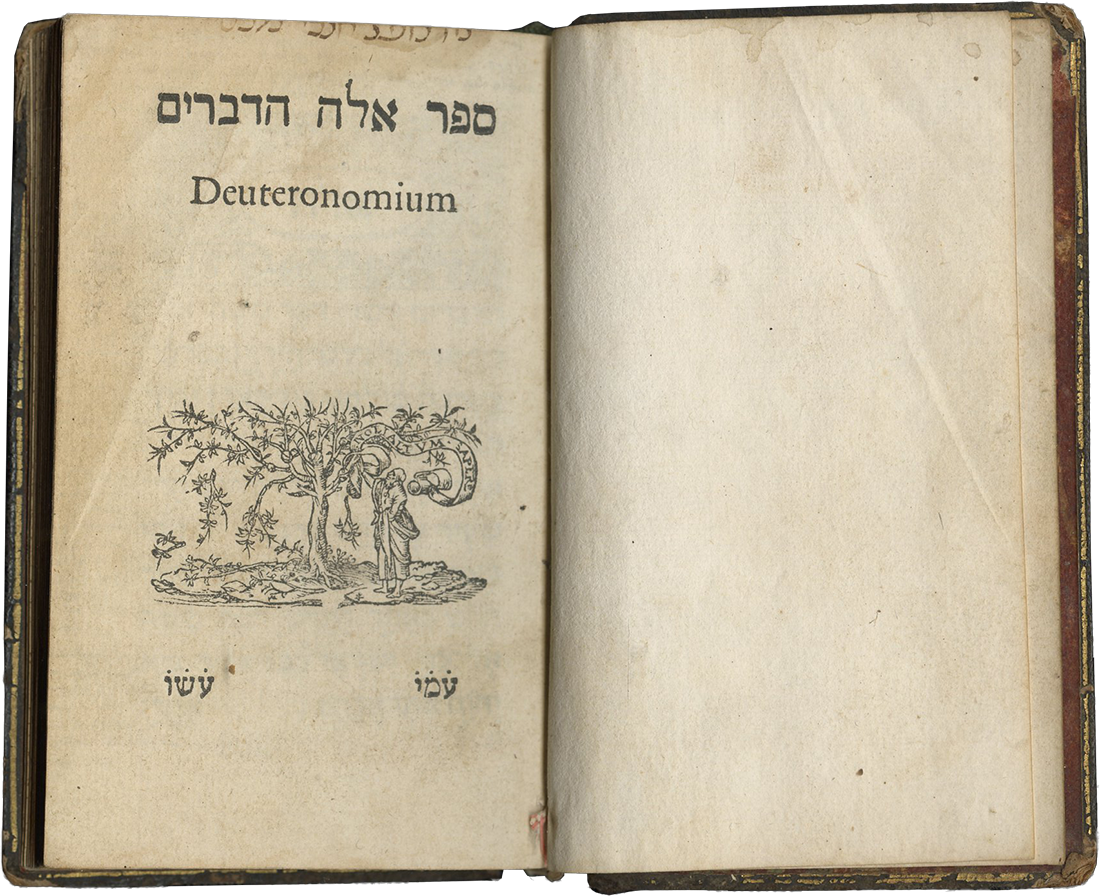
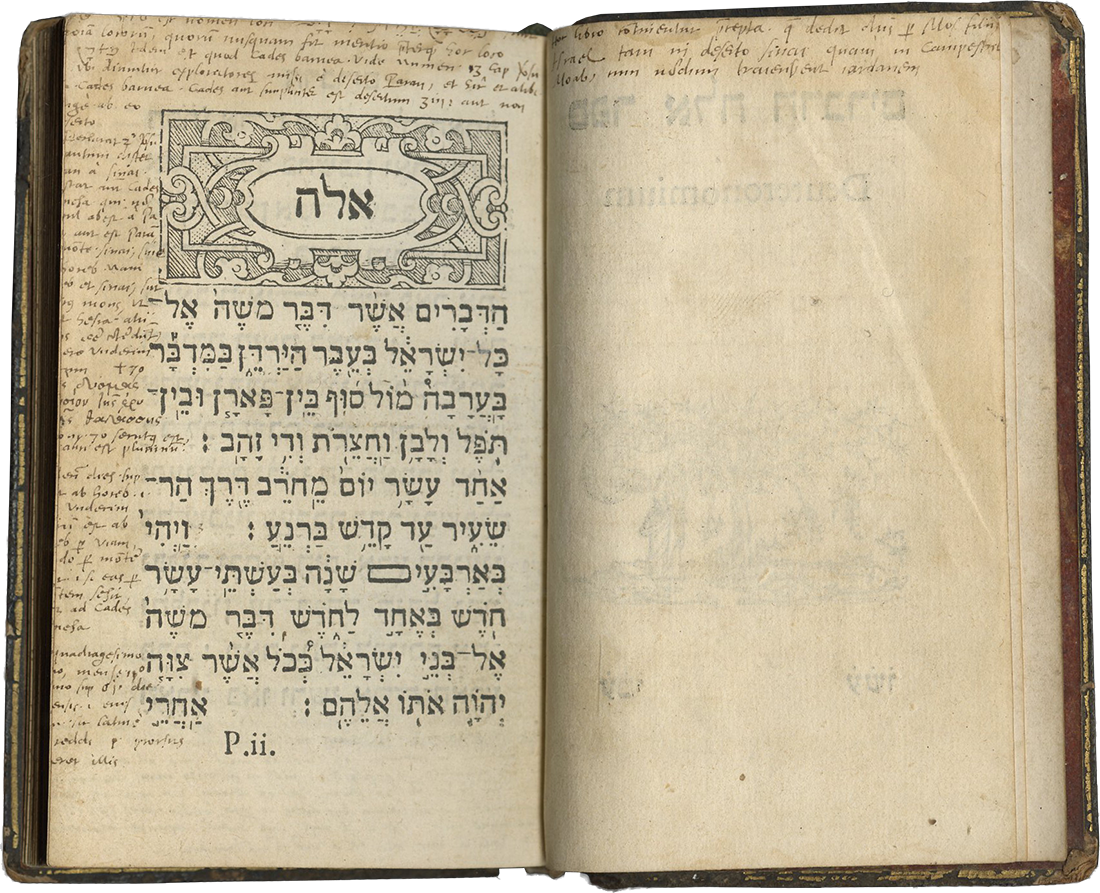
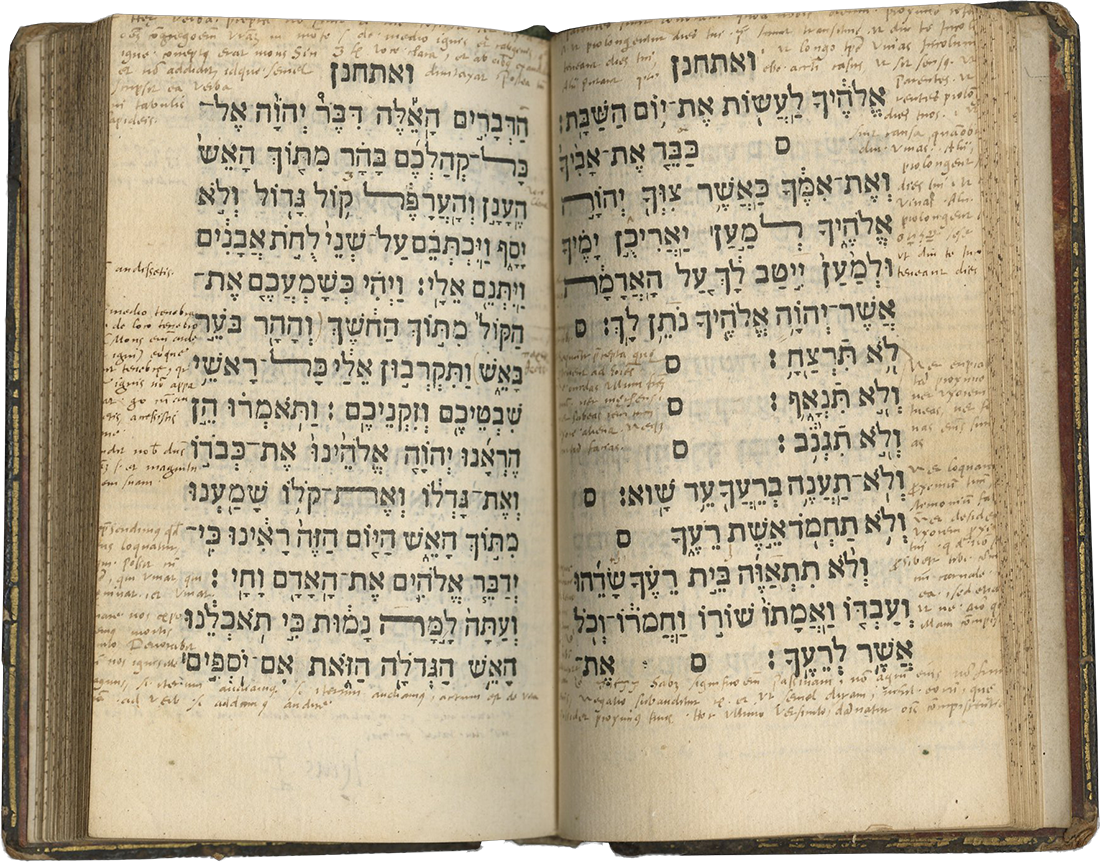
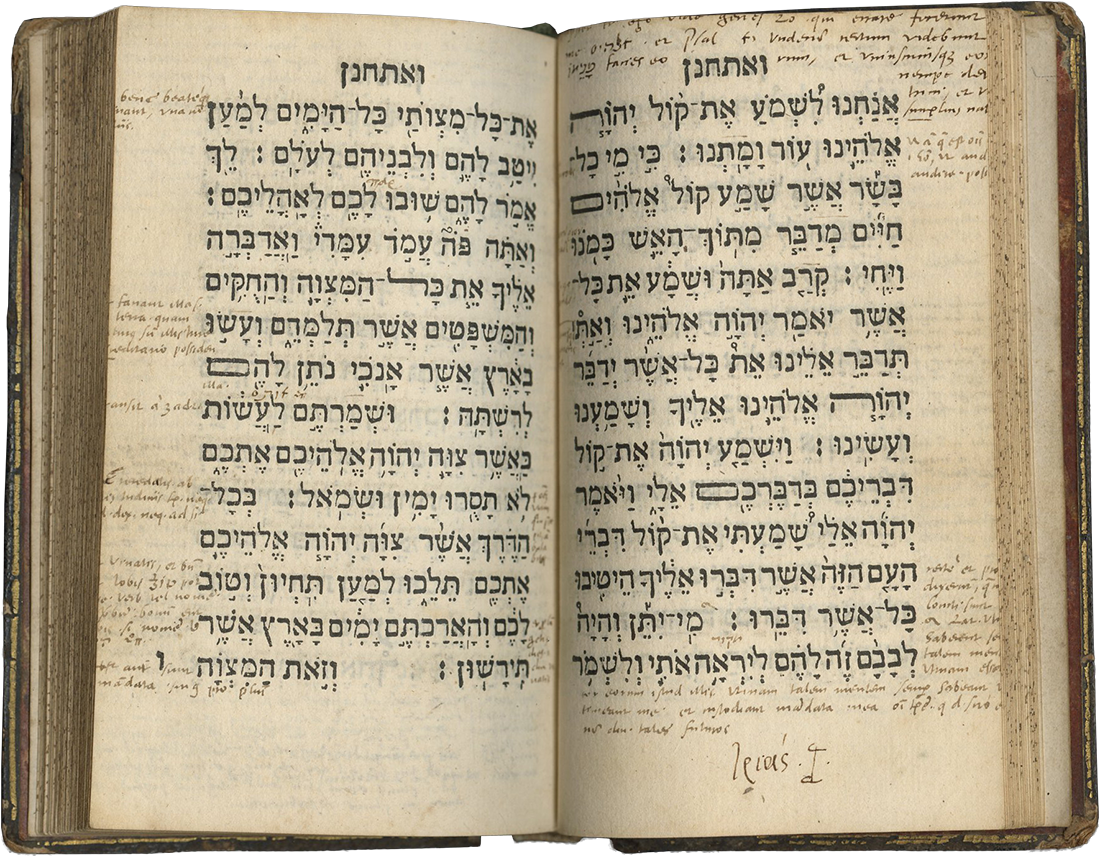
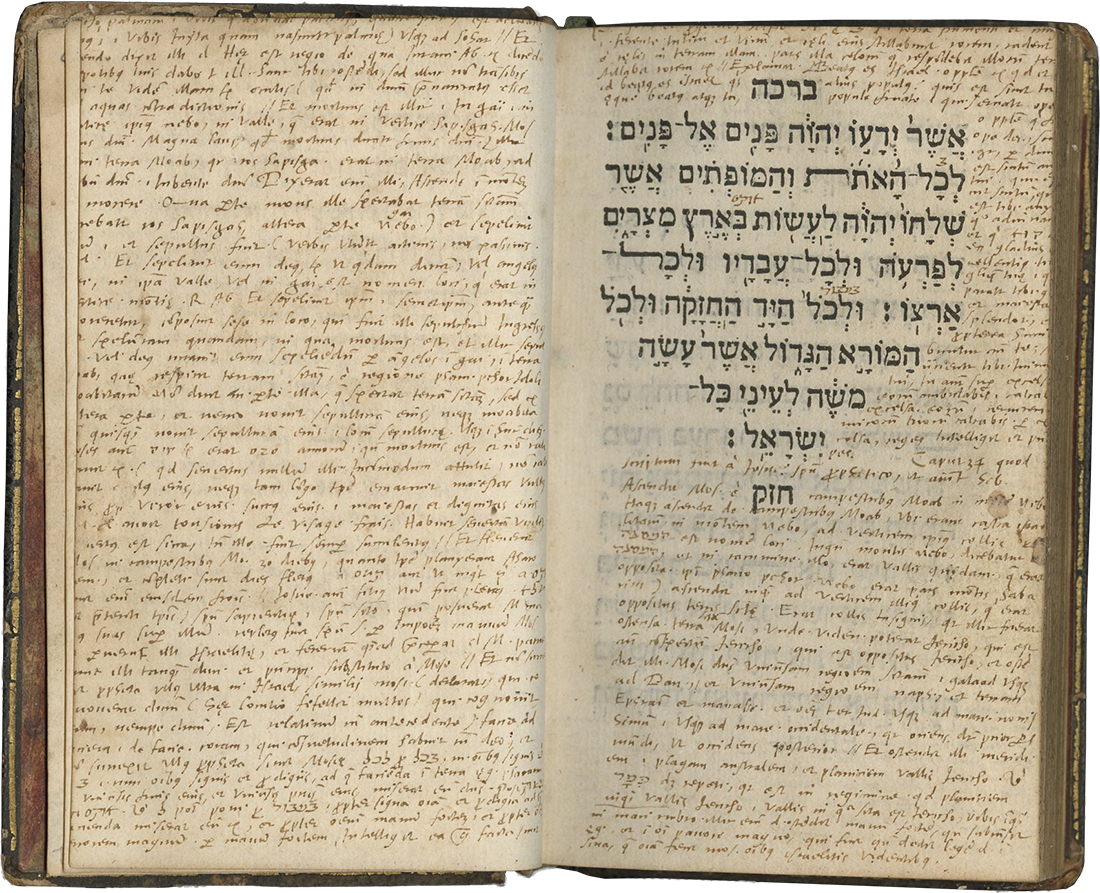
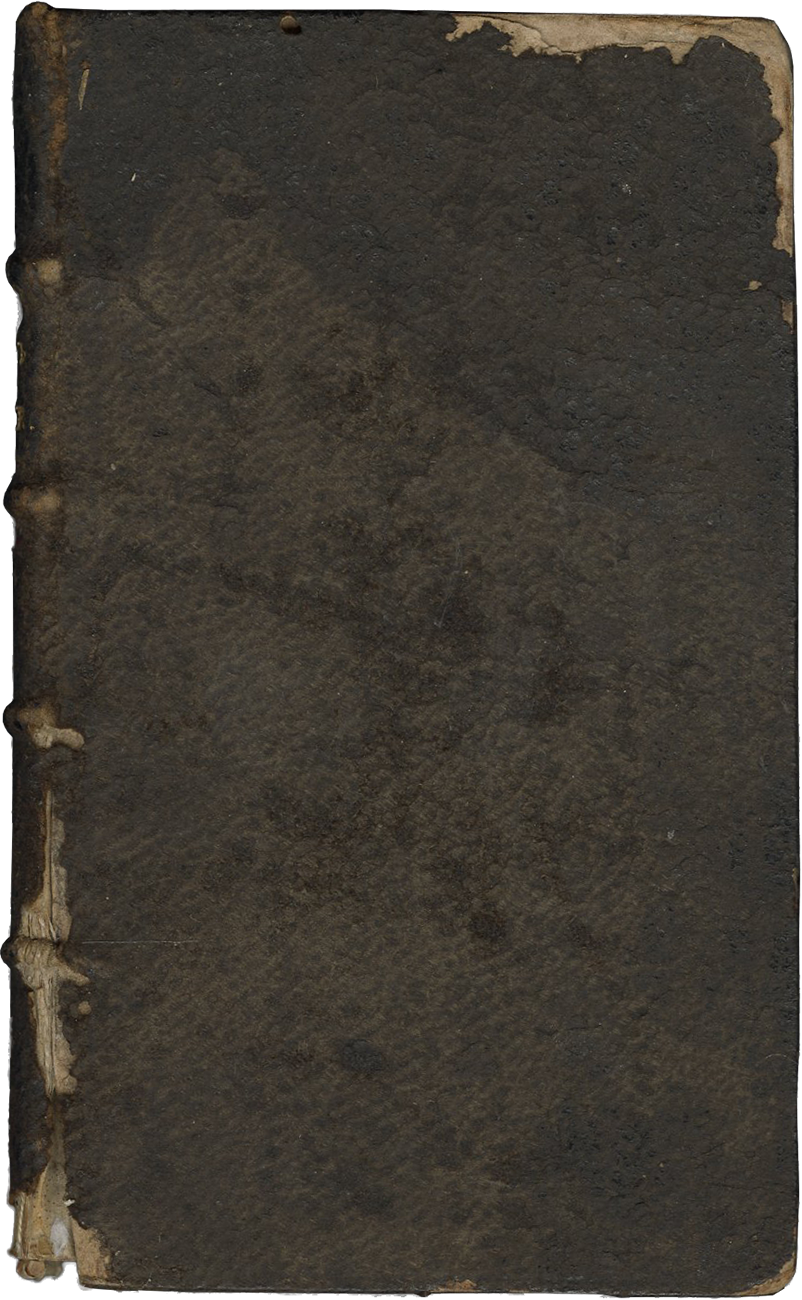
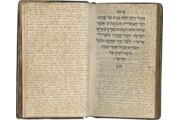
ii + 108 +ii folios on paper, marbled pastedowns, no visible watermark, (collation: P – Z8 AA-DD8 EE4), complete, catchwords at the end of gatherings, (justification 80 x 47 mm), single column in 14 lines, printed with Hebrew type cut by Jean Arnoul le Picard with cantillation and Tiberian vocalization, heavily annotated throughout by an exceptionally small, neat late sixteenth-century humanist cursive hand in Latin, Greek, Hebrew, and French in light brown ink, a second similar hand occasionally writing in darker ink, interlace decoration printed around אלה on f. P2r, Estienne’s olive tree printer’s mark on f. P1r (Renouard, 1926, no. 298), some slight staining in margins, some loss of marginal text due to later cutting and binding, otherwise good condition. Seventeenth-century binding in sheep, spine in four bands with “DEVTER” gilt on spine, bottom of spine is chipped, back cover worn and chipped in top corner, gilt edges, otherwise good condition. Dimensions 112 x 66 mm.
A pocket-sized “typographic jewel,” this book is one of the finest examples of Parisian Hebrew printing from the sixteenth century, executed by Robert Estienne in exquisite detail and beauty (Renouard, 1863, p. 65). Even more remarkable are the dense annotations that fill every page of this tiny codex. A humanist scholar working in the decades following inserted notes in Latin, Greek, Hebrew, and French clarifying the grammar and context of the Hebrew text and translating large parts of it. The copious annotations, combined with a précis on the authority of scripture at the end of the book, offer rare insights into the working method of a Protestant humanist scholar grappling with the intricacies of the Hebrew scriptures during a fraught time for biblical interpreters.
Provenance
1. This book was part of a larger print run of the entire Pentateuch, printed by Robert Estienne (1503-1559) between 3 February and 3 March, 1546. (The date given in Hebrew at the beginning of Genesis is Adar [5]306 (Schwarzfuchs, 2004, no. 173)). Estienne was appointed imprimeur et libraire ès lettres Hebraiques et Latines to the King on June 24, 1539. Between 1539 and 1546 he printed two complete editions of the Hebrew Scriptures; one in quarto and this in sextodecimo. The type used for both editions was cut by Jean Arnoul le Picard (Armstrong, 1986, pp. 51-52).
2. The first owner of the book entered copious marginal and interlinear annotations in Latin, Greek, Hebrew, and French on every page in an extremely small but quite legible cursive of the later sixteenth century. An inscription in Hebrew on f. P1r at the top of the page may belong to the original owner, but the letters have been cut in half by a later binder. Given how close the annotations are to the spine and some loss of text due to later cutting, it is likely that this owner purchased and annotated the book when it was unbound.
3. A later owner has written what appears to be “leius .I.” on f. R6v in a larger and clumsier hand than the rest of the annotations.
4. A seventeenth-century owner cut the pages to their current dimensions and bound the book in its current form.
Text
ff. P1r-EE4v, Deuteronomium, incipit, “לעיני כל ישראל…אלה הדברים אשר.“
The text of this book belongs to a sextodecimo edition of the Pentateuch printed by Robert Estienne between February 5 and March 5, 1546, the Quinque libri legis (Schwarzfuchs, 2004, no. 173). With few alterations, Estienne printed the text of the “second rabbinical edition printed by Daniel Bomberg at Venice, edited by Jacob ben Chayim, 1524-25” (Armstrong, 1986, p. 121). This copy represents one of two editions of the Pentateuch in Hebrew that Estienne printed between 1539 and 1546 (these two editions are quite frequently confused or conflated in local cataloguing), the first printed in France. According to Estienne himself, the Bibles were printed in two sizes: “one larger, so some would have copies in which they could conveniently take notes of the interpretations of Royal and other teachers; another smaller, which others could carry around easily wherever they went” (see Armstrong, 1986, p. 121 n. 2). It is ironic, then, that this sextodecimo copy contains so much marginal commentary.
The character of the commentary that fills every page of this book can best be summarized as "philological.” Many interlinear comments quote the Vulgate translation and sometimes introduce other possible translations, such as at f. Q3v (Deut 3.12): usque ad mediam partem montis Galaad and at f. R8r (Deut 6.8) where the Vulgate et ligabis ea quasi signum in manu tua is quoted and a variant translation offered uel alligabis ea brachio tuo in signa. On the same folio, the Vulgate translation of 6.9, scribesque, is translated interlineally as, curabis illa scribenda. The alternate renderings into Latin do not match any Latin translations made from the Hebrew in the sixteenth century, notably Castellio’s Moses Latinus (1546) and the Louvain Bible (1547). Similarly, throughout the commentary, readings from the Septuagint translation are usually introduced by the number “70” and followed by the Greek text, e.g. at f. P4v (Deut 1.27) “70 διὰ τὸ μισεῖν κύριον ἡμᾶς” (“because the Lord hated us”).
Occasionally, there are also French translations given by the commentator sometimes preceded by “gall” or “gal,” for example in the left margin of f. DD5v where there is a translation of Deut 32.24 “gal Je les batre de peste de famine de guerre et des bestes, desquelles aumnes les mangeront et les aullies par leur venin les luront[?]”. Other French translations can be found at ff. P2v, S1r, T3v, Z4r and elsewhere. The commentator offers new French renderings of Deuteronomy that are different from both the translations of Olivetan (1535) and Castellio (1555).
There are also frequent remarks about the grammar and meaning of Hebrew words, for example, whether a word is a passive verb or a participle. There are also cross references to other books of the Old Testament used as comparative evidence in the interpretation of the Hebrew as well as long notes on geography and place names. The unique translations suggest either an entire series of now-lost printed bible translations, or, more likely, that the commentator was translating each of these languages on the fly, for himself—a bravura performance of linguistic aptitude in mid-sixteenth-century France.
On the verso of the final folio of the book (f. EE4v), the commentator writes in a somewhat larger hand a paragraph on the topic “De conciliorum auctoritate” (On the authority of councils). The topic is discussed with three references to Augustine: 1.) “Adversus Maximinum”, an anti-Arrian text in which Augustine compares the relative value of the Council of Nicea (325) and the Council of Rimini (359) in determining the meaning of the word homousion, but ultimately settles on the ultimate authority of Scripture (Augustine, Contra Maximinum, 2.14); 2.) “Contra Donatistas,” in modern editions titled De baptismo, in which Augustine remarks that later councils can correct earlier councils in the light of progressive revelation (Augustine, De baptismo, 2.3); 3.) “Scribens ad Hieronymum”, probably citing Augustine Letter 82, in which Augustine refutes Jerome’s arguments about scriptural interpretation based on the authority of the fathers with direct quotation from scripture (Augustine, Epistulae, 82.24); 4.) “Ecclesiam non esse in hoc seculo”, citing an excerpt from Retractationes book 2, in which Augustine retracts a statement from De baptismo calling the church “without wrinkle and spot” (sine ruga et macula) and saying further that the church of his day does not deserve this praise (Augustine, Retractationes, 2.44). Bolstered by the authority of Augustine, all of these excerpts argue for the superior authority of scripture to that of possibly faulty church councils and tradition.
In the first half of the sixteenth century, the study of Hebrew language and culture expanded greatly throughout Europe. Catalyzed by events like the expulsion of Jews from Spain in 1492, the founding of the Collegium Trilingue in Louvain in 1530, and, in the same year, the establishment of three readers in Hebrew at the University of Paris, Christian Hebraism sought to understand the Old Testament in its original language. Confronted with variants in the text of the Hebrew Old Testament, humanist textual scholars came to the realization that “a variant reading in Homer or Livy was a textual problem, but an unstable text of [scripture] was an existential one” (Dunkelgrün, 2025, p. 14). Thus, in the course of the first half of the sixteenth century, scholars and printers worked together to produce Hebrew bibles, grammars, dictionaries, and translations of the Old Testament into Latin and European vernaculars based on Hebrew. Moreover, in the same year as this book’s printing (1546), the Fourth Session of the Council of Trent convened and issued its most famous proclamation concerning the authenticity of the Latin Vulgate translation of the Bible. It is important to note that vernacular translations of the Bible were produced and circulated before and after this edict, which crucially did not ban reading the Bible in the vernacular. Instead, “any decision regarding vernacular Bibles remained…in the hands of the local authorities who continued to decide according to their own local traditions” (Agten, 2018, p. 126).
There is a strong possibility that this book contains the private notes of a scholar studying the text and language of Deuteronomy very closely, perhaps in the hope of producing a commentary or translation of the book. The idiosyncratic character of the translations into Latin and French in the marginal notes provides a privileged look into the working methods of a quadrilingual humanist construing the meaning of the Hebrew text before our eyes. The compilation of excerpts from Augustine on the final folio also firmly place the anonymous commentator in a humanist-Protestant intellectual sphere in which the authority of scripture outweighs the later church fathers and councils.
Literature
Agten, Els and Wim François. “The Council of Trent and Vernacular Bible Reading: What Happened in the Build-Up to and during the Fourth Session (1546)?” in The Council of Trent: Reform and Controversy in Europe and Beyond (1545-1700): Volume 1 Between Trent, Rome and Wittenberg, ed. Wim François and Violet Soen, Göttingen, 2018, pp. 101-130.
Armstrong, Elizabeth. Robert Estienne, Royal Printer: An Historical Study of the Elder Stephanus, rev. ed., Appleford, Berkshire, 1986.
Augustine. Epistulae: Pars II Ep. XXXI-CXXIII, CSEL 34, ed. A. Goldbacher, Vienna, 1898.
Augustine. Retractationum libri duo, CSEL 36, ed. P. Knöll, Vienna, 1902.
Augustine. De baptismo, in Scriptorum contra Donatistas pars I, CSEL 51, ed. M. Petschenig, Vienna, 1908.
Augustine. Contra Maximinum libri duo, in Scripta Arriana Latina Pars II, ed. Pierre-Marie Hombert, CCSL 87A, Turnhout, 2009.
Burnett, Stephen G. Christian Hebraism in the Reformation Era (1500-1660): Authors, Books, and the Transmission of Jewish Learning, Leiden, 2012.
Campanini, Saverio. “Hebrew Students and Teachers across Boarders in the Renaissance,” in Trilingual Learning: The Study of Greek and Hebrew in a Latin World (1000-1700), ed. Raf Van Rooy, Pierre Van Hecks, and Toon Van Hal, Turnhout, 2022, pp. 55-76.
Chambers, Bettye Thomas. Bibliography of French Bibles: Fifteenth- and Sixteenth-Century French-Language Editions of the Scriptures, Geneva, 1983.
Dunkelgrün, Theodor. The Multiplicity of Scripture: The Making of the Antwerp Polyglot Bible, Toronto, 2025.
Renouard, Antoine Augustin. Annales de l’imprimerie des Estienne, 2nd ed., Paris, 1863.
Renouard, Philippe. Les Marques typographiques parisiennes des XVe et XVIe siècles. Paris, 1926.
Schwarzfuchs, Lyse. Le Livre hébreu à Paris au XVIe siècle: Inventaire chronologique, Paris, 2004.
Vervliet, Hendrik D. L. The Paleotypography of the French Renaissance: Selected Papers on Sixteenth-Century Typefaces. Leiden, 2008, vol. 1, p. 144.
Online Resources
Olivetan Bible (1535) https://archive.org/details/olivetan/olivetan_complete/mode/1up
Castellio Bible (1555) https://play.google.com/store/books/details?id=aShJAAAAcAAJ&rdid=book-aShJAAAAcAAJ&rdot=1
Moses Latinus (1546) [Castellio’s Latin Translation of the Pentateuch] https://www.e-rara.ch/bau_1/doi/10.3931/e-rara-33065
“Humanism and translations of the Bible into the vernacular,” Musée protestant, 2026 https://museeprotestant.org/en/notice/humanism-and-translations-of-the-bible-into-the-vernacular/