

Book of Hours (use of Arras)
In Latin and French, manuscript on parchment
France, Arras, c. 1475
TM 1503
- $12,000.00
 Textmanuscripts - Les Enluminures
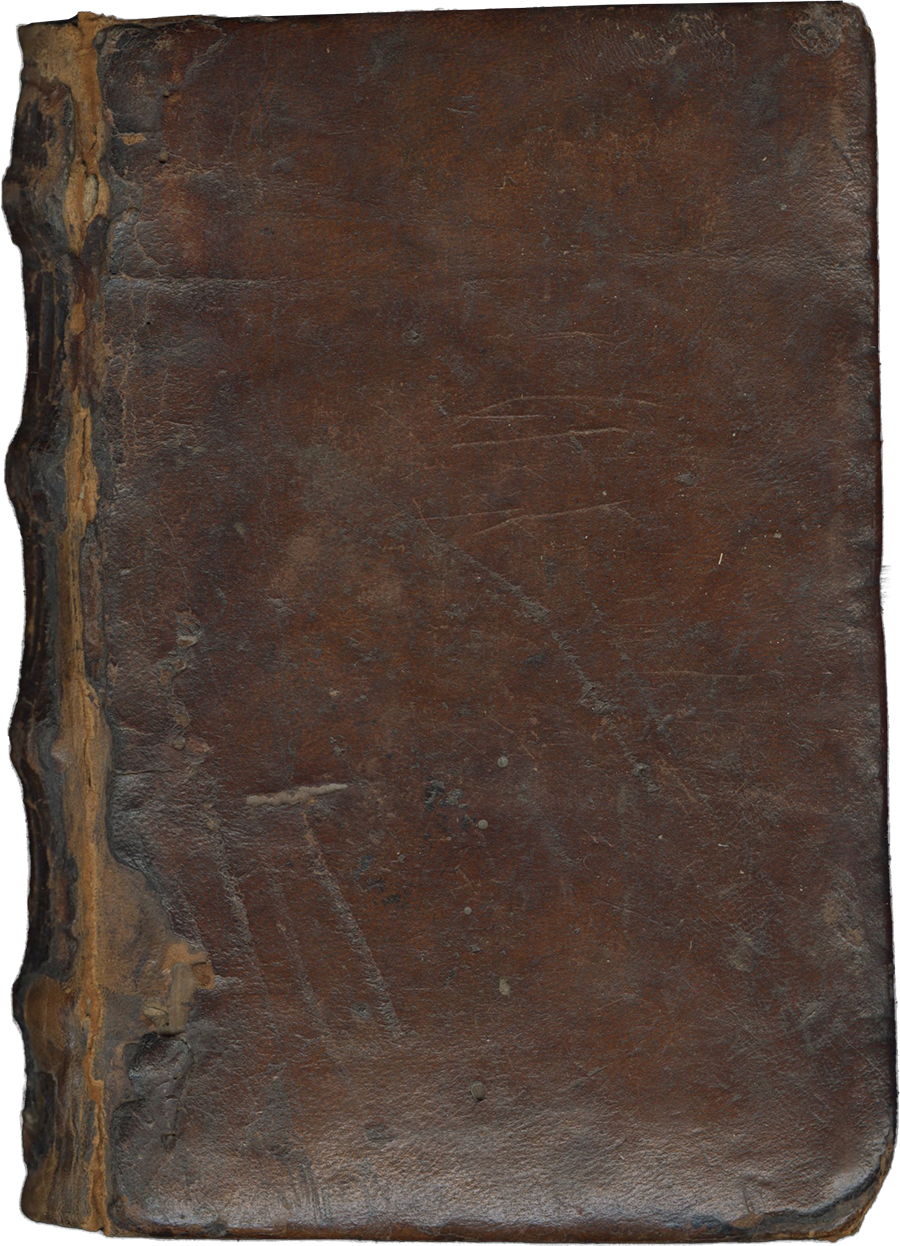
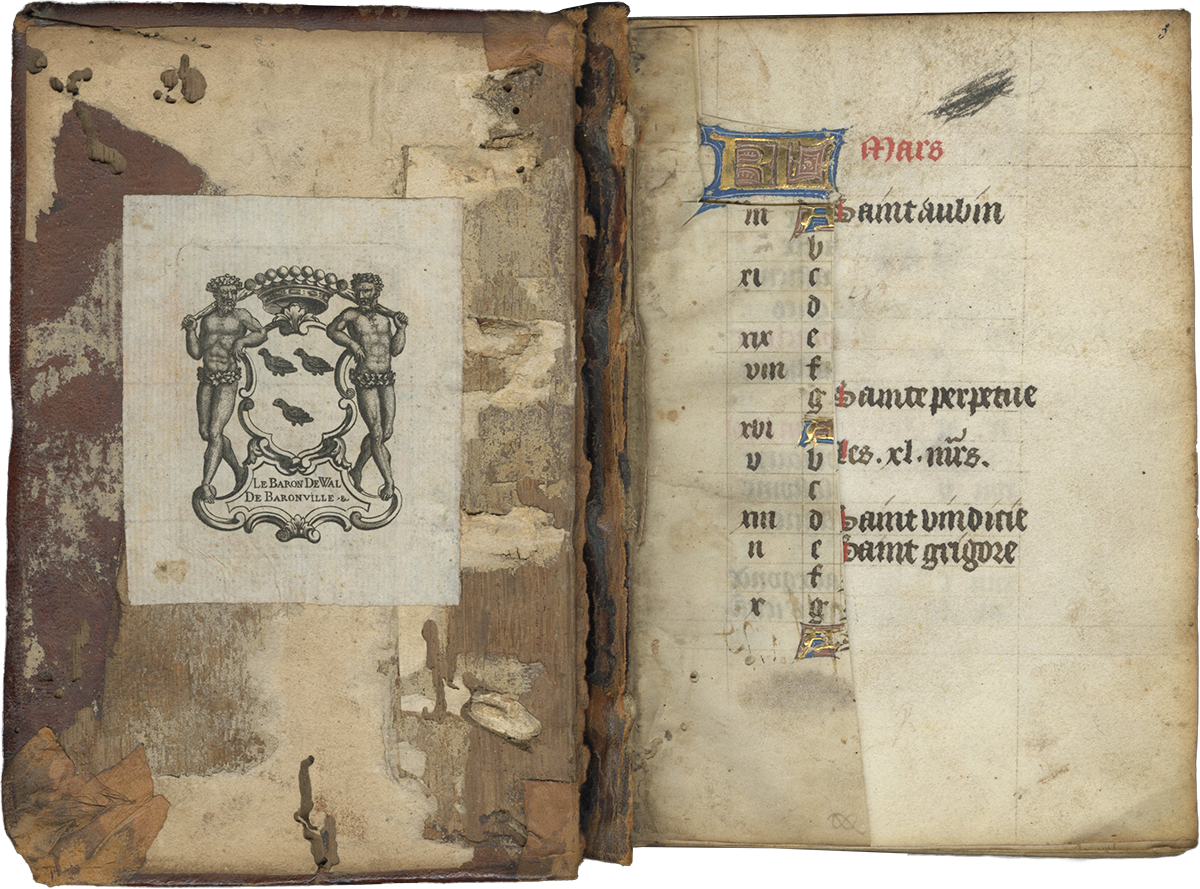
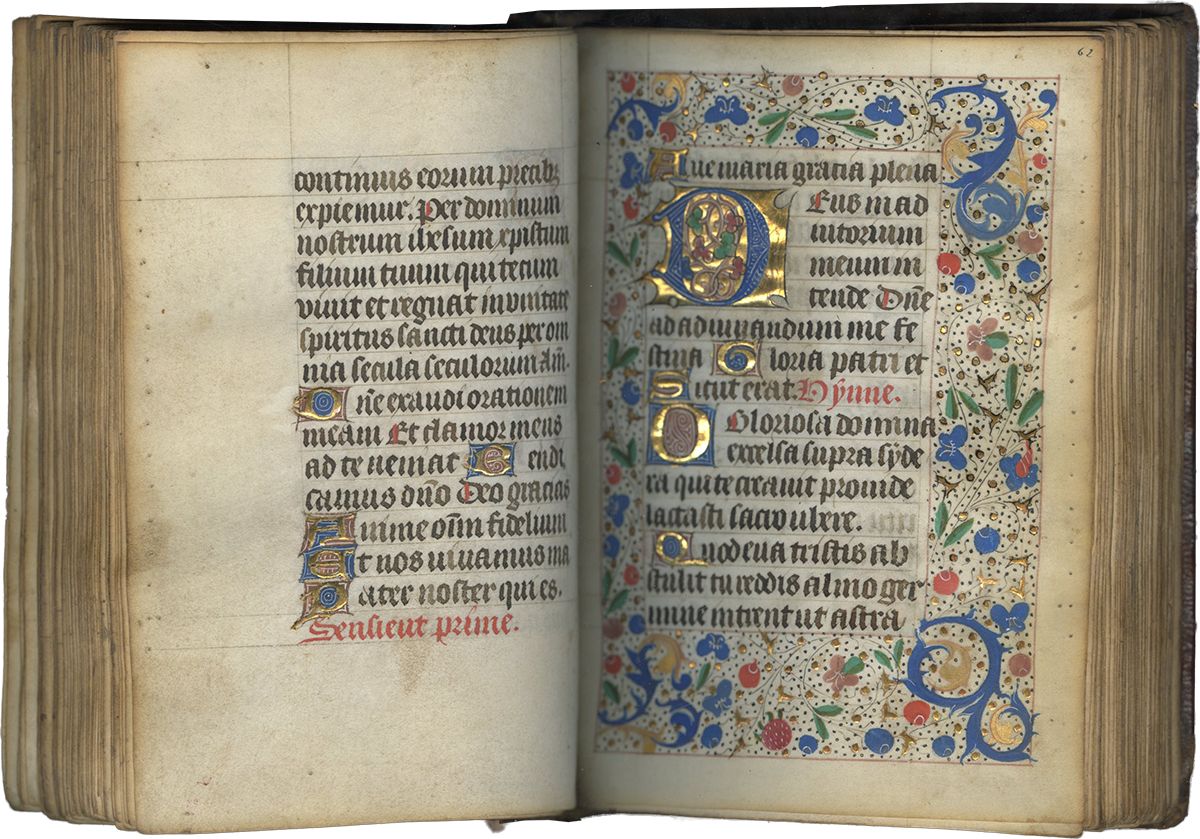
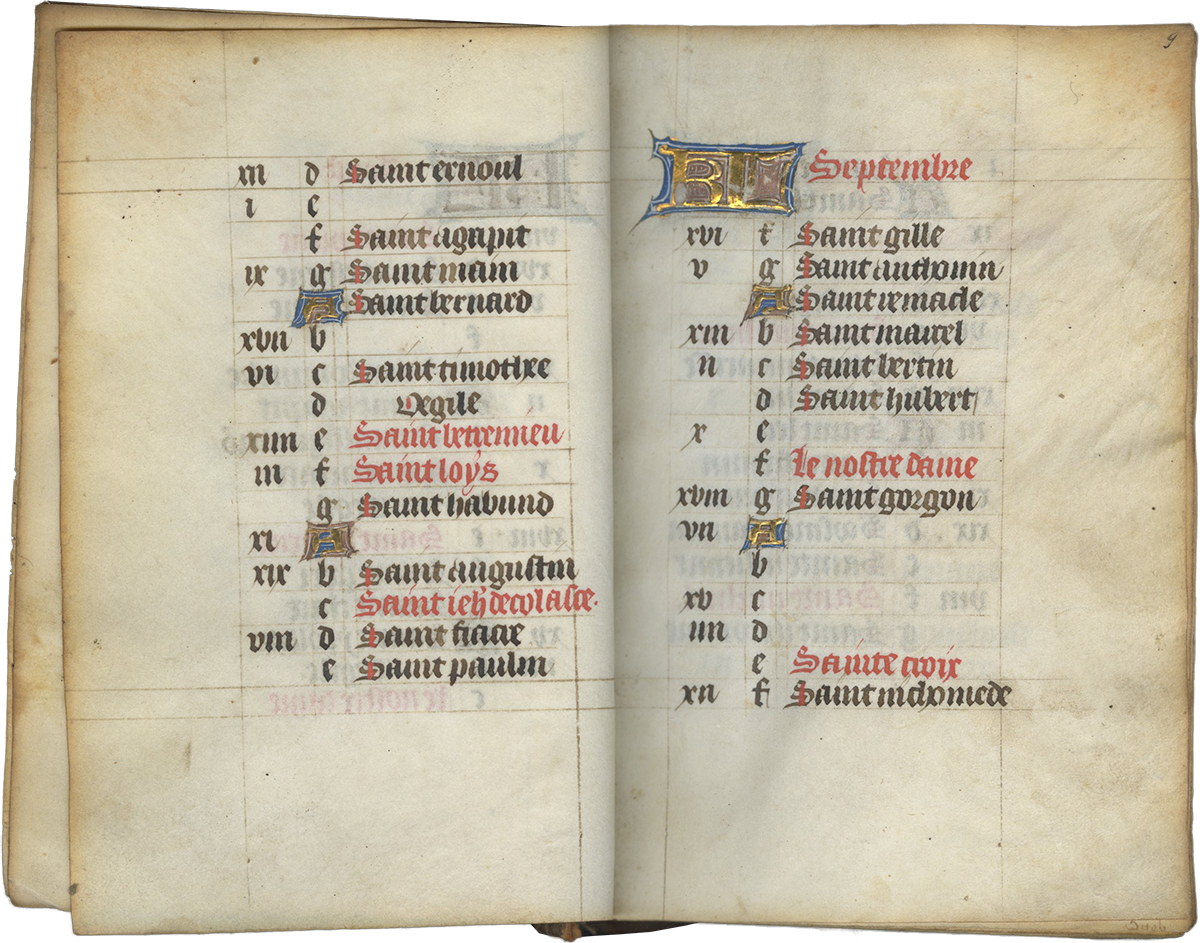
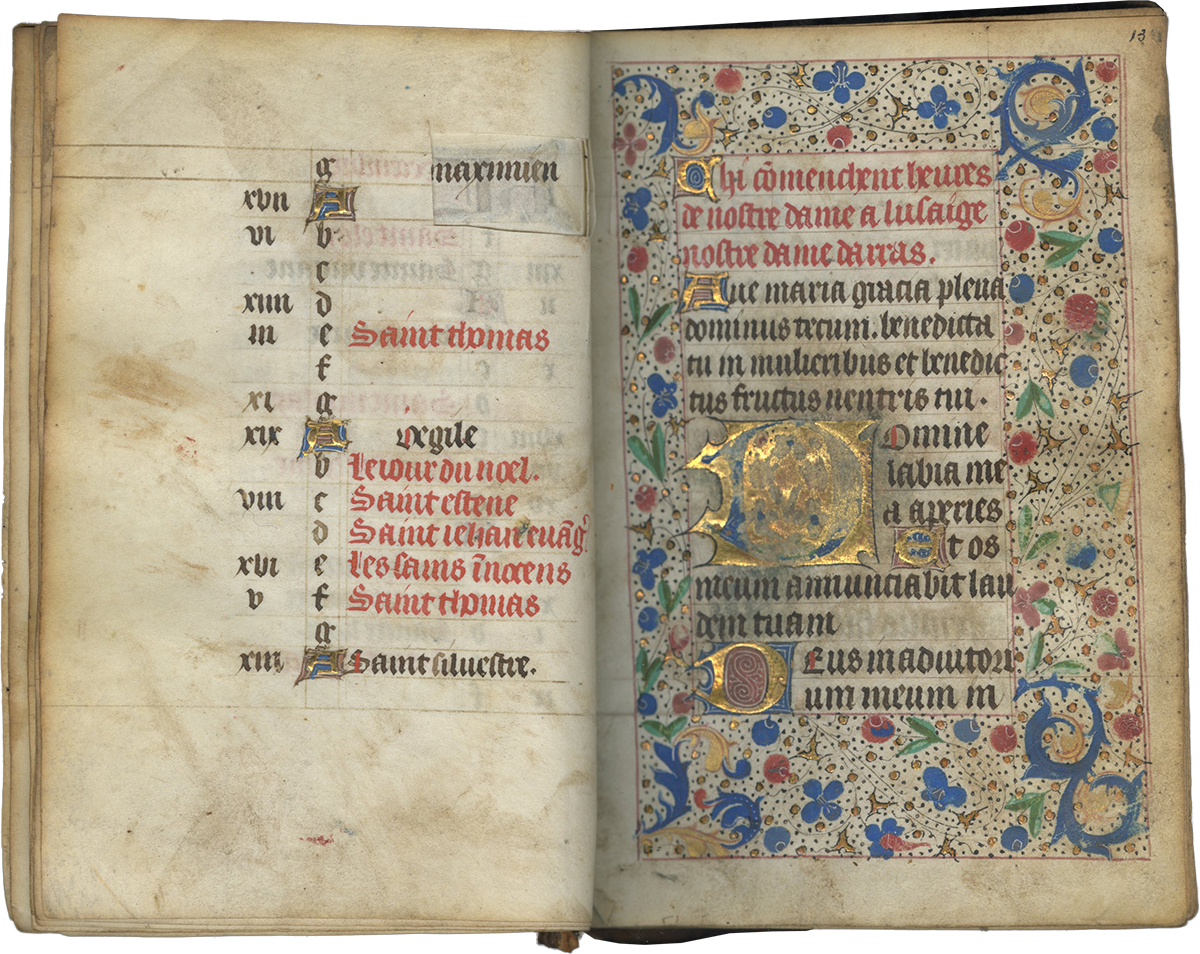
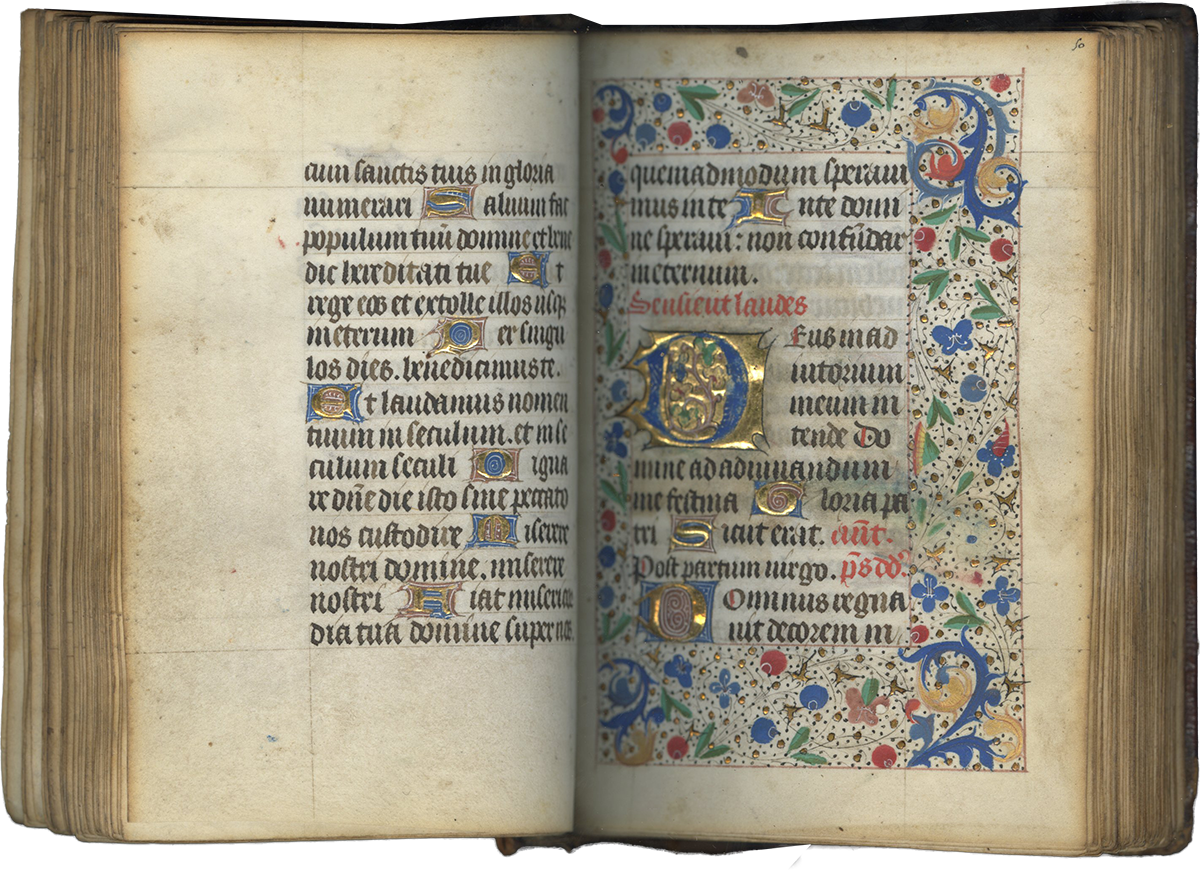
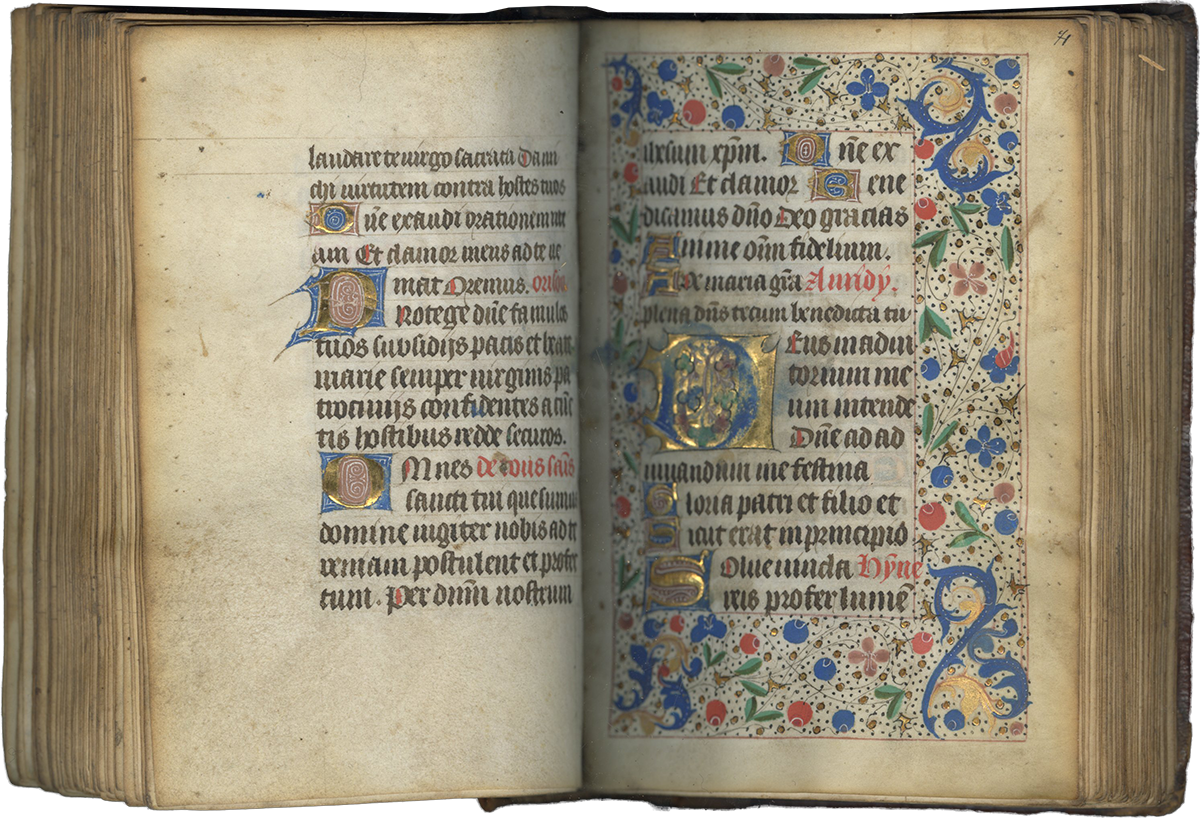
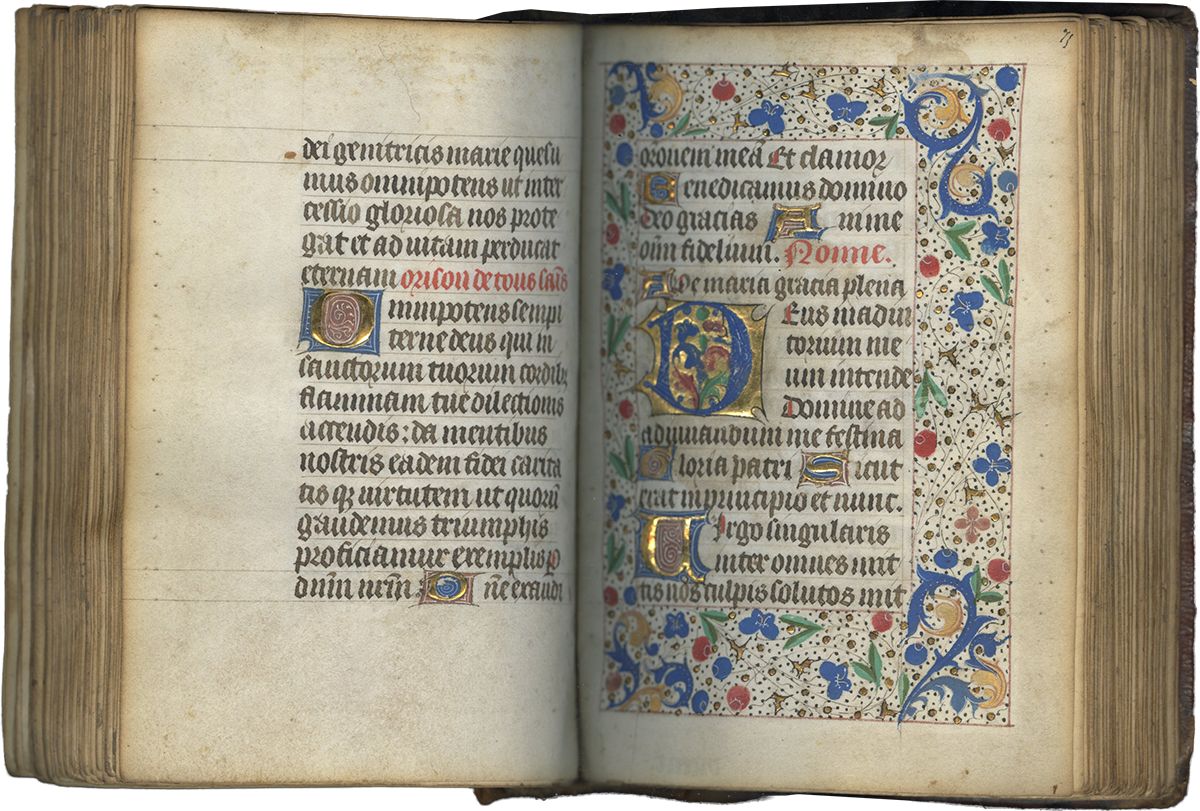
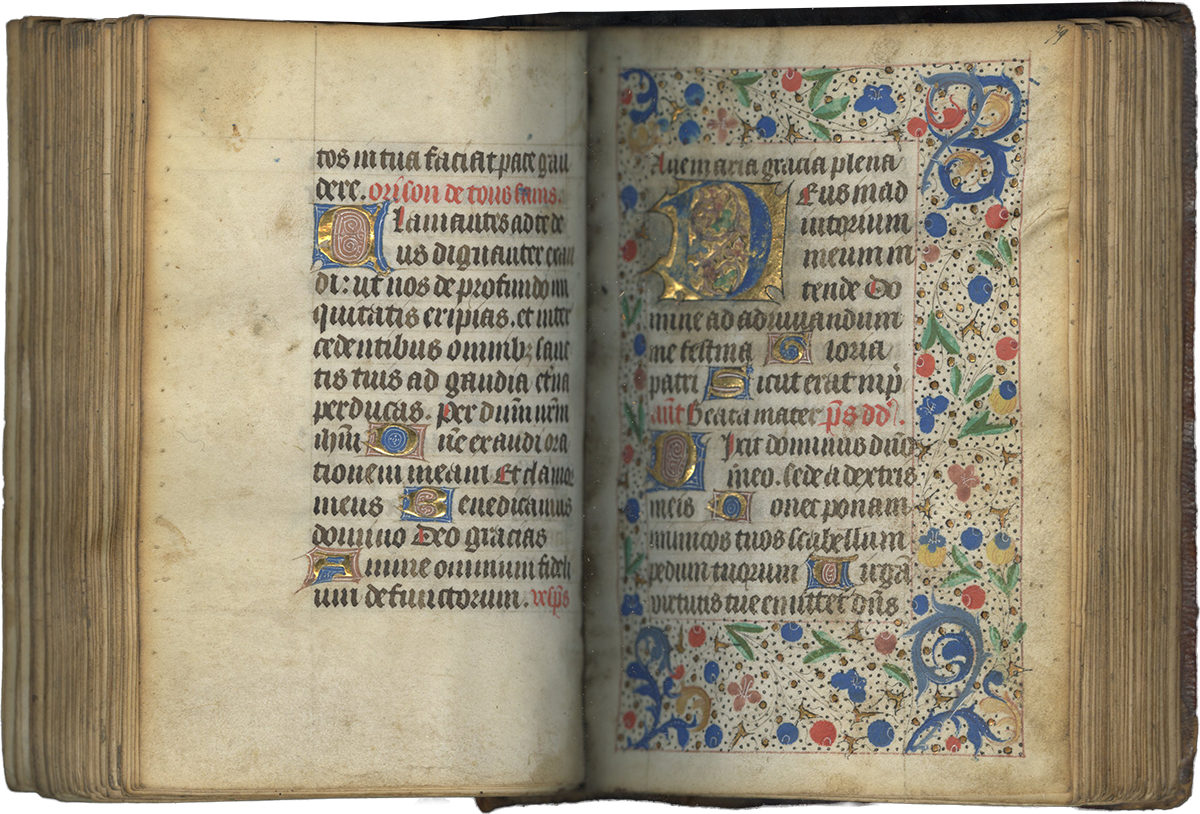
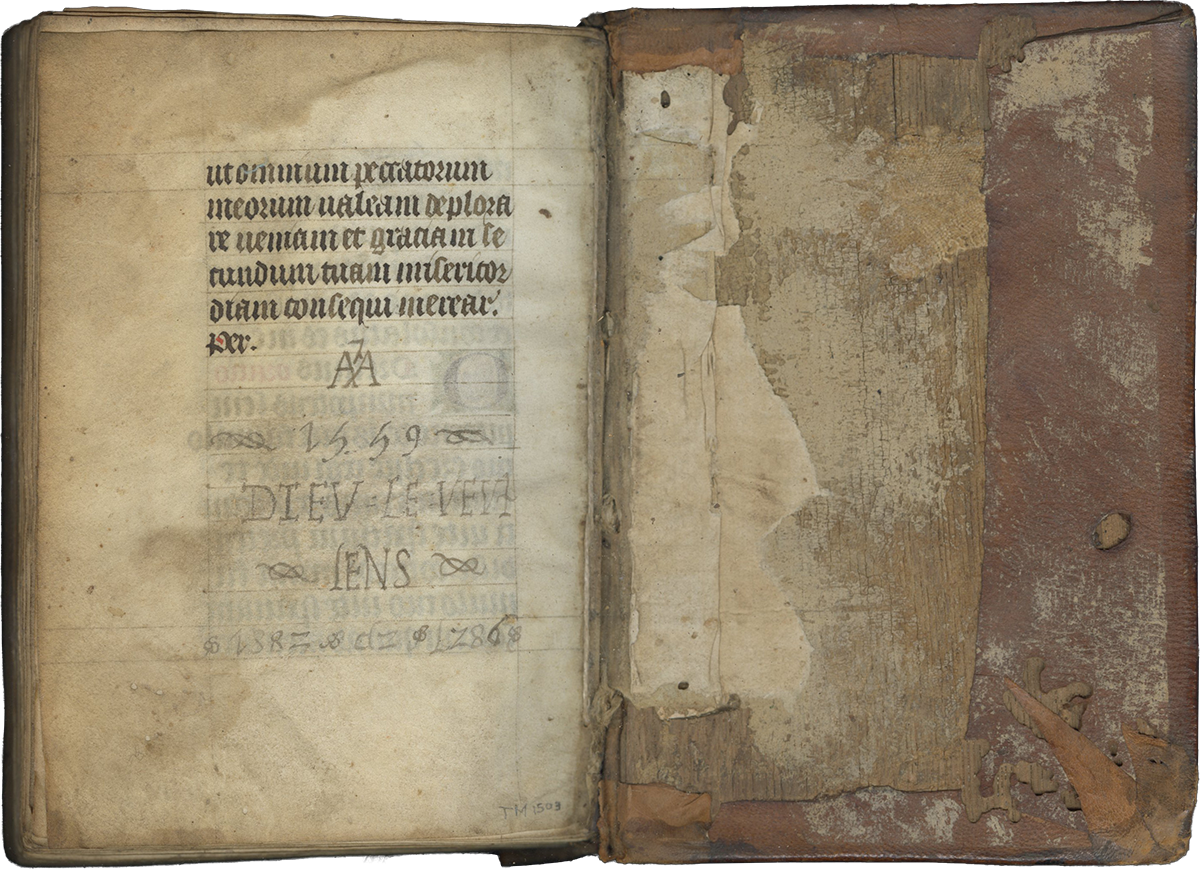
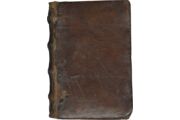
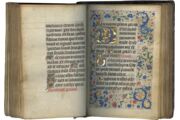
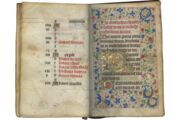
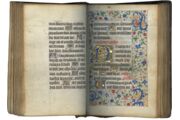
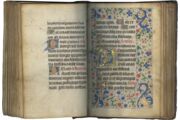
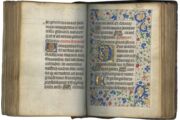
164 parchment folios, foliated in black ink in upper right corner, catchwords, some quire signatures, incomplete, (collation: i12-1, 2, 5, 6, 7 ii-vii8 viii8-7,8 ix-x8 xi8-3 xii8-1 xiii8-7,8 xiv8-1,2,5 xv8-5, 6 xvi-xxi8 xxii8-8), ruled in ink, (justification 100 x 55 mm) single column of 15 lines in textualis, one- and two-line illuminated champ initials throughout, four-line illuminated foliate initials at major divisions with full illuminated borders (ff. 13, 50, 62, 71, 75, 79), ff. 1-2 mostly cut away, some initials in the calendar cut out, some marginal staining and incisions in quires near cut-out folios, and aside from missing leaves otherwise in good condition. Bound in modern calf over boards, sewn on four cords, front board detached. Dimensions 165 x 110 mm.
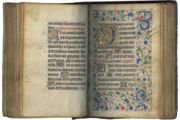
This is a fine Book of Hours for local use that may never have been intended to have miniatures. Even without full page illumination, its skillful script and generous margins, its decorated initials, rich with gold leaf, and its charming full floral borders, reveal a manuscript that must have been treasured by its owner(s). With its Picard dialect in the rubrics and calendar and its local liturgical use of Arras, this manuscript reminds us that Books of Hours were made and consumed not just by the wealthy but by members of the middle class, in this case in the diocese of Arras.
1. The incipit identifies the use as Arras, supported also by the inclusion of St. Vedast in the calendar in red (f. 10) and among the ancillary prayers (f. 110v), as this unusual saint’s relics are housed at Arras. The Picard dialect of French displayed in the calendar and rubrics, together with the specific liturgy also matches that of a digitized Arras Book of Hours, spelling “Barthélemy” “Betremieu” and “Clement,” “Climent,” for example (see Online Resources). With little of the calendar or litany remaining, the usual tests for date cannot be applied, and the border style was used for decades across the middle and later fifteenth century.
2. The volume remained in the diocese into the sixteenth century, as attested by an inscription “1559 Dieu le Veult Lens” (God Wills It Lens) (f. 169v). This references either Lens, Belgium, or, more likely, Lens, France, just north of Arras and still in its diocese at this time. The inscription lies below a monogram “AA” that may not be by the same hand. Whilst the date may be coincidence, Lens (and Arras) was very much part of the territory involved in the disputes leading to the Eighty Years War, and Philip II departed the Netherlands for Spain in 1559, after which the peace deteriorated before open conflict began. Again, perhaps coincidentally, the use of the medieval Crusader motto “Dieu le Veult” also fits the period of the European Wars of Religion.
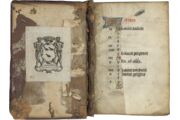
3. Bookplate of the Barons de Wal de Baronville, either Henri Auguste Joseph de Wal (1758-1829), ennobled in 1816, or his son, Charles Stanislas Alexandre (1791-1872). The de Wals had no clear connection to Arras or its environs, as their seat in Baronville and holdings in Trognée, Heer, and elsewhere lay instead between Brussels and Liège (Godts lot 207, Heers, Eglise Saint-Maurice, see Online Resources).
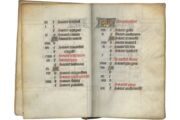
ff. 1-12v, Calendar, acephalous and incomplete;
ff. 13-90v, Hours of the Blessed Virgin Mary, use of Arras, incipit, “hi commenchent heures de nostre dame a lusaige nostre dame darras,” f. 13 (Matins), followed by the lessons for the days of the week, f. 50 (Lauds), f. 62 (Prime), f. 68 (Terce, acephalous), f. 71 (Sext), f. 75 (Nones), f. 79 (Vespers), f. 86 (Compline, acephalous);
This all matches well with the Psalter-Hours, Paris, Bibliothèque nationale de France, MS lat. 1328 (see Online Resources).
ff. 91-112v, acephalous, Penitential Psalms followed by the now fragmentary Litany and Gradual Psalms;
ff. 113-142v, acephalous, Office of the Dead, also use of Arras;
ff.142v-169v, a normal selection of the usual occasional prayers, including, among many more, Mass of St. Gregory, ff. 147-148v, Verses of St. Bernard, ff. 168-169; ff. 161v-168v in French, incipit, “Marie dame toute belle.”
Books of Hours survive in greater numbers than any other type of manuscript from the Middle Ages and the Renaissance. Made to support private prayer, by the fifteenth century Books of Hours were copied for a very wide audience indeed, and surviving examples range from some of the most luxurious and famous illuminated manuscripts like the Très Riches Heures belonging to Jean, Duc de Berry, to more utilitarian examples made for the use of simple merchants. If a family in the fifteenth century owned a book at all, there is a very good chance that the book they owned was a Book of Hours.
Arras serves as the capital of the Artois region, dividing Picardy from Flanders, and has paid the price as a border region for many centuries. This volume may bear a testament to that, with a sixteenth-century inscription that looks backward to the Crusader motto and may fit the volume into the religious and dynastic wars that plagued sixteenth-century Europe. Before the Reformation, the fifteenth century saw a gradual homogenization of liturgical use, as the Use of Rome displaced local liturgical uses across France. In the face of this tendency, the present volume remains resolutely local, featuring practiced, but not fine, decorative illumination likely made in Arras itself, and both a defiantly Picard French and liturgical use of Arras. Very similar decoration appears in the secondary decoration in another Arras volume that may also have been made locally (Arras, Médiathèque de l'Abbaye Saint-Vaast, MS 212, see Online Resources).
This Book of Hours reminds us that not all Books of Hours, even illuminated Books of Hours, were designed for miniatures, as they catered to clientele of the widest possible financial means. Most of the remaining major texts within this volume begin mid-page, and therefore did not begin with miniatures, and could not have accommodated even single-page, tipped-in miniatures. If such were ever used, they could only have been added ahead of the most substantial divisions of the volume: Matins, and the missing openings of the Penitential Psalms and the Office of the Dead.
Books of Hours of the use of Arras can be found in North American libraries but rarely appear on the market anymore in the twenty-first century. This is an excellent opportunity to acquire an example that demonstrates the reach of the Book of Hours into the provincial middle classes.
Reinburg, Virginia. French Books of Hours: Making an Archive of Prayer, c. 1400-1600, Cambridge, 2012.
Wieck, Roger. Time Sanctified: The Book of Hours in Medieval Art and Life, London, 1988.
Wieck, Roger. Painted Prayers: The Book of Hours in Medieval and Renaissance Art, New York, 1997.
Arras, Médiathèque de l'Abbaye Saint-Vaast, MS 212 https://arca.irht.cnrs.fr/ark:/63955/md57np195s8r
Eglise Saint-Maurice https://www.egliseinfo.be/lieu/55/baronville/saint-maurice
Gunhouse, Glenn, A Hypertext Book of Hours https://www.medievalist.net/hourstxt/home.htm
Heers, https://grootheers.be/rs_charles_de_wal/
Henri Godts, Brussels, 18 Oct, 2016 Lot 207 https://www.bibliorare.com/wp-content/uploads/catalogue/pdf/godts18-10-2016-cat.pdf
Paris, Bibliothèque Nationale de France, MS lat. 1328, Arras Psalter-Hours, https://archivesetmanuscrits.bnf.fr/ark:/12148/cc59279v
Schoenaers, D. and A. van de Haar, “Een bouc in walsche, a Book Written in French: Francophone Literature in the Low Countries (1200-1600),” Queeste 28:1 (2021), pp. 1-29. https://doi.org/10.5117/QUE2021.1.001.SCHO
TM 1503