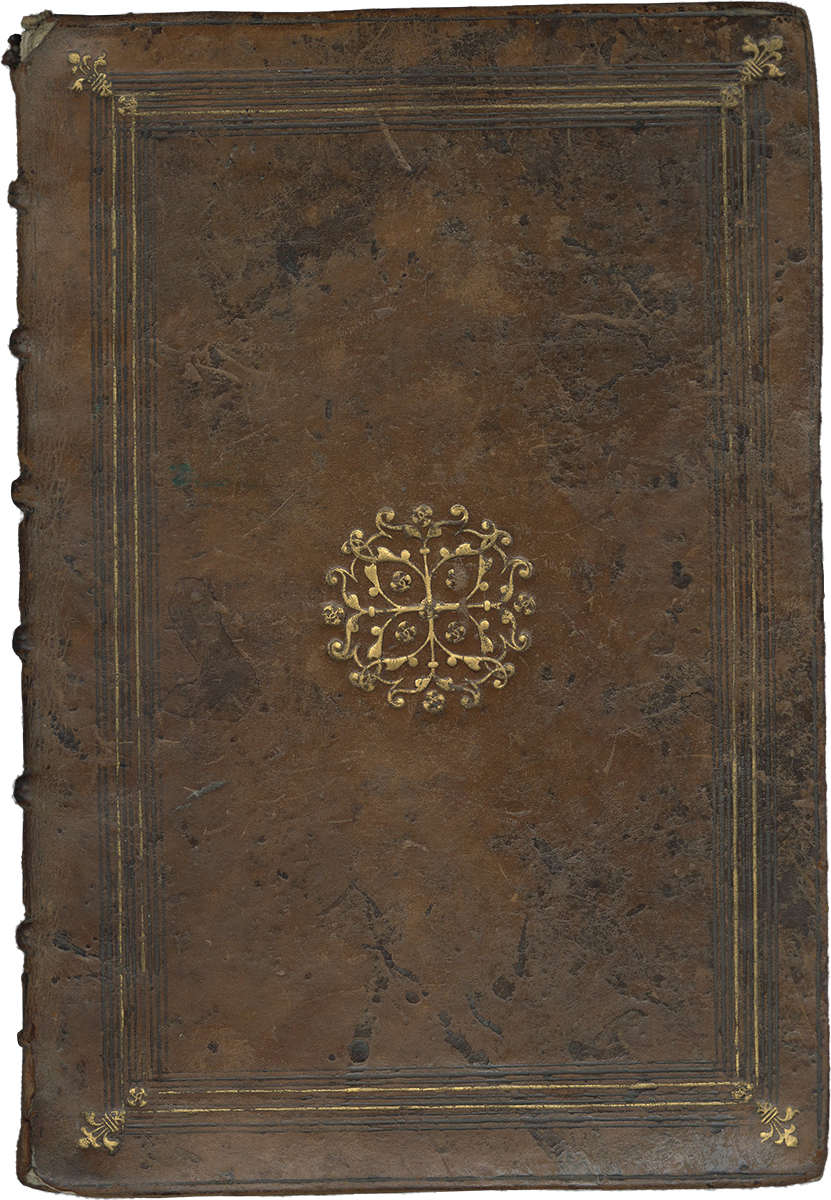
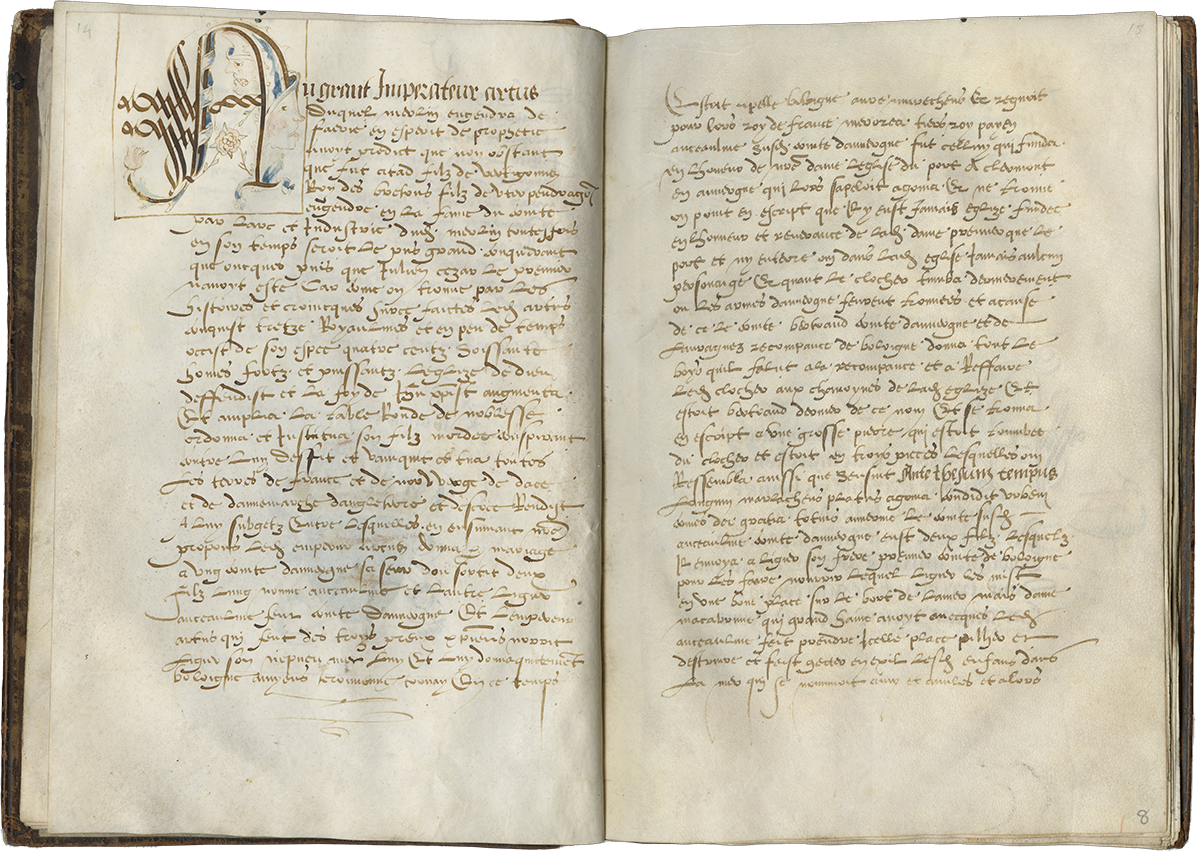
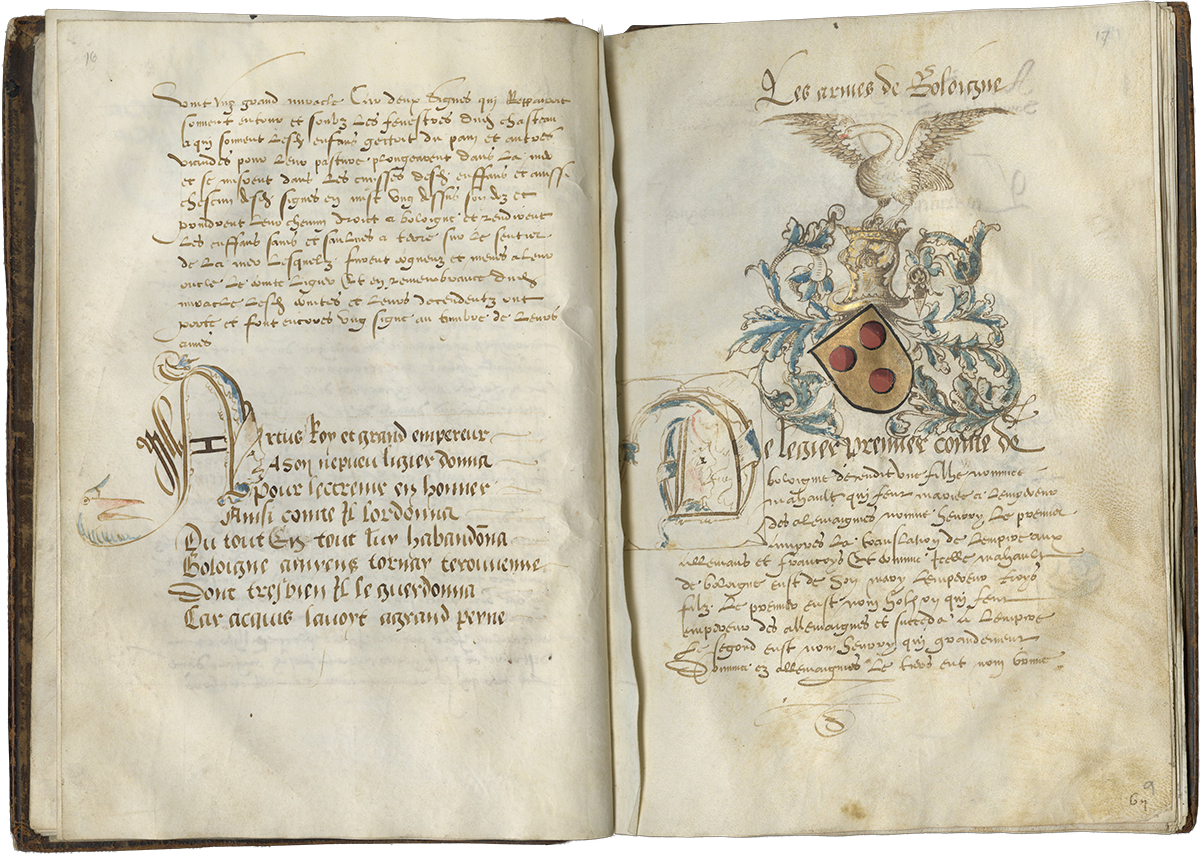
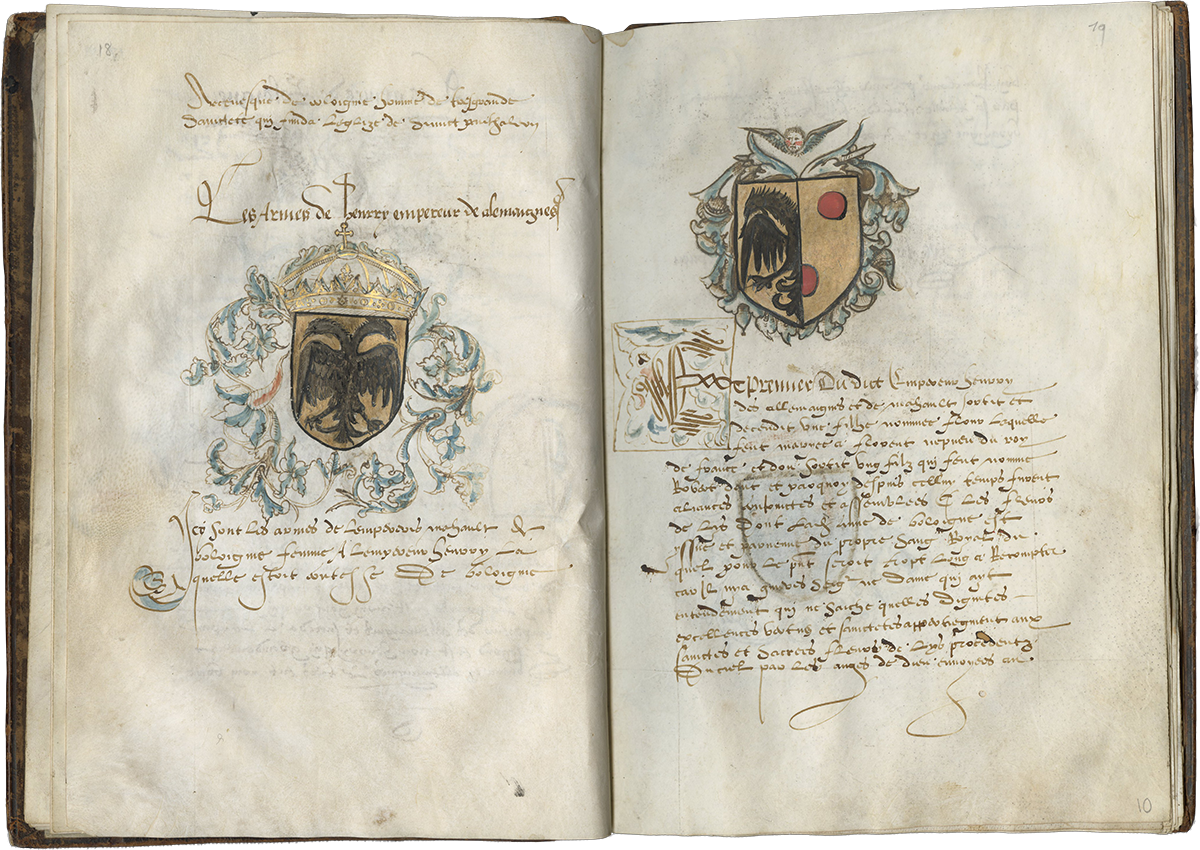
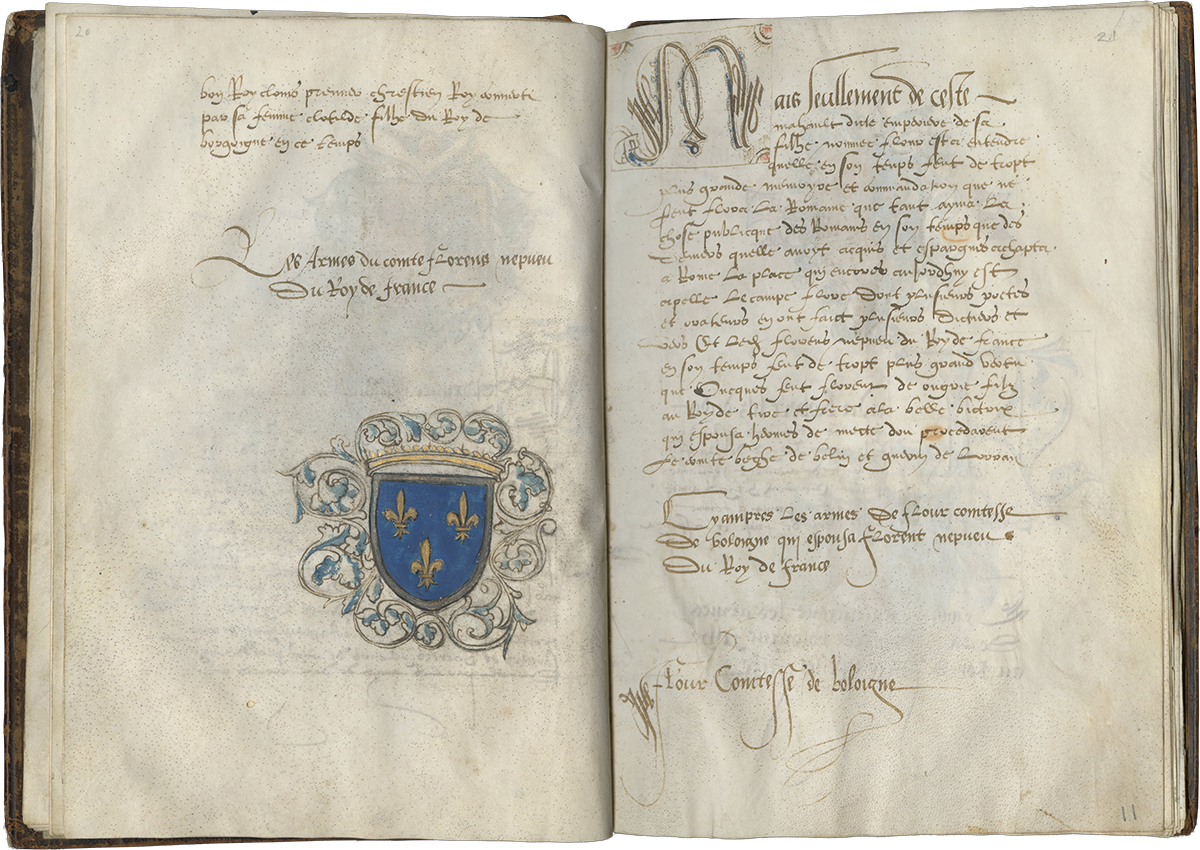
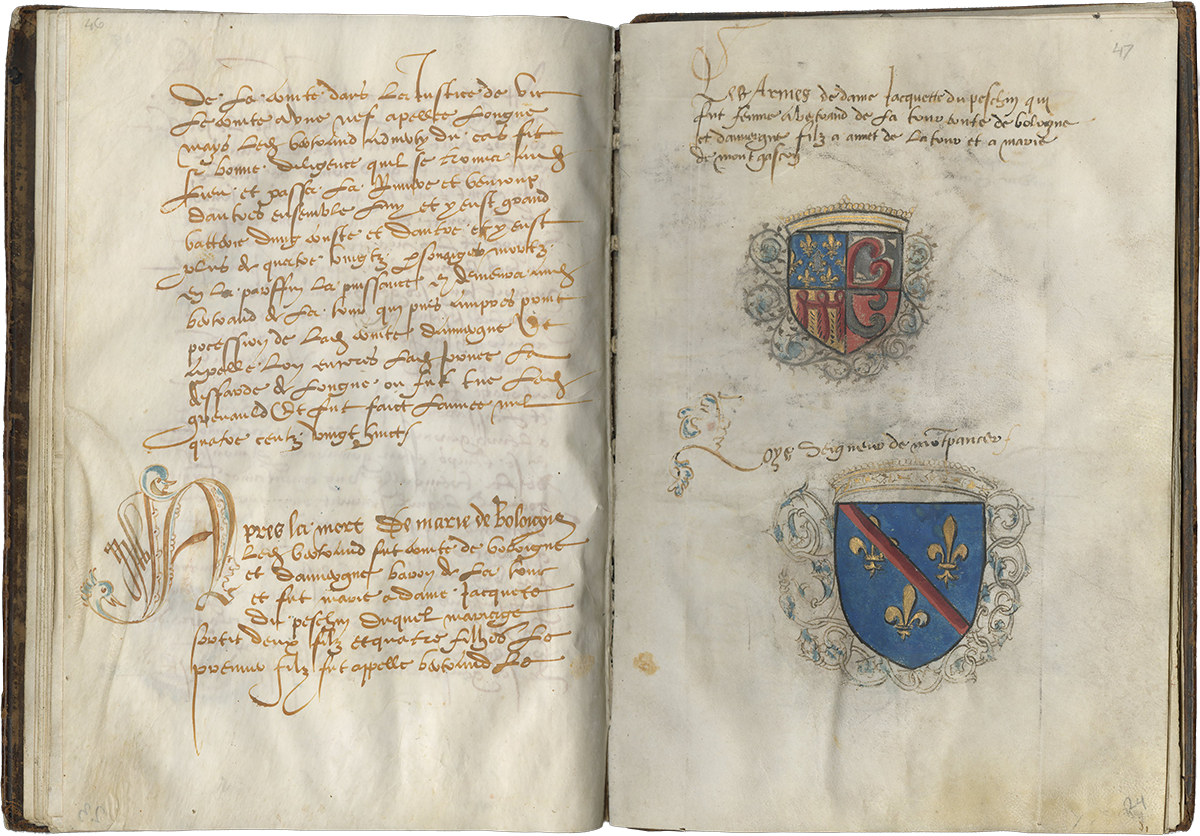
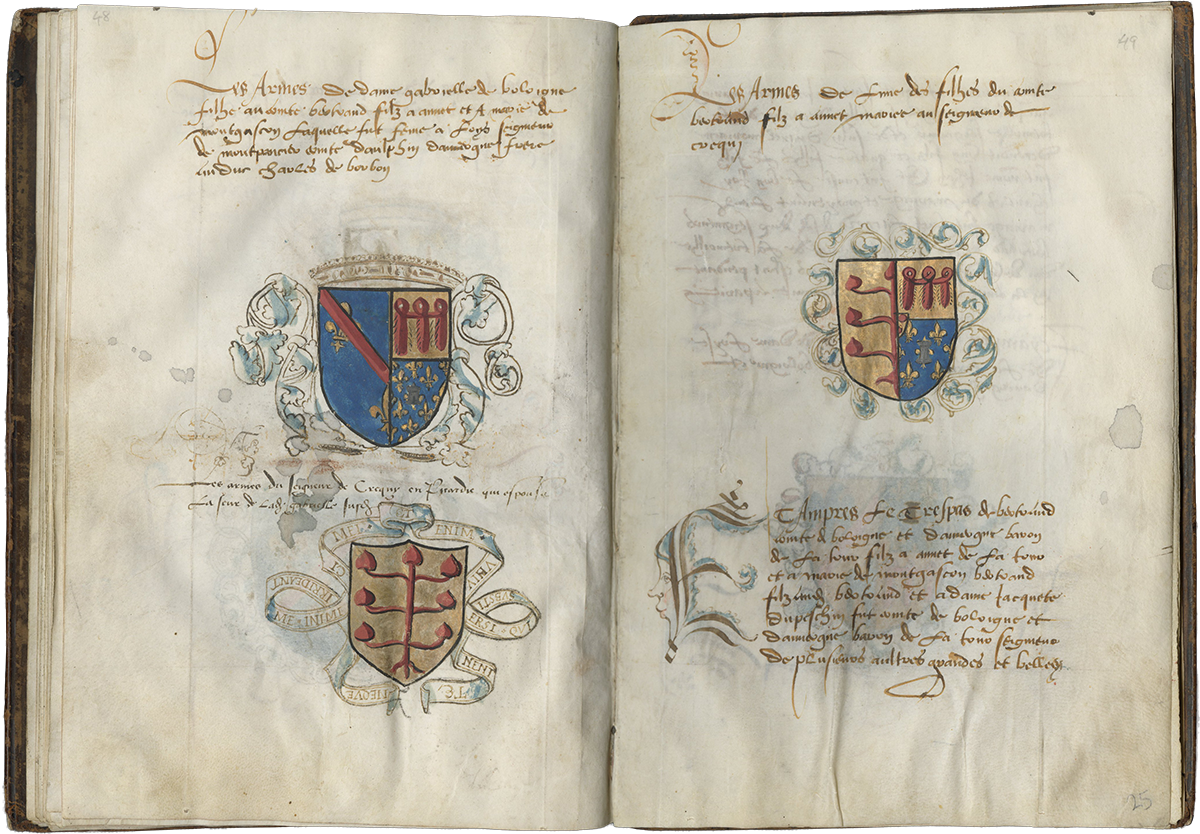
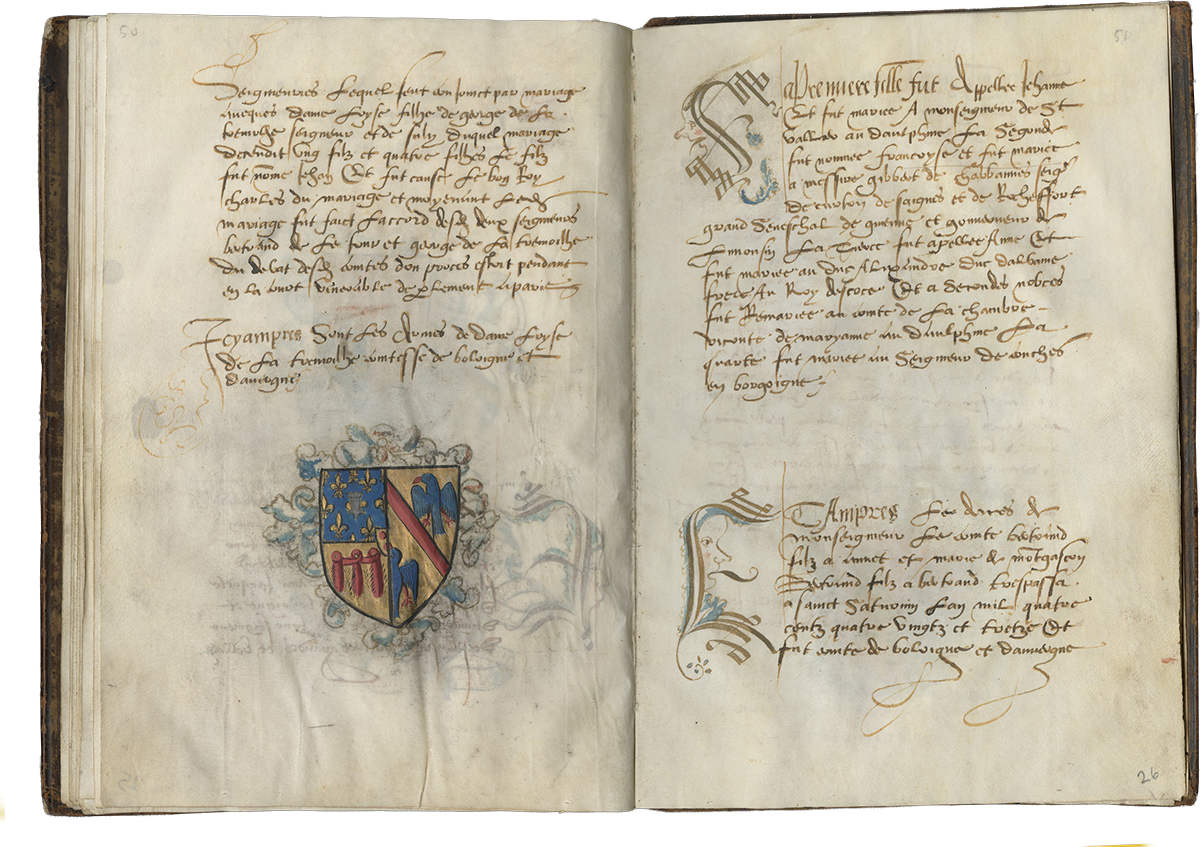
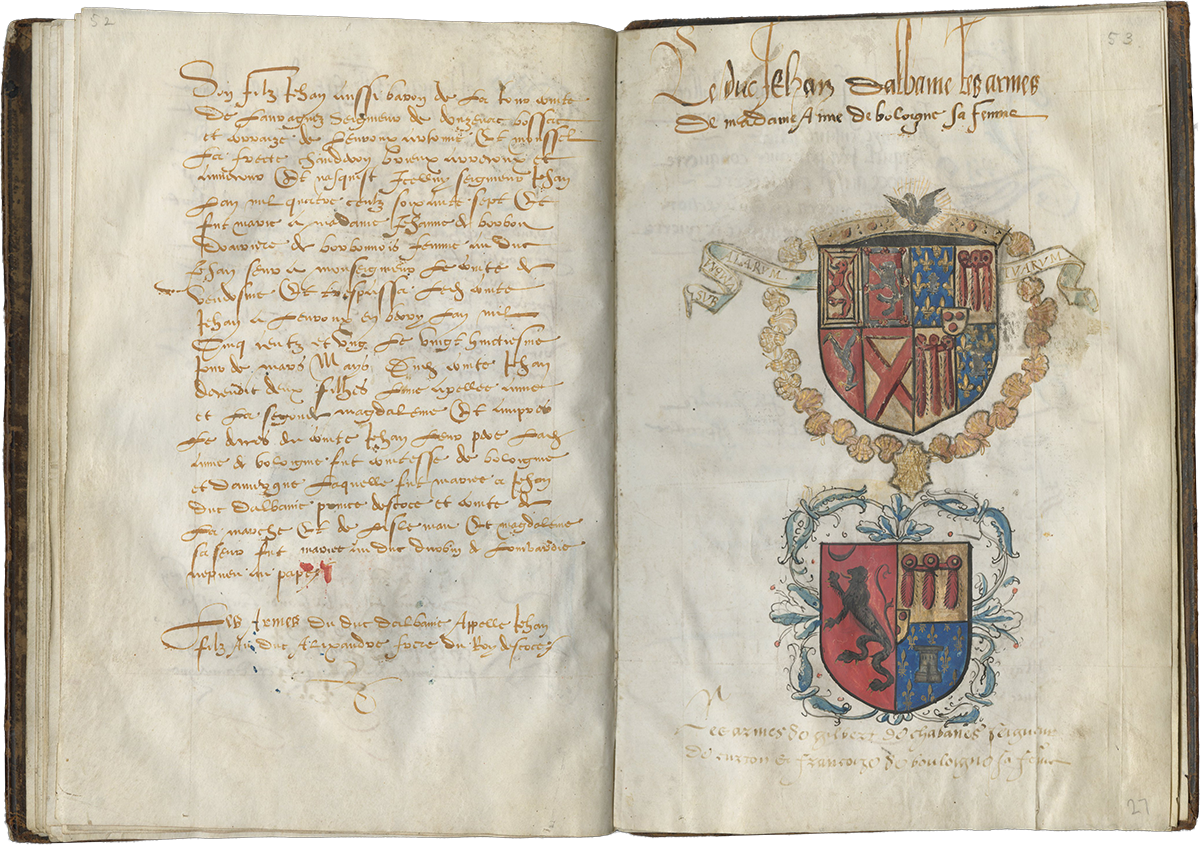
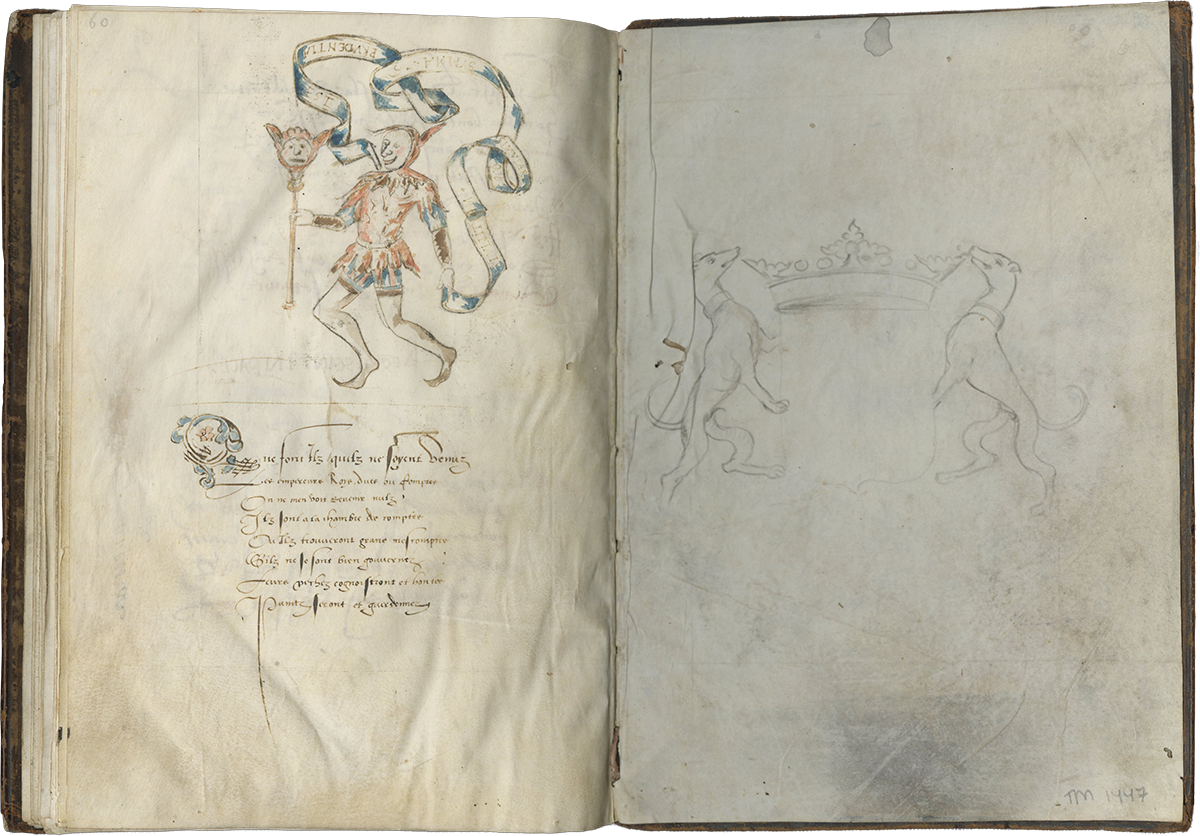
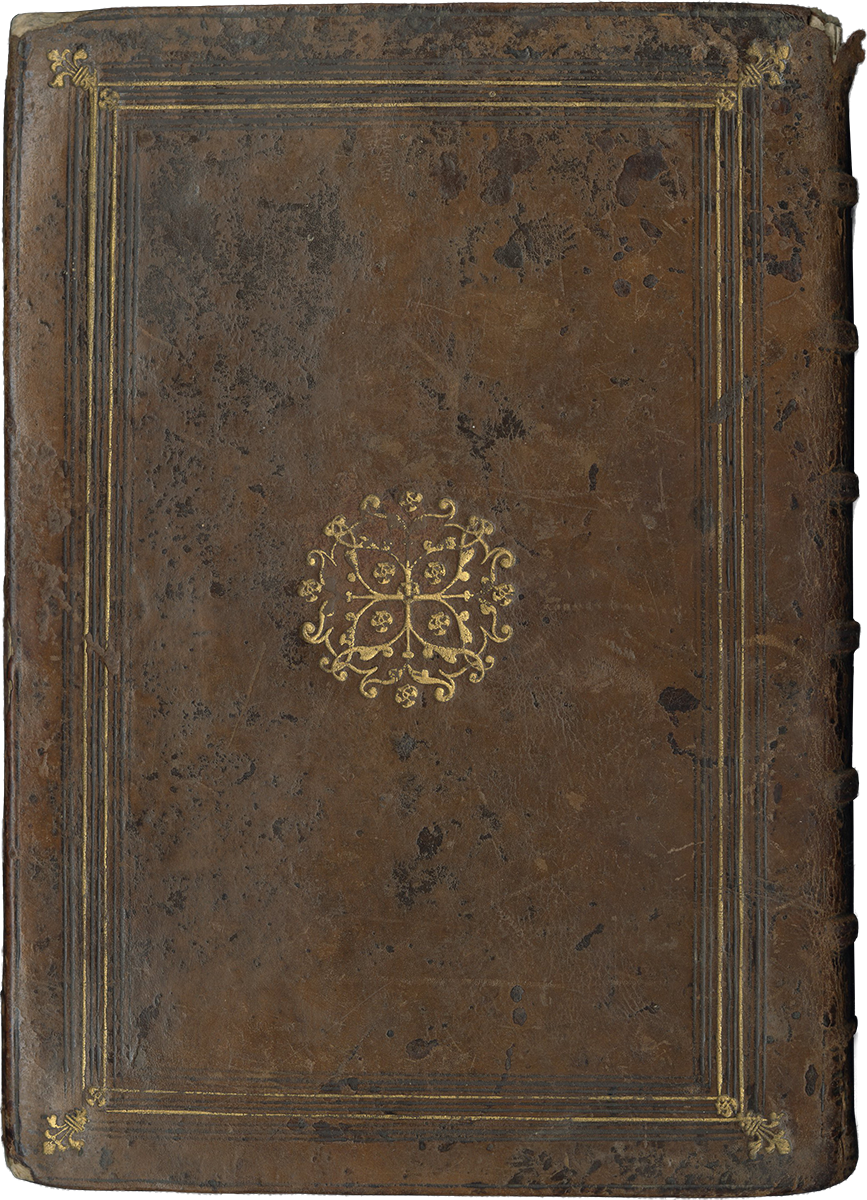
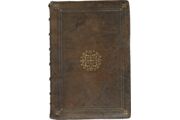
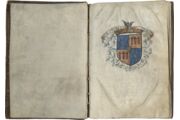
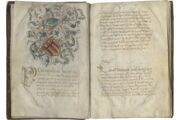
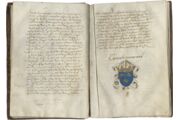
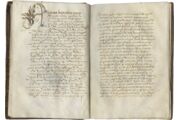
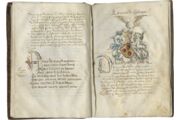
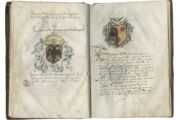
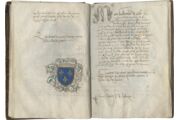
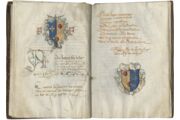
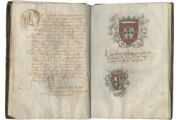
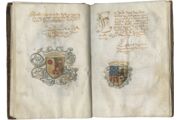
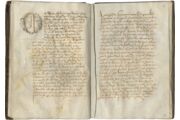
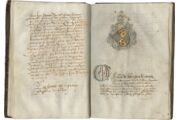
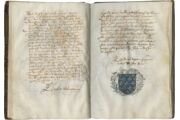
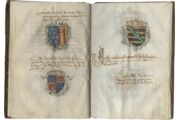
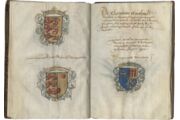
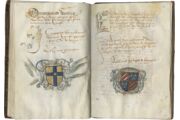
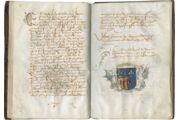
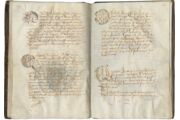
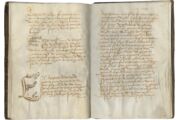
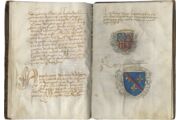
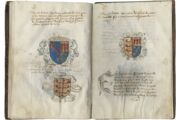
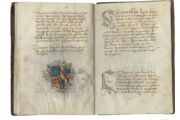
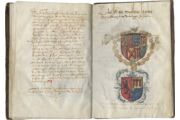
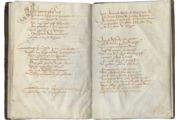
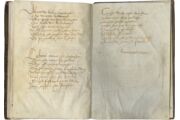
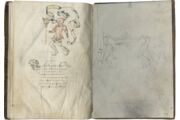
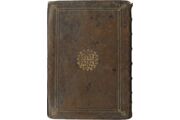
30 folios on parchment, modern foliation in pencil, 1-30, modern pagination in pencil, 1-60, complete (collation: i6 ii6 [-1, lacking one leaf after f. 6, without loss of text; -4, lacking one leaf after f. 8, without loss of text] iii2 iv4 [stub in the middle of the quire, no loss of text] v8 vi6), alphanumeric quire signatures (mostly cropped, “bij” visible on f. 9), no catchwords, frame ruled in brown ink (justification c. 162 x 105 mm), written in Gothic cursive script in brown ink in a single column on c. 25-28 lines, thirty-six 6-8-line decorated strapwork initials, thirty-three illuminated coats of arms accompanied by mottos and insignia, an heraldic drawing in pencil on the end pastedown showing a crowned (unfinished) shield supported by two greyhounds, a few natural flaws to the parchment, with minor staining and light wear, in overall excellent condition. Early binding of brown, tooled calf over pasteboards, spine with six raised bands, original parchment pastedowns, binding leather worn on the spine and at the corners, otherwise in overall good condition. Dimensions 237 x 164 mm.
This manuscript both records and illustrates the French lineage (real and imagined) of Anne de La Tour, while also promoting the political ambitions of her exiled Scottish, royal husband, John Stuart, Duke of Albany. Illuminated with thirty-one finely painted coats of arms, the genealogy begins with King Arthur and culminates in contemporary marriages of major political consequence, including the union of Anne’s sister Madeleine de La Tour with Lorenzo II de’ Medici, nephew of Pope Leo X and future parents of Catherine de’ Medici, later queen of France. The book is a historically significant witness to early sixteenth-century strategies of dynastic propaganda and the construction of political legitimacy through genealogy and heraldry.
Provenance
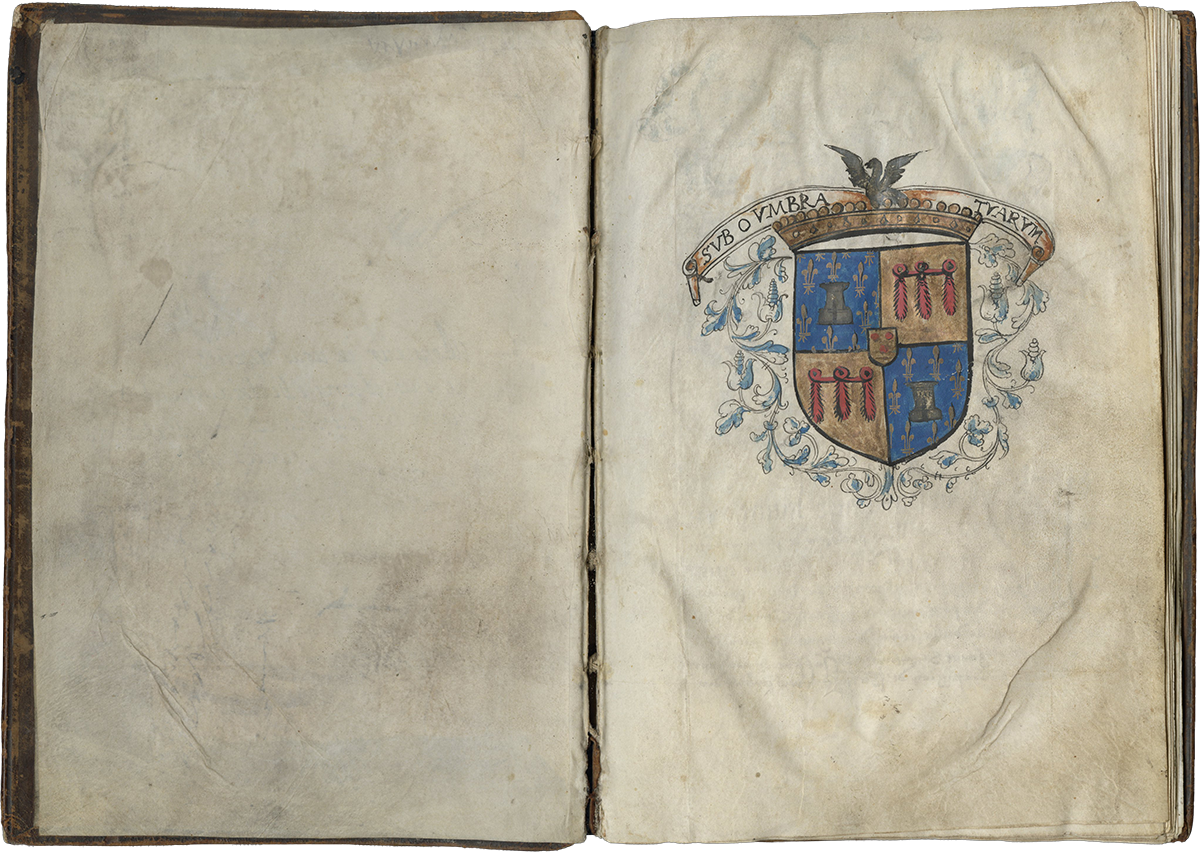
1. The manuscript is a copy of the original dedicatory version of the work composed by Bremond Domat in 1518 for John Stuart, Duke of Albany, and his wife, Anne de La Tour d’Auvergne (The Hague, Koninklijke Bibliotheek, MS 74 G 11). The present copy was probably produced at Mirefleurs in Auvergne, shortly after the completion of the original in 1518, and likely by an assistant rather than by Domat himself (see below). The text of the genealogy ends on f. 26v recording the marriage of Anne’s sister Madeleine de La Tour to Lorenzo II de’ Medici, “Et magdalene sa seur fut mariee au duc d'urbin & Lombardie nepveu du pape.” The marriage took place in 1518, and the text makes no reference to their deaths in 1519, nor to the birth of Catherine de’ Medici shortly before, suggesting that the manuscript was made in 1518, like the Hague manuscript, unless it represents a word-for-word copy made at a later date. The present manuscript opens with the arms of Anne de La Tour d’Auvergne (1496-1524), Countess of Auvergne, who inherited the title from her father Jean IV de La Tour d’Auvergne, and who married John Stuart (1482-1536), Duke of Albany, in 1505. The principal text, an armorial genealogy (ff. 7v-27), culminates in the Hague manuscript with the impaled arms of John Stuart and Anne de La Tour. In the present manuscript, these are followed by the arms of Gilbert de Chabannes (1439-1492), seigneur de Curton, and Françoise de Boulogne (1445-1484), who married in 1469 (f. 27). Françoise de Boulogne and de La Tour d’Auvergne was the aunt of both Anne de La Tour and John Stuart, but the couple left no direct descendants (Gilbert’s children were the issue of his second marriage to Catherine de Bourbon-Vendôme (1462-1524)). The presence of their arms therefore does not appear to refer to a direct recipient of the manuscript. It is possible that the manuscript was intended for Anne de La Tour’s personal use, paralleling the Hague manuscript, which was produced for John Stuart’s own use. However, at the present stage, there is insufficient evidence to identify the manuscript’s original owner.
2. Catalogue of the Parisian bookseller Thomas-Scheler (19 rue de Tournon), Précurseurs et inventeurs. Livres et autographes scientifiques et médicaux, nouvelle série, no. 1, 1957, lot 2575 (Schoenberg Database of Manuscripts).
3. Private collection in the United States built up in the 1950-1960s; then by descent to Switzerland, private collection.
Text
f. 1, the coat of arms of Anne de La Tour d’Auvergne with the motto “SUB O (sic) UMBRA TUARUM,” otherwise blank;
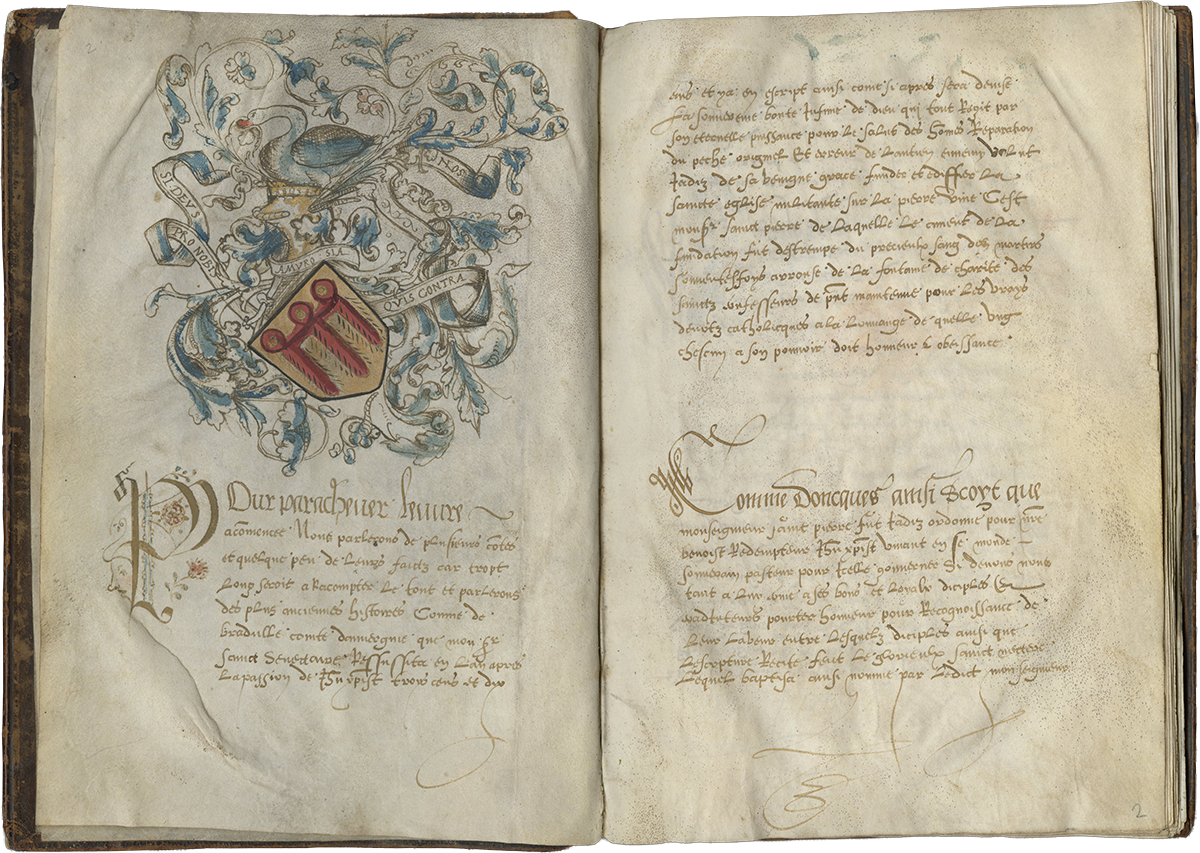
ff. 1v-7, an introductory narrative, the legend of Saint Nectaire, and genealogies tracing Anne’s lineage from Arthurian and regional ancestors to her mother, Jeanne de Boulogne, incipit, “Pour parachever l’ouvre acommancee, nous parlerons de plusieurs comtes et quelque peu de leurs faictz, car tropt long seroit a raconter le tout...”;
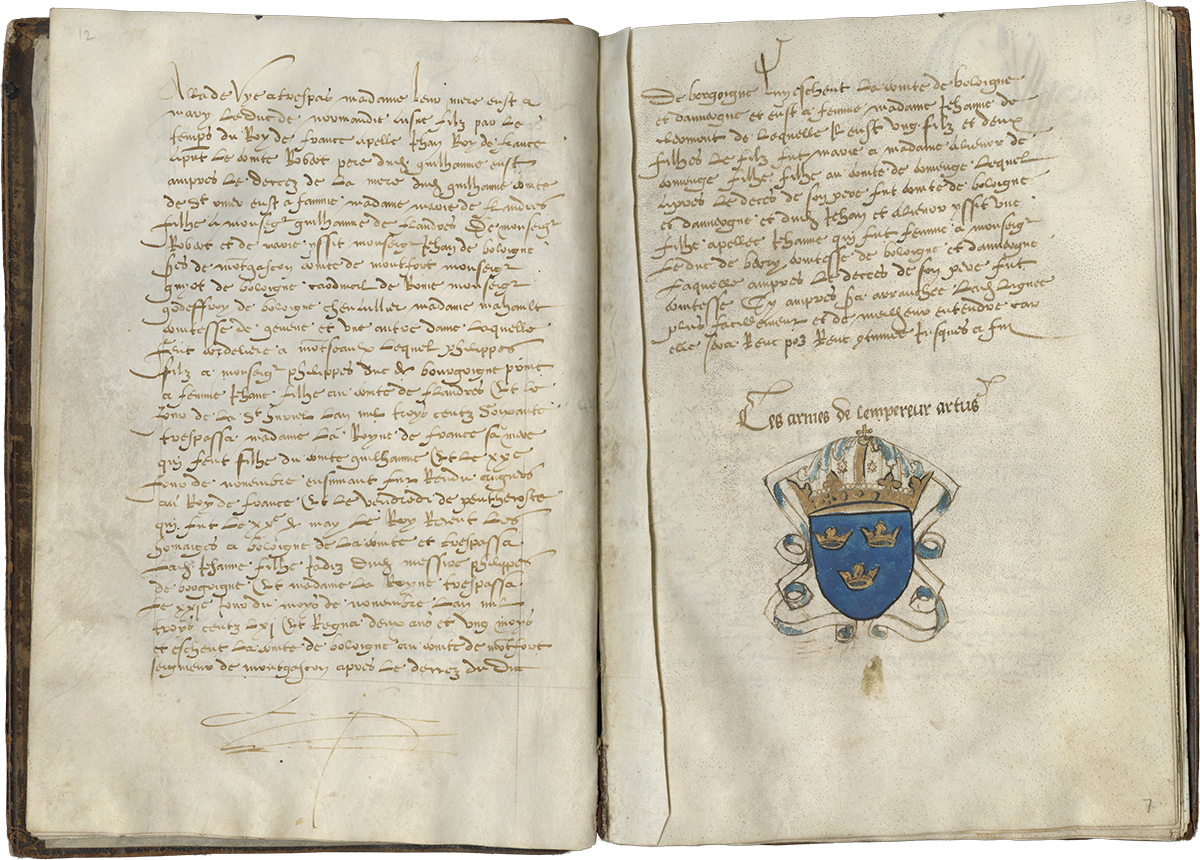
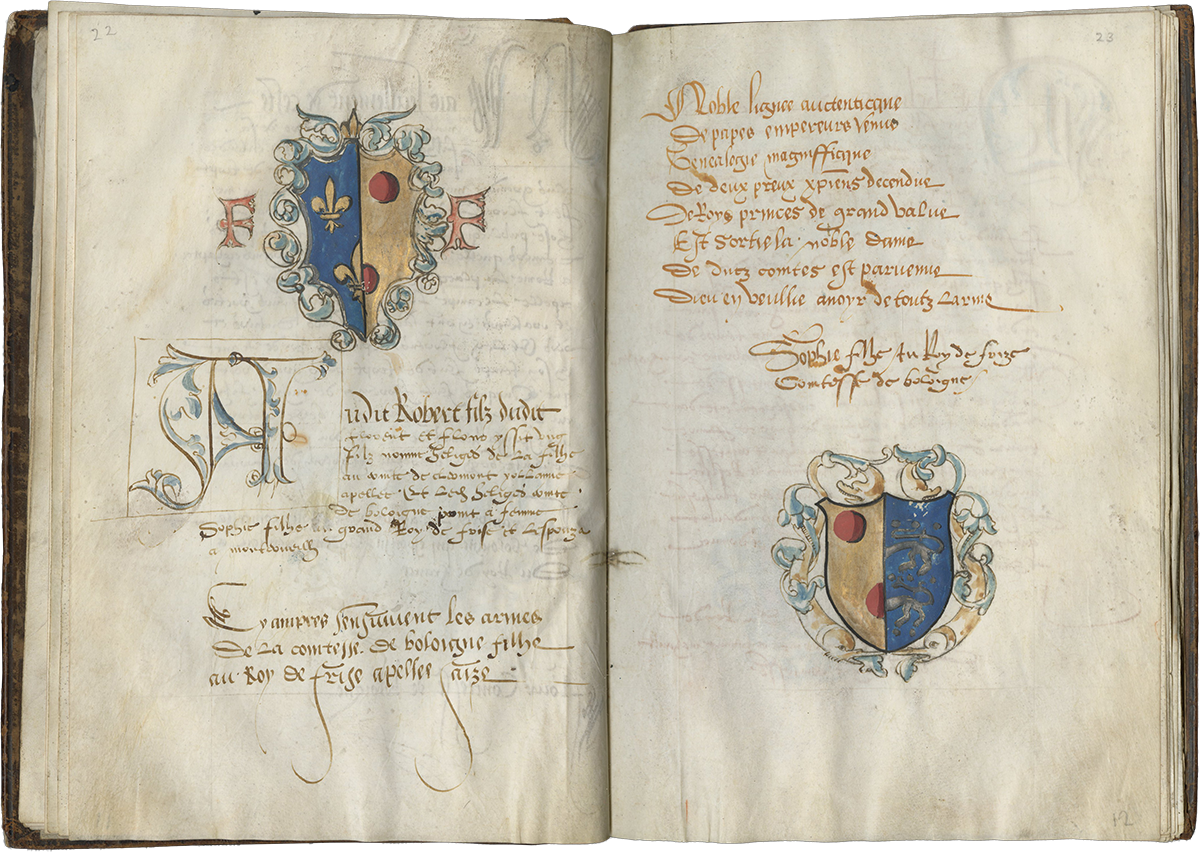
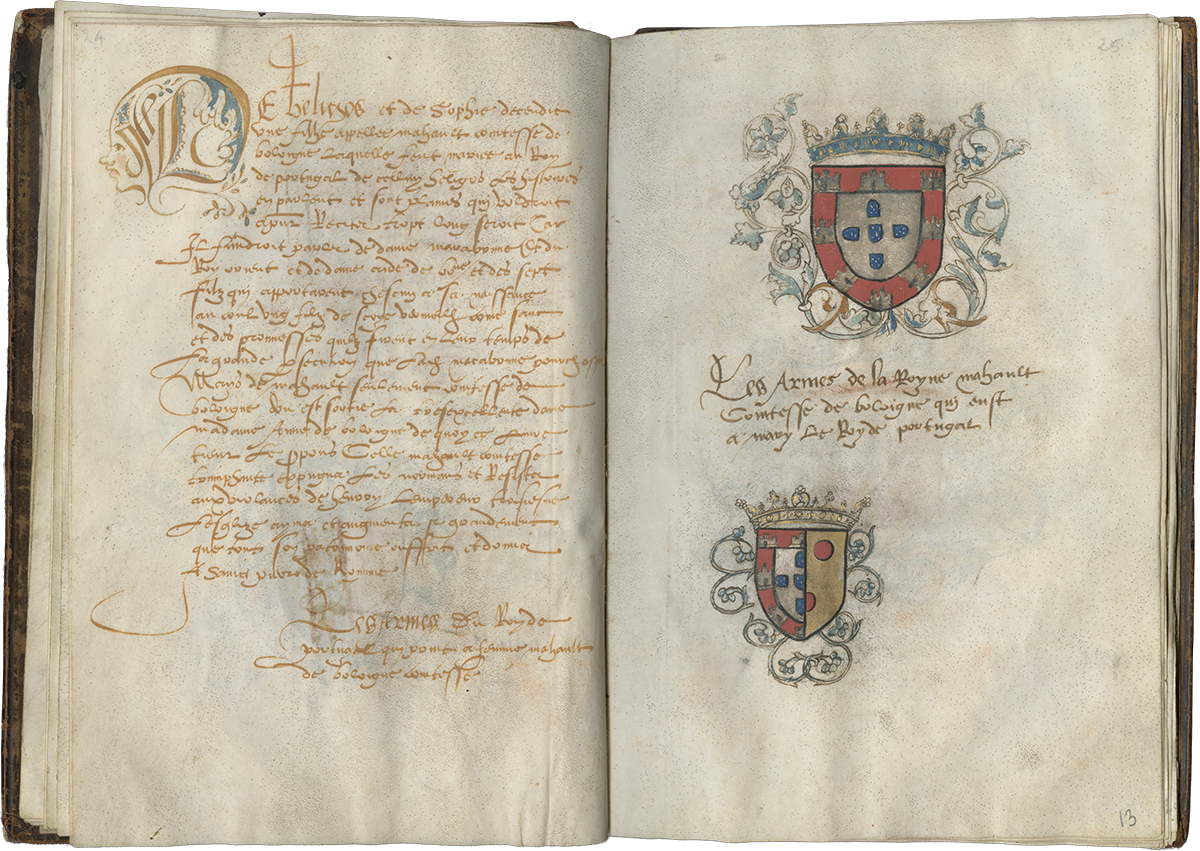
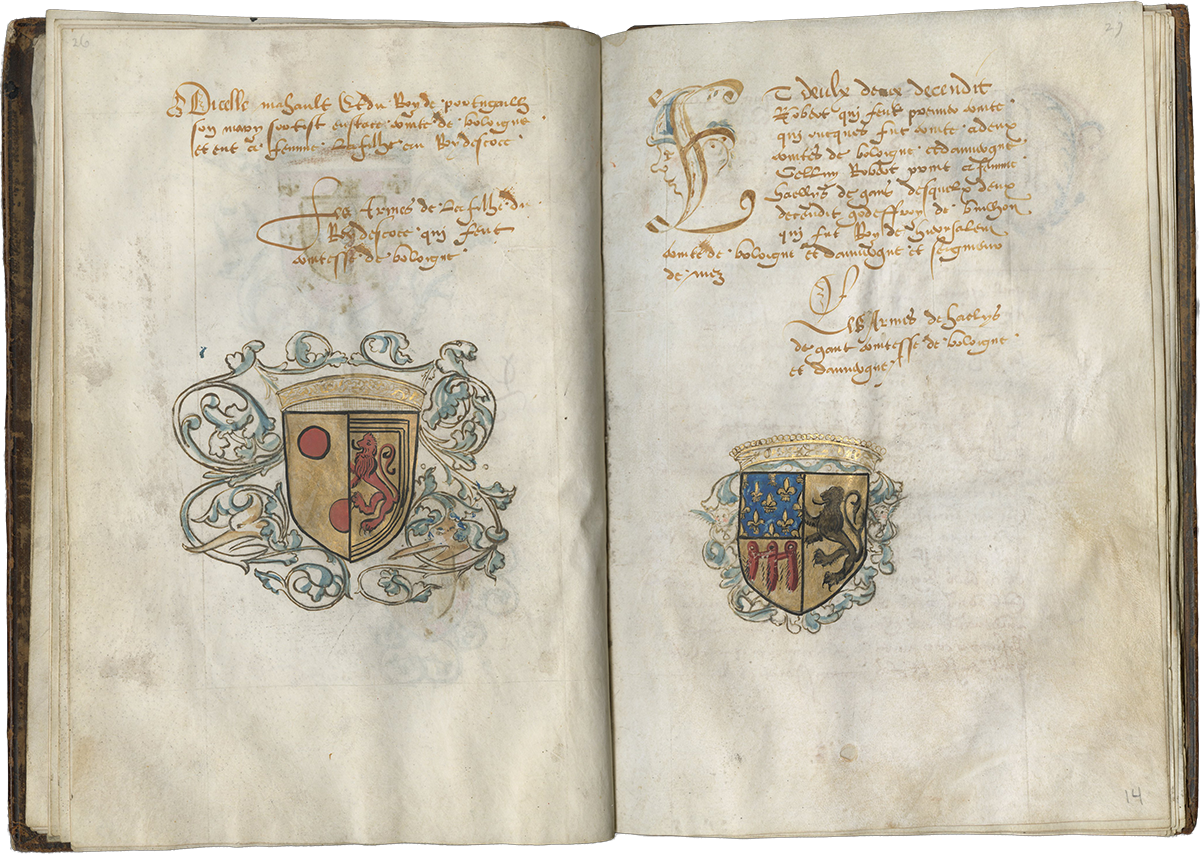
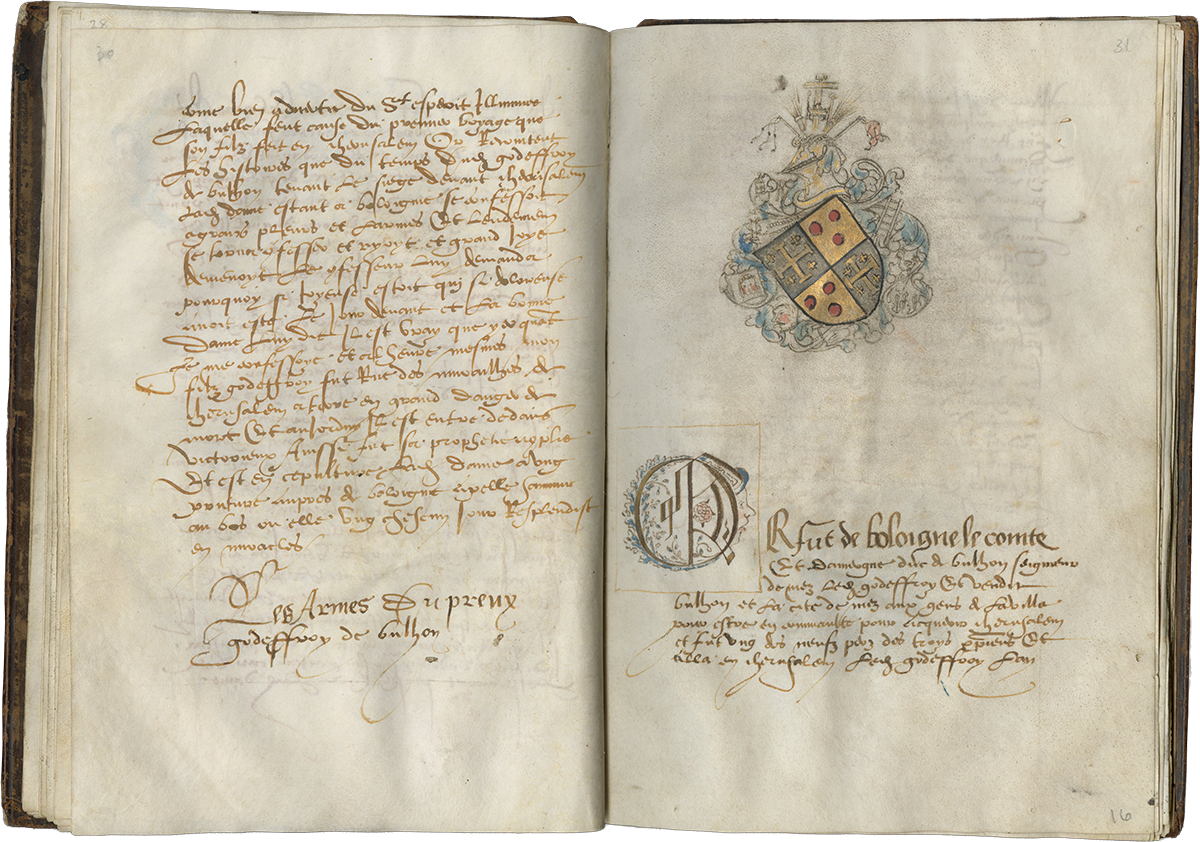
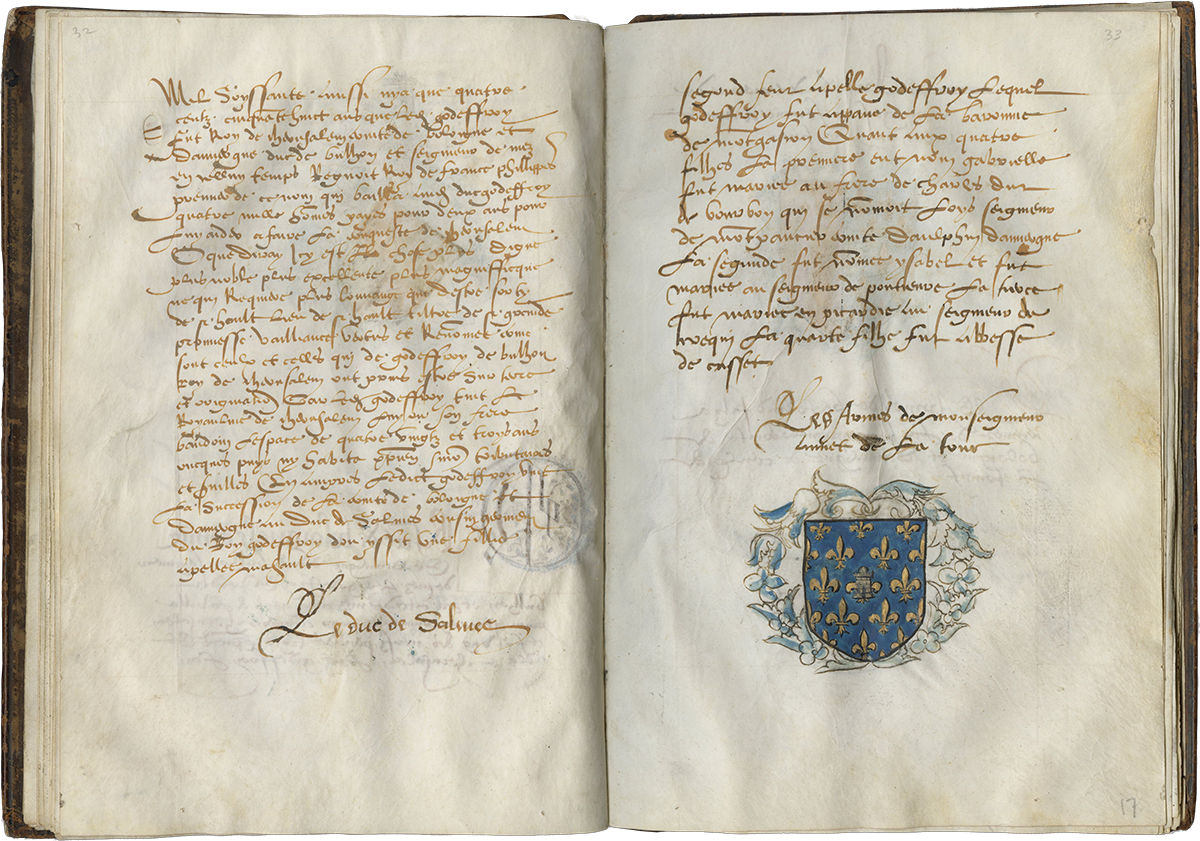
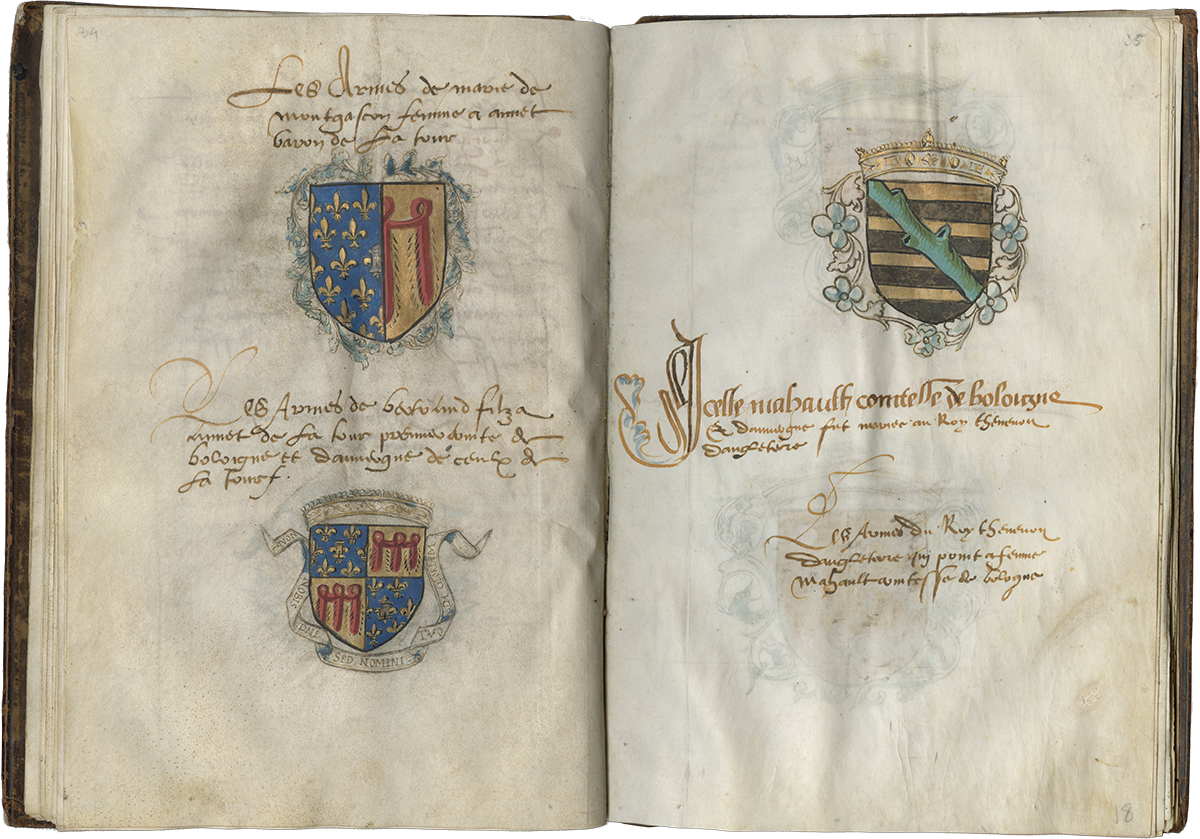
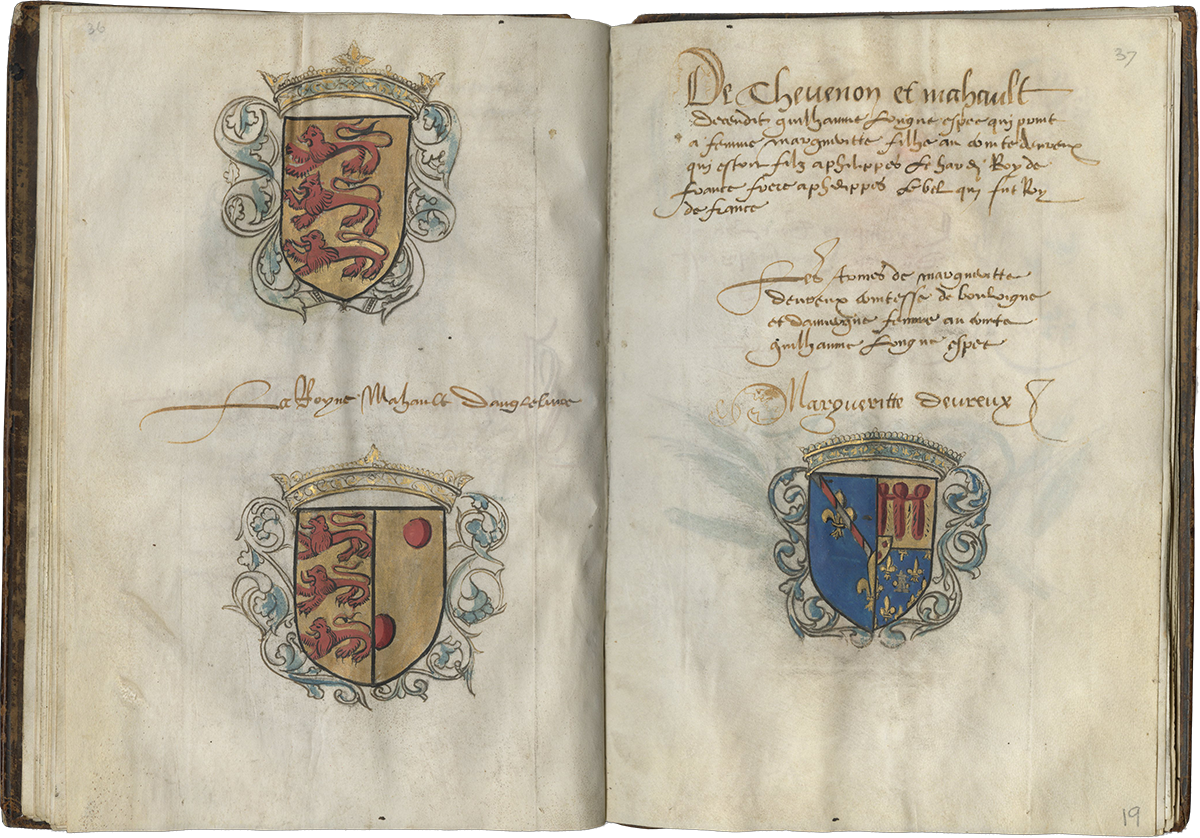
ff. 7-27, armorial genealogy tracing Anne’s lineage from King Arthur to the marriages of John Stuart and Anne de La Tour (1505), and of Anne’s sister Madeleine to Lorenzo II de’ Medici (1518), presenting thirty-two beautifully painted coats of arms. On the last page are painted the arms of John Stuart and Anne de La Tour, and the arms of Gilbert de Chabannes and Françoise de Boulogne (f. 27);
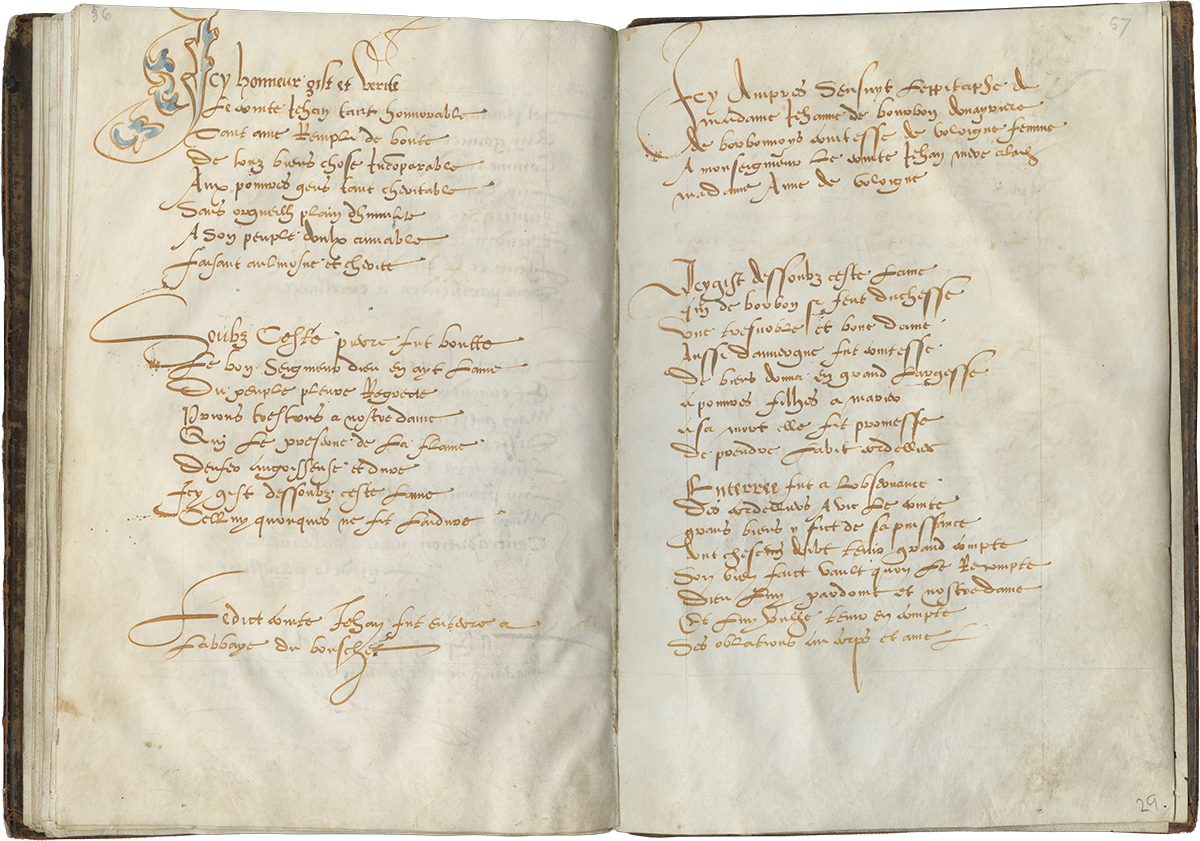
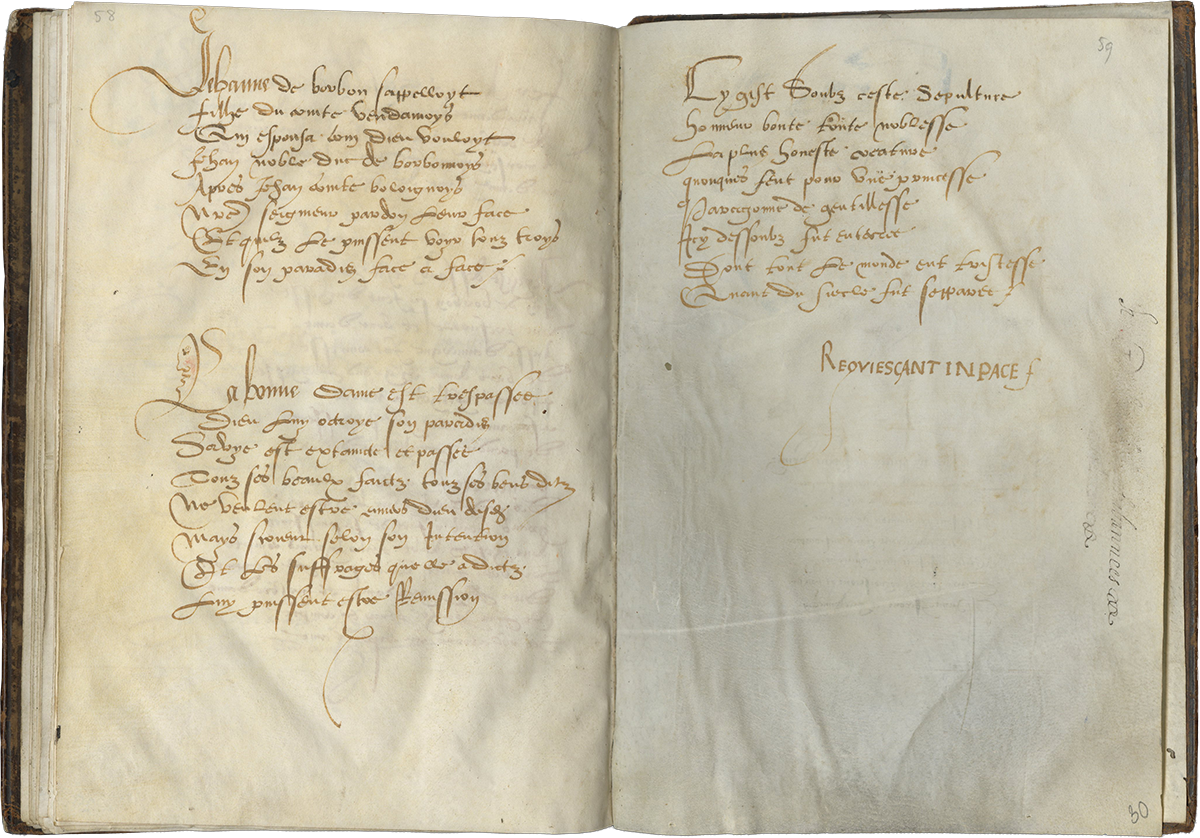
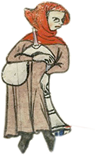
ff. 27v-30v, three poems and the epitaphs of Anne’s parents, beginning with a huitain recounting a prophecy at the birth of John Stuart (f. 27v): “An mil quatre cens quatre-vingt et deux en Ju(i)llet/ Le huictiesme/ nasquit sur terre/ Albanye enfant Joliet/ Lequel Ira par mer conquerre/ Escoce aussi angleterre/ Et les metra en subjection/ Par force d’armes et de guerre/ Il en prendra pocession.” This poem is followed by a three-stanza poem on the influence of the planets on Albany’s life, beginning “Venus planete principalle / Gourvernant sa nativite / Luy promet puissance papalle ....” (ff. 27v-28), and the epitaphs of Anne’s parents, John de La Tour d’Auvergne and Jeanne de Bourbon, Countess of Boulogne, who died in 1512 (ff. 28v-30); f. 30v, a drawing of a fool accompanying a huitain on the good governance of princes, “Que font Ilz qu’ilz ne soient venuz...”
Illustration
36, 6-8-line tinted strapwork initials, a large pen-and-ink drawing of a fool (f. 30v) and thirty-three painted coats of arms
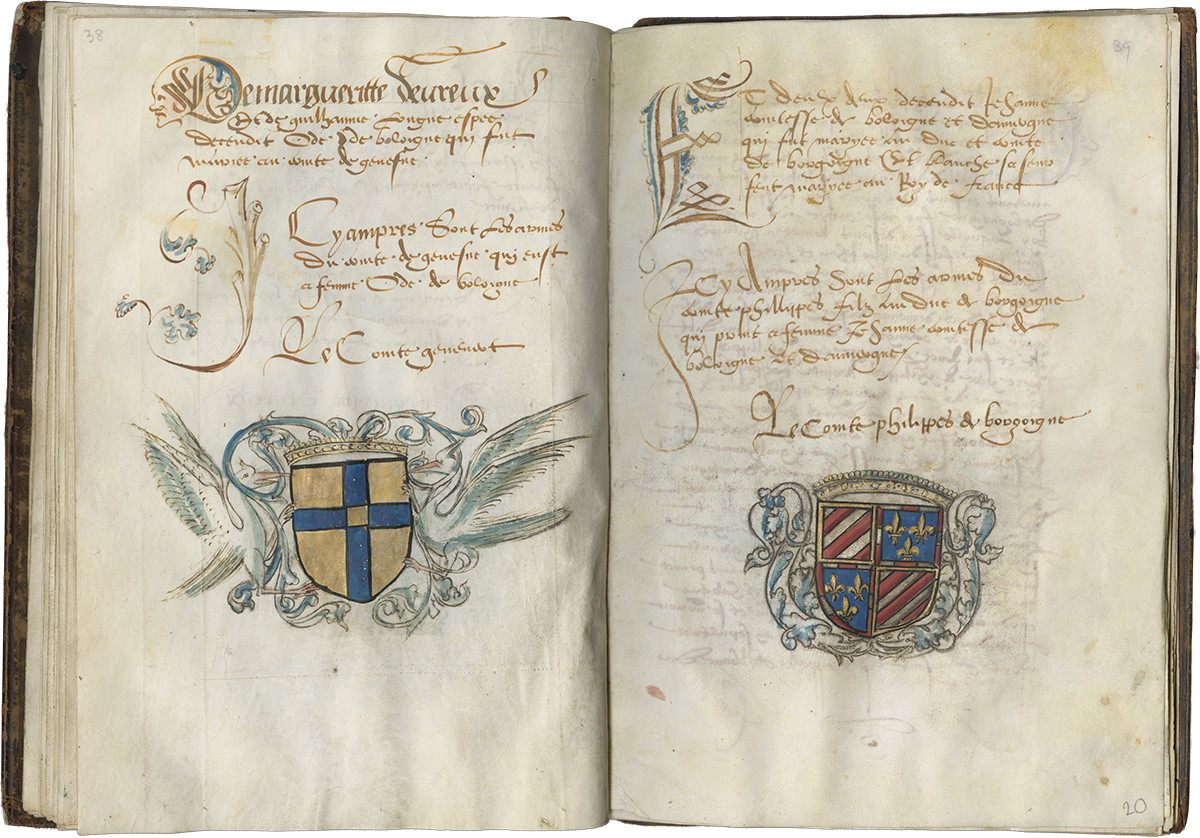
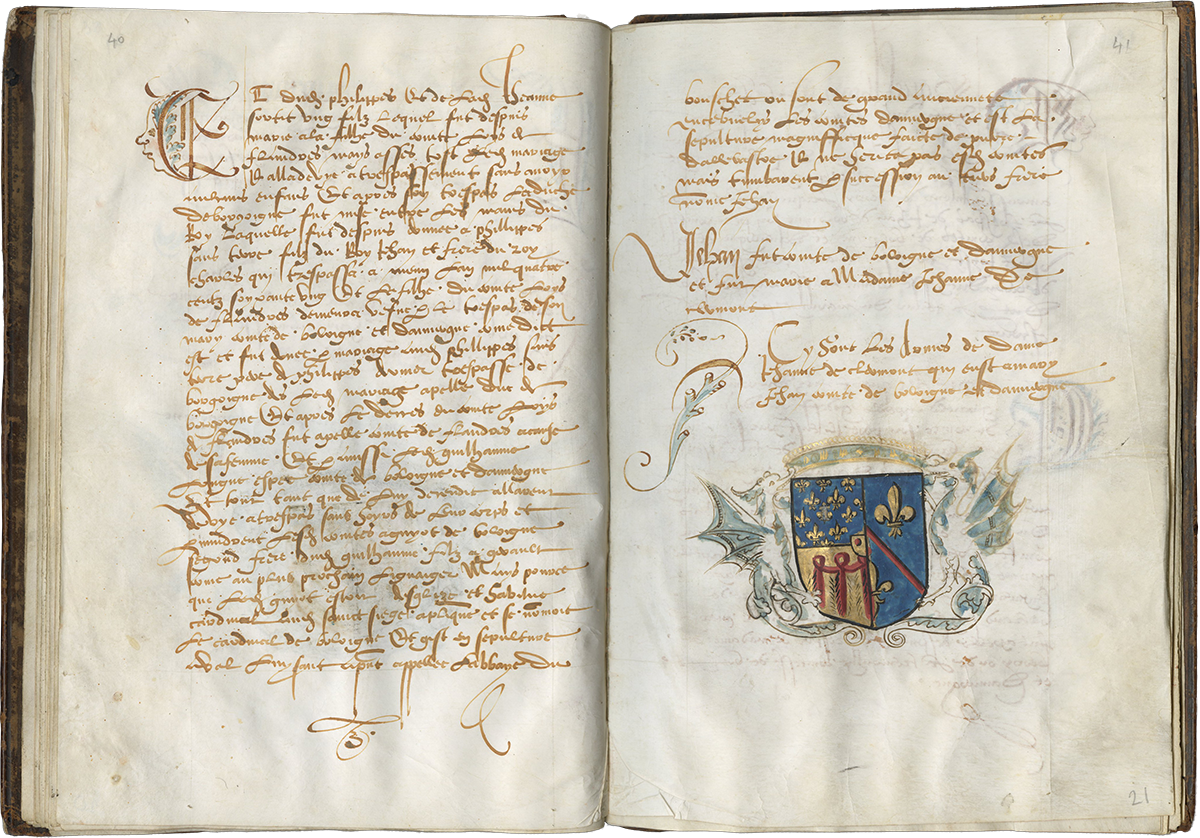
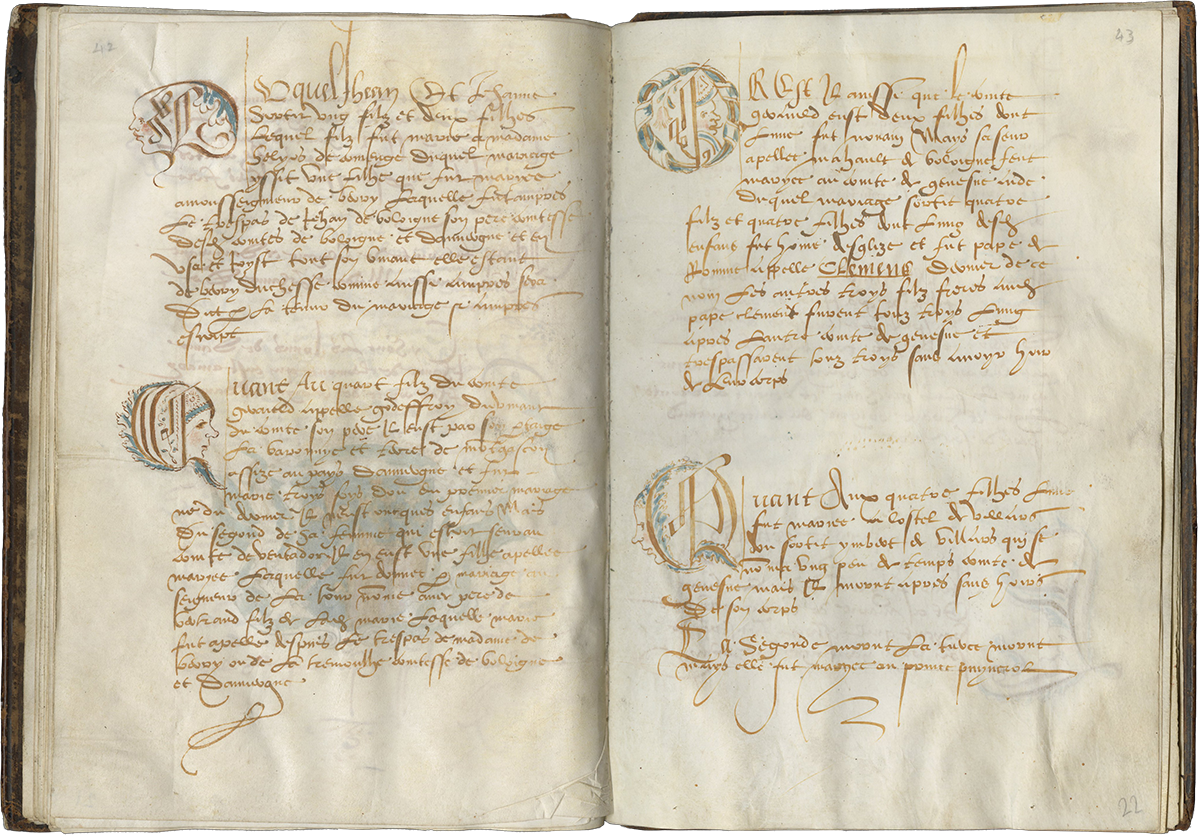
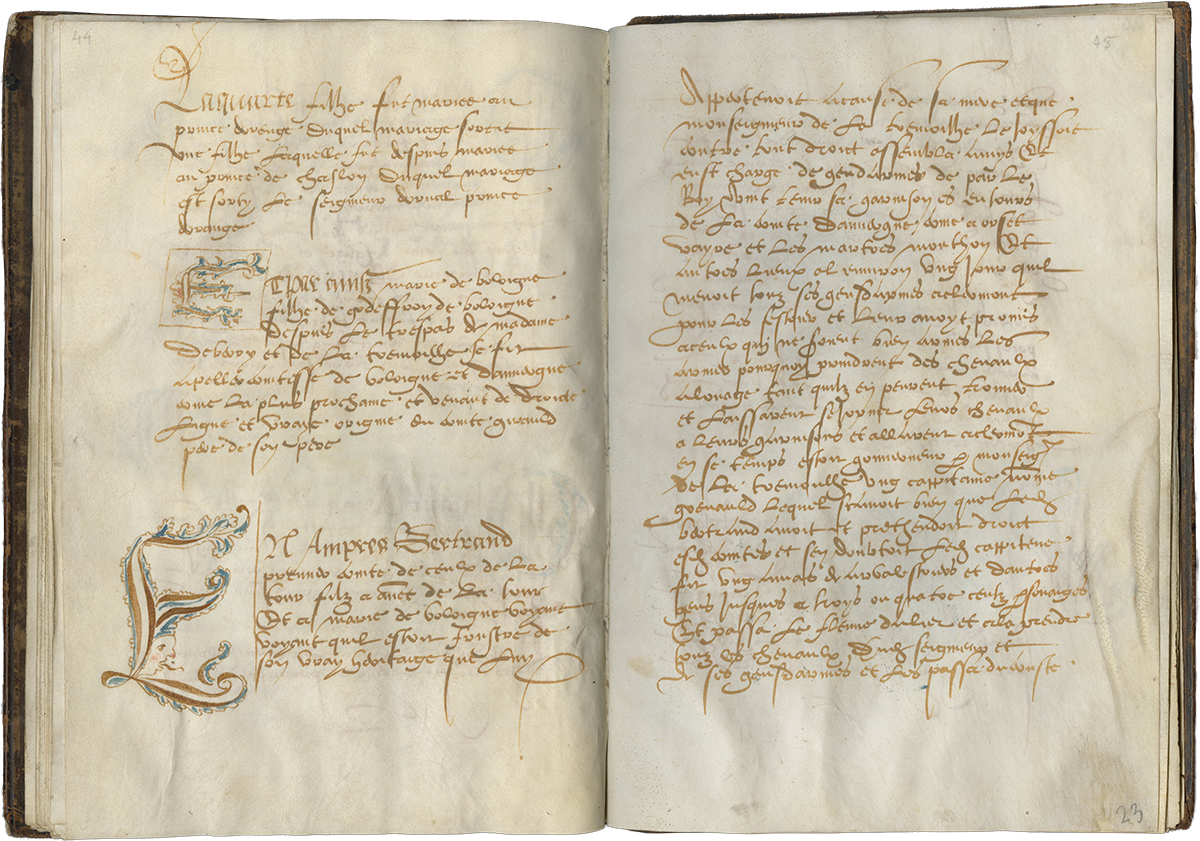
The visual program of the manuscript is dominated by heraldry, complemented by a single nearly full-page drawing of a fool on the final page. Together, these elements frame genealogy not merely as lineage, but as a moral and political argument. The thirty-three painted coats of arms form the manuscript’s primary mode of illustration. Executed in full color and gold and enclosed within pen-drawn garlands of flowers, foliage, and symbolic objects, the arms function as visual anchors within the armorial genealogy. Their cumulative effect is to transform abstract descent into an immediately legible and authoritative sequence of noble alliances. Rather than serving decorative ends alone, therefore, the heraldry structures the text itself: lineage is apprehended visually before it is read. Particular emphasis is placed on unions that support the political claims of John Stuart, Duke of Albany, by asserting ancient ties between the houses of Boulogne, Scotland, and France, culminating in marriages of contemporary political importance. The prominence and careful execution of the arms underscore the manuscript’s role as a vehicle of dynastic propaganda.
The drawing of a fool on f. 30v, accompanying a huitain on princely governance, introduces a striking shift in tone. In late medieval and early sixteenth-century court culture, a fool often functioned as a paradoxical moral figure: outwardly marginal yet licensed to speak truths about power, justice, and folly. Here, the fool’s presence at the conclusion of the manuscript serves as a visual and ethical counterpoint to the preceding celebration of lineage and noble legitimacy. His association with a poem on the responsibilities of rulers suggests a didactic purpose, reminding the reader that hereditary right must be tempered by wise governance. Within a manuscript otherwise devoted to the assertation of dynastic authority, the fool introduces an element of moral reflection, reinforcing the idea that noble blood alone does not guarantee just rule. Taken together, the heraldic imagery and the fool articulate a balanced political message: lineage confers legitimacy, but good governance remains essential. The illustration program thus supports the manuscript’s broader ideological aims through both affirmation and gentle admonition.
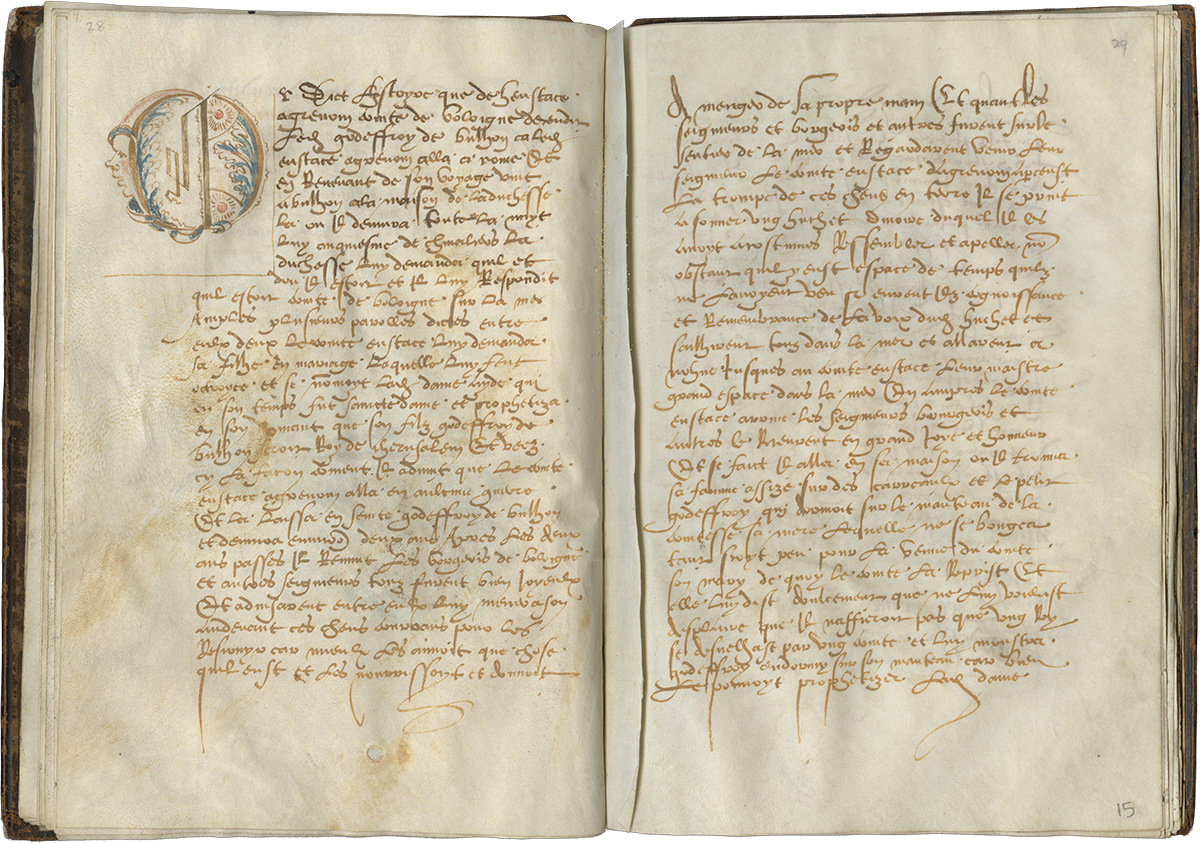
Bryony Coombs has convincingly argued that the Généalogie was authored, copied and illustrated by Bremond Domat, a poet-artist employed by John Stuart for over a decade in his hometown Mirefleurs in Auvergne (Coombs, 2015). The poems and illustrations in the present manuscript are not signed by Domat, unlike those in the dedication copy. Indeed, the motto on f. 1 contains an error, and the illustrations are less refined. Therefore, this copy was likely produced by an assistant rather than by Domat himself, closely following the original. Though they are not as sumptuous as those in the copy Domat presented to John Stuart, nevertheless, the coats of arms are executed with care.
This manuscript adds a sixth witness to a group of five sixteenth-century manuscripts that derive from the original composition of the Généalogie d’Anne de la Tour d’Auvergne made by Bremond Domat for the couple John Stuart and Anne de la Tour in 1518 (KB 74 G 11). The group includes Paris, Bibliothèque nationale de France, MSS fr. 5227 and fr. 20209, Paris, Bibliothèque de l’Arsenal, MS 4264, and a later manuscript sold at Sotheby’s in 2012 (Coombs 2024, pp. 238-240). These copies were made as diplomatic gifts for the circle of the couple. The most sumptuous of them, BnF fr. 5227, was produced around 1530 for Pope Clement VII (great-uncle of Catherine de’ Medici). A finely painted copy on paper, BnF MS fr. 20209, was made for the influential la Guesle family of Auvergne. The later copies, Arsenal MS 4264 and the Sotheby’s manuscript, preserve only the château portraits (absent from the present manuscript) and poems from the original composition transmitted in the Hague exemplar. The latter also bears the arms of Catherine de’ Medici and was apparently bound for presentation to Marguerite de Valois (Sotheby’s, 2012).
This corpus is closely related to another genealogical manuscript, La genealogie des contes de Boulogne, connected to John Stuart’s role in the negotiations surrounding Catherine de’ Medici’s marriage. This work is found among others in BnF MSS fr. 4653 and fr. 20209 (also containing the Généalogie d’Anne de la Tour d’Auvergne), and Aix-en-Provence, Bibliothèque municipale, MS 638, the latter a fine presentation copy made for Catherine de’ Medici (Coombs 2024, pp. 240-241). Moreover, in 1519, Domat also prepared a French translation of the Liber Pluscardensis, including a genealogy of the kings of Scotland (Paris, Bibliothèque de Sainte-Geneviève, MS 936, see Online Resources).
Stuart employed the genealogical manuscripts to emphasize, as Bryony Coombs has convincingly argued, “the importance of a union between a descendant of the kings of Scotland and of the Capetian kings of France” (Coombs, 2018, p. 194). John Stuart, Duke of Albany, was born in Auvergne, the son of Alexander Stuart, exiled brother of James III of Scotland. After James IV’s death at Flodden in 1513, John became heir presumptive to the Scottish throne and was proclaimed Regent in 1514 following Margaret Tudor’s remarriage. The year 1518 marked a major elevation in John’s standing when his sister-in-law Madeleine de La Tour married Lorenzo II de’ Medici, aligning him with the Medici family and indirectly with Pope Leo X. After the deaths of Madeleine and Lorenzo in 1519, their daughter Catherine de’ Medici became a major heiress, with John appointed as her guardian and tutor following Leo X’s death in 1521.
Anne de la Tour d’Auvergne married into the political and dynastic world in which genealogical self-fashioning was not merely desirable but necessary. Her husband’s persona was shaped by an unusually international upbringing: Scottish by blood, French by birth and culture, and connected by marriage and diplomacy to England, Italy, and the Habsburg Empire. Anne’s marriage to him in 1505 consolidated the duke’s position within the French aristocracy and invested him the titles of Comte de Boulogne, de la Marche, and d’Auvergne – titles that derived directly from Anne’s lineage.
Stuart’s political instability in Scotland contrasts with the solidity of Anne’s hereditary claims in France. While the duke struggled as regent of Scotland after the death of James IV (caught between Queen Margaret, the Scottish nobility, and the competing interests of France and England), Anne embodied continuity, legitimacy, and territorial inheritance within France. Her genealogical importance could be asserted visually and textually as the structural foundation of John Stuart’s French status, reinforcing his titles and political identity, an impulse behind the genealogical project that is the Généalogie d’Anne de la Tour d’Auvergne.
Literature
Bentley-Cranch, D. and R. K. Marshall. “John Stewart, Duke of Albany, Lord Governor of Scotland, and his Political Role in 16th-century France: a Reassessment in the Light of New Information,” Proceedings of the Society of Antiquaries of Scotland 133 (2003), pp. 293–313. Available online:
https://journals.socantscot.org/index.php/psas/article/view/9585
Coombs, Bryony. Visual Arts and the Auld Alliance, Edinburgh, 2024.
Coombs. Bryony. “John Stuart, Duke of Albany and His Distribution to Military Science in Scotland and Italy, 1514-36: from Dunbar to Rome,” Proceedings of the Society of Antiquaries of Scotland 148 (2019), pp. 231-266. Available online:
https://journals.socantscot.org/index.php/psas/article/view/10264
Coombs, Bryony. “The Artistic Patronage of John Stuart, Duke of Albany, 1520-30: Vic-le-Comte, the last Sainte-Chapelle,” Proceedings of the Society of Antiquaries of Scotland 147 (2018), pp. 175-217. Available online:
https://journals.socantscot.org/index.php/psas/article/view/10110
Coombs, Bryony. “The Artistic patronage of John Stuart, Duke of Albany 1518-19: the ‘Discovery’ of the Artist and Author, Bremond Domat,” Proceedings of the Society of Antiquaries of Scotland 144 (2015), pp. 277-309. Available online:
https://journals.socantscot.org/index.php/psas/article/view/9818
The Hague, Koninklijke Bibliotheek, MS 74 G 11
Korteweg, Anne S. Splendour, Gravity & Emotion: French medieval manuscripts in Dutch collections, The Hague, 2002.
Schoysman, A. “Jean Lemaire de Belges et la Généalogie d’Anne de La Tour d’Auvergne dans le ms. 74 G 11 de La Haye (1518),” Le Moyen Français 57–58 (2006), pp. 315–333.
Online Resources
Généalogie fabuleuse d’Anne de la Tour
Paris, Bibliothèque nationale de France, MS fr. 5227: https://archivesetmanuscrits.bnf.fr/ark:/12148/cc582170?collect
----. MS fr. 20209:
https://archivesetmanuscrits.bnf.fr/ark:/12148/cc51770f?collect
Paris, Bibliothèque de Sainte-Geneviève, MS 936 https://arca.irht.cnrs.fr/ark:/63955/md49t148hq83
de Hondt, Peter Abraham. Bibliothecae Petauiana et Mansartiana...aux quelles on a ajoute le Cabinet considerable des Manuscripts du fameux Justus Lipsius, 23 February, 1722, lot 85. https://archive.org/details/bibliothecaepetavianaetmansa/page/422/mode/2up?q=genealogie
Notice de “Généalogie d'Anne de la Tour d'Auvergne, Jean Lemaire de Belges” dans la base Jonas-IRHT/CNRS:
http://jonas.irht.cnrs.fr/oeuvre/21400
Sotheby’s, London, From the Collection of Prince and Princess Henry De la Tour d’Auvergne Mauraguais, 3 May 2012, lot 311. https://www.sothebys.com/en/auctions/ecatalogue/2012/from-the-collection-of-prince-and-princess-henry-de-la-tour-dauvergne-lauraguais/lot.311.html