


LEONARDO BRUNI, De bello Italico adversus Gothos, libri IV
In Latin, manuscript on paper
Italy, c. 1450-1475
TM 1381
- $32,000.00
 Textmanuscripts - Les Enluminures
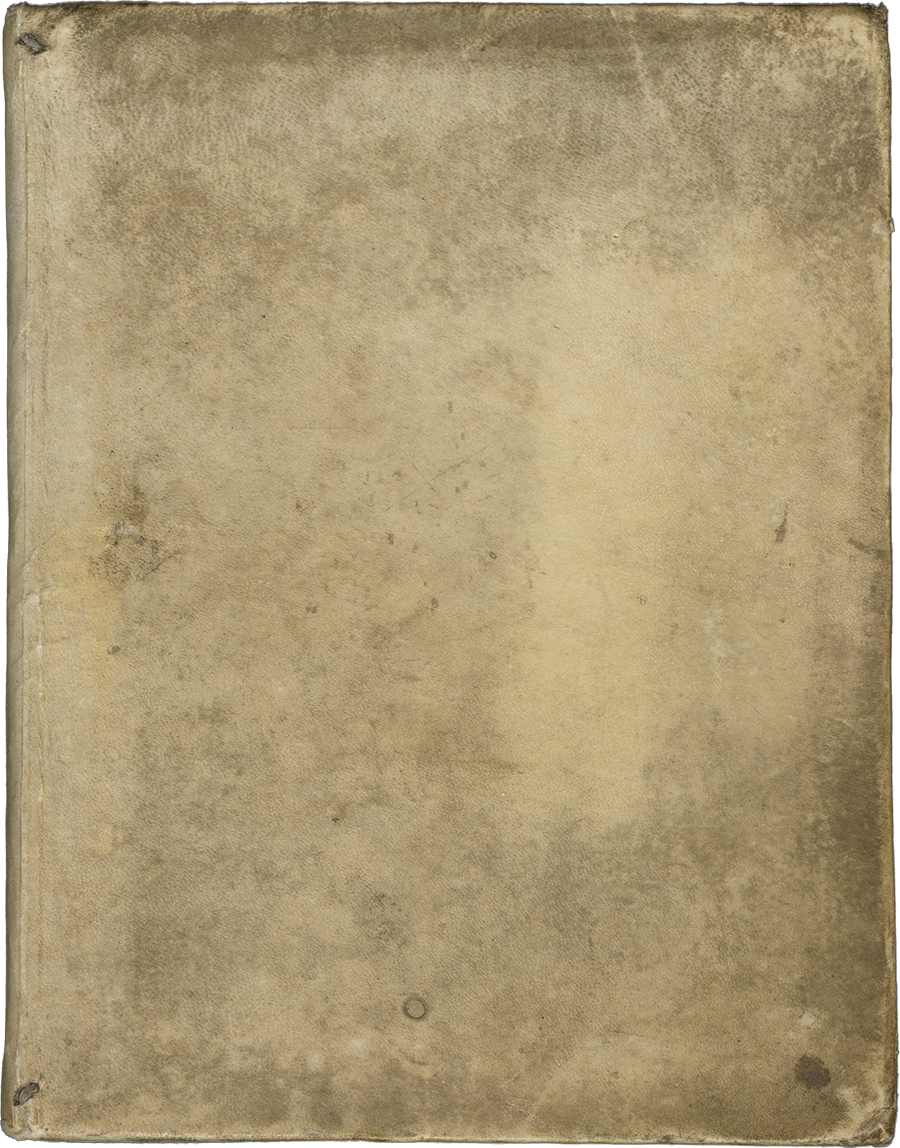
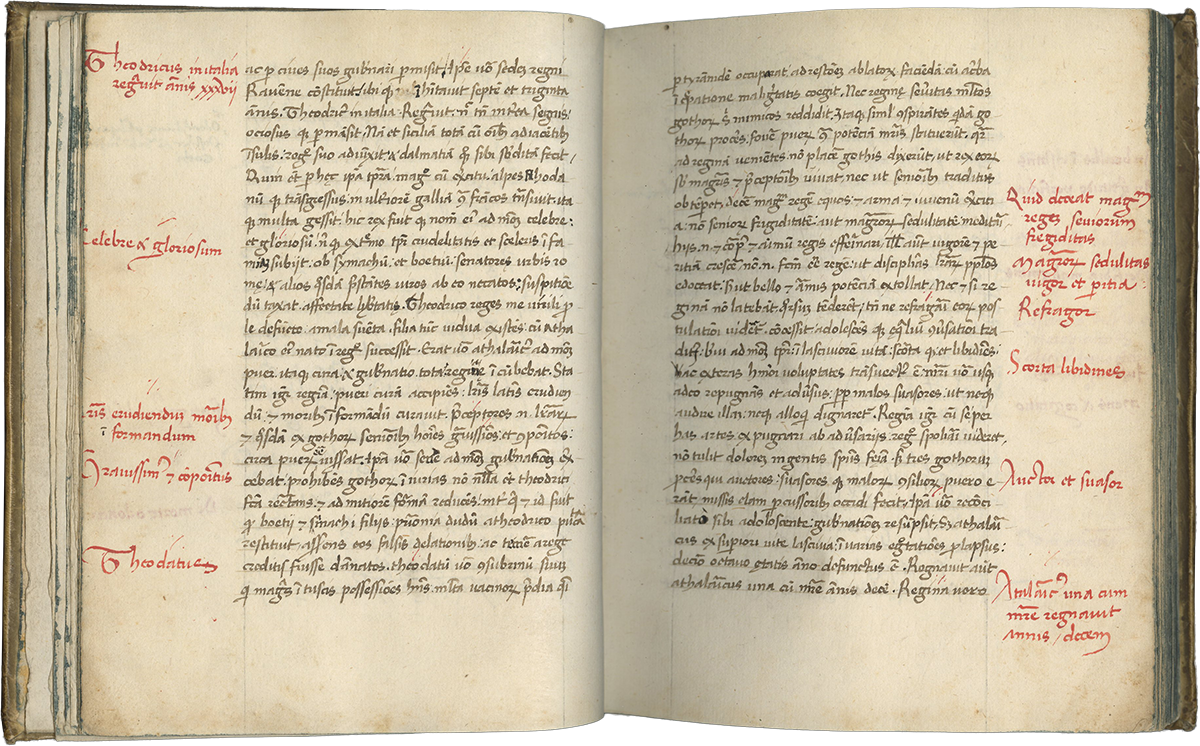
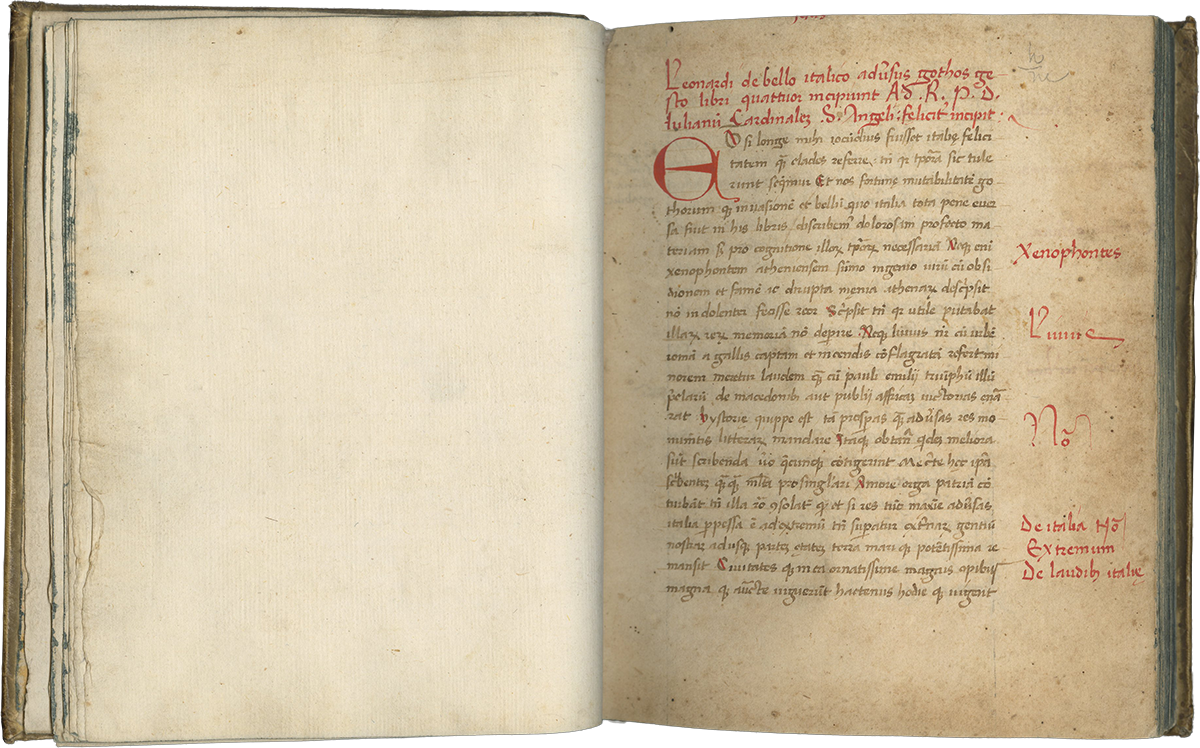
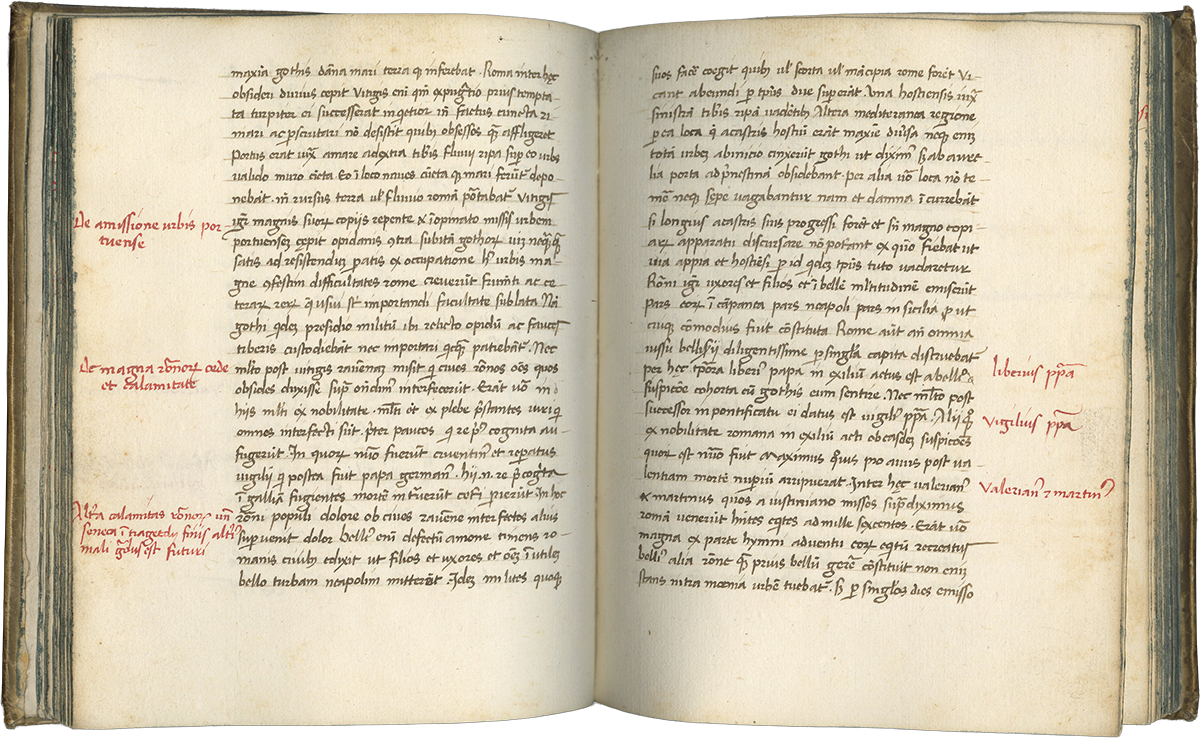
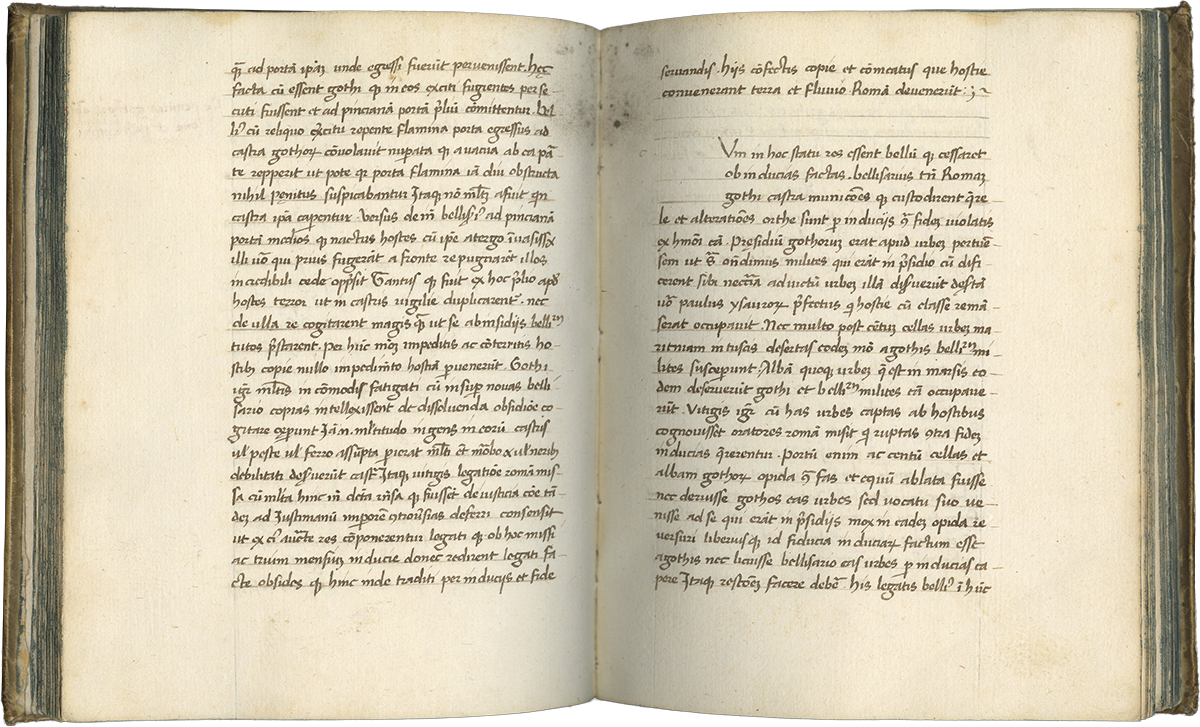
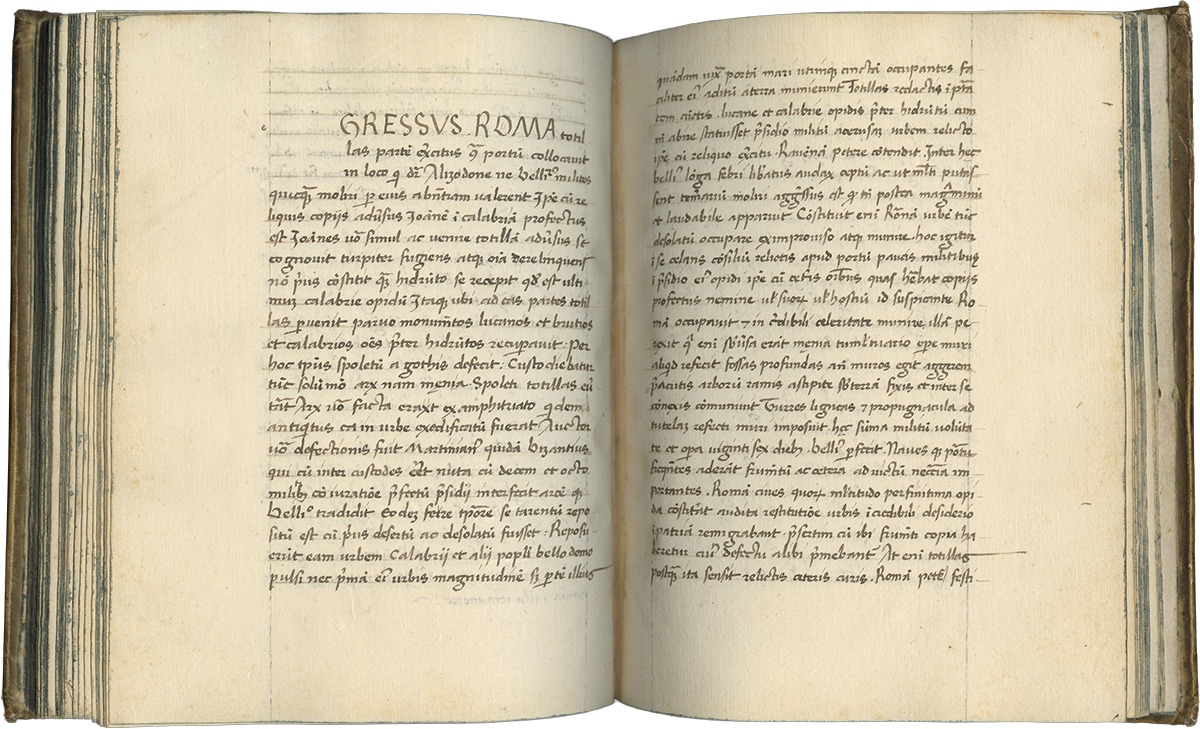
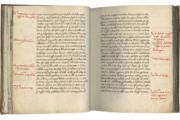
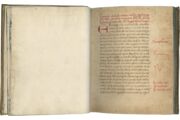
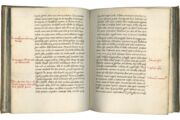
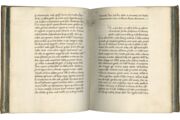
viii + 82 + ii paper leaves, watermarks not fully visualizable given density of script, complete, (collation: i10 ii-vii12), catchwords, ruled in single column, leadpoint, 25 lines per page, (justification c.140 × 85 mm), written in a fast humanistic script with incipits in majuscules, the first rubric in red, blank spaces for others, side-notes in red as far as f. 24, sometimes slightly cropped, apparently left unfinished by the original scribe and so ff. 79–82 provided by a second scribe in the sixteenth or seventeenth century, spaces for initials, one three-line red initial, f.1. Bound in undecorated modern vellum over pasteboards, marbled endpapers, the spine blank and with no raised bands. Dimensions c. 187 x 145 mm.
A good, clean copy of Bruni’s controversial translation project on the ancient wars between the Italians and the Goths. The extensive contemporary glosses in red ink in an excellent humanist hand in the margins of the manuscript are what distinguishes this copy and merit further study on the use and understanding of Bruni’s translation project. Brought to England by the celebrated dealer-collector Abbé Luigi Celotti, this manuscript is also distinguished by its earlier Italian provenance.
1. Possibly at some point owned by the Maffei family of Verona, as Verona is noted in the margins three times by a later reader (ff. 46 and 78), and the Veronese books in Celotti’s sale (see 2 below) were from the Maffei collection.
2. Abbé Luigi Celotti (1759–1843), a Venetian manuscript and art dealer, his sale at Sotheby’s, 1825, lot 41, with a clipping from the catalogue stuck to f. i verso (Schoenberg Database of Manuscripts SDBM 44861, see also Literature and Online Resources below).
3. John Cochran, A Catalogue of Manuscripts in Different Languages [...] of Various Dates, from the Twelfth to the Eighteenth Century [...] (London, 1829), no. 155 (SDBM 13977).
4. William van Mildert (1765–1836), Bishop of Durham, sold by his executors at Evans’s, London, 21–27 July 1838, as recorded by inscription on f. ii, “Bought at Sale of MSS by order of the Executors of the Bishop of Durham (Evans, 93 Pal Mall) 26 July 1838.”
5. “Mrs Watts,” inscribed on the verso of the last flyleaf.
6. Brief typescript description in Swedish loose inside front cover.
ff. 1-82, Leonardo Bruni, De bello Italico adversus Gothos, libri IV, incipit, “Leonardi de bello italico adversus gothos gesto libri quattuor incipiunt Ad .R.P.D. Iuliani Cardinalem .S. Angeli: feliciter incipit”...Finisque fuit anni decimioctavi huius belli.”
Leonardo Bruni (1370-1444) was the leading civic humanist of the Italian Renaissance. He served as the apostolic secretary to four Popes (1405-1414), and as the Chancellor of Florence from 1427-44. Famous in his lifetime as a translator, orator, and historian, his works survive in numerous manuscripts and early printed editions, attesting to his popularity during the fifteenth century. Born in a poor family in Arezzo, he arrived in Florence in the early 1390s and became one of Coluccio Salutati’s followers, devoting himself to the study of classical history and literature. The breadth of subjects on which he wrote was wide; his history of the Florentine people led to him to become known as “the first modern historian” and “the father of historical criticism.” He studied Greek with the Byzantine exile, Manuel Chrysoloras, and many of his works are translations from Greek into Latin.
Bruni’s De bello italico concerns the ancient struggle for possession of Italy between the Romans and the Goths. Infamously, the work, and especially Book IV, stirred up an intellectual property battle in mid-fifteenth-century Italy that sounds quite modern. Bruni circulated the work as his own. However, scholars soon recognized that, rather than a heavily edited translation of multiple Greek works, Bruni had instead translated quite directly from a single work: Procopius’ Greek De bello gothico. In short, the great Leonardo Bruni had plagiarized. While recognizing the value of such a translation, his contemporaries generally ceased to identify the work as Bruni’s own (Ianziti, 2012, 283). This incident does not seem to have diminished the circulation of Bruni’s works, or even that of the troublesome Book IV. The Repertorium Bruniam lists 139 copies of Book IV alone that remain extant today, attesting to substantial circulation in manuscript. The first printed edition of the entire De bello italico appeared (using Procopius’ title) in 1470, with more following in 1471, 1485, and after 1500 (see Literature and Online Resources). Hundreds of years later, Abbé Celotti was central to teaching the English to collect medieval Italian manuscripts and art, and he sold this copy there. Yet, evidence of this enduring popularity remains vanishingly rare in North America, where a census of Bruni works found only one copy of this book in North American collections, and the work continues to lack a modern edition (see Literature).
Bruni, Leonardo. De bello Italico adversus Gothos, Aquila, c.1485. ISTC ib01235200.
Eze, Anne-Marie. “Abbé Luigi Celotti (1759–1843): Connoisseur, Dealer, and Collector of Illuminated Miniatures,” Unpublished Doctoral Dissertation, Courtauld Institute of Art, University of London, 2010.
Hankins, James. Repertorium Bruniam: A Critical Guide to the Writings of Leonardo Bruni, Rome, 1997.
Ianziti, Gary. Writing History in Renaissance Italy: Leonardo Bruni and the Uses of the Past. Cambridge, MA, 2012.
Rosa, Lucia Gualdo, ed. Censimento dei codici dell'epistolario di Leonardo Bruni. 2 vols. Rome, 1993.
Bruni, Leonardo. De bello Italico adversus Gothos, Foligno, 1470. ISTC ib01234000. https://www.digitale-sammlungen.de/en/view/bsb00066107
Bruni, Leonardo. De bello Italico adversus Gothos, Venice, 1471. ISTC ib01235000. https://www.digitale-sammlungen.de/en/view/bsb00065914?page=,1
A Catalogue of the Hebrew, Greek, and Latin Antient Manuscripts, the property of the Abbé Celotti … Chiefly Collected from the Illustrious Families of … Maffei of Verona …, 14 March 1825, Sotheby’s: London, 1825. https://www.google.com/books/edition/Celotti_manuscripts_a_catalogue_of_the_H/jzRbAAAAQAAJ?hl=en&gbpv=1
Nickell, Frank. “Leonardo Bruni.” https://www.ebsco.com/research-starters/biography/leonardo-bruni
Schoenberg Database of Manuscripts https://sdbm.library.upenn.edu/
TM 1381