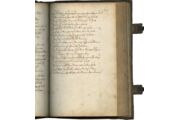


[Anonymous], Chronica der Stat Nürmberg (Chronicle of the City of Nuremberg)
In German, manuscript on paper
Nuremberg, 1596-99
TM 1173
- $18,000.00
 Textmanuscripts - Les Enluminures
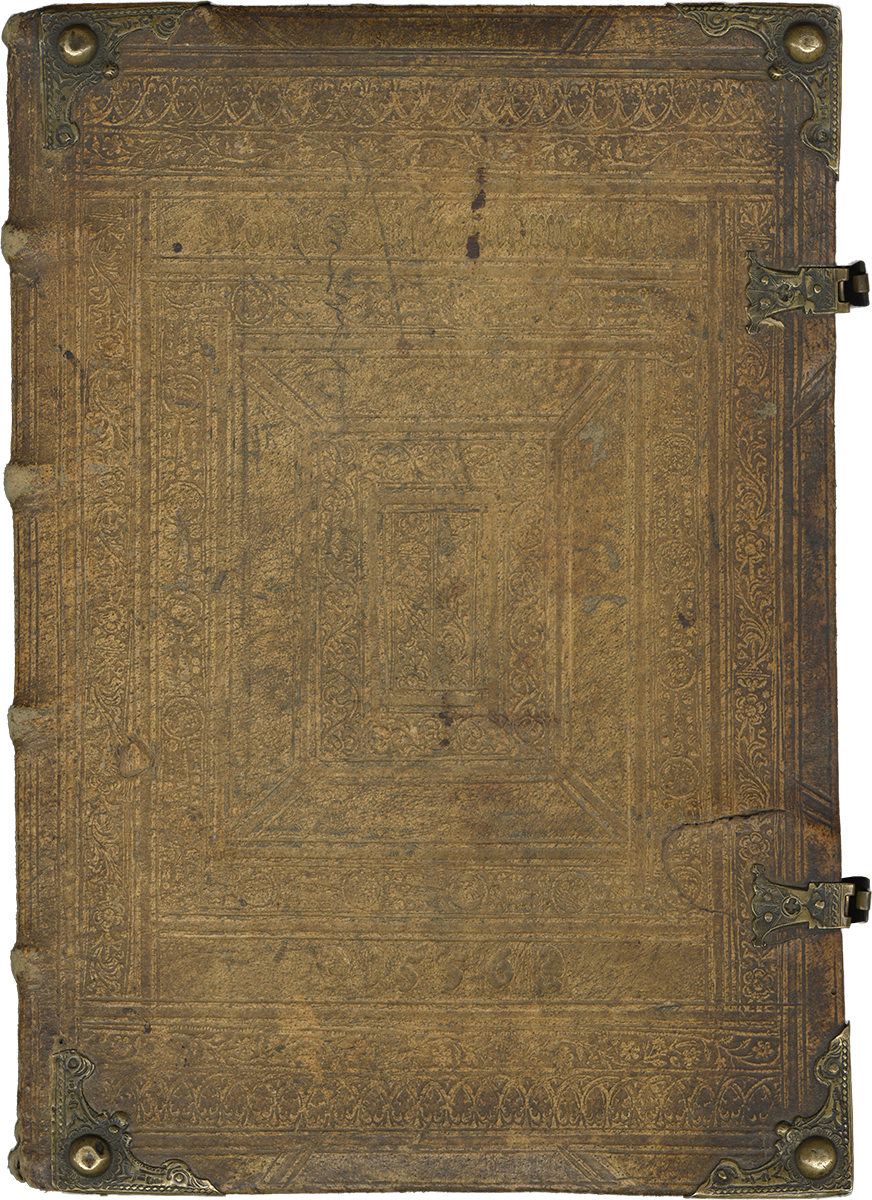
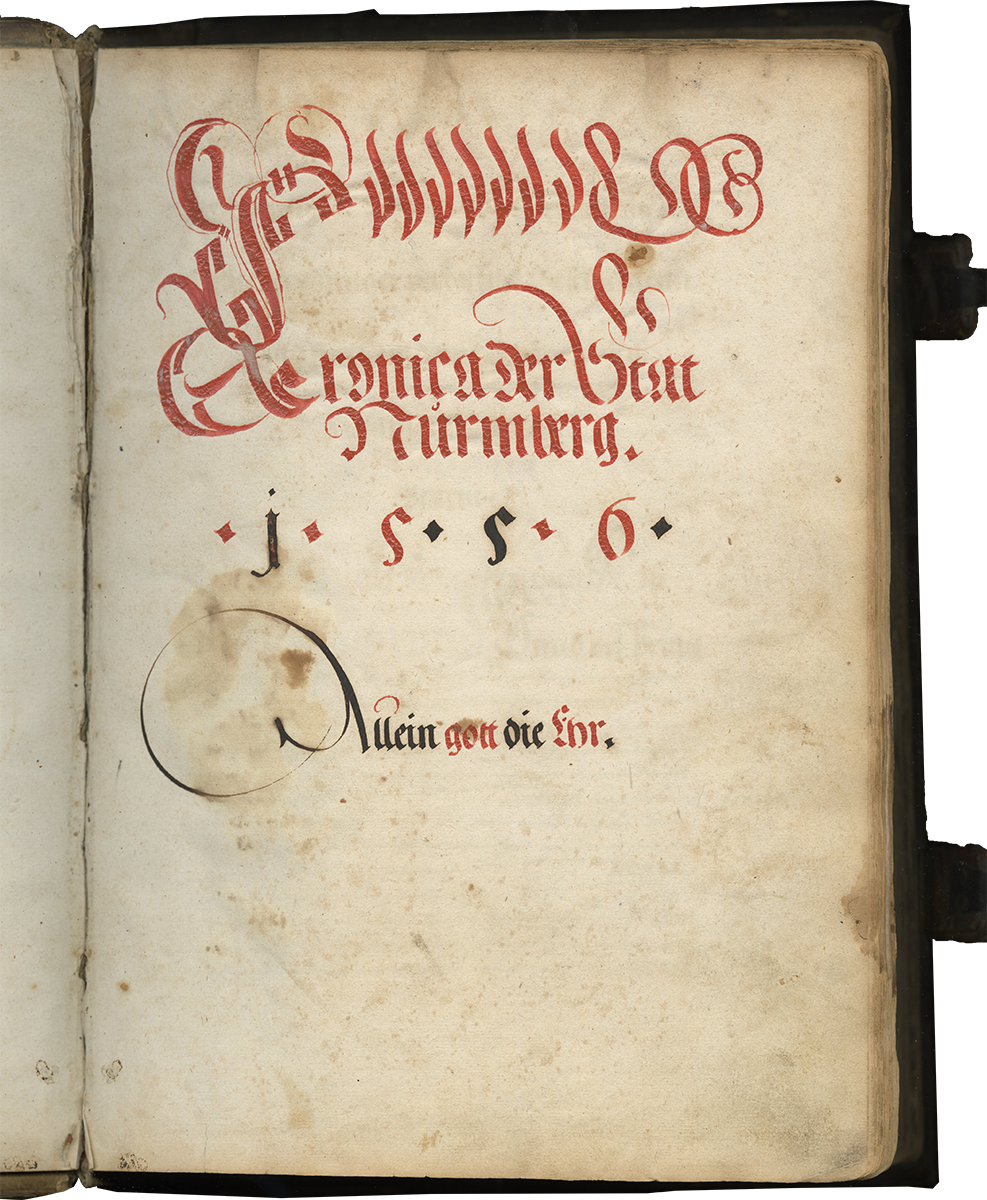
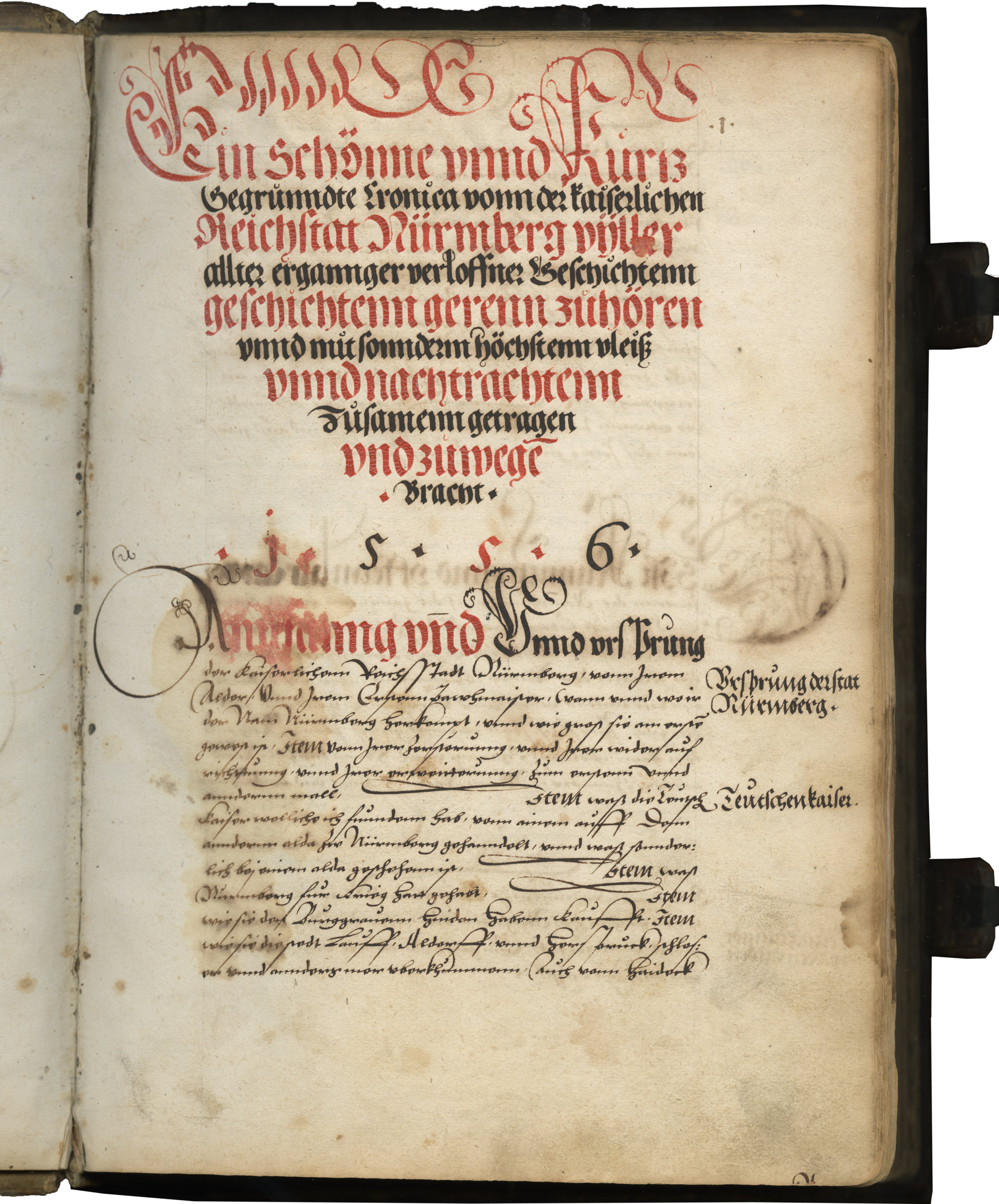
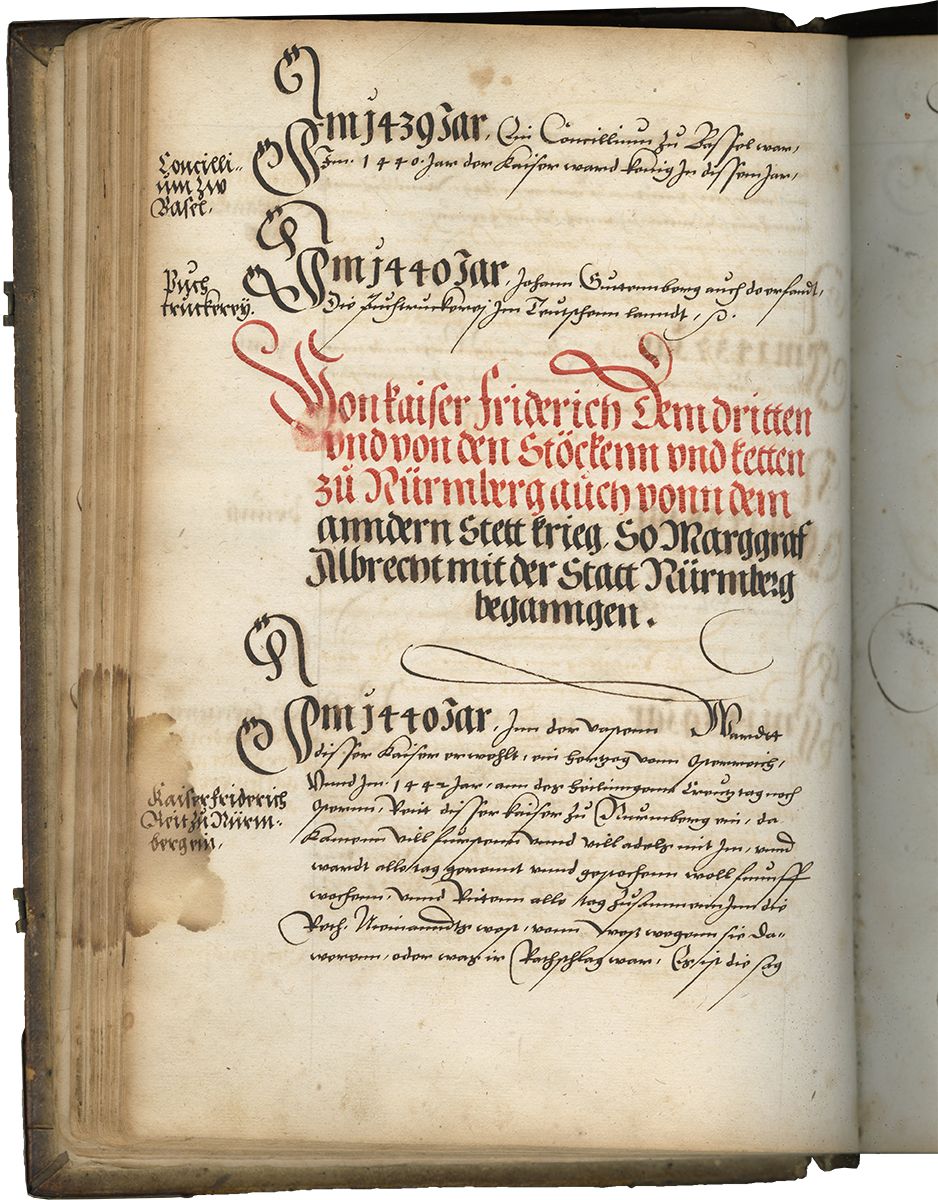
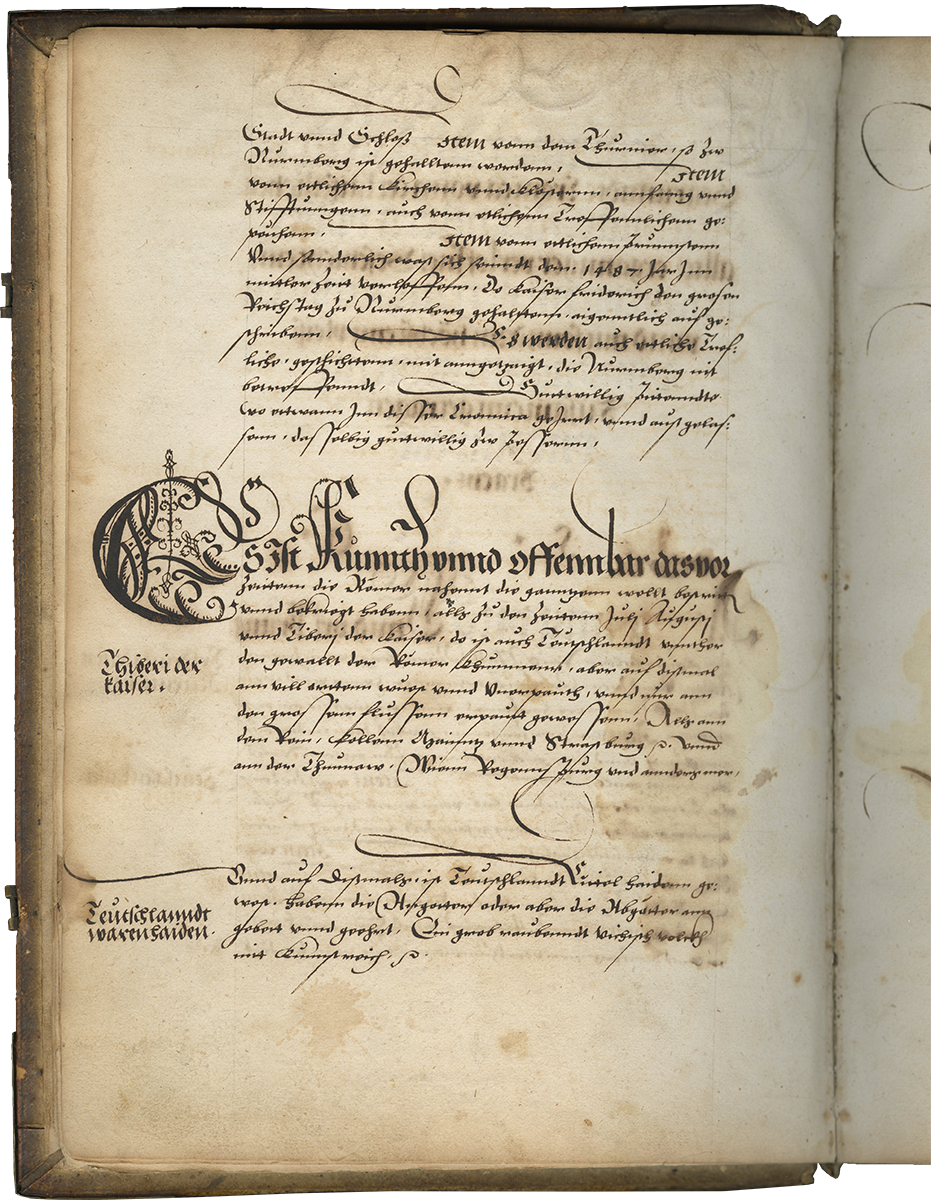
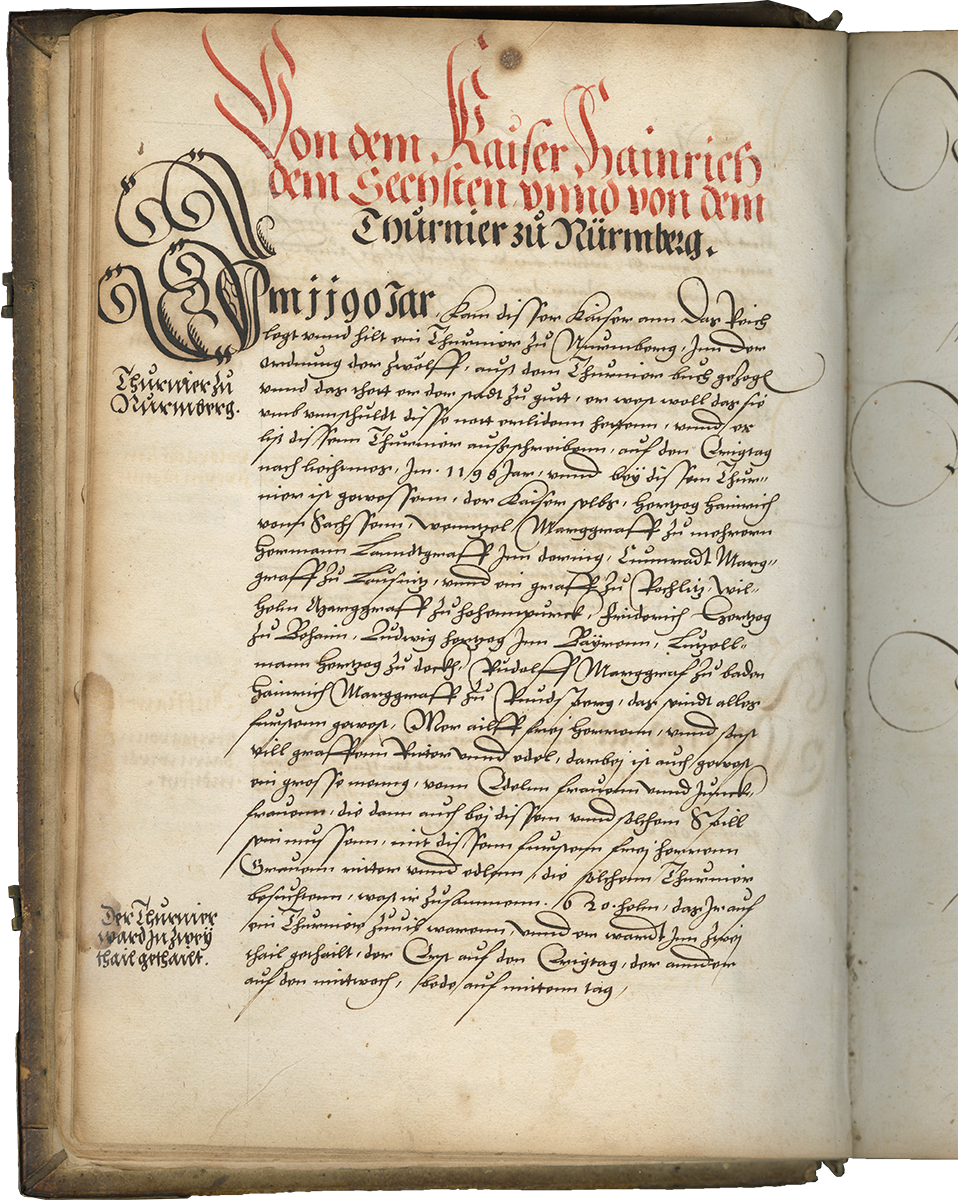
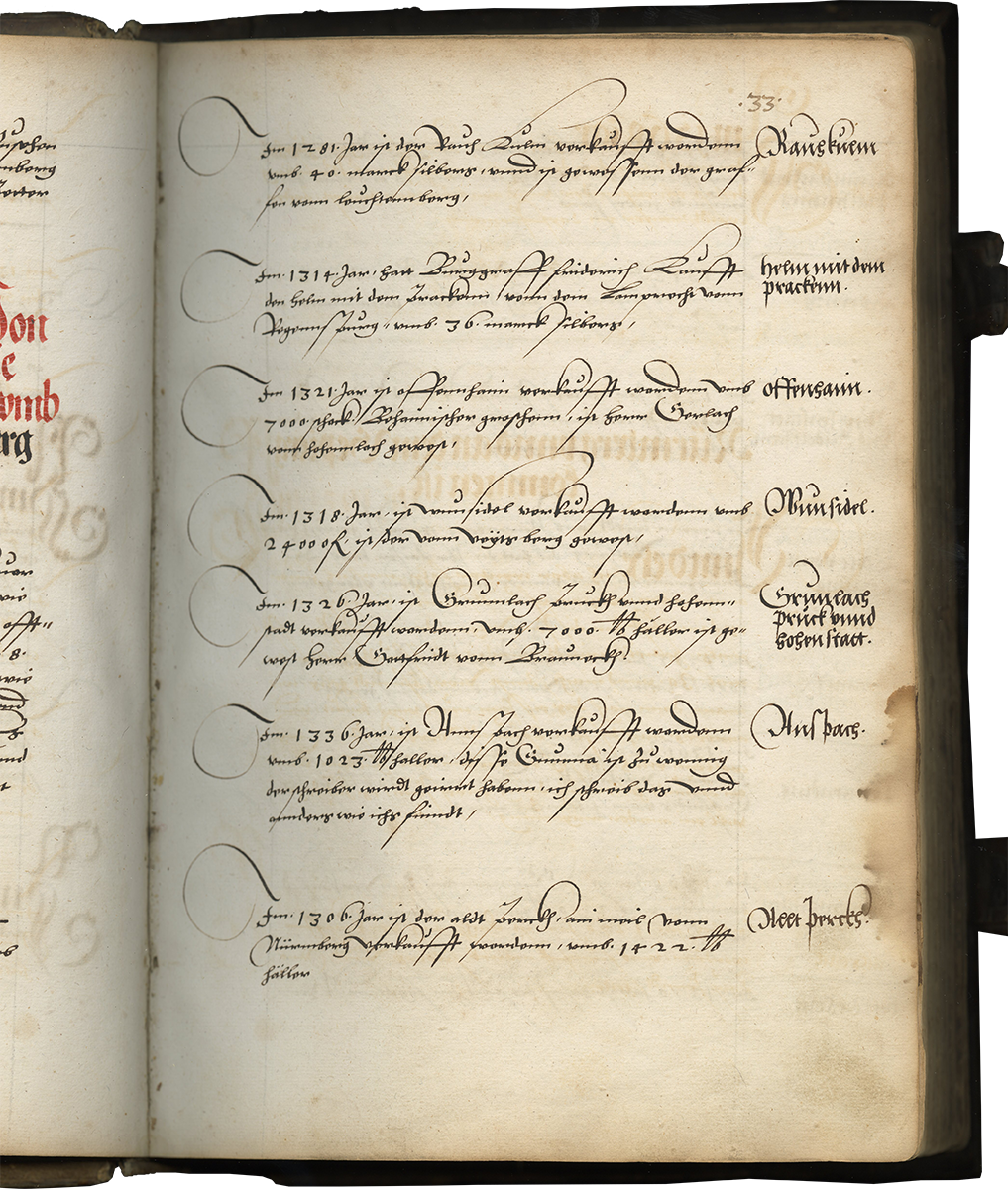
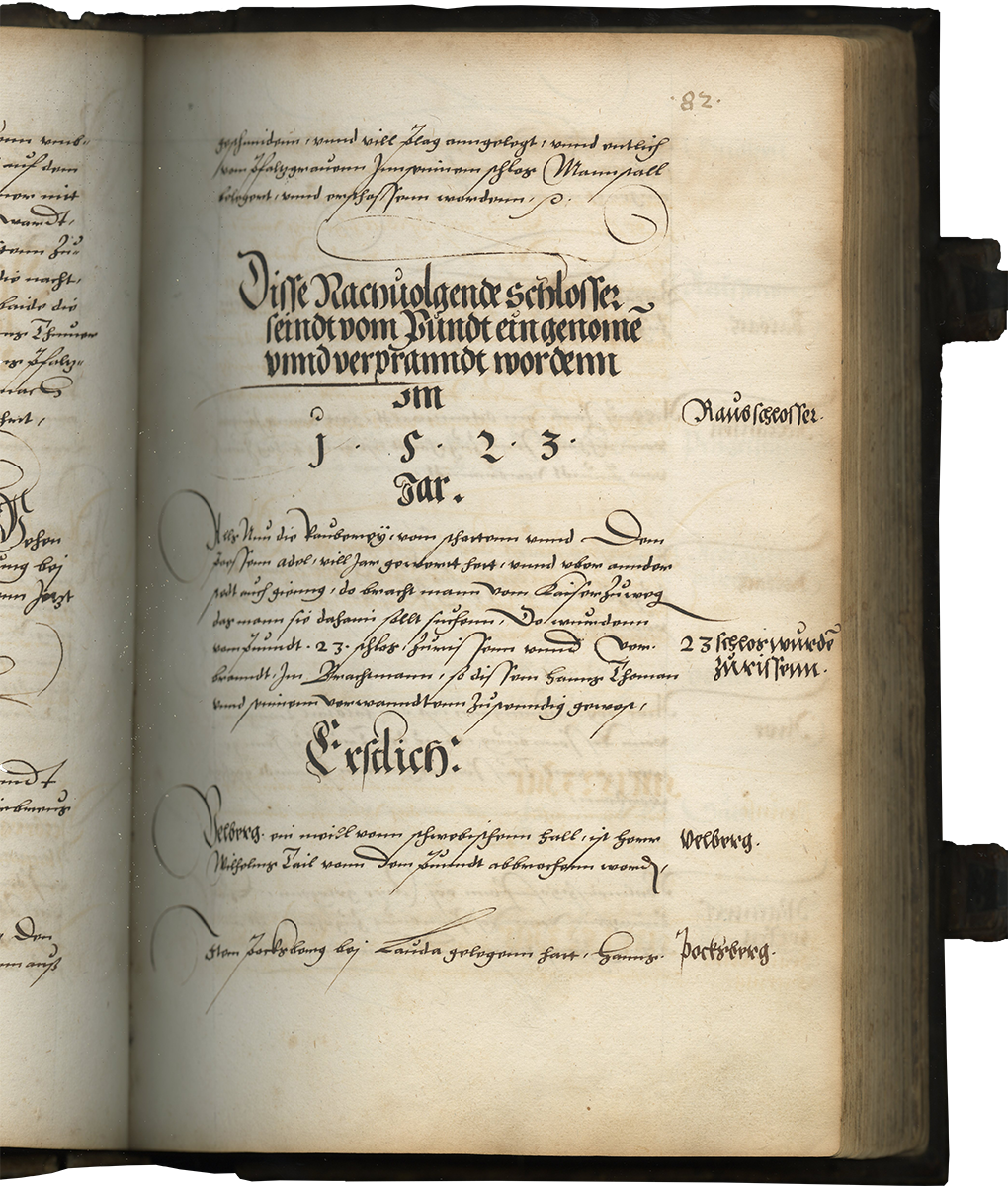
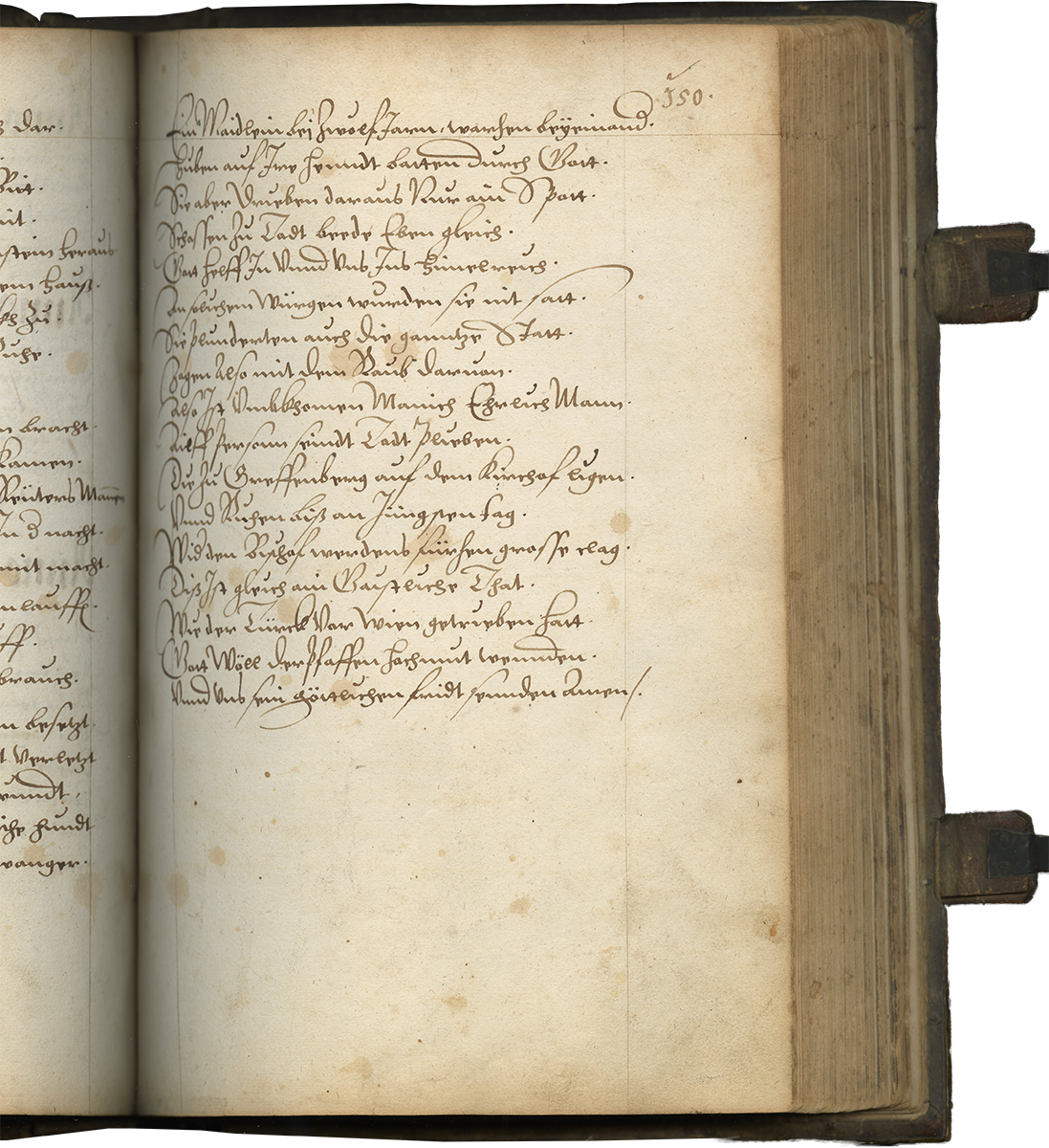
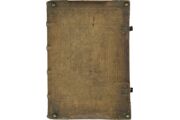
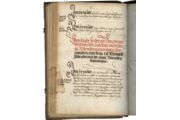
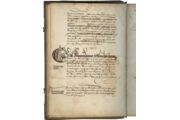
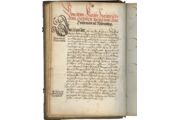
290 folios on paper, watermark, coat-of-arms of Nuremberg (Kleines Wappen), Briquet no. 916 (Nuremberg, 1541, 1544-63), contemporary foliation in ink top right recto 1-150 (folio 141 bis) on folios 5-155, modern foliation in pencil top right recto, (collation: i2 ii12 iii8 iv12 v8 vi12…manuscript becomes too tightly bound to assess further collation), complete, single column, ruled in ink, (justification 230 x 131mm), in fraktur for titles and chapter headings in red and black ink, a lower grade fraktur for marginal notes, a fine kurrentschrift with long descenders in black ink (ff. 5-144), and a second rounder and broader kurrentschrift in brown ink (ff. 1v-2, 144v-150, 261-277), a 17th century hand has added notes in kurrentschrift in light brown ink on ff. 82v, 83v, 101v, 103; majuscules with flourishes in black ink of 3-5 lines throughout, display fraktur majuscules with flourishes in red ink (f. 4, 5, 9, 10v, 12v, 14, 15, 17v, 19v, 20v, 24, 27, 28, 30, 36v, 40, 44, 45, 50v, 64, 84), wormholes on ff. 1-2 top with minimal loss of text, tear on top of f. 44, outer margin of f. 109 and bottom of f. 133, staining ff. 3-82 on outer edge without obscuring text, ink smudged on f. 5, light occasional staining throughout, otherwise good condition. Early binding, pigskin, geometric and floral tooling patterns, brass corners with bosses and two brass book clasps, four bands on the spine, front cover reads “Chronika der stat Nürmberg 1556,” tear near bottom clasp on front cover, moderate wear with some chipping, fair condition. Dimensions 296 x 212 mm.
This impressively large manuscript, bound in intricately tooled pigskin and adorned with brass corners with bosses and clasps, contains an anonymous chronicle of the city of Nuremberg. The scribe, Leonhard Fürstenhauer, writes in a beautiful, slender German cursive of the late sixteenth century and supplies chapter titles in a magisterial fraktur in black and red ink. The unpublished text of the chronicle reveals the ancient and medieval historical interests of the citizens of Nuremberg, the financial costs of the recent Second Margrave War, and moments of wonder, like the installation of a great bell in the city in 1552. Alongside the other vernacular chronicles of sixteenth-century Nuremberg, this manuscript provides a detailed picture of urban life in the city.
1. The manuscript was written by Lienhart Furstenhawer (Leonhard Fürstenhauer) between 1596 and 1599. Furstenhawer names himself in an acrostic poem on f. 1v dated 1596 and again below another dedicatory poem on f. 2 he writes, “Lienhart Furstenhawer Acad. Oeconomus Manu Propria scripsit Altorfinia A[nno] 99o” (L. F. University Provisioner wrote this with his own hand at Altdorf in the year [15]99). In the matriculation rolls of the University of Altdorf there is an entry for “Le. Fürstenhauer” who is listed as the Speisemeister (i.e. Oeconomus or Provisioner) in 1599 (see von Steinmeyer, 1912, p. 217, note 5; and, DWB, s.v. “speisemeister”). While Fürstenhauer was certainly the scribe of this manuscript, the actual authorship of the historical materials in this Chronicle is extremely difficult or impossible to determine. An explosion in popular chronicle writing in Nuremberg in the sixteenth century by craftspeople, i.e. Handwerkerchroniken, has left a rich corpus of around a thousand manuscripts (Stahl, 2000, p. 205).
2. A book plate inside the front cover and insert identifies the next owner of the manuscript as Paul Wolfgang Merkel (1756-1820) (see Radlmaier, 2008, plate 26). Merkel was a successful merchant in Nuremberg who helped Nuremberg assimilate into the state of Bavaria in the early 19th century. Merkel was also an avid collector of art and books. Much of his library is still preserved in the Germanisches Nationalmuseum Nürnberg.
3. In the twentieth century, owned by the Revels family in Oklahoma, USA.
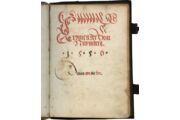
f. 1v, [Acrostic Poem], incipit, “Leblich […] zu aller stündt…herrn geburt 1596 far zu dem wurdt”;
The acrostic for this dedicatory poem reads “LIENHART FURSTENHAWER”, the same name used in the scribal colophon on the following folio.
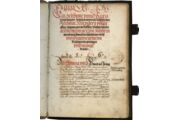
f. 2, [dedicatory poem], incipit, “Soli Deo Gloria. Gottes…was sie mir gönnen,” ff. 2v-3v, [blank];
Another dedicatory poem giving thanks to God. Lienhart Furstenhawer (or Leonhard Fürstenhauer, see PROVENANCE) notes that he wrote this “with his own hand” (manu propria).
f. 4, Cronica der Stat Nürmberg 1556, [title page], f. 4v, [blank];
ff. 5-155, Ein Schönne unnd kürz Gegrunndte Cronica vonn der kaiserlichen Reichstat Nürmberg vüller allter ergannger verloffner Geschichtenn geschichtenn gerenn zu hören unnd mit sonnderm höchstenn vleiß unnd nachtrachtenn zusamenn getragen und zuwegen Bracht 1556, incipit, “Annfanng unnd unnd ursprung der kaiserlichem Reichstadt Nürmberg…Unnd uns sein göttlichen Friede sennden amen,” ff. 155v-260v, [blank];
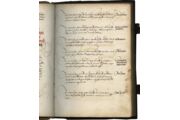
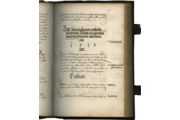
ff. 261-277, [Table of Contents], incipit, “Nun folget hernach das Register…Pfaffenn Krieg 149,” ff. 277-290v, [blank].
This manuscript belongs to a large and diffuse class of chronicle writing that flourished in Nuremberg in the sixteenth and seventeenth centuries known as Handwerkerchroniken (Artisans’ Chronicles). A recent survey estimates that nearly a thousand of these Handwerkerchroniken survive, many of which are part of Paul Wolfgang Merkel’s collection housed in the Germanisches Nationalmuseum Nürnberg (Stahl, 2000, p. 205, n. 2). In his catalog of Merkel’s manuscripts, Dominik Radlmaier (2008) lists three dozen. To the Merkel manuscripts should also be added another Handwerkerchronik found at the University of Iowa Special Collections MSC0542. These thirty-seven manuscripts (a small fraction of the total number of Handwerkerchroniken) all share a basic set of similarities with TM 1173: they all begin with the mythical founding of the city of Nuremberg by Nero Claudius Drusus Germanicus (born 39 or 38 BCE) and continue until a time roughly contemporary with the manuscript, usually the second half of the sixteenth century or early seventeenth century. Many of these manuscripts are holographs compiled by the Handwerker, in this case by Leonhard Fürstenhauer, but the textual content can only occasionally be attributed to a known author (Radlmaier, 2008, p. 238). Additionally, many of these manuscripts, including this one, also contain continuations by other chroniclers, usually anonymous. In this manuscript, a continuator has written entries for 1556-61 (ff. 144v-155) and provided a table of contents for the chronicle and its continuation (ff. 261-277). In Lotte Kurras’s estimation, these chronicle manuscripts do not carry much historical weight individually but taken together they provide an unparalleled look at urban life in Nuremberg in the sixteenth century (Kurras, 1983, p. XV). While these chronicle manuscripts share many features in their general structure, they can differ significantly in their style and details (see Stahl, 2000).
In the text of this manuscript, the chronicle advances briskly from an account of its founding by Nero Claudius Drusus Germanicus and its situation in Germany (f. 5-6v), to its interactions with Charlemagne (808 CE, f. 9), to Conrad I (913, f. 10v), to Otto I (937, f. 12v), to Henry I (1057, f. 14), to Conrad III (1138, f. 17v), to Frederick Barbarossa (1152, f. 19v), to Henry VI (1190, f. 20v), up to the year 1504 at f. 72, where the historical narration becomes more detailed with the mention of the “Bairisch Krieg” (Bavarian War or War of the Succession of Landshut), when Nuremberg greatly expanded its territory through the conquest of neighboring towns and villages. The later half of the chronicle is primarily concerned with the reign of Charles V (r. 1519-56) and his relations with the city of Nuremberg. At ff. 103v-105 there is an account of the Holy Roman Emperor’s visit to Nuremberg (“Kaiser Karl der Funnfft Reit zu Nurmberg ein”). Toward the end of the chronicle there is a detailed account of the Second Margrave War of Nuremberg (1552-56, ff. 123v-143v). On f. 129rv, the chronicle records a settlement between the citizens of Nuremberg and the Margrave Albrecht in 1552. The text gives exact figures in florins paid by both sides. The final entry in the original chronicle at f. 144 records the founding and installation of a bell in Nuremberg by Hans Glockengiesser III (ca. 1490-1559). The chronicler records the weight and the inscription on the bell and describes it in detail. It is interesting to note that the bell is not recorded in Deutsche Biographie. A continuator provides entries for the next few years (1556-61, ff. 144v-55), and the chronicle then ends abruptly with over a hundred blank folios following it (ff. 155v-260v), suggesting that the chronicle was intended to be continued indefinitely.
This manuscript partakes in the rich, diverse, and understudied tradition of vernacular history writing (Handwerkerchroniken) in the city of Nuremberg in the sixteenth century. Beautifully bound in tooled pigskin and adorned with brass corners and clasps, this impressive folio volume testifies to the importance of local history to the local tradespeople of Nuremberg. While it shares many formal similarities with other Handwerkerchroniken, it contains a wealth of detail, which can give us a clearer picture of the concerns of local historians, the financial burdens of war, and notices of events that intrigued citizens of the time. This manuscript then represents a tile in the great historical mosaic of popular, vernacular early modern historiography in Nuremberg.
Lottes, Günther. “Stadtchronistik und städtische Identität. Zur Erinnerungskultur der frühneuzeitlichen Stadt,” Mitteilungen des Vereins für Geschichte der Stadt Nürnberg 87 (2000), pp. 47-58.
Kurras, Lotte. Norica: Nürnberger Handschriften der frühen Neuzeit, vol. 3, Wiesbaden, 1983.
Radlmaier, Dominik. Handschriften der Welser: Die Bibliothek der Paul Wolfgang Merkelschen Familienstiftung im Germanischen Nationalmuseum Nürnberg, Nürnberg, 2008.
Schneider, Joachim. “Anfänge in der Stadtgeschichte. Über Legenden in der mittelalterlichen Nürnberger Stadtchronistik und ihren historischen Auskunftswert,” Mitteilungen des Vereins für Geschichte der Stadt Nürnberg 87 (2000), pp. 5-46.
Schneider, Joachim. “Typologie der Nürnberger Stadtchronistik um 1500. Gegenwart und Gechichte in einer spätmittelalterlichen Stadt,” in Städtische Geschichtsschreibung im Spätmittelalter und in der frühen Neuzeit, ed. Peter Johnek, Böhlau, 2000, pp. 181-204.
Stahl, Irene. “Nürnberger Handwerkerchroniken,” in Städtische Geschichtsschreibung im Spätmittelalter und in der frühen Neuzeit, ed. Peter Johnek, Böhlau, 2000, pp. 205-214.
von Steinmeyer, Elias. Die Matrikel der Universität Altdorf: Zweiter Band, Zweiter Teil, Register, Würzburg, 1912.
Strassner, Erich. Graphemsystem und Wortkonstituenz: Schreibsprachliche Entwicklungstendenzen vom Frühneuhochdeutschen zum Neuhochdeutschen untersucht an Nürnberger Chroniktexten, Tübingen, 1977.
Deutsches Wörterbuch von Jacob Grimm und Wilhelm Grimm (=DWB), “speisemeister,” https://www.dwds.de/wb/dwb/speisemeister
Hirschmann, Gerhard. “Merkel, Paul Wolfgang,” Deutsche Biographie, 1994, https://www.deutsche-biographie.de/gnd119063239.html#ndbcontent
Paul Wolfgang Merkel'sche Familienstiftung, https://www.merkelstiftung.de/
Schaper, Christa. “Glockengießer, Hans III,” Deutsche Biographie, 1964, https://www.deutsche-biographie.de/gnd133697967.html#ndbcontent