

MARCUS TULLIUS CICERO, Eight Speeches
In Latin, manuscript on parchment
Italy, Florence or Venice, c. 1418
TM 1384
sold
 Textmanuscripts - Les Enluminures
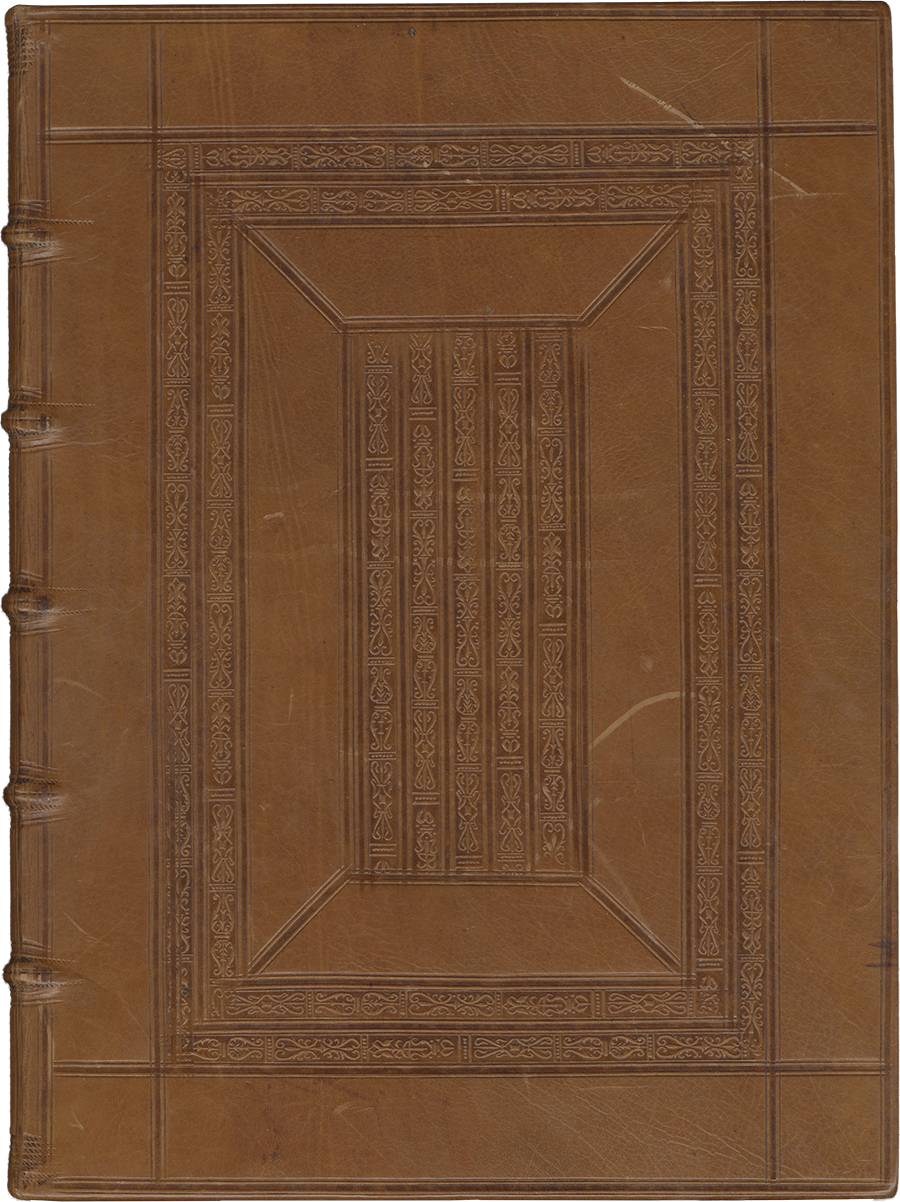
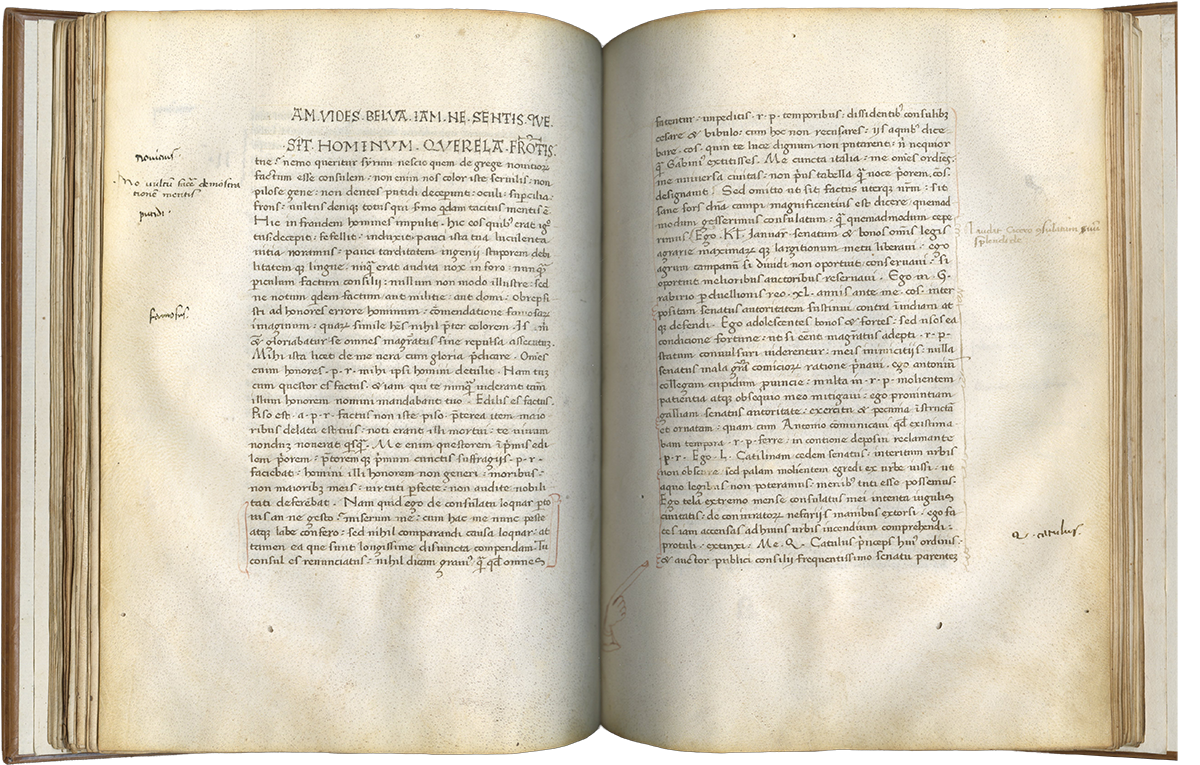
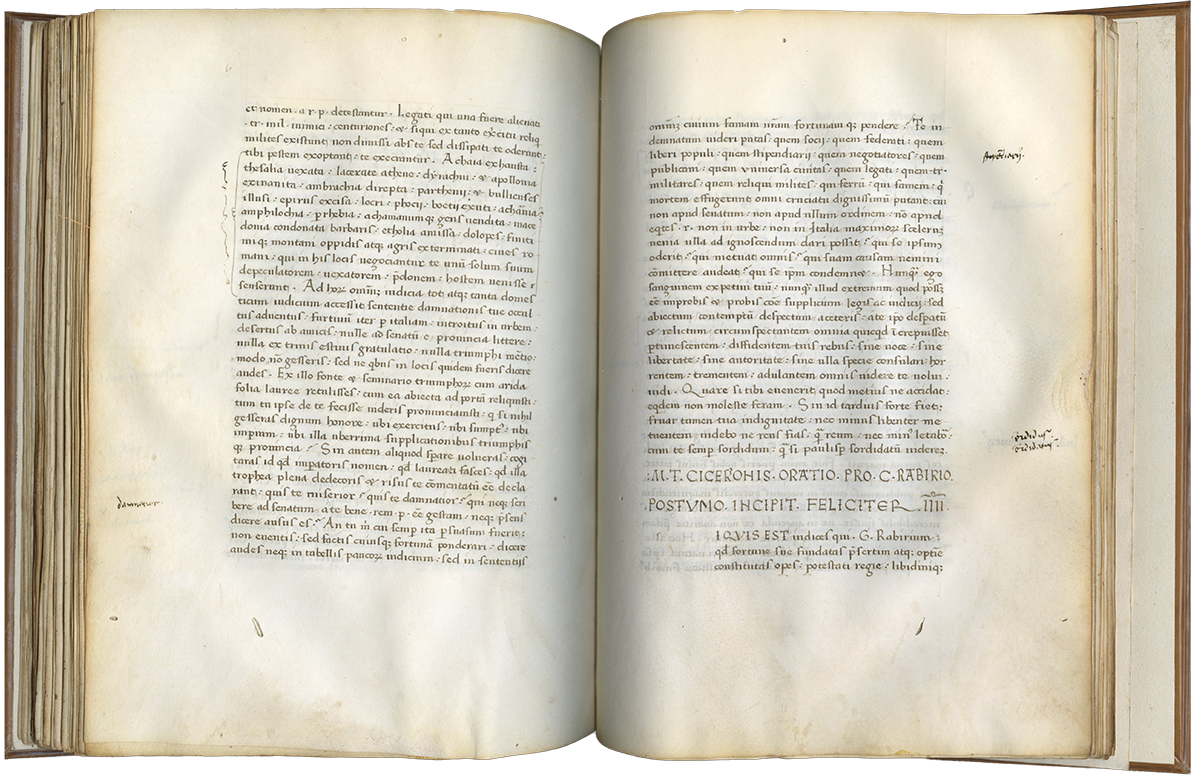
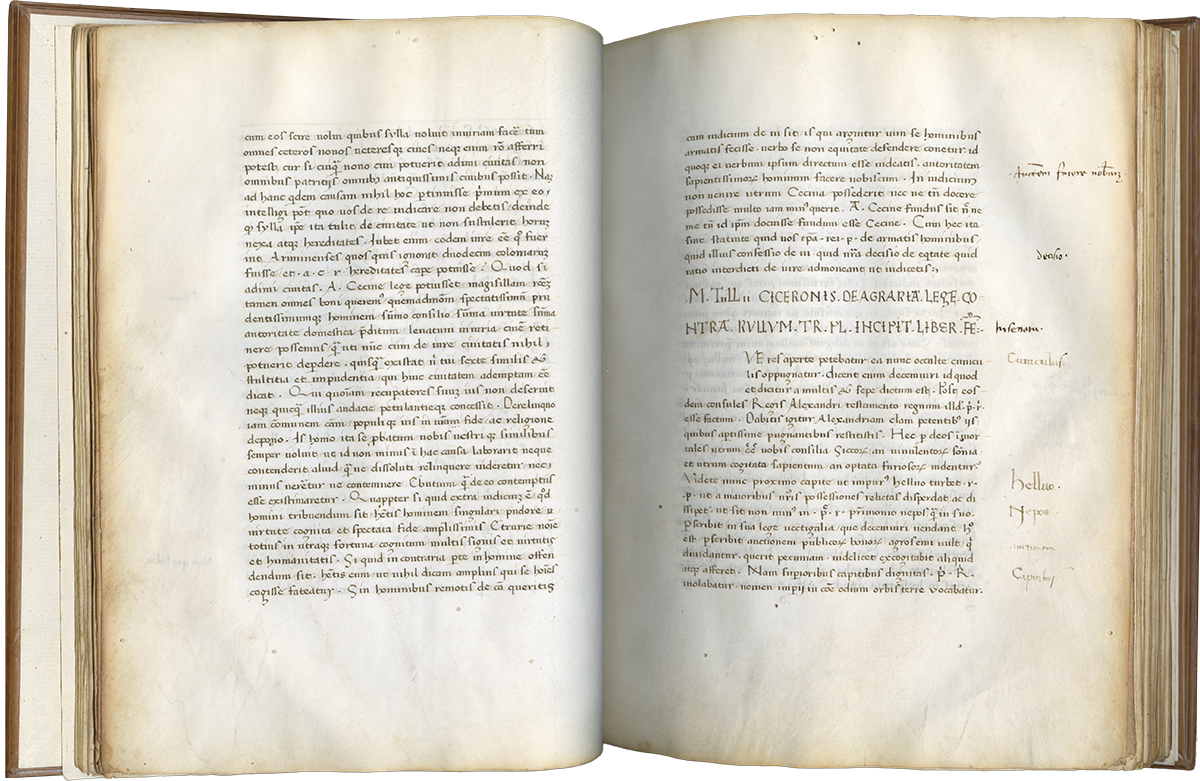
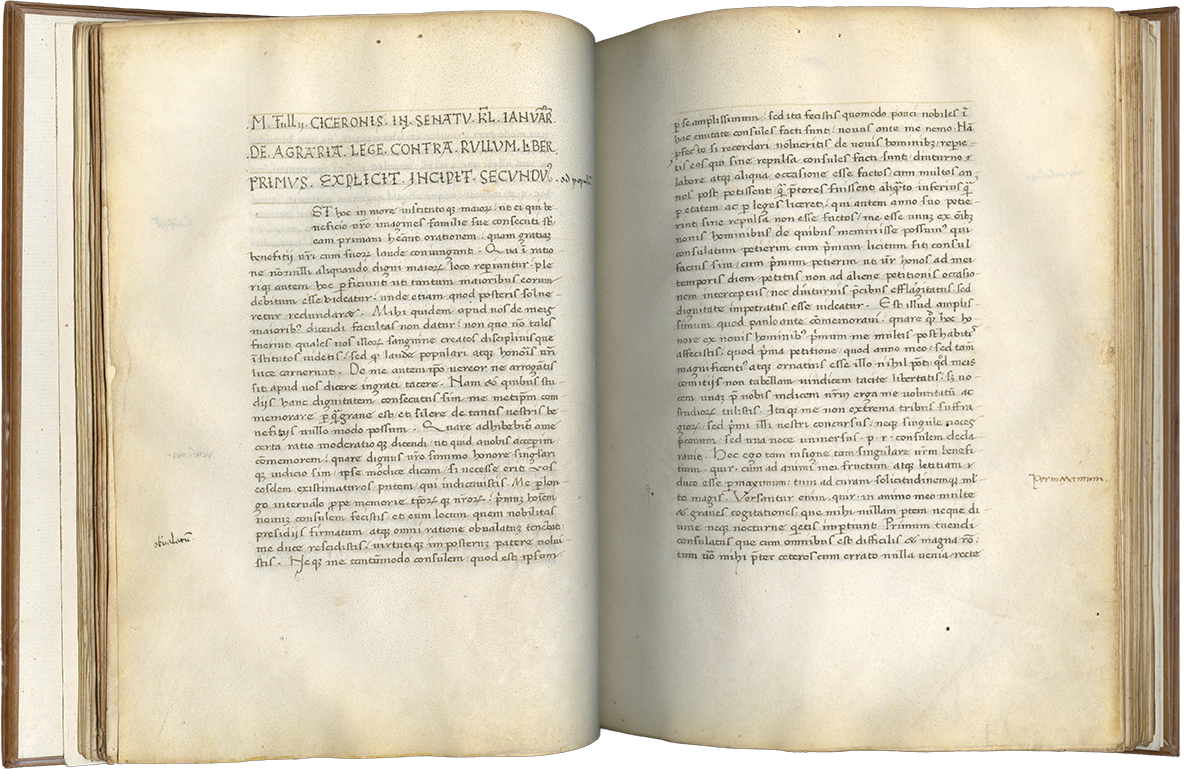
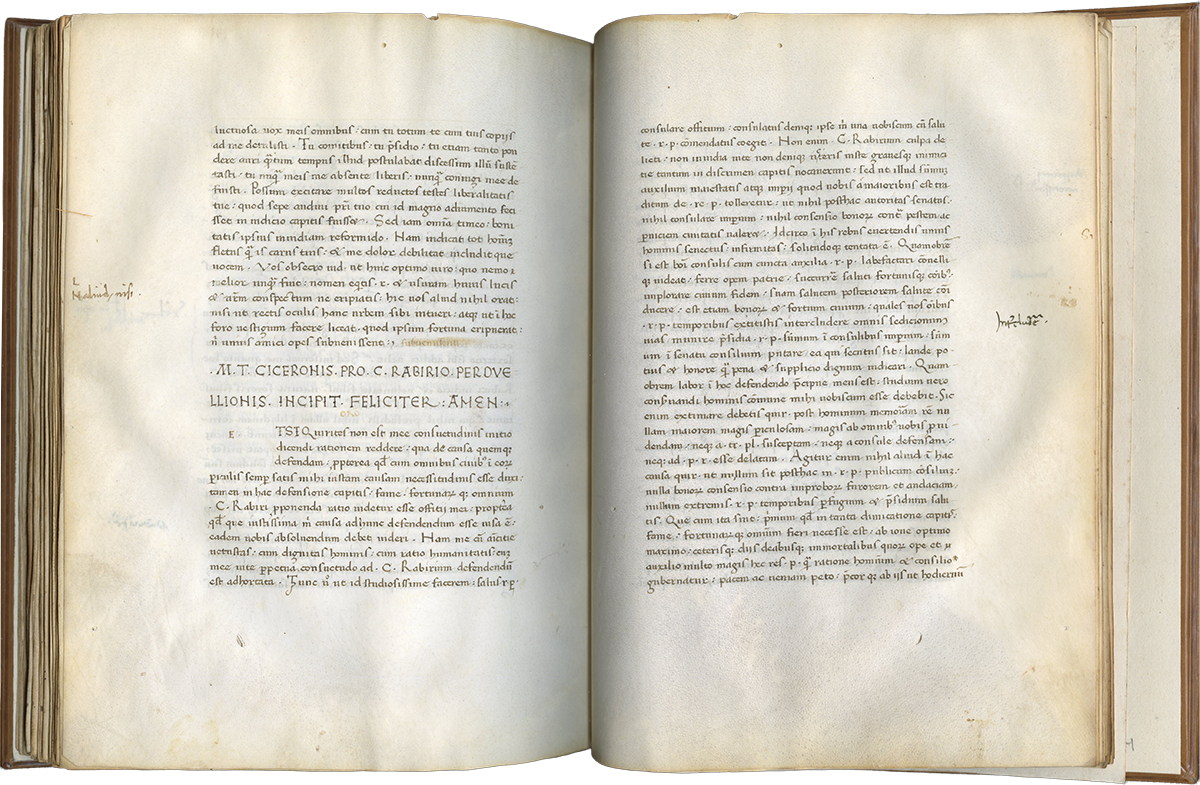
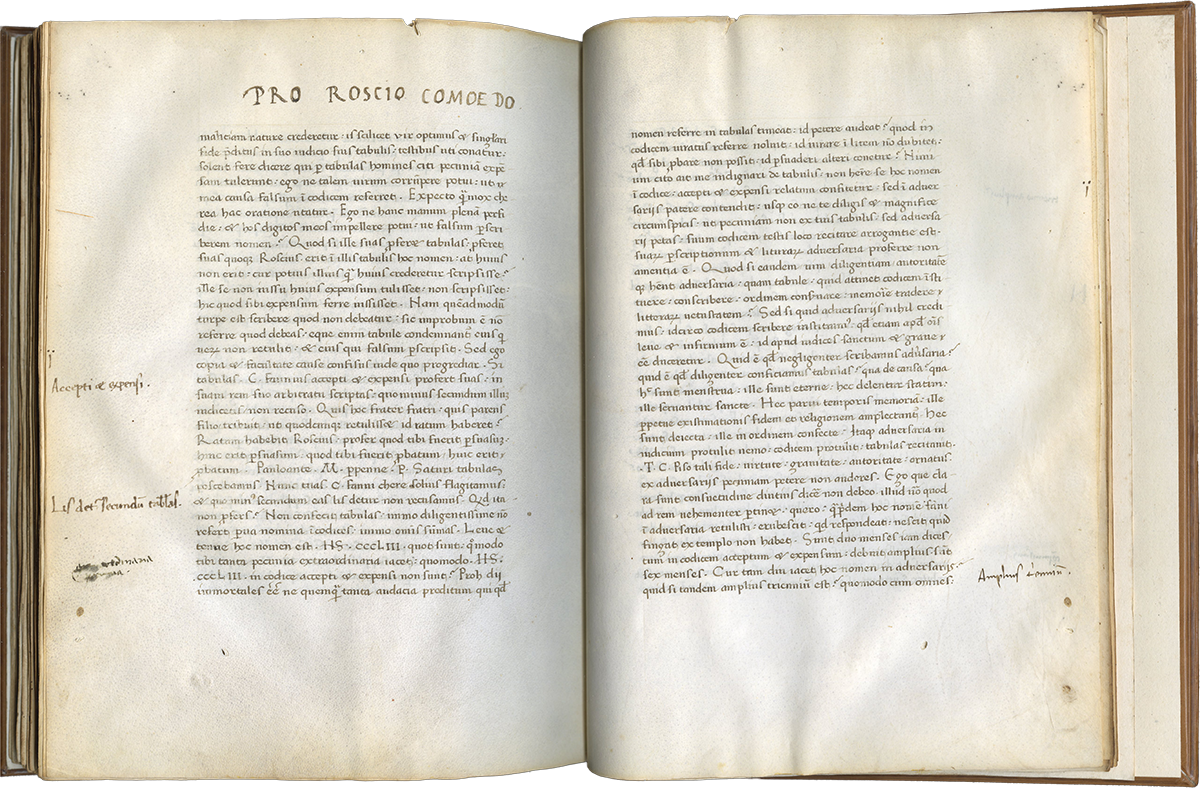
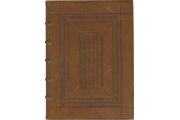
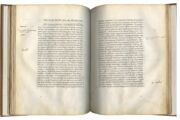
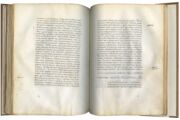
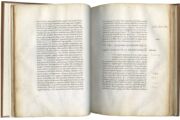
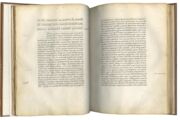
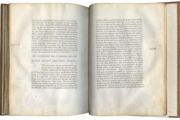
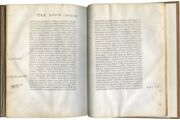
i(paper)+86+i(paper) parchment leaves, foliated in pencil in upper right corner, complete, (collation: i-viii10 ix6 (7-10 cancelled blanks)), horizontal catchwords, single column, 31 lines ruled in drypoint (justification: 170x110mm), in a fine humanist script, headings in majuscules, spaces left for initials, marginalia in several hands throughout, some smudging, edges darkened and some wormholes but otherwise in clean condition. Sewn on five bands and bound in twentieth-century blind-stamped brown leather. Dimensions 275 x 205 mm.
This manuscript contains Cicero’s so-called Eight Speeches, the collection of speeches concerning legal issues assembled, and partly rediscovered, by the famous humanist Poggio. The rediscovery of these speeches heralded a new victory for humanists during the burgeoning Renaissance amidst their efforts to recover traces of classical culture lost to time. Possibly one of the earliest extant copies anywhere, the present manuscript is certainly part of one of the earliest textual families of the Speeches and was copied in a lovely script. Other early copies reside at the Vatican and Oxford, and this offering is unique on the North American market.
1. Inscribed in the late fifteenth or sixteenth century “Jo. Maria de Pusterla” (f. 86v), perhaps a member of Lombard family of that name recorded in Milan and Piacenza; the inscription ends with an abbreviation, apparently. Also inscribed “PP 1713 M,” near which is written “PP M.C. 79,” and “M.C. 79.” Figure of a man partly sketched.
2. Inscribed “Sebasnanus (Sebastian) DeBubalis romano” (f.86v, and his partially erased ownership inscription in the upper margin of f. 1, “Iste liber est,” etc.).
3. Internationaal Antiquariaat, Amsterdam, Catalogue 247 (1964), no 68 (Schoenberg Database of Manuscripts MS 550), Sotheby’s notes Astor purchased it from here, see 4 below;
4. William Waldorf, first Viscount Astor, heirs sold the volume at Sotheby’s, 21 June 1988, lot 87 (SDBM MS 550), bought by:
5. Maggs Bros., London; Catalogue 1093: Early Printed Books and Manuscripts, 1989, no. 2, and Catalogue 1103: European Bulletin No. 15, 1989, no. 4 (SDBM MS 550); acquired by:
6. Martin Schøyen, Oslo, Norway and London, UK (born January 31, 1940), a Norwegian businessman, traveler, historian, and collector of books; The Schøyen Collection, MS 699 (see Online Resources).
ff. 1-86, Cicero’s Eight Speeches, including, ff. 1-19, Pro Caecina, incipit, “[S]i quantum in agro...ff. 19-45, De Lege Agraria (i–iii); ff. 45v-65, In Pisonem; ff. 65-72v, Pro Rabirio Postumo; ff. 72v-78, Pro Rabirio Perduellionis; ff. 78v-86v, Pro Roscio Comoedo (title added later)...hoc est Roscio debebat,” followed by a large space and a note “def[icit] residuum” (see discussion below).
Within the large oeuvre that survives from Cicero (106 BCE to 43 BCE), considered to be Rome’s greatest orator, his speeches are extremely important because they provide remarkable insight into the social, legal, and political world of the turbulent late Roman Republic.
This volume contains Ciceronian speeches discovered by Poggio Bracciolini (1380–1459) during a series of excursions while he was attending the Council of Constance (1414–18). He found and copied Pro Caecina at Langres, and the other speeches probably in Cologne Cathedral, in 1417, as he records in his autograph manuscript (Vatican City, Biblioteca Apostolica Vaticana, MS Vat. lat. 11458, see Online Resources). Based on the order of the speeches and the textual corrections, the present manuscript is closely related to the three earliest known copies, all apparently made when the copy-text was briefly in the care of Florentine humanist Niccolò Niccoli in the first half of 1418: Oxford, Bodleian Library, MS D’Orville 78, copied by Giovanni Aretino for Cosimo de’ Medici; Florence, Biblioteca Medicea Laurenziana, MS Plaut. 48.26, partly copied by Guglielmino Tanaglia; and Vatican City, Biblioteca Apostolica Vaticana, MS Vat. lat. 13689 (see Online Resources; Davies, 1984, p. 253 n. 5, 254; Mulholland 2018, p. 70). Of these, the present manuscript seems textually closest to D’Orville 78 and may therefore mark a heretofore unidentified early copy of Poggio’s collection produced by another of the famed humanist scribes in Niccoli’s immediate circle in 1417-18.
Yet scholars recognize that of these three early copies, only Vat. Lat. 13689 was copied directly from Poggio’s Vat. Lat. 11458: the other two early witnesses were copied from a no-longer extant intermediary (Mulholland, 2018, p. 70). Only future textual and paleographical research can identify whether the present manuscript was copied from D’Orville 78, or from that manuscript’s missing copytext. Likewise, future research may well identify the present manuscript’s fine scribe among those humanists surrounding Niccoli. The titles of each speech in the present manuscript adhere more closely to Poggio’s own orthography than Aretino’s, placing a punctus between each word, as does Plaut. 48.26 (Mulholland, 2018, p. 88; Online Resources). The lack of an original title for the final speech is also consonant with this early transmission (Mulholland, 2018, p. 95). These features hint that the present manuscript may derive from D’Orville’s exemplar, rather than D’Orville, but only future research can fully trace this manuscript’s textual history.
Textual gaps dutifully reproduce the incomplete state of Poggio’s own discoveries. To this day, no complete manuscript of Pro Rabirio Perduellionis or Pro Rosco Comoedo has ever been found. Thus, the final comment “deficit residuum,” included in Poggio’s own manuscript and transmitted in copies like this one, functions like a “This Page Left Intentionally Blank” notice on official documents. Early readers appreciated the volume, and a series of them left brief comments in the margins throughout, attesting to ongoing interest in Ciceronian rhetoric from the fifteenth century onwards. The entire set of Ciceronian speeches were printed in 1471, and they were included in the first enormous Ciceronian Opera omnia in 1498 (Literature and Online Resources). As with the rest of Cicero’s works, the speeches have rarely been out of print since: they are among the most classic of classical works of literature.
Cicero, M. T. Orationes, Rome, 1471. ISTC ic00541000.
Davies, Martin. “A note on the history of MS D'Orville 78,” Bodleian Library Record 11 (1984), pp. 253–58.
Marek, Václav, ed. M. Tulli Ciceronis scripta quae manserunt omnia, Fasc 16 Orationes de lege agraria. Oratio pro C. Rabirio perduellionis reo, Berlin, 1983.
Mulholland, O. F. Studies on the Transmission of Cicero’s Speech Pro Roscio Comoedo. Phd dissertation. Freie University Berlin, 2018.
Olechowska, Elzbieta, ed. M. Tulli Ciceronis scripta quae manserunt omnia. Fasc 25 Orationes pro Cn. Plancio, pro C. Rabirio postumo, Berlin, 1981.
Reeve, Martin. Text and Transmission Oxford, 1983.
Vatican City, Biblioteca Apostolica Vaticana, MS Vat. lat. 13689
Cicero, M. T. Opera, vol. 2, Milan, 1498-9. ISTC ic00498000. https://www.digitale-sammlungen.de/en/view/bsb00066408?page=,1
Clark, Albert Curtius, ed. Orationes. Recognovit brevique adnotatione critica instruxit, Oxford, 1909-52, vol. 4. https://archive.org/details/orationesrecogno04ciceuoft/page/n5/mode/2up
Florence, Biblioteca Medicea Laurenziana, MS Plut. 48.26 https://tecabml.contentdm.oclc.org/digital/collection/plutei/id/792539/rec/1
Oxford, Bodleian Library, MS D’Orville 78, samples here https://digital.bodleian.ox.ac.uk/objects/44f06165-e6cf-4e6f-a6cb-e3f94cc6897f/
(formerly) The Schøyen Collection, MS 699 https://www.schoyencollection.com/law/roman-law/cicero-law-speeches-ms-699
Vatican City, Biblioteca apostolica vaticana, Vat. Lat. 11458 https://digi.vatlib.it/view/MSS_Vat.lat.11458
TM 1384