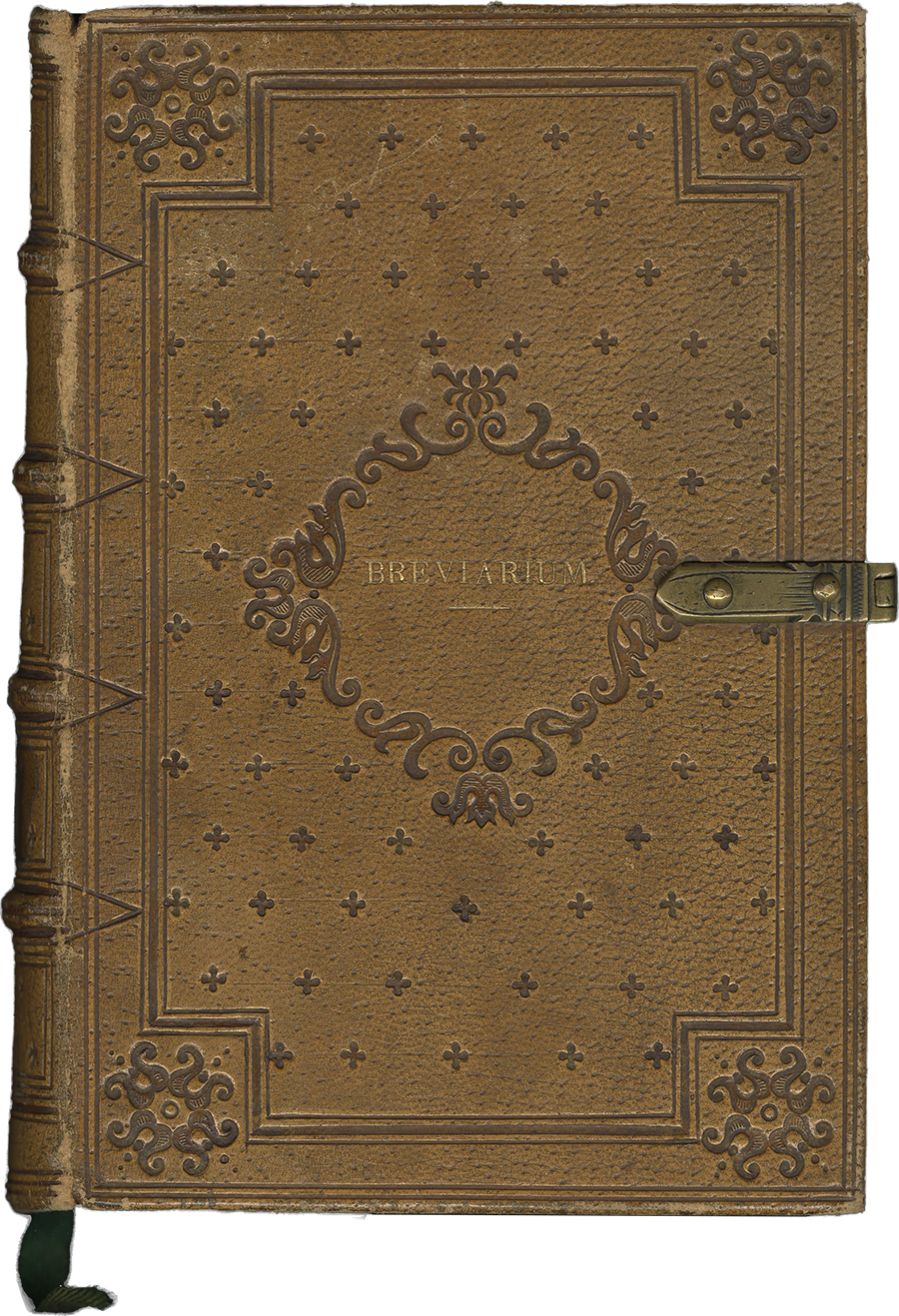
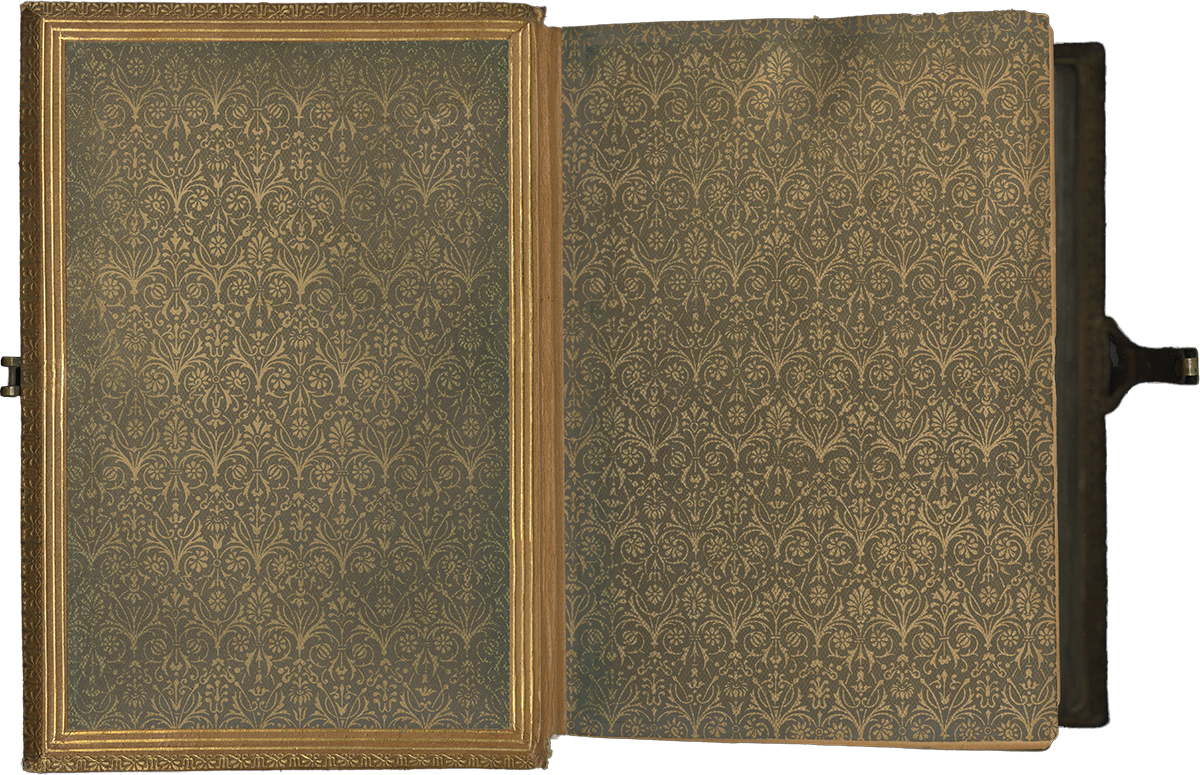
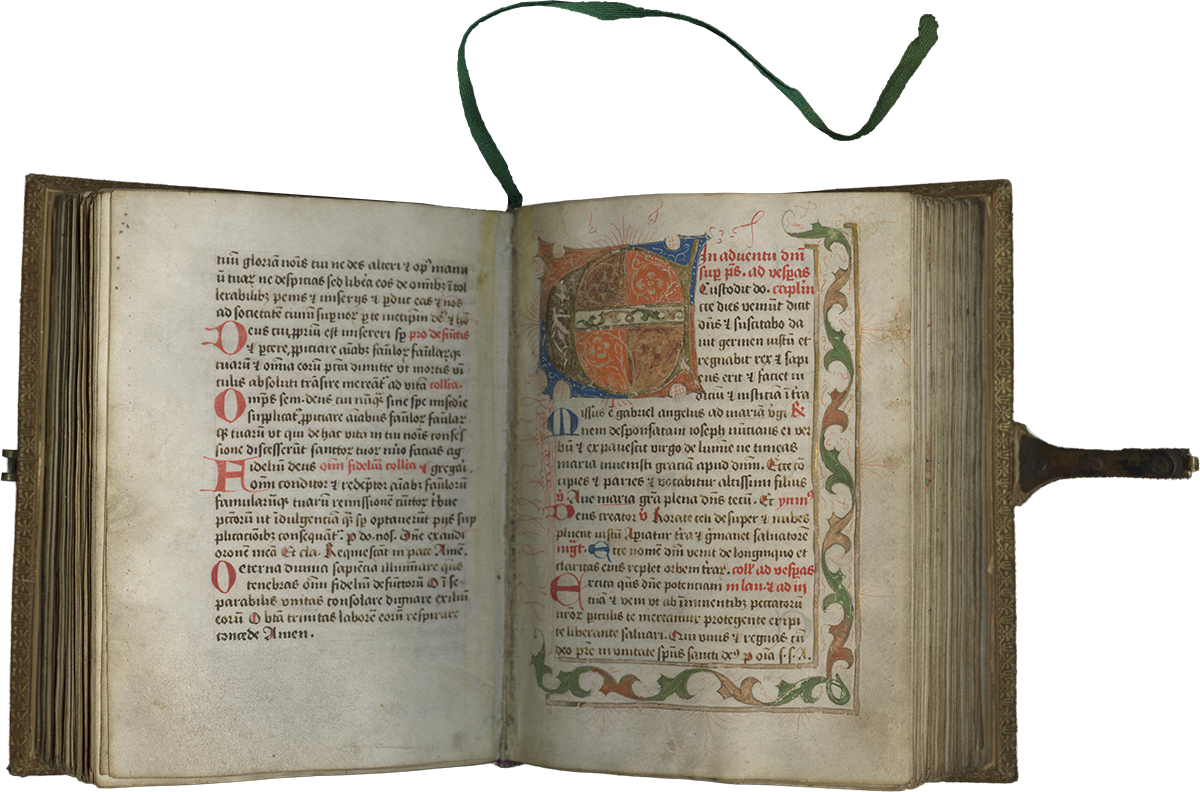
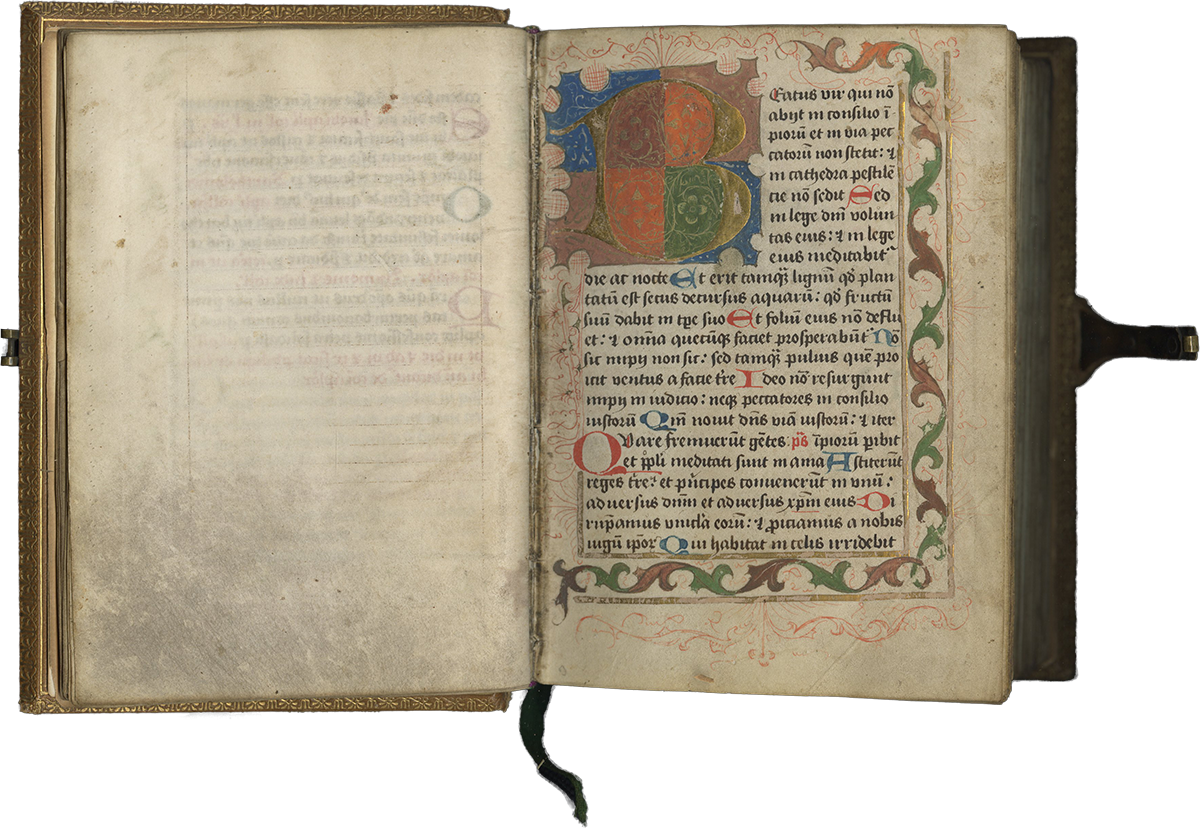
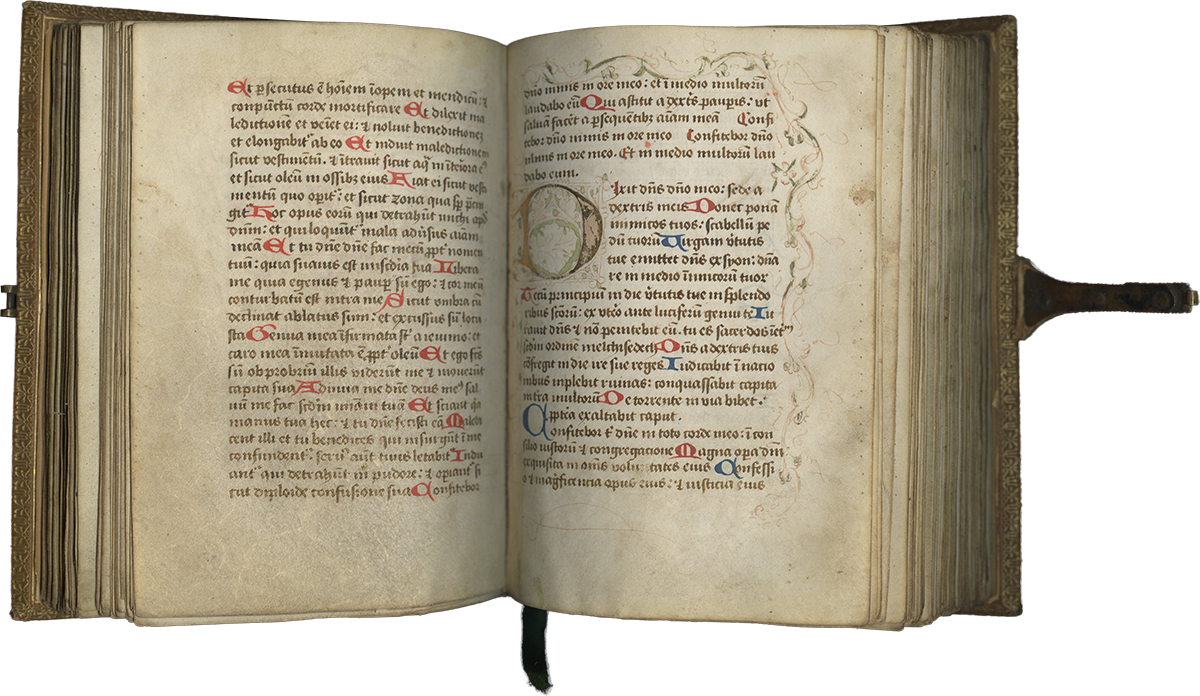
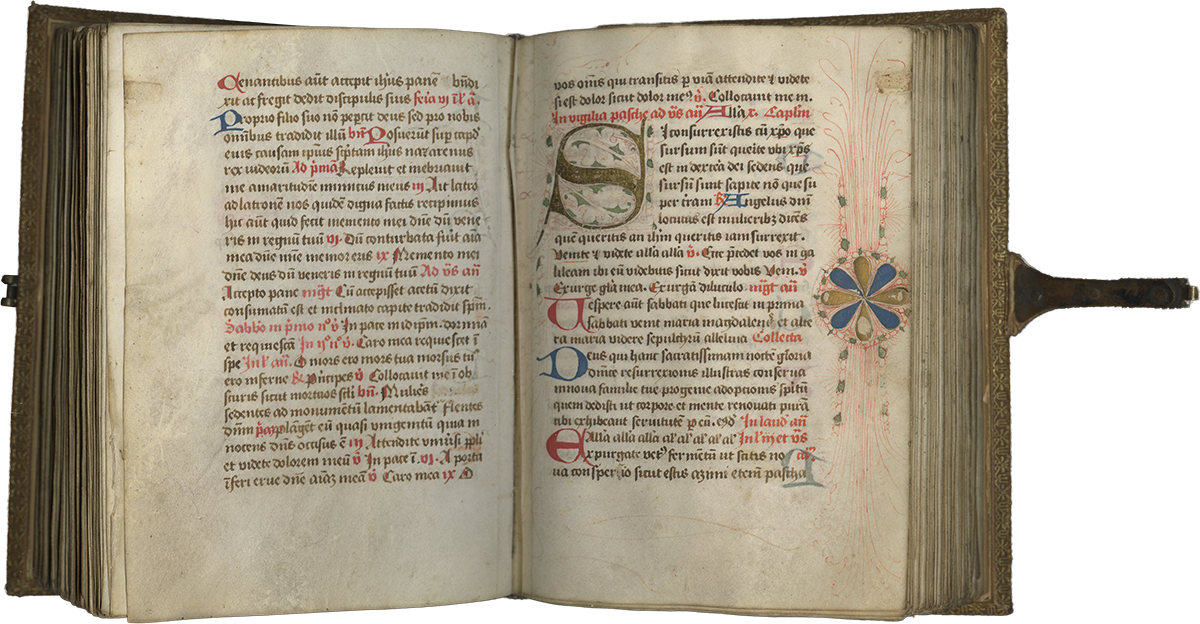
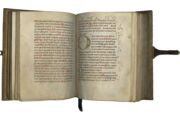
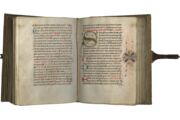
ii (paper)+253+ ii (paper) parchment folios, foliated in pencil in upper right corner, no catchwords, quire signatures in far lower right, mostly trimmed, incomplete, (collation: i-ii6 iii-xiv8 xv10 xvi-xix8 xx10-2,8 xxi-xxxi8 xxxii8-2), ruled in brown ink in a single column of 23 lines, (justification 115 x 73mm), copied in textualis, 1-4 line ink initials in red or blue, 3-4-line initials in blue or red, flourished in brown, blue, red, or violet, 3-6-line blue ink initials flourished in red and green, 4-6-line gold initials flourished in red or violet and green, some with ink borders, 7-line gold and blue puzzle initial with red and green flourishing (f. 177, John the Evangelist), 5-line gold initial with rose pigment and red and green flourishing (f. 161, Vigil of Pentecost), 9-11-line champ initials with partial borders (ff. 13, 119), many texts originally tabbed, but tabs now missing, otherwise generally in very good condition. Modern stamped calf binding with cloth pastedowns and clasp. Dimensions 165 x 113 mm.
This is a really lovely illuminated medieval Breviary with unusually fine decoration. Evidence in the calendar and litany suggests it was made for a member of a Cistercian community, a well-to-do member judging from the extent and quality of the illumination. Internal evidence points to that community being in the region of Osnabruck, Germany, where there were a number of important Cistercian foundations. Showing several centuries of active use, the volume offers an excellent example of a medieval Breviary, containing the entire Psalter and the daily round of prayers at the heart of monastic life.
Provenance
1. Evidently copied for a Cistercian community, given the concentration of Cistercian saints in the calendar and litany, and how closely the calendar matches the official Cistercian calendar (Online Resources). The litany is quite brief, but manages to include Benedict, Bernard of Clairvaux, Robert of Molesme, Guillaume de Donjeon (spelled ‘Wylhelme’ here), and even Edmund of Canterbury, whose relics resided at the Cistercian abbey at Poligny (f. 112r-v).
Whilst Crispin and Crispian are included in the Cistercian calendar, given 2 below, it may be noteworthy that their relics were held, in part, at Osnabrück in Lower Saxony, where they are housed in the Cathedral (originally dedicated to Saint Peter), thanks to a gift in the ninth century by Charlemagne. Devotion to these two saints is intimately woven into the spiritual culture of the region, which leads to the hypothesis that a member of a local Cistercian convent may have been the owner of this manuscript.
The script and decoration point to the fifteenth century, as do several of the feasts. Anne appears in calendar and Breviary (f. 203v): she was added to Cistercian calendar in 1454 (and her relics were in the Rhineland). The Feast of the Visitation in both calendar and Breviary (f. 19) suggests a date in the final quarter of the century, as it was added to the Cistercian calendar in 1476.
2. The volume seems to have remained with Cistercians near Osnabrück for some time, as attested by an inscription, “O graciosus princeps Ericus Osnaburghensis et Paderbornensis episcopus dux Brunswick” (O gracious Prince Eric of Osnabrück and Paderborn, prince-bishop of Brunswick), dated 14 May 1532, on the prince-bishop's death (f. 3). Moreover, an even later hand shifts Robert of Molesme’s feast back two weeks in April to be celebrated along with Stephen Harding (another Cistercian founder), an alteration that fits a liturgical change dating to the seventeenth century (f. 2v). The Cistercian nun Lutgardis also received an office in the seventeenth century, and a similar script dutifully adds her name in June (f. 3v).
3. Chicago Theological Seminary, bookplate on flyleaf, embossed flyleaf, and their shelfmarks, B571.5 B846RARE, accession number 19661. The Seminary’s rare book collection was donated by a variety of people over the years, and since its deaccessioning the institution no longer has records of these donations (private communication).
Text
ff. 1-6, Calendar (see Provenance above);
ff. 7-12, Collects for the feasts lacking special collects, incipit, “De sanctis qui speciales non habent collectas,” giving collects generally for the Common of the Saints, but also including individual saints from the Sanctorale such as Agnes, Crispin and Crispian, Edmund of Canterbury, and more, f. 12v blank;
ff. 13-113, Psalter, Psalms 1-150 (ff. 13r-102v), followed by the Gallican Canticles, hymns, and Creed (ff. 102v-111v) Confitebor tibi domine, Ego dixi in dimidio, Exultavit cor meum, Cantemus domino, Domine audivi, Auditi celi, Te deum, Benedictus dominus deus, the Magnificat, Nunc dimittis, Quicumque vult, then the Litany (f. 111v-113), with major initials highlighting the psalms sung at Matins in both secular and monastic divisions of the psalter, that is both secular use (Psalms 1, 26, 38, 52, 68, 80, 97 and Sunday at Vespers, Ps. 109), and, as we would expect in a Cistercian Psalter, the Psalms for Matins following monastic use (Psalms 20, 32, 45, 59, 73, 85, 101);
ff. 113v-118v, Office of the Dead;
ff. 119-174v, Breviary, Temporale from Advent through Sundays after Corpus Christi;
ff. 175-176, Dedication of a Church;
ff. 176-221, Sanctorale from Stephen (26 December) to Lucy (13 December);
ff. 221-228, Common of the Saints, including both groups (martyrs, confessors, etc) as well as groupings of specific, named saints within those categories;
ff. 228-234v, Canticles for a variety of different feasts from the Temporale, Sanctorale, and Common; for example, for the Nativity, Circumcision, Epiphany, and Purification of Mary (ff. 230-231), for the apostles, evangelists, and martyrs (ff. 232-232v), for the Feast of the Crown of Thorns (f. 234r-v), among others;
ff. 234v-253, Hymns and sequences for the Temporale, followed by select feasts of the Sanctorale, followed by the Common of Saints; f. 253v blank, Latin prayers added in later hands.
The Breviary contained the prayers said at specific times of day and night year-round and provided the core daily ritual around which medieval monastic life, in particular, turned. This present manuscript offers a lovely, clean, compendious example of this practice for a late medieval Cistercian house in Germany. Founded as a strictly reformed branch of the Benedictines at the end of the eleventh century, by the fifteenth century, the order had drifted far from its ascetic origins. Yet, this volume makes some gestures to their continued interest in simplicity. The calendar looks spare in comparison with liturgical calendars of other orders which can appear crammed in this period. The Cistercians may have prayed to fewer saints than others, but from their perspective, they prayed with greater focus and piety. The parchment is good quality and clean.
Indicating only the largest divisions of the volume, the illumination – both the border decoration and the decorated initials – is quite idiosyncratic and merits further study. Investigations should start with manuscripts of origin in Cistercian communities in Osnabruck or even with those bearing the local style of lay illuminators in the city itself.
Literature
Backaert, B. “L’évolution du calendrier cistercien,” Collectanea ordinis Cistercensium reformatorum 12 (1950), pp. 81-93, pp. 302-315; 13 (1951), pp. 108-127.
Hughes, Andrew. Medieval Manuscripts for Mass and Office: A Guide to Their Organization and Terminology, Toronto, 1982.
Leroquais, Victor. Les bréviaires manuscrits des bibliothèques publiques de France, 5 vols., Paris, 1934.
Mearns, James. The Canticles of the Christian Church, Eastern and Western, in Early and Medieval Times, Cambridge, 1914.
Salmon, Pierre. The Breviary through the Centuries, Collegeville, Minnesota, 1962.
van Dijk, S.J.P., ed. Sources of the Modern Roman Liturgy: The Ordinals of Haymo of Faversham and Related Documents, 1243-1307, 2 vols. Leiden, 1963.
Online Resources
Calendrier cistercien, http://www.musmed.fr/CMN/calcistw.htm
The History of the Breviary
http://www.newadvent.org/cathen/02768b.htm
TM 1456