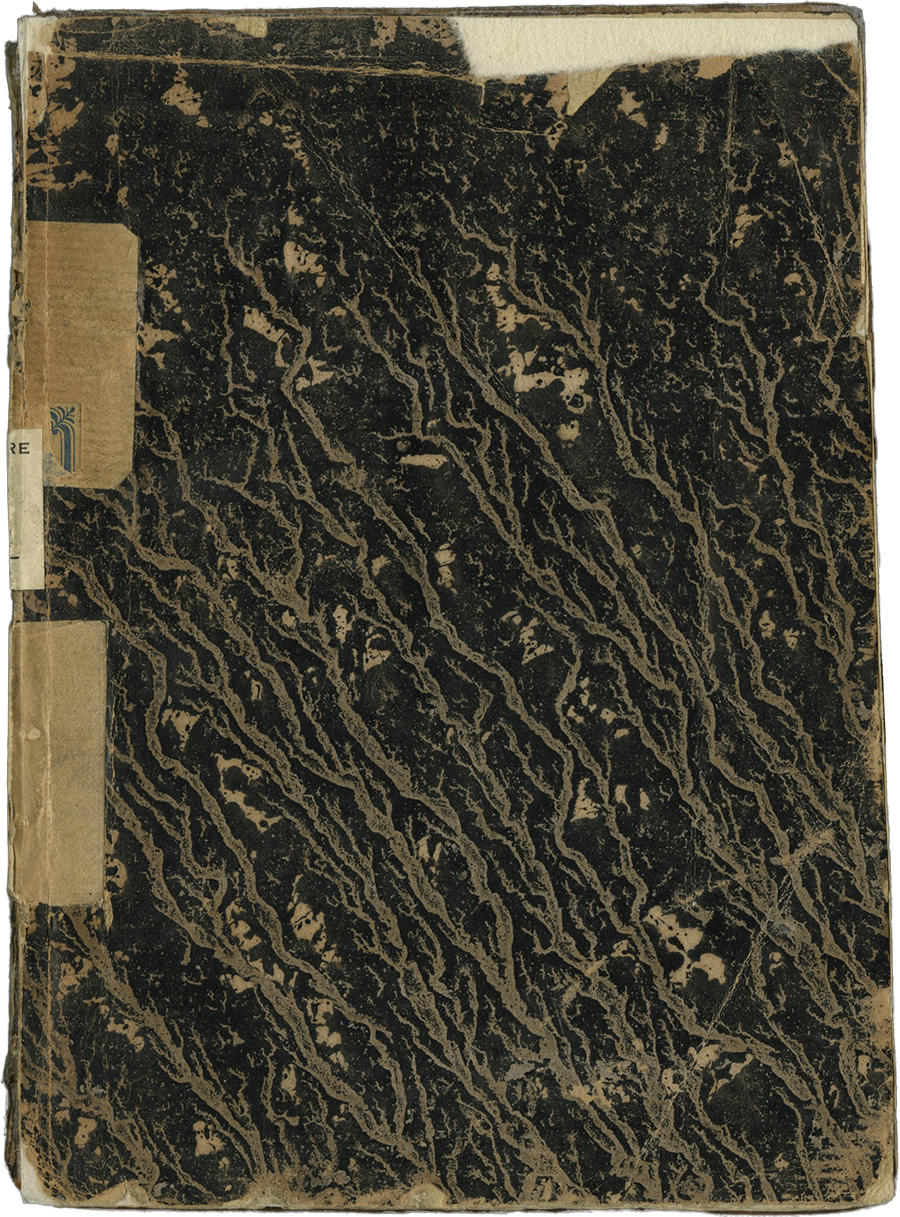
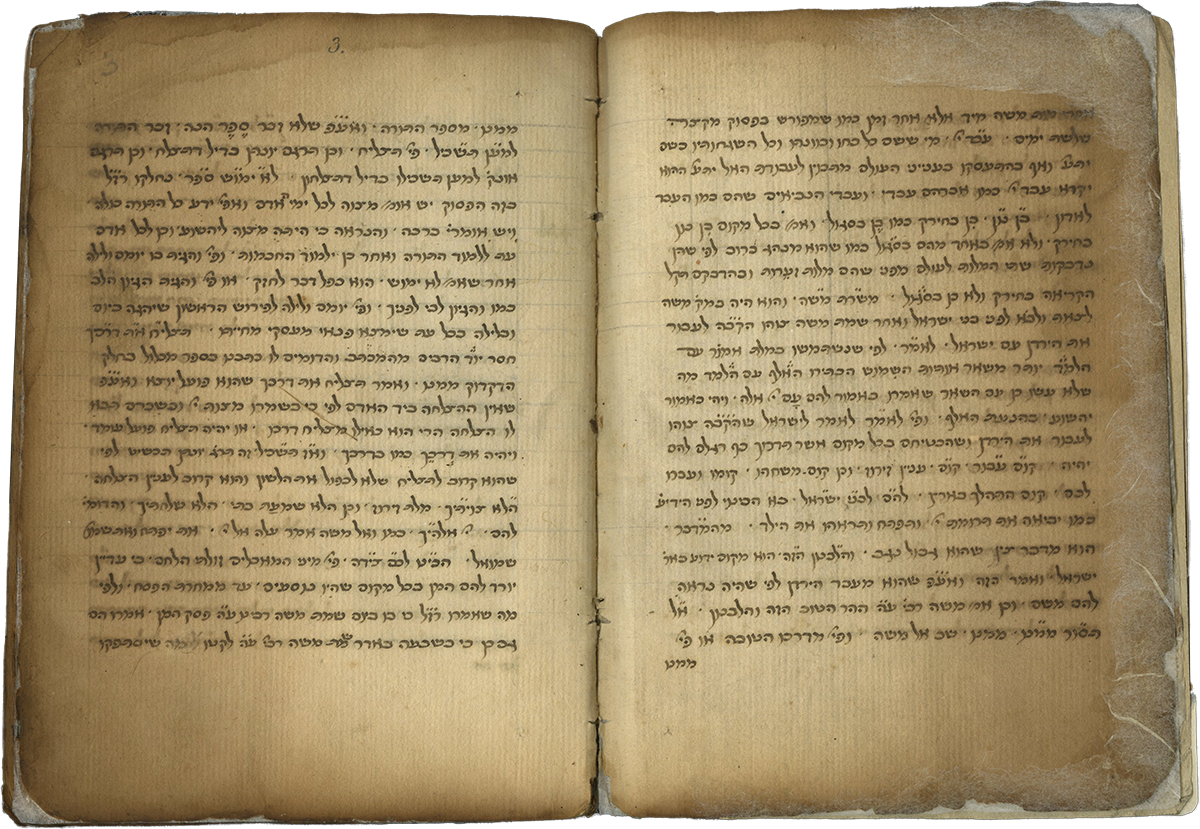
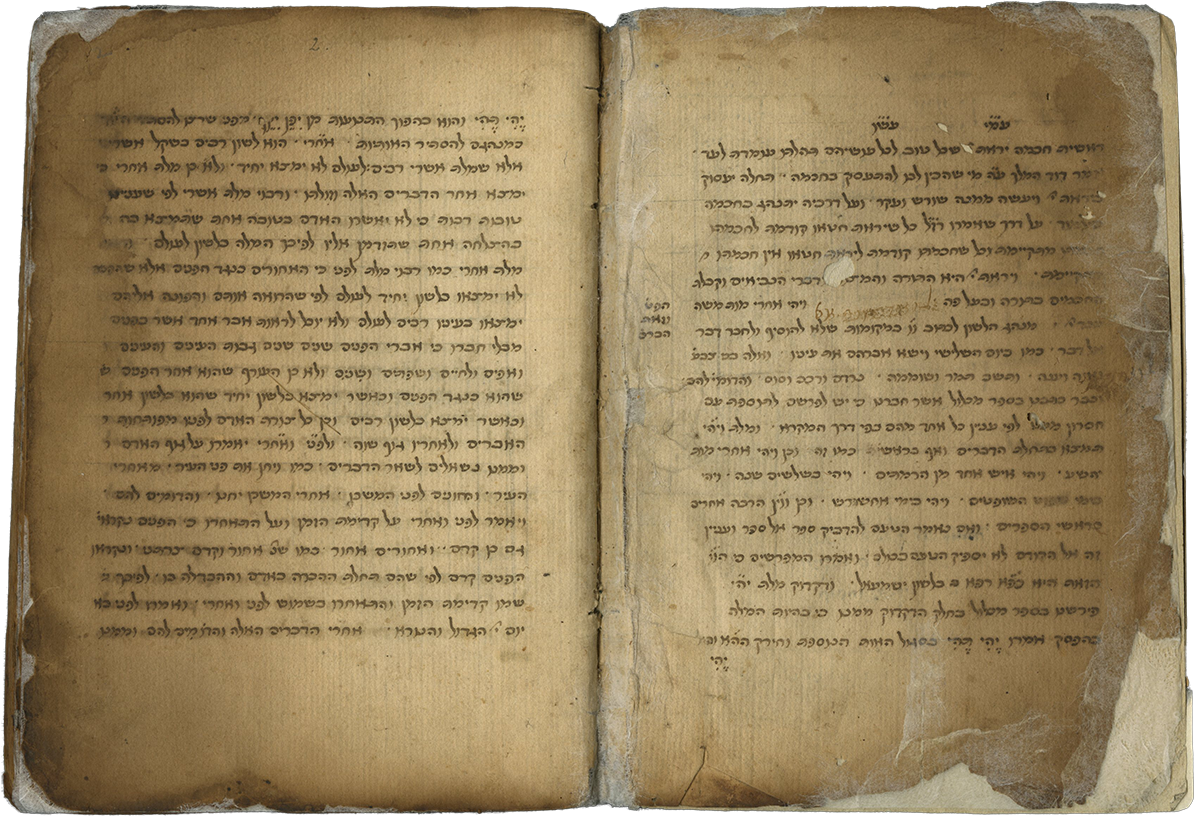
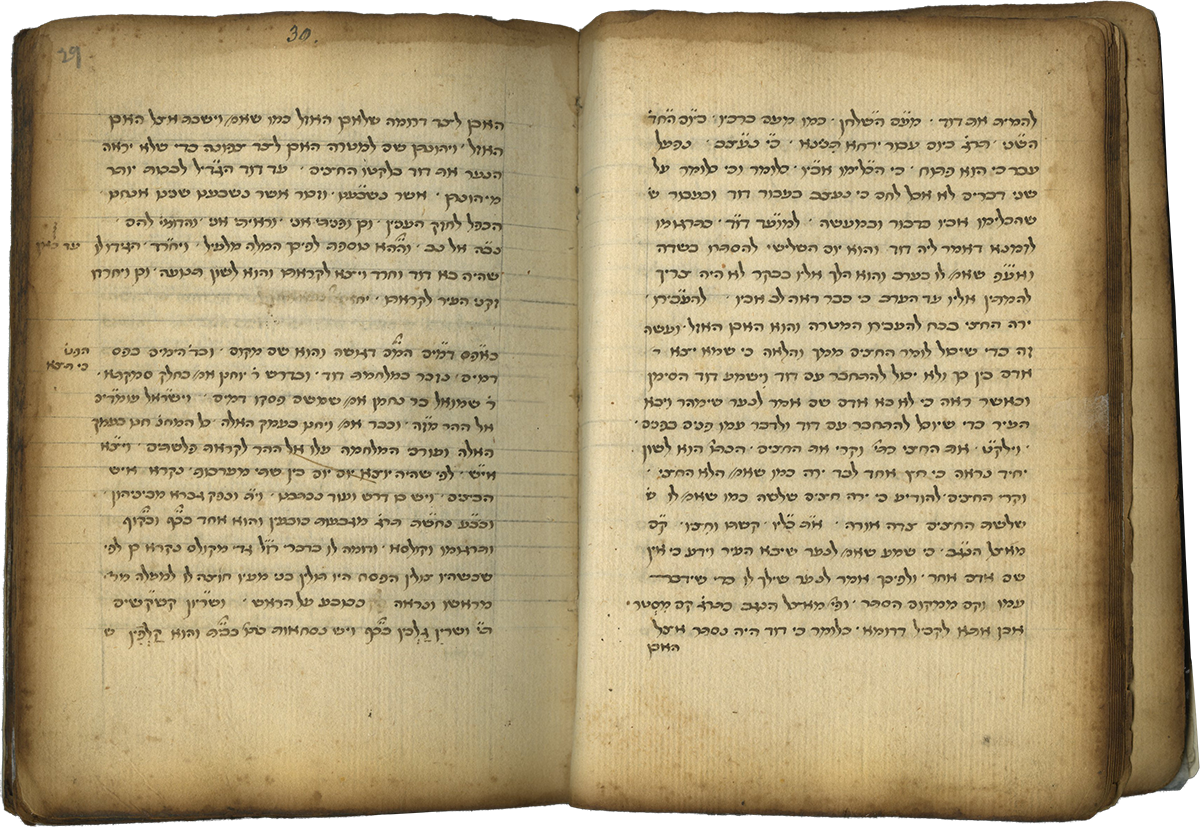
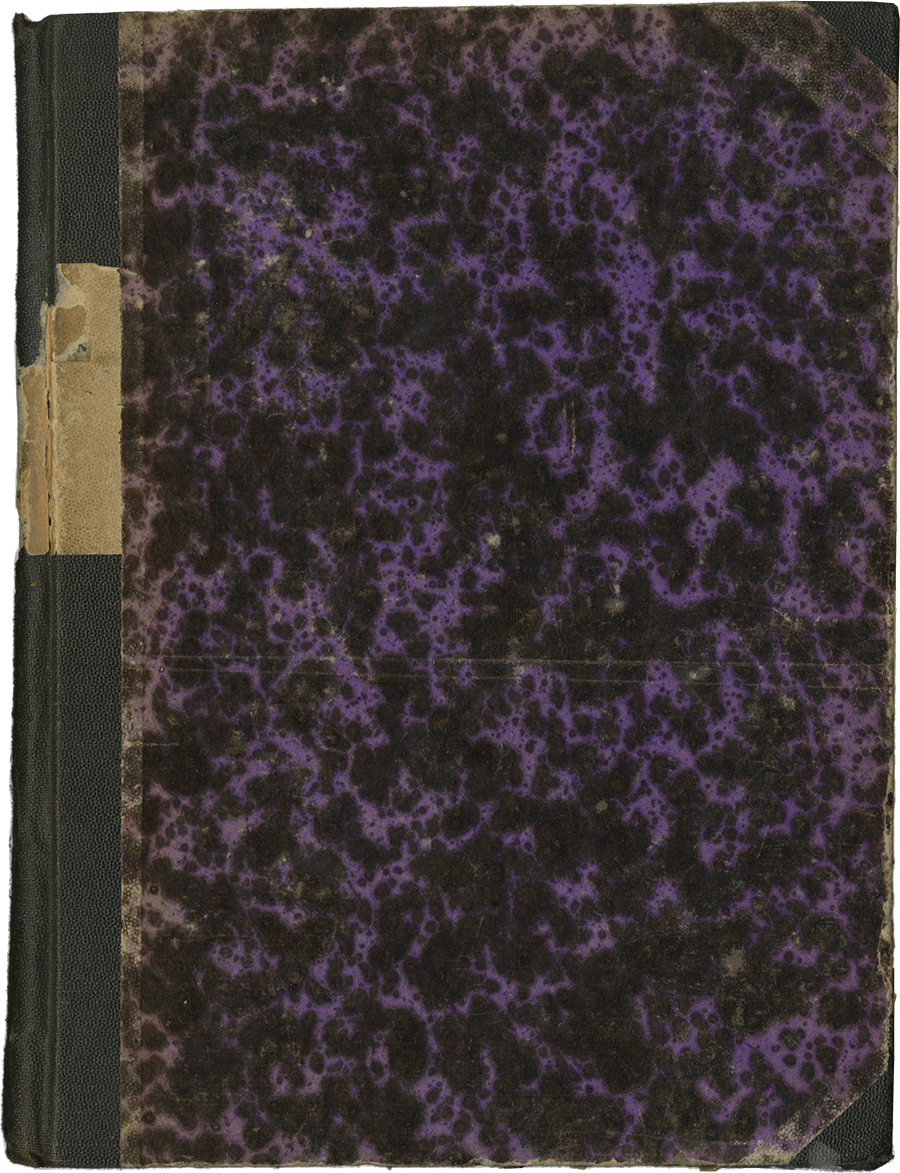
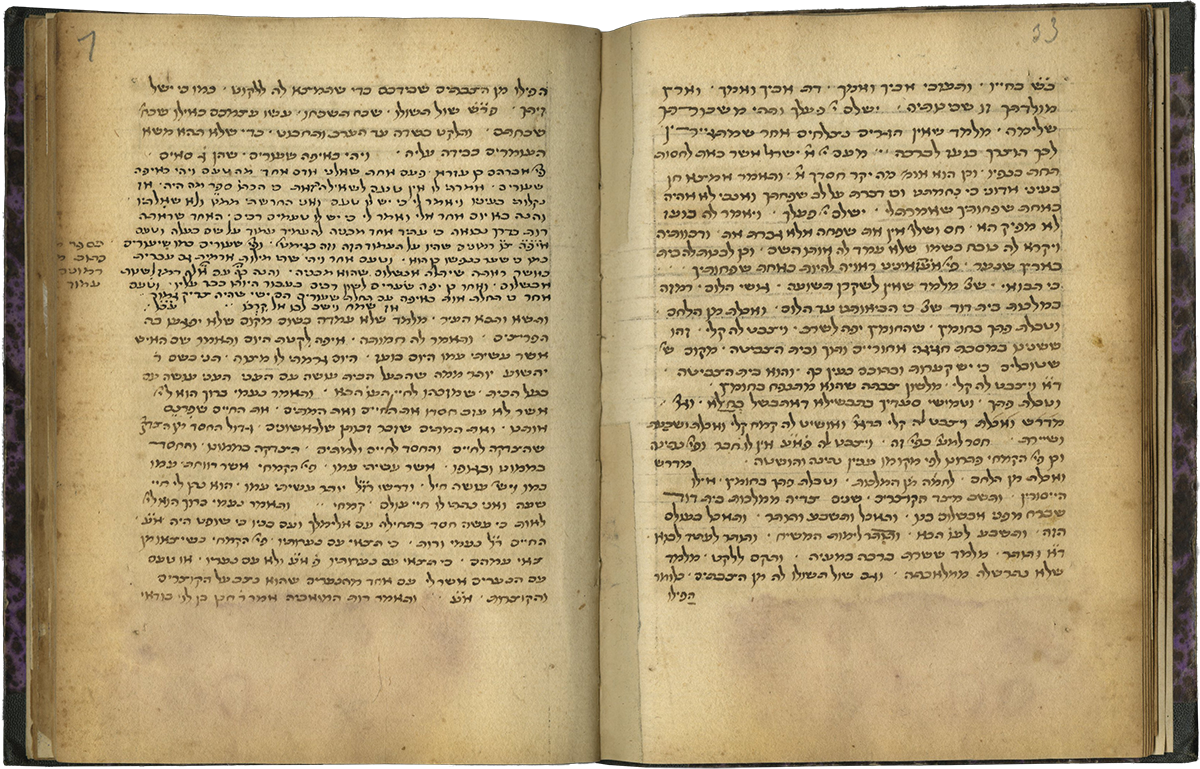
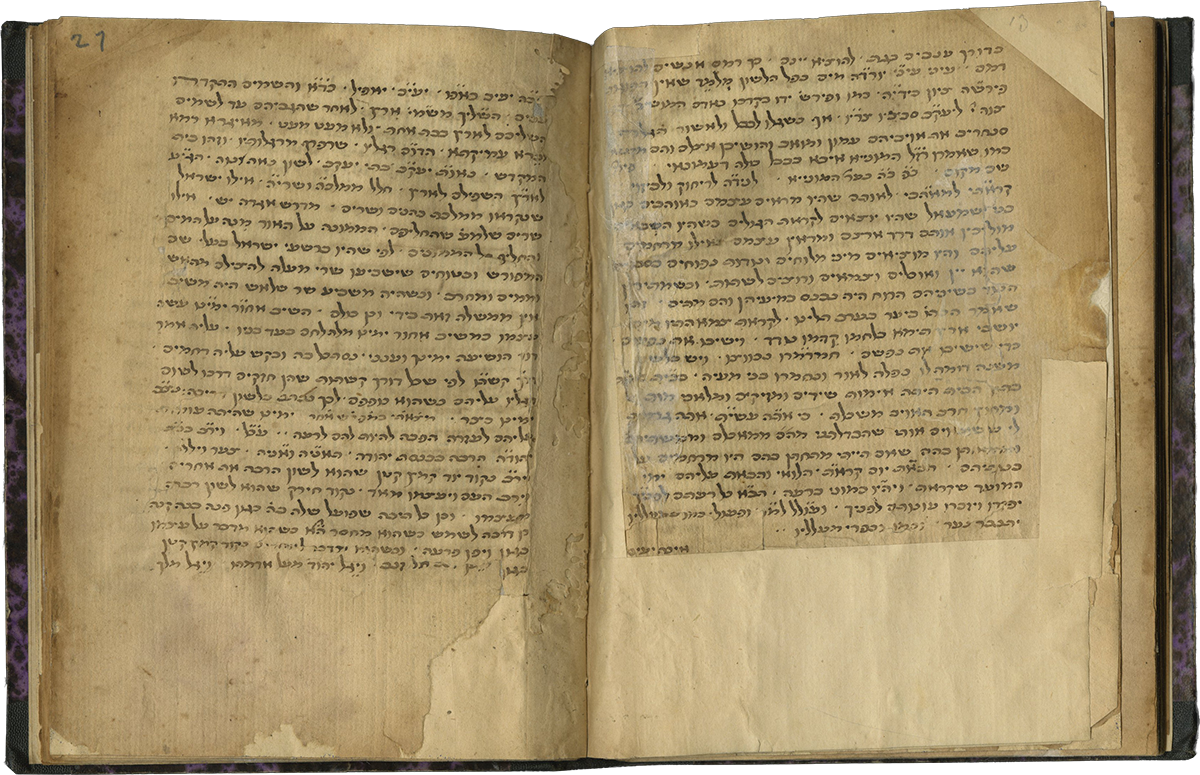
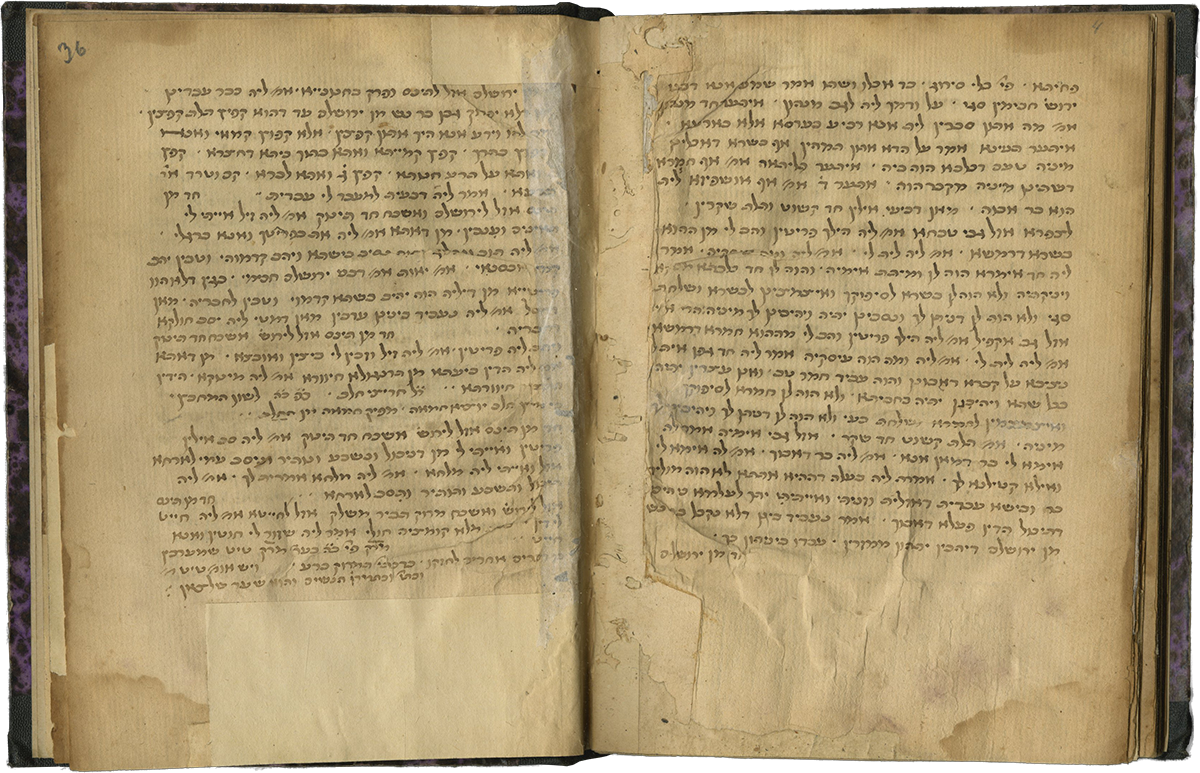
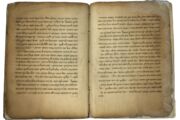
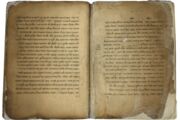
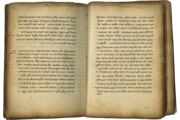
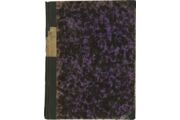
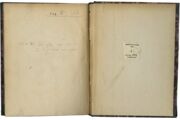
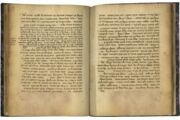
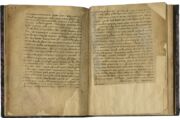
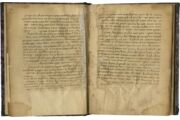
Two volumes: Volume 1: i + 65 + i folios on paper, 2 folios (ff. 56, 67) on parchment, modern foliation in pen in Arabic numerals in center at head of rectos (1-28, 30-68), modern foliation in pencil in Arabic numerals in upper-outer corner of rectos (1-67) (cited), complete (collation i-ii20 iii15 [iii9 canceled, with stub present] iv12), for ff. 1-50: horizontal catchwords, ruled in plummet (justification approximately 127 x 100 mm.), single-column text written in an elegant Italian semi-cursive script in brown ink in 21 lines, justification via insertion of space fillers, abbreviation, use of anticipatory letters, and dilation or contraction of final letters, Tetragrammaton abbreviated to the letter yod followed by an apostrophe, periodic vocalization, episodic marginalia and corrections in primary hand, occasional erasure, doodle in margin of f. 56, slight scattered staining, heavier on f. 1, dampstaining in outer edges throughout, small repairs in edges of some leaves (e.g., ff. 1-2), some corners rounded, small holes in lower margin of f. 10, inner margin of f. 11, upper-outer corner of f. 23, outer edge of f. 57, outer margins of ff. 59, 65, and across f. 66, gutters of ff. 40-42, 59 strengthened, slit across much of f. 48, f. 56 tightly bound with resulting loss of legibility of text in gutter, small worm tracks on ff. 61-66 affecting only individual letters, lower-outer corner of f. 67 repaired without loss of text. Nineteenth-century marbled paper wrapper, worn and torn, especially along spine, nineteenth-century paper pastedowns and flyleaves. Dimensions 195 x 135 mm. Volume 2: i + 38 + i folios on paper, modern foliation in pencil in Arabic numerals in upper-outer corner of versos running from rear to fore, modern foliation in pencil in Arabic numerals in upper-outer corner of rectos running from fore to rear (cited), incomplete (collation i24 ii14), horizontal catchwords, ruled in plummet (justification approximately 120 x 100 mm.), single-column text written in an elegant Italian semi-cursive script in brown ink in 21-25 lines, justification via insertion of space fillers, abbreviation, use of anticipatory letters, and dilation or contraction of final letters, Tetragrammaton abbreviated to the letter yod followed by an apostrophe, periodic vocalization, episodic marginalia and corrections in primary hand, manicule on f. 28v, slight scattered staining, gutters strengthened throughout, small repairs in edges of some folios, an unknown number of folios lacking after ff. 24v, 38v, lower-outer corner of f. 1 repaired with some loss of text, small hole in the middle of f. 4 not affecting text, marginal worm tracks on ff. 17-24, lower-outer corner of f. 20 lacking without loss of text, tape repairs to tears on ff. 25-38 with some loss of text, sometimes serious. Nineteenth-century marbled paper over boards, bumped and worn, cloth spine. Dimensions 177 x 130 mm.
Biblical exegesis was an evergreen genre among medieval Jewish scholars. Some scribes copied commentaries in full, while others selected those portions necessary for their or their patrons’ own studies; the present manuscript features both types of works. Its preservation of readings that differ in many cases from the printed editions of these texts is particularly significant for their textual history, especially with regard to those surviving in relatively few copies.
Provenance
1. According to Abraham Berliner (1881), these two volumes, together with a third now split between the Jewish Historical Institute in Warsaw (Ms. 260) and the Bibliothèque nationale de France in Paris (Ms. hébreu 1467), originally comprised a single manuscript copied primarily by a single scribe, Shabbetai ha-Levi ben Judah ha-Levi, who signed his name several times in the Warsaw and Paris portions of the work in the Hebrew year 5186 (1426) in Ascoli, Rieti, and Siena. Three of these colophons make it clear that he produced this manuscript for himself and/or his children. We do not know whether our volumes were copied in one of the above cities or in some other part of Central Italy, but it is assumed that the year of production was the same.
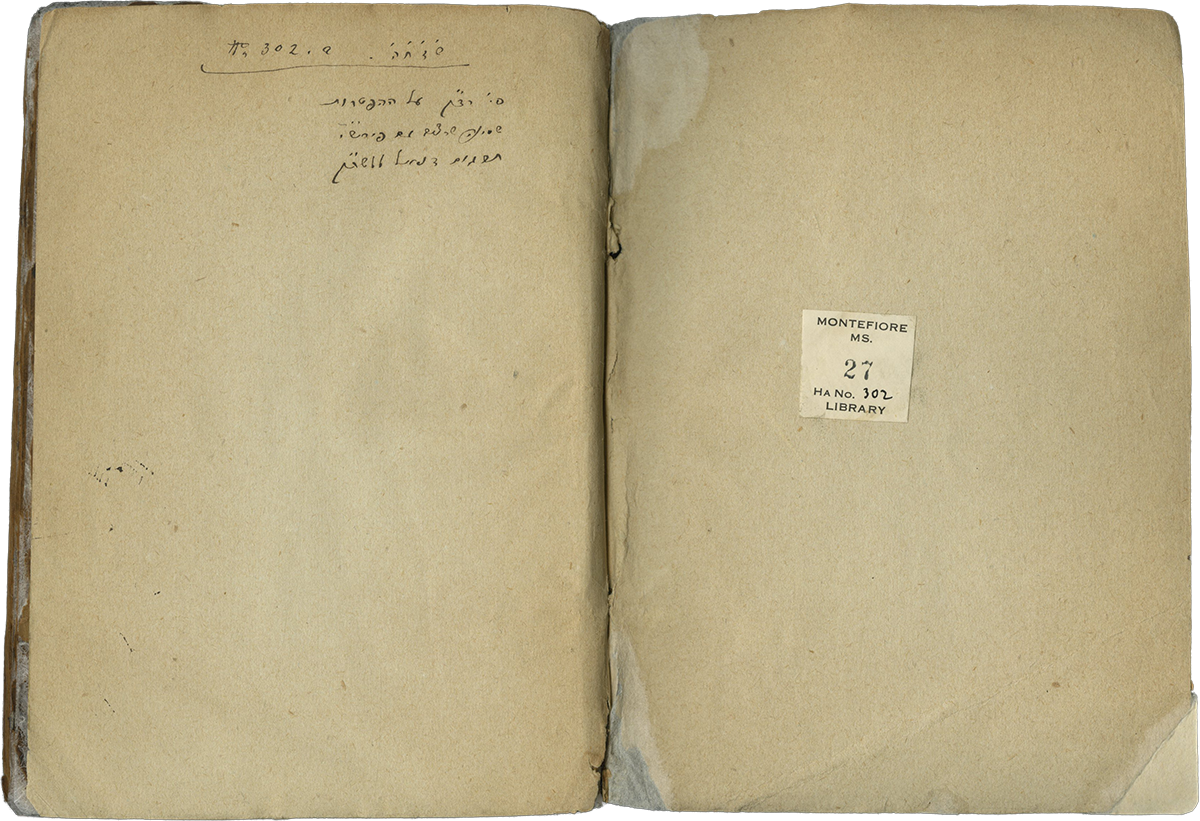
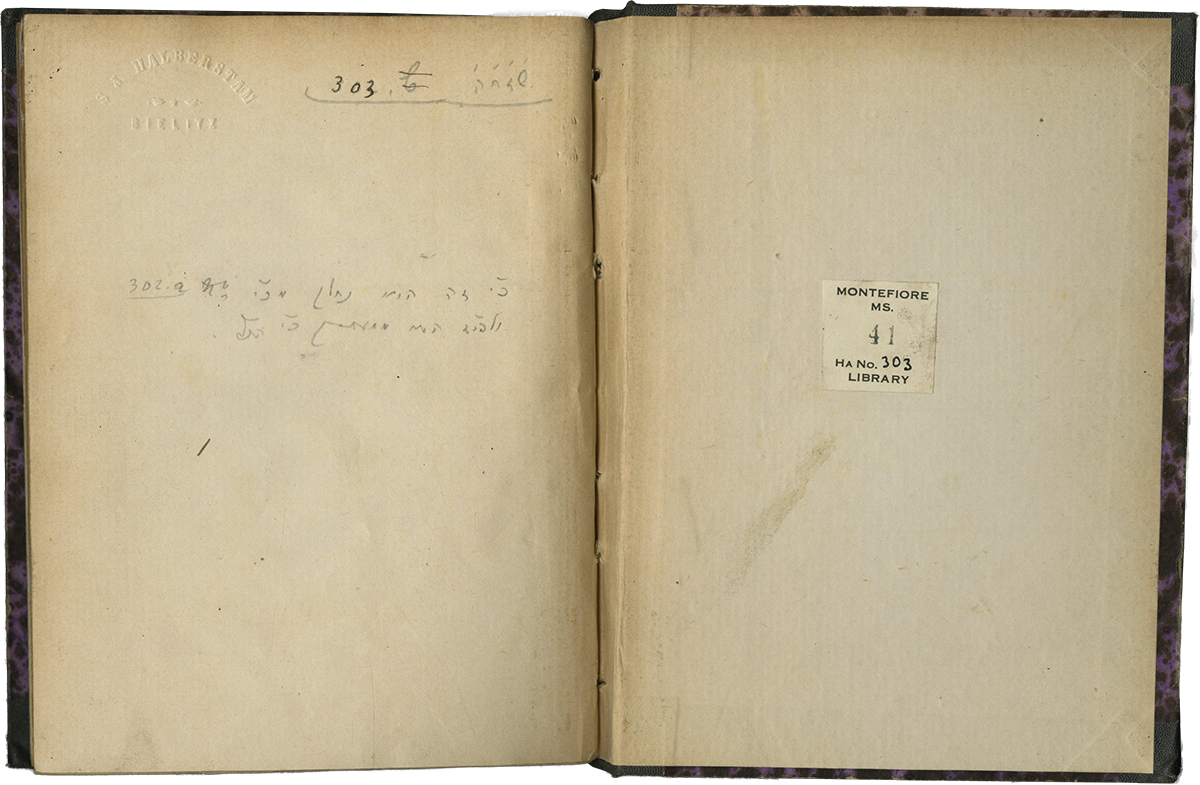
2. In Adar 5633 (February-March 1873), Solomon Joachim Halberstam (1832-1900), a wealthy Polish Jewish scholar and bibliophile, bought this codex from the Jerusalem author and bookseller Rabbi Nahman Nathan Coronel (1810-1890) (New York, The Library of the Jewish Theological Seminary of America, Ms. 2823, f. 31v). It appears that the manuscript was then divided into three volumes numbered 302a, 302b, and 302c. Halberstam inscribed these original shelf marks in pen on the upper flyleaf and f. 1 of Ms. 302a (our Volume 1) and on the upper flyleaf of Ms. 302b (our Volume 2) but subsequently renumbered them 302 and 303, respectively (Ms. 302c became 304). He also provided a brief overview of their contents on those flyleaves and on paper tickets adhering to the volumes’ spines (now mostly abraded), as well as when he printed the catalog of his collection in 1890.
3. The Judith Lady Montefiore College in Ramsgate, England, purchased 412 manuscripts from Halberstam’s collection, including the present ones. The transaction was carried out by Rabbi Moses Gaster (1856-1939), principal of the college between 1891 and 1896. The codices bear the library stamp of the institution, known in Hebrew as Yeshivat Ohel Mosheh vi-Yehudit, on ff. 1, 67v (Volume 1) and ff. 1, 38v (Volume 2), as well as paper tickets with the Halberstam (302, 303) and Montefiore (27, 41) shelf marks on the spines (again, now mostly abraded) and upper pastedowns (Hirschfeld, 1904).
4. Between 1898 and 2001, most of the Montefiore manuscripts, including ours, were placed on permanent loan at Jews’ College in London. In 2001, they were returned to the Montefiore Endowment Committee.
5. The volumes were offered at Sotheby’s New York on October 27, 2004 (lot 26), without result.
Text
Volume 1
f. 1, an amulet against the Evil Eye, incipit, “ke-ha neged ha-ayin ha-ra… be-shem h[a-shem] elokei yisra’el amen,” followed by the first line of the poem Ahalleh le-koni;
ff. 1v-50v, selections from Rabbi David Kimhi’s Commentary on the Prophets, incipit, “reshit hokhmah yir’at [ha-shem] sekhel tov le-kol oseihem tehillato omedet la-ad… ve-ken peiresh ve-gam me-hem ekkah la-kohani[m] ve-la-leviyyim am[ar ha-shem]”; [ff. 51-55v largely blank];
ff. 56r-v, 67, Rabbi Judah ben Benjamin Anav’s commentary on a portion of Rabbi Isaac Alfasi’s digest of Babylonian Talmud Tractate Shabbat 107a-109a, incipit, “shemonah sheratsim ha-holed ve-ha-akhbar ve-go[mer]… ve-ein tsarikh littol reshut mi-beit din lammah li ka-tanei”;
ff. 57-63, a Hebrew translation of the Aramaic section of the book of Daniel, incipit, “va-yedabberu ha-kasdim la-melekh bi-leshon aram… ve-ha-davar be-libbi nishmeret tam ve-nishlam t[ehillah] l[e-e-l] o[lam]”; [ff. 63v-66v largely blank].
Volume 2
ff. 1-12, Rabbi Tobias ben Eliezer’s Midrash lekah tov on the book of Ruth, with various exegetical interpolations, incipit, “peirush sefer rut im ketsat ha-derashot… aval ke-she-hem aniyyim hem mit‘assekim ba-torah she-hem re‘eivin u-mit‘assekim be-lev tov nishlam pei[rush] rut”;
ff. 12v-24v, Rashi’s commentary on the Song of Songs, with additions from Midrash lekah tov, incipit, “be-shem mashpi[l] u-merim athil va-asayyem pei[rush] shir ha-shirim… memulla’im ba-tarshish leshon even yekarah”;
ff. 25-33, Rashi’s commentary on the book of Lamentations, with various exegetical interpolations, incipit, “megillat eikhah lefi mah she-matsati be-he‘tek hu me-rabbeinu shelomoh z[ikhrono] l[i-berakhah]… mi-penei she-mesayyem be-divrei tokheihah huzkak li-kefol mikra she-lefanav ve-ken kohelet vi-yesha‘y[ahu]”;
ff. 33v-38v, excerpts from the midrashic work Eikhah rabbah on the book of Lamentations, incipit, “ekhtov kan ketsat me-ha-derashot eikhah be-kitsur ahat min ha-sibbot she-eineni mevin pitronam pitron ha-millot… u-zekhary[ah] amar od [yeshevu] zekenim u-zekeinot be-sha‘arei [yerushalayim ve-i]sh mish‘anto be-yado.”
Rabbi David Kimhi (Radak; c. 1160-c. 1235), grammarian and lexicographer, is also one of the most popular Jewish biblical exegetes of all time. His glosses to the Prophets, in particular, have served generations of students seeking an accessible, plain-sense understanding of Scripture. Manuscripts of his various commentaries survive in hundreds of codices and fragments copied throughout the Jewish Diaspora. One of these, Volume 1 of the present manuscript, mainly comprises Radak’s comments to the verses that make up several of the haftarot, the lections from the Prophets read weekly in the synagogue. The haftarot included are, in order, as follows: Parashat ve-zot ha-berakhah (Simhat Torah), Parashat shelah, Rosh Hashanah (both days), Parashat ki tetse, Parashat zakhor, Parashat hayyei sarah, Parashat va-yehi, Parashat va-yera, Parashat shekalim, and Shabbat hol ha-mo‘ed sukkot, interspersed with his comments on numerous other verses. Other manuscripts and fragments containing Radak’s comments to verses from the haftarot can be found in several public and at least one private collection, suggesting that the idea of cherry-picking his glosses in this way was not unique to our scribe, Shabbetai ha-Levi ben Judah ha-Levi.
It seems that Shabbetai himself appended at the end of Volume 1 a single quire comprising a parchment bifolium containing the comments of Rabbi Judah ben Benjamin Anav (c. 1215-1280) to Rabbi Isaac Alfasi’s (1013-1103) digest of a small part of Tractate Shabbat, as well as five paper bifolia containing a translation of the book of Daniel’s Aramaic section (2:4-7:28) into Hebrew. Both texts feature marginalia apparently written in Shabbetai’s hand. Anav’s commentary on Shabbat was published for the first time based on a London manuscript (British Library, Ms. Add. 26901) (Blau, 1987), though at least one other copy of the work is preserved in Moscow (Russian State Library, Ms. Guenzburg 108). The translation of Daniel’s Aramaic verses into Hebrew was not unheard-of in the past, with at least seven other manuscripts or fragments of such a translation extant, all part of institutional collections. The editio princeps of a slightly different Hebrew translation of Daniel’s Aramaic was published in Leiden in 1685, with a few other editions having appeared subsequently.
Volume 2 is composed of a series of commentaries on three of the Five Scrolls—namely, Ruth, Song of Songs, and Lamentations—that combine plain-sense and homiletical approaches to the text. The gloss to Ruth is essentially a copy of Midrash lekah tov on Ruth by Rabbi Tobias ben Eliezer (late eleventh-early twelfth century), a Greek scholar who anthologized rabbinic homiletical material from various sources and arranged it in the form of a commentary, sometimes including his own explanations as well. Shabbetai (or a scribe who produced the text from which he was copying) interpolated into the Midrash various glosses by some of the greatest plain-sense commentators of the Middle Ages, including Rashi (1040-1105), Rabbi Abraham Ibn Ezra (c. 1089-c. 1164), and Radak. Midrash lekah tov on Ruth is preserved in probably fewer than a dozen other codices, all held by institutional libraries, and was first published in Mainz in 1887.
By contrast, the gloss to the Song of Songs is basically a copy of Rashi’s commentary thereon interspersed with some Midrash lekah tov material, mostly concentrated toward the beginning of the biblical book. The gloss ends at Song 5:14a, with the remainder of the text apparently lacking. The gloss to Lamentations, too, is chiefly comprised of Rashi’s commentary, spiced with some explanations from Radak and an unidentified “different commentator.” Finally, the last section of Volume 2 contains excerpts from Eikhah rabbah, one of the earliest midrashic collections extant, commenting on select verses from the book of Lamentations. Like the gloss to the Song of Songs, it cuts out at the end. Eikhah rabbah, or selections therefrom, survives in numerous codices and was first printed in Pesaro in 1519 (or, possibly, in Constantinople five years earlier).
It should be noted that Volume 3 of this manuscript set, now split between the Jewish Historical Institute in Warsaw and the Bibliothèque nationale de France in Paris, comprises a number of commentaries/midrashim on the book of Esther (as well as other exegetical and legal material), continuing the theme observed in Volume 2 vis-a-vis Ruth, Song of Songs, and Lamentations.
Literature
Berliner, Abraham. “Eine seltene Privat-Bibliothek,” Magazin für die Wissenschaft des Judenthums 8 (1881), pp. 108-116.
Blau, Moshe Yehuda ha-Kohen, ed. Shittat ha-kadmonim al massekhet shabbat kolel peirushei rabbeinu yehudah be-r[abbi] binyamin ha-rofe, pp. 207-209, New York, 1987.
Halberstam, Solomon Joachim. Kohelet shelomoh, pp. 51-52 (nos. 302-303), Vienna, 1890.
Hirschfeld, Hartwig. Descriptive Catalogue of the Hebrew MSS. of the Montefiore Library, pp. 6, 8 (nos. 27, 41), London and New York, 1904.
Ilan, Nahem. “‘Lekah tov’ le-rabbi toviyyah ben eli‘ezer: midrash o peirush?” in Al yad yehi’el: kovets mehkarim u-ma’amarim muggash li-yechiel kara im perishato le-gimla’ut, ed. Shalom Pinhas-Cohen, pp. 175-186, Kiryat Ono, 2018.
Jacobs, Jonathan. “Peirush ‘lekah tov’ al shir ha-shirim: mekomo be-toledot parshanut shir ha-shirim ve-yahaso le-peirush rashi la-megillah,” Shenaton le-heker ha-mikra ve-ha-mizrah ha-kadum 23 (2014), pp. 225-241.
Rabbinovicz, Raphael Nathan Nata. Sefer dikdukei soferim, vol. 8, p. v, Munich, 1877.
Richler, Benjamin. “Ketuvei-yad ivriyyim she-nitpatselu,” Asuppot 1 (1987), pp. 105-158.
Walfish, Barry Dov. “Bibliyyogerafyah mu‘eret shel ha-parshanut ha-yehudit al shir ha-shirim mi-yemei ha-beinayim,” in Ha-mikra bi-re’i mefareshav: sefer zikkaron le-sarah kamin, ed. Sara Japhet, pp. 518-571, Jerusalem, 1994.
Online Resources
Our MSS
https://www.nli.org.il/he/manuscripts/NNL_ALEPH990001745670205171/NLI
https://www.nli.org.il/he/manuscripts/NNL_ALEPH990001686360205171/NLI#$FL32097191
Formerly Ms. Halberstam 304 (now split between Warsaw, Jewish Historical Institute, Ms. 260, and Paris, Bibliothèque nationale de France, Ms. hébreu 1467)
https://www.nli.org.il/he/manuscripts/NNL_ALEPH990001169620205171/NLI#$FL49982332
https://www.nli.org.il/he/manuscripts/NNL_ALEPH990001169610205171/NLI
https://archivesetmanuscrits.bnf.fr/ark:/12148/cc5326n
Analysis of the copyist’s script
https://www.hebrewpalaeography.com/data/specimens/902/?tab=details
Sotheby’s New York sale, October 27, 2004 (lot 26)
https://www.sothebys.com/en/auctions/ecatalogue/2004/important-hebrew-manuscripts-from-the-montefiore-endowment-n08040/lot.26.html
Editio princeps of the Hebrew translation of Daniel’s Aramaic (Leiden, 1685)
https://www.nli.org.il/he/books/NNL_ALEPH990022111390205171/NLI
Editio princeps of Midrash lekah tov on Ruth (Mainz, 1887)
https://www.hebrewbooks.org/39307
Editio princeps of Eikhah rabbah (Pesaro, 1519)
https://www.nli.org.il/he/books/NNL_ALEPH990019871090205171/NLI
TM 1438