

Dominican Antiphonal, Summer Part
In Latin, illuminated manuscript on parchment
Spain, Baena, 1522
TM 1223
sold
 Textmanuscripts - Les Enluminures
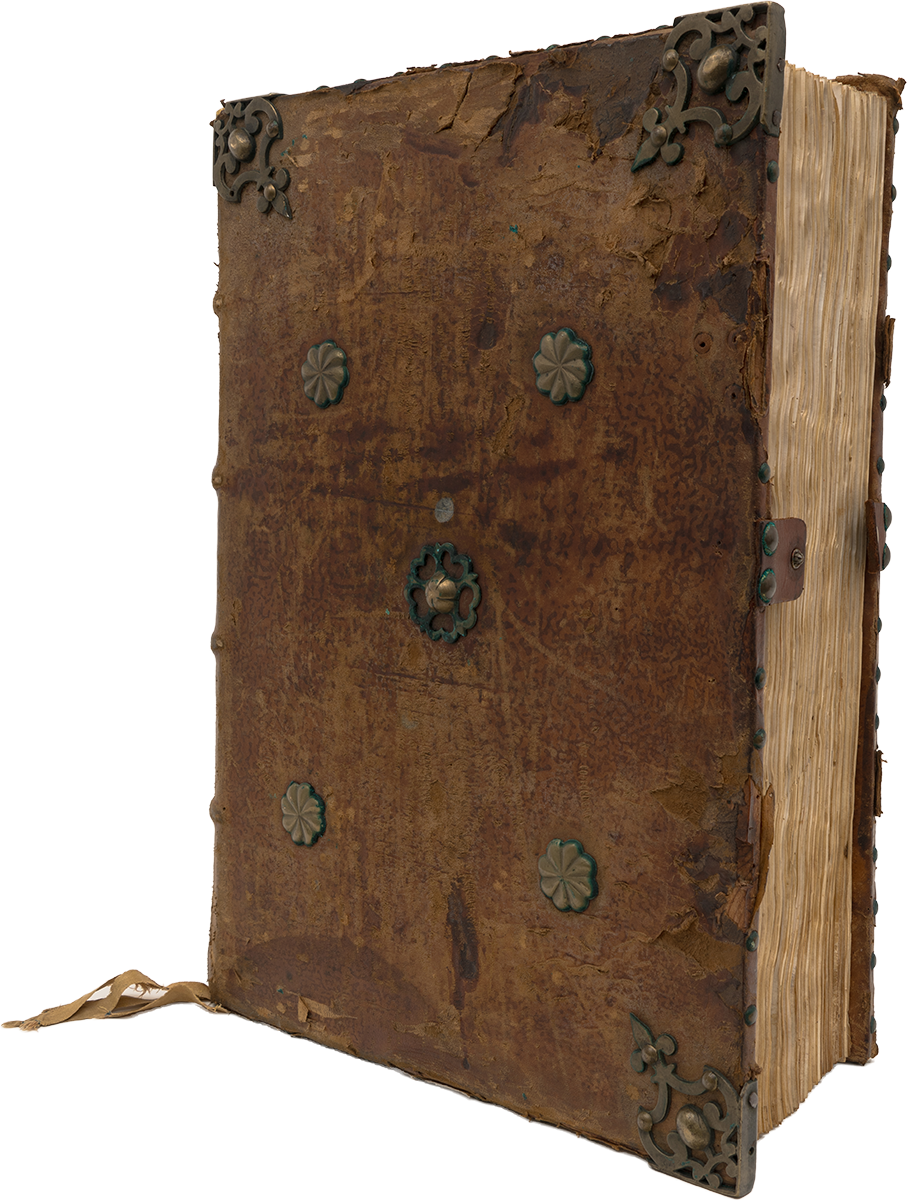
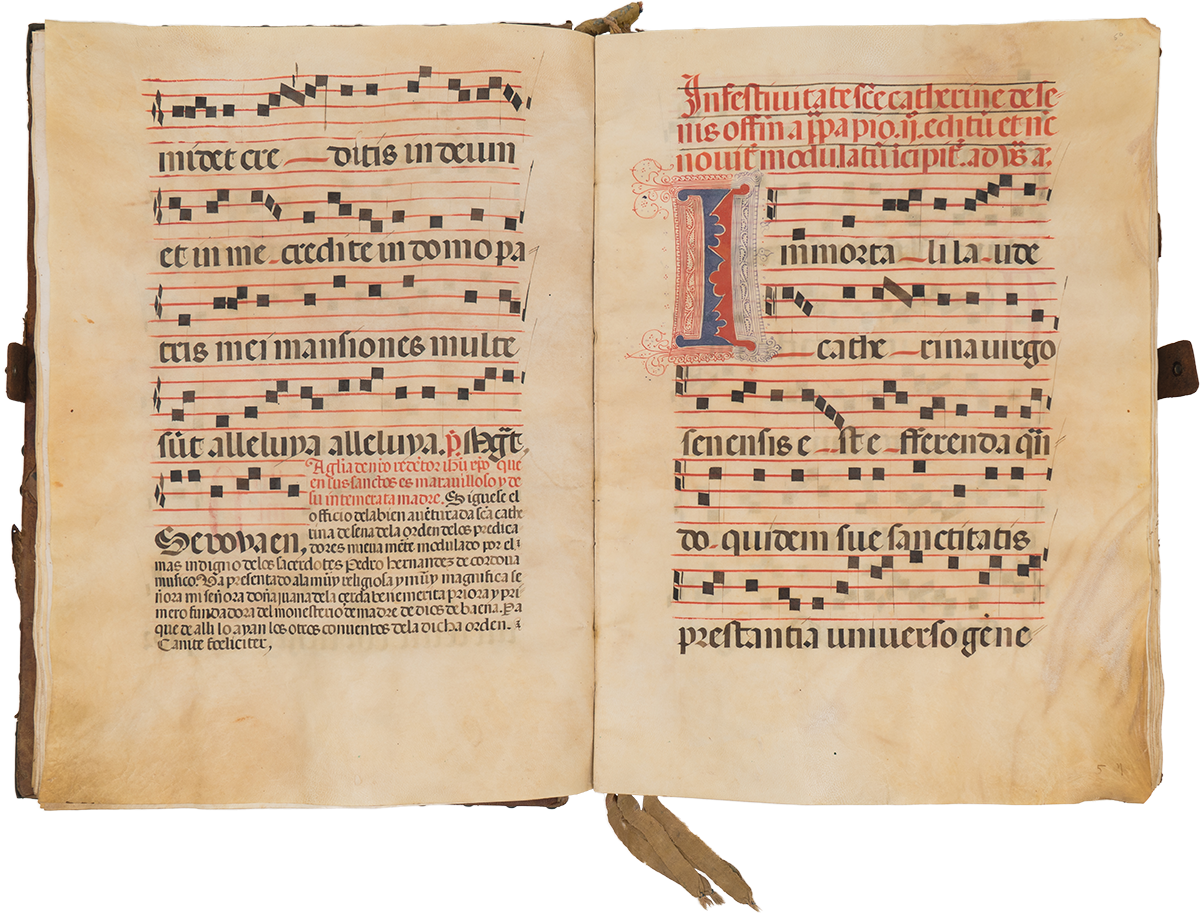
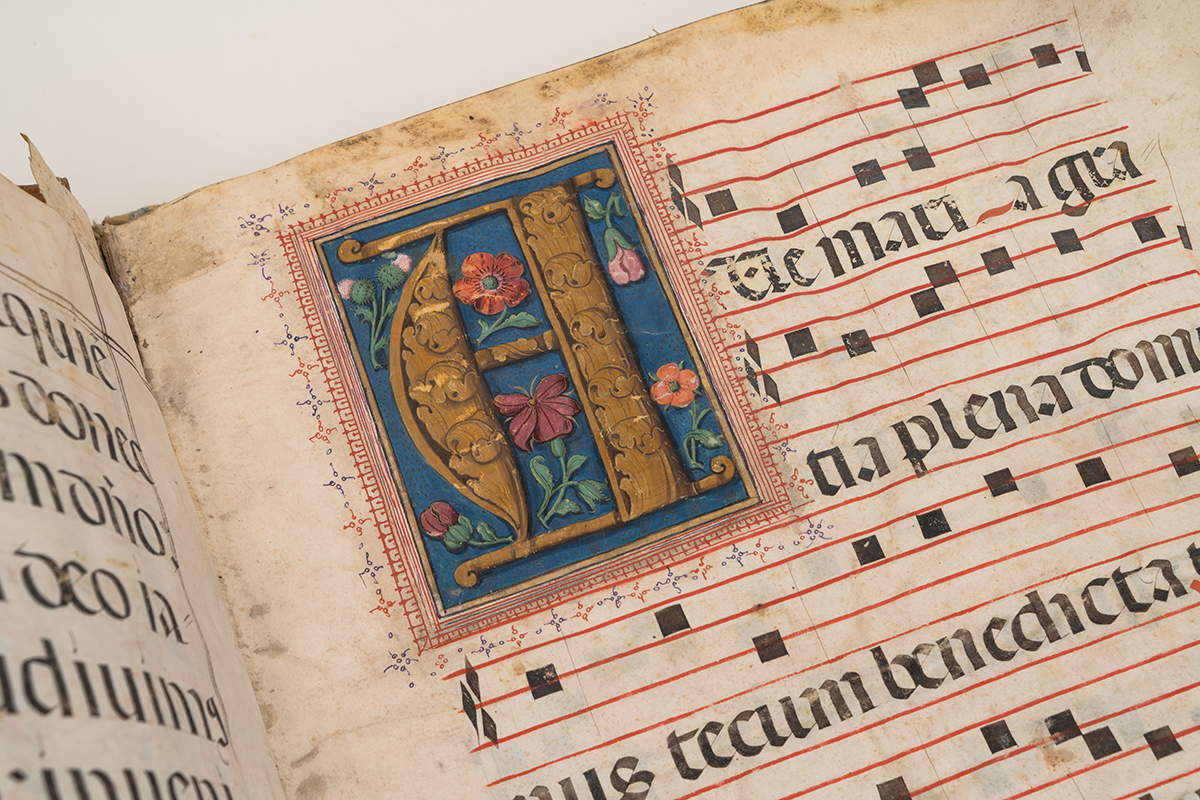
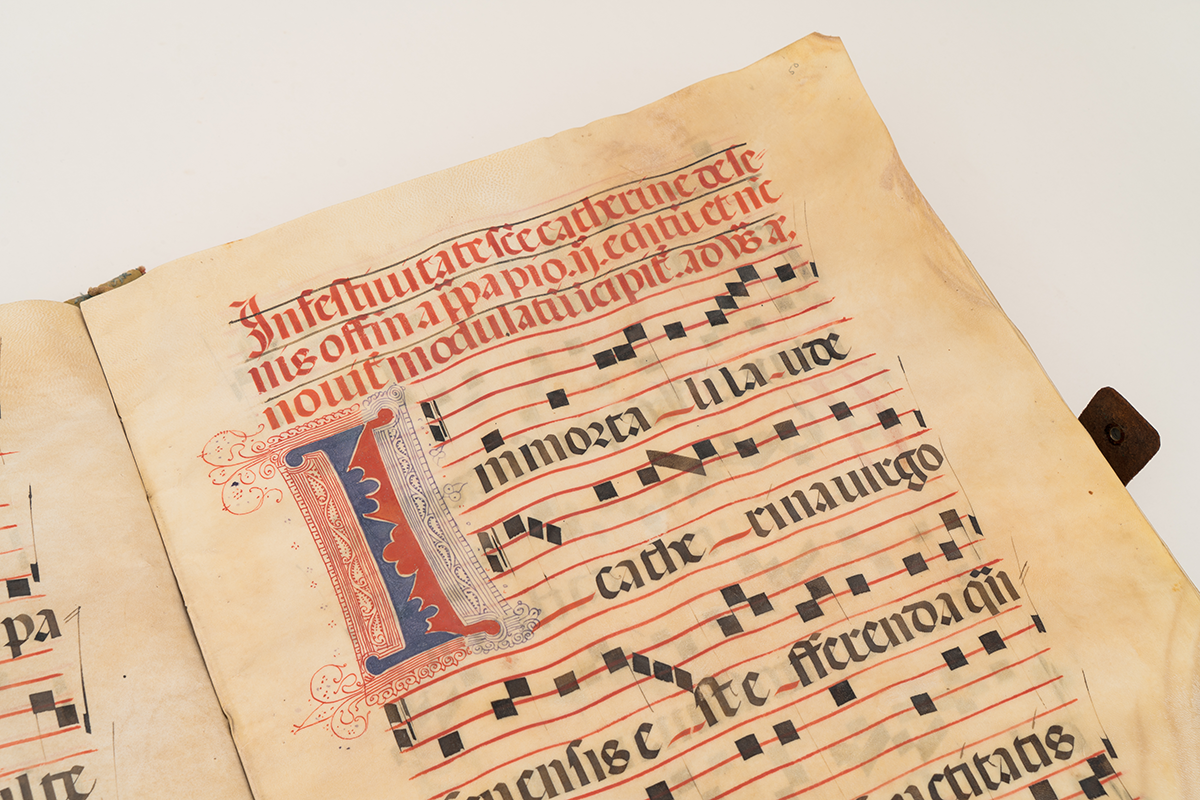
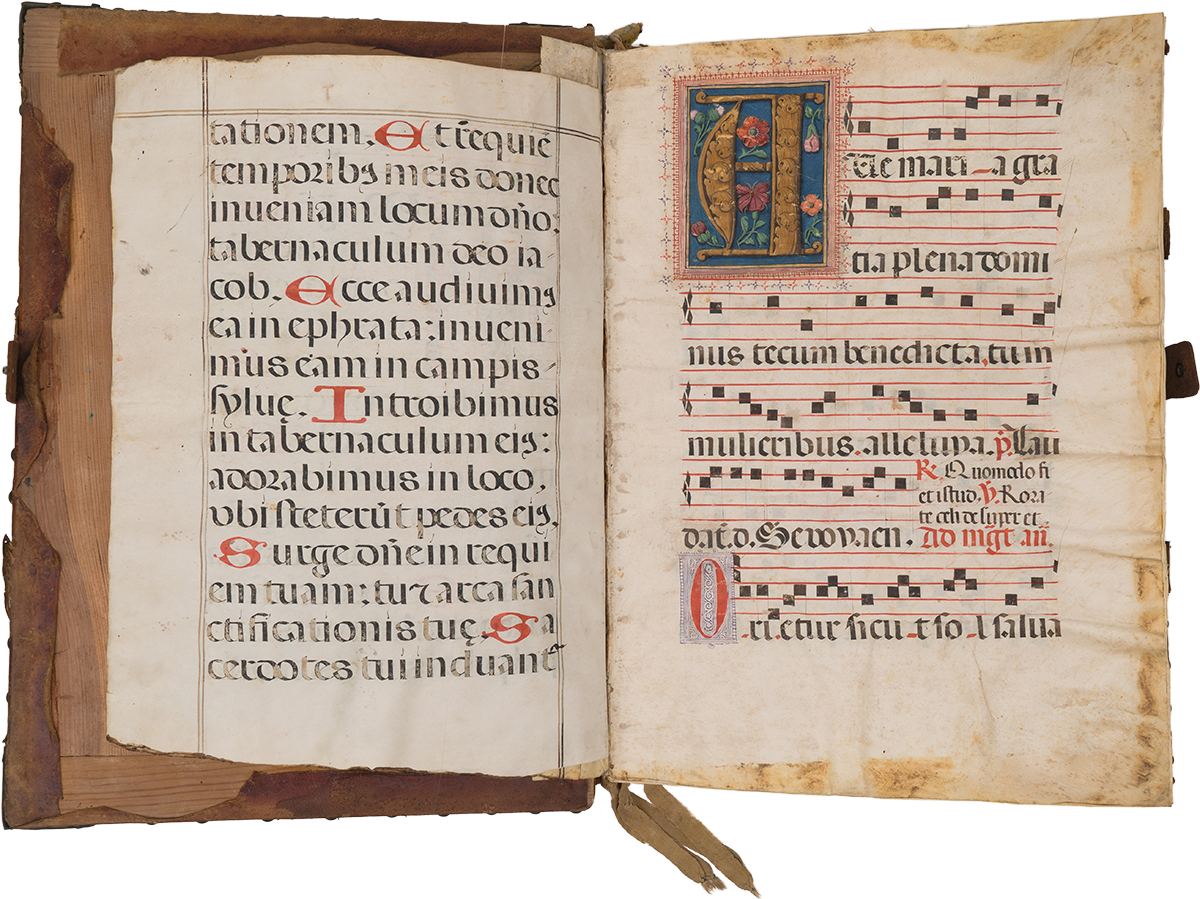
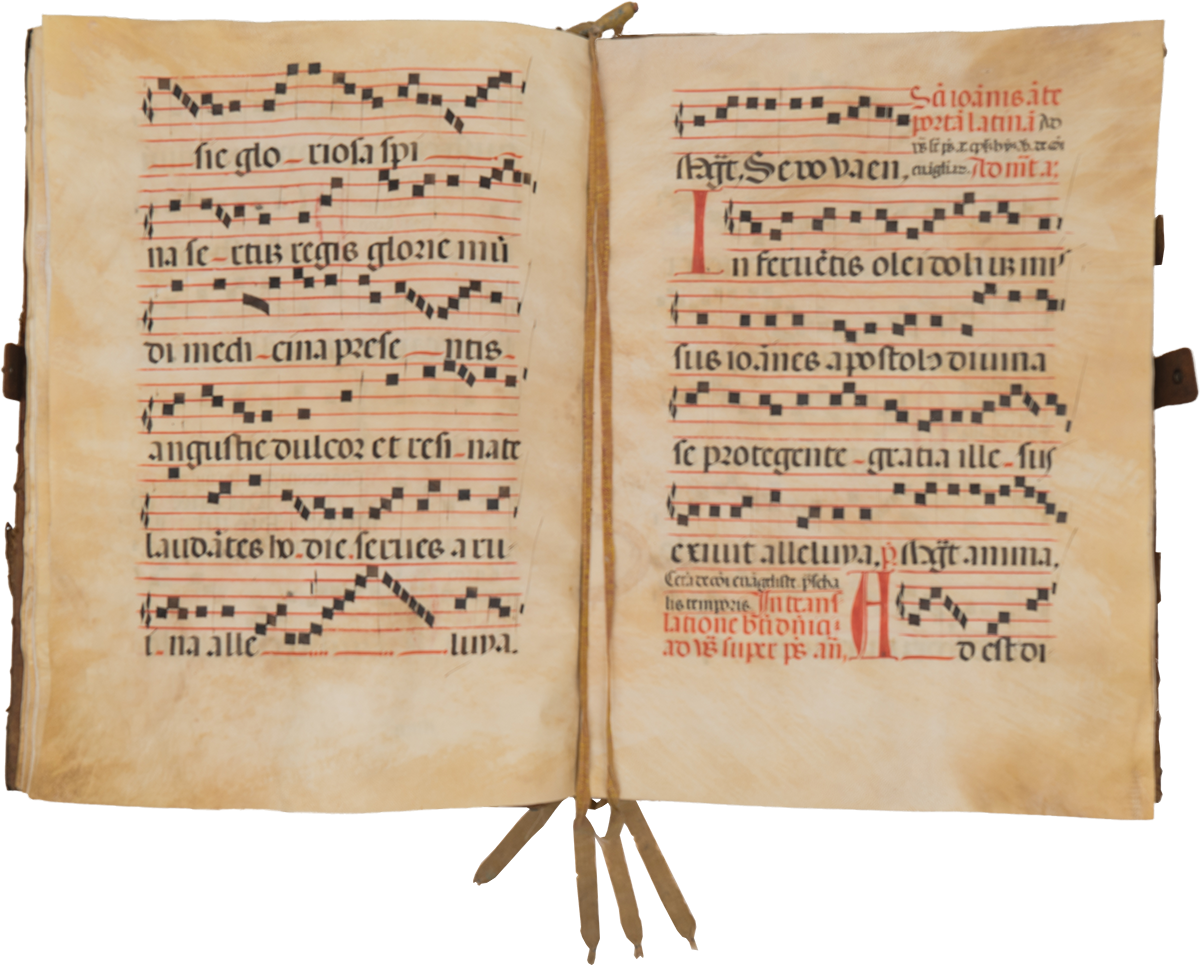
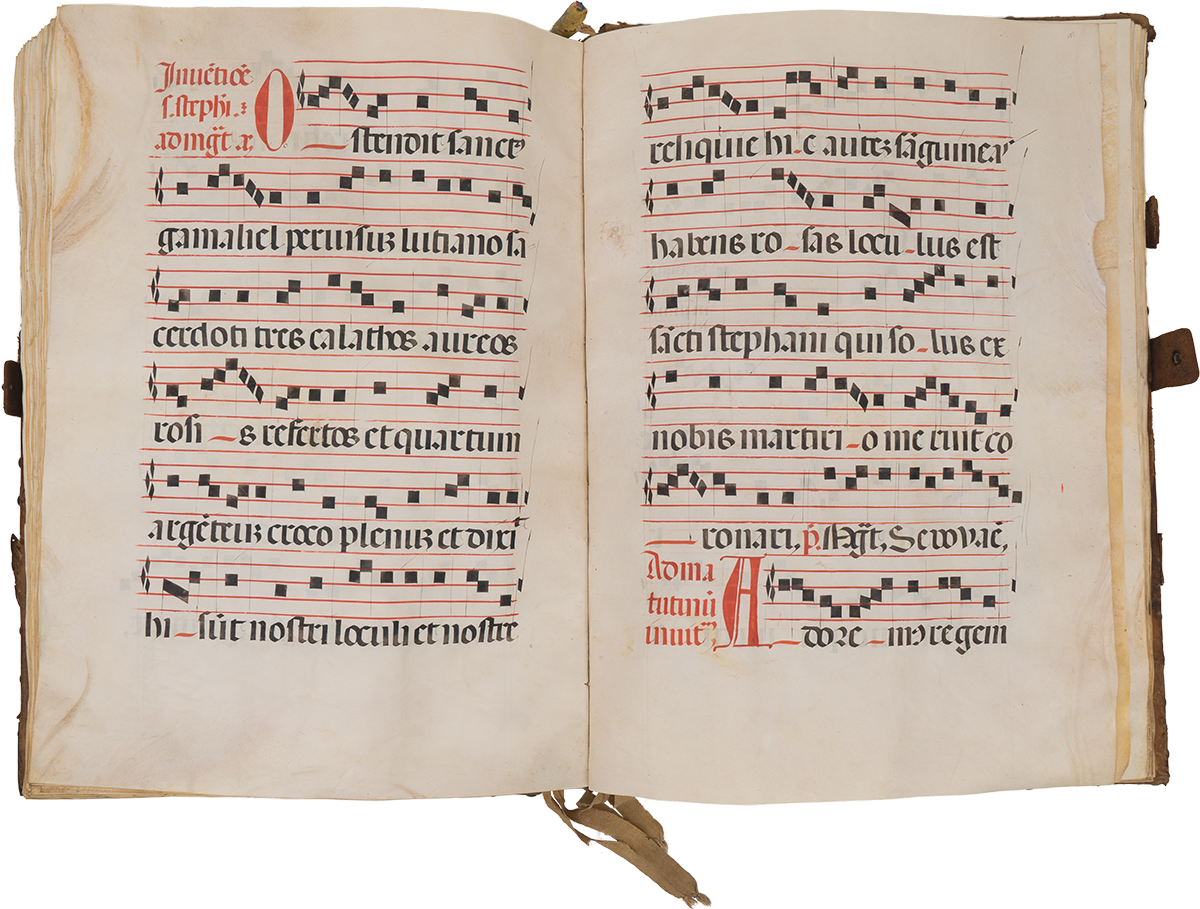
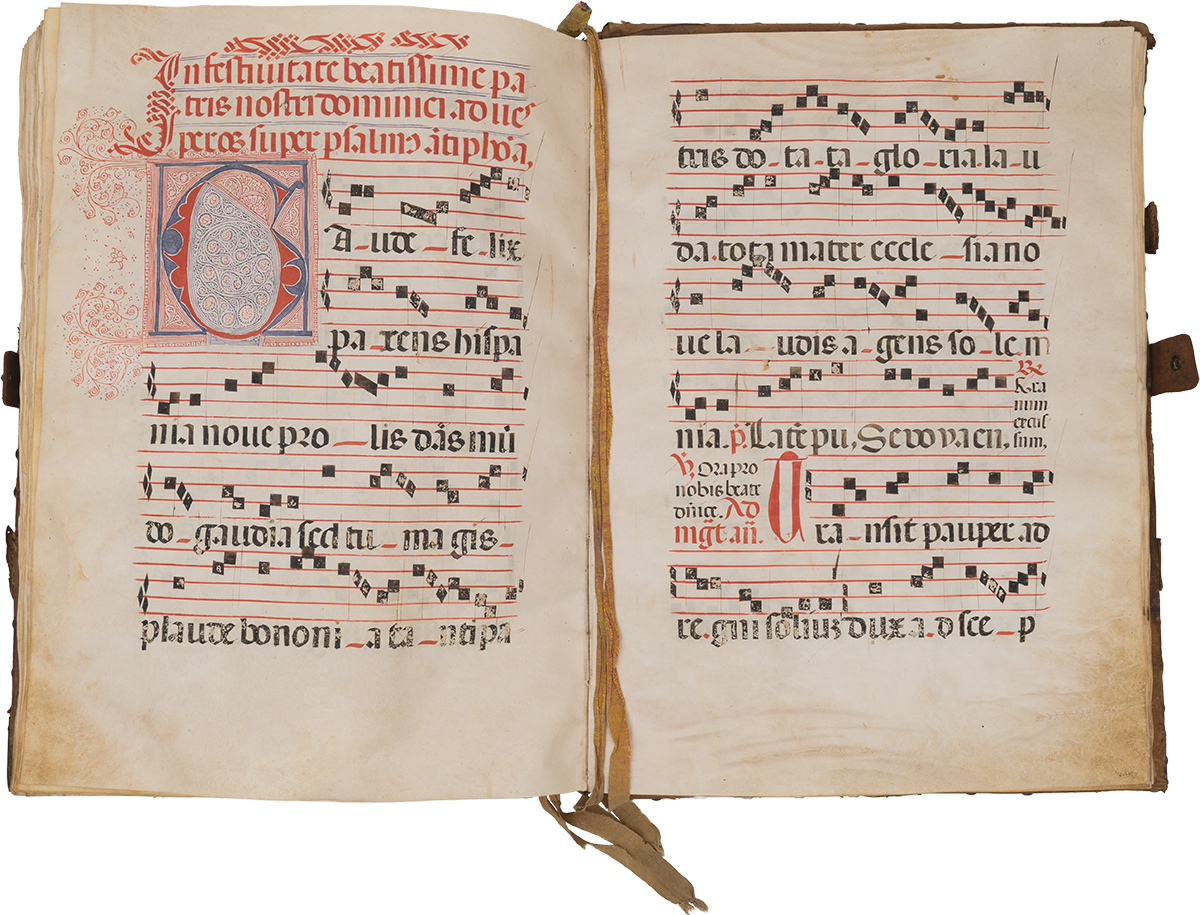
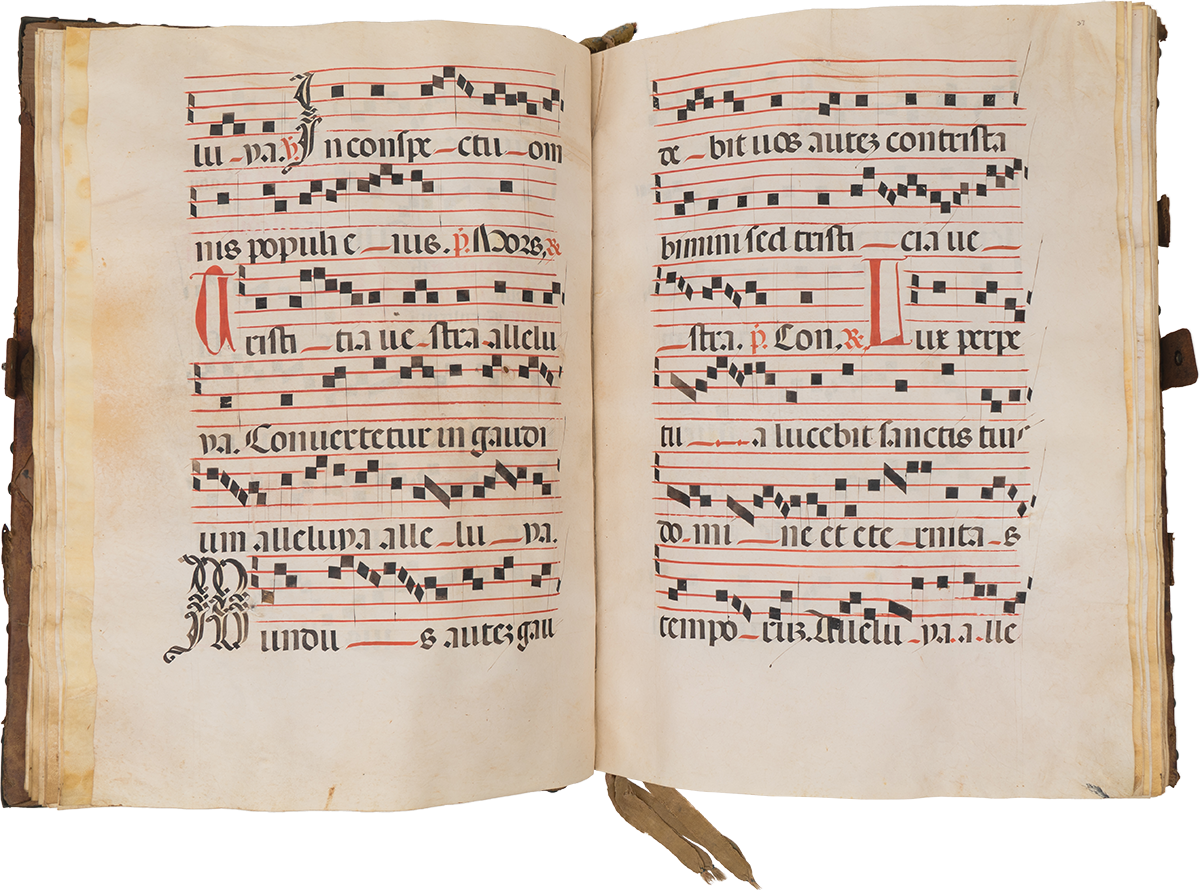
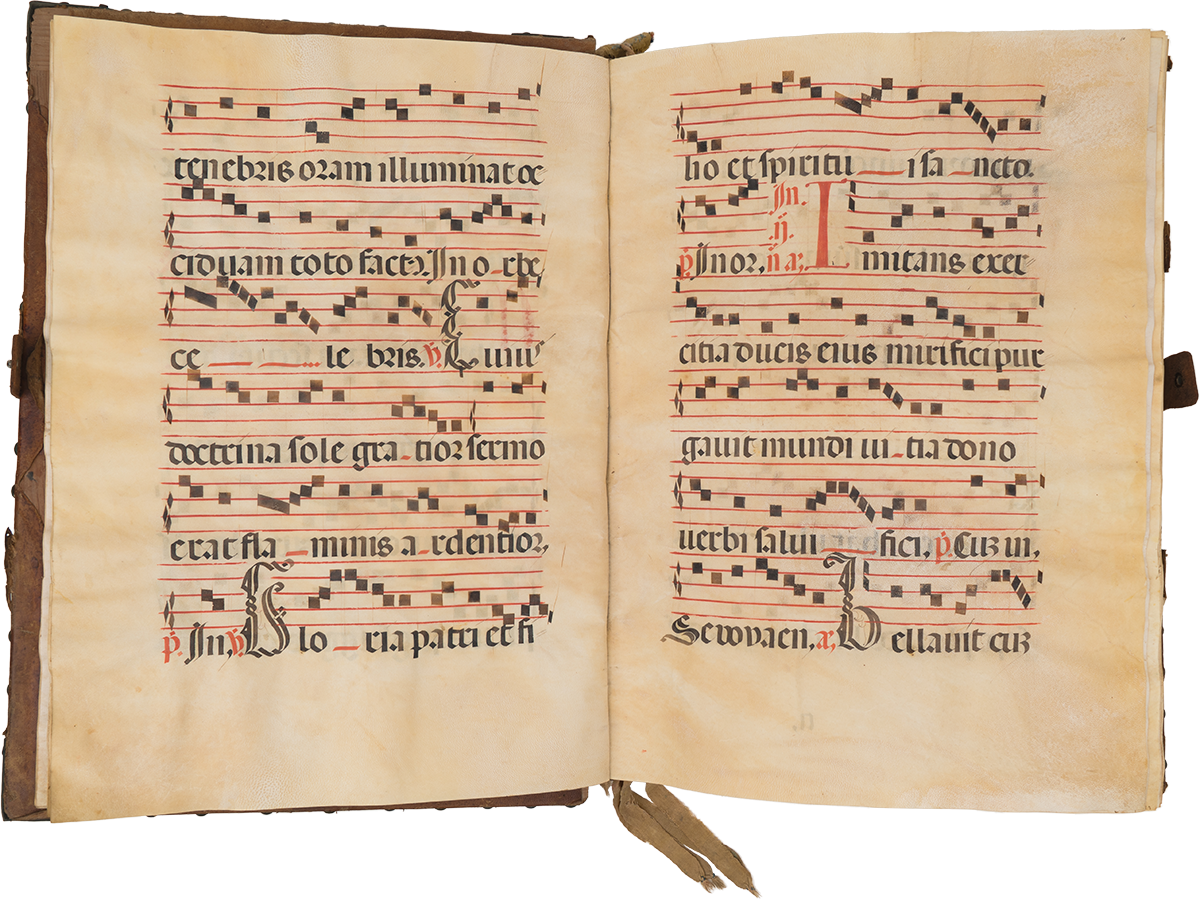
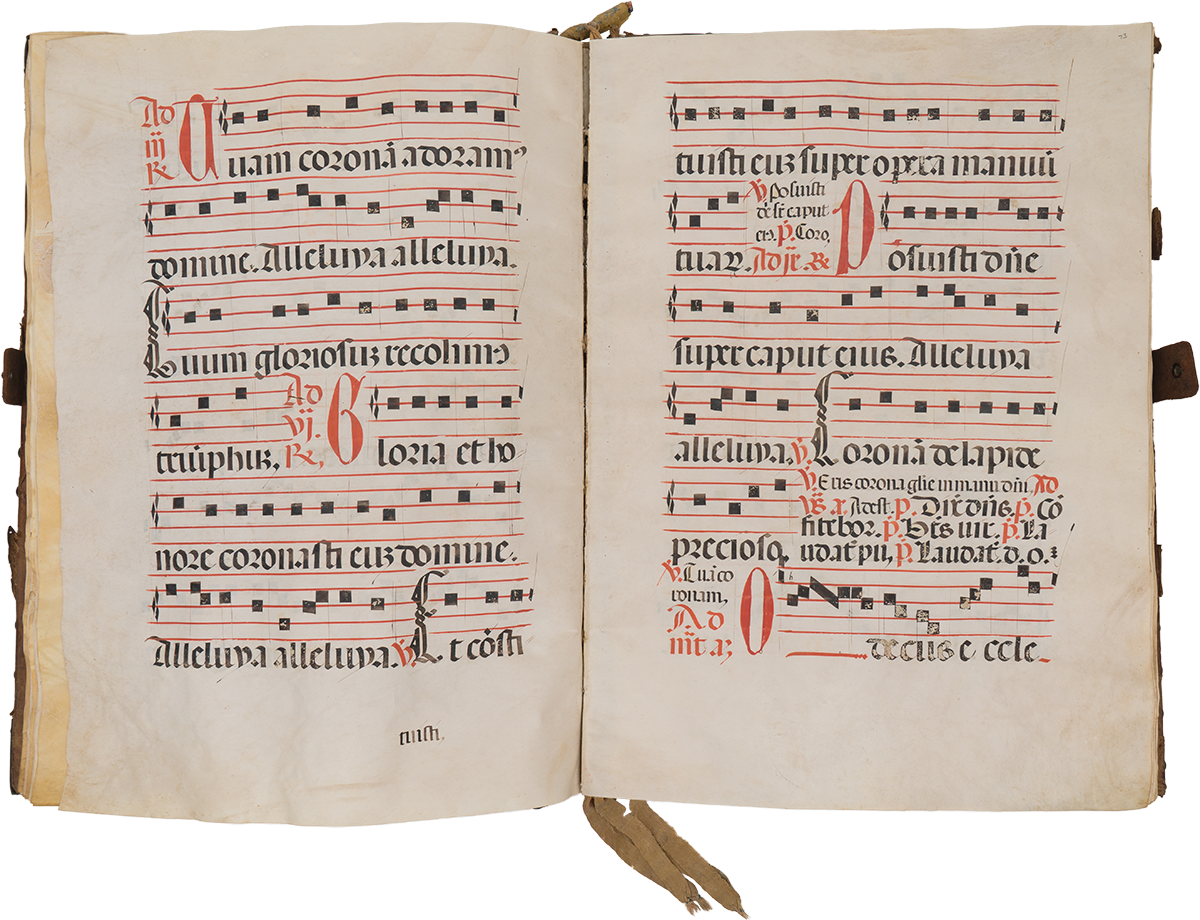
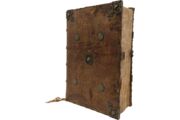
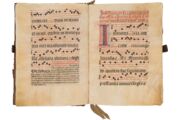
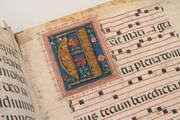
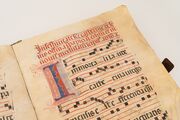
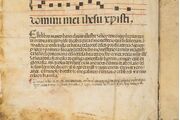
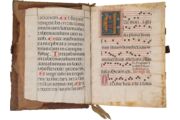
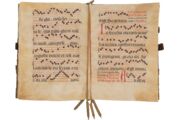
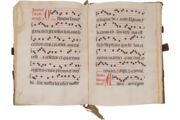
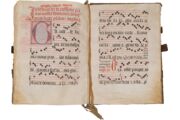
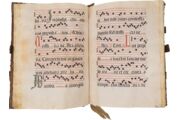
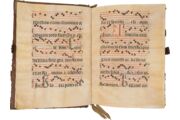
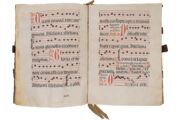
ii+184+ii folios on parchment, flyleaves from a later, fire-damaged choirbook, foliated in pencil, catchwords, quire signatures a-z, (collation: i-xxii8, xxiii1), complete, ruled in brown ink, mostly erased, (justification 385 x 250mm), square notation on 5-line staf in red, copied in a Spanish textualis rotunda, yellow-flashed majuscules, 6-line red lombards, 6-line black, strapwork initials, three 6-12-line puzzle initials in red, blue and violet with red, blue, and violet flourishing (ff. 1, 50, 154 for the Annunciation, Catherine of Siena, and Dominic), one 13-line illuminated initial (f. 1) marking the Annunciation, many leaves show stitched repair and parchment shows substantial use of offcuts, both normal for such a large and late volume. Seventeenth- or eighteenth-century binding on four bands in full leather, damaged, tablet-woven bookmark ribbons showing red warp and yellow weft, binding over wood boards, partly detached from book-block, edge inscription, decorative metal corners and central bosses on front and rear, intact leather clasp (later). Dimensions 545 x 385 mm.
Large-scale sixteenth-century Choir Books from Spain are not rare. However, this one presents a number of truly exceptional features. Inscriptions written in Spanish tell us where and for whom it was made, who wrote it, and, most unusually, how many quires it contains and how much it cost. Sponsored by a powerful noble family, the counts of Cabra, for a Dominican convent of nuns that housed four of their daughters, including the founding abbess, the manuscript also credits the counts of Cabra with commissioning a new musical setting for the feast of Catherine of Siena.
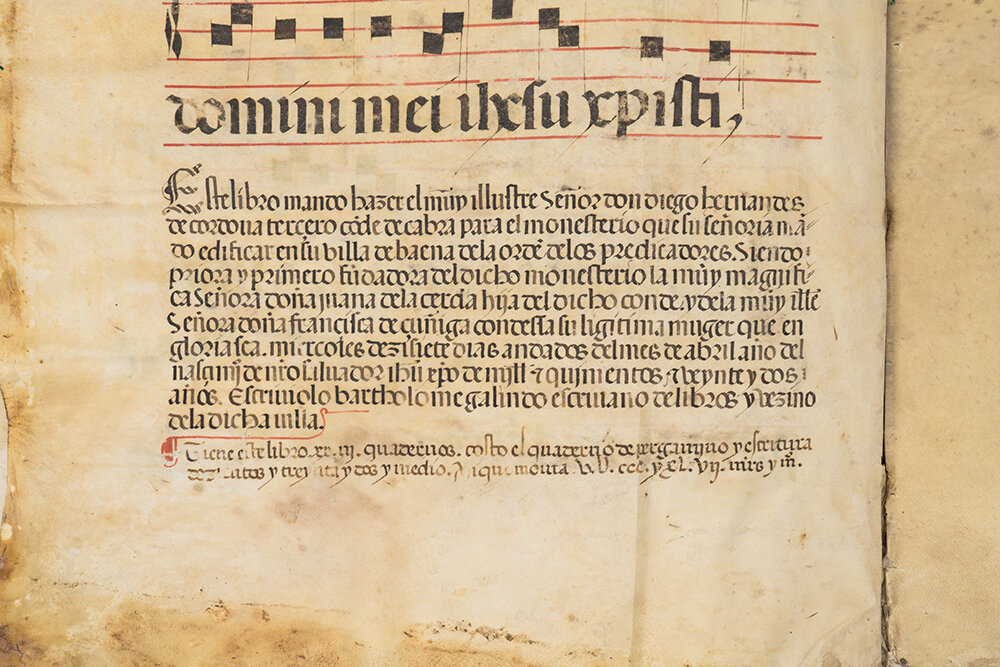
1. The book was ordered by Diego Fernández of Córdoba Hurtado de Mendoza, third Count of Cabra (1460-1525), for the Dominican monastery which he had built in the town of Baena, the Convento de Madre de Dios (founded 1511), likely in part as a memorial for his wife. Juana de la Cerda, daughter of the Count and his wife Countess Francisca de Zuñiga (d. 1511) served as the first abbess. Bartholome Galindo, writer of books and citizen of the Baena, offered all this provenance in a statement in which he adds that he copied the antiphonal on Holy Wednesday, 17 April, 1522: “This book was ordered by the most illustrious Lord Don Diego Hernandes de Cordova, third Count of Cabra for the Dominican monastery that his wife founded in the town of Baena. The daughter of the said count and the most illustrious and magnificent Lady Francisca de Zuñiga his lawful wife, who passed into holy glory on Wednesday the seventeenth day of April in the year of the birth of our Savior Jesus Christ one thousand five hundred and twenty-two, the most magnificent Lady Juana de la Cerda served as founding prioress of the said monastery. I, Bartholome Galindo, writer of books and citizen of the said town, wrote this”; (“Este libro mando hazer el muy illustre señor don Diego Hernandes de Cordova tercero co(n)de de Cabra para el monasterio que su señoria ma(n)do edificar en su villa de Baena de la orde(n) de los predicadores. Siendo priora y primero fu(n)dadora del dicho monesterio la muy magnifica señora don(n)a Juana de la Cerda, hija del dicho conde, y de la muy ill(ustr)e señora don(n)a Francisca de Zuñiga condessa, su ligitma muger, que en gloria s(an)c(t)a miercoles dezisiete dias andados del mes de abril, año del nascimi(ent)o de n(ost)ro salvador Ih(es)u (Christ)o de millón & quinientos & veynte y dos años. Escriviolo Bartholome Galindo, escrivano de libros y vezino de la dicha villa,” f. 185v). Galindo records the cost of this commission at the end, noting that the book is made up of twenty-three quires and that the parchment and writing of each cost 232 ½ [maravedis], bringing the scribal total to 5,374 ½ maravedis: “This book is 23 quires, cost per quire was 232 ½ [maravedis]. The total is 5,374 ½ maravedis” (“Tiene este libro .xx.iij. quadernos, costo el quaderno de pergamino y escritura dozientos y treynta y dos y medio. An que monta v. V. ccc. y xl.vij. M(a)r(avedie)s y m(edi)o,” f. 185v). Medieval costings are not as straightforward as they might first appear, however, and this total may also include the puzzle initials and even the illuminated initial (but equally may not). Also, maravedis were units of account, so this amount would have been paid to Galindo in gold, or more likely silver, coinage.
2. Partial table of contents pasted onto front board in eighteenth- or nineteenth-century script suggests use well into the modern period.
3. Private collection assembled in Spain and Britain from the 1960s through the 1980s
ff. 1-185v, Sanctorale for the summer months, Annunciation (25 March) to St. Lawrence (10 Aug.), incipit, “Ave maria gratia plena...domini mei jhesu christi.”
Among others, the volume includes the Dominican feasts for Vincent Ferrer, Catherine of Siena, Dominic and his translation, and two of the three puzzle initials of the volume mark Catherine and Dominic. A note highlights that the music for the Office of Catherine of Siena was written by a priest-musician, Pedro de Córdoba for Juana de la Cerda so that other convents in the order could copy it from the Baena book: “Siguese el officio de la bien aventurada sancta Catherina de Sena de la orden de los predicadores nuevamente modulado por el mas indigno de los sacerdotes, Pedro Hernandez de Cordova, musico. Va presentado a la muy religiosa ... Juana de la Cerda ...del monesterio de Madre de Dios de Baena. Par que de alli lo ayan los otros conventos de la dicha orden” (f. 49v). Further musicological research might demonstrate how widely this setting eventually spread.
Antiphonals contained music for singing the Divine Office, services required throughout the day and night year-round. By the late Middle Ages, this corpus of music had grown so large and complicated that religious institutions had to amass truly enormous sets of volumes to contain it all. While older foundations might develop these substantial collections over time, new foundations like Madre de Dios had to attract sufficient donations to cover those needs. While this present Antiphonal dates to a decade after the convent’s foundation, we might view those years as busy with manuscript acquisitions like this one. Moreover, this volume was not made by the Dominican nuns themselves, but by a professional copyist, Bartholome Galindo, and we might add, one who specialized in copying music.
While plus-sized sixteenth- and seventeenth-century Spanish Choirbooks are not rare, few on the market come with as secure and illustrious provenance as this present Antiphonal. Diego Fernández (spelled in the volume Hernandez) of Córdoba was scion of one of the most illustrious families of Castille, played a signal role in the defeat of the Emirate of Granada in 1492, and was one of two dozen noblemen enjoying the highest status granted by King Ferdinand. Queen Isabella requested that Diego and Francisca accompany Infanta Catalina (Catherine) to England for her marriage to Prince Arthur Tudor, and Diego later took part in the Spanish queen’s funeral cortege in 1504 (Peña González, 2018, p. 401; García, 2022, p. 152). Several of their daughters entered the Convent of the Mother of God and served as successive prioresses. One son rose to be Dean of Córdoba, and another the Bishop of the Canary Islands. Other sons served in royal and imperial courts across Europe. Thus, this Antiphonal, including the musical setting created for the feast of Catherine of Siena, must be viewed as a material trace of the highest cultural circles of sixteenth-century Europe.
Escudier, D. “Les manuscrits musicaux du Moyen Age (du IXe au XIIe siècle). Essai de typologie,” Codicologica 3 (1980), pp. 34-35.
Gastoué, A. Musique et liturgie. Le graduel et l’antiphonaire romains, 1913.
Geldhof, J. “Trent and the Production of Liturgical Books in its Aftermath,” in The Council of Trent: Reform and Controversy in Europe and Beyond (1545-1700), vol. 1: Between Trent, Rome and Wittenberg, Göttingen, 2018, pp. 175-189.
Hughes, A. Medieval Manuscripts for Mass and Office: A Guide to Their Organization and Terminology, Toronto, 1982.
Huglo, M. Les livres de chant liturgique, Turnhout, 1988.
del Mar Graña Cid, María. “El Linaje Fernández de Córdoba y la espiritualidad reformista de la incipiente edad moderna.” ed. Francisco Toro Ceballos, Los Fernández de Córdoba: nobleza, hegemonía y fama. Alcalá la Real, 2021, pp. 171-184.
Available here: http://www.moderna.ih.csic.es/fmi/xsl/fehm/anexos/P3A/Fernandez%20Cordoba%20color.pdf
Moller, H. “Research on the Antiphonar. Problems and Perspectives,” Journal of the Plainsong and Medieval Music Society 10 (1987), pp. 1-14.
Peña González, José Maria. “La Casa condal de Cabra en la historia de España,” ed. Francisco Toro Ceballos, Los Fernández de Córdoba: nobleza, hegemonía y fama. Alcalá la Real, 2021, pp. 395-404.
Available here: http://www.moderna.ih.csic.es/fmi/xsl/fehm/anexos/P3A/Fernandez%20Cordoba%20color.pdf
Antiphonarium Romanum ad ritum Breviarii..., Venice, 1623. https://www.digitale-sammlungen.de/de/view/bsb10496233?page=,1
Cantorales in the Americas and Beyond https://cantusdatabase.org/Cantorales/
Fundación Centro de Documentación Juan Alfonso de Baena, https://juanalfonsodebaena.org/Cultura/baena-monumental/convento-de-madre-de-dios
García, África Espíldora. “El cortejo fúnebre de Isabel I de Castilla en Granada (1504),” Historia. Instituciones. Documentos. 48 (2022), pp. 143-65. https://institucional.us.es/revistas/historia/49/6-EspildoraGarcia-HID49.pdf
Kidd, Peter. “A Spanish Choirbook Dated 1522,” https://mssprovenance.blogspot.com/2022/02/a-spanish-choirbook-dated-1522.html
PARES (National Archive of Spain). “Person - Fernández de Córdoba Hurtado de Mendoza, Diego (1460-1525),” https://pares.mcu.es/ParesBusquedas20/catalogo/autoridad/48797?nm