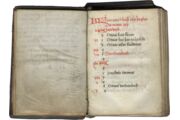
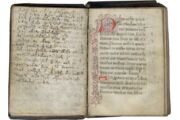
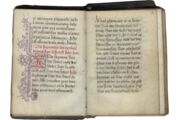
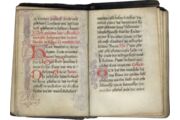
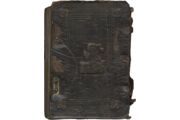


Dutch Prayerbook
In Dutch and Latin, decorated manuscript on parchment
Belgium, Wallonia, c. 1550
TM 1504
- $14,000.00
 Textmanuscripts - Les Enluminures
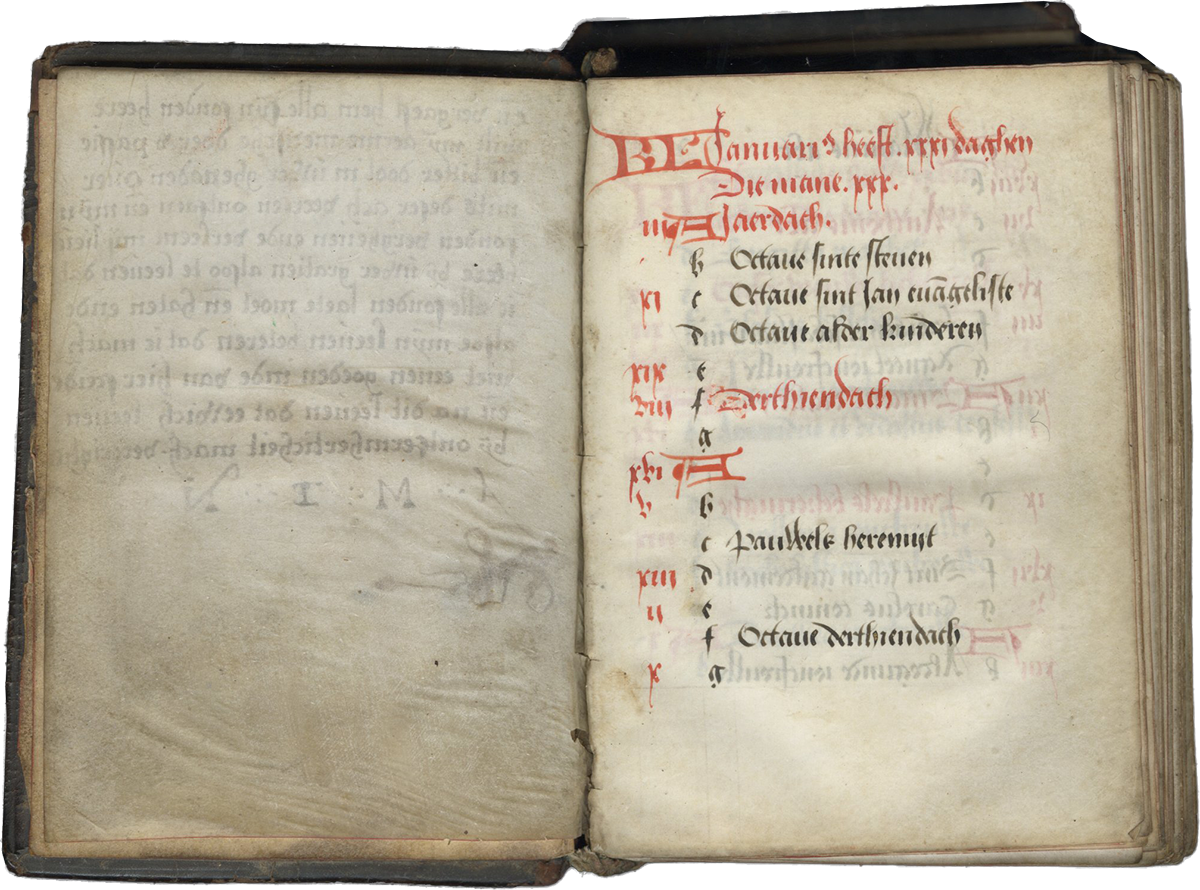
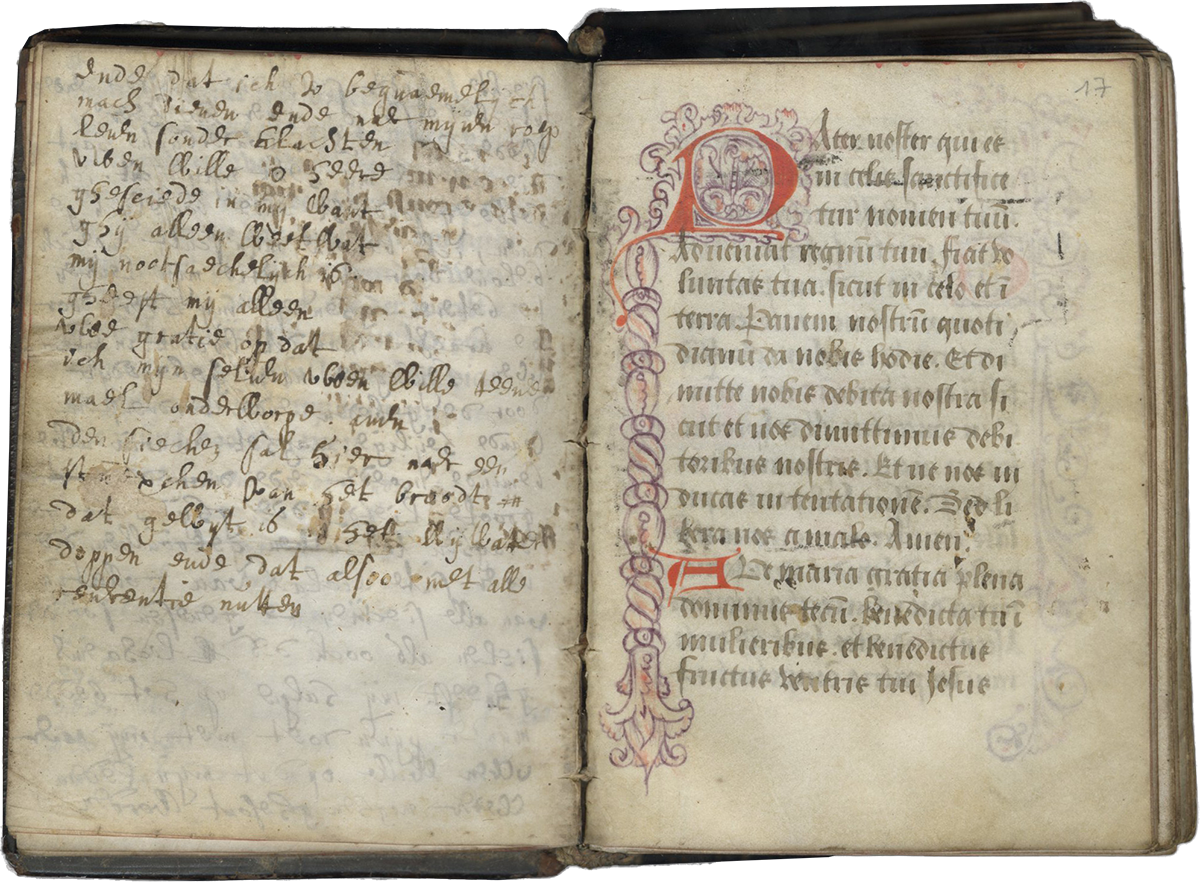
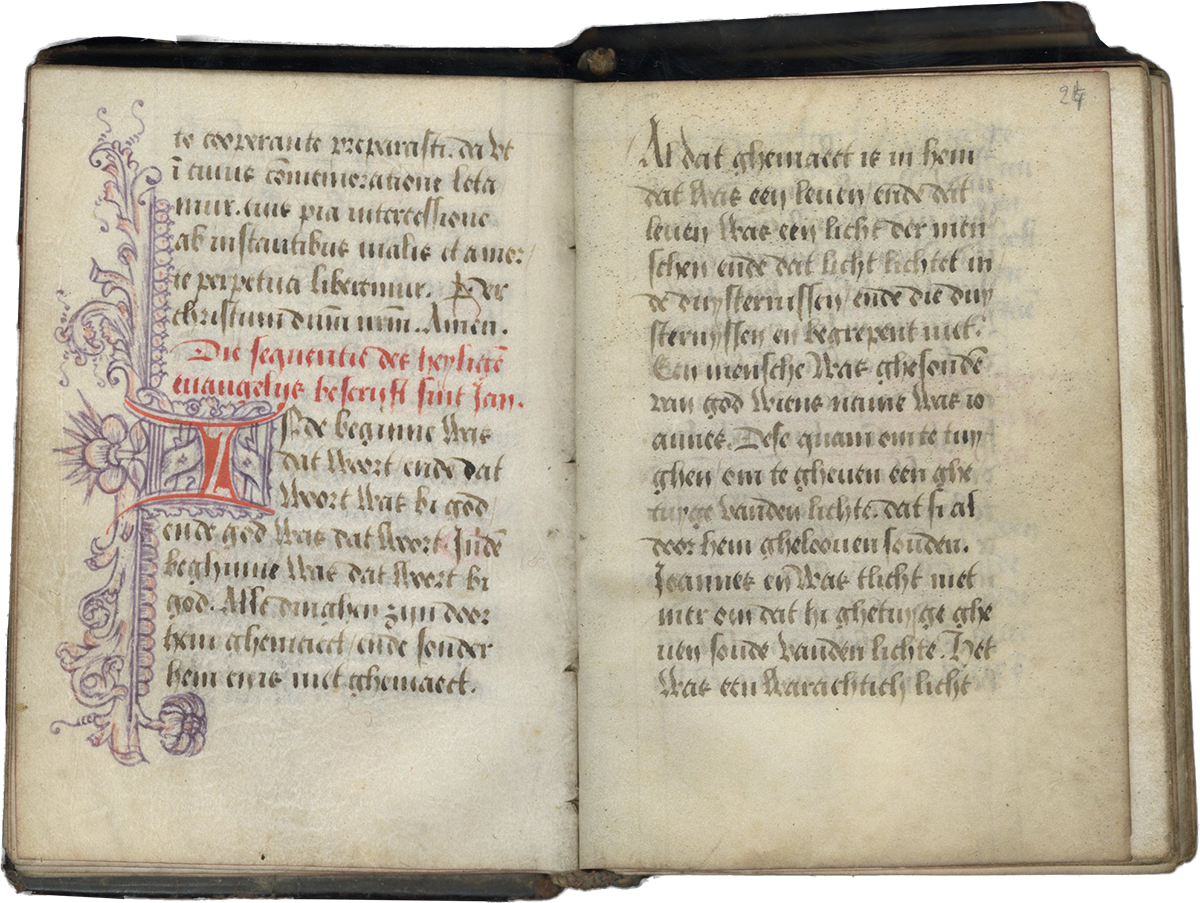
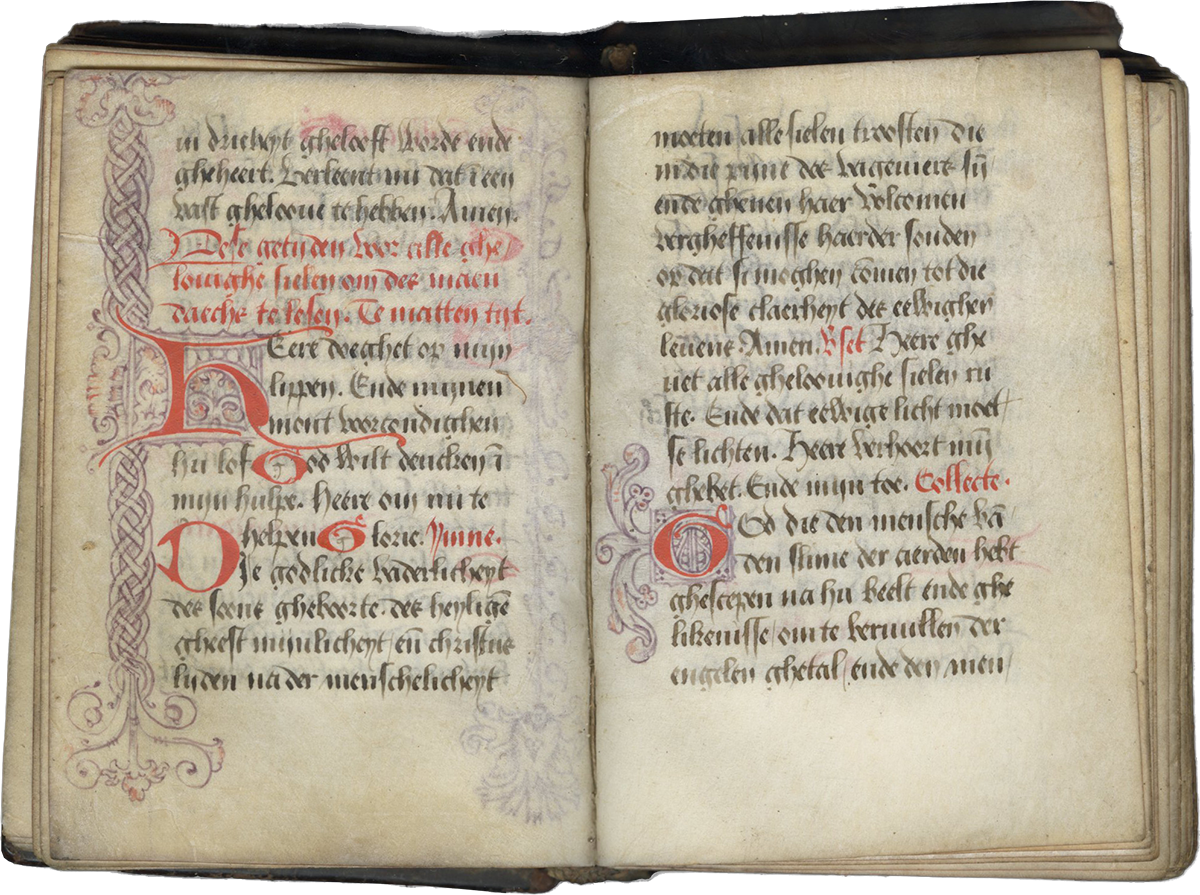
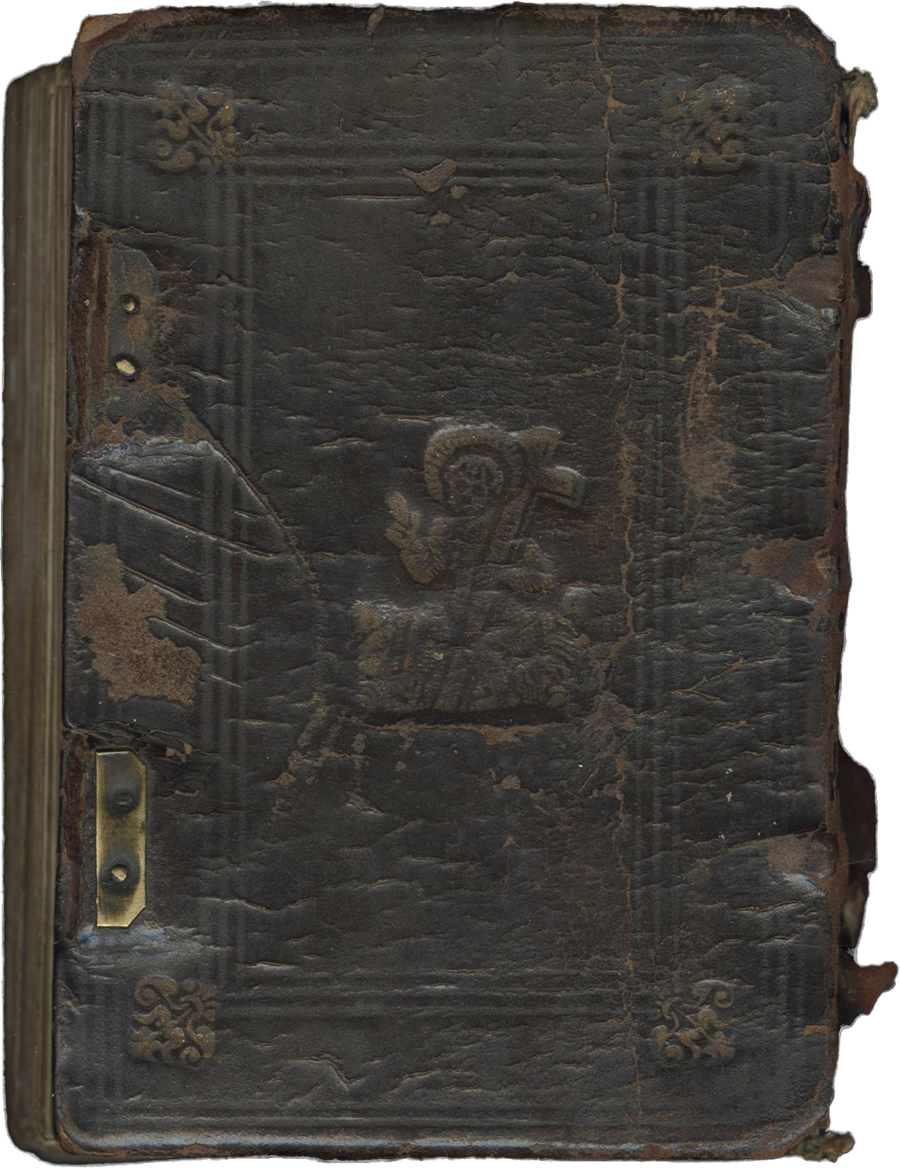
i(parchment)158+iii (paper, no visible watermarks) parchment folios, foliated in pencil in upper right corner, (collation: i-xv8 xvi10 xvii8 xviii8-5,6 cancelled xix4 xx6 xxi6-5,6 cancelled), ruled in ink, mostly erased in a single column of 13-17 lines, (justification 82-84 x 53 mm), original material in two different hybridas, with contemporary additions in humanistica and cursive scripts, red rubrics, 2-3 line red initials with brown or violet and red flourishing, often dimensionally shaded, sometimes extended the full length of the border, good condition. Early modern blind-stamped calf over wood, rubbed gilt central ornament of the Christ Child holding the Cross on covers, spine with three raised bands, red edges, spine damaged, remains of two clasps. Dimensions 110 x 80 mm.
A delightful Dutch Prayerbook, dated by the scribe over several years in French, this book also offers a large number of inventive, expertly drawn ink initials and borders: many of which are unusually abstract and original. With many prayers and a range of biblical texts in both Latin and Dutch translation, this charming volume highlights the complex linguistic landscape of what is today southern Belgium.
1. Made for Martin van Yessche [Essche] over an extended period of time. The volume is dated in several places in the scribe’s hand in French, the only French in the volume: on f. 95v: “A. l’an M.1549 E. 22.defe.N,” (AMEN 22 February 1549, at the end of the O Intemerata translated into Dutch), on 107v: “Pour Martin l’an.1549.le.viij.de mars,” (For Martin 1549 8 March, at the end of a prayer to St. Margaret), and in red between prayers to be said during various parts of the mass, “Martin van Yesshe” “1551.le vie de feburi[e]r” (Martin van Essche 6 February 1551)(f. 135). The combination of French and Dutch in the volume suggests origins in the southern Low Countries, as do the saints in the calendar and particularly the sparse litany, which includes Amand (f. 79), and in red, Nicasius of Rheims (f. 13v) who is sometimes recognized among a group along with Quirinus (f. 5v). Both saints have Walloon connections, and Quirinus’ relics reside at Malmedy (near Liège).
2. Front flyleaf is inscribed No. 127 in brown ink, and the front pastedown has an earlier dealer number in pencil 990315/99-68.
f. 1, (added, same script as the final additions in the volume) final part of a Dutch prayer; f. 1v blank;
ff. 2-14, Calendar in Dutch;
ff. 14v-15v, (added) “Totten heyligen cruijce”;
ff. 15v-16v, (added) prayer in a Dutch cursive hand;
ff. 17-23v, Latin prayers (Pater Noster, Ave Maria, Credo, Magnificat) and texts for Mass;
ff. 23v-25, Beginning of the Gospel of John, in Dutch translation;
ff. 25-28v, “Die ghetijden vander heyligher drieuuldicheit”;
ff. 28v-32, “Dese getijden voor alle ghelouige sielen”;
ff. 32-36, “De getijden van den heylighe gheest”;
Many of these sequences of prayers throughout the volume are for use at specific canonical hours.
ff. 36v-39v, “Hier beghinne die ghetijden van alle heylige”;
ff. 40-44, “De ghetijden vanden heylighe(n) sacramente”;
ff. 44-48, “Die ghetijden vande(n) heylighen cruyce”;
ff. 48-67, “Onser lieuer vrouwen ghetijden” and Marian prayers;
ff. 67-77v, “Seuen psalmen,” the Penitential Psalms in translation, a slightly different dialect than Groote (see Online Resources);
ff. 77v-79v, Litany;
ff. 79v-90, “Een ghebet totter eewigher wusheyt” and Marian prayers;
ff. 93-107v, Suffrages and prayers to the Holy Spirit, John the Baptist, Peter, Paul, Andrew, John, Michael, Jacob, Lawrence, Adrian, George (spelled “Joris”), Thomas, Cornelius, Roche, Anna, Mary Magdalene, Katherine, Barbara, Appollonia, and Margaret, including a prayer that “the Kaiser Maximilian used to read” (f. 93). Maximilian I died in 1526.
ff. 108-113, Long confessional statement in Dutch drawn from “meester Godschalk roesmont” (the Leuven theologian Godschalk Rosemondt [1480-1526]);
As the Short-Title Catalogue of the Netherlands makes clear, Rosemondt’s Dutch oeuvre remains in editions extant in only a very few copies, and few of these are digitized, despite the number of editions: his short, pastoral works were clearly popular and were read to pieces. This passage is likely from one of these works.
ff. 113-118v, “Een devote oeffeninghe vander messe” and other Dutch prayers to be said during mass;
ff. 118v-131, “Hier na volghen die .xv. Bloetstortinghen ons liefs heere Jesu Christi,” a first-person meditation on the Wounds;
ff. 131-135, Prayers to be read during Mass in Dutch;
ff. 135-140v, “Een scoen ghebet vanden heilighen sacramentm” and the like, the primary scribe ends the text in a triangle of decreasing line width, and though this marks a production break, it is not the end of the quire;
ff. 141-145v, “Misse vander heyligher drievuldicheyt” (in Latin, by a different scribe or in a different script), including readings from the First Epistle of John “Omne quod natum est” (1 John 5:4-10) and the Gospel of John “In illo tempore dixit Iesu discipulis suis cum venerit paraclitus” (John 15:26-16:4);
ff. 146-150, “Missa de Domina” (Ladymass) (Latin), “Salve sancta parens,” with readings from Ecclesiasticus “Ab initio et ante” (Ecclesiasticus 24: 14-16) and Luke “In illo tempore. Loquente Iesu ad turbas: extollens vocem” (Luke 11:27-8);
ff. 150v-168v, (added) “Een goede beuele tot onse(n) lieue heere.”
While the European Book of Hours remains an iconic medieval book and famously stands as the most common book remaining from medieval Europe, this interest in personalized prayer resulted in more different forms in different parts of Europe than we might imagine. In the Netherlands, for example, Geert Groote translated the Book of Hours into Dutch in 1383-1384, and copies of his translation provided an extremely durable competitor to the Latin Book of Hours in the Netherlands. This popularity also supported a thriving culture of Prayerbooks, anthologies of prayers that often featured material also found in Books of Hours, if not the Hours of the Virgin themselves. The present book is such a volume, with the Penitential Psalms, calendar and litany, gospel readings, prayers for before, during, and after mass, and more, all commonly found in Latin Books of Hours and offered here in Dutch translation complete with charming ink decoration.
Importantly, this book was copied in the middle of the sixteenth century, decades after Luther’s Reformation had begun to change the religious landscape of the Low Countries. Religious unity fragmented, and religious confession became another element driving a series of revolts and wars throughout these decades. We can see these changes reflected in this volume in the inclusion of a yet-unidentified text attributed to Godschalk Rosemondt. Rosemondt’s Dutch publications featured works of pastoral care and must be viewed in the context of his learned, Latin writing against Luther and other reformers.
Epinay-Burgard, G. Gerard Grote (1340-1384) et les débuts de la Dévotion Moderne, Wiesbaden, 1970.
Van Engen, John H. Sisters and Brothers of the Common Life: the Devotio Moderna and the World of the Later Middle Ages, Philadelphia, 2008.
Montreal, McGill University Library, MS 100, Groote’s translation of the Book of Hours, digitized, https://archive.org/details/McGillLibrary-rbsc_book-of-hours_ms100-21318/mode/2up
Van Wijk, N. Het Getijdenboek van Geert Grote, Leiden, E.J. Brill, 1940. https://www.dbnl.org/tekst/grot001geti01/
TM 1504