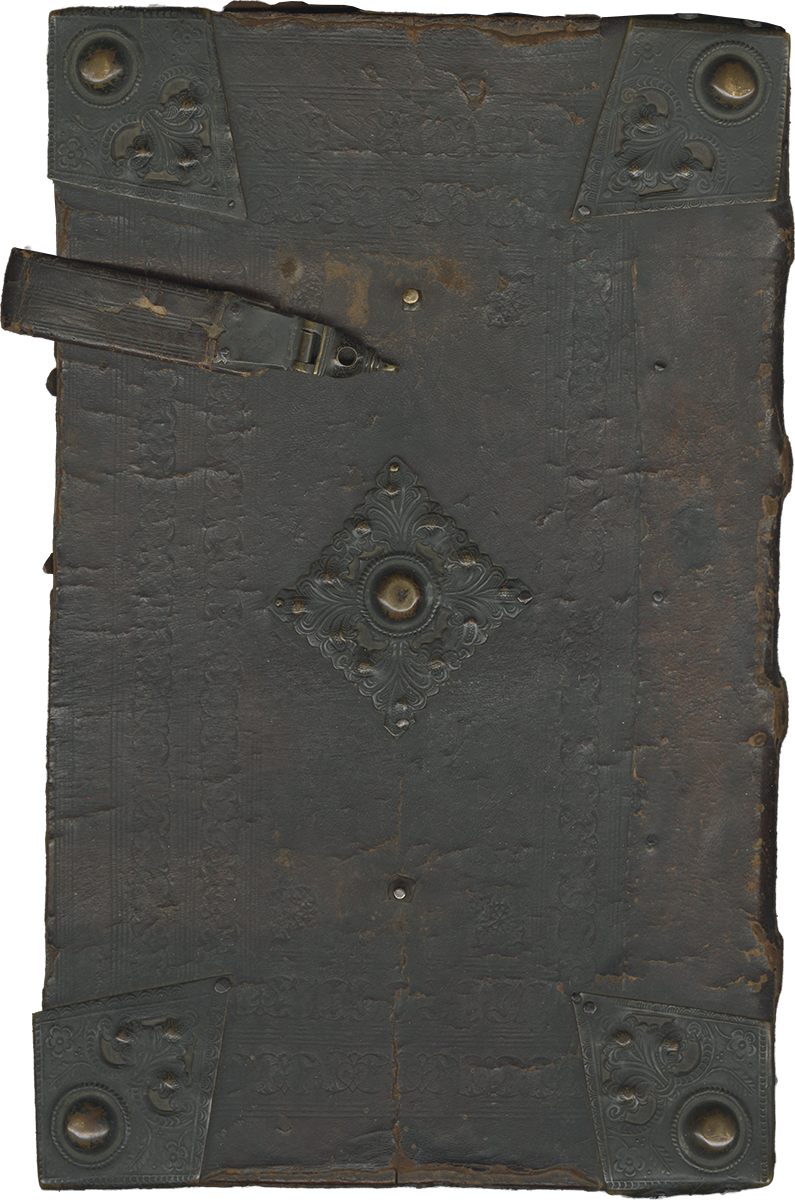
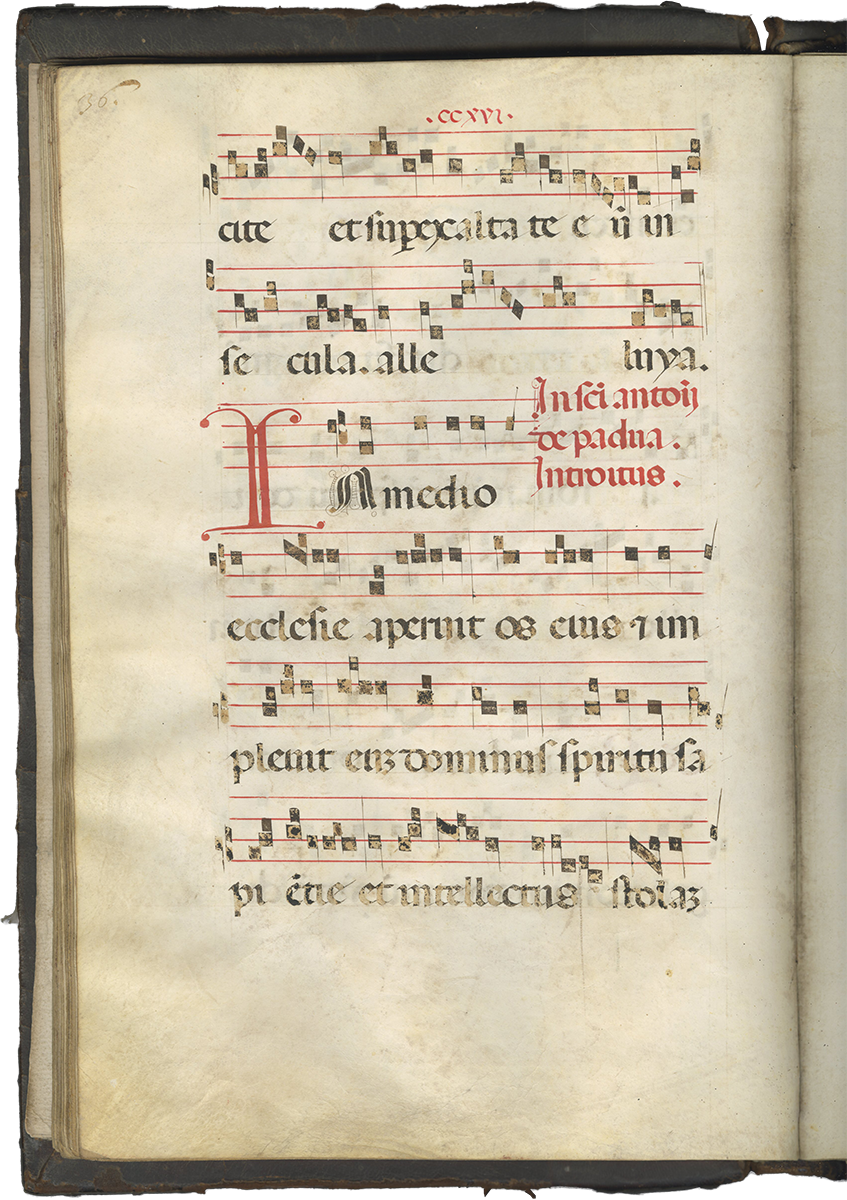
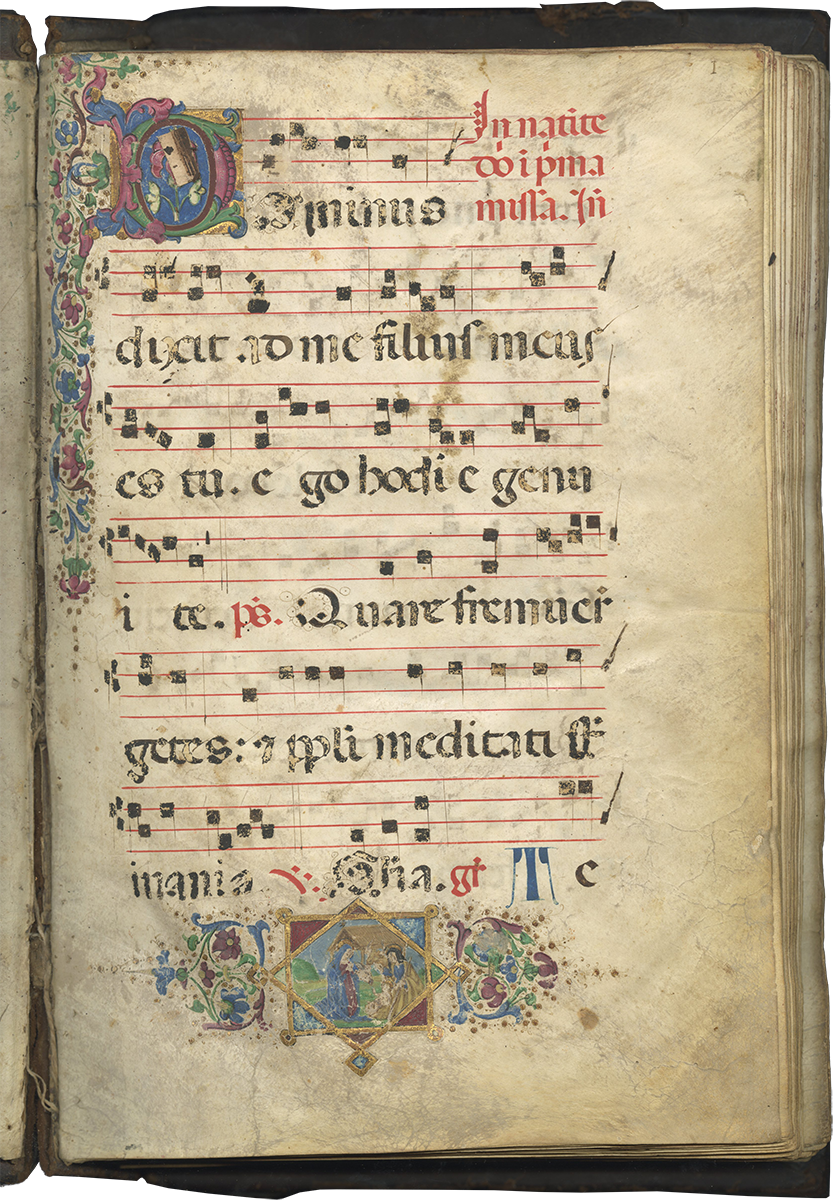
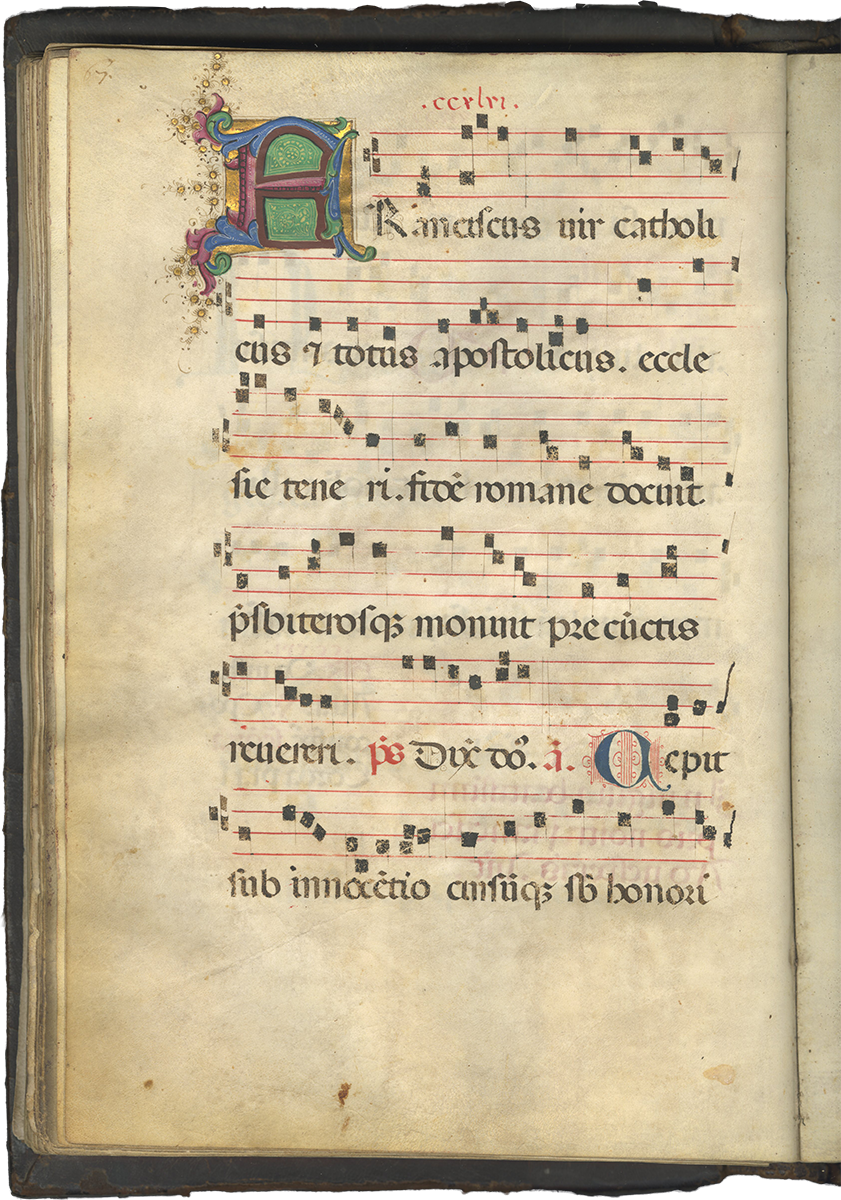
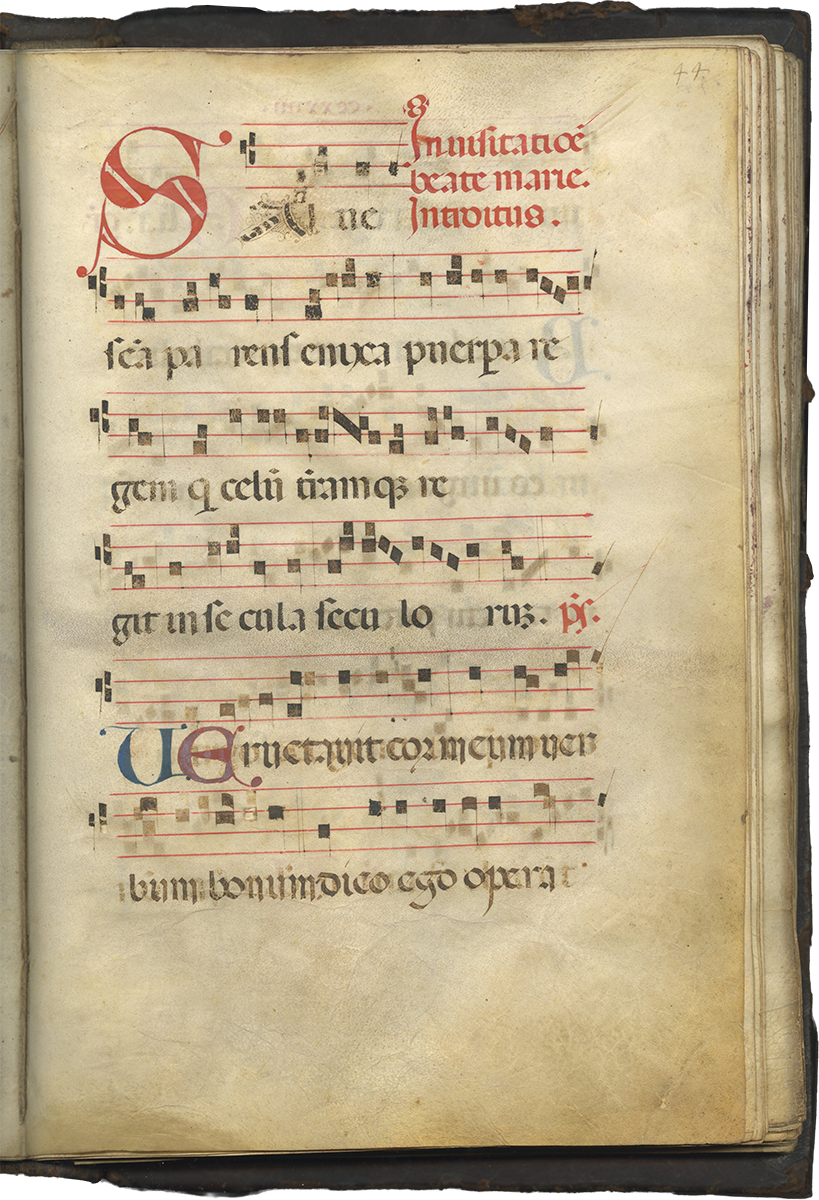
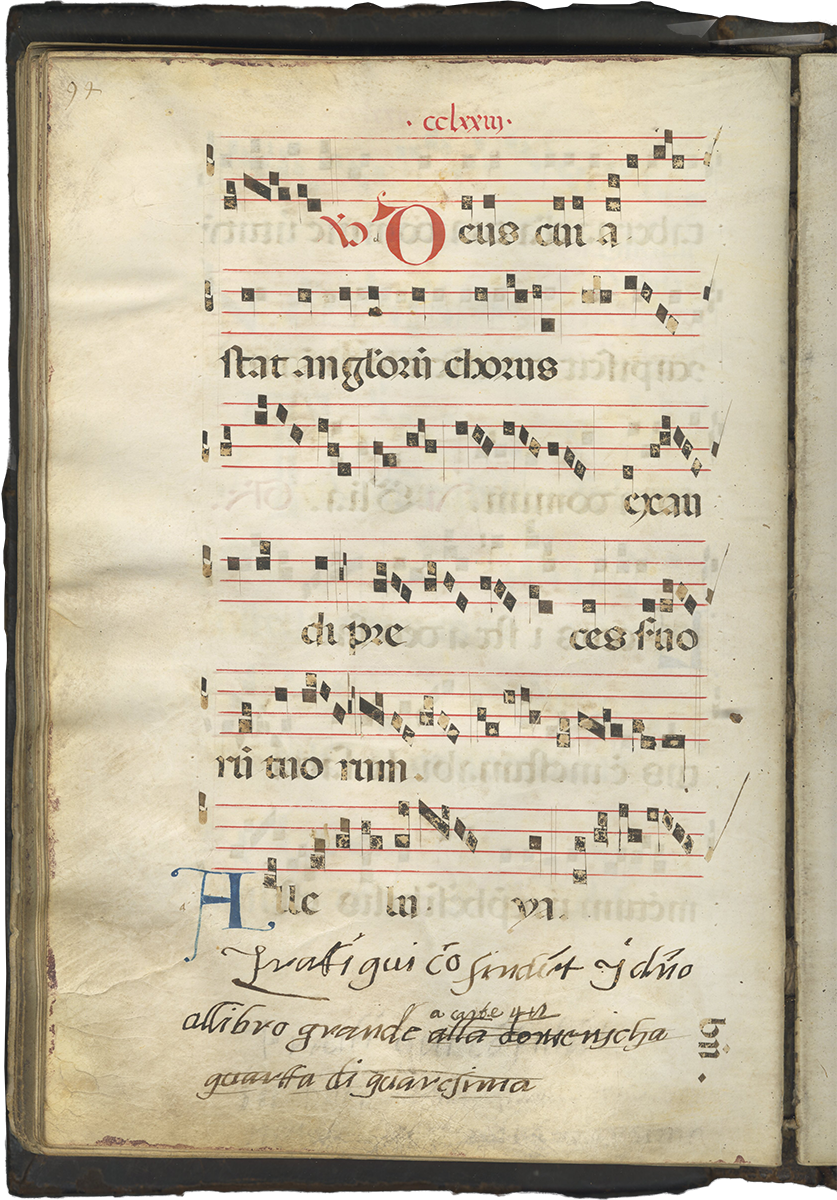
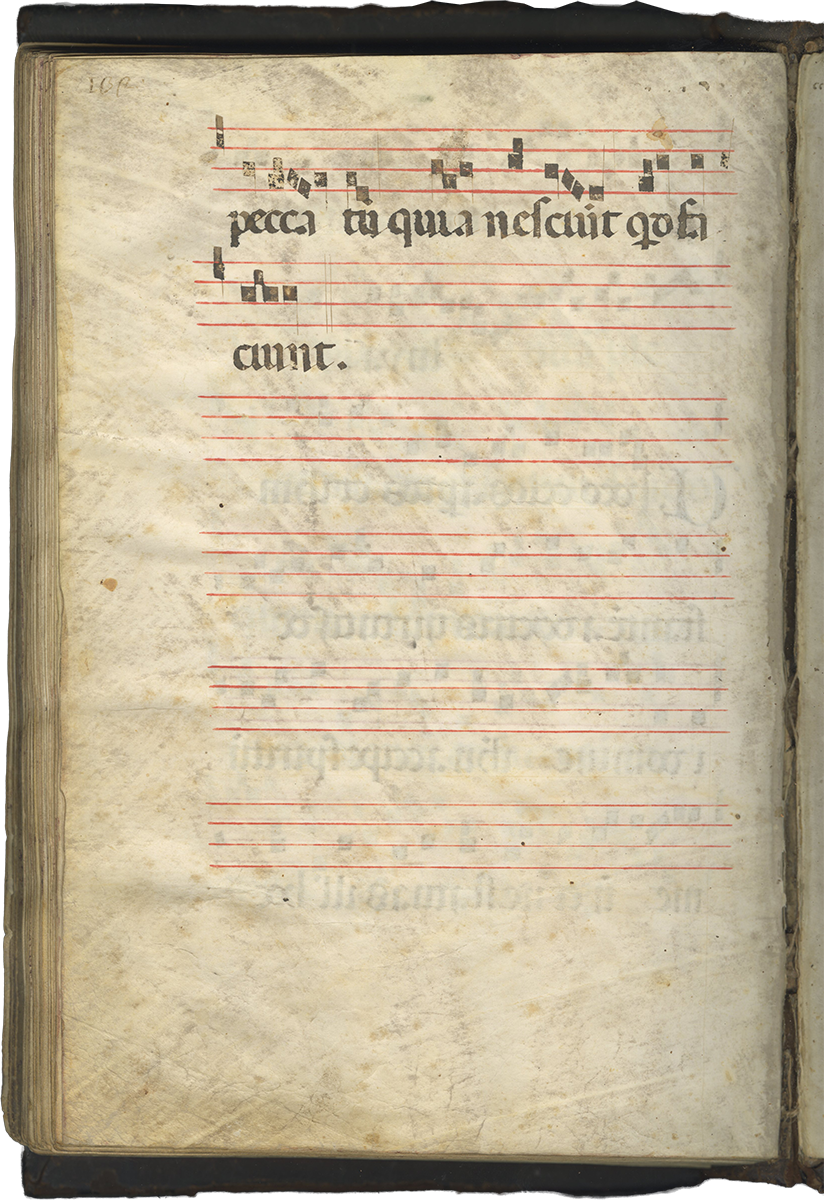
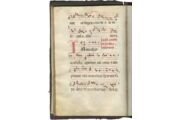
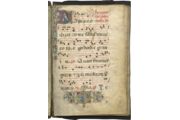
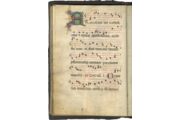
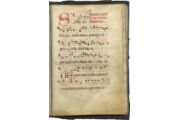
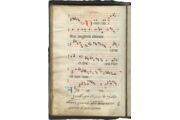
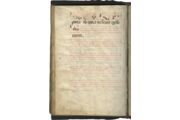
v (paper)+i (parchment leaf with music for the rite of blessing holy water)+132+i (parchment), foliated 181-298 in roman numerals red ink center top on versos or rectos, foliated 1-132 in arabic numerals in brown ink in upper corner in early modern period (used here), vertical catchwords, (collation: i10, ii8, iii-v10, vi6, vii-xi10, xii8, xiii-xiv10), ruled in brown ink, mostly erased, square notation on 4-line stafs, 35 lines (justification 265 x 180mm), copied in a textualis rotunda with many additions and corrections in subsequent hands, finely decorated majuscules, 3-line red or blue initials, 3-line red or blue initials with flourishing in alternate color, 6-line blue or red initials parted like a puzzle initial but using the bare parchment ground as the alternate color, 7-line illuminated initial (f. 67v, feast of St. Francis), 5-line illuminated initial with sprays (f. 1, Nativity) and ONE MINIATURE (f. 1, Nativity with Virgin and female saint). Bound in an early, rebacked binding of wooden boards covered in blind stamped calf leather with brass corners and center bosses; with clasps in leather and brass, one of which is detached but present, attaching on the back, suggesting that the binding is Italian. Dimensions 370 x 250 mm.
Copied at a size that could be seen by choirs in dark churches illuminated only by flickering candlelight, Graduals contained the music for Mass and the Divine Office for the entire liturgical year and required churches to collect many volumes to ensure a complete set. The present book presents a single volume from an originally extensive set made for a convent of nuns, the Poor Clares in Arezzo. A copy of the Clares’ rule also exists that was illuminated by the same artist as this Choir Book, suggesting a wealthy donor arranged a handsome gift of both Gradual and Rule for this humble and pious order.
Provenance
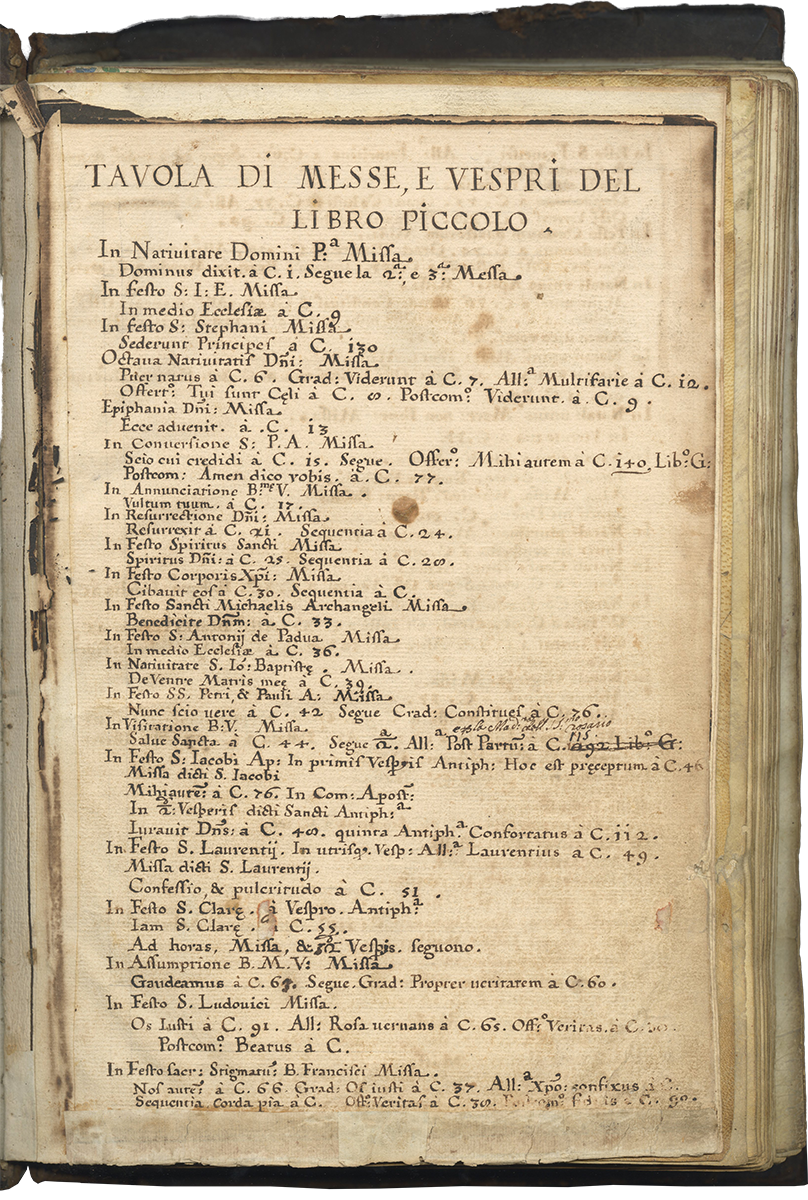
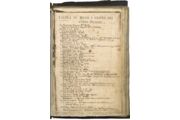
1. Made for the Poor Clares in the Convent of Santa Margherita and Santa Maria in Arezzo. While their ownership inscription is lacking from the present volume, it remains preserved in a sister volume containing the rule of the Poor Clares, Princeton, Princeton University Library, MS Garrett 96 (Skemer, 2013, p. 213). Additions and updating in the volume, including the addition of a table of contents on the paper flyleaves in an eighteenth-century hand show continued use nearly into the modern period.
2. On front and back inner pastedowns, shelfmark stickers of Howel Wills (1854-1901), Anglo-Chinese barrister, and book and art collector. His library was sold at Sotheby's, 11 July 1894 (Kidd, Manuscripts.org.uk). Late in life Wills lived in Florence and it is not impossible that he acquired the manuscript in that area.
3. On the front inside pastedown is a description of this book from a 1901 (incorrectly labeled in pen 1902) Caxton Head Catalogue by London bookseller James Tregaskis (1850-1926) (his wife and business partner Mary having died in 1900). The Schoenberg Manuscript database demonstrates that Tregaskis advertised the volume from January to October, 1901. The label pasted onto the board shows the stock number from the 28 October catalogue, and the volume must have been purchased from this.
4. Sold at Sotheby’s 31 July, 1922, lot 433.
5. In 1922 and 1923 the volume appeared for sale in the London bookdealer Reginald Atkinson’s catalogues, as the Schoenberg Manuscript database records.
Text
Ff. 1-132, an Antiphonal containing the antiphons for the mass and vespers running from the Nativity to All Saints, though not inclusive, the Common of the Saints with special masses, and a range of additional feasts, including Ascension, Presentation of the Virgin, ferials after Easter, and St. Stephen’s day.
The present volume represents the second part of a Gradual, as indicated by the original foliation, beginning at f.181. The volume includes a range of Franciscan traits, including an illuminated initial at St. Francis’s feast (f. 67v), and special emphasis on Franciscan saints and feasts, including Francis, Holy Stigmata—not yet a papal feast in the fifteenth century but observed by the Franciscans—Clare, Anthony of Padua, and Louis of Toulouse.
Illustration
f. 1, Nativity with Virgin, Child, and a female saint (45 x 37mm)
This unusual Nativity leaves out Joseph, although it does include the ox and the ass and the star of Bethlehem. On the right is a haloed woman in a black veil, blue gown, and buff or gold cloak, carrying a rough staff, and seemingly presenting the Christ Child. It is unclear who she is (Anne?) and exactly what is taking place.
The decorative illumination features a vibrant palette limited to blue, violet, and fuchsia with highlights in buff and tracery in a light brown pen around gold motifs. The technique, motifs, and interest in cartouching miniatures within lightly interlaced gold medallions all matches the techniques and style found in Garrett 96, strongly suggesting that the same hand, or at minimum, the same workshop, painted both volumes.
As Hildegard von Bingen’s famous musicality reminds us, the medieval Church took music seriously. While priests might chant, both masses and office also featured choirs singing outright, sometimes demonstrating quite complex settings. As the number of choristers increased throughout the Middle Ages, the size of Choir Books also increased, and the volume of musical notation necessary grew exponentially. By the end of the Middle Ages the music required for even basic coverage of mass and office could necessitate a small library of large volumes. Together with the two different foliation systems that the volume displays, the table of contents added to the volume in the eighteenth century assigns this volume the letter ‘C’, all of which suggests that the present volume was fit among at least 3 different sets of Choir Books over several hundred years. Thus, this small antiphonal highlights an enduring passion for music even in the most humble monastic orders.
Demonstrating his change of heart, St. Francis famously stripped himself in the middle of church, rejecting any clothing provided by his father before embarking on a life of ascetic poverty as a friar. His early follower St. Clare was not so dramatic, but she and other early Franciscan nuns were equally committed to austerity. Though larger than many medieval books, by fifteenth-century standards this Antiphonal is quite humble—no one could begrudge the Poor Clares a Nativity and another illuminated initial celebrating Francis himself. Even Clare’s feast received no illumination. With an identifiable early provenance at a nunnery, displaying art known from other manuscripts, and containing music used for hundreds of years, this volume offers a host of teaching potential, all within an early binding.
Literature
Hughes, Andrew. Medieval Manuscripts for Mass and Office: A Guide to Their Organization and Terminology. Toronto, 1982.
Pincelli, Anna. Monasteri e conventi del territorio aretino. Florence, 2000.
Online Resources
Cantus Database. https://cantusdatabase.org/
Kidd, Peter. “Howel Wills (1854?-1901).” http://www.manuscripts.org.uk/provenance/collectors/wills.htm
British Museum. “Howel Wills.” https://www.britishmuseum.org/collection/term/BIOG132162
Princeton, Princeton University Library, MS Garrett 96, samples digitized at https://theindex.princeton.edu/s/view/ViewWorkOfArt.action?id=2EB2182E-8E8D-4145-B7C5-00187913D308
Schoenberg Database of Manuscripts https://sdbm.library.upenn.edu/
Skemer, Don C. Medieval & Renaissance Manuscripts in the Princeton University Library. Princeton, 2013, pp. 212-13. https://dpul.princeton.edu/catalog/dc4j03db09z