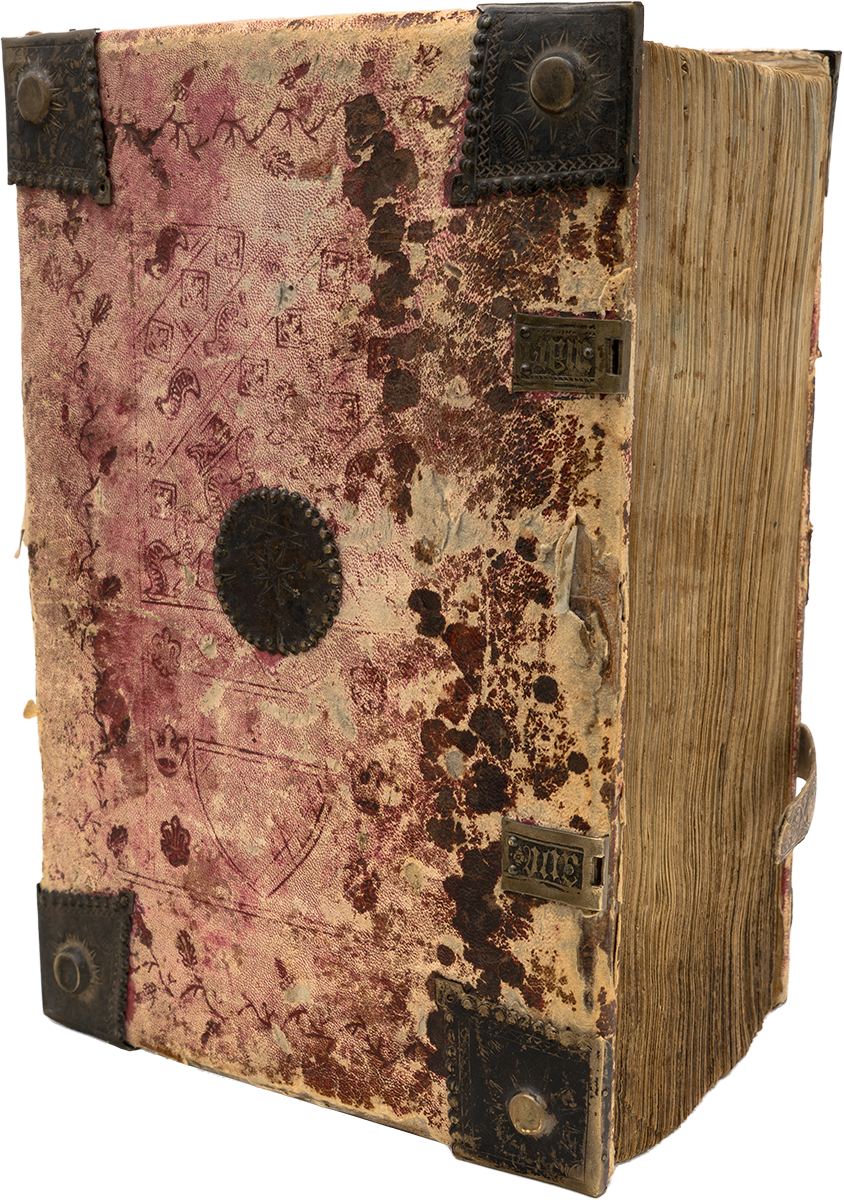
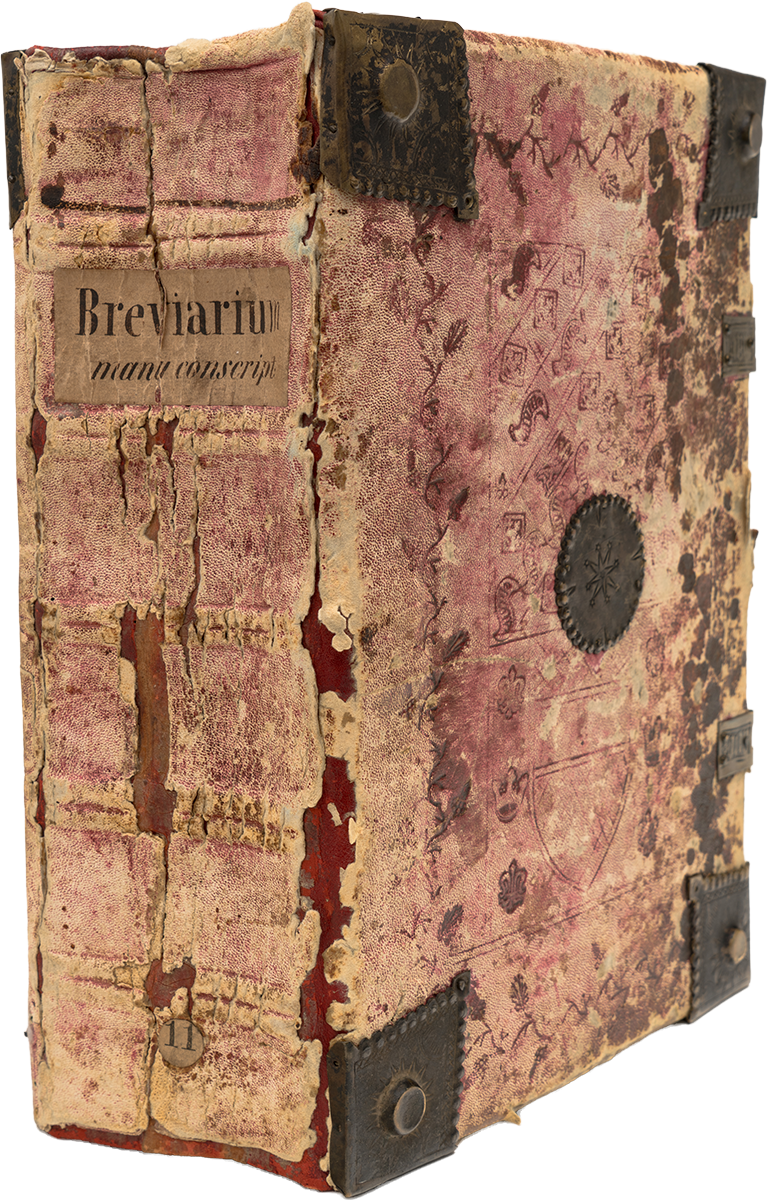
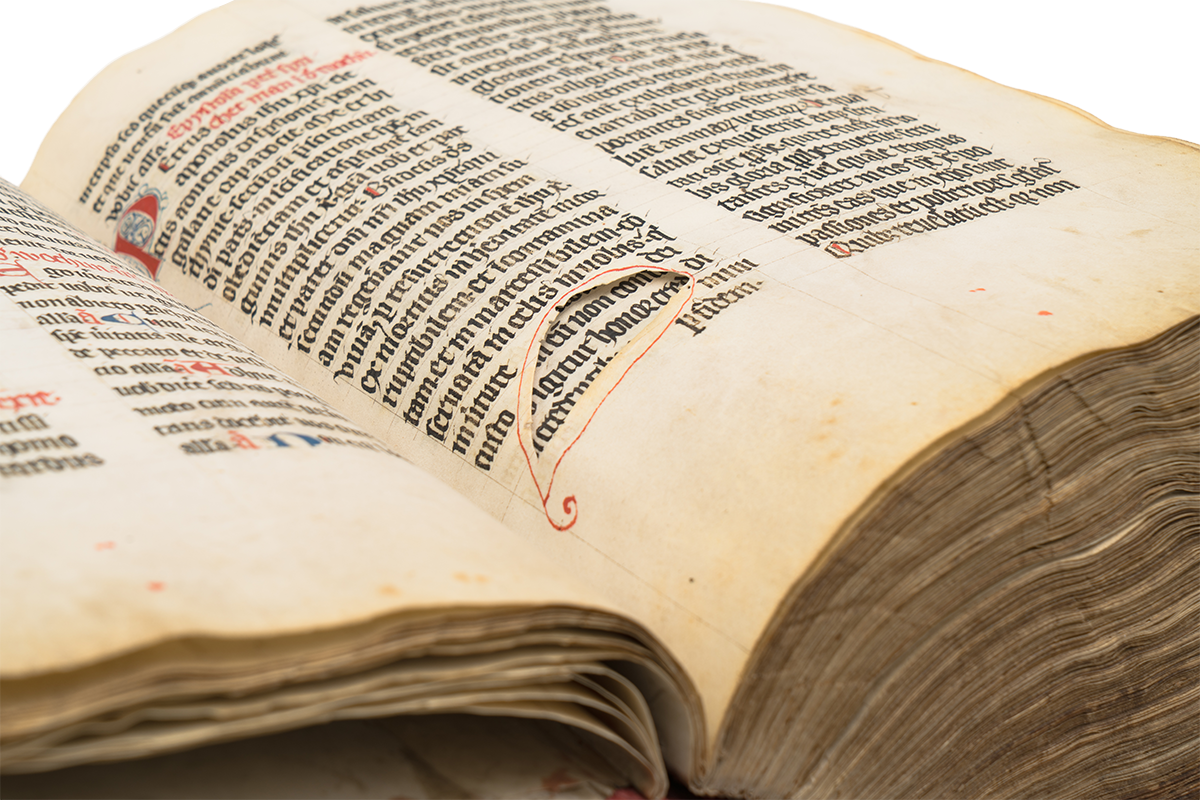
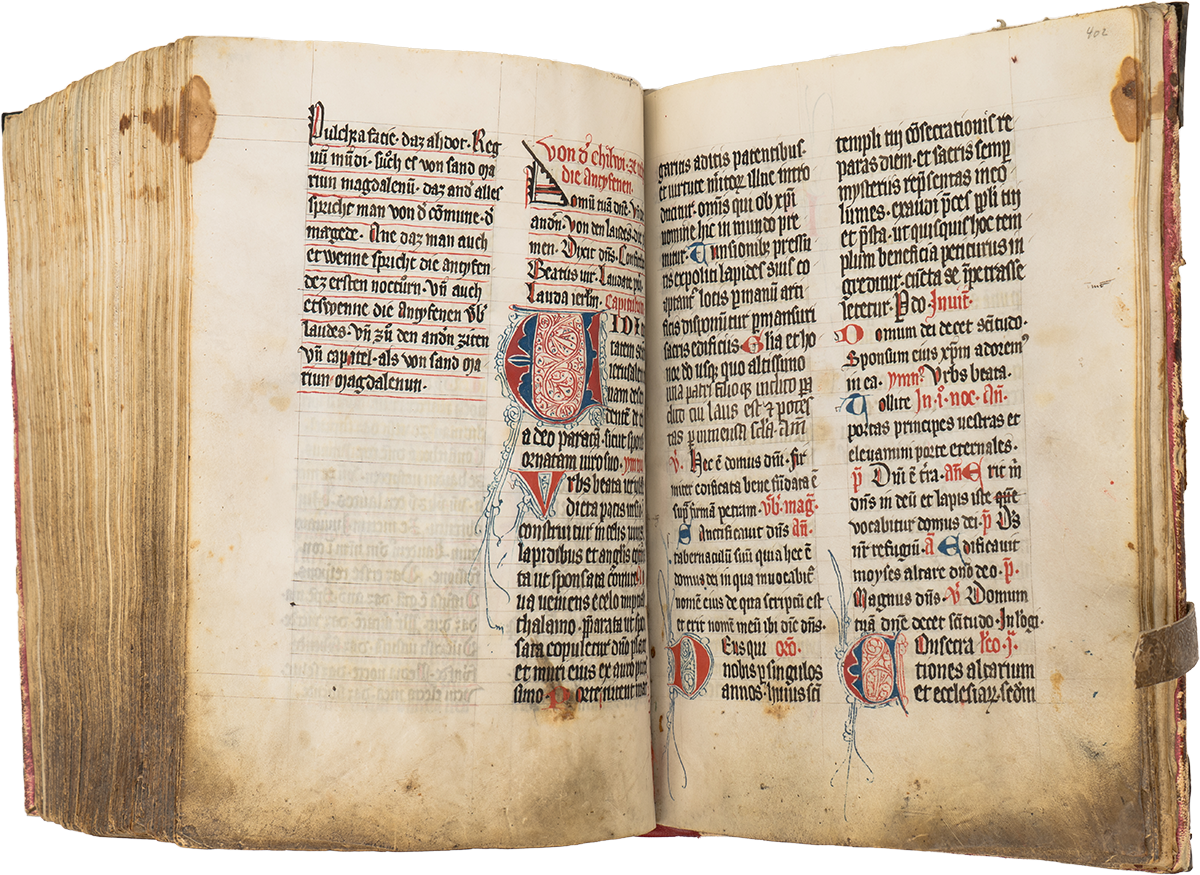
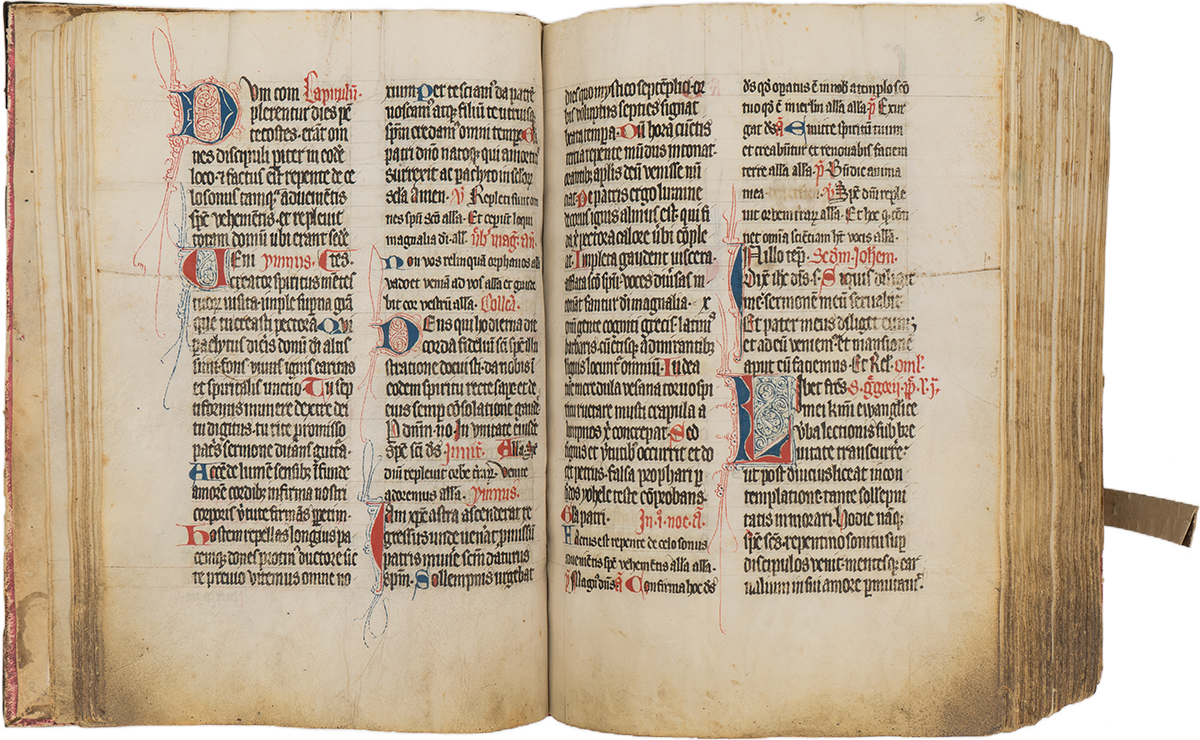
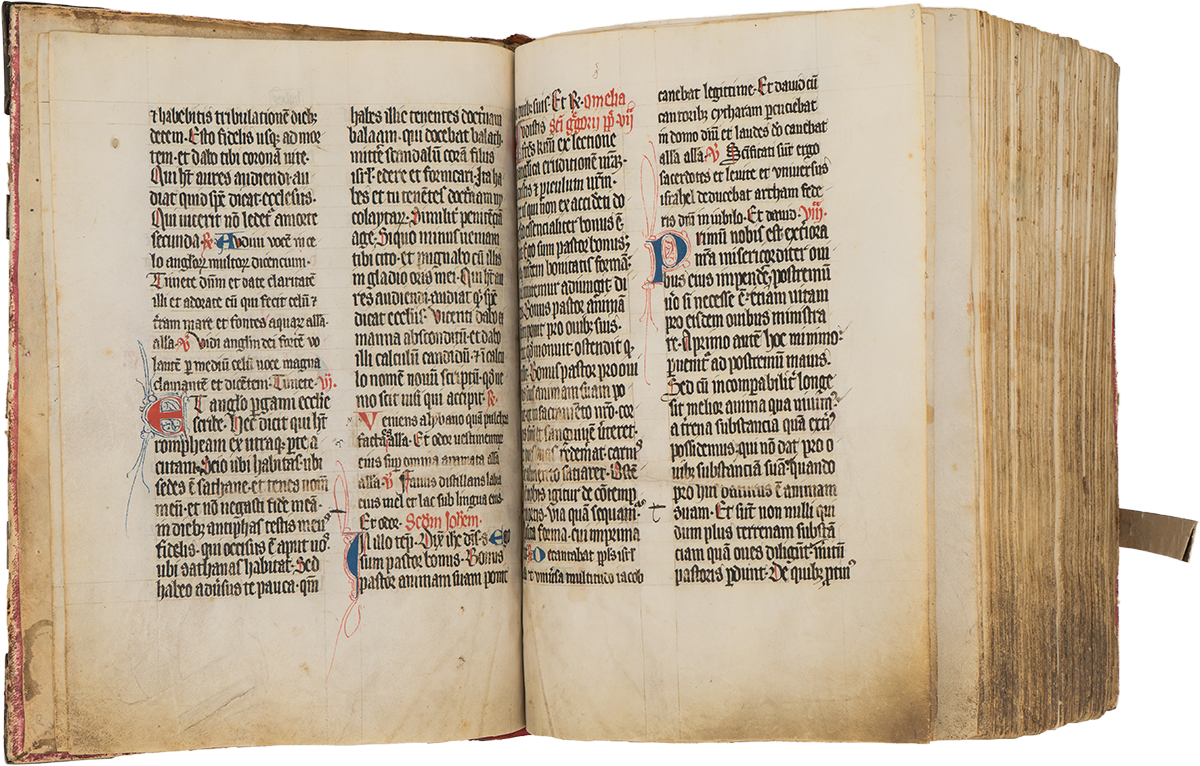
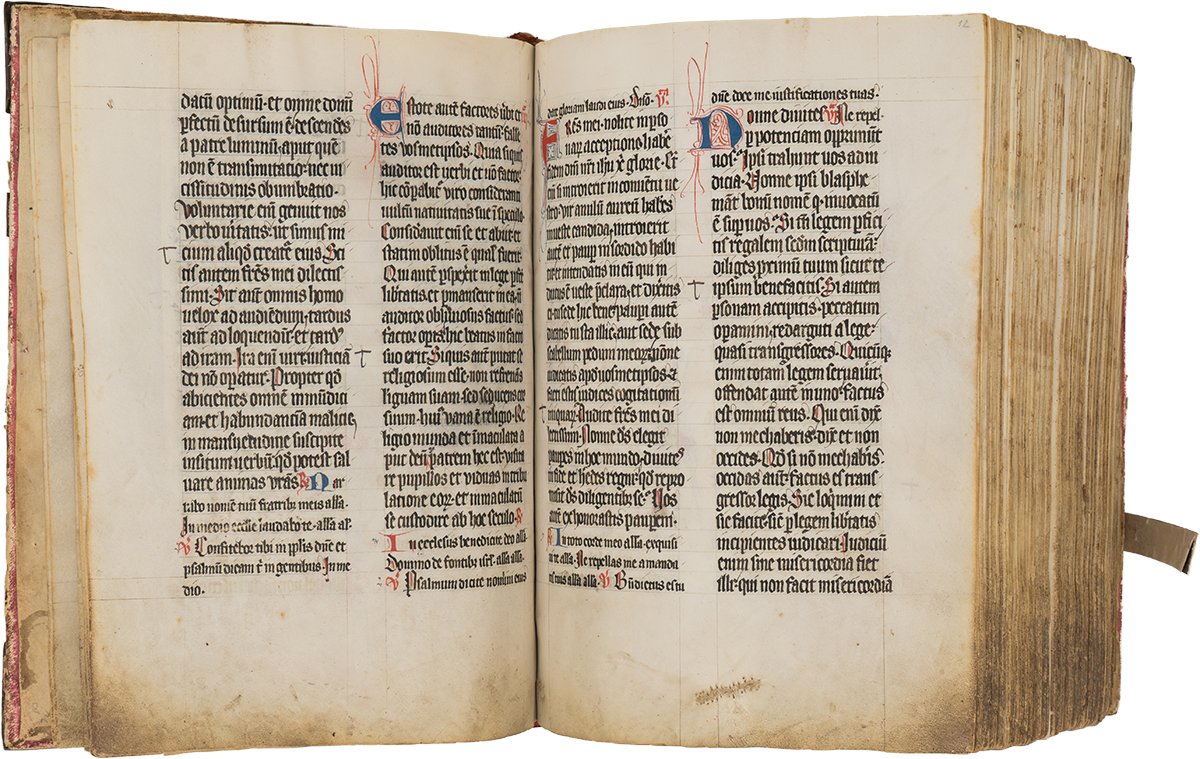
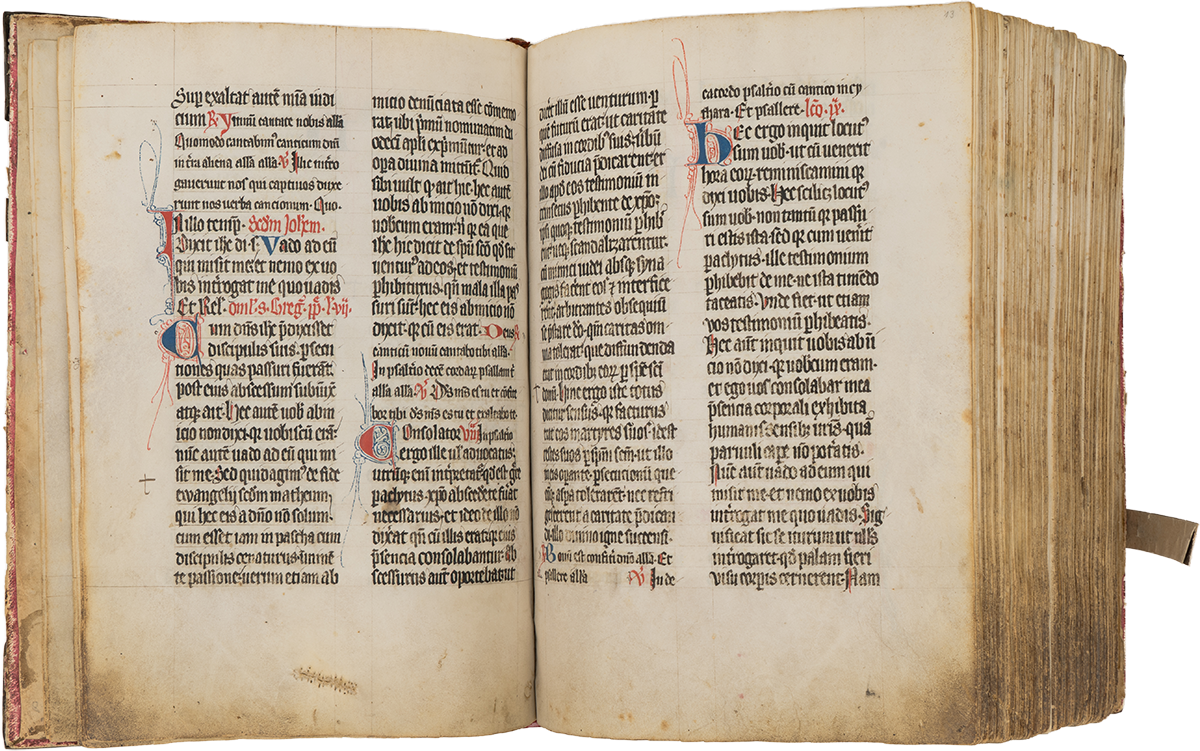
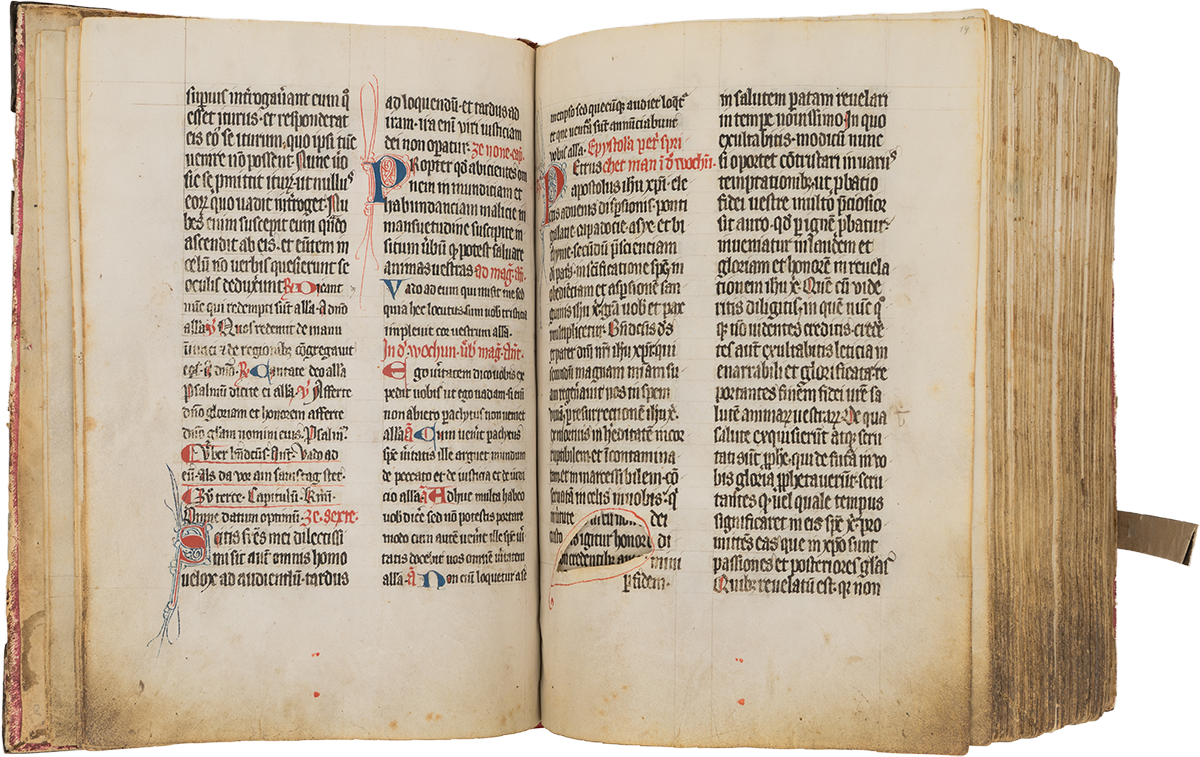
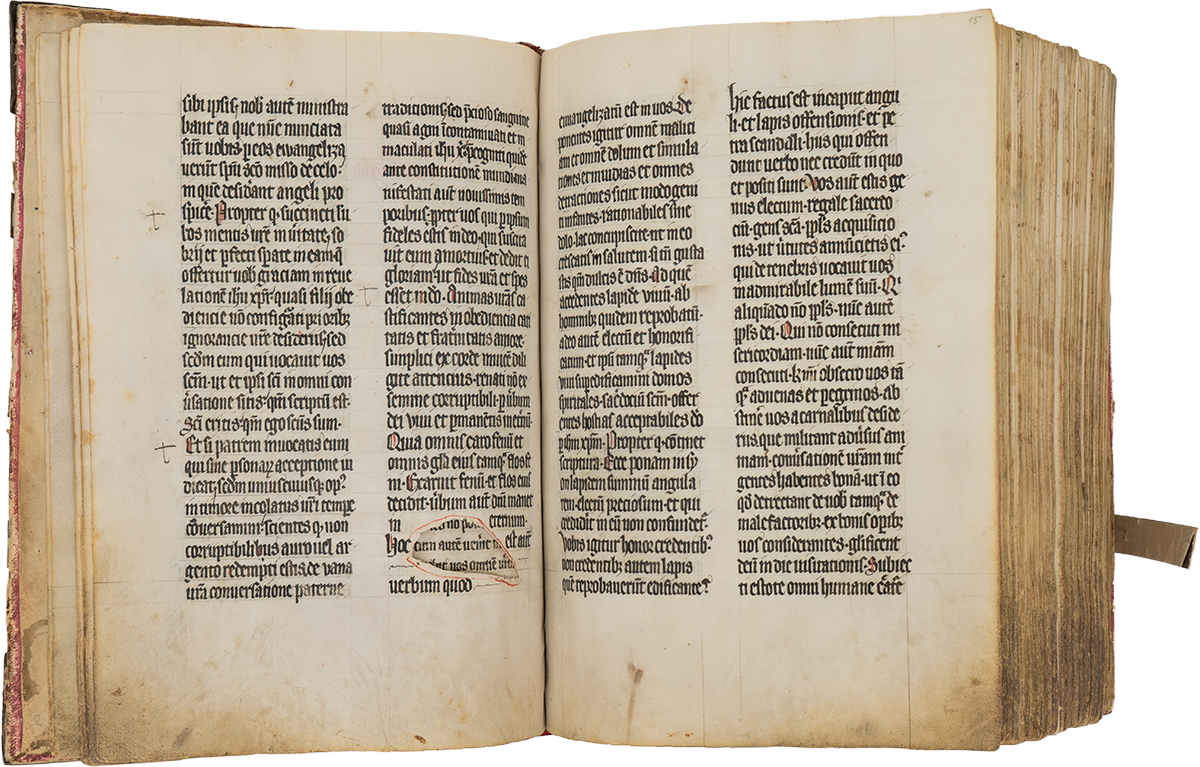
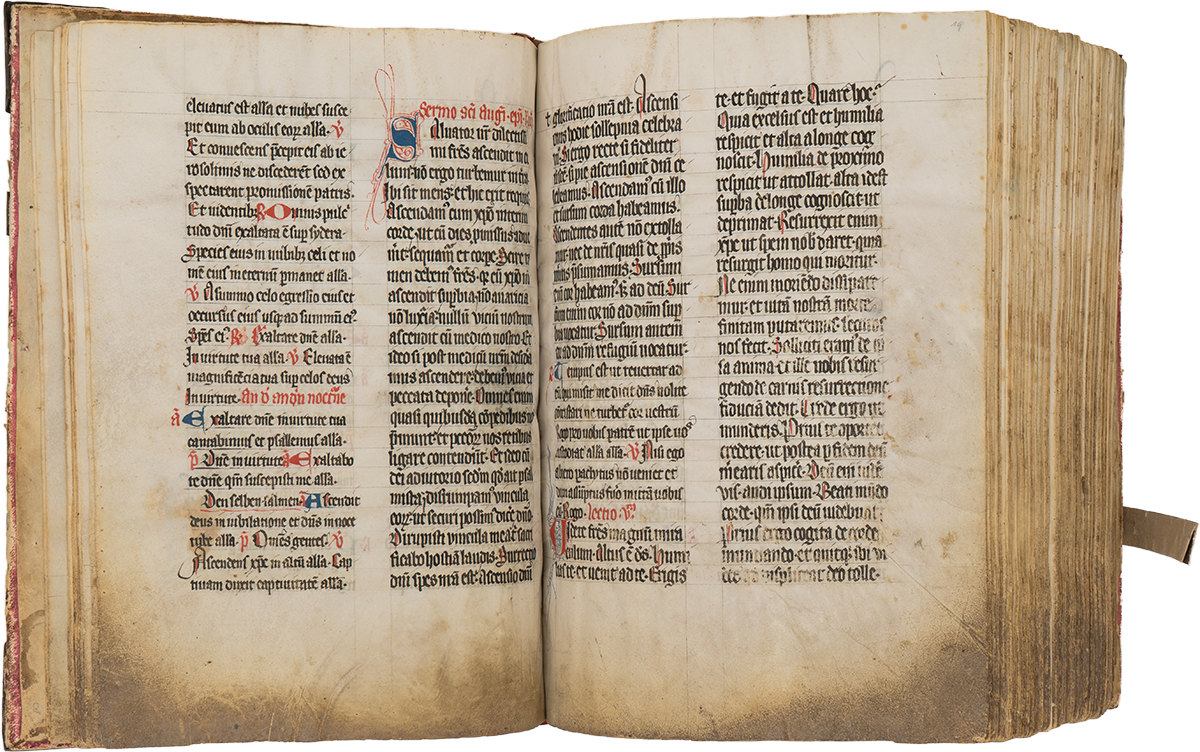
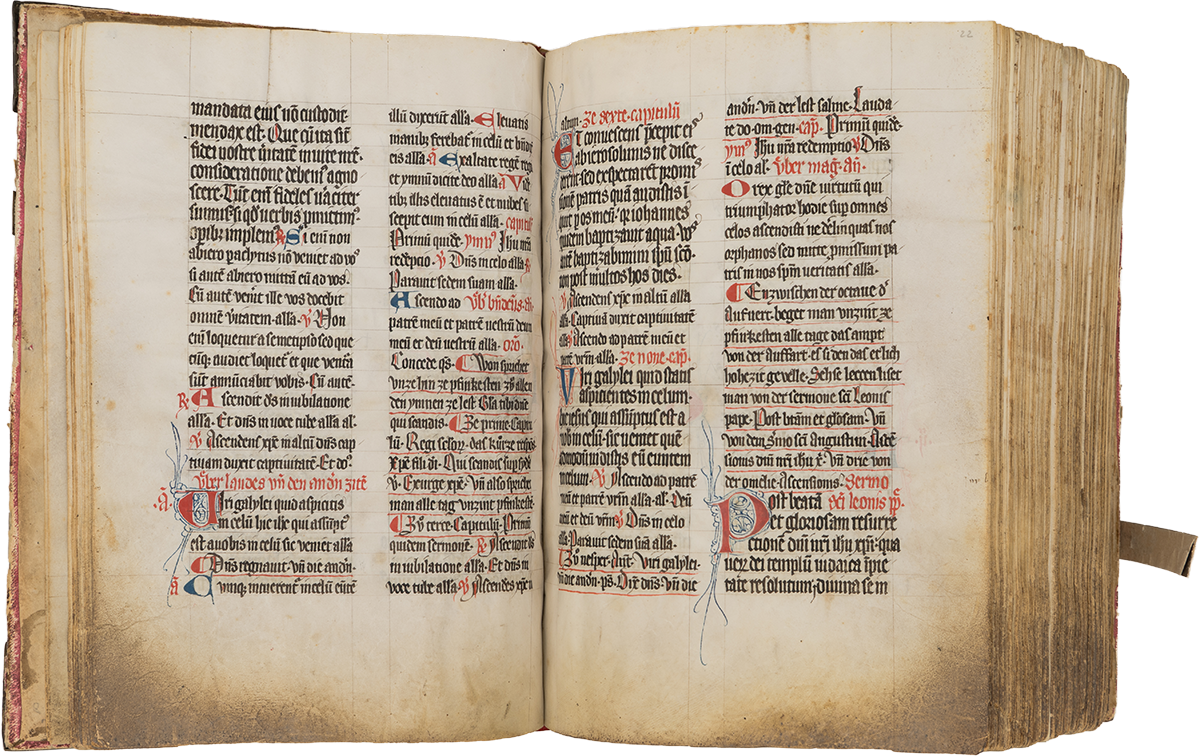
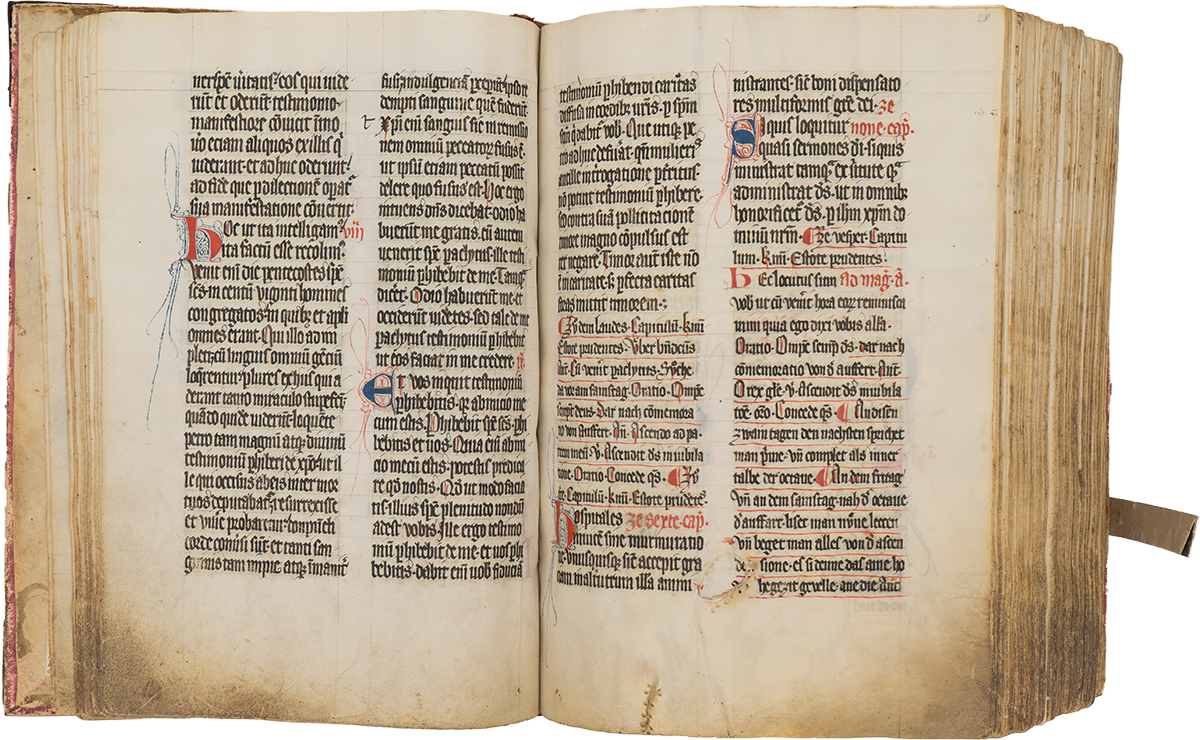
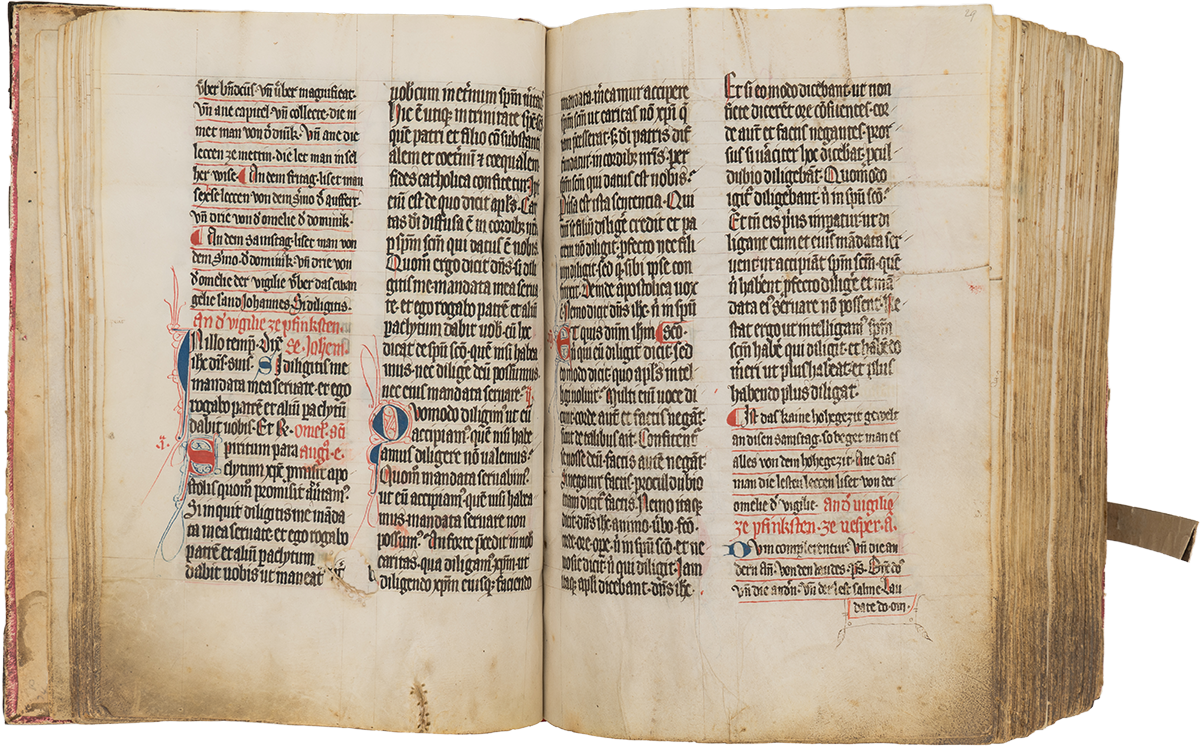
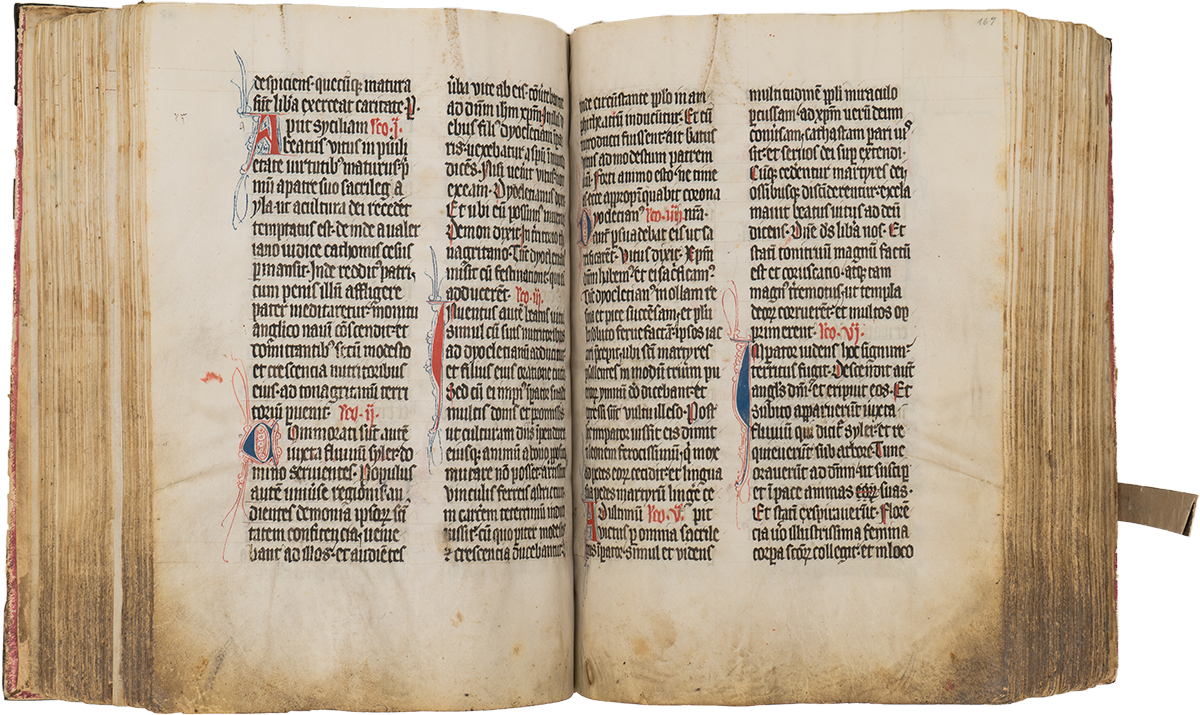
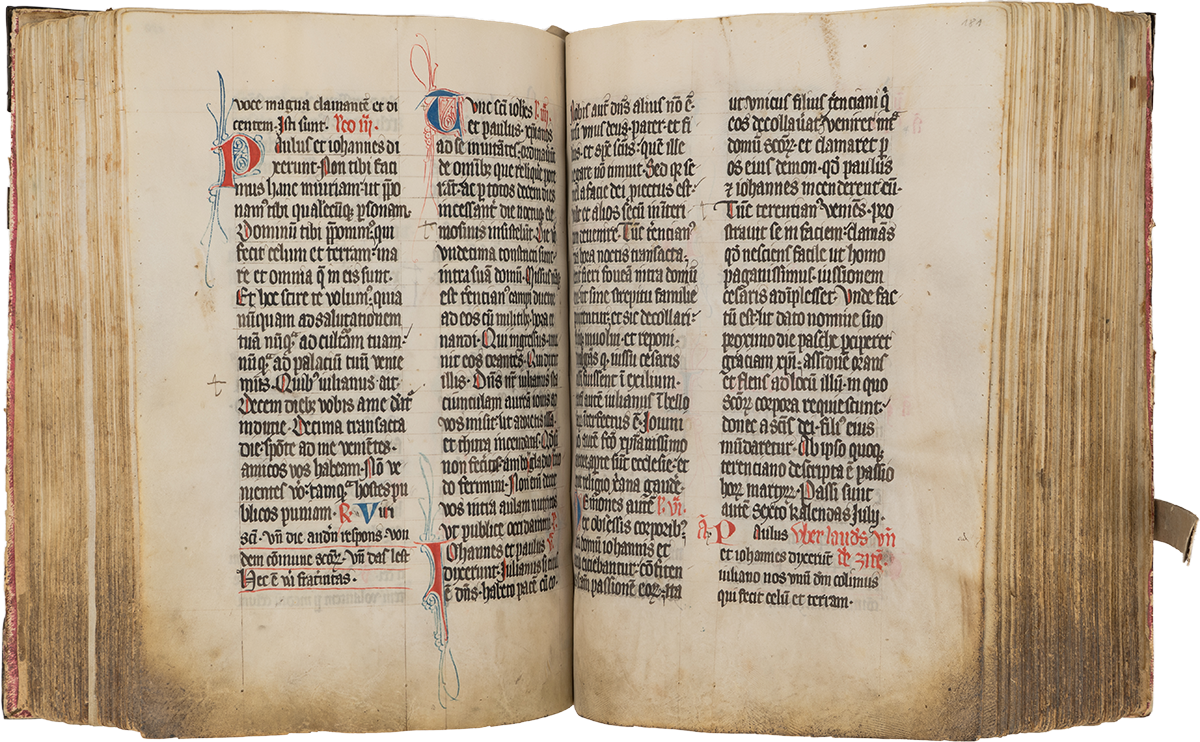
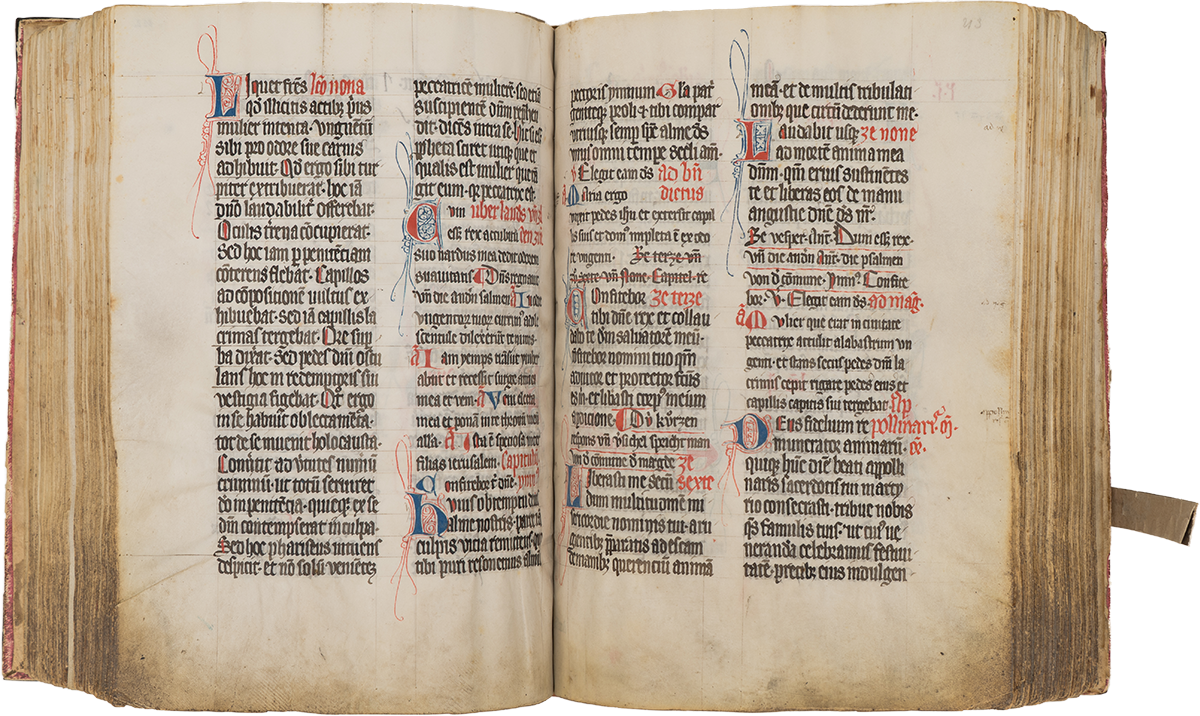
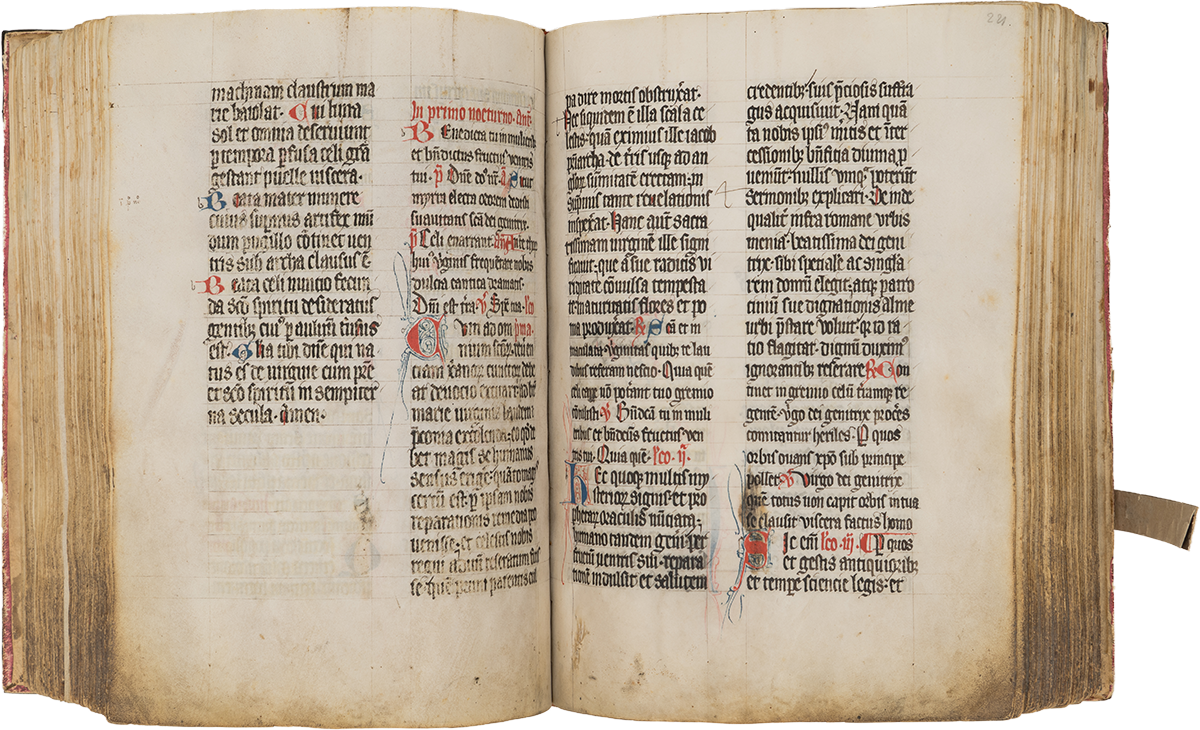
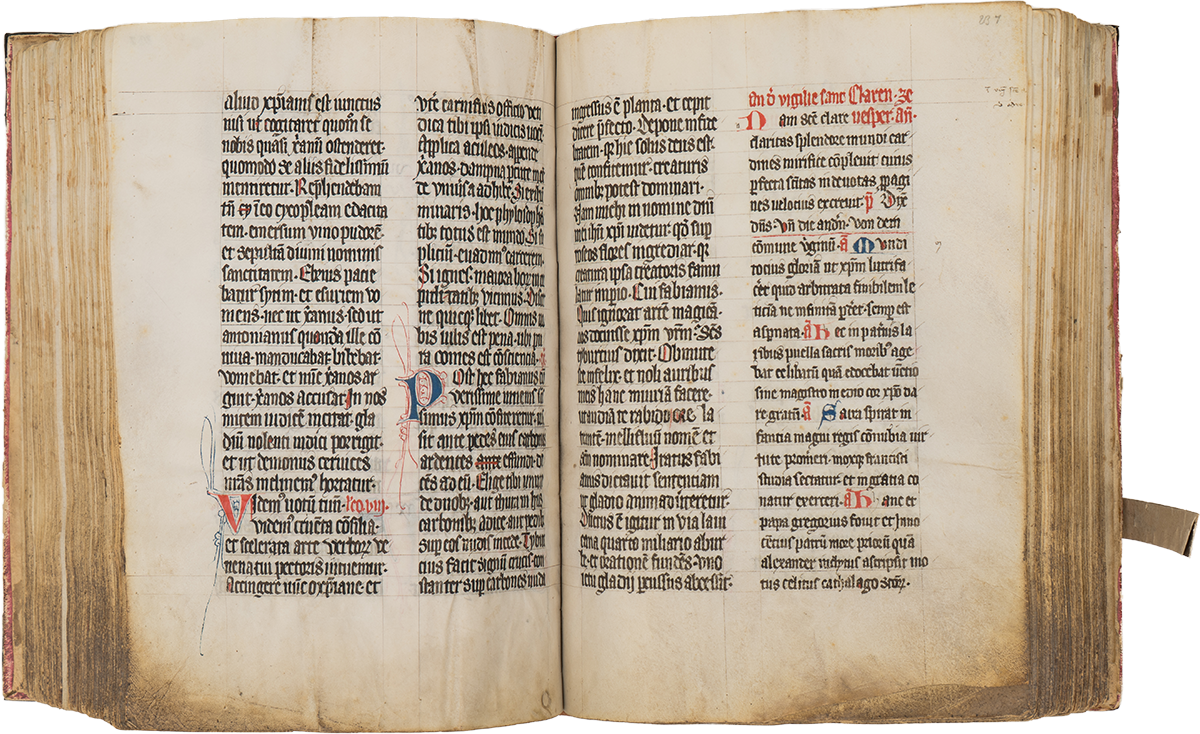
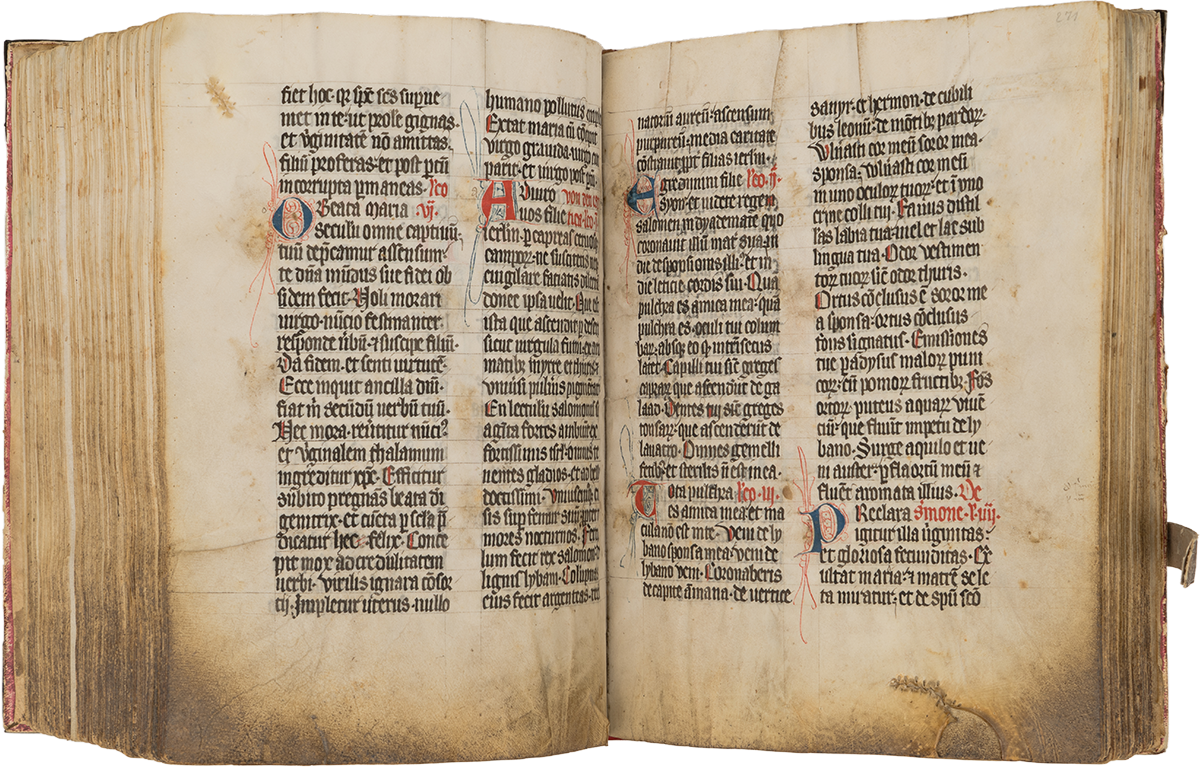
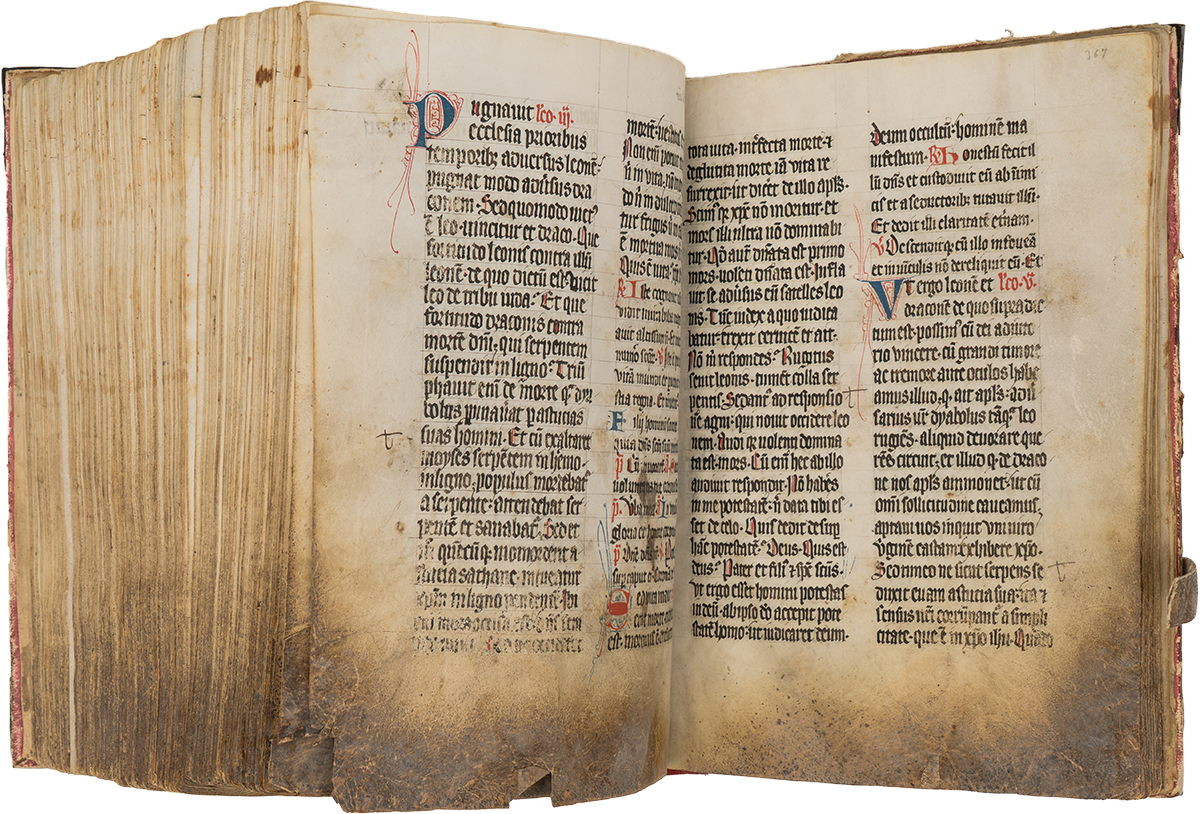
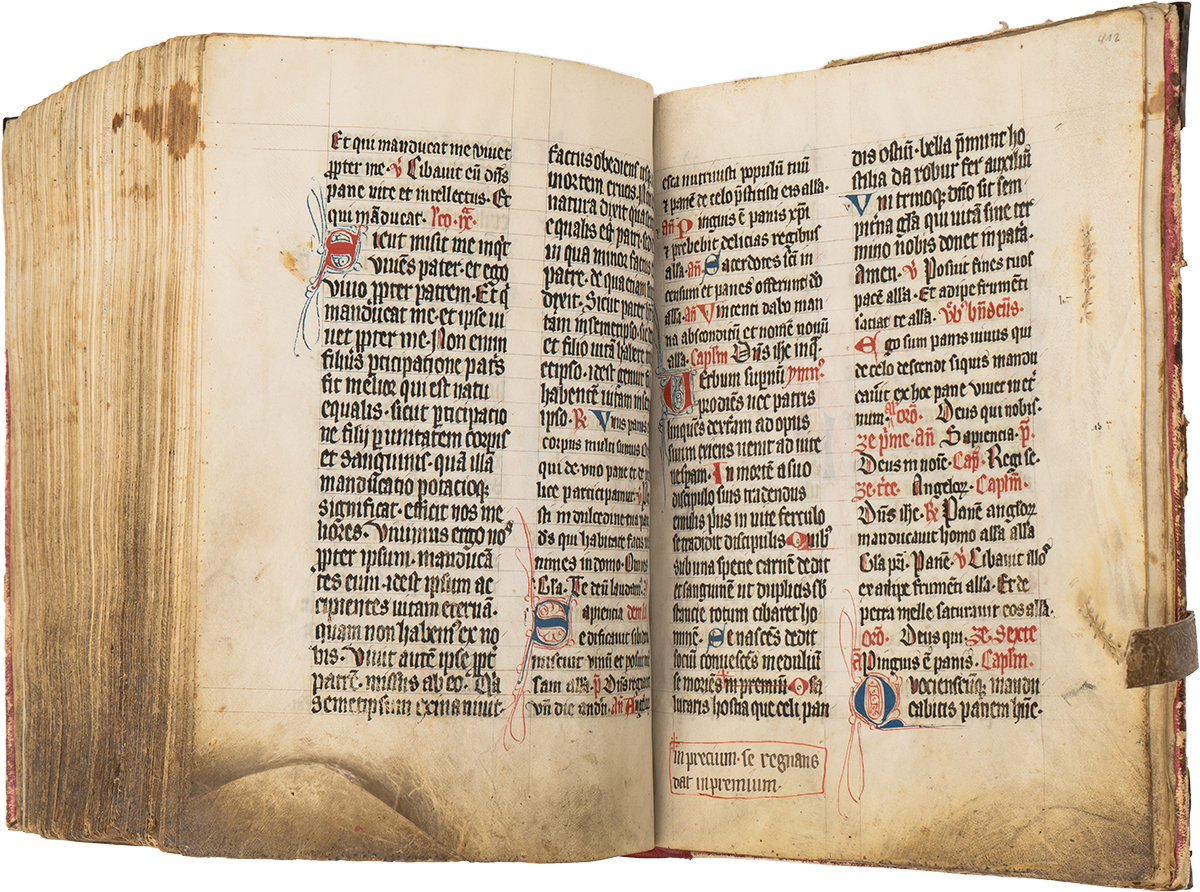
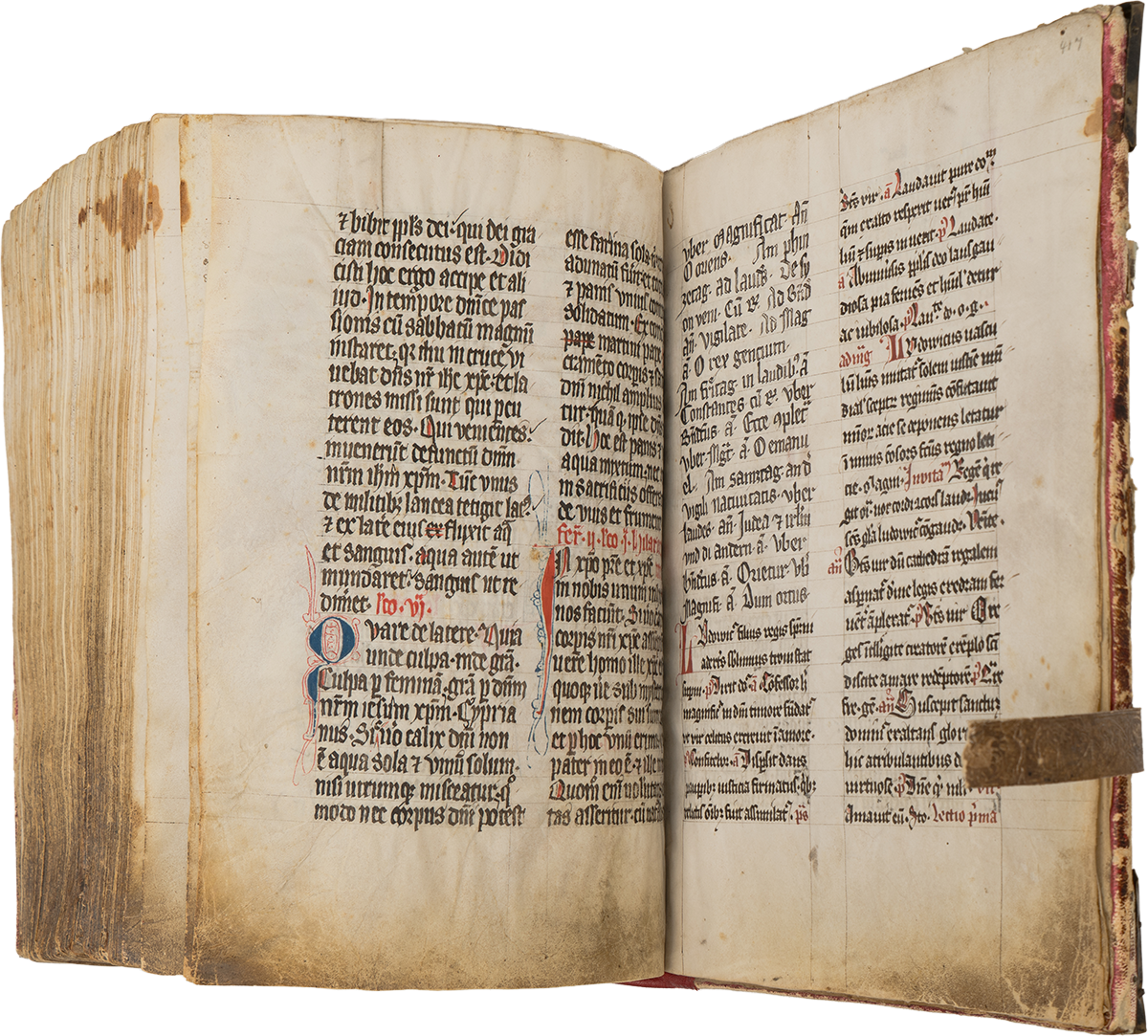
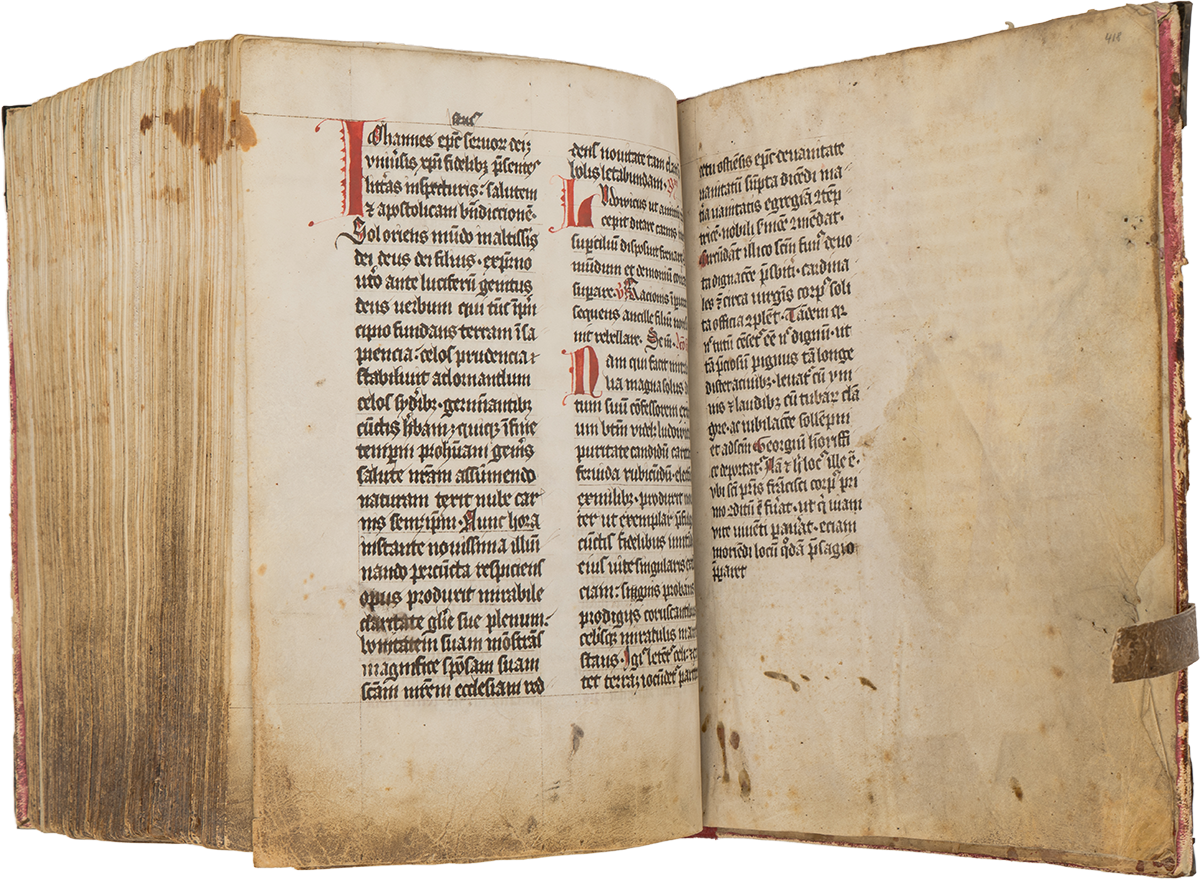
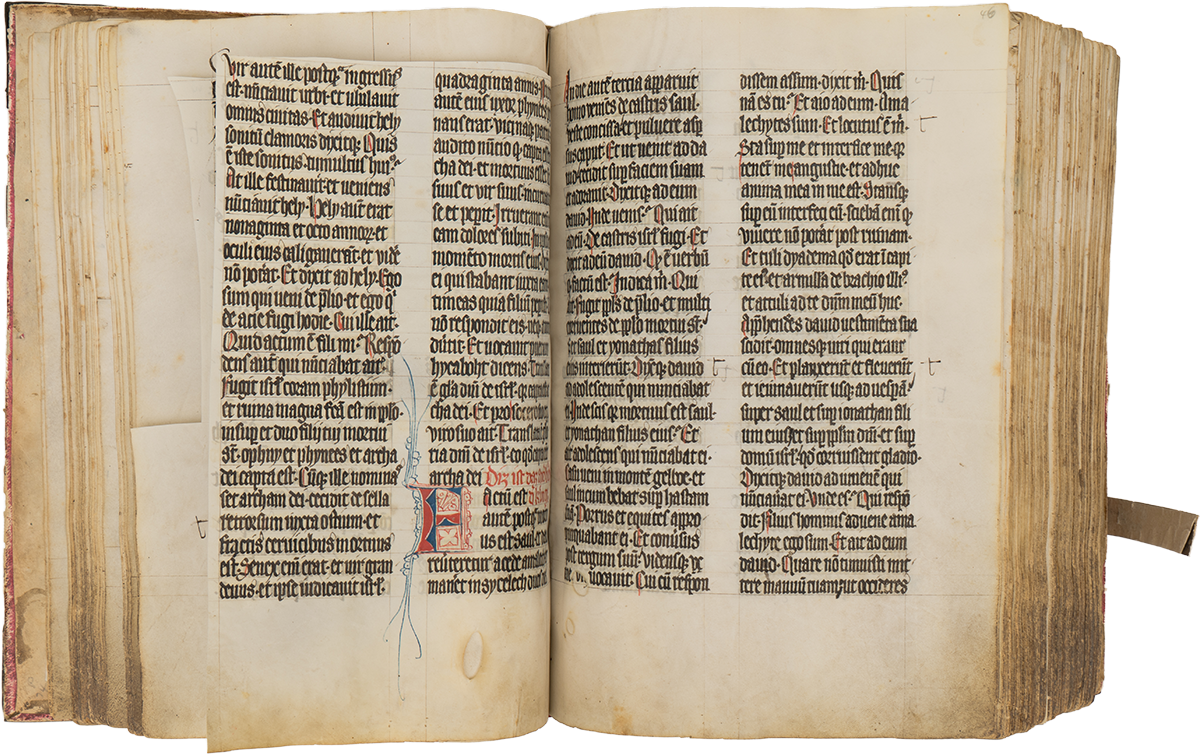
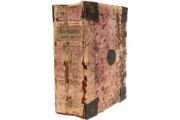
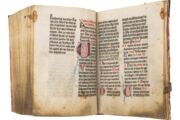
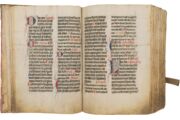
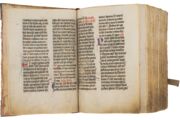
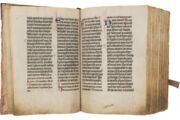
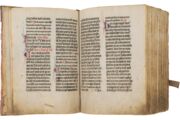
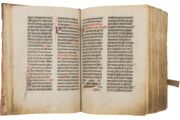
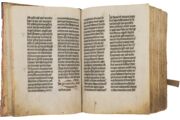
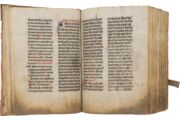
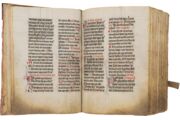
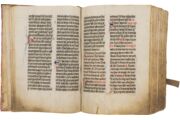
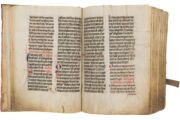
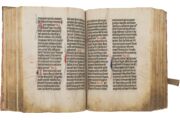
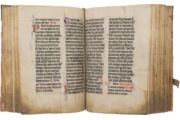
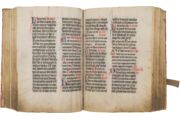
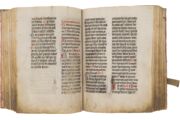
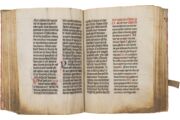
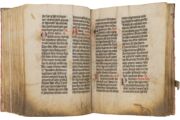
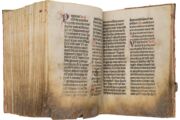
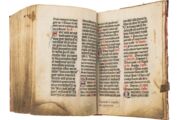
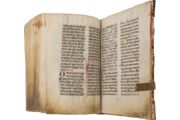
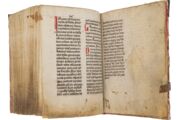
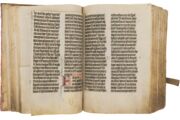
418 parchment leaves, incomplete, (collation: i4(missing 5-10 or 5-12), ii12, iii8(missing 1-2 or 1-4), iv-ix12, x10, xi12, xii10(missing 11-12), xiii6(missing 1, 3, 7-8), xiv2(missing 10 leaves total), xv8(missing 1-4), xvi12, xvii11(missing 2), xviii-xx12, xxi10, xxii2(missing 2-11), xxiii-xxiv12, xxv11(missing 11), xxvi-xxxi12, xxxii10, xxxiii-xxxviii12, xxxix10, xl2(missing 3-12 or 3-10), xli2), boxed catchwords, ruled in ink with two columns of 24 lines (justification (215 x 157mm), copied in a textualis, some ascenders extended and decorated, majuscules flashed in red, 1-line lombards in red or blue and red paraphs, 2-3-line lombards alternately in red and blue with alternate-colored flourishing, 3-7-line puzzle initials in red and blue flourished in red and blue, one 5-line puzzle initial and partial ink border in red, blue, green, and yellow (f. 243v), many signs of extended use: dirty lower corners, some margins excised, few with any loss of text, some other cuts and tears, one repaired early with green silk thread, before the lower margin wear (f. 368), but generally sound. Early binding sewn on five wide double bands laced into wood boards covered with red-stained leather blind-tooled with an outer border of foliage surrounding two rectangles, the upper one with a pattern composed of lozenge-shaped stamps each enclosing a crown, a rectangular one with a dragon(?), and a scroll filled with pseudoscript, the lower one with crowns, fleurs-de-lis, and a large shield, metal corner-pieces and central boss engraved with celestial motifs (one corner detached, back central boss lost), two clasps with metal fittings stamped ‘ave’ and ‘mari[a]’, one strap of leather blind-stamped with Renaissance ornament, the other detached and kept in an envelope (see Provenance), rebacked, preserving most of the original spine, with a nineteenth-century paper title-piece inscribed ‘Breviarium / manu conscript’ [sic] and a circular label printed ‘11’, in a fitted calf slip-case, cracking, its spine lettered in gilt capitals “Manuscript / Breviary // Fifteenth century” with a label inscribed “31.” Dimensions 310 × 220 mm.
Containing the cycle of daily prayers said year-round by the clergy, Breviaries were at the heart of medieval Christianity. Rather than ordinary, however, this Breviary is extraordinary. It is enormous, just over a foot in height and sports a hefty contemporary, red binding complete with corner pieces, bosses, and clasps. It also contains long instructions to the reader not in the usual Latin, but in German. This feature perhaps suggests that this Breviary was made for a convent of Poor Clares, or more likely, a house of Franciscan tertiaries, who were sometimes less educated than the friars themselves, and needed the instructions in their own language.
Provenance
1. The selection of saints and German incipits evince copying and use in a Franciscan friary, probably around Lake Constance, and the script and ink flourishing suggest first half of the fourteenth century, perhaps even before 1325, as the office of Louis of Toulouse (canonized 1317) was added later. (Thanks to Stephen Mossman for dialect consultation.)
2. The heraldic shield on the binding has not been identified.
3. Unidentified German(?) collection: inscribed in the nineteenth century ‘No. 349 (11): front pastedown, upper outer corner; cf. the label at the base of the spine.
4. Sotheby’s, 4 June 1934, lot 17, bought by Marks & Co., 84 Charing Cross Rd, perhaps on behalf of Dawson’s (see lot 20).
5. Dawson’s, of Los Angeles, Catalogue 106 (May 1935), no 8 (a clipping from this catalogue is stuck to the front pastedown), and Catalogue 114 (Nov. 1936), no 19; perhaps bought from them by Otto Ege.
6. Otto F. Ege (1888-1951), Akron, Ohio, teacher, lecturer, bookseller, and well-known book-breaker, with a paper label printed “331” (probably his; the same as the ‘326’ label in the Gaetani Bible, lot 20); the front pastedown inscribed by his wife, Louise, “Germany 1450.” One of the clasp fittings is in an envelope inscribed “Mr Ege – We are very sorry about this broken clasp […] Charles Val Clear,” suggesting that the manuscript was exhibited at the Akron Art Institute, now the Akron Art Museum, of which Clear was Director, from 1945-49; sold by the Ege heirs at Sotheby’s, 11 December 1984, lot 53; bought by Alan Thomas.
7. Alan Thomas (1911-1992), renowned English antiquarian bookseller and bibliophile based in Bournemouth, United Kingdom offered in his Catalogue 48 (1985), no 1 and pl.1, priced £6,500; acquired by Schøyen.
8. Martin Schøyen, Oslo, Norway and London, UK (born January 31, 1940), a Norwegian businessman, traveler, historian, and collector of books; The Schøyen Collection, MS 9, his ex-libris.
Text
ff. 1-125, The summer portion of a Breviary, with the Temporale beginning imperfectly in the second Sunday after Easter to November;
ff. 125-355, Sanctorale from the Common of the Martyrs during Easter followed by George (23 April) to Katherine (25 November), including the Translation of Francis (f. 142), Anthony of Padua (f. 152), Dominic (f. 217), Clare (f. 237), Elizabeth of Hungary (f. 339v), and Francis, with the vigil and first lesson marked by puzzle initials on ff. 292v and 294, remains of a string tab for Margaret (f. 203);
ff. 355-407, Common of Saints;
ff. 407, instructions for Office of the Blessed Virgin Mary;
ff. 407-17, Feast of Corpus Christi, incomplete;
ff. 417-18, (added) office for Louis of Toulouse (canonised in 1317 and perhaps suggesting that this breviary was copied before 1317)
Medieval monks prayed a daily round of prayers on an annual cycle, and Breviaries contained the text for this task. Because people prayed from Breviaries literally day and night, they were frequently small volumes, and to maintain that size, they contained just part of the year, or only day or evening prayers. The present Breviary limits itself to the summer, a normal division, but displays a plus-sized format. This large size marks just one of the unique traits of this book. While Breviaries are very common medieval manuscripts, those predating the Black Death, like this one, are far rarer. The slightly later addition of the feast of Louis of Toulouse suggests that the original volume dates to just before 1317, when he was canonized. However, the feast of Corpus Christi marks the end of the original volume, and this feast too only became fully added to the Roman calendar in 1317, though it was added to diocesan calendars in Germany in the decades prior. One can easily imagine the present Breviary being copied from a slightly earlier Breviary that itself had added the feast of Corpus Christi to the end, when it was formalized by the local bishop. Thus, this one Franciscan Breviary displays traces of earlier liturgical development and the consequent expansion of liturgical volumes used over time.
And there’s more. Vanishingly few extant Breviaries feature the vernacular rubrics found throughout the present volume, sometimes taking up an entire column of text or more (for example ff.121v, 142r–v, 401r–v), and thanks to these same rubrics we can localize this manuscript around Lake Constance. The use of German rubrics in Latin liturgical manuscripts is often said to indicate that they were written for the use of nuns. Though this Breviary includes both the feasts of Clare and Elizabeth of Hungary, both saints were also venerated by the friars. Thus, it is difficult to assess whether the noteworthy use of the vernacular in this Breviary indicates a convent of Poor Clares rather than perhaps a tertiary house. Indeed, these rare rubrics are doubly important, as their rarity, coupled with the attractive hefty contemporary binding, may have preserved the volume from being dismembered like so many others that passed through the notorious Otto Ege’s hands. Of the over 300 Ege manuscripts Scott Gwara has identified, he found only fourteen remained whole, including the present manuscript (Gwara, 2013).
Literature
Gwara, Scott. Otto Ege's Manuscripts: A Study of Ege's Manuscript Collections, Portfolios, and Retail Trade: with a Comprehensive Handlist of Manuscripts Collected Or Sold. Cayce, SC, 2013, Handlist 149.
Hughes, Andrew. Medieval Manuscripts for Mass and Office: A Guide to Their Organization and Terminology, Toronto, 1982.
Van Dijk, S. Sources of the Modern Roman Liturgy: The Ordinals of Haymo of Faversham and Related Documents (1243-1307), 2 vols, Leiden, 1963.
Online Resources
“Liturgical Books,” https://liturgical.columbia.edu/
Liturgia Latina http://www.liturgialatina.org/
Otto Ege Project https://fragments.yale.edu/otto-f-ege-project
Schieszer, Ashleigh Ferguson, “Otto Ege: Hero or Villain?” Cincinnati and Hamilton County Public Library https://blog.thepreservationlab.org/2024/09/otto-ege
Shailor, Barbara, “Otto Ege: His Manuscript Fragment Collection and the Opportunities Presented by Electronic Technology,” The Journal of the Rutgers University Libraries 60 (2003), https://jrul.libraries.rutgers.edu/index.php/jrul/article/view/4