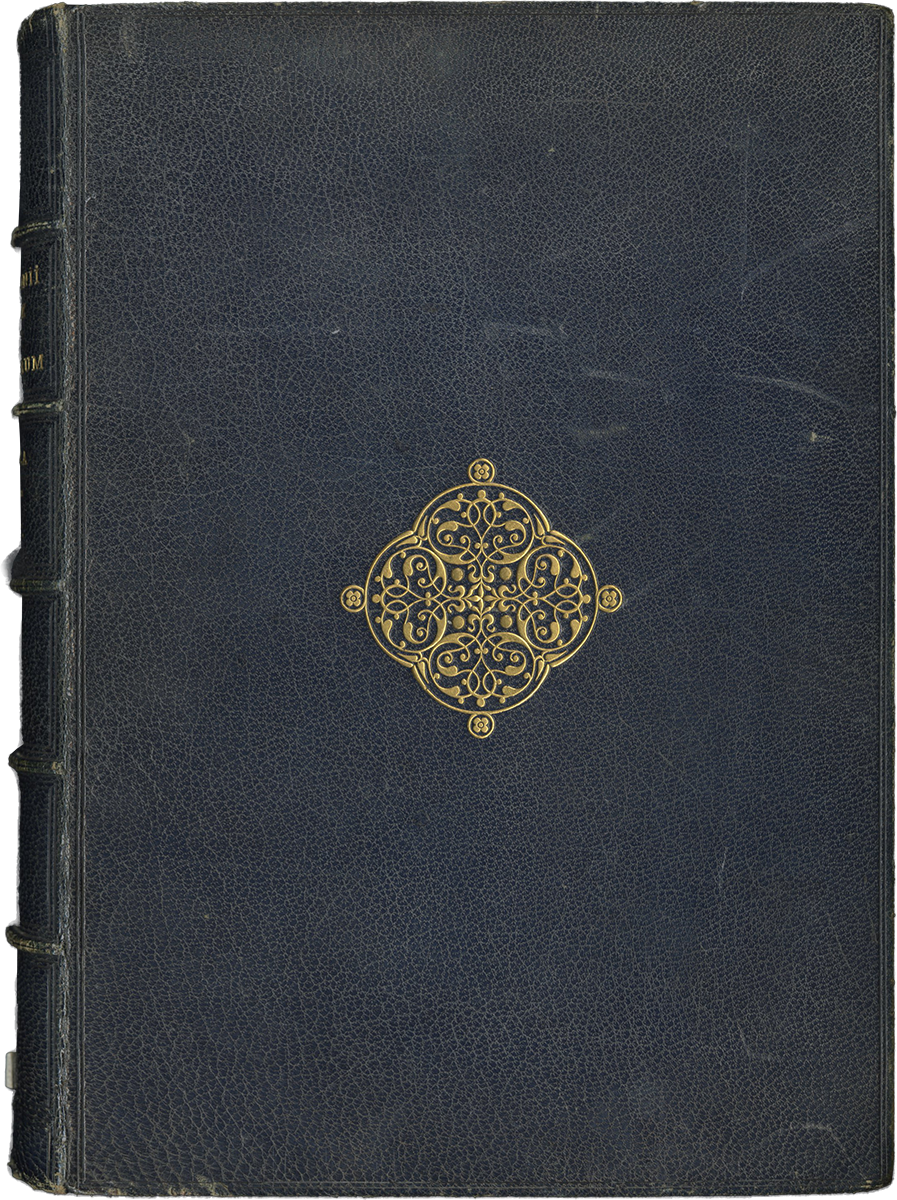
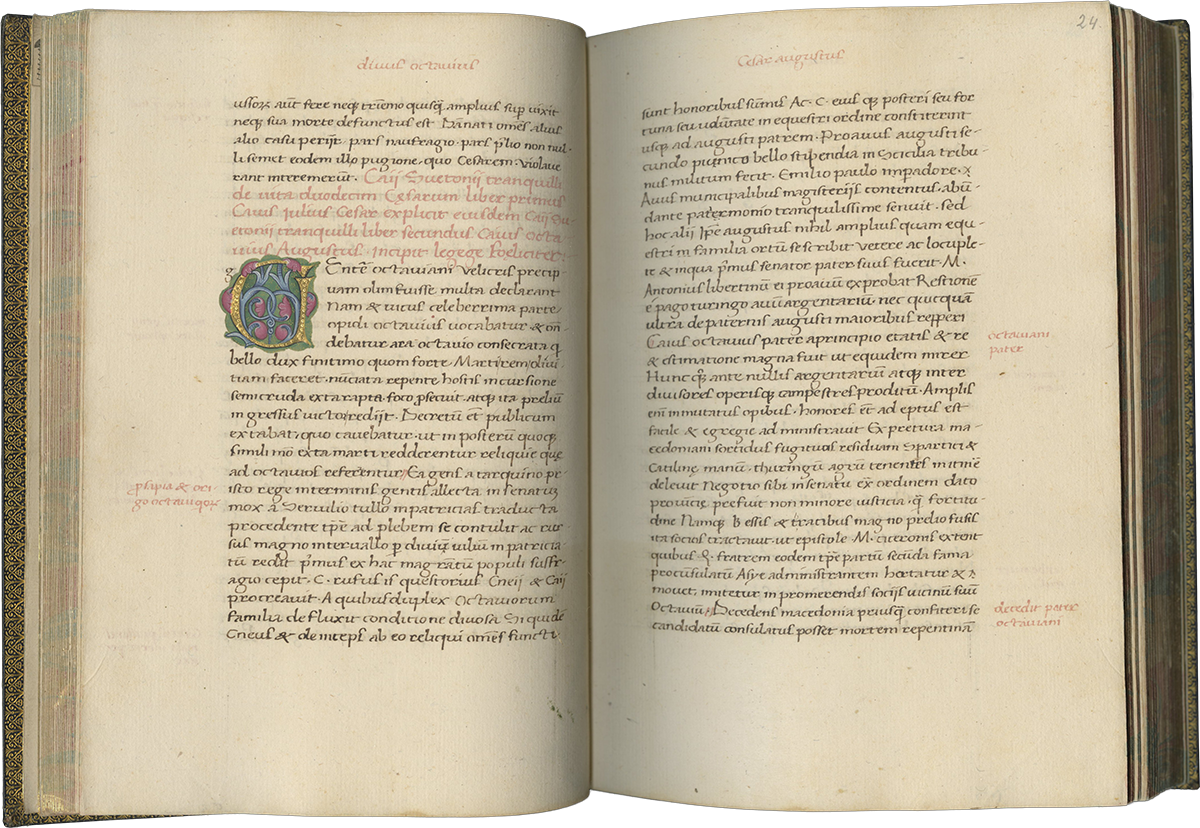
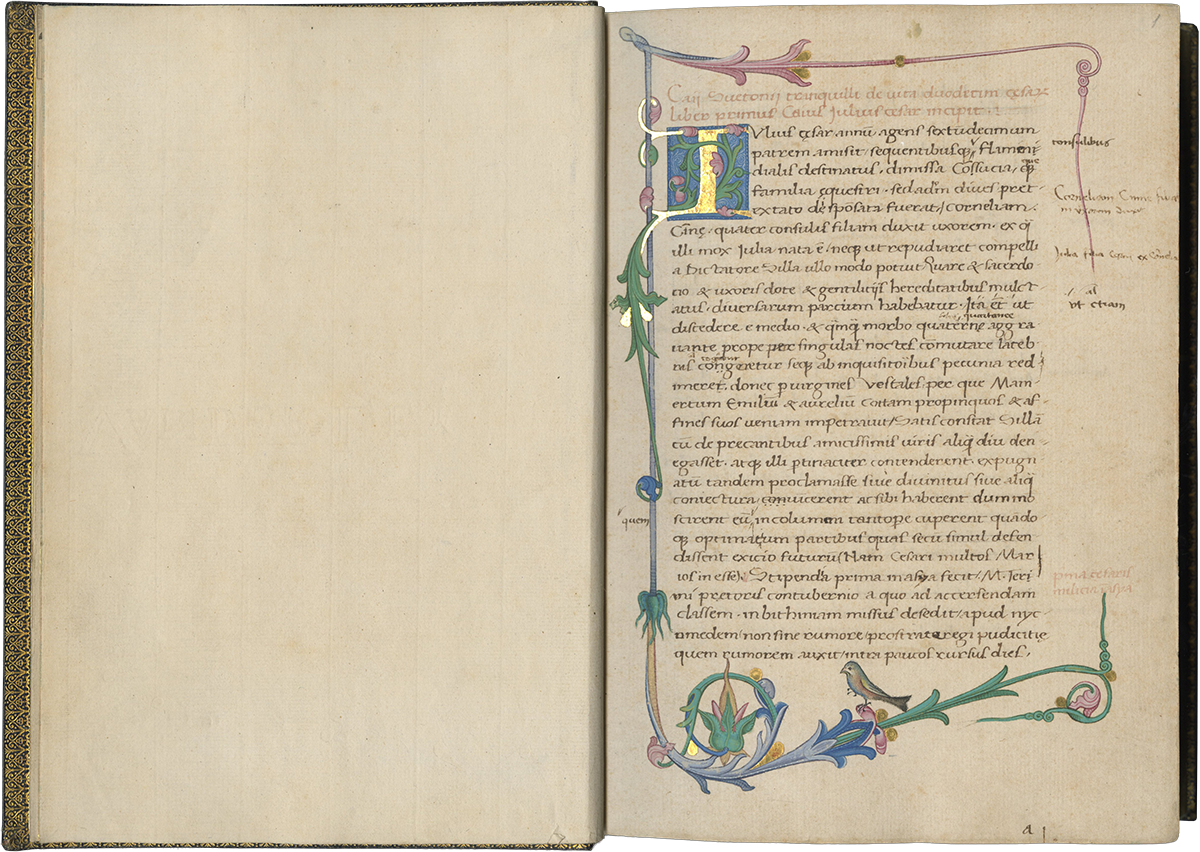
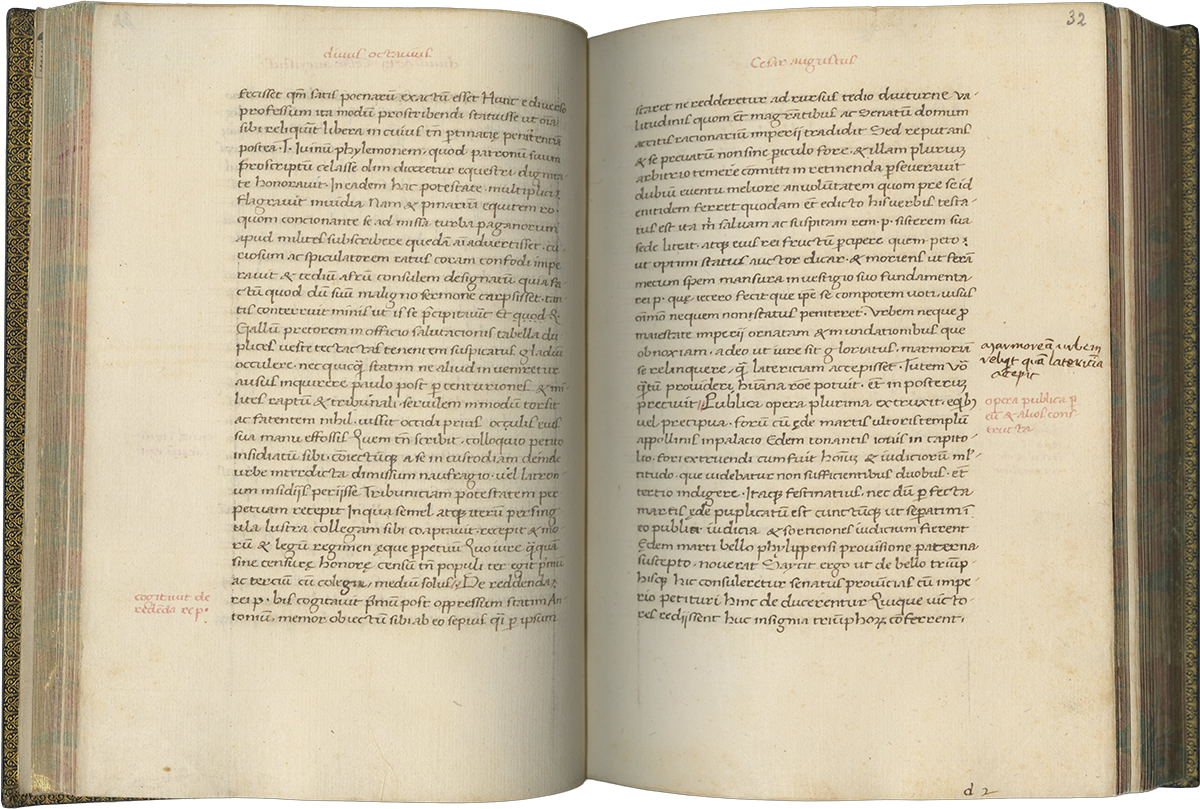
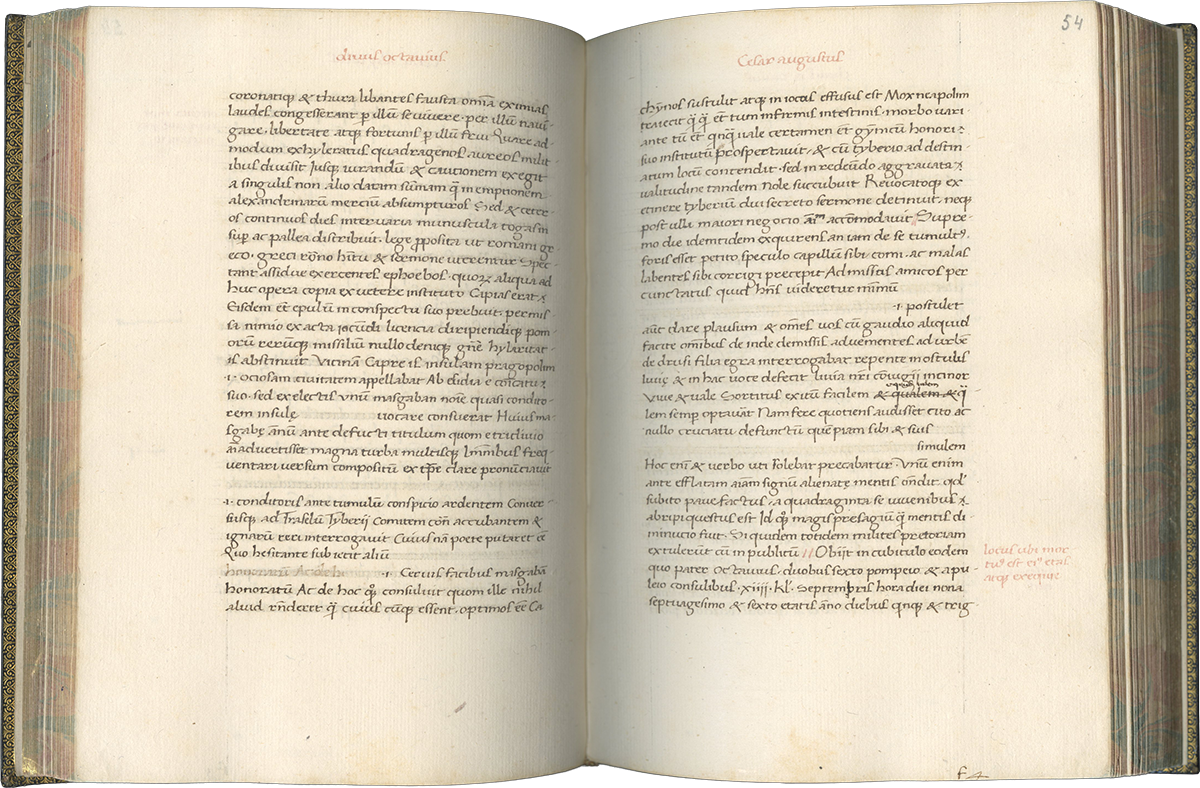
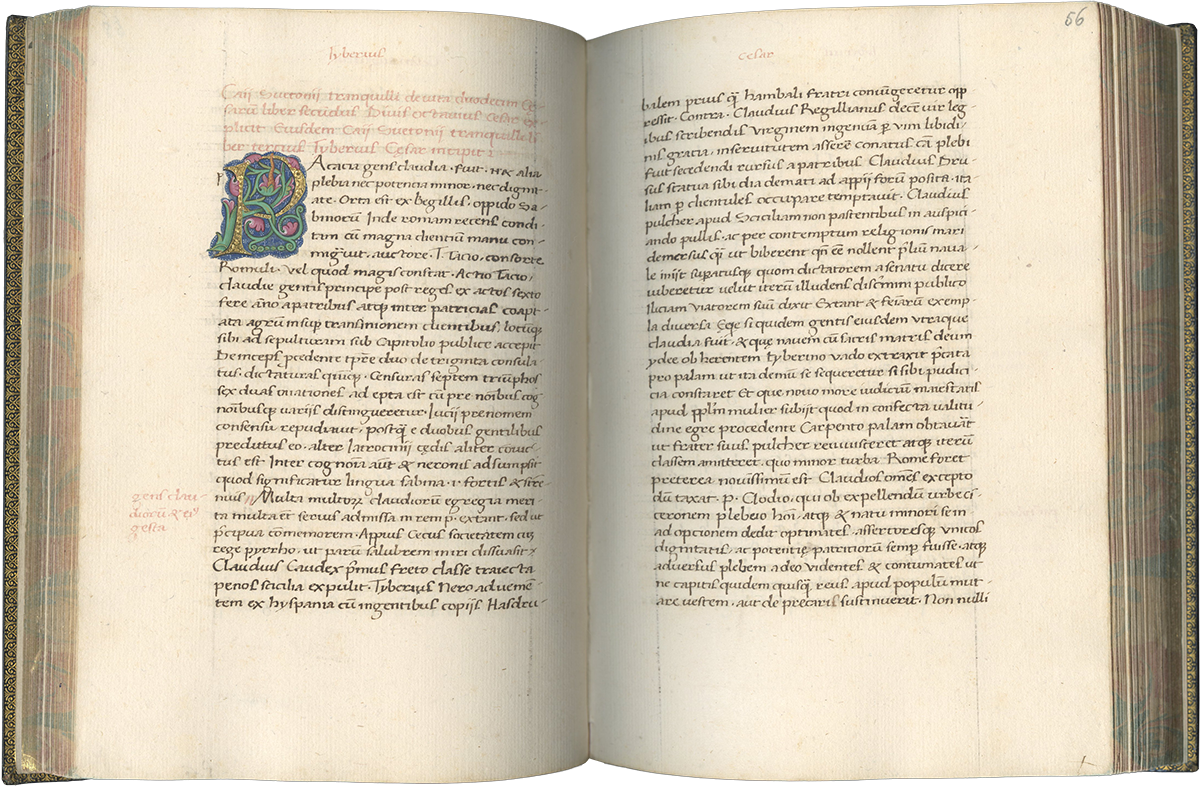
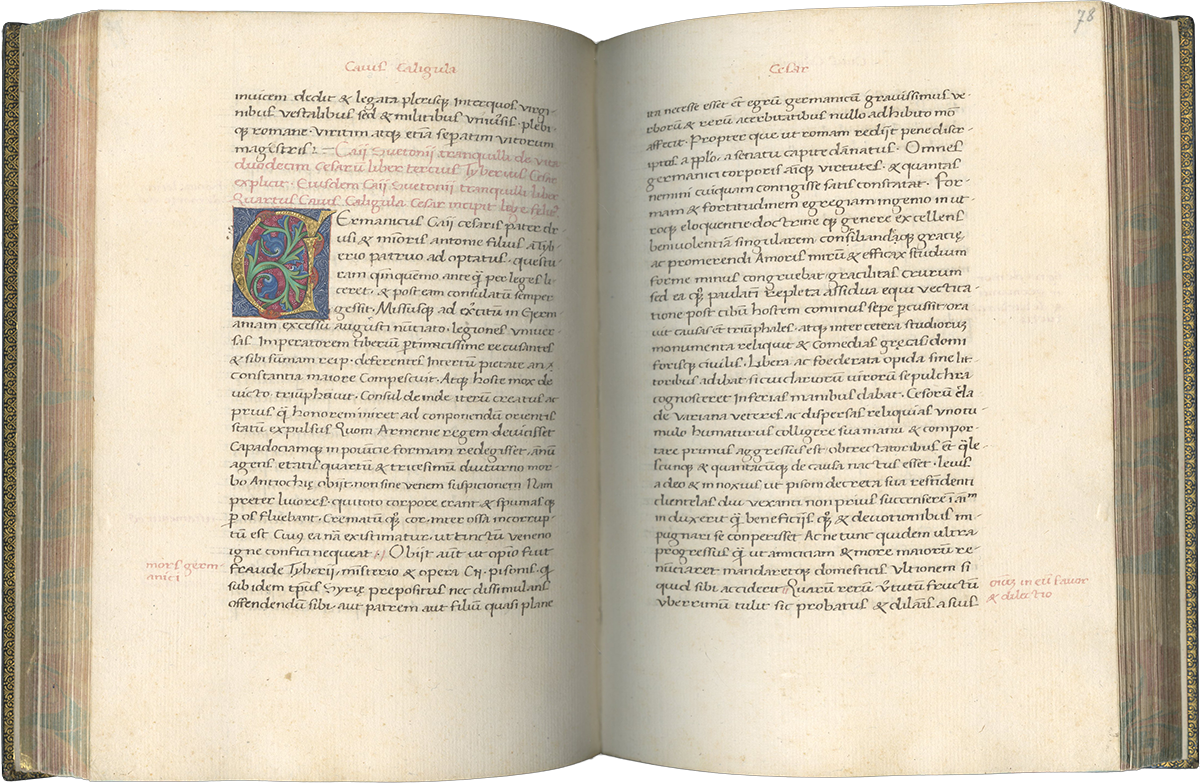
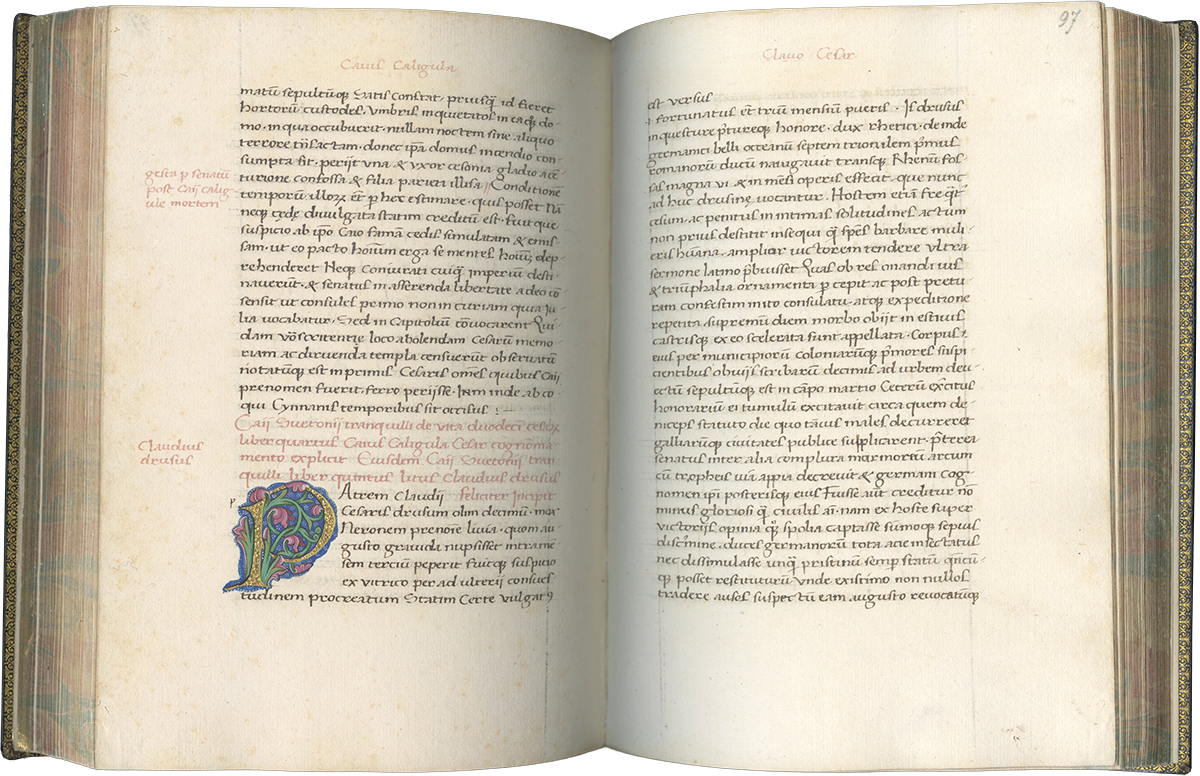
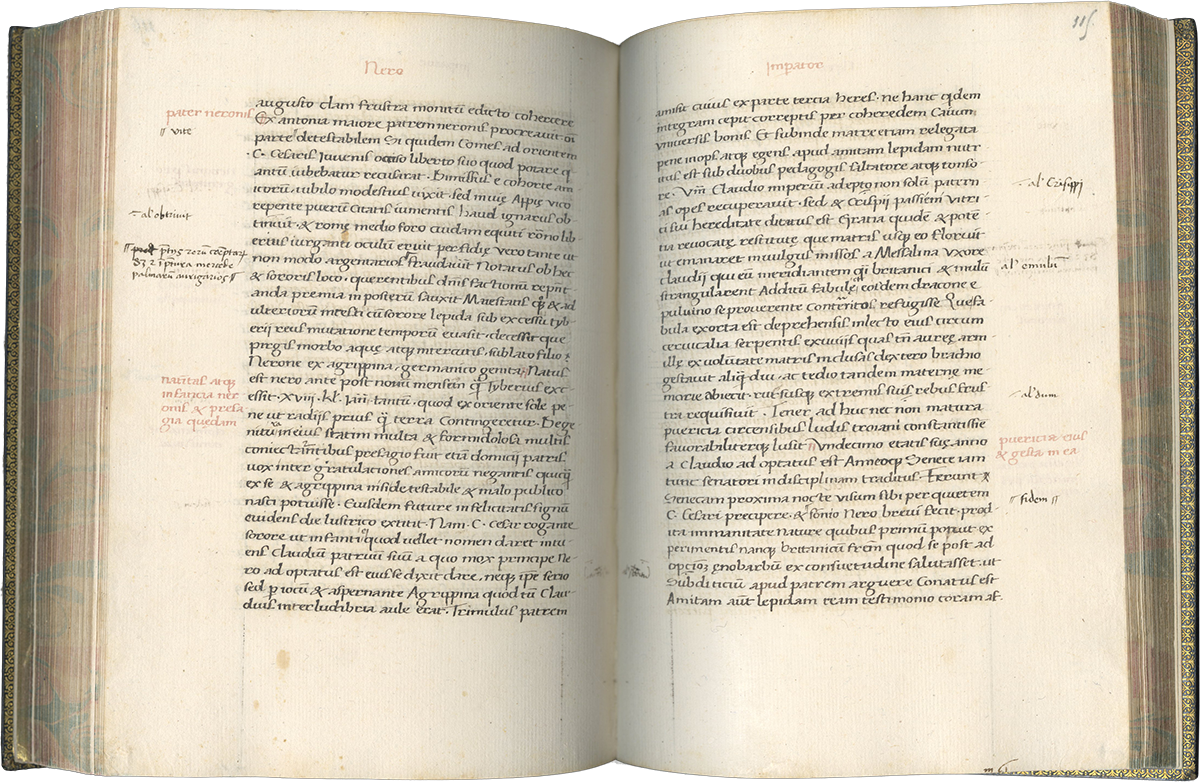
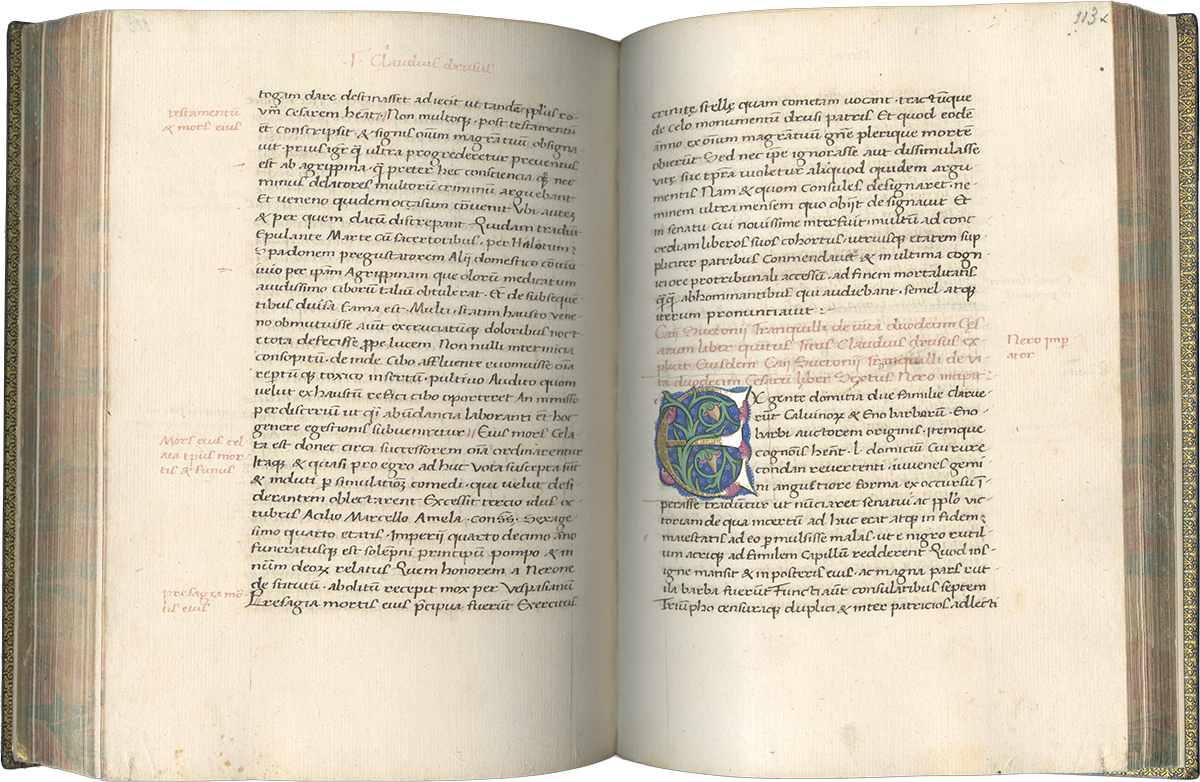
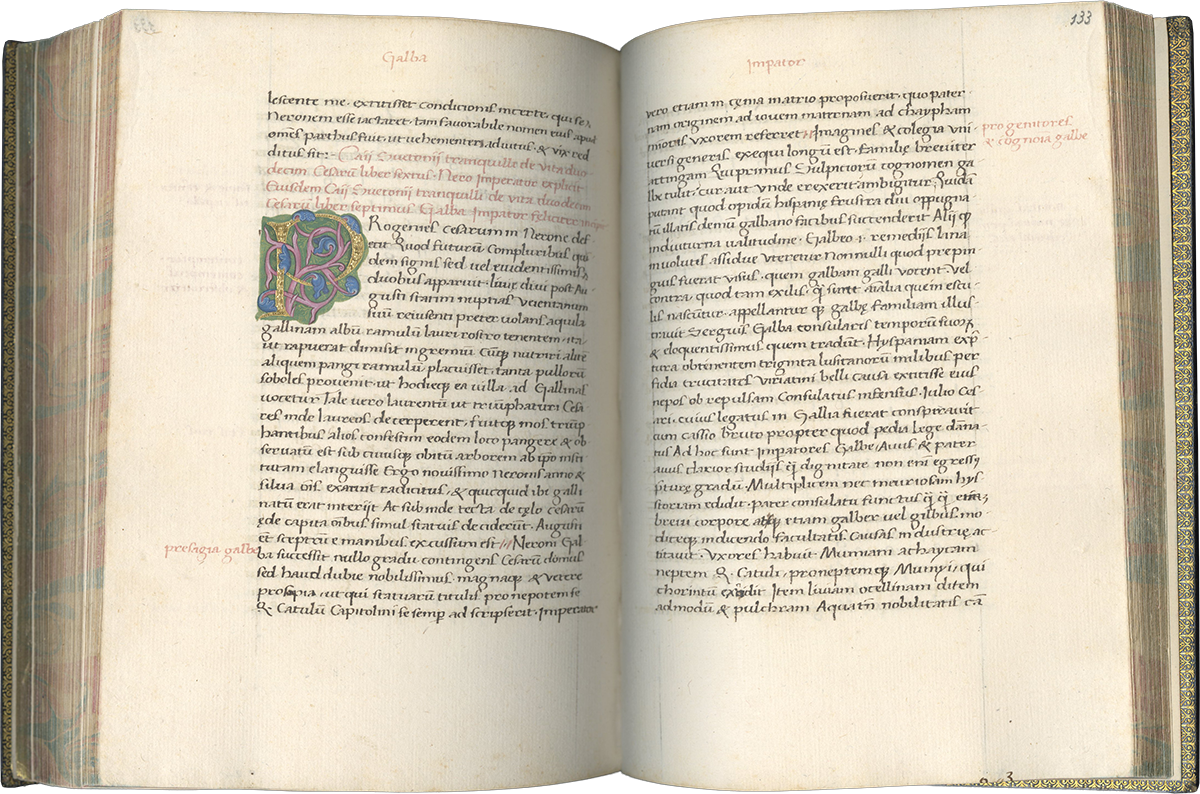
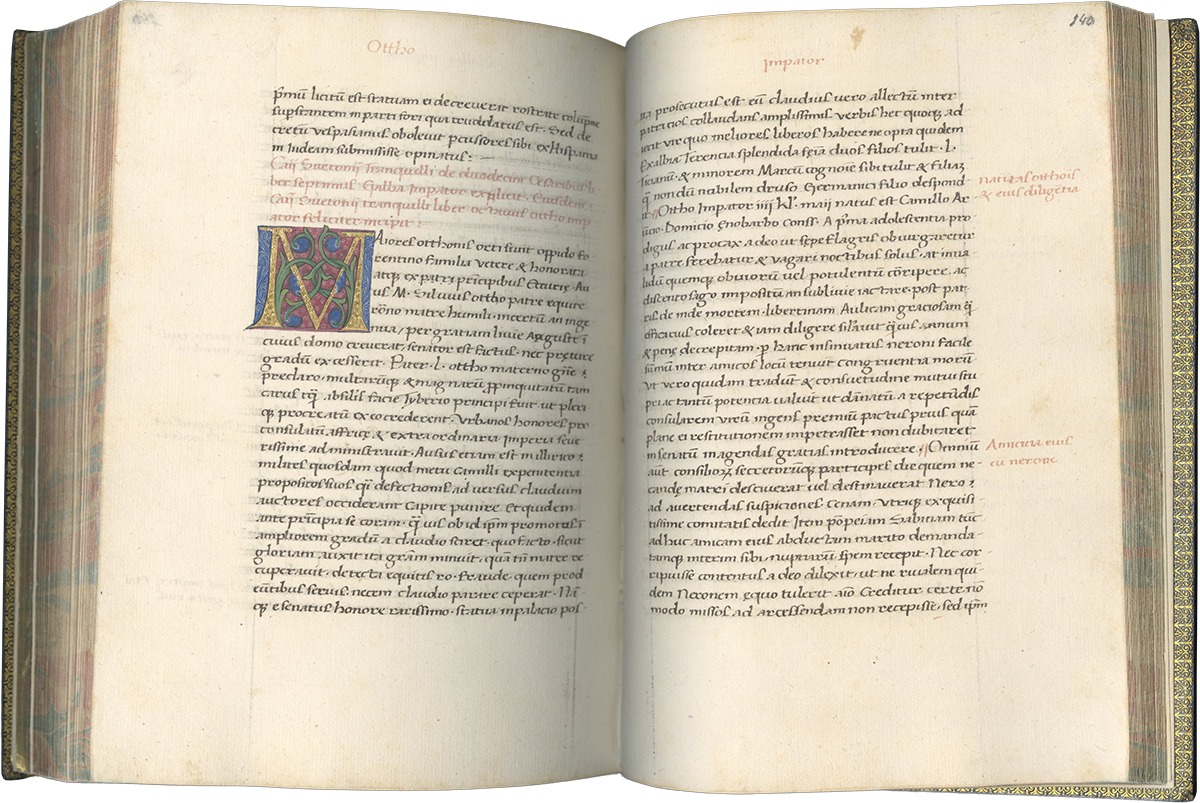
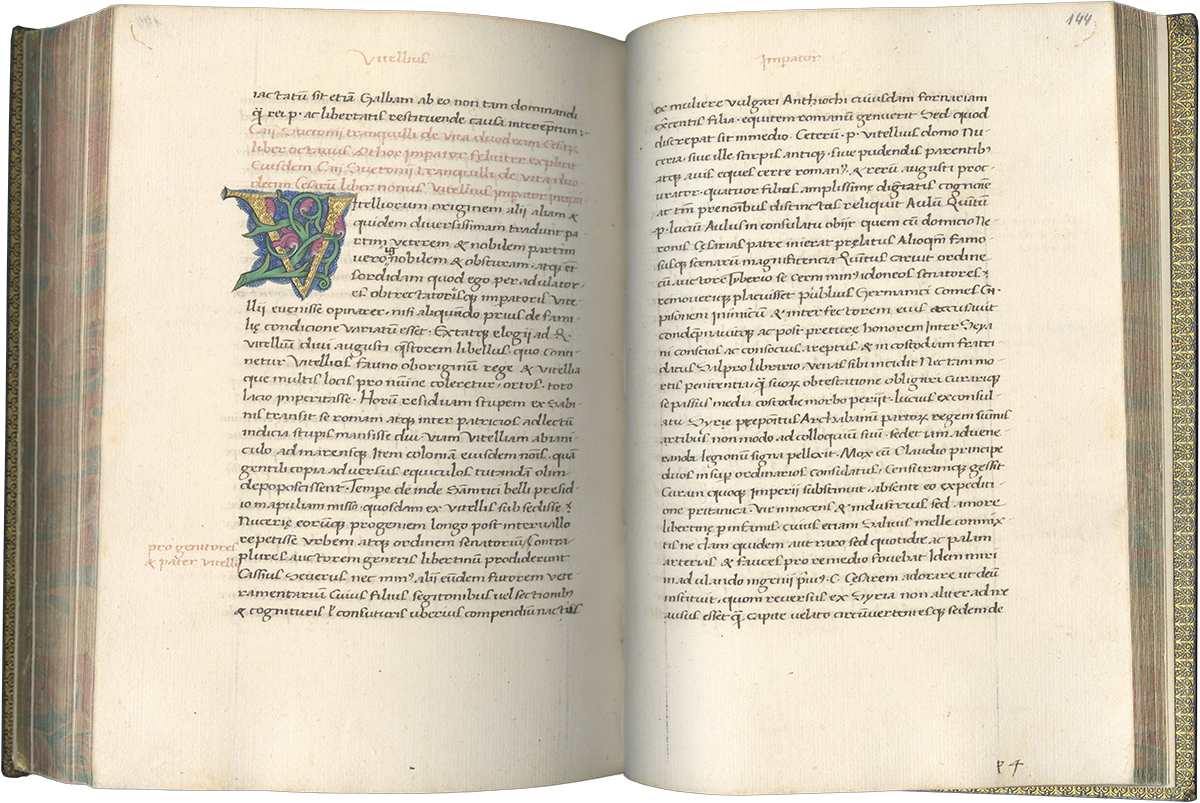
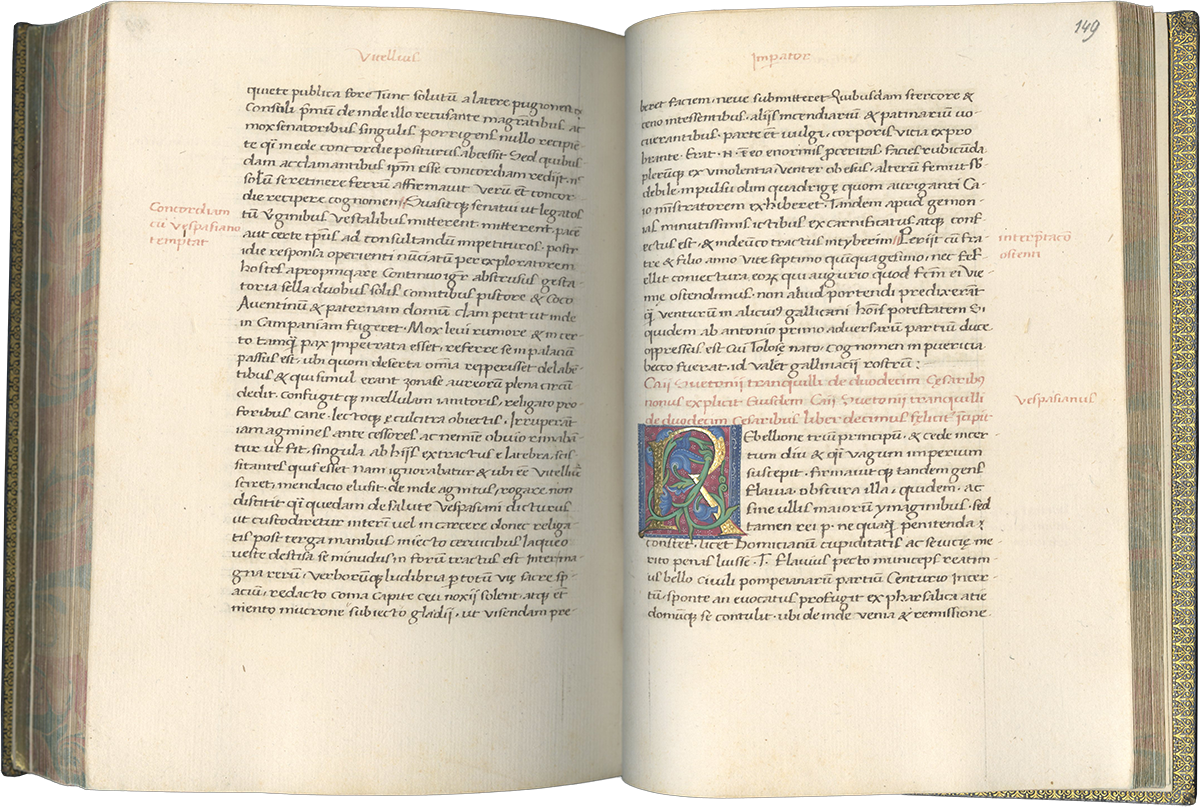
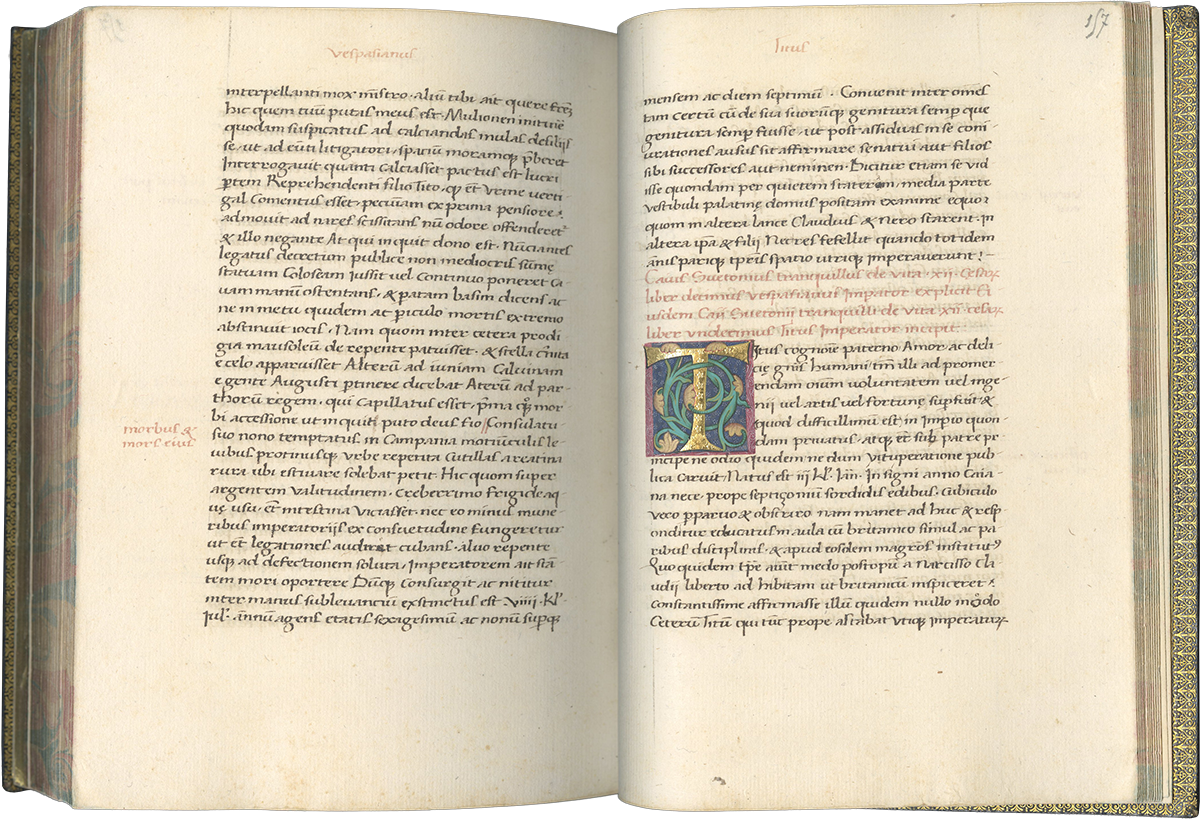
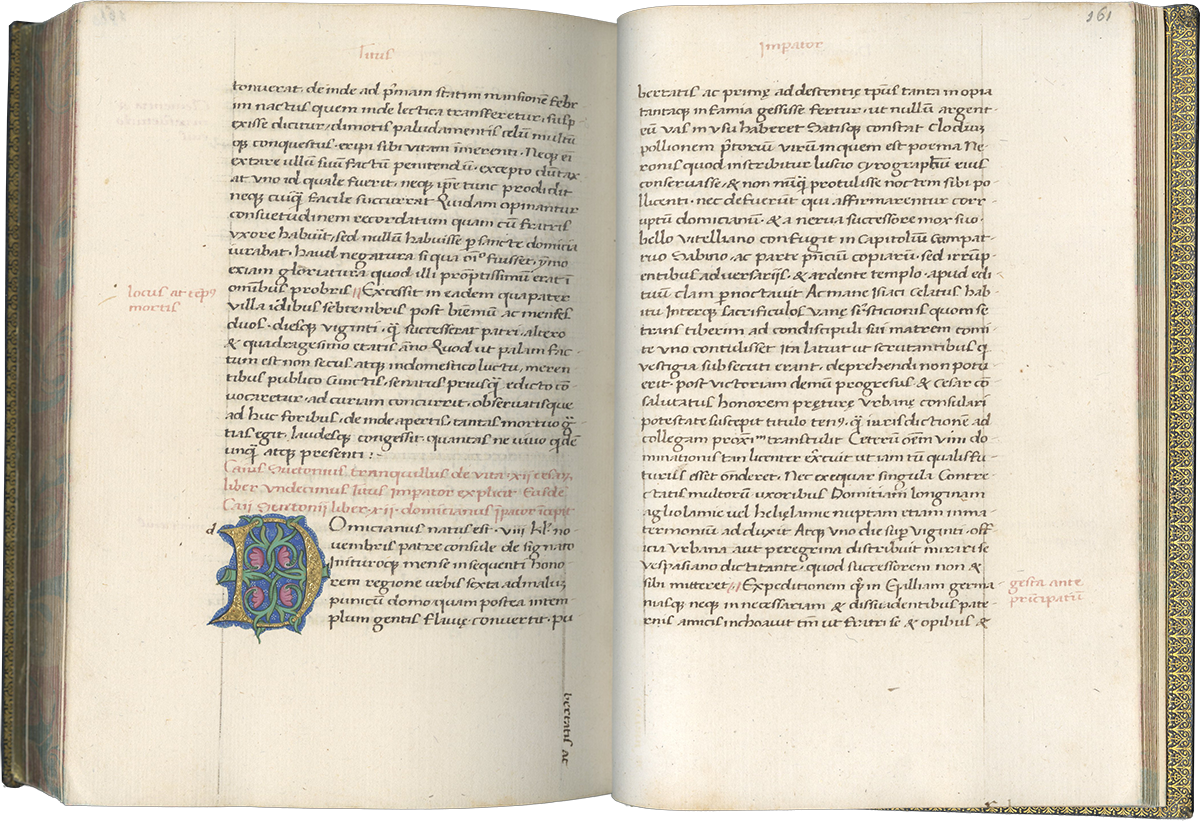
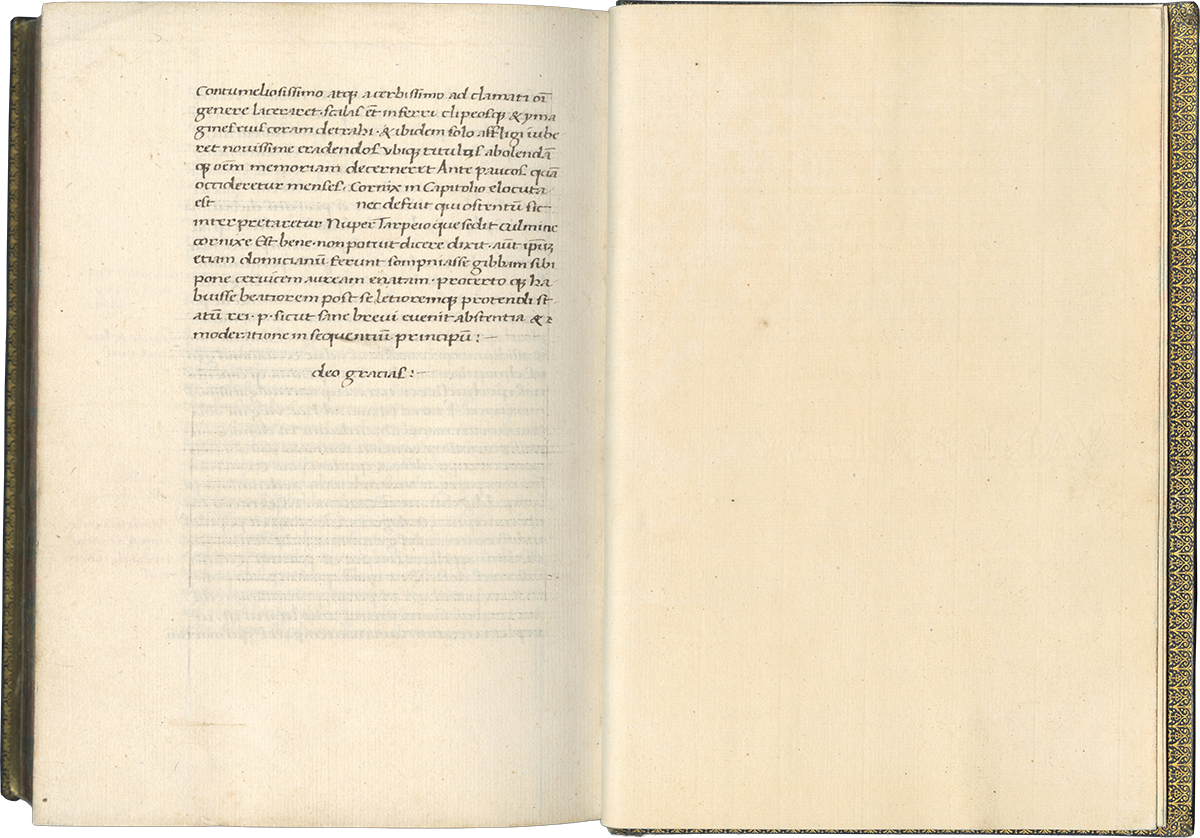
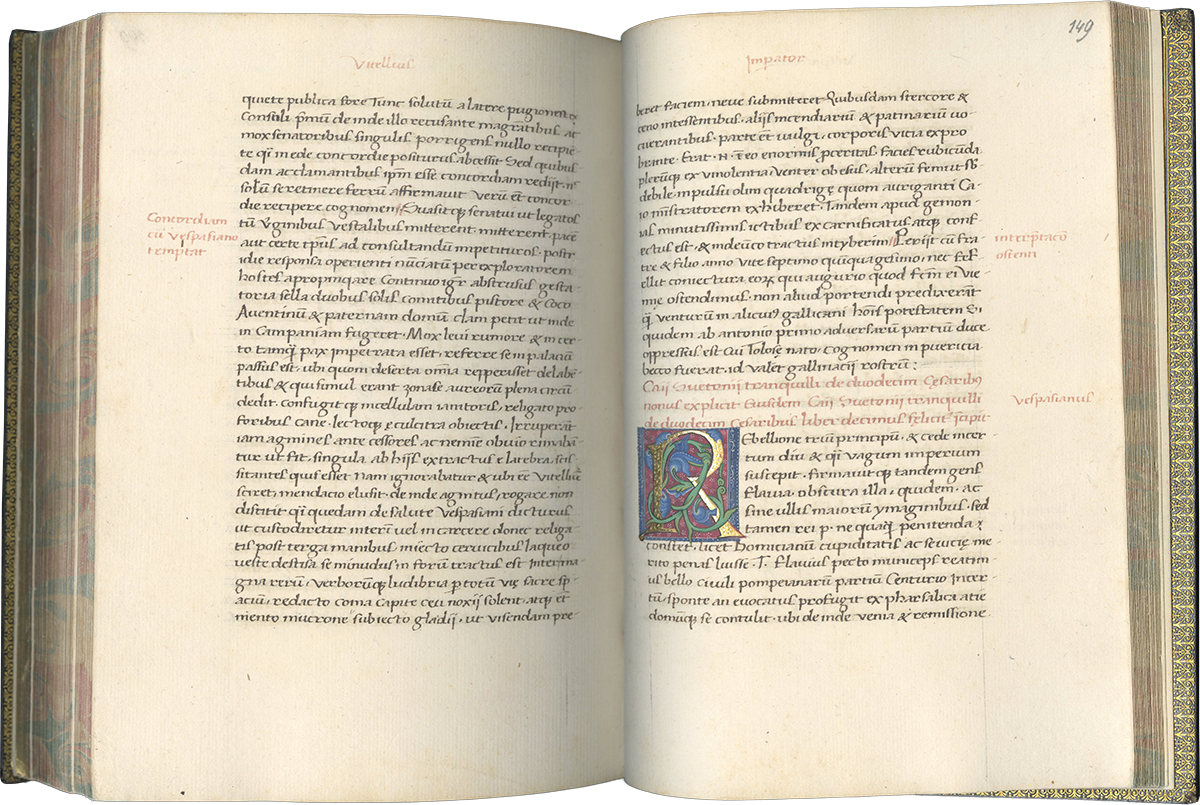
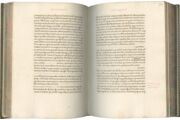
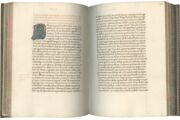
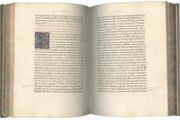
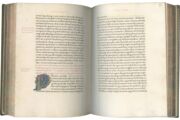
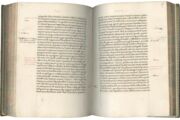
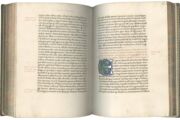
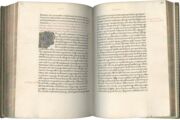
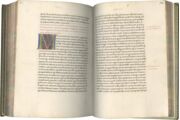
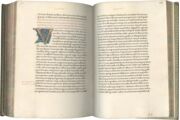
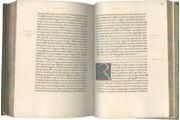
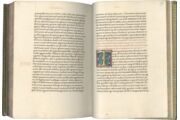
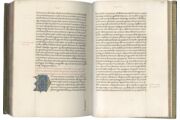
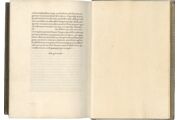
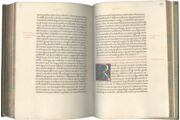
ii+169+ii paper leaves, with a watermark of a letter ‘n’ in a circle, close to Piccard nos. 28984–88 (Ravenna 1458, Bologna 1463), complete, (collation: i-xvi10, xvii9(10 cancelled)), vertical catchwords and alpha-numeric leaf signatures throughout, ruled for both the tops and bottoms of minims (a sign of a very high-grade production) for 30 lines per page, (justification 160 × 105mm), written in a humanistic script, headings and side notes in pale red, illuminated with twelve large initials, the first with a three-sided border of foliage incorporating a bird (a few margins with stains, but generally in fine condition). Gilt blue morocco binding sewn on 5 bands and (by 1876) signed by Lortic and with his label, gilt edges and turn-ins, marbled endleaves, green silk place-markers (slightly scuffed, the corners bumped). Dimensions 240 × 170 mm.
Suetonius is described by his friend Pliny the Younger as “quiet and studious, a man dedicated to writing.” Yet his Lives of the Twelve Caesars is known for selecting spicy details that we all know about Roman history even today—Nero fiddling and Caesar crossing the Rubicon and more. This elegant copy was written in Italy for a German canon and illuminated in Vienna in an exceptionally unusual and fine Austrian version of Italian bianchi girari by the workshop of Ulrich Schreier. Due to its popularity, copies of Lives of the Twelve Caesars rarely come on the market anymore, and the known commissioner and illuminator, together with its unique adaptation of Italian illumination, mark this book as a very special opportunity.
Provenance
1. The watermarks suggest that the paper was made in Italy, but the illumination is by Ulrich Schreier of Salzburg, Vienna, and Bratislava (active between 1457 and 1490) or his workshop; see Illustration. It was perhaps made for Johannes Tröster (c.1425-1485), German humanist and canon of Regensburg Cathedral, for whom Schreier illuminated at least three other books that were purchased undecorated abroad.
2. Ambroise Firmin-Didot (1790–1876), printer, publisher, scholar, and bibliophile, of Paris: his 1850 oval bookplate; in his sale by Delestre & Labitte, Paris, 6 June 1878, lot 59 (Online Resources).
3. Gustav von Emich (1843–1911), Hungarian minister to Berlin and collector, of Budapest: sold as “The Property of a Gentleman in Austro-Hungary" at Sotheby’s, 20 June 1900, lot 111; bought for £9 by a collector or agent, Dickson (Schoenberg Manuscript Database).
4. Joseph Baer & Co., Frankfurt, Katalog 500: Katalog 500: Handschriften und Drucke des Mittelalters und der Renaissance, 1905, no. 12, priced M.300 (Schoenberg).
5. Karl W. Hiersemann, Leipzig, Katalog Nr. 460: Handscriften, Inkunabeln und wertvolle Ausgaben der Klassiker des Altertums der Humanisten und Neulateiner enthaltend den betr. Teil der Bibliothek des Kunstmalers F. von Schennis und andere Sammlungen, 1918, no. 174 (Online Resources).
6. Paul Graupe, Berlin, Katalog Nr. 57: Manuskripte, Inkunabeln […], 14 December, 1925, lot 20 (Schoenberg).
7. Unidentified collector’s mark “E K” within an oval on flyleaf.
8. Maggs Bros., London, sold on 12 November 1959 to Major John Roland Abbey (1894–1969), soldier, brewery owner, and bibliophile: with his gilt leather book label and acquisition notes, his “JA 6963” (inscription).
9. In Abbey’s sale at Sotheby’s, 1 December 1970, lot 2885, bought for £400 by a collector or agent named Roman according to the Schoenberg Manuscript Database.
10. Sotheby’s, 21 June 1988, lot 89, Western Manuscripts and Miniatures; bought by Bruce Ferrini according to the Schoenberg Manuscript Database.
11. Martin Schøyen, Oslo, Norway and London, UK (born January 31, 1940), a Norwegian businessman, traveler, historian, and collector of books; The Schøyen Collection, MS 118, acquired from Bruce P. Ferrini (1949–2010), book dealer, of Akron, Ohio.
Text
ff. 1-169v, Suetonius, Vitae XII Caesarum, “Caij Suetonij tranquilli de vita duodecim Caesarum liber primus Caius Iulius Caesar incipit”...in sequentium principium, deo gratias,” passages left blank for the insertion of Greek.
Gaius Suetonius Tranquillus (c.69-c.122) served in the imperial secretariate for several Roman emperors until Emperor Hadrian dismissed him for running afoul of court etiquette. He began writing biographies when he was secretary at the imperial palace under Trajan, and completed this project c. 120 AD. His Lives of the Twelve Caesars covers the Roman Emperors from Julius Caesar (d. 44 BC) to Domitian (d. 96 AD). Suetonius’ position gave him access to both historical documents and court gossip, and he is the main source of the famous story of Julius Caesar crossing the Rubicon, his assassination in the Senate, Nero singing while Rome burned, and many other well known events. He was a friend of Pliny the Younger, who described him frequently in his letters as “quiet and studious, a man dedicated to writing.”
Illustration
Although it bears no historiation, each biography begins with a fine illuminated initial, and the first a partial border (ff. 1, 23v, 55v, 77v, 96v, 113, 132v, 139v, 143v, 149, 157, and 160v). Michaela Schuller-Juckes confirmed that this illumination issued from the shop of the illuminator and stationer Ulrich Schreier (personal communication). The decoration was perhaps for the humanist canon of Regensberg, Johannes Tröster, or his circle. Tröster was friends with the Piccolomini family (and therefore several popes and cardinals) over several generations, and with Pirkheimer’s father, and traveled frequently to Italy: although his scholarship is not well known today, he moved in the highest humanist circles. Schreier ran quite a busy shop, one that illuminated both manuscript and printed works and also produced fine bindings (Schuller-Juckes, 2009). During the 1460s Schreier’s shop finished several books for Tröster. One of these, Munich, Universitätsbibliothek, 2° Cod. 549, includes an inscription from Tröster about his having purchased the manuscript in northern Italy without illumination or binding, and having hired Schreier to complete these (Daniel, 1979, p. 69). Such practices raise the possibility that Tröster made other Italian purchases to be completed in the north as well. It certainly seems likely that the present copy of Suetonius was likewise made in Italy and finished in Vienna for the Regensburg bishop. Schreier’s workshop worked to a high standard, arguably finer work than the copying itself, and it may be that Tröster knew he could only source humanist texts copied in humanist script in Italy, but that he could afford better illumination locally.
Moreover, Schreier’s workshop not only painted to a high standard, but innovated and invented unique initials especially suited to classical texts. A few decades earlier, Italian humanist illuminators had developed an archaizing initial design for use with humanist manuscripts called bianchi girari. Outside of Italy, only England is recognized as having adapted bianchi girari decoration for local use (Alexander, 2016, Kennedy, 2023). However, the emphasis on the vinestem and small leaves in profile in the present manuscript and in Cod. 549 and Schreier workshop volume Munich, Bayerische Staatsbibliothek, Clm 15,142, suggest that there were more transalpine responses to bianchi girari than scholarship has generally realized (Schuller-Juckes, 2008, 2009). The Schreier vinestem initials elegantly blend transalpine and bianchi girari traditions, perhaps so seamlessly that they have not been widely noticed before.
Though the name Suetonius may be less familiar today, everyone knows his version of Roman history. This book, Lives of the Twelve Caesars, covering Emperors from Julius Caesar (d. 44 BC) to Domitian (d. 96 AD), contains a veritable greatest hits of Roman history. From the Twelve Caesars we learn about Julius Caesar crossing the Rubicon. From the Lives of the Caesars we hear about his harrowing assassination in the Senate. In Lives of the Caesars Nero sings while Rome burns. Five hundred years later, Shakespeare specialized in plucking precisely such memorable stories from classical texts and popularizing them on stage, adding another layer to the importance of Lives of the Twelve Caesars and a further reason for the familiarity of its stories to us today. Suetonius continues to be read in Latin and in translation in History classes to the present day, and the Lives are implicitly referenced every time any number of Shakespeare plays are read or performed. We are all familiar with Suetonius’ Lives of the Twelve Caesars, whether we realize it or not.
Suetonius was popular through the Middle Ages, and especially so as appreciation for classical texts rose in the late Middle Ages. Of the 200 known manuscripts of the Lives of the Twelve Caesars, fewer than twenty pre-date 1300 (Kaister, 2014). Thus the great majority of surviving manuscripts date from after 1400, and from 1470 they were joined by two editions printed in Rome (ISTC is00815000 and is00816000): fifteen editions total were printed before 1500 (ISTC). The Lives of the Twelve Caesars was certainly popular in the fifteenth century, and that popularity has rarely wavered in the centuries since then.
Manuscript copies of Suetonius’ Lives of the Caesars can be found in university libraries and museum collections across Europe and North America. However, the work rarely appears on the market anymore according to the Schoenberg Manuscript Database, and indeed, this copy’s last sales mark the only times the Lives has been offered in the past several decades, and the only time the present seller has offered it in our company’s history. It may be some time before any other copy comes available, much less one with such high humanist provenance, from a known illuminator, and displaying such exquisite art.
Literature
Alexander, Jonathan. The Painted Book in Renaissance Italy. New Haven, CT, 2016.
Kaister, Robert A. “The Transmission of Suetonius's Caesars in the Middle Ages,” Transactions of the American Philological Association. 144 (2014), pp. 133–186.
Kennedy, Kathleen E. “Italian Art and English Artists in the English Quattrocento: Naturally Seeking Out Things Italian,” The Sixteenth Century Journal 54 (2023), pp. 285-308.
Munich, Bayerische Staatsbibliothek, Clm 15,142.
Munich, Universitätsbibliothek, 2° Cod. MS 549.
Schuller-Juckes, Michaela. “Inkunabelausstattung Aus Dem Atelier des Salzburger Buchkünstlers Ulrich Schreier,” in Neue Forschungen Zur Buchmalerai, ed. Christine Beier, Cologne, 2009, pp. 243-259.
Schuller-Juckes, Michaela. Ulrich Schreier und seine Werkstatt: Buchmalerei und Einbandkunst in Salzburg, Wien und Bratislava im späten Mittelalter, PhD thesis, University of Vienna, 2009. https://utheses.univie.ac.at/detail/2876#
Schuller-Juckes, Michaela. “Johannes Tröster als früher Auftraggeber des Salzburger Buchkünstlers Ulrich Schreier,” Pirckheimer Jahrbuch für Renaissance und Humanismusforschung, 23 (2008), pp. 233–45.
Suetonius. Lives of the Caesars, Translated by J. C. Rolfe. Introduction by K. R. Bradley. 2 Vols. Cambridge, MA, 1914.
Wallace-Hadrill, Andrew. Suetonius, the Scholar and His Caesars. London, 1983.
Zirnbauer, Heinz. Ulrich Schreier: ein beitrag zur buchmaleri Salzburgs im späten mittelalter unter besonderer berücksichtigung der entwicklung der landschaftsdarstellung, Munich, 1927.
Online Resources
Daniel, Natalia, Gerhard Schott, and Peter Zahn. Die Lateinischen Mittelalterlischen Handschriften Der Universitätsbibliothek München. Wiesbaden, 1979, pp. 68-9. Linked here https://handschriftenportal.de/search?hspobjectid=HSP-b7e35ce0-5d78-3f35-bf07-1d036094dfdd&q=Universit%C3%A4tsbibliothek+2+Cod.+ms.+549&hl=true
Delestre, Maurice, and Adolphe Labitte. Catalogue Illustré des Livres Précieux Manuscrits et Imprimés Faisant la Partie de la Bibliothèque de M. Amboise Firmin-Didot. Paris, 1878, p. 43 https://babel.hathitrust.org/cgi/pt?id=pst.000022926623&seq=65
Hiersemann, Karl W. Leipzig, Katalog Nr. 460: Handscriften, Inkunabeln und wertvolle Ausgaben der Klassiker des Altertums der Humanisten und Neulateiner enthaltend den betr. Teil der Bibliothek des Kunstmalers F. von Schennis und andere Sammlungen, 1918, no. 174. https://www.deutsche-digitale-bibliothek.de/item/BS5VDD6NFASU65I5OEFQ663YDFNIGJDK
Incunabula Short Title Catalogue https://data.cerl.org/istc/_search
Schoenberg Manuscript Database https://sdbm.library.upenn.edu/manuscripts/540
Thayer, Bill. Suetonius: The Lives of the Twelve Caesars https://penelope.uchicago.edu/thayer/e/roman/texts/suetonius/12caesars/home.html