
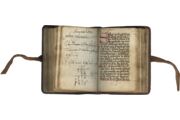
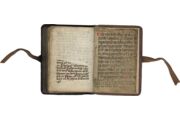


Sermons and Catechetical Treatises
In German, manuscript on paper
Northern Bavaria, c. 1450-1480
TM 1393
- $25,000.00
 Textmanuscripts - Les Enluminures

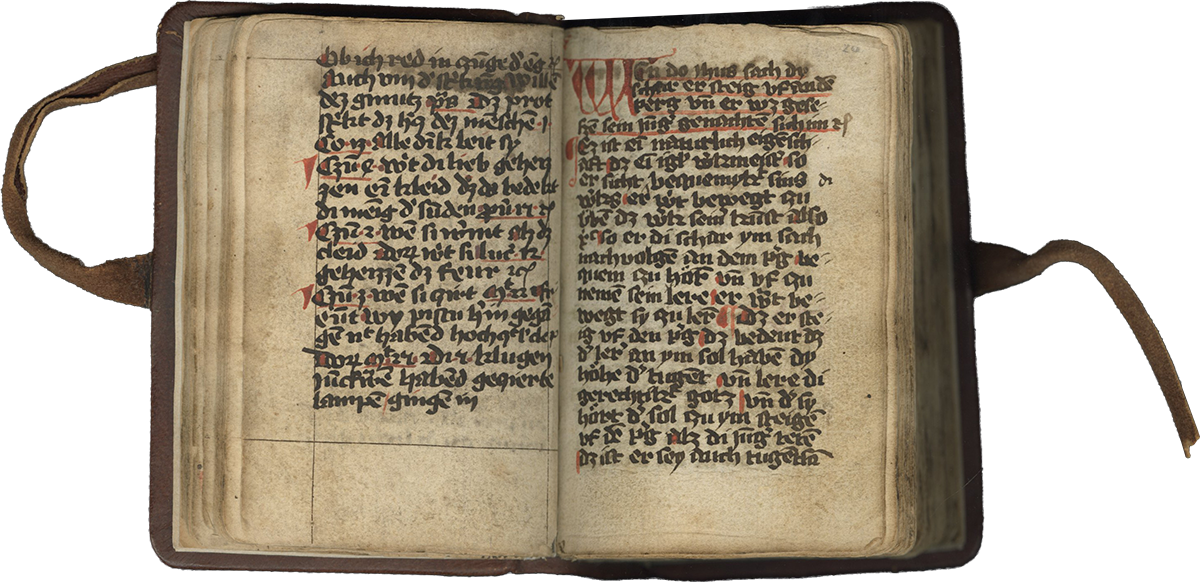
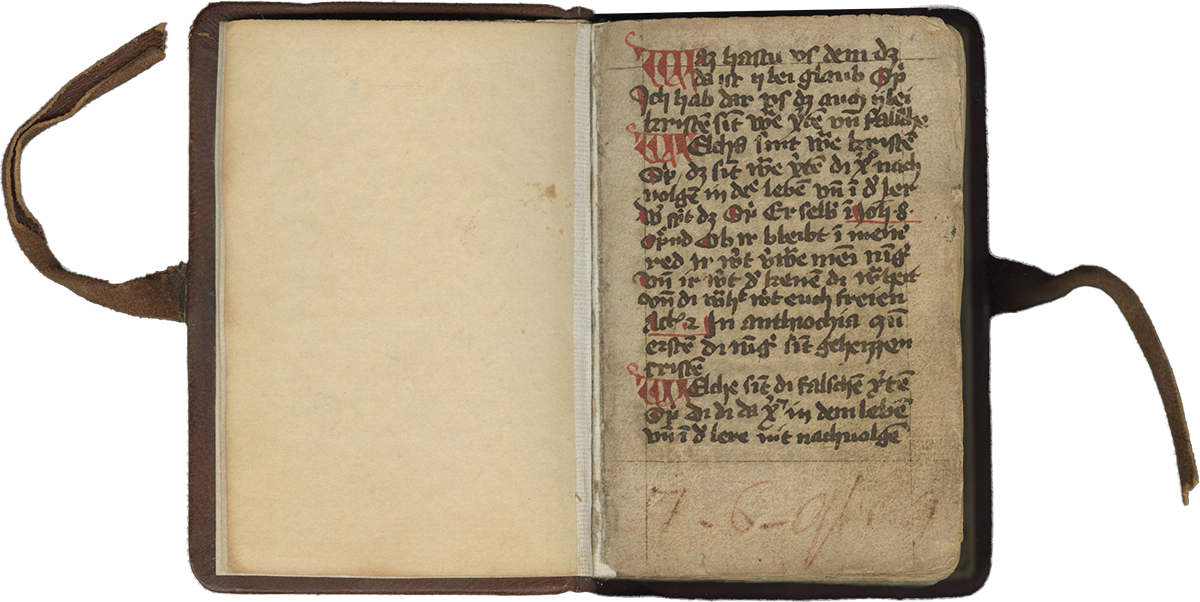
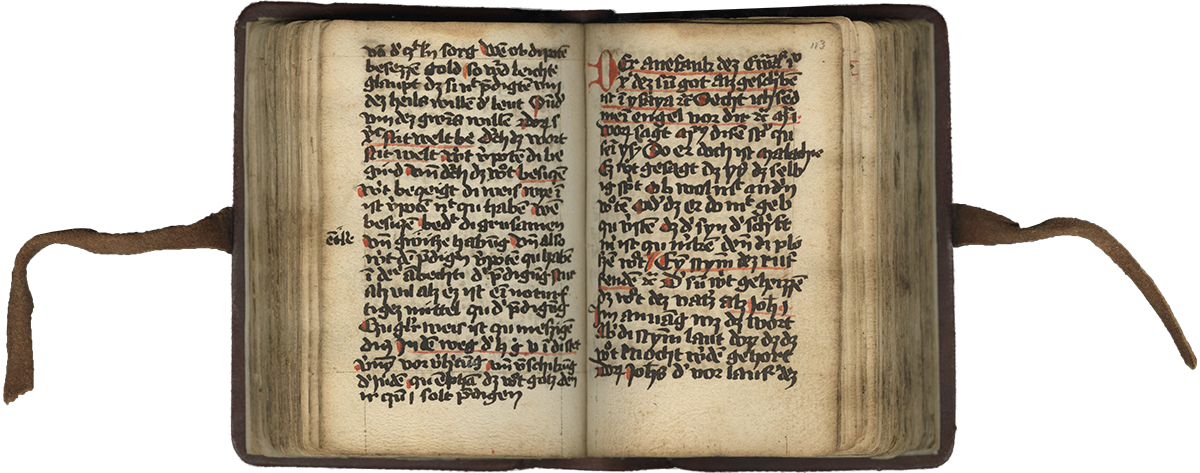
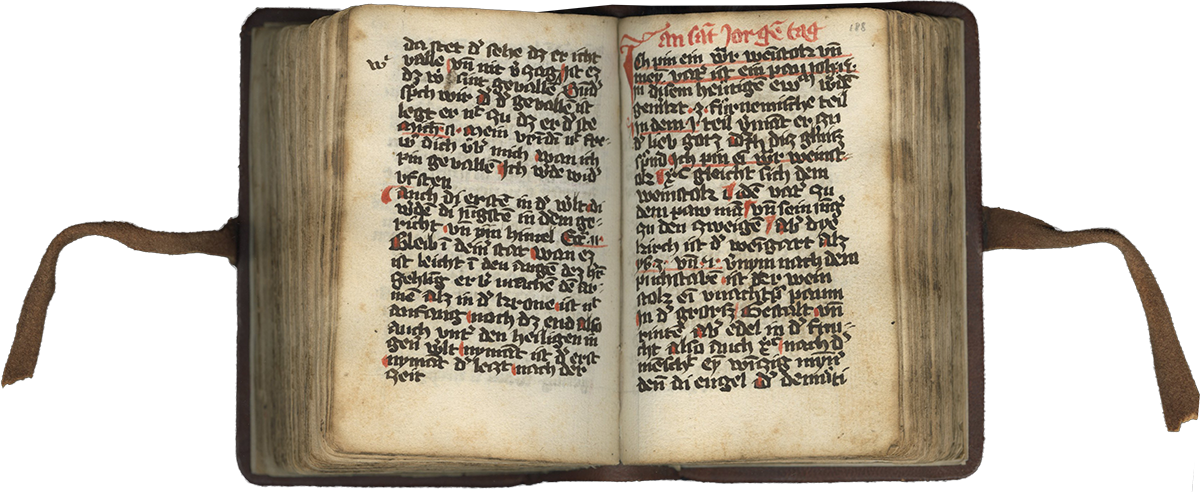
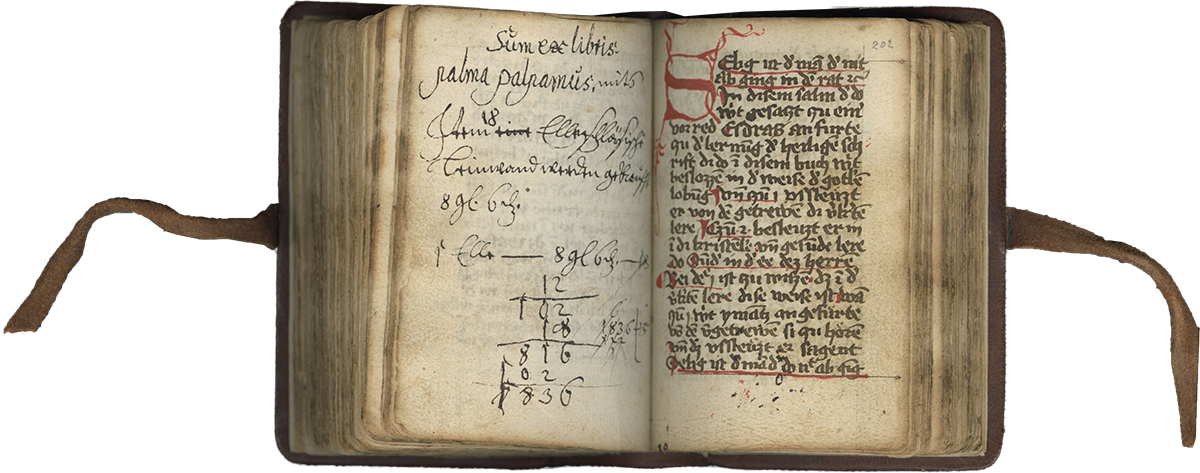
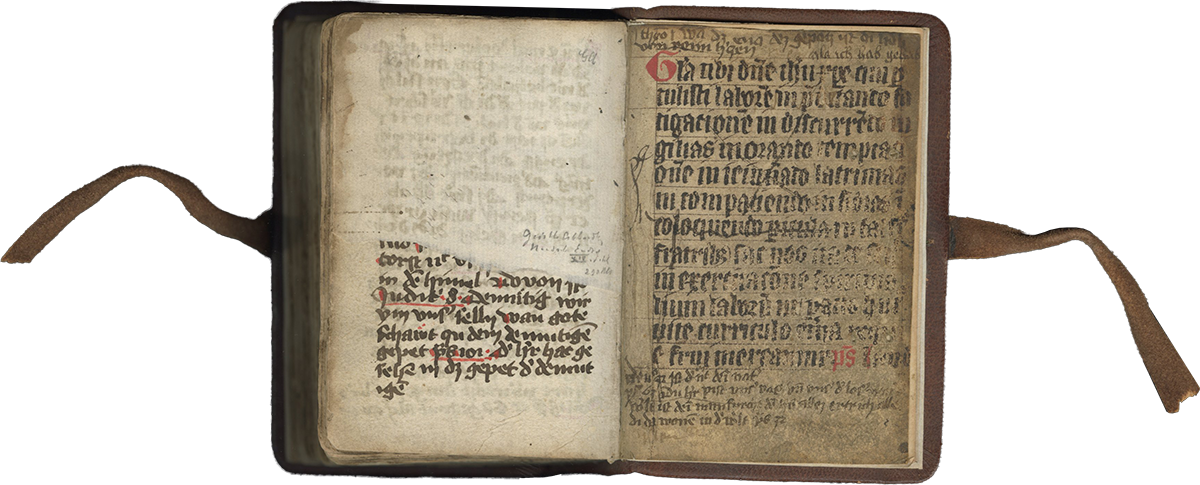
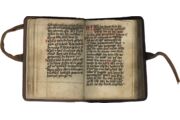
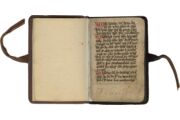
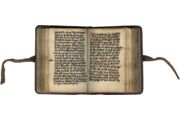
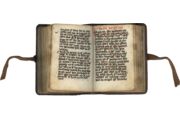
iii + 292 + i (parchment)+ iii paper leaves, pages too small and covered in script to visualize watermarks fully (see Provenance below), modern pencil foliation, upper margin, right, as 1-292, (collation: i2 [wants probably 10 of 12, text lost] ii11[wants 1 at start, text lost] iii-iv12 v9[wants 1 at end, without loss of text] vi-viii12 ix10[wants 2 at end, without loss of text] x-xi12 xii5[wants 1 at end, without loss of text] xiii13[leaf cancelled between ff. 122+123, without loss of text] xiv12 xv-xvi11[each wants 1 at end, without loss of text] xvii12 xviii9 [uncertain] xix-xx12 xxi10[wants 2 at end, without loss of text] xxii12 xxiii16[leaf cancelled between ff. 236+237, without loss of text; wants 1 at end, without loss of text] xxiv-xxvi12 xxvii5[wants 1 at end, without loss of text]), catchwords at end of quires, and tiny quire numbers at the start of new quires, often trimmed, single-column, leaves ruled with outline frame only, (justification: c.85 x c.55 mm), written in black ink on usually 18-21 lines by two principal hands, the divisions mostly, though not entirely, corresponding to the quire structure: (i) a textualis currens, ff. 1-25v, 47-70v, 93-168, 178-178v, 200v-201, 202-235, 236-259, 260-74, 275-90, and 291-92; (ii) a more formal textualis libraria, ff. 26-46v, 71-92, 169-177v, and 180-200; with one text on ff. 179-179v entered by a third hand, a looser textualis currens, and occasional annotations in further later fifteenth-, sixteenth-, and possibly seventeenth-century hands throughout, two- and three-line initials in red and rubrication throughout, ff. 168, 235 and 292 are torn through horizontally, with only the upper half of these leaves remaining. Sewn on three cords, in a skillful modern binding of brown leather over pasteboards, and a leather tie attached with small brass plates on front and rear, an original parchment pastedown, with liturgical prayers in Latin (much abraded), in a probably fourteenth-century textualis formata, now forms a rear flyleaf. Dimensions 115 x 78 mm.
This pocket-sized manuscript assembles German sermons on Christ’s public ministry and on the Psalms alongside catechetical texts and treatises of religious instruction; none is known to be paralleled elsewhere. The volume’s unique texts would repay intensive study as evidence of transposition of Latinate knowledge into the vernacular. As a whole, the manuscript offers a fascinating window into the world of religious instruction, in its form and in its content, in the late medieval city.
1. The format of the paper makes an exact dating by the watermark method impossible, but the fragments of one or more tower watermark(s) visible on ff. 6, 15, 94, 123 and 236 must belong to the broad group Piccard, Turm, II 307-377. These papers were in use for about a generation from c.1440 into the early 1470s. A dating of the manuscript into that period, i.e. the mid- to third quarter of the fifteenth century, is consistent with the scripts employed by its principal scribal hands, who write broadly in northern Bavarian dialect and in, for a vernacular manuscript, unusually heavily contracted forms. Taken together with the content, this may suggest an origin in a male religious community with responsibility for preaching and pastoral care: a collegiate church, perhaps, or a friary.
2. The manuscript remained in Germany during the early modern period: amongst the various doodles, pen-tests and isolated notes entered onto blank leaves in sixteenth- and seventeenth-century hands are a pen-test in German on f. 92v (das ist es gewißlich) and on f. 201v, under the Latin entry sum ex libris: palma palpamus, an arithmetical calculation of the total cost reckoned in a different currency of 18 ells of Silesian linen cloth purchased at 8 fl. 6 d. per ell.
3. Gothenburg, Sweden, private collection, where the manuscript was rebound in the late nineteenth or early twentieth century: label on inside rear cover “Otto von Schoultz’s Bokbinderi, Göteborg” refers to Robert Otto Mauritz von Schoultz (1856-1921), owner of a bookbinding workshop in Gothenburg (see Online Resources below).
ff. 1-2v, Catechetical questions and their answers, incomplete, incipit, “Waz hastu vs dem daz da ist ij lei glaub. Sprich. Ich hab dar vs daz auch ij lei kristen sint ware christen vnd falsche. WElchs sint ware kristen. Sprich. daz sint ware christen di christo nach uolgen in dem leben vnd in der ler...”;
Issues addressed include the distinction of true and false Christians, the duties of the Church militant, what God is and what one has to believe of and in God.
ff. 3-25v, Five lessons derived from 1 Cor. 16:13-14, acephalous, incipit, “Bei d[em] .j. v[er]nym daz wir sullen wachen vnd fleiszig sein daz ist offen vs .ii. Daz .j. wenn der glaub ist ein anfank oder ein gruntfest oder ein túr dez christenlichen lebens. Daz .2. wenn er ist daz erst notdurftigste geczew czu eim christenlichen leben...”;
The five lessons are subdivided in the scholastic manner into usually six points, each in turn further divided. They concern, in sequence, what it means to “watch” (ff. 3-6v); constancy in faith (ff. 6v-13); constancy in good works (ff. 13v-17v); constancy in pursuit of the good despite tribulation (ff. 17v-20); and how works may be undertaken in a meritorious manner (ff. 20-25v).
ff. 26-46v, A treatise on the eight beatitudes (Mt 5:3-10), incipit, “WEn do Ihesus sach dy schar er steig vf an den perg vnd er waz geseszen sein junger genachten sich im etc. Ez ist ein naturlich eigenschaft daz ein iglicher werkmeister so er sicht bequemykeit sins werks...”;
Proceeds from Mt 5:1, covering poverty of spirit (ff. 26v-29), meekness (senftmutikeit, ff. 29v-31), weeping (ff. 31v-32v), hunger and thirst for divine justice (ff. 33-33v), mercy (ff. 34-35), purity of heart (ff. 35-35v), pacificity (gefridsam, ff. 35v-36v), and the suffering of tribulation, with an extended discussion on the legitimacy of flight from tribulation (ff. 37-42), before concluding with a final disquisition on true beatitude, multiply subdivided in similar manner to the previous text (ff. 37-46v).
ff. 47-54, A treatise on Mt 5:13-16, incipit, “IR seit ein salcz der erd Mt .5. [Mt 5:13] vernym bedeutlich vnd nit selb wesenlich noch formilich Alz ob er spreche Ir solt vs ewerm ambecht haben di eigenschaft dez salcz zu salczen di irdischen leut...”;
Starts with Christ’s appellations of his apostles as “salt of the earth” (ff. 47-49) and “light of the world” (f. 49); then interpretations of the “city on a hill that cannot be hidden,” with an extended allegory of the city (ff. 49-52v), and of not hiding a lighted lamp under a bushel (ff. 52v-54). At the start of this treatise, in the upper right-hand margin of f. 47, the word peichtiger (“confessor”) has been entered by a later hand, perhaps indicating that the text was felt suitable for the instruction of, or use by, confessors.
ff. 54v-70v, A set of three sermon-treatises, incipit (f. 54v), “Wann ez war etliche heiden von den di da vf stigen daz si peten etc. Joh .12. [Io 12:20] M[--] auch si werden der hort. wen .3. R’ .8. spricht Salomon der fremd der da nit ist von deinem volk...”; incipit (f. 61), “Und an dem .3. tag nach der ruffung philipps vnd Nathanaels der da waz der .13. tag dez .32. iars daz ist an dem selben tag der jarczeit der tavf dez herren...”; incipit, (f. 65v) “Nach disen dingen daz ist nach dem czeichen daz er tet vf der hochczeite Ihesus steig ab czu Capharnaum daz er da liez di muter vnd di brvder dorum daz Joseph waz gestorben...”;
The first sermon concerns the calling of the apostles, with a treatment of Christ’s Passion and of what it means to follow Christ (ff. 54v-60v). The second deals with the wedding at Cana (ff. 61-65v), and third concerns the cleansing of the temple in Jerusalem (ff. 65v-70v).
ff. 71-92, A treatise on Mt 5:17-20, incipit, “DEr da vf lo/est eins von disen mynsten gepoten der da vf lo/est mit dem poszen leben eins von disen mynsten gepoten vernim di ich nu pin czu sagen vnd czu geben wenn ein sulche weis hat di schrift czu reden von den dingen...”;
Christ’s injunctions regarding the fulfilment of the law as given to the Israelites are framed here in terms of successful admission to the Church militant. The treatise is structured around the interpretation of six commandments given to the Israelites in the Old Testament, exploring their fulfilment in the New Testament in terms of their extension into precepts with binding force upon Christians, and in the process treating such difficult problems as vengeance and the lex talionis (“an eye for an eye”).
ff. 93-168, A series of approximately twenty sermons, incipit (f. 93), “OB ymant wil kumen na etc. Mt .16. Mr .8. L .9. [Mt 16:24-28; Mc 8:34-39; Lc 9:23-27] Hy seczt er ein weg allen sein getrewen czu begreiffen daz ewig leben vnd spricht Ob ymantz wil kumen nach mir...”, incipit (f. 97v), “Gewerlich sag ich euch Ez ist nymant der da wirt lazzen daz havs oder di bruder etc. Mr 10. Luc 18 Mt 19 [Mc 10:29-30; Lc 18:29-30; Mt 19:29], incipit (f. 99), “Wann ich sag euch daz manig kumen vom vfgang etc. L 7. Mt .8. [Lc 13:29; Mt 8:11] In disem .2. wirt bedeut di gancz welt. von di da durch di predigung der poten mang sein kumen czu dem glauben...”, incipit (f. 101), “Wan so di pharisei vs gingen von Ihesus vs der synagogen wen ir gmut waz abgekert von dem herrn...”; incipit (f. 105), “Dy lieb deins hausz asz Jo .2. [Io 2:17] Di s[pruch?] wirt geszen von der liebe dez haus gotz Di da alle verkarten dink di er sicht begert er czu strafen vnd nit rugt biz er si gepeszert...”, incipit (f. 106v), “Wan da ihesus sach di schar er derbarmt sich ir wen si warn gemut vnd lagen etc. Mt 9 L 9 Mr 6 [Mt 9:36; Mc 6:34; Lc 9:11] Er spricht Do ihesus sach mit der ansehung der gu/etikeit...”, incipit (f. 113r), “DEr anefank dez Ewangeliums ihesv christi dez sun got als geschriben ist in Ysaya etc. Secht ich send mein engel vor dir Mr .1. [Mc 1:1-2] Worum sagt Marcus disen spruch czu sein Ysaya so er doch ist Malachie...”, incipit (f. 118), “Ez ist gemacht ein frag vs den iungern Johannes wen si warn alz der vrsprunk mit den juden di in wider sprechen von der gereynigung welcher da wer volkumner Christus oder Johannes...”, incipit (f.122), “UNd an dem samstag ging er in di synagogen vnd lert si do. \Mr 1. Lc 4/ [Mc 1:21; Lc 4:16] daz er mangen frumpt wan mang kamen do czu samen. gebend den predigern eyn peispil...”, incipit (f. 125) “UNd do er waz kumen in daz haus Symons \Mt 8/ [Mt 8:14] Etliche sagen daz petrus het ein haus in Capharnaum durch der hausfrawen willen vnd etliche sagen daz ez nit sein eigen wer...”, incipit (f. 127), “UNd gar frue so ez waz gein acht tag Er stvnd vf vnd gieng yn ein wustat [Mc 1:35; Lc 4:42] vnd er sprach czin Wen m[ir?] geczimt auch andern steten czv predigen...”, incipit (f. 129), “Wan so der sun dez menschen wirt kumen in seiner maiestat vnd alle sein engel mit im etc. Mt .25. [Mt 25:31] Hye merk daz in eim iglichen gricht werden gesucht .3. ordenung...”, incipit (f. 135), “UNd so er waz in gangen in daz haus do genachten sich di iunger czu im heimlich etc. Mr .9. Mt .17. Luc .17. s. [Mc 9:27; Mt 17:18; Lc ?] Worum mocht wir in nit vsgwerfen wen si vorchten daz ez icht wer vm irer schuld willen...”, incipit (f. 141), “MErkt Luc. 21 Mr 13 Merkt daz ist Hut euch mit fleizz daz ewere herczen nit werden beswert etc. [Lc 21:34; Mc ?] Er spricht euch wen ez ist ewer nucz nit meiner...”, incipit (f. 143v), “Wan ich sag euch ein iglicher der mein bekent vnd mein wort in disem ebenchischen etc. Mt 10 [Mt 10:32?] Merk daz di nit bekennen dez glaubens vnterweiln ist eyn swere sund...”, incipit (f. 147), “Dorum der da kumt czu mir alz der lernend czu de[m] meister vnd hort mein wort mit andacht si czu vernemen vnd tur si in dem werk...”, incipit (f. 153), “EIn ander beispil Sint daz ges[agt] ist von dem samen .3. teil verdorben vnd neur eis wirt behalten vnd dennoch wirt in daz gelazzen vil raten geseet...”, rubric (f. 156), An sant Elsbethen t[ag] daz ewangelium, incipit, “Daz reich der himel ist gleich eim schaz etc. [Mt 13:44] Hy wirt gesaczt daz .5. beispil bedeutend daz wesen der kirchen nachvolgend dem vorigen...”, incipit (f. 158), “In dem czeit Ihesus antwurt vnd sprach Herr vater dez himels vnd der erden Mt .11. [Mt 11:25] Dicz ewangelium wirt geteilt in 2 teil. Czum .1. dankt Christus seinem him[el]schen vater...”, incipit (f. 166v), “Wan ez wart getan do si gingen vnd er selb ging in Luc 10 [Lc 10:38] Ez ist geschen Aber wen daz wirt nit funden Er ging in ein kastell Bethaniam Eyn weib bei etc...”;
Each sermon takes its lemmata from the Gospel accounts of Christ’s public ministry. Some that seem to be marked as independent sermons in the manuscript are not actually, however, and it remains difficult to state the exact number of sermons in this cycle. The rubric at f. 156, for example, indicates that the Gospel verse is that for the feast of St Elisabeth, and the text is presented as discrete, but the content itself explicitly continues the structure of the preceding text. Moreover, their format varies as well. They are of varying length, and while most are structured in the scholastic manner with multiple sub-divisions, a smaller number are of a more homiletic character, expounding the meaning of the scriptural text successively.
ff. 169-177v, incipit, “In disen .2. gepoten hangt alle dy ee vnd di weisagung alle gotliche gepot die da sint genomen durch di .10. gepot die hangen in disen .2. gepoten. Daz ist in der lieb gotz vnd dez nehsten...”; incipit (f. 178), “Merk daz .4. pose dink phlegen czu kumen vs der vberflúzzikeit der reichtumer alz ez offenbar ist von dem reichen...”; incipit (f. 179), “Merk .5. erczney wider dye geitikeit. Di .1. ist die merkung dez todez...”;
A short treatise explaining how the ten commandments are all encapsulated in the two commandments to love God and to love one’s neighbour, first treating those, and then moving through the remaining commandments. Ambrose and Augustine are quoted alongside scriptural texts. It is followed by two brief lists, added by different hands, of four evils that proceed from excessive wealth, and five beneficial medicines against avarice; Ambrose, Gregory, Jerome and Isidore are all (repeatedly) cited.
ff. 180-201, incipit, “...gangen wan di kunig iude haben glaszen di er dez mechtigen vnd haben versmecht dy vorcht gotz. vnd auch ist mer gricz in dem mer denn gestirn in dem himel...”; rubric (f. 188), An sant Jorgen tag, incipit, “ICh pin ein war weinstok vnd meyn vater ist ein pau[man] Joh .15. [Io 15:1] In disem heutigen ewangelium werden gemerkt .3. fu/ernemische teil. In dem .1. teil vermant er czu der lieb gotz...”; incipit (f. 193), “Ihesus sprach czu symon peter Symon liebstu mich mer denn dise er sprach czu im Ja herr etc. Johs .21. [Io 21:15] Dicz heutig ewangelio wirt geteilt in .5. furnemische. In dem .1. teil wirt geseczt dy frag von der volkummen lieb...”; rubric (f. 200v), An s. Philip vnd Jacob, incipit, “Eur hercz wird nit betrubt noch furcht sich. Dy iunger waren betrupt so sy horten di verratung Jude vnd di verlaukenung petri vnd der andern poten...”;
A set of four sermons that appears to continue, in scriptural lemmata, in structure, and in content, dealing with Christ’s public ministry, the series of twenty at ff. 93-168 above; the first begins mid-sentence, incomplete. The third is by far the longest and contains extensive quotation from Bede. The fourth by far the shortest, and may represent no more than an excerpt from a full sermon.
ff. 202-235, incipit, “SElig ist der man der nit ab ging in dem rat etc. [Ps 1:1] In disem salm der do wirt gesaczt czu einer vorred Esdras an furte czu der lernung der heiligen schrift...”; rubric (f. 206), Der 6. Psalm, incipit, “HErre nit straf mich [Ps 6,1] David macht dise salm pitend barmherczikeit von got vm di gotliche verserung daz er vbermu/eticlich het heizzen geben daz volk...”; rubric (f. 210), Der 28 Psalm, incipit, “Czu tragt dem herr ir sun gotz [Ps 28:1] Disen salm machet der der in der volpringung dez geczeldez daz er macht daz man darin seczt di arch dez herrn...”; rubric (f. 214), Der 104 Psalm, incipit, “BEkent dem herrn vnd anruft seinen namen etc. Ps 104 [Ps 104:1] Diser salm wirt geteilt in .ii. teil Czum .1. der wekt der macher dez salms daz volk czu dem gotlichen lob...”; incipit (f. 224), “IN dem vs gang israels von eg[ypten] Ps 113 [Ps. 113:1] In disem salm anfurt der macher dez salms czu dem lob gotz aus der merkung der gutet gotz di er verlihen hat dem volk von israel...”; rubric (f. 231v) Der .81. Psalm, incipit, “GOt stund in der samelung der goter etc. Ps .81. [Ps 81:1] Aschaf macht disen psalm wider di verkorten richter straffend ir schalkeit vnd pit dor vber di gotlichen gerechtikeit...”, incipit (f. 233), “LObt ir kinder den herren Ps. 112 [Ps 112:1] In disem salm an furt der macher dez salm czu dem lob gotz vs der merkung seiner hochen fúrsichtikeit...”;
A set of seven sermons, each taking as its scriptural lemma the first line of a psalm, and often beginning with a statement of each psalm’s author, explaining the context of its origin. Of particular note is a passage at the end of the fifth sermon, on ff. 230v-231. Here elements extracted from the text of Ps 113 are presented in red ink, set into the text otherwise in black, in the manner of scriptural commentary, but they are not otherwise marked; this manner of layout must, therefore, have been integral to the text from the outset, in order for subsequent copyists to have recognized the distinction between scriptural text and the preacher’s words.
ff. 236-292, incipit, “ICh wil reden in der kirchen 5 wort meins sinns daz ich die andern vnter weise etc. [I Cor 14:19] Und das sullen sunderlichen tun die prediger dez volks verkundigend di .5. wort...”; incipit (f. 239), “MErk von der red der tu/erstigen oder torechten sint .6. lei gestalt...”; incipit (f. 242), “MErk von der juncfrawschaft waz di ist an ir selbez von der spricht Ciprianus...”; incipit (f. 245), “Ob du wilt wiszen oder vernemen ob der herr sei in dir Daz merk in .6. lei weis...”; incipit (f. 248v), “Dy sund di do geistlichen kreuczigen den herrn sint swerer vnd scheuczlicher vnd schreklicher denn di di in haben gekreuczigt am leib...”; rubric (f. 252), Am 2 phincztag in der vasten, incipit, “DOrum Ihesus sprach czu den juden dy ym glaubten ob ir etc. Joh. 8. [Io 8:31] In disem ewangelio seczt er ein driualtige frucht dez wortz dez herren...”; incipit (f. 255v), “DEr da vberwint dem gib ich czeszen von dem holcz daz da ist in dem baradiß meins gotz spricht der herr Apok .2. [Apc 2:7] Welcher mensch nu begert czu eszen von disem wuniclichen wucher dez himilischen reichs...”; incipit (f. 260), “ES ist czu merken daz vil dink sint di di leut czu got fúrn Vnd czum .1. di kraft der predig dez wort gotz...”; incipit (f. 262), “MErk daz vil dink sint dy vns sullen czihen vnd reiczen czu der gefridsamkeit Daz .1. ist di vermanung der schrift...”; rubric (f. 264), An sant Andres tag daz ewangelium Mt 4, incipit, “WAn ihesus wandernd bei dem mer galilee Er sach 2 bruder etc.” [Mt 4:18] Nit leipliche sunder geistliche nit sehend an ir antlucz sunder an ir herczen...”; incipit (f. 270), “UNd ihesus um gi[ng] al gal[ilee] [Mt 4:23] alz ein fleizziger arczt czu dem da nit mugen kumen die kranken...”; incipit (f. 275), “MErk alz der mensch der erst wirt geporn Ist noch durftig vnd krank vnd vol vnreynikeit...”; incipit (f. 276), “UNd er ging durch di stet vnd kastel vnd predigt Luc. 13 [Lc 13:22] Do da wirt berurt di vmlaufung der predigung christi der da predigt vberal...”; incipit (f. 278v), “Merk daz in den puzzenden ist .3. lei hindernisz in der weis czu pu/ezzen...”; incipit (f. 279), “Wan ez ist geschehen so da w[art?] derfult di etc. Luc. 9 [Lc 9:51] daz ist seinez leidens durch daz er waz in czu gen...”; incipit (f. 280v), “UNd ez ist geschehen an eim andern sabath vernym denn an dem er ging vber di sathe di Mt .12. Mr 3. Luc. 6 [Mt 12:1; Mc 2:23; Lc 6:1] Daz ihesus aber ging in di synagoge daz er lert...”; incipit (f. 285v), “Wan di pharisei fragten in wen do kem daz reich gotz Luc .17. [Lc 17:20] Dise frag di hy ist furglegt alz in gespo/et di waz auch furgelegt von den jungern...”; incipit (f. 287), “MErk daz .4. lei dink ist vm daz sich der mensche sol betruben vernym der gerecht...”; incipit (f. 291), “ES ist czu merken daz ein iglicher mensch sol got dinen in 4 lei weis...”;
An assembly of eight or nine sermons, similar to those encountered earlier, interspersed in this final section of the manuscript with a whole series of lists. These deal with everything from the attributes of virginity (ff. 242-244v, citing Cyprian, Bernard and Augustine), to the types of sinner who crucify Christ spiritually (ff. 248v-251v), and the factors that draw people to God (ff. 260-261v), to pacificity (ff. 261-263v). Some of these lists seem to be directed at a clerical audience: the first factor that draws people to God is the preaching of God’s word (f. 260), for example, and the first factor that draws people to pacific behaviour is the admonition of Scripture (f. 262).
A collection of sermons and catechetical texts of this kind might be understood in two ways: either as a study collection for those without a good command of Latin, whether urban laity or enclosed religious; or as a handbook resource for preachers, whether secular clerics or friars, to provide instruction through texts prepared in the vernacular. There are multiple indications that this manuscript should be understood as the latter. The text, for a vernacular manuscript, is unusually heavily abbreviated; one section at ff. 230v-231 is set out in the manner of an exegesis, using red and black inks to distinguish scriptural text from running commentary; in the sermons, the locations of the scriptural lemmata are always provided, and those on the Psalms all begin with identification of the psalmist. The content of the sermons packages academic theology into a communicable format, expounding the meaning of Christ’s teachings – what it means to follow Christ, the implications of the sermon on the Mount, the key lessons from his public ministry – and of the Bible as a whole, working through the meaning of Old Testament injunctions to the Israelites for a contemporary Christian audience, and how the Ten Commandments may be understood as encapsulated in the two central precepts to love God and to love one’s neighbour. The character of the collection as a whole is less devotional than catechetical and moral. The very first, fragmentarily preserved text may offer a clue to the rest: a series of questions and answers for the catechumen to learn the essential fundaments of Christian doctrine. As a whole, the manuscript offers a fascinating window into the world of religious instruction, in its form and in its content, in the late medieval city.
Derolez, Albert. The Palaeography of Gothic Manuscript Books: From the Twelfth to the Early Sixteenth Century, Cambridge, 2003.
Piccard, Gerhard. Die Turm-Wasserzeichen, Die Wasserzeichenkartei Piccard im Hauptstaatsarchiv Stuttgart. Findbuch 3, Stuttgart, 1970.
Handschriftencensus: Eine Bestandsaufnahme der handschriftlichen Überlieferung deutschsprachiger Texte des Mittelalters
https://www.handschriftencensus.de/
Handschriftenportal: European Book Manuscripts in German Collections
https://handschriftenportal.de/
Stockholm, Kungliga Biblioteket, Porträttkatalogen (card-catalogue index to portrait collection), entry for Otto von Schoultz, bookbinder in Gothenburg
https://kortkataloger.kb.se/portratt/58029/
TM 1393