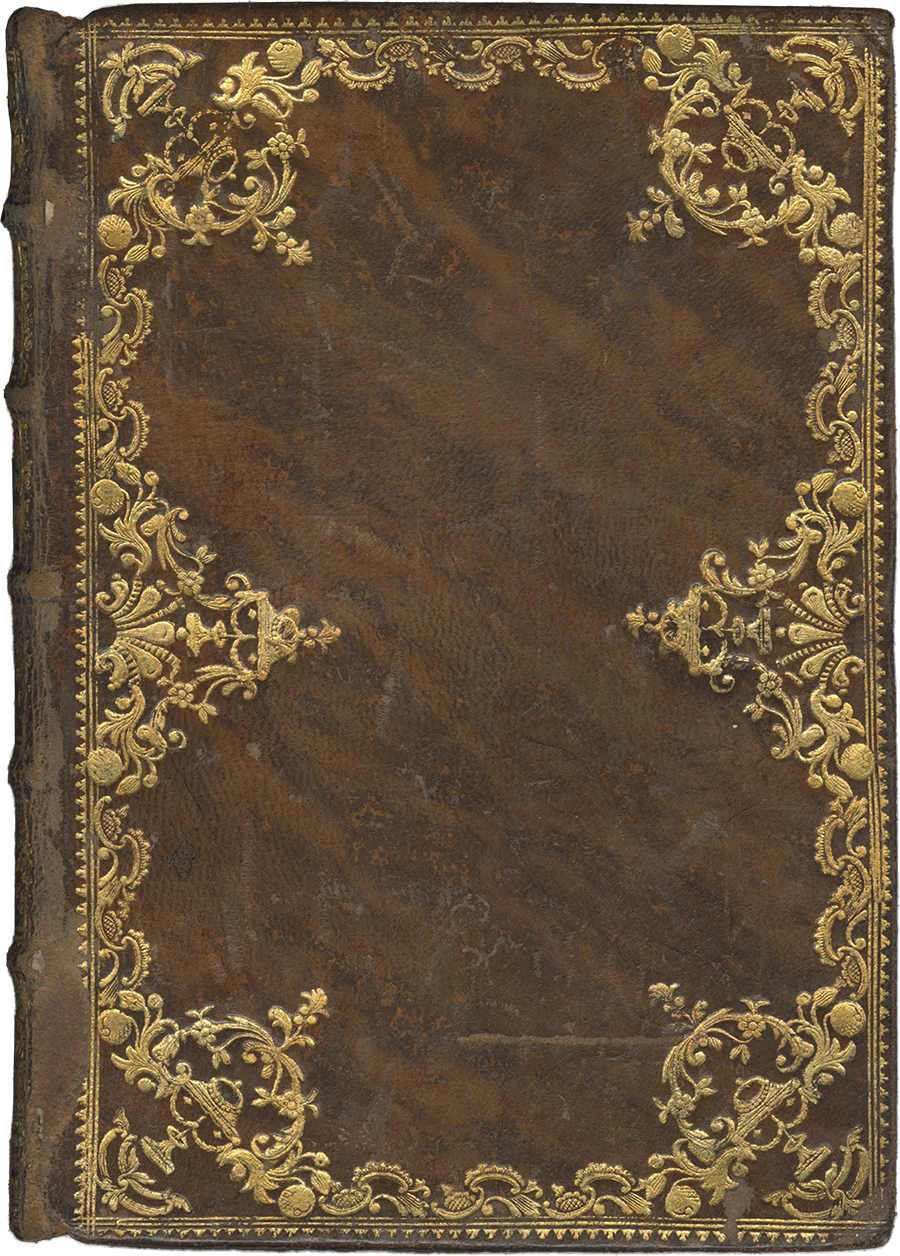
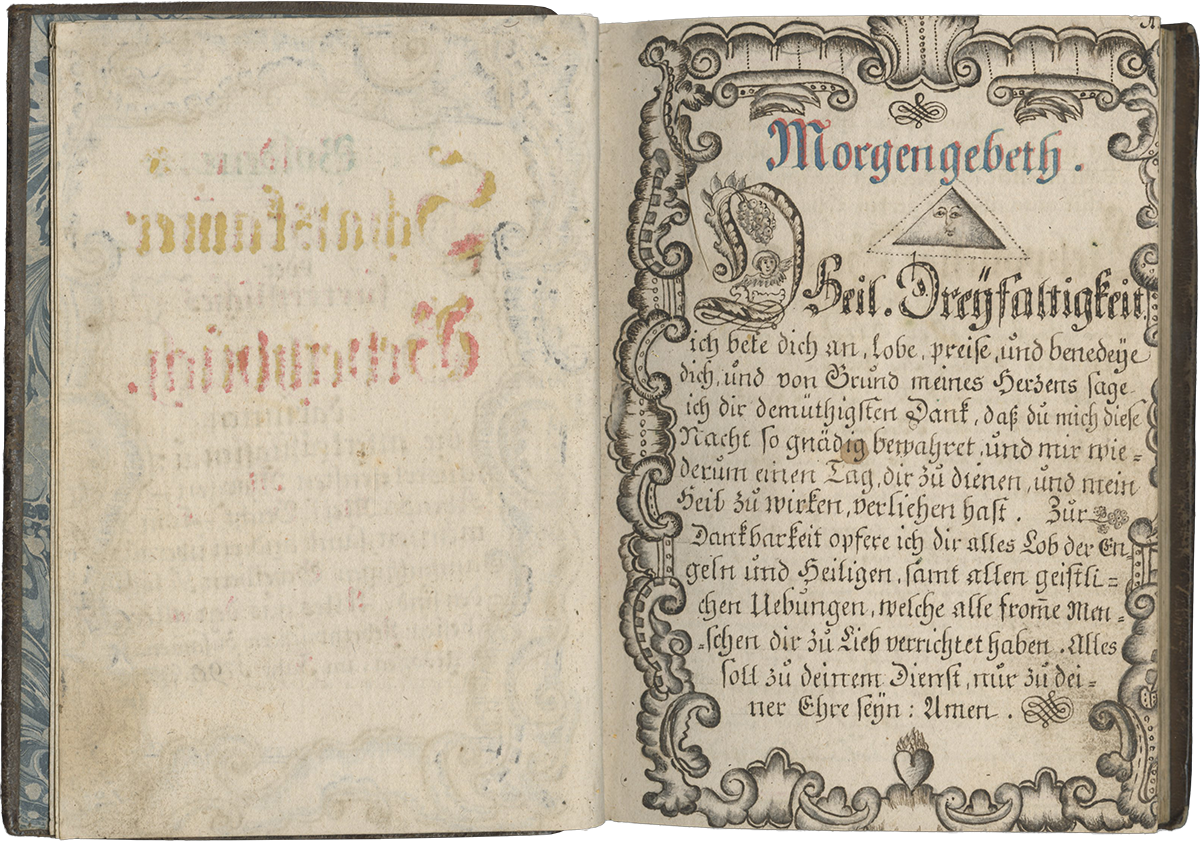
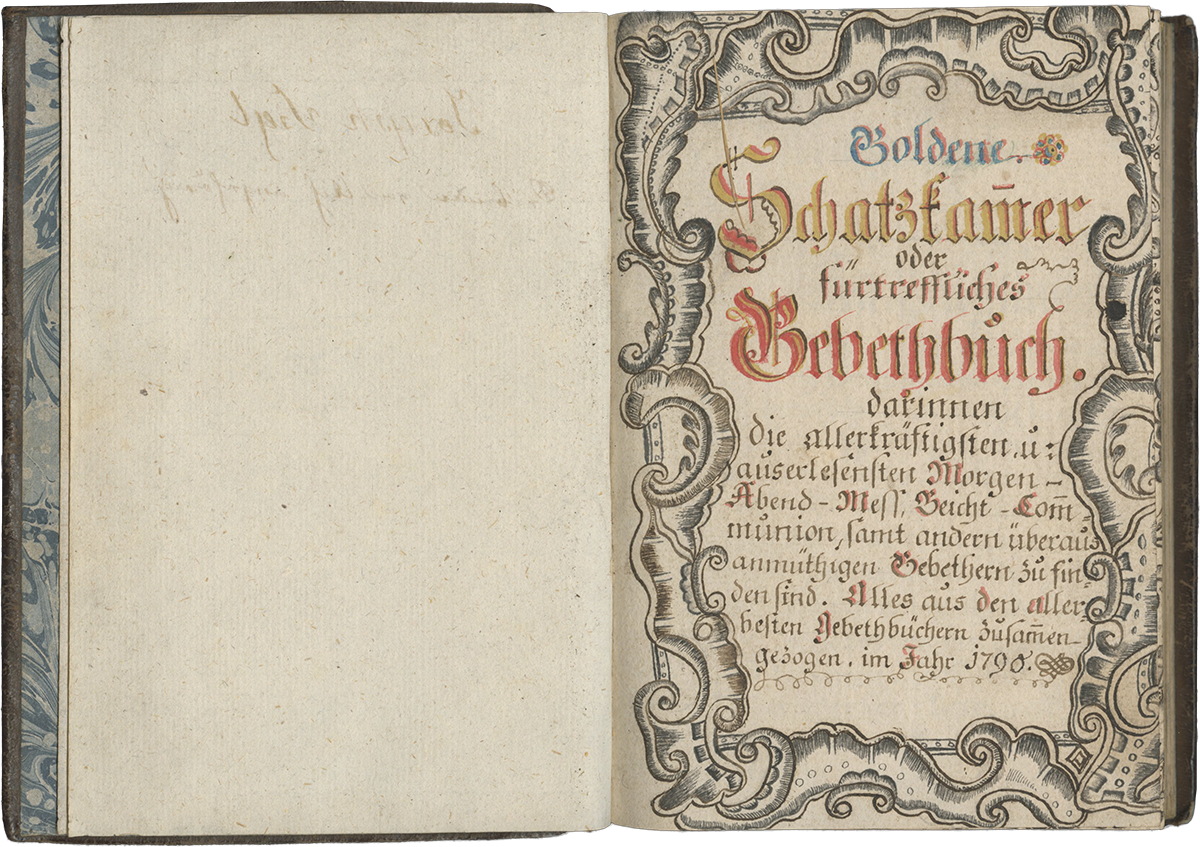
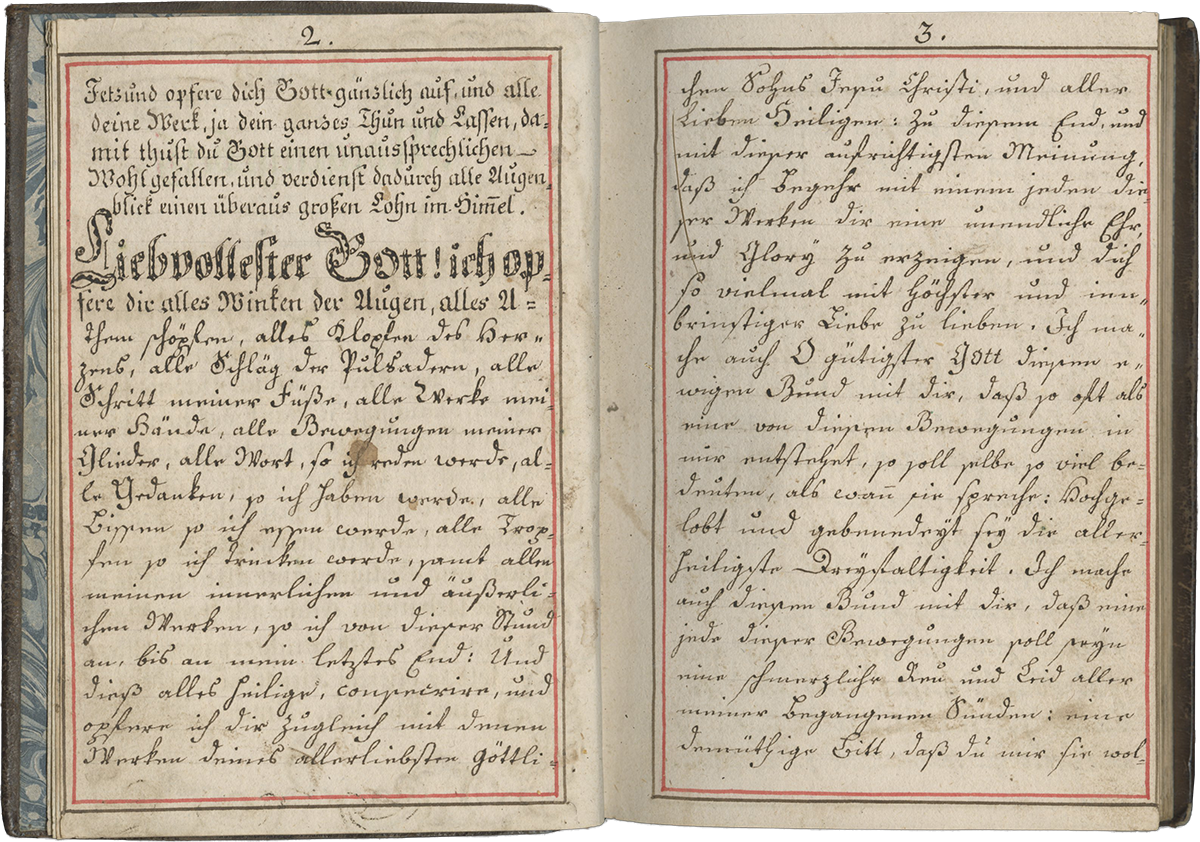
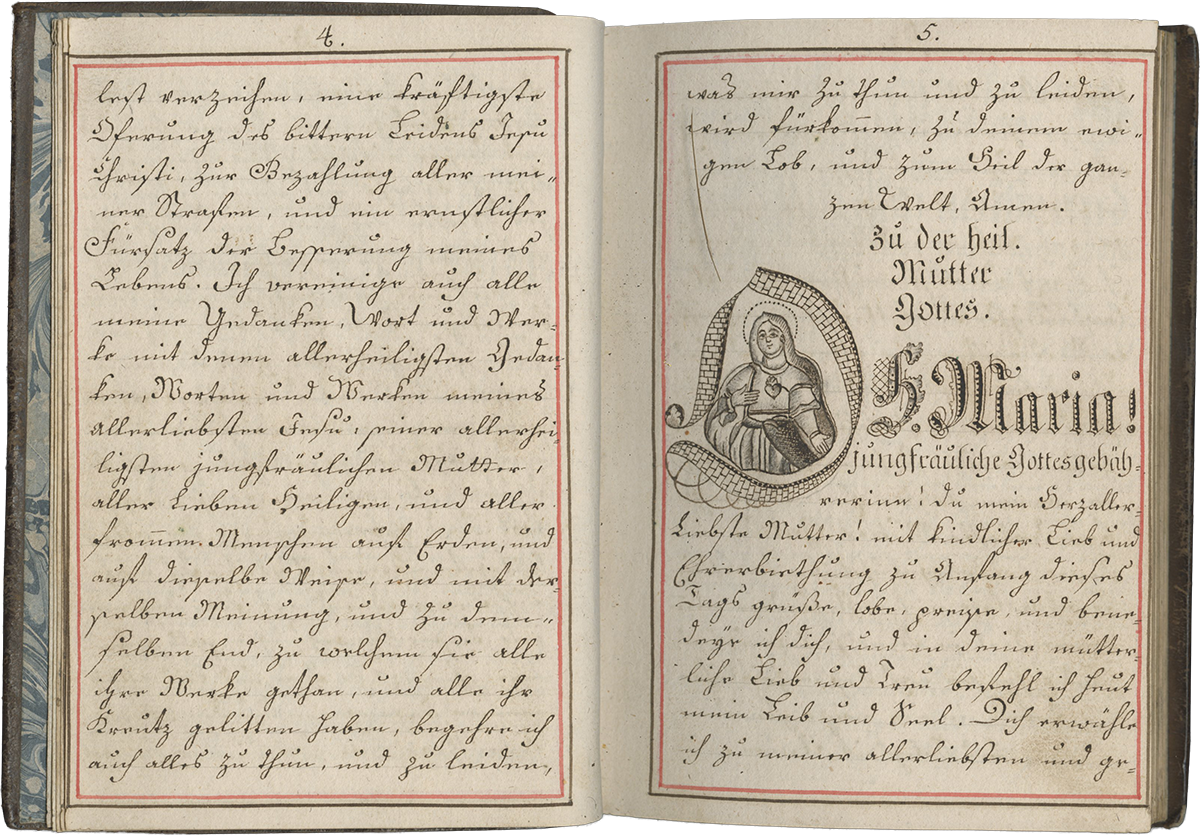
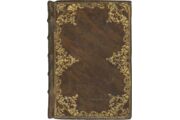
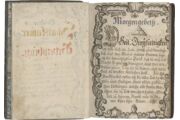
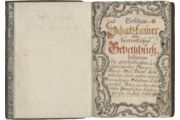
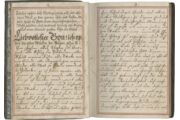
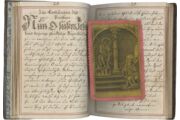
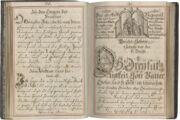
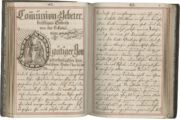
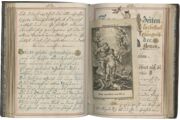
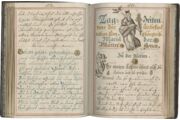
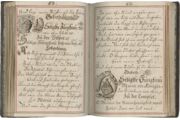
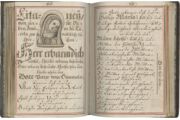
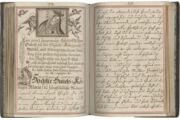
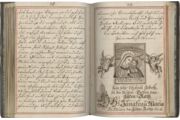
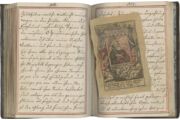
ii + 86 + ii folios on paper, contemporary pagination 1-110 on folios 2-56v, too tightly bound to determine collation, single column, 19-21 lines ruled in pencil, (justification 155 x 103 mm), single hand throughout writing in a variety of scripts, a legible kurrentschrift is used for the main text throughout in black ink (writing in red ink at p. 40 and brown ink at pp. 46 and 50), headings and titles written in fraktur (often calligraphic, and in red, blue, and yellow ink on title page and p. 53), rectangular frame in black and red ink, rococo frame in black ink on title page and p. 1, 3-5-line historiated ink initials with various motifs throughout, SIXTEEN HISTORIATED INITIALS, NINE LINE DRAWN MINIATURES, FOUR INTERLEAVED PRAYER CARDS, small stain on pp. 1-2 and pp. 99-100, very minor staining occasionally throughout, otherwise excellent condition. Nineteenth-century calf binding, gold tooling with floral motifs on front and back covers and spine, 5 bands on binding, some scuffing along spine, gilt edges, calf slip cover with simple double line tooling, paper inside slip cover with black and blue brick pattern and dotted squiggle patter in red and blue, some chipping on the bottom right corner and back, otherwise good condition. Dimensions 184 x 124 mm.
A unique copy of a Prayerbook compiled, written, and used by an Austrian woman for private devotion at the end of the eighteenth century. The hand-drawn illustrations and calligraphic excellence displayed grant us a rare glimpse into non-standard practices of Catholic devotion at a time when Emperor Joseph II and his administration endeavored to regularize all aspects of Catholic faith and worship. Prayer cards from earlier in the eighteenth century kept in the manuscript, together with iconography that seems influenced by the Marian shrine at Mariazell, attest to the enduring influence of older Catholic practices. The prayer cards preserve rare ephemera and reflect rarely witnessed facets of eighteenth-century Christian devotion.
Provenance
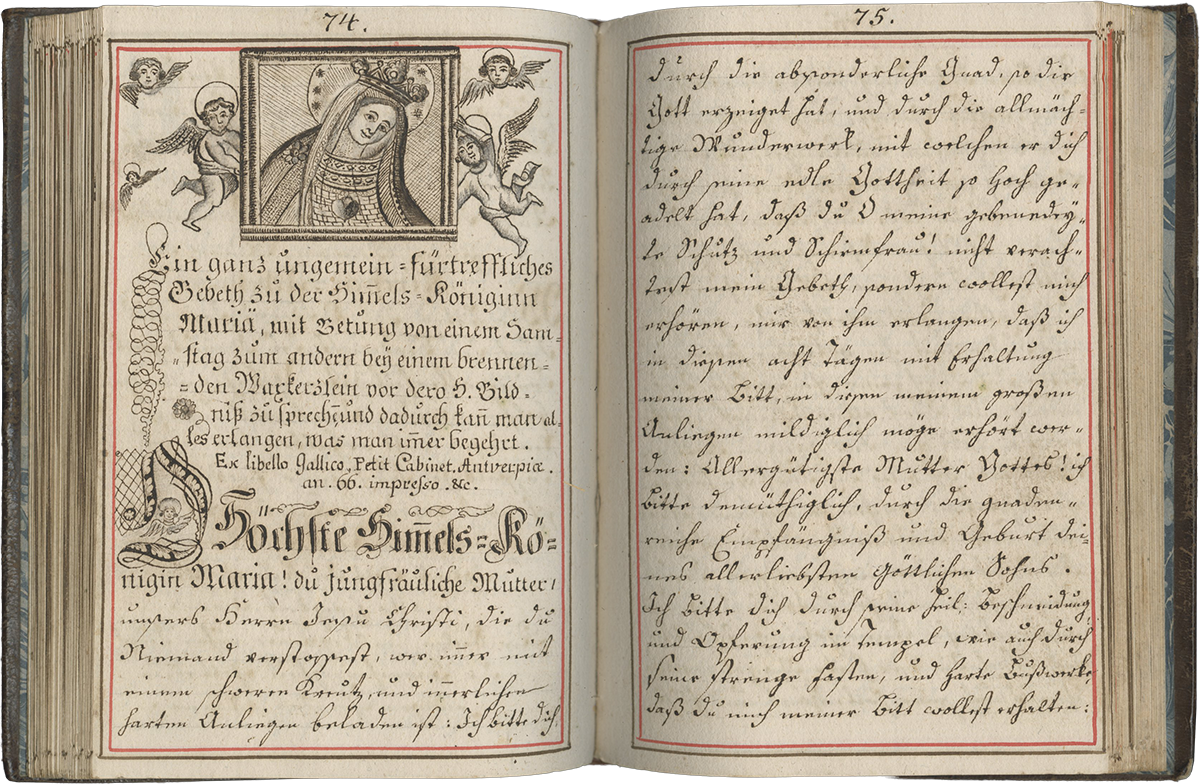
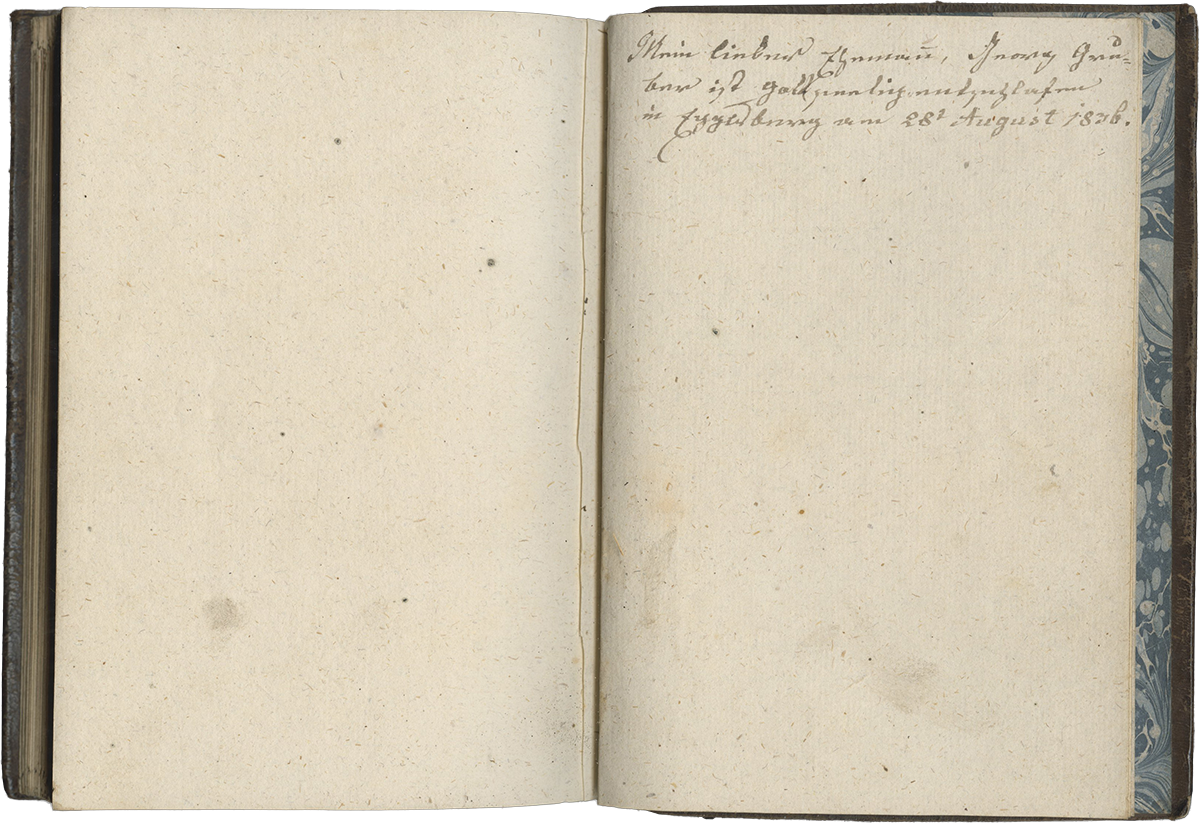
1. The scribe of this manuscript, very likely an Austrian woman, notes that this Prayerbook was compiled and written in 1790. An interleaved prayer card found between pages 24 and 25 is dated to 1733. The compiler of this manuscript also mentions copying and translating a prayer from a French book (“Ex libello Gallico Petit Cabinet Antverpiae an. 66 impresso &c”) on page 74. This appears to refer to an edition of Le petit Cabinet des Catholiques printed in Antwerp in 1766.
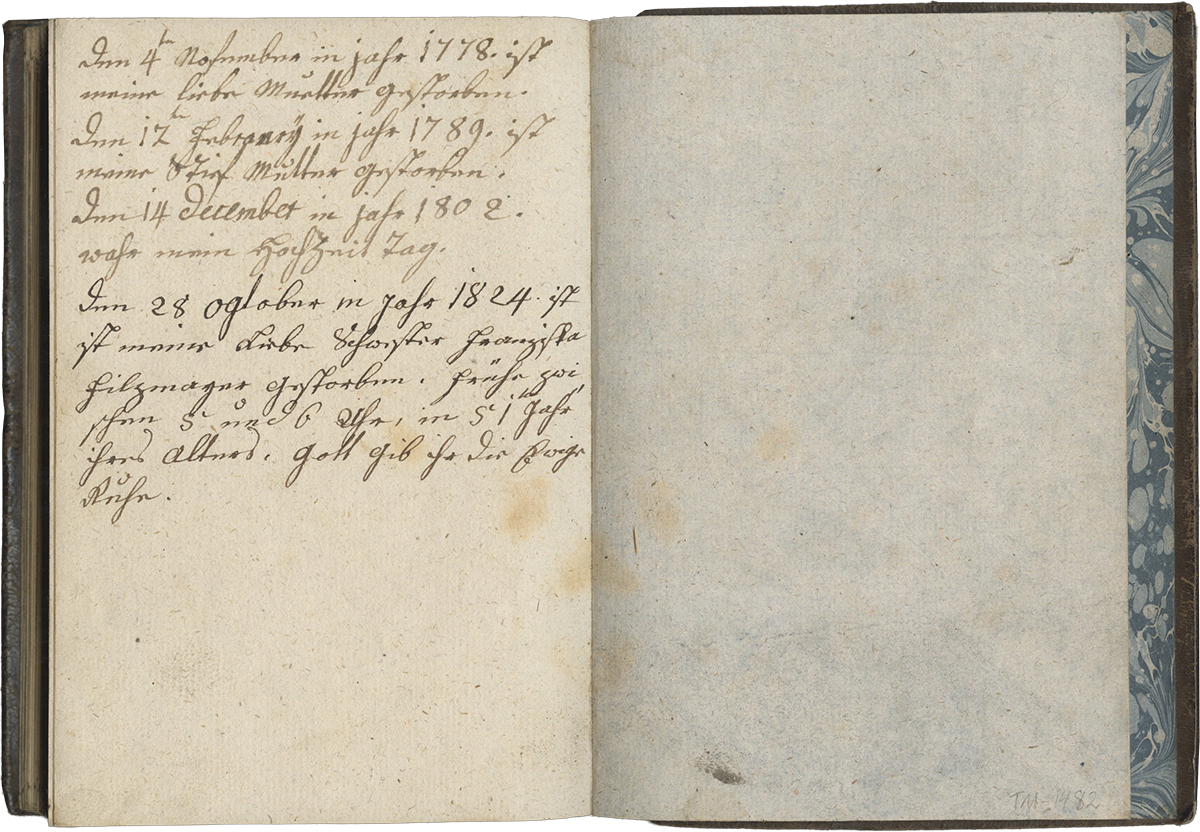
2. On the front flyleaves, Joseph Sigl (or Siegl) identifies the book as belonging to him. On the back flyleaves, the same hand also notes important dates such as weddings and deaths in the family ranging in dates from 1778-1836. The hand does not seem to be the same as that of the Prayerbook. The Joseph Sigl mentioned in this manuscript may be the same as a hop-merchant who opened a brewery in Salzburg in 1775. The brewery is still in operation under the direction of Josef C. Sigl, son of Josef Sigl VII.
3. Sigl, or a slightly later owner in the nineteenth century, provided the manuscript with its current binding.
Text
ff. 1-56v (=pp. i – 110), Goldene Schatzkammer oder fürtreffliches Gebethbuch, incipit, “Morgengebeth: O heilige Dreyfaltigkeit ich bete dich…und Seligkeit ihnen verleihen wollest. Amen.”
This manuscript contains a unique copy of a Prayerbook compiled in 1790 by an accomplished calligrapher and artist in Austria. As the scribe writes on the title page, all the prayers within this manuscript have been “collected from all the best prayer books” (Alles aus den aller besten Gebethbüchern zusammen gezogen). In one instance (p. 74) the compiler identifies a source for a Marian prayer taken from a libellus Gallicus called “Petit Cabinet” printed in Antwerp in the year ’66. Since the “Petit Cabinet” was likely a collection of French prayers, the compiler of this Prayerbook must also sometimes have been a translator. Other published German prayer collections from the first half of the eighteenth century are also translations, such as the Tägliche Andachts-Ubungen Zum Gebrauch Der Allerdurchläuchtigsten Königin Zu Hungarn u. Böheim, collected and translated from Latin anonymously and printed by Johann Georg Lochner in Bamberg in 1745. It is therefore likely that textual parallels for the prayers in this manuscript will be found in Latin, French, and Italian prayerbooks (and perhaps Prayerbooks in still other languages). The text of the prayers is organized into seven main sections: 1.) Morning Prayers (pp. 1-8); 2.) Evening Prayers (pp. 8-14); 3.) Prayers for Mass (pp. 15-27); 4.) Prayers for Communion (pp. 28-30 and 42-52); 5.) Prayers for Confession (pp. 31-41); 6.) Prayers to the Holy Family (Mary, Joseph, and Anna) (pp. 53-94); 7.) Miscellaneous Prayers and Hymns of Praise (Lobgesängen) for Day Offices, Prayers to St. Barbara, and Prayers for the Dead (pp. 95-110).
Several authoritative collections of prayers circulated within Hapsburg Austria in the late eighteenth century, such as Karl Heinrich Seibt’s (1735-1806) Katholisches Lehr- und Gebetbuch, first printed in Prague in 1779 and with many subsequent editions, and the Normalmeßgesang, Litaneyen, und Gebether, wie selbe bey der neuen Gottesdiensteseinrichtung zu allgemeinen Gebrauch vorgeschrieben worden, printed in Vienna in 1783. While neither of these collections provide direct sources for the present collection, they constitute useful comparanda. In the case of Seibt’s collection, the Prayerbook contains educational material for children on the necessity and usefulness of prayer; in the Normalmeßgesang, a standardized set of hymns and litanies established by Emperor Joseph II (r. 1780-1790) constituted a new, regular Mass for Austrian Catholics.
Illustration
This manuscript is heavily illustrated, with many historiated initials and a full suite of miniatures, all executed as ink line-drawings, evidently by the copyist. The potential that some of this iconography rises from the shrine at Mariazell deserves further examination, especially in light of the thirty-two panels of miracles featured in the Large Mariazell Miracle Altar (now in the Alte Galerie – Universalmuseum Joanneum GmbH, Graz), the densely painted interior of the church in this period, and the use of prints to spread this iconography from an early date (Zika, 2017, pp. 12, 24).
3-5-line historiated initials:
p. 1, An angel, and above the prayer a triangle with a face representing the Trinity.
Given the artist’s evident interest in the triangular appearance of the dressed cult statue at Marianzell, her insistent representation of the Trinity as a triangle is also notable (Zika, 2017, p. 7).
p. 5, Mary displaying the immaculate heart;
p. 15, A host in a monstrance;
p. 23, Communion chalice topped by the host, with an angel above;
p. 31, The Trinity as a triangle;
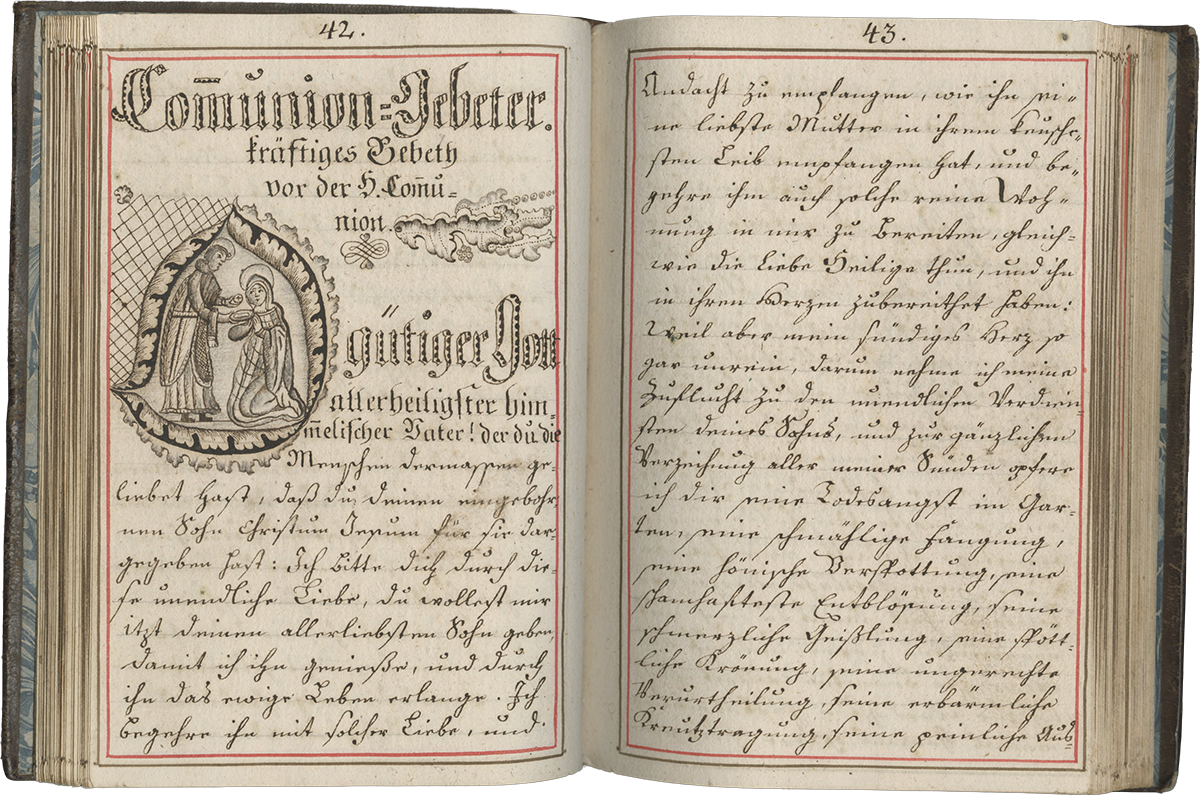
p. 42, A haloed woman taking communion from a haloed priest;
p. 48, An angel;
p. 51, An angel;
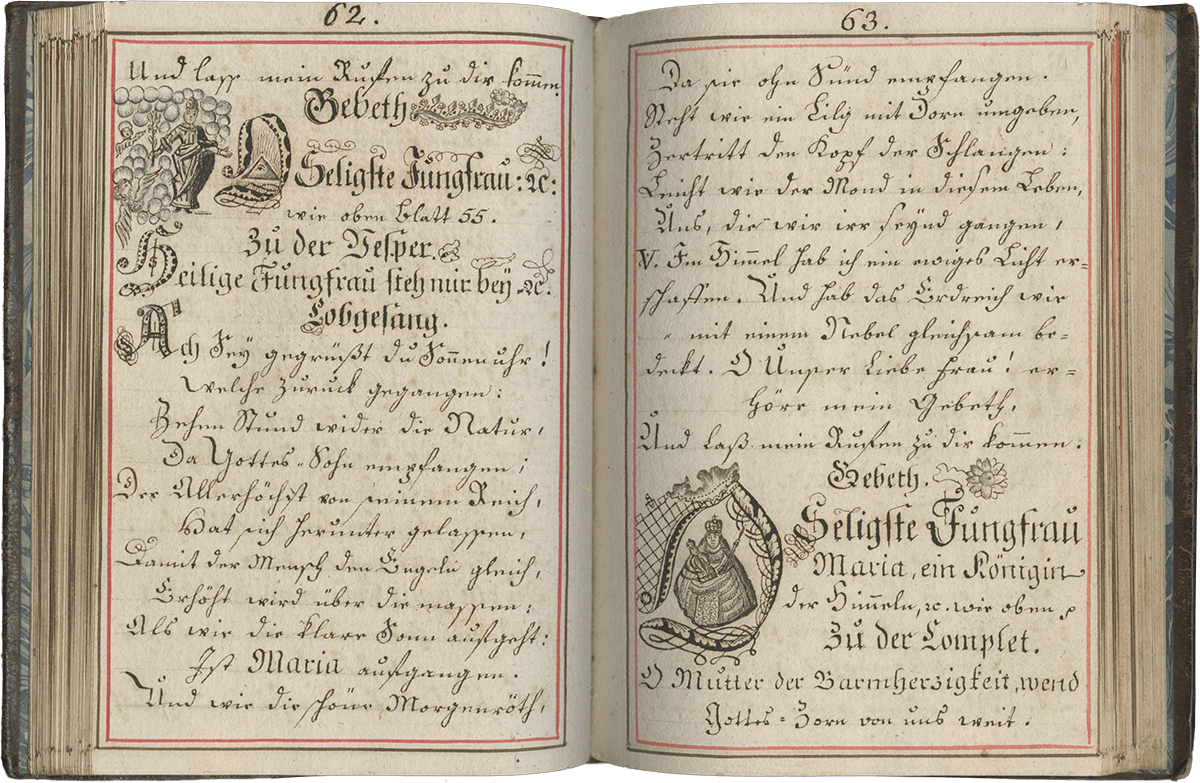
p. 62, The Trinity as a triangle;
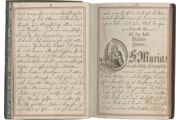
p. 63, Virgin and Child, both crowned, in clothing denoting cult statues, apparently a reference to the Statue of Mercy (Gnadenstatue), a popular cult statue at Mariazell, Austria known also as the Magna Mater Austriae. Despite a sale of the statue’s considerable wardrobe, the banning of its devotion in 1783 did not seem to slow interest in the shrine for very long and by 1793 the Magna Mater once again boasted a substantial collection of crowns and gowns (Zika, 2017, pp. 5n10, 6);
p. 74, An angel;
p. 95, The Trinity as a triangle and an angel; the Godhead crowned by the Trinity as a triangle in red and blue ink;
p. 99, A city scene;
p. 102, St. Barbara next to her Tower, holding the Host, Chalice, and a Crucifix;
p. 105, A soul Purgatory praying to the Host and Chalice;
p. 108, The Trinity as a triangle;
Miniatures reflect the subjects and contents of the prayers and appear at major divisions within the Prayerbook:
p. 7, A guardian angel leading a child by the hand;
p. 15, Priest saying mass at an altar flanked by two kneeling angels;
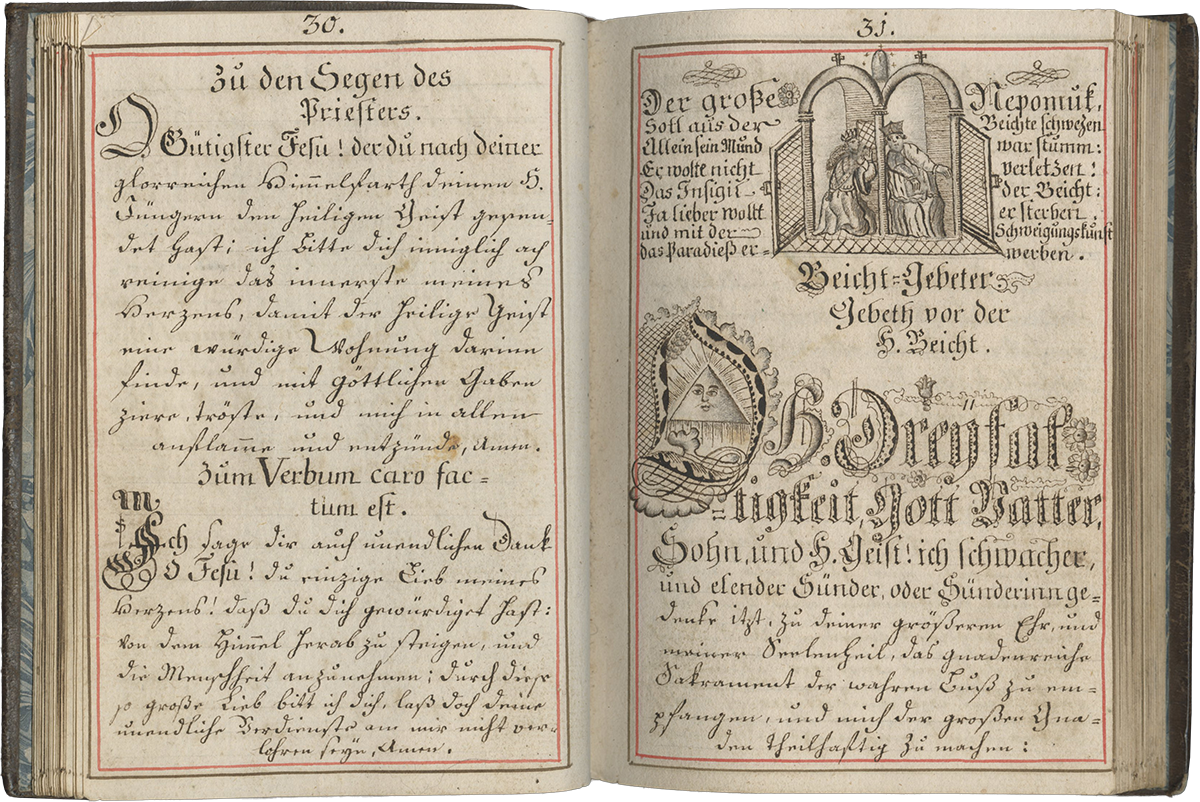
p. 31, A drawing of St. John of Nepomuk hearing a queen’s confession, followed by prayers for confession;
St. John of Nepomuk (ca. 1345-1393) was a Bohemian saint whose cult was popular in Hapsburg Austria. A popular tradition held that King Wenceslaus IV asked St. John of Nepomuk to reveal secrets told to him by the Queen under the seal of the confession. The King then commanded that John be thrown into the Vltava River, where he was martyred. Even though this narrative is largely legend, it linked St. John to the sacredness of the seal of the confession. In the first half of the eighteenth century, the Austrian state fostered a cult and confraternity of St. John, but under Maria Theresa new confraternities were forbidden from being founded, and, under Joseph II, in 1783 all religious confraternities were abolished and replaced by a single state-sponsored one. (Bowman, 1999, pp. 53-6) The appearance of St. John of Nepomuk in this manuscript suggests that it was used for private devotion frowned upon by Joseph II, who attempted to control religious and devotional practice as much as possible during his tenure as sole emperor over Austria (1780-1790).
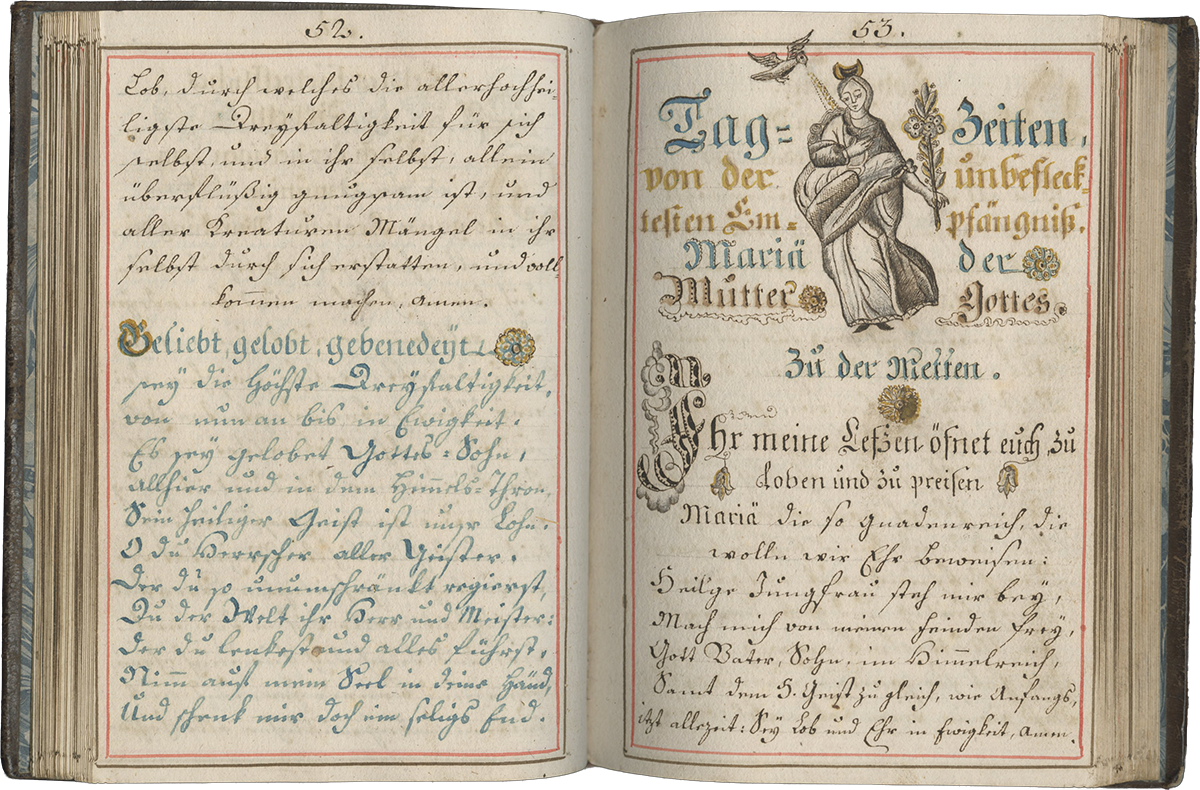
p. 53, Anunciation containing Mary crowned with the crescent moon receiving Christ from the Holy Spirit depicted as a dove and holding the Rod of Jesse;
p. 62, Mary as Queen of Heaven holding a Rod of Jesse while adoring the Trinity in the form of a triangle inside the initial;
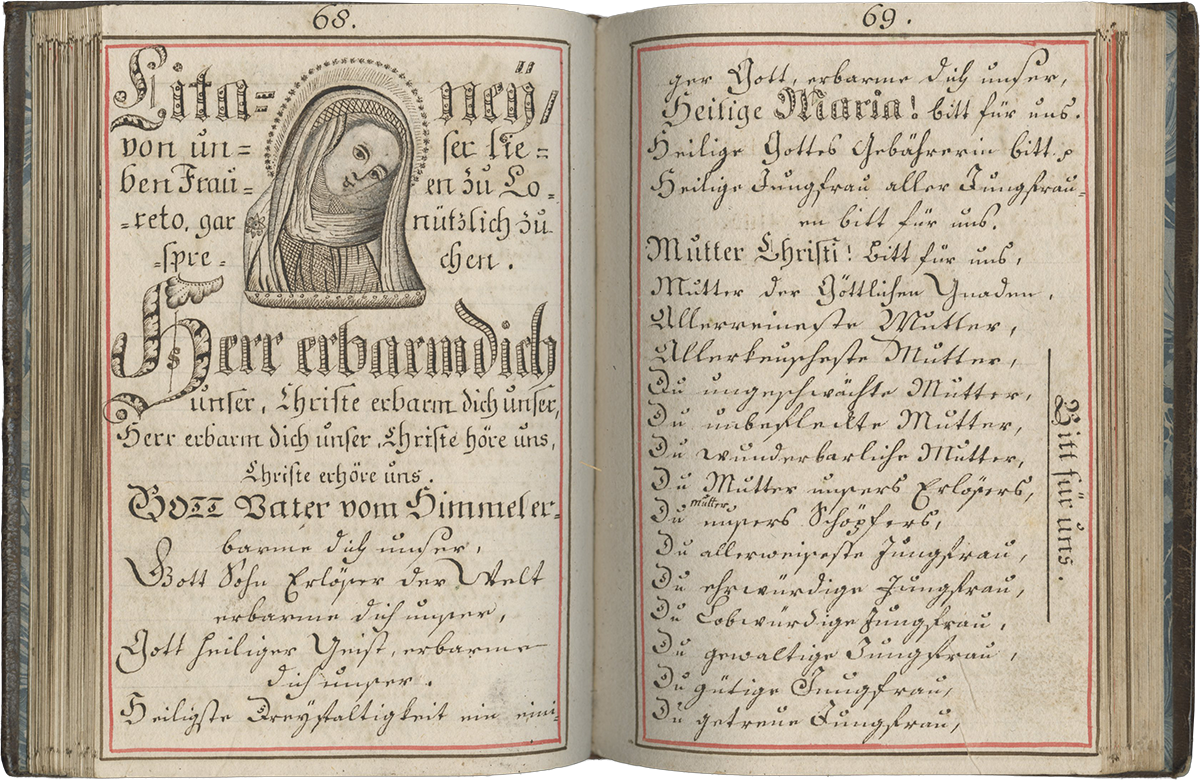
p. 68, Bust of Mary in a hodegetria pose, possibly a reference to a Byzantine icon or the Byzantine-influenced Treasury Image (Schatzkammerbild) at Mariazell;
p. 74, Image of Mary as Queen of Heaven and bearing the Immaculate Heart, dressed as a cult statue within a frame held by putti;
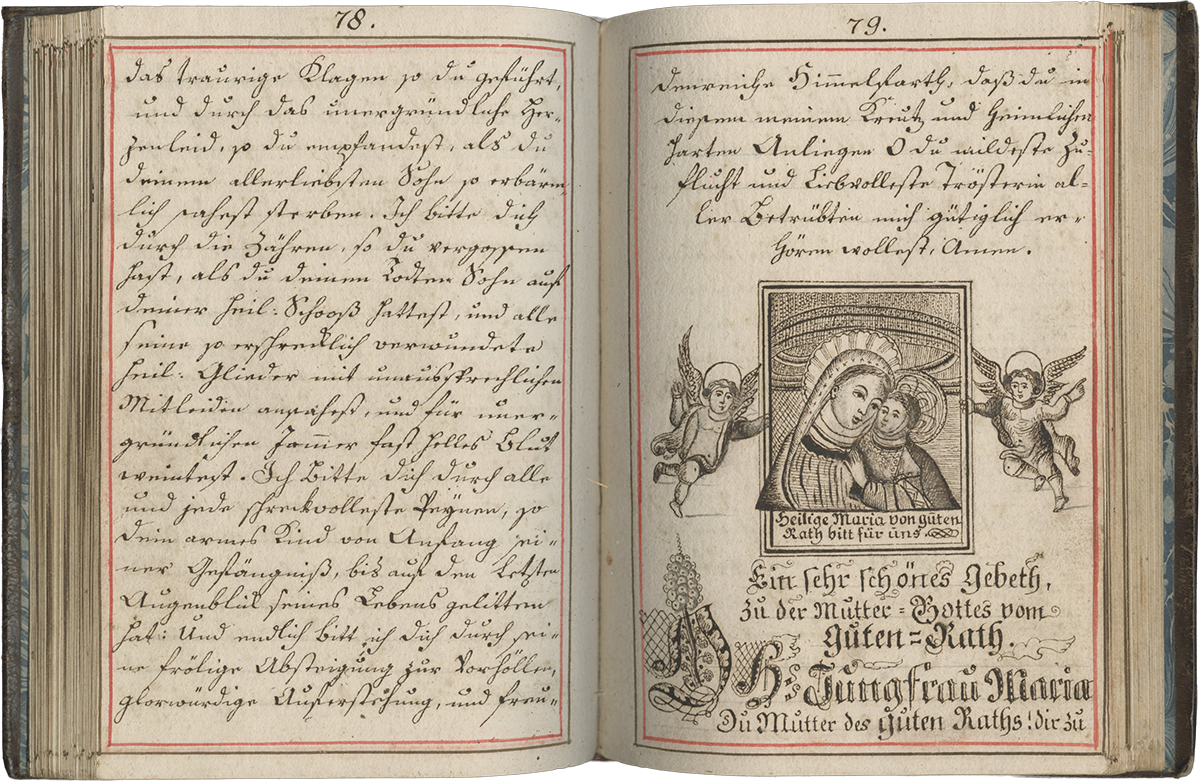
p. 79, Framed image of Virgin and Child held by Angels;
p. 83, Joseph holding the Christ Child and a Rod of Jesse in an oval frame or nimbus;
p. 87, St. Anne teaching the Virgin to read;
The strong focus on the Holy Family (Anna, Mary, Joseph, and the Christ Child) and the appearance of female figures participating in the sacraments in several illustrations suggest that this prayer book was likely used by woman and probably a mother, who may have also been the scribe and artist.
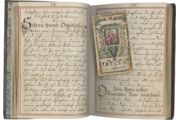
Interleaved Prayer Cards
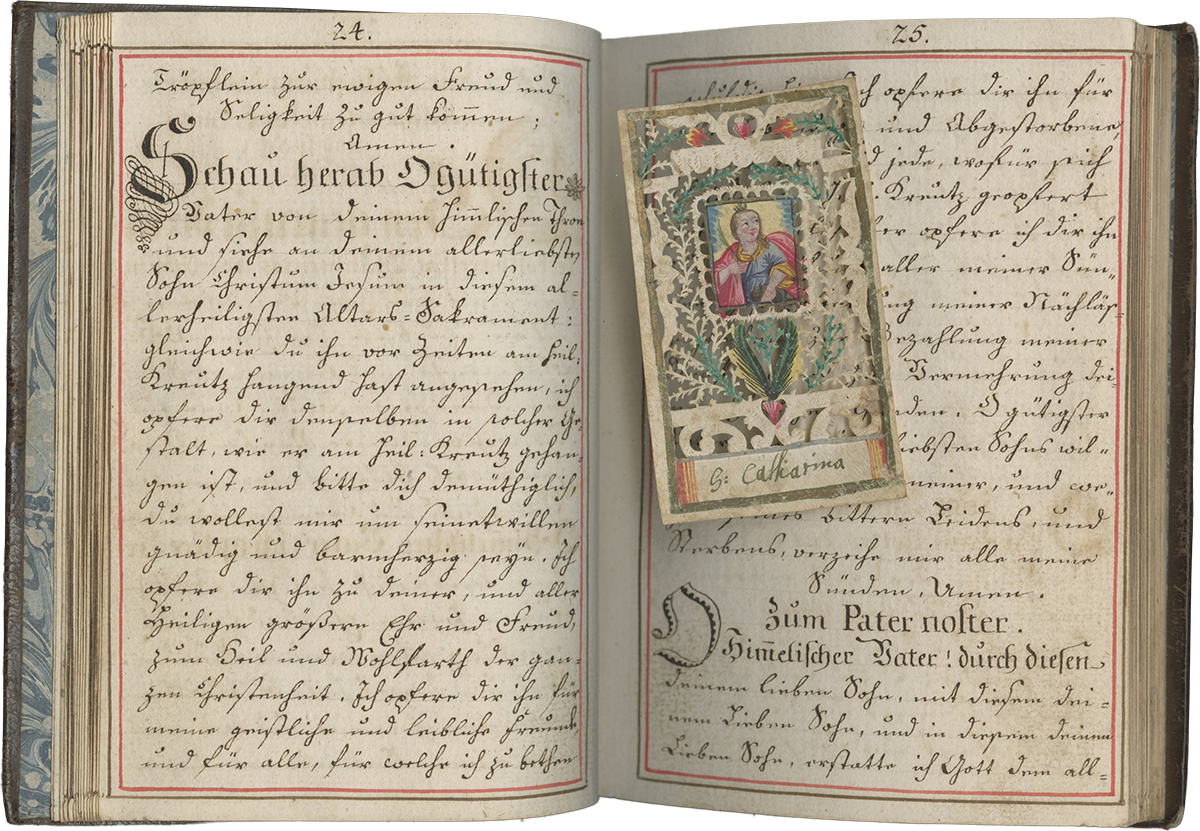
1. Between pp. 24 and 25, cut-paper (scherenschnitte) prayer card to St. Catherine with gold border, St. Catherine holding a palm, her other hand resting on the top of her wheel, and dressed in blue and pink robes, with floral border, parts painted green, orange, yellow, and pink. The back of the prayer card is inscribed with the date 1733.
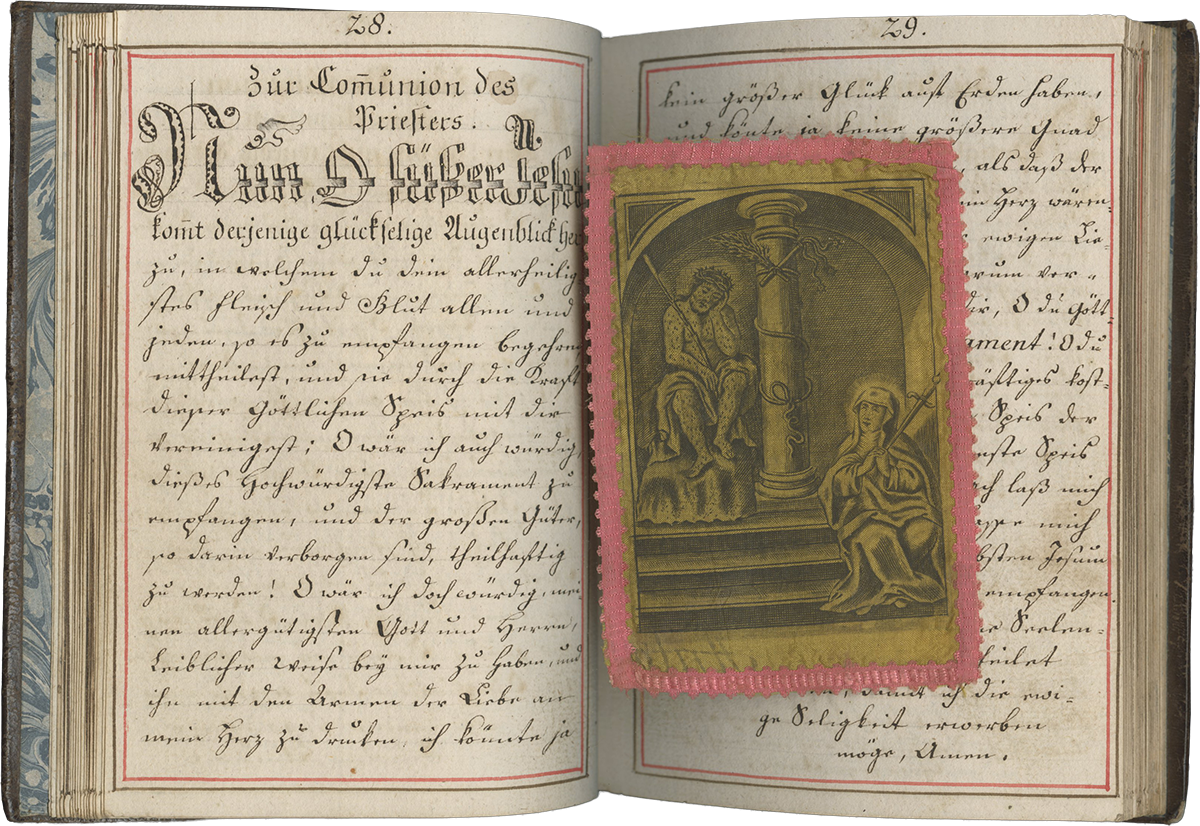
2. Between pp. 28 and 29, yellow silk prayer card with a pink ribbon border depicting Mary, her heart pierced by the sword of her compassion contemplating Christ as Man of Sorrows. The name Anton is written on the back.
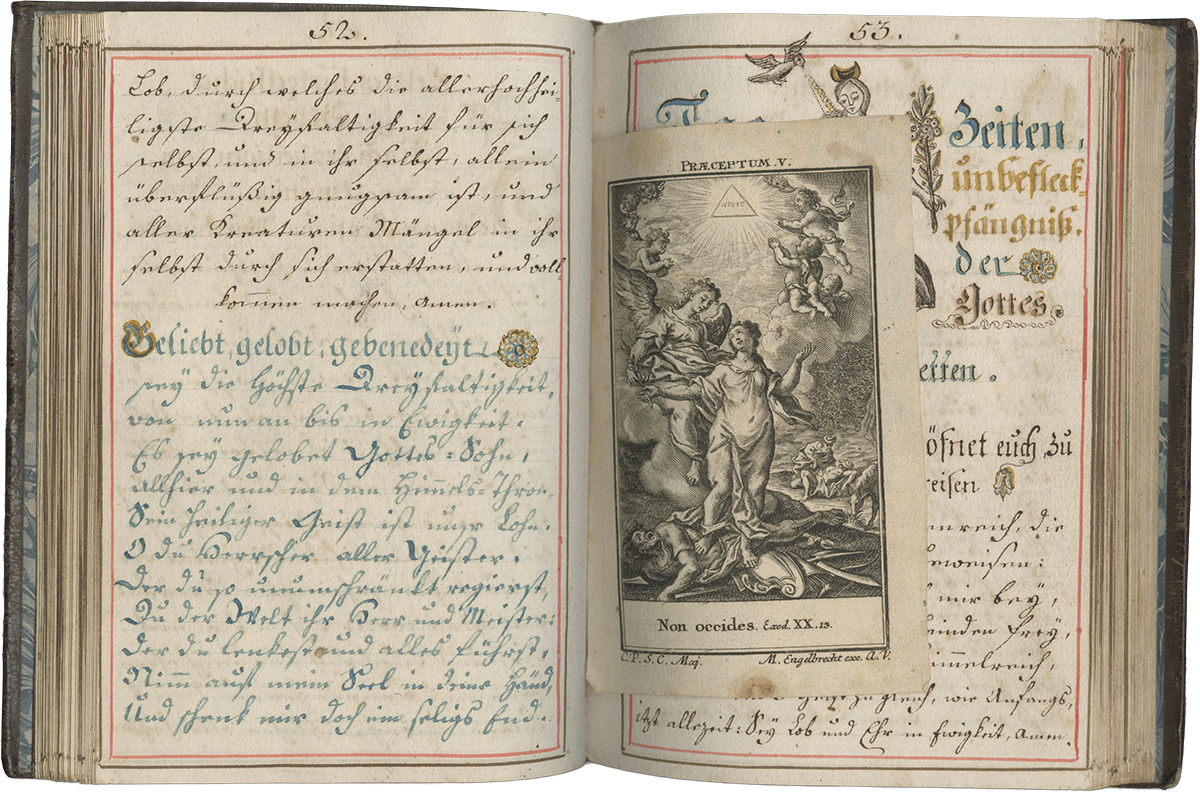
3. Between pp. 52 and 53, emblematic paper prayer card depicting putti adoring the Trinity in the form of a radiant triangle, a larger angel handing an olive branch of peace to a woman personifying peace standing over a conquered man symbolizing war. The card reads “PRAECEPTVM V” (Commandment 5) “Non occides” (Thou shalt not kill). On the bottom of the card is printed “C.P.S.C. Maj” (Cum Privilegio Sacrae Caesareae Majestatis, that is, with the privilege of the Holy Imperial Majesty or Holy Roman Empire) and “M. Engelbrecht exc. A. V.” (i.e. “M. Engelbrecht excudit apud Vindobonam.”) The printer is Martin Engelbrecht (1684-1756), an inventive and revolutionary printer in Vienna who pioneered many different styles of printing, including early pop-up books. Engelbrecht’s ephemera is naturally rare today, and his prayer cards are further difficult to identify due to cataloguing inconsistencies, but a different example can be found at the Staatliche Museen zu Berlin (see Online Resources).
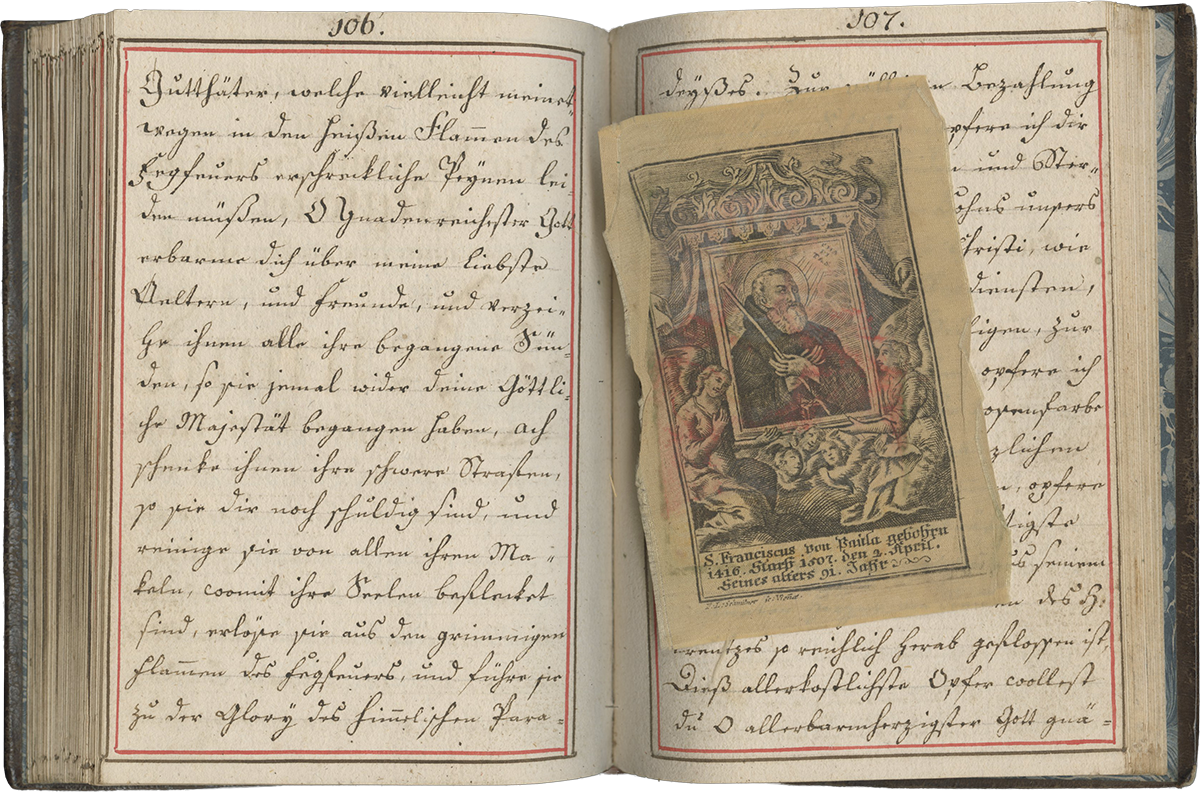
4. Between pp. 106 and 107, pale yellow silk prayer card printed with St. Francis of Paola, receiving CARITAS from above. St. Francis of Paola is holding a staff and is being venerated by angels within an elaborate draped frame. In small print at the bottom of the card is “F. L. Schnulner sc: Viennae.” An F. L. Schnulner is known to have printed other small ephemera in the eighteenth century, including armorial bookplates (Leiningen-Westerburg, 1901, p. 212).
The devotional practices of Austrian Catholics changed profoundly under the policies of Maria Theresa (r. 1740-1780) and her son Joseph II (r. 1780-1790). The seventeenth and early eighteenth centuries saw the codification and establishment of pietas austriaca (Austrian Piety), which enshrined the “cults of the cross, of the eucharist, and of Mary” as central tenets of the Hapsburg monarchs’ faith (Coreth, 2004, p. 7). In the second half of the eighteenth century, however, “Josephism” (or “Josephinism”) renegotiated the relationship between the Monarchy and the faithful (Beales, 1987, p. 8). Under the regime of Josephism, many earlier Catholic practices such as Marian devotion, pilgrimages (especially to Mariazell), and confraternities were seen as excrescences inimical to a robust, liberal Catholic faith. These practices were gradually banned, but pockets of resistance maintained traditional devotional practices throughout the eighteenth and into the nineteenth century.
This manuscript is an exceptionally rare witness to private Catholic devotion in Austria during the stringent Josephinist reforms that sought to regularize and control Catholic worship. The prayers contained within this book reflect a larger library of prayers available to the woman who compiled them, at least some predating Josephism. Moreover, the hand-drawn illustrations depicting women at mass and receiving sacraments as well as the Holy Family and saints are noteworthy and not usually found in other manuscript Prayerbooks of the same time period. (See for example Walter’s Art Museum, W.513 from the third quarter of the eighteenth century, which contains prints pasted into the book, but not hand-drawn illustrations, see Online Resources.) The prayer cards kept between some of the pages are extremely rare survivals of devotional ephemera, likely the only examples of these prints extant, and show a continuity of Catholic practices from the early eighteenth century until the time of the manuscript’s production (see Verheggen, 2024 for the history of prayer cards in the Netherlands). In all, this is a remarkable testament to women’s private spirituality in an era dominated by attempts to control public faith.
Literature
Beales, Derek. Joseph II, 2 vols., Cambridge, 1987-2009.
Bowman, William D. “Popular Catholicism in Vormärz Austria, 1800-48,” in Catholicism and Austrian Culture, ed. Ritchie Robertson and Judith Beniston, Edinburgh, 1999: pp. 51-64.
Bowman, William D. Priest and Parish in Vienna, 1780-1880, Boston, 1999.
Coreth, Anna. Pietas Austriaca, trans. William D. Bowman and Anna Maria Leitgeb, West Lafayette, 2004.
Gampl, Inge. Staat – Kirche – Individuum in der Rechtsgeschichte Österreichs zwischen Reformation und Revolution, Vienna, 1984.
Kovács, Elisabeth. “Kirchliches Zeremoniell am Wiener Hof des 18. Jahrhunderts im Wandel von Mentalität und Gesellschaft,” Mitteilungen des österreichischen Staatsarchivs 32 (1979), pp. 109-42.
Tropper, Peter G. “Von der katholischen Erneuerung bis zur Säkularisation – 1648 bis 1815,” in Österreichische Geschichte: Geschichte des Christentums in Österreich von der Spätantike bis zur Gegenwart, ed. Rudolf Leeb, Maximilian Liebmann, Georg Scheibelreiter, Peter G. Tropper, Vienna, 2003, pp. 281-360.
Leiningen-Westerburg, Karl E. Deutsche und oesterreichische Bibliothekzeichen, Exlibris: ein Handbuch für Sammler, Bücher- und Kunstfreunde, Stuttgart, 1901. https://archive.org/details/bub_gb_X6wgAQAAMAAJ/mode/2up
Winter, Eduard. Der Josefinismus: Die Geschichte des österreichischen Reformkatholizismus, 1740-1848, Berlin, 1962.
Zika, Charles. “The Emotional Economy of Early Modern Pilgrimage Shrines: The Case of Mariazell,” Emotions: History, Culture, Society 1 (2017), pp. 1-27.
Online Resources
Berlin, Staatliche Museen zu Berlin, Salvator Mundi, https://recherche.smb.museum/detail/501133/salvator-mundi
Le petit Cabinet des Catholiques (USTC no. 1545489)
https://www.ustc.ac.uk/editions/1545489
Müller, Hannelore. “Engelbrecht, Martin” in Neue Deutsche Biographie
https://www.deutsche-biographie.de/gnd118684728.html#ndbcontent
Normalmeßgesang, Litaneyen und Gebether, wie selbe bey der neuen Gottesdiensteseinrichtung zu allgemeinen Gebrauch vorgeschrieben worden, Vienna, 1783, https://vd18.gbv.de/viewer/fullscreen/00759416X/1/
“Prayer Book, W.513,” The Walters Ex Libris, https://manuscripts.thewalters.org/viewer.php?id=W.513#page/8/mode/2up
“Tägliche Andachts-Ubungen Zum Gebrauch Der Allerdurchläuchtigsten Königin Zu Hungarn u. Böheim,” Publikationsserver Universität Marburg, digitized 2016, https://archiv.ub.uni-marburg.de/eb/2016/0061/
Verheggen, Evelyne. “The Mystical Union Between Christ and His Brides: Devotional Prints as a Source for Catholic Women’s History,” Early Modern Low Countries 9 (2025), pp. 125-142. https://www.evelyneverheggen.nl/Documenten-website-Evelyne/The-Mystical-Union-Between-Christ-and-His-Brides.pdf
Verheggen, Evelyne. “Te versnijden devotieprenten in Keulen, Antwerpen en de Noord Nederlandse Republiek, 1600-1800 Een eerste verkenning,” Delineavit et Sculpsit, Tijdschrift voor Nederlandse prent- en tekenkunst 54 (2024), pp. 15-38. https://www.evelyneverheggen.nl/Documenten-website-Evelyne/Te-versnijden-devotieprenten.pdf
Zika, Charles. “The Treasury Image of Mariazell: The Materialisation of Hope, Assurance and Security,” Emotions: History, Culture, Society 7 (2023), pp. 52-75. https://brill.com/view/journals/ehcs/7/1/article-p52_5.xml?srsltid=AfmBOop9wTvLeh56GeCsmLCRVuZYzolJ8aEdrTNMDShWW66KDlWbtENp