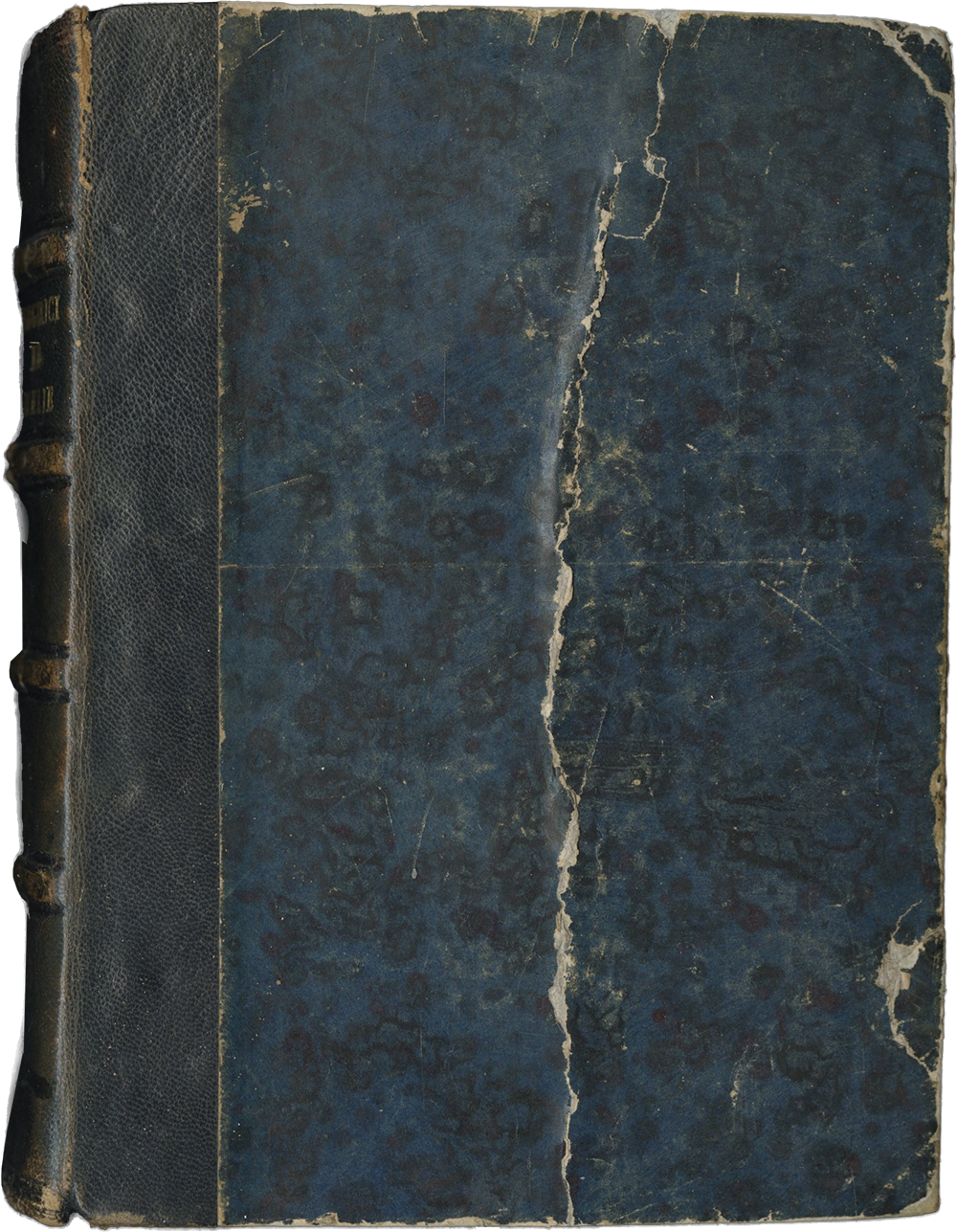
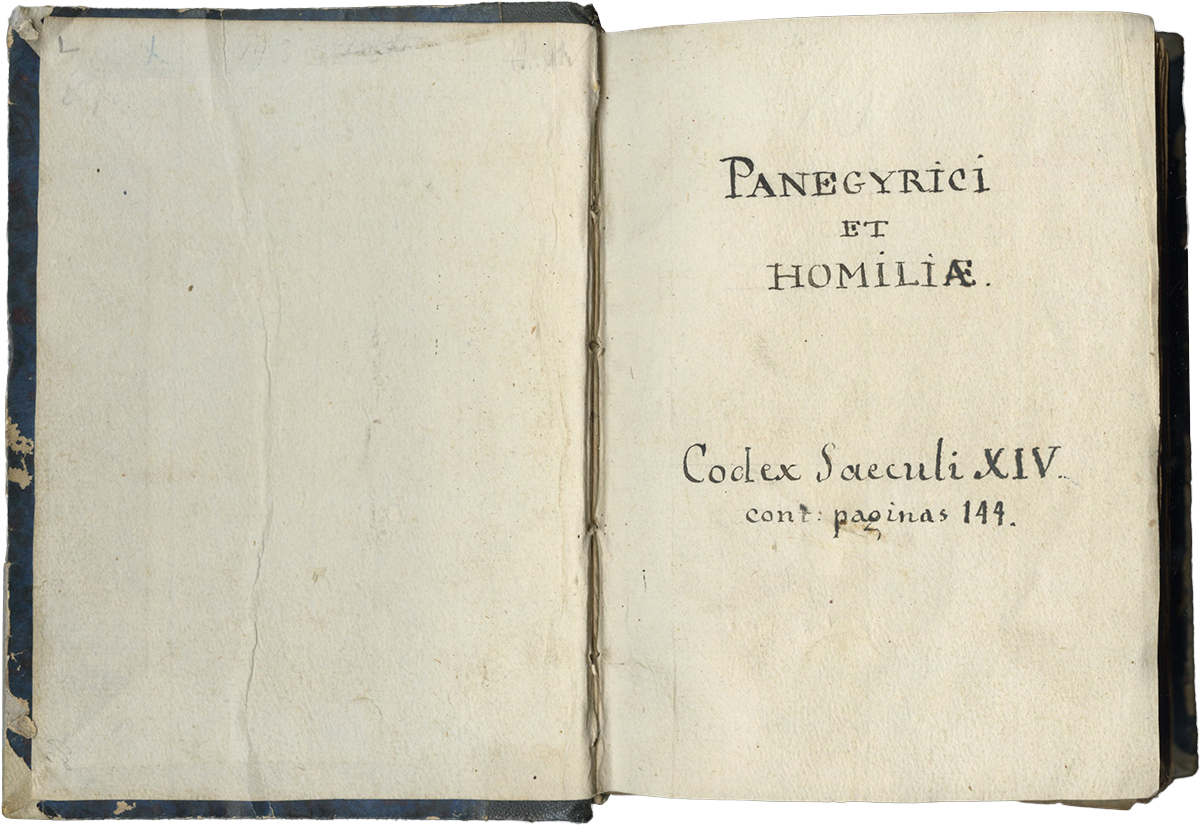
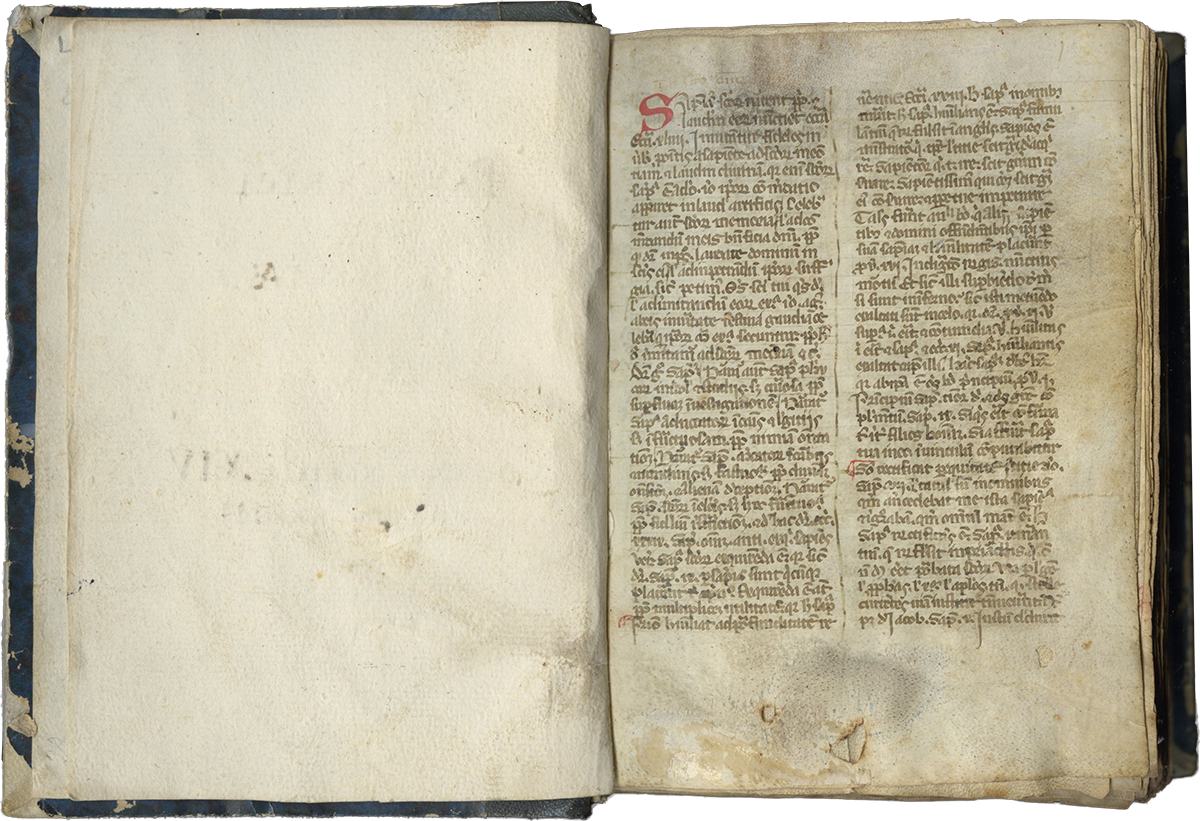
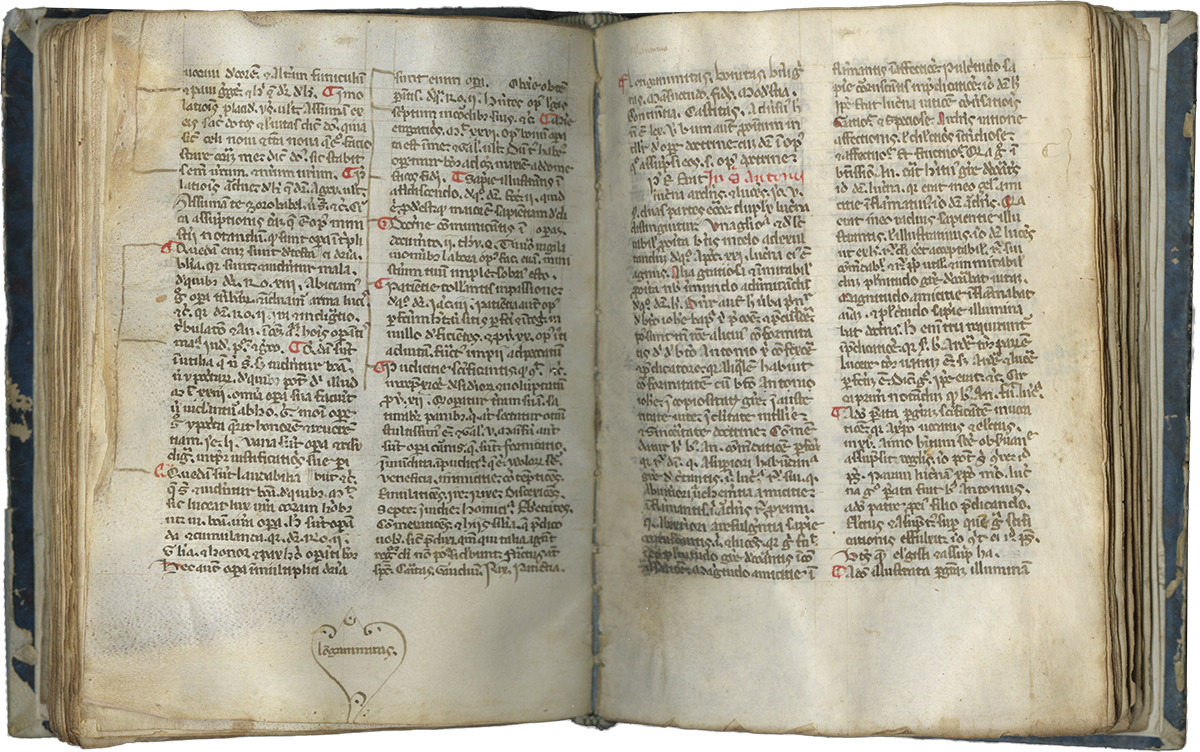
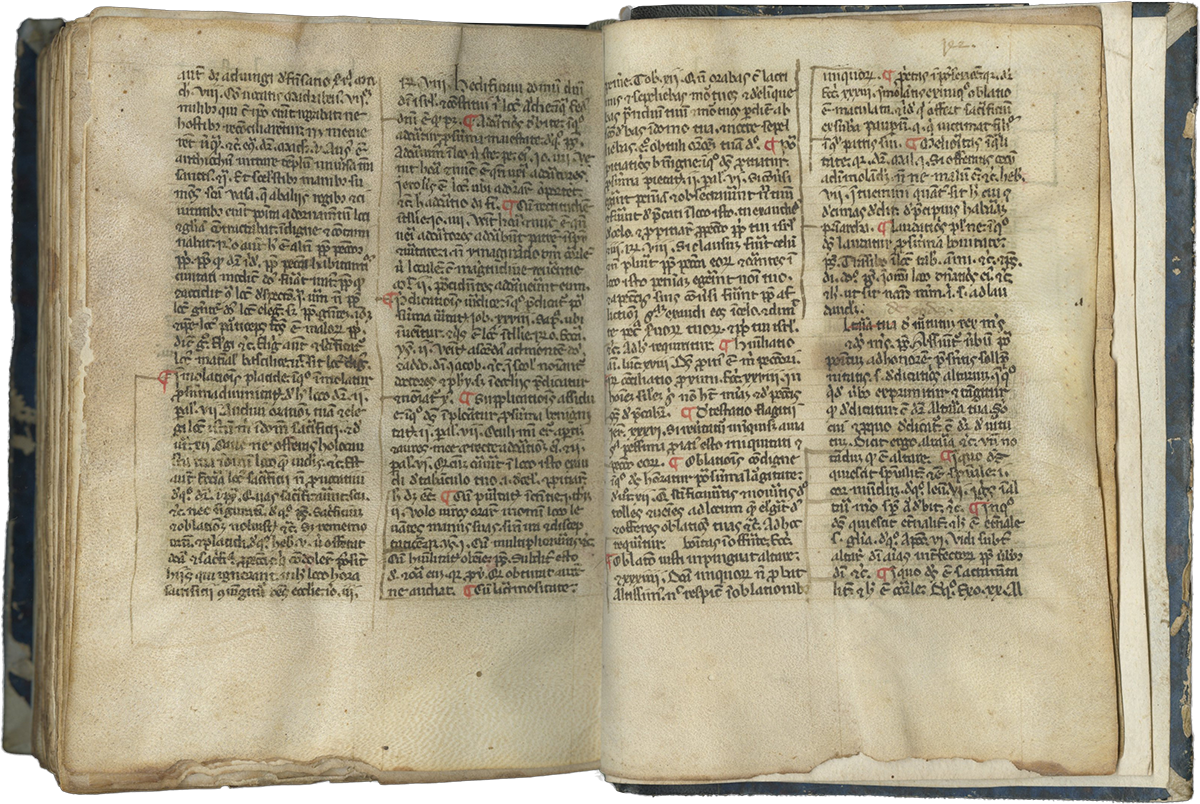
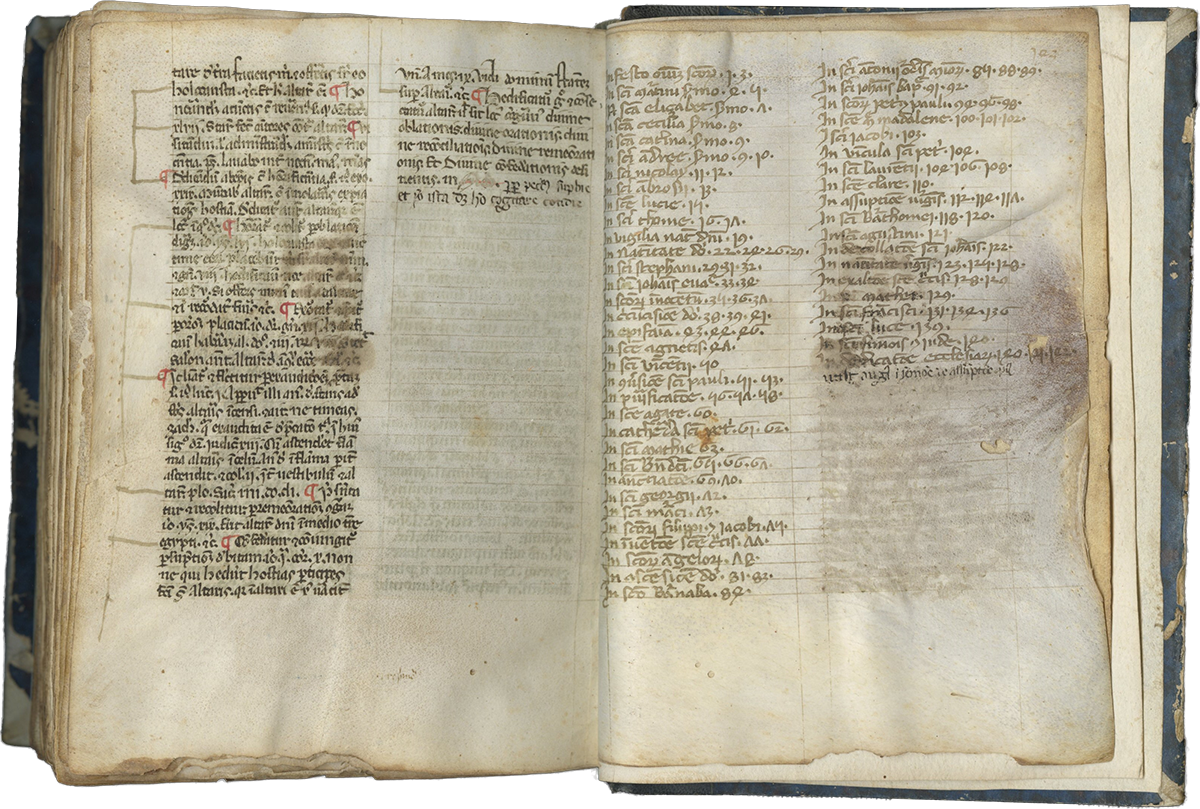
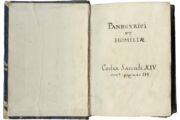
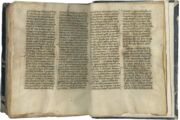
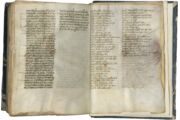
i + 144 + i folios on parchment, contemporary foliation in top right recto, complete, (collation: i-xii12), catchwords on final verso of gatherings, two columns of 32 lines, ruled in lead, pricking visible, (justification 116 x 91 mm), single main hand writing in a neat Gothic textualis libraria in black ink, a contemporary hand provides corrections, titles, and a table of contents in a Gothic hybrida in brown ink, another contemporary hand writing in a thin Gothic textualis leaves two notes at ff. 142v-143, bracketing in brown ink used to indicate sermon structure, highlighting and paraphs in red ink, most initials left blank with guide letters in margin, two-line initials in red ink on ff. 1, 2v, 4rv, tears on ff. 11, 106, sewn repairs on ff. 14, 54, 125, holes on ff. 21, 54, 104, 125, 127, faded text on ff. 43, 55, 61, 103, 122v, 134v, 138v, 141, wrinkling on f. 139, otherwise good condition. Eighteenth-century quarter calf binding, blue marbled paper over cardboard, vertical crease along center front cover, some chipping and scuffing on front and back cover, spine contains gold tooling on four bands, chipping on second band from top, gilded title “PANEGIRICI ED OMELIE,” fair condition. Dimensions 170 x 125 mm.
Active at the court of Saint Louis, whom he may have accompanied on the First Crusade, student and collaborator of Bonaventura, participant in the Council of Lyon, the Franciscan Guilbert of Tournai has passed into obscurity today, even among medievalists. As an author, he is distinguished for his sermons, though his best known, Sermones de festis et de sanctis, is only partially edited. The present group exists in only two, or perhaps three, manuscripts, entirely unedited. Guibert’s work only rarely comes to market, and the Schoenberg Database of Manuscripts lists just three sold in the last fifty years.
Provenance
1. Based on the script, this manuscript was likely produced in Northern Italy in the first half of the fourteenth century. The used of up-right, half-uncial d beside uncial d, the inverted c form (Ɔ) of the “-us” abbreviation, the round aspect, and preference for single compartment a are all highly indicative of an Italian scribe.
2. A second Italian owner in the eighteenth century provided the binding and flyleaves, along with the title “Panegyrici et Homeliæ.” The title on the spine “PANEGIRICI ED OMELIE” indicates an Italian owner.
Text
ff. 1-142v, Sermones additi, incipit, “Sapientiam sanctorum narrent populi et laudem eorum nunctiet ecclesia. Eccl. xliiii. Imitantur fideles in uerba propositis…confederationis desinentis in [erased]. Propter peccatum superbie et ideo ista debet homo cogitare cotidie”;
f. 143, [Table of Contents], incipit, “In festo omnium sanctorum. 1. 3…In dedicatione ecclesiarum. 140. 141. 142”; ff. 143v-144v, blank.
The set of sermons contained in this manuscript was developed by Guibert of Tournai (c. 1200-1284), a Franciscan Doctor of Theology at Paris with a prolific literary output. His most widely disseminated work, Sermones de festis et de sanctis, survives in 48 manuscripts, and has only been very partially edited (Horowski, 2015). The sermons in this manuscript do not belong do this collection and have not been edited at all, but have been given the name “Sermones additi” (Additional Sermons) by Schneyer in his Repertorium (Schneyer, 1970, pp. 310-314, nos. 322-383) and are otherwise found in Vatican City, Biblioteca Apostolica Vaticana, Vat. lat. 11444 (another Italian manuscript, probably early fourteenth century, see Online Resources). This manuscript and Vat. lat. 11444 are the only two known manuscripts of Guibert’s Additional Sermons, but their contents are not identical. Both begin with sermons for the Feast of All Saints (S79; Oct 31), but Vat lat. 11444 ends with sermons for the Feast of Sts. Jude and Simon (S78; Oct 28), while this manuscript contains an additional three sermons for the dedication of a church (C11). The placement of the Feast of All Saints at the beginning of the collection indicates that it was intended as a cycle of sermons on the Saints through the calendar year, yet there are some sermons intended for the major feasts of the Temporale such as the Nativity and Circumcision of Christ. It is possible that our manuscript was intended to contain more sermons because a dozen or so lines have been erased at the end of the table of contents (f. 143) and at the end of the final sermon another scribe has written “Propter peccatum superbie et ideo ista homo cogitare cotidie” ([This is] because of the sin of pride and so one should think about these things every day.) Our manuscript notably omits a series of four sermons for Holy Week; the Vatican manuscript is missing five sermons for various saints and the final sermon for the dedication of a church. While many of the incipits to the sermons are the same in both manuscripts, only a full collation will reveal their exact textual affiliation. There is a third manuscript that contains some of the same sermons but has had no research published determining how close it might be to either the present manuscript or to the Vatican manuscript: Charleville-Mézières. Bibliothèque municipale, Ms. 92 (Online Resources).
Guibert of Tournai converted to the Franciscan order in 1240 and had an illustrious career in Paris as a Master of Theology. In 1254, Pope Alexander IV requested that Guibert send him a collection of sermons that is now known as the Sermones de festis et de sanctis. He published widely on many other topics including a travelogue of King Louis IX’s crusading (Hodoeporicon primae profectionis Ludovici Galliae regis in Syriam), an educational treatise (De modo addiscendi), a mirror-for-princes (Eruditio regum et principum), and an encyclopedia (Rudimentum doctrinae or Erudimentum doctrinae), among others (see Horowski, 2016 for a useful summary of his life and works).
The attribution of these sermons to Guibert of Tournai is all but certain. Horowski notes that four of the sermons in this manuscript appear in an Innsbruck manuscript containing some of the Sermones de festis et de sanctis (Innsbruck, ULB, ms. 445 ff. 92ra-92va, see Online Resources; Horowski, 2015, p. 712 n. 155). He has also found some of the “Additional Sermons” in a Munich manuscript (Ludwig-Maximilians-Universität München. Universitätsbibliothek, 4 Cod.ms. 141, ff. 1r-25v; Horowski, 2015, p. 712 n. 164). In the preface to his Sermones ad status, Guibert himself notes that his collection went through several stages of revision and addition before being sent to Pope Alexander IV, who had requested them (D’Avray, 1985, pp. 120-124). Thus, this manuscript is an important, and at times unique, textual witness to the “Additional Sermons,” since it contains six sermons not listed in Schneyer, who relied upon the Vatican manuscript. Lacking further textual research, however, it remains difficult, however, to establish how these sermons relate to Guibert’s wider oeuvre.
The style of the sermons is formulaic and follows the university style sermon, beginning with a thema, i.e. a scriptural quotation, which is given an allegorical equivalent in a prefatory prothema. A prayer for divine assistance usually comes next, followed by a bridge passage. The body of the sermon consists of a number of divisions and subdivisions, made clear in this manuscript by rubrics and brackets drawn in the margins, highlighting primo, secundo, tertio, quarto, etc. Once the divisions of the thema are complete, the sermon will end by reducing the divisions back to the thema. (See Wenzel, 2015, pp. 45-86 for examples and analysis.) In these sermons, Guibert’s working method is formulaic and direct. For example, in his Sermon on St. Catharine (ff. 8v-9, Schneyer, p. 310, no. 328) he begins with a quotation from 1 Sam 25.3: “Abigail was a very wise woman”; then, he remarks that “this cited passage can be taken to agree with the praise of the blessed virgin [i.e. Catharine] in three ways”; then, Guibert discusses the three ways Catharine and Abigail are alike, two ways in which Abigail is commendable, and two ways to interpret Abigail’s wisdom with the first way divided into three parts. Guibert bolsters all his interpretations with more scriptural quotations and ends with quotation with which he began “It says, therefore, Abigail was etc.”. The preponderance of biblical quotation suggests that these sermons like this were primarily intended as a framework a preacher could use to write his own more elaborate sermon.
Literature
D’Avray, D.L. The Preaching of the Friars: Sermons diffused from Paris before 1300, Oxford, 1985.
Horowski, Aleksander. "Il ms. L.I7.SUP dell'Ambrosiana e la tradizione manoscritta dei 'Sermones dominicales et festivi' di Gilberto di Tournai (1284)," Archivum Franciscanum Historicum 102 (2009), pp. 89-133.
Horowski, Aleksander. “Opere e Manoscritti di Gilberto di Tournai (Nota Bibliografica Integrativa),” Collectanea Franciscana 85 (2015), pp. 693-720.
Horowski, Aleksander. “Gilberto di Tournai. Un Pedagogo in Cerca di Pace. Tra l’Università, il Chiostro, il Pulpito e la Corte,” in Storia della Spiritualità Francescana, I: Secoli XIII-XVI, ed. Marco Bartoli, Wiesław Block, Alessandro Mastromatteo, Bologna, 2017, pp. 205-218.
Schneyer, Johannes Baptist. “Guibertus de Tornaco,” in Repertorium der Lateinischen Sermones des Mittelalters für die Zeit von 1150-1350 (Autoren: E-H), Münster, 1970, pp. 282-318.
Wenzel, Siegfried. Medieval Artes Praedicandi: A Synthesis of Scholastic Sermon Structure, Toronto, 2015.
Online Resources
Charleville-Mézières. Bibliothèque municipale, Ms. 92 https://portail.biblissima.fr/ark:/43093/mdata82b07721f867a31d2063cf3a5033437fed39004c
Innsbruck, ULB Tirol, Cod. 445: Sermones de Sanctis, https://ulb-digital.uibk.ac.at/urn/urn:nbn:at:at-ubi:5-3069
Munich, Ludwig-Maximilians-Universität München. Universitätsbibliothek, 4 Cod.ms. 141, https://resolver.staatsbibliothek-berlin.de/HSP0004EF5700000000
Vatican City, Biblioteca Apostolica Vaticana, Vat. lat. 11444. https://digi.vatlib.it/mss/detail/Vat.lat.11444
TM 1367