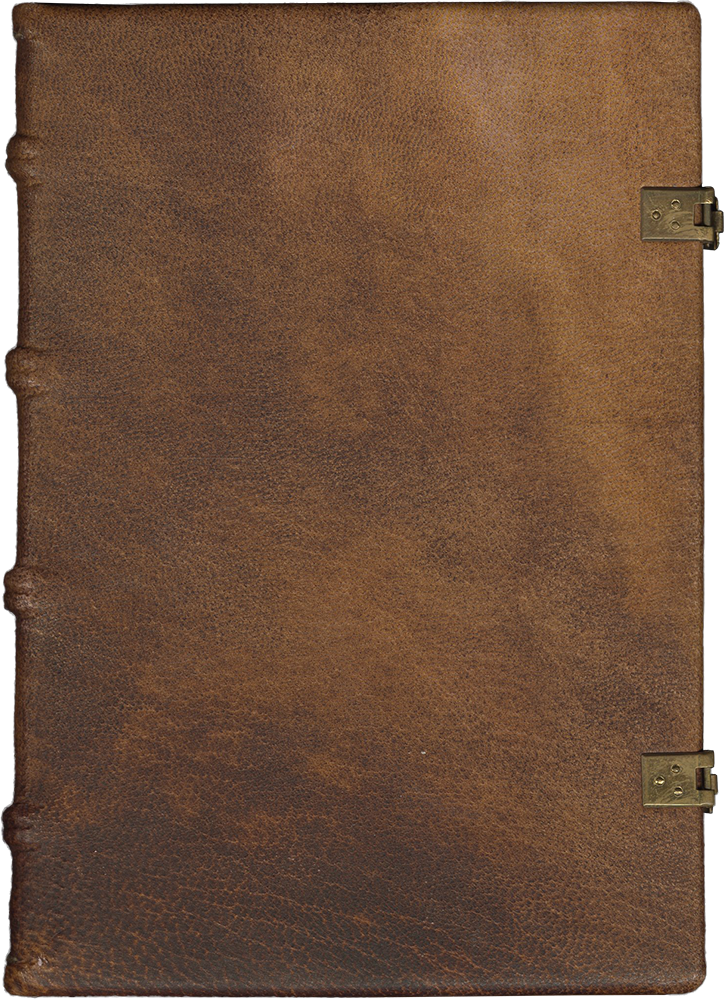
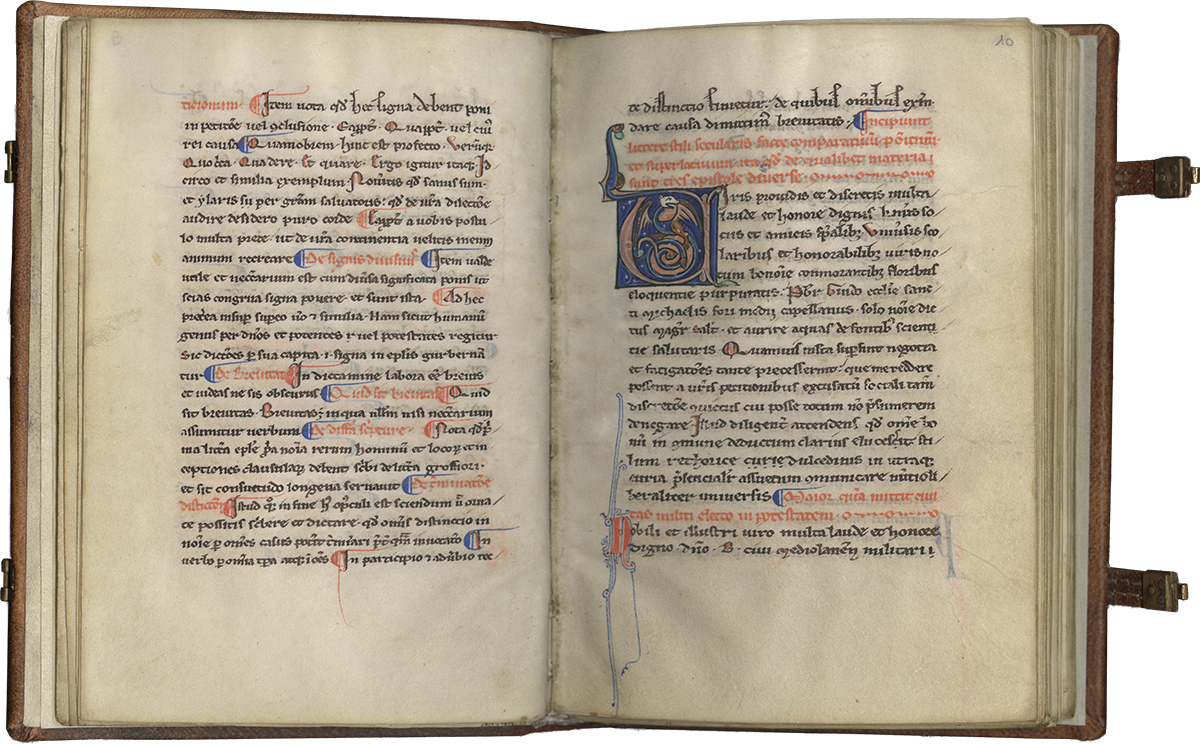
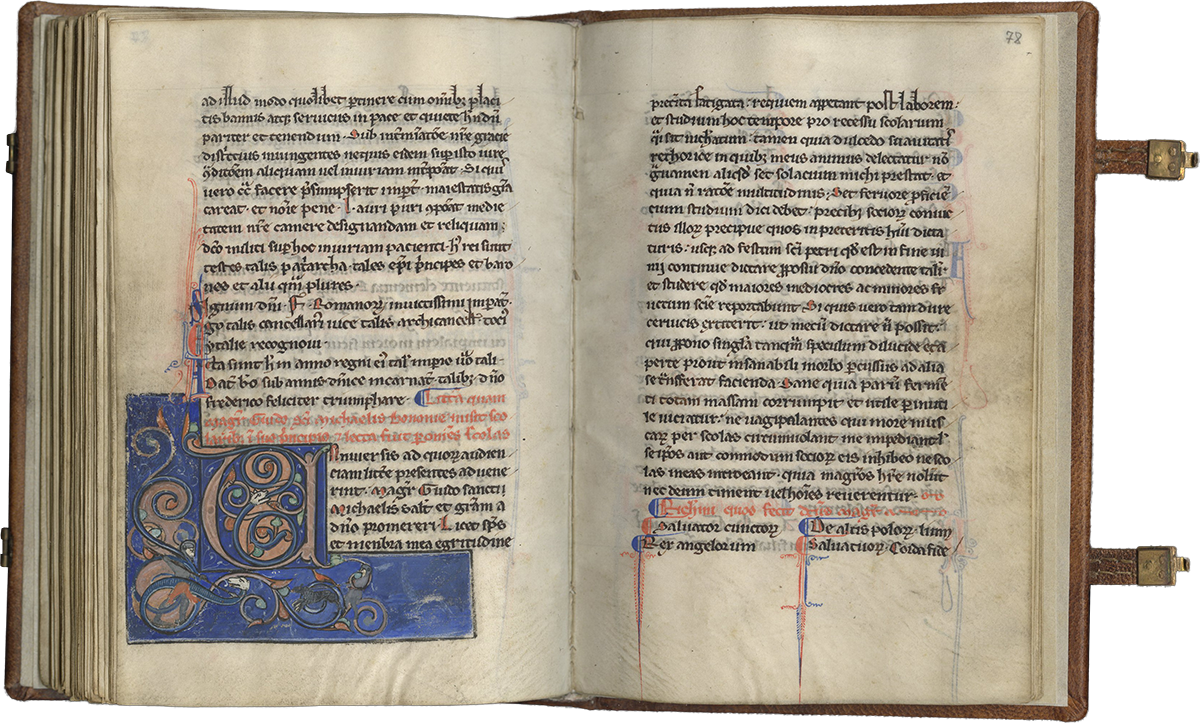
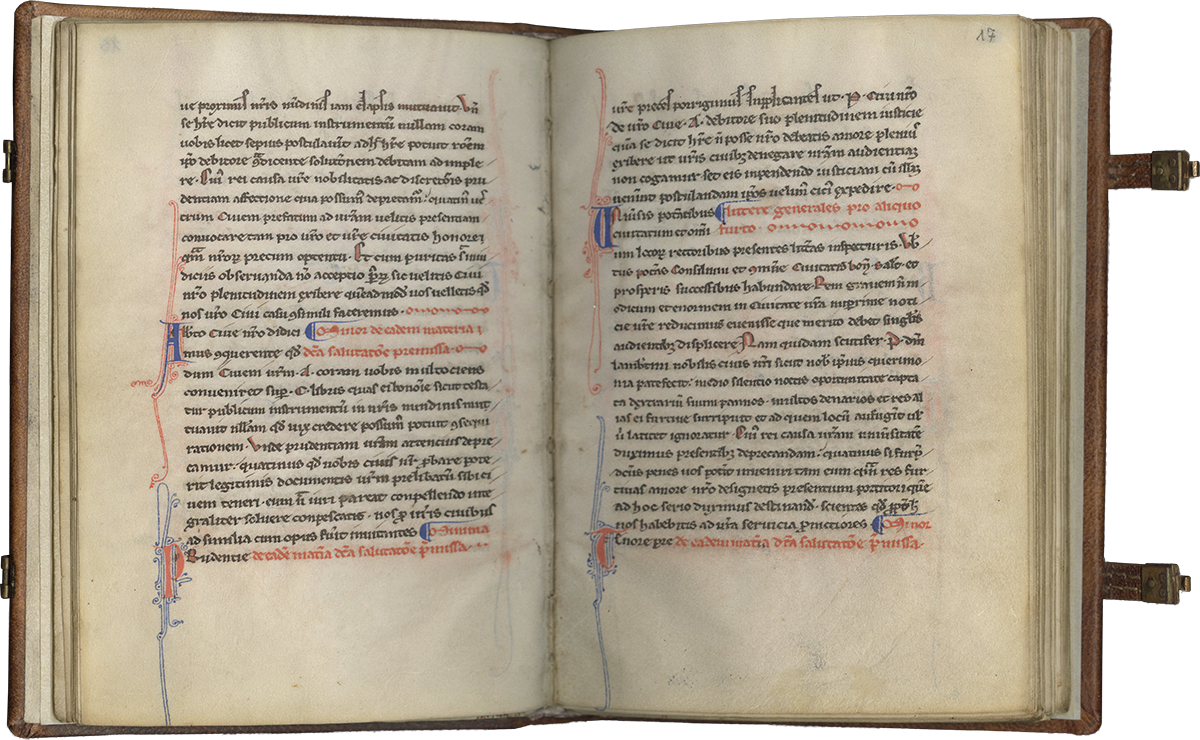
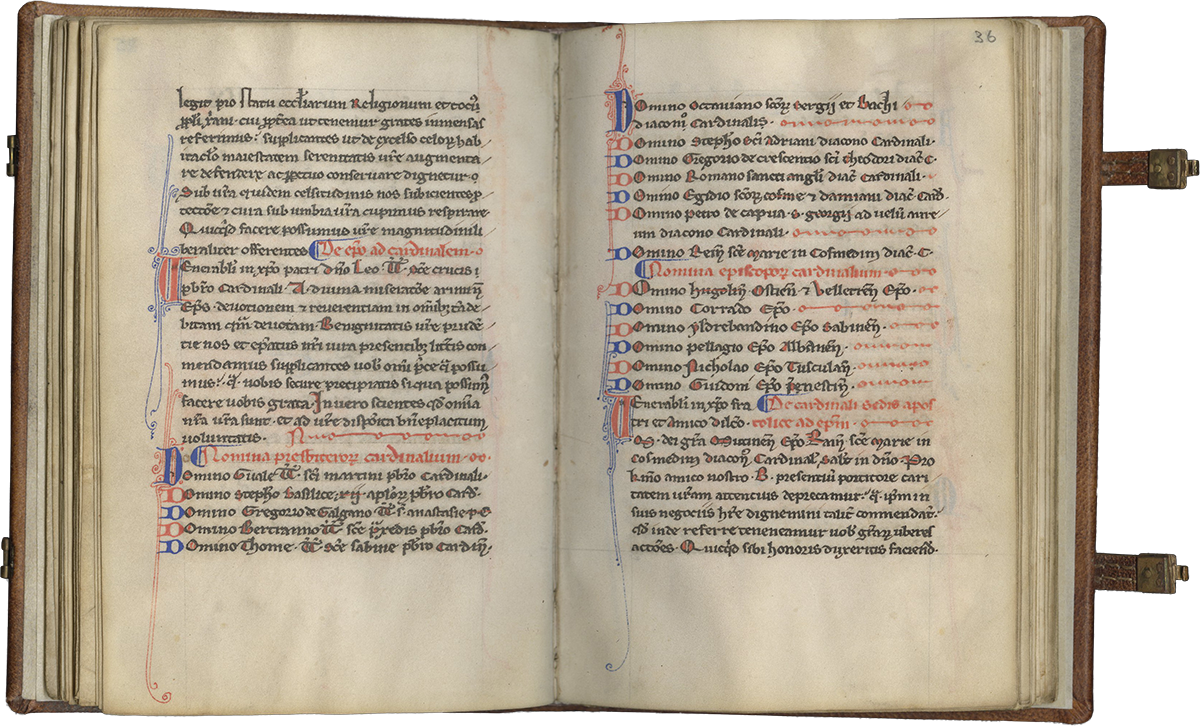
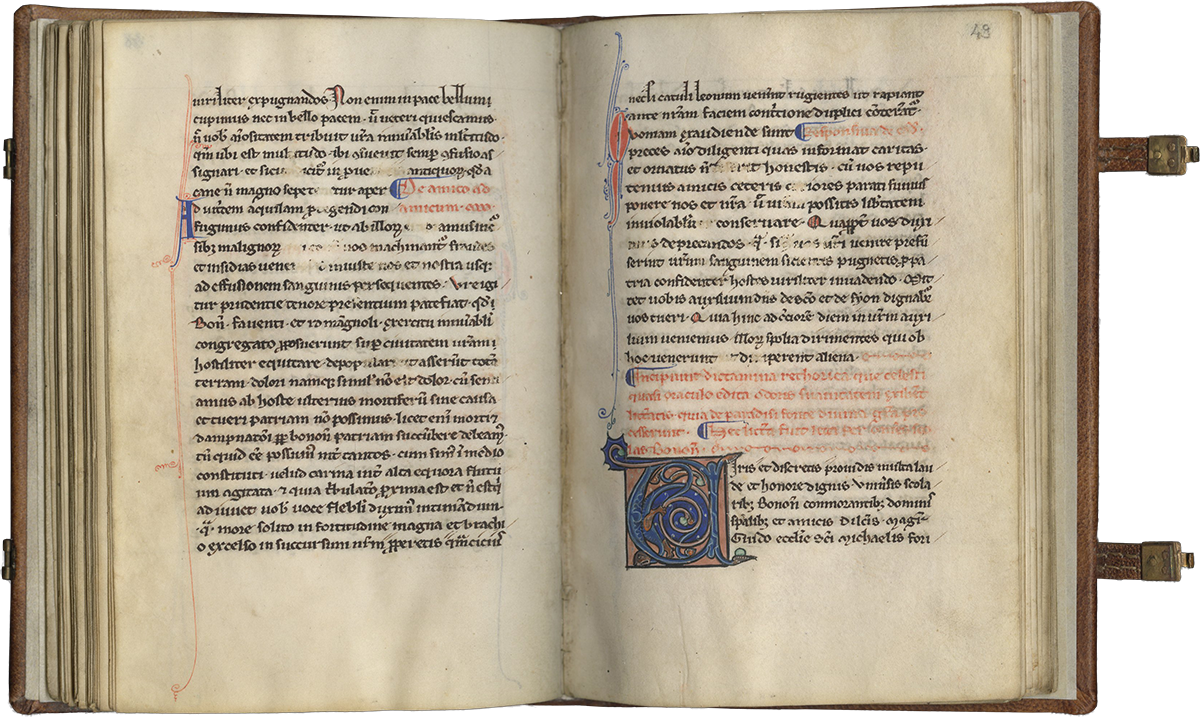
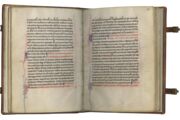
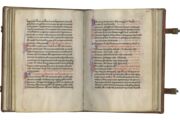
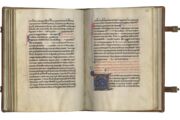
iii (paper) + 86 + iii (paper) folios on parchment, modern foliation in pencil on top, outer corner recto, text begins and ends imperfectly, (collation: i8+1, ii-iii12, iv14+1, v-vi12, vii16), ruled in lead with the top and bottom ruled lines full across, full-length vertical bounding lines (justification, 106 x 73-70 mm), written in a fast but clear northern textualis with some extended ascenders, majuscules flashed red, red rubrics beginning with blue paragraph marks, two-line alternately red and blue pen initials flourished in the alternate color, 5-6-line pigment initials infilled with zoomorphs (ff. 10, 49 and 77v), one with partial border border featuring zoomorphs hunted with spears by two mailed knights (f. 77v), border is smudged and may have been retouched, occasional leaves worn, some with loss of text, overall in good condition. Rebound after 2012 in brown calf with two clasps. Dimensions 160 x 114 mm.
Husbands to their wives, students to their parents, between lovers, from one leader of a city to another, the letters in this manual of epistolary models cover a wide variety of circumstances – a sort of A-I of the thirteenth century. Manuscripts by the thirteenth-century rhetorician Guido Faba on the art of letter writing are slowly gaining scholarly interest, and the two works preserved here, printed only in rudimentary nineteenth-century editions, deserve modern critical study. Dating close to the author’s lifetime, this attractive manuscript is an early copy of these texts, which are not known in any other examples in North America. The Schoenberg Database records the modern sale of no other codices containing Faba’s works.
Provenance
1. The script and the decoration both suggest an origin at a professional atelier in northern France, and most likely Paris, around the middle of the thirteenth century, placing the manuscript around the time of or just after the death of the author (c. 1242). While the study of rhetoric was a route to professional careers in royal and ecclesiastical chanceries, the quality of the manuscript suggests it was made for someone of some wealth, rather than a young clerk at the beginning of that ladder.
2. Private European collection.
Text
ff. 1-48, Guido Faba, Summa dictaminis, acephalous, incipit, “..et faciat inspirante domino que sunt iustu. Ad modum serentis qui certam spinis...”;
This copy of parts of Guido Faba’s Summa dictaminis begins imperfectly in the first chapter (Gaudenzi, 1890, p. 288). The text in this manuscript often differs from that printed by Gaudenzi.
ff. 48-86v, Guido Faba, Dictamina rhetorica, incipit, “Incipiunt dictamina rhetorica que celesti quasi oraculo edita odoris suauitatem exhibent literatis quia de paradisis fonte diuina gratia porcesserunt. Hec littera fuit littera...Responsiua, Reuerendo in christo patri et domino I dei gratia Archiepiscopo Ravenatis Henricus.”
This copy of parts of Guido Faba’s Dictamina rhetorica also differs substantially from that printed by Gaudenzi (Gaudenzi, 1892, i, pp. 86-129 and ii, pp. 58-109).
The study of Rhetoric as a formal educational discipline goes back to the ancient world, when it focused on the art of oral persuasion. By the Middle Ages, the art of letter writing had become a central part of the study of Rhetoric, reflecting a culture where official letters were an integral part of both secular and ecclesiastical government. Beginning in the eleventh century, works appeared teaching the theory and practice of composing official letters, the ars dictaminis, or “art of letter writing.” Rhetoric was widely taught and by the thirteenth century, Bologna was the most important center for the teaching of Rhetoric. It was a practical art; students trained in letter writing were prepared for careers in both the royal and papal chanceries.
Guido of Faba was born in Bologna, that center of Rhetorical study, around 1190 and had completed the arts course at the University by 1210. Although he spent a few years studying law, most of his career was devoted to the study of Rhetoric in both its practical and theoretical forms. He served as a notary and then as the professor of “dictamen” at the chapel of San Michele de Mercato di Mezzo in Bologna and died c. 1242. He was the author of several important rhetorical treatises.
This manuscript includes parts of Faba's Summa dictaminis (c. 1228-9), which included some theoretical discussion of the art of letter writing, but, like all of Guido’s works, focused on practical information. As Faba put it, letters “mak[e] the sender's desire clear beyond a messenger's capacity to expound it,” conveying the intended information fully and perfectly, “like a mirror” (Carmargo, 1996, p. 2). Guido also wrote two collections of model letters, one of which, the Dictamina rhetorica (c. 1226-7), included more than 220 different letters. The model letters included in the present manuscript cover a wide variety of topics, including letters between leaders of cities, a letter expelling an undesirable citizen, a letter from a city to a Count, a letter from a city to the knights of Florence. Many of the letters concern matters related to Church administration. Other letters are directly relevant to the life of the student, including letters from students to their parents, and letters between brothers. Other letters cover personal occasions, such as letters from a husband to a wife, or a letter between lovers. Overall, the texts, which were designed for medieval students, are also quite accessible to the modern student of the Middle Ages.
The surviving manuscripts of Guido’s works have yet to be carefully analyzed, and the sole edition of the Dictamina rhetorica and the Summa dictaminis reflects nineteenth-century editing practices and does not necessarily adequately reflect the complexity of the transmission of these works. The present manuscript includes portions of both texts but deviates a great deal from the printed editions. As Martin Camargo has observed, the transmission of dictaminal texts, especially model letter collections, was always complicated, as additional letters were often added to an existing text (Carmargo, 1991, p. 48).
Charles Faulhaber suggests that Faba’s complete corpus today is limited to about forty manuscripts total, and he decried the lack of a complete census or modern editions (Faulhaber, 1978, p. 86, note 2). Nevertheless, it may simply be that Faba’s useful books were so frequently consulted that they were read to tatters and do not survive in numbers attesting to their medieval popularity. The Schoenberg Manuscript Database records no Faba manuscripts changing hands in its records. There appear to be no copies in North America aside from the present manuscript. Moreover, Ciceronian rhetoric swamped older traditions over the course of the fifteenth century and therefore neither the Summa dictaminis nor the Dictamina rhetorica were printed before 1500.
Literature
Carmargo, Martin. “Where's the brief? The ars dictaminis and reading/writing between the lines,” in Essays on Medieval Rhetoric. London, 2012, part III, reprinted with original pagination from Disputatio 1 (1996), pp. 1-17.
Carmargo, Martin. Ars dictaminis, ars dictandi, Typologie des sources du moyen âge occidental, Turnhout, 1991.
Copeland, Rita. “Medieval Intellectual Biography: the Case of Guido Faba,” in Through a Classical Eye: Transcultural and Transhistorical Visions in Medieval English, Italian, and Latin Literature in Honour of Winthrop Wetherbee, ed. Andrew Galloway and Robert F. Yeager, Toronto, 2009, pp. 107-24.
Faulhaber, Charles B. “The Summa Dictaminis of Guido Fabo,” in Medieval Eloquence: Studies in the Theory and Practice of Medieval Rhetoric, ed. James J. Murphy, Berkeley and Los Angeles, pp. 85-111.
Huglo, Michel. “Le théoricien bolognais Guido Fabe,” Revue de Musicologie 55 (1969), pp. 78-82.
Raccagni, Gianluca. “The Teaching of Rhetoric and the Magna Carta of the Lombard Cities: the Peace of Constance, the Empire and the Papacy in the Works of Guido Faba and His Leading Contemporary Colleagues,” Journal of Medieval History 39 (2013), pp. 61-79.
Vescovo, Michele, “Sul Fortleben dei Dictamina rhetorica di Guido Faba nella scrittura epistolare e documentaria dal Duecento al Quattrocento,” Studi medievali 66 (2025), pp. 203-18.
Online Resources
Gaudenzi, Augusto. “Guidonis Fabe dictamina rhetorica,” in Il Propugnatore N.S. 5 (1892) i, pp. 86-129 and ii, pp. 58-109. https://babel.hathitrust.org/cgi/pt?id=coo.31924070530955&seq=94 and https://babel.hathitrust.org/cgi/pt?id=coo.31924070530955&seq=540&view=1up
Gaudenzi, Augusto. “Guidonis Fabe Summa dictaminis,” in Il Propugnatore N.S. 3 (1890) i, pp. 287-338, and ii, pp. 345-393. https://babel.hathitrust.org/cgi/pt?id=cub.p108100509007&seq=297 and https://babel.hathitrust.org/cgi/pt?id=coo.31924070530930&seq=781
Perelman, Les, “The Medieval Art of Letter Writing: Rhetoric as an Institutional Expression,” in Textual Dynamics of the Professions: Historical and Contemporary Studies of Writing in Professional Communities, ed. by Charles Bazerman and James Paradis, Madison, WI, 1988, available online at: http://wac.colostate.edu/books/textual_dynamics/chapter4.pdf
TM 1462, digitized at https://arca.irht.cnrs.fr/ark:/63955/md75db78x56c