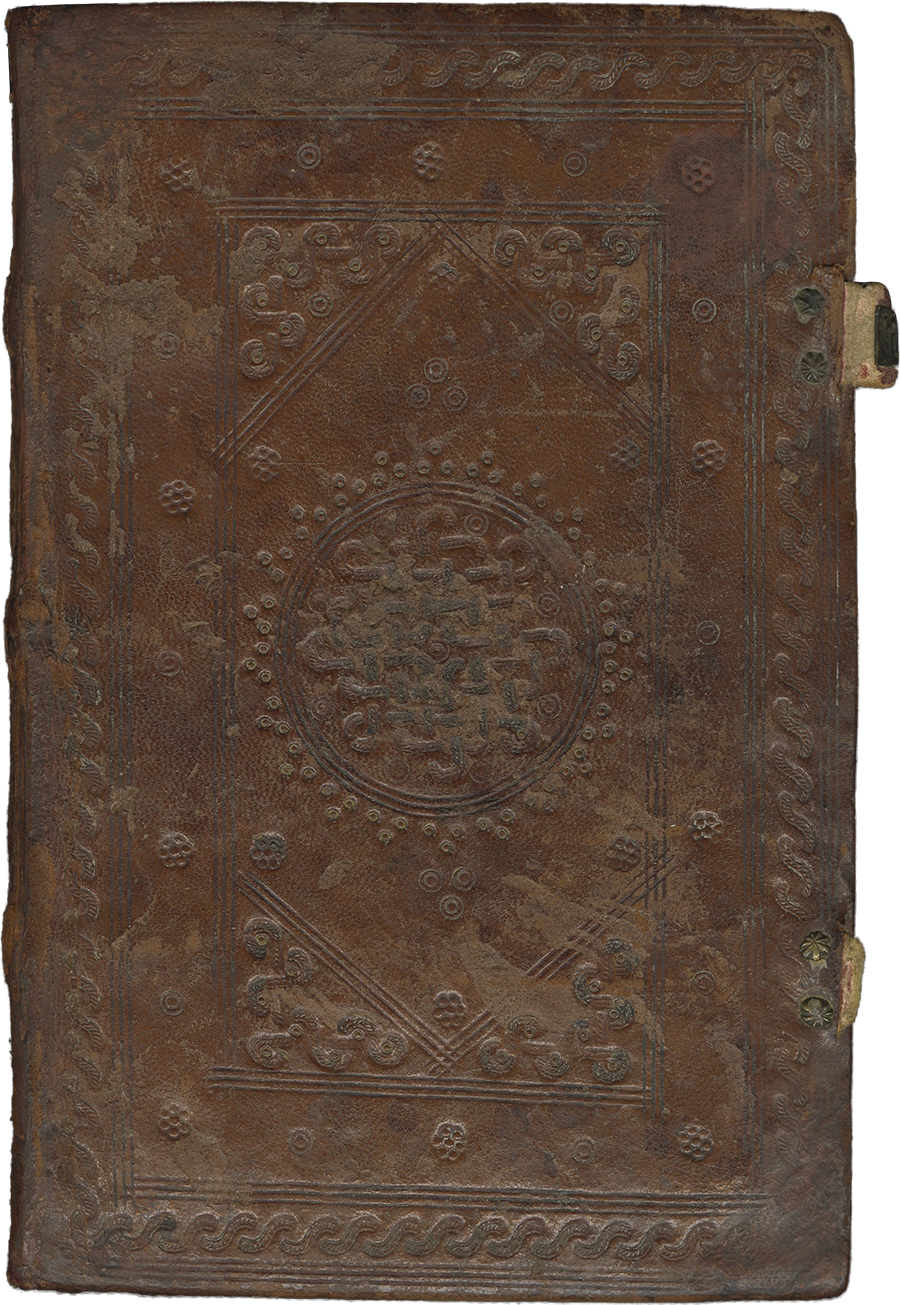
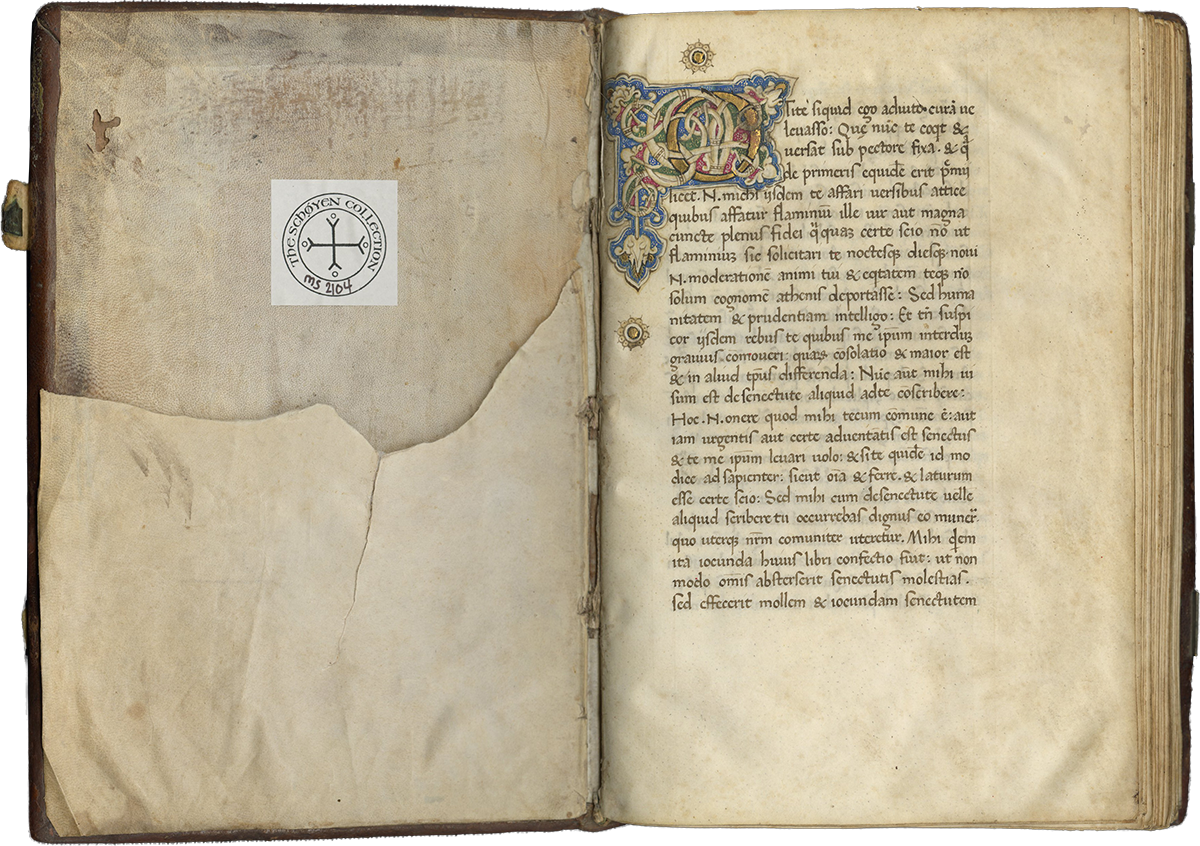
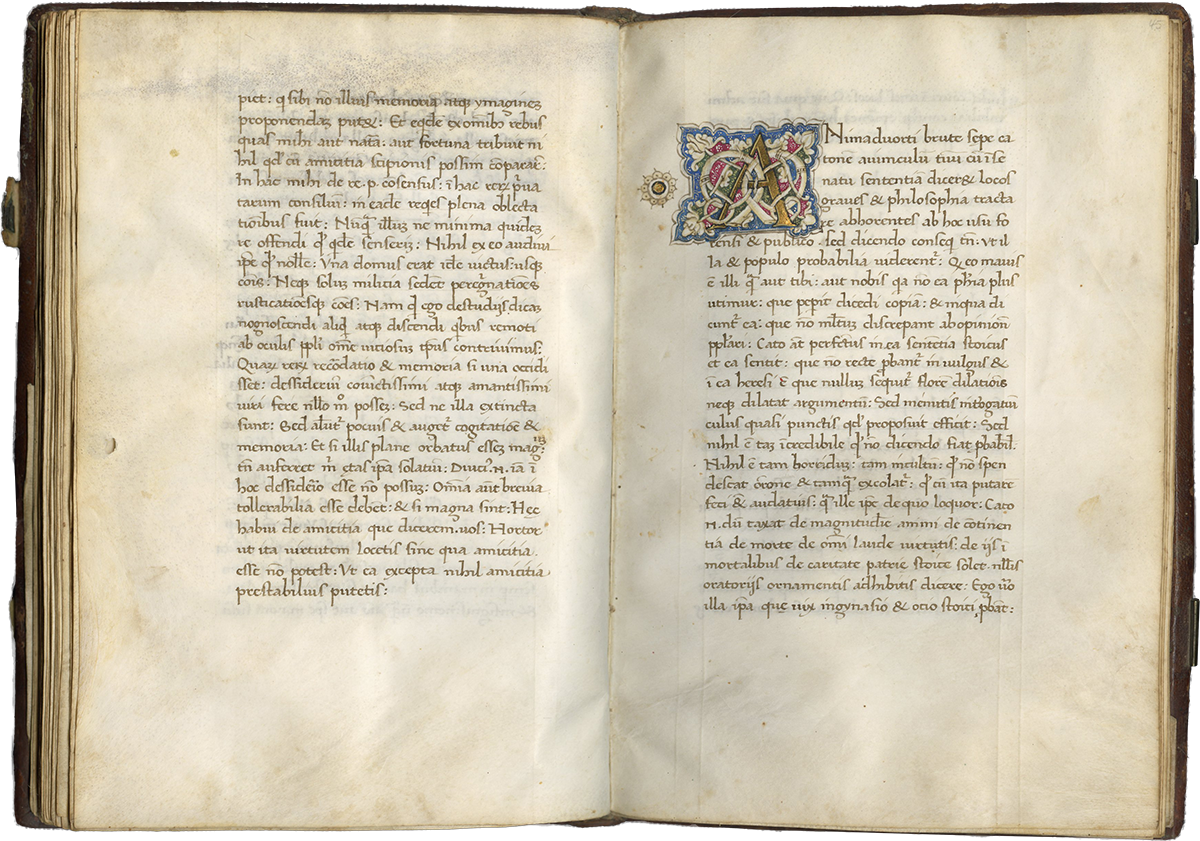
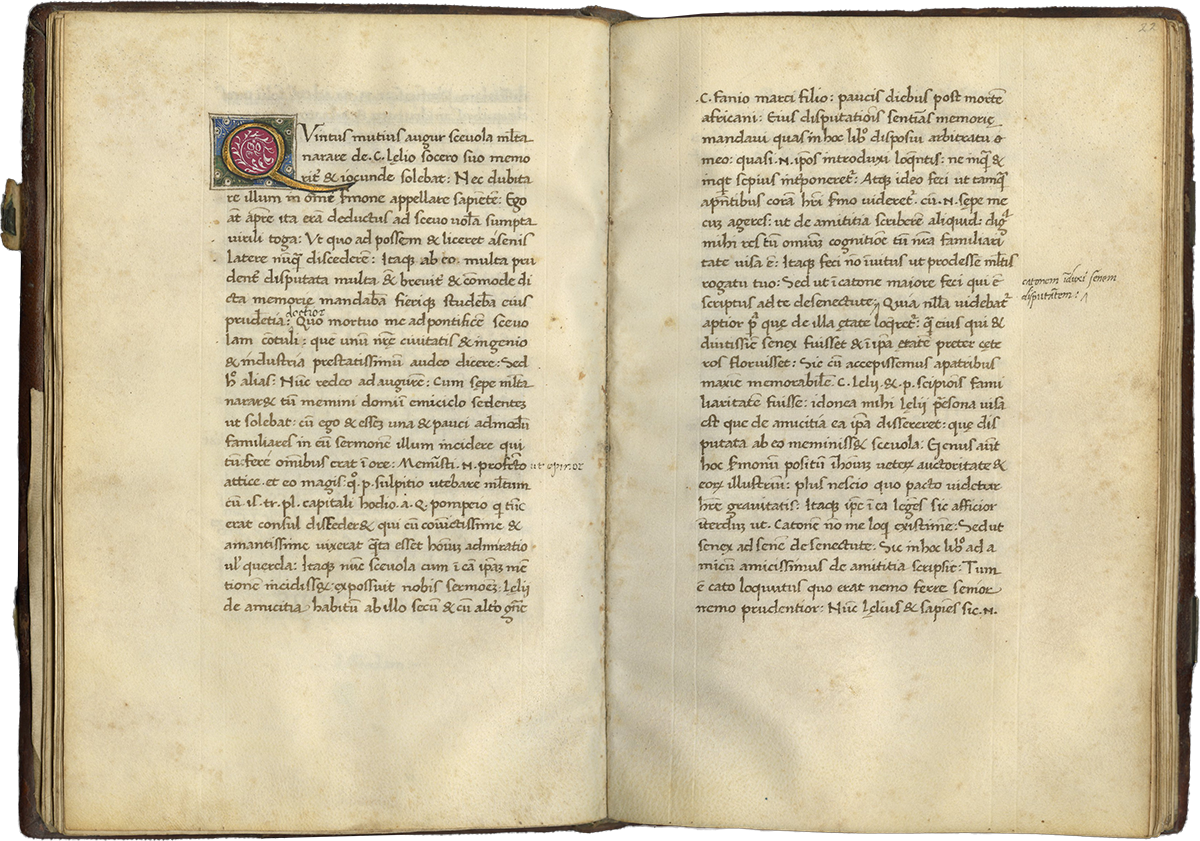
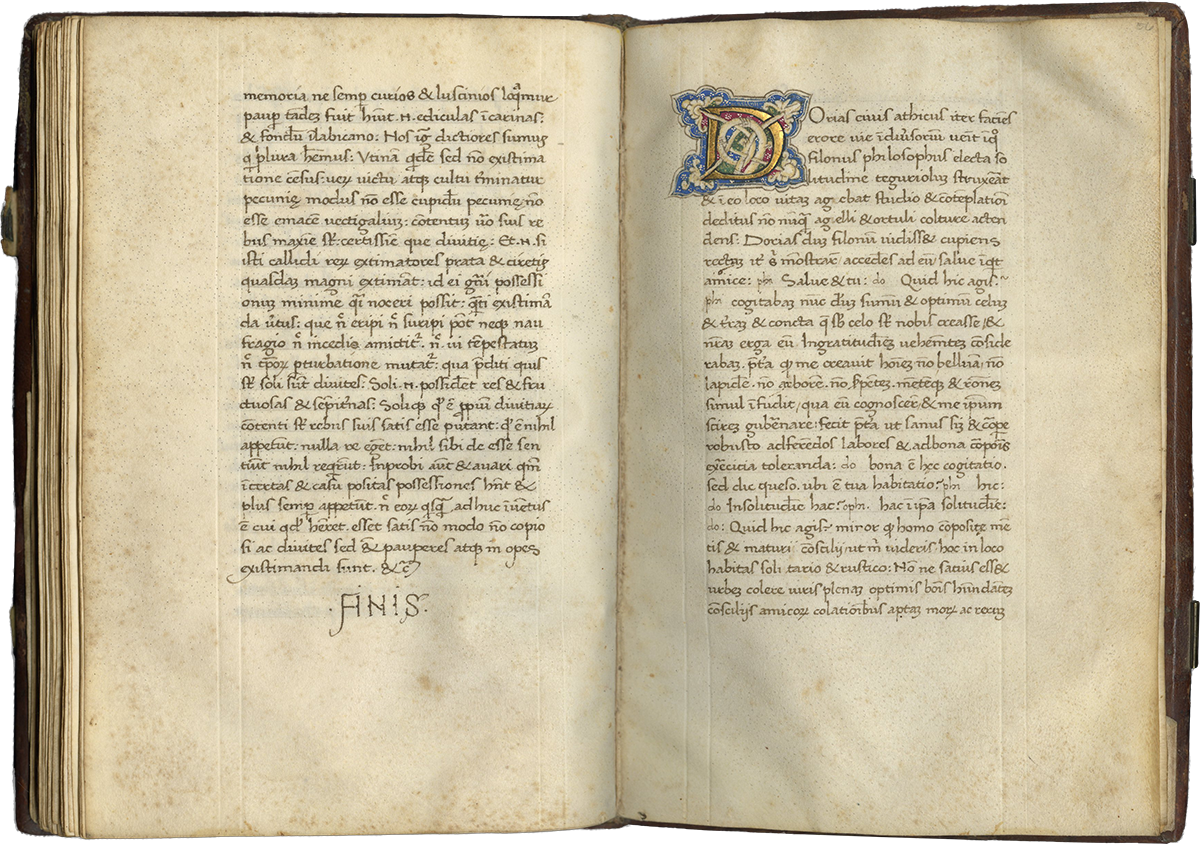
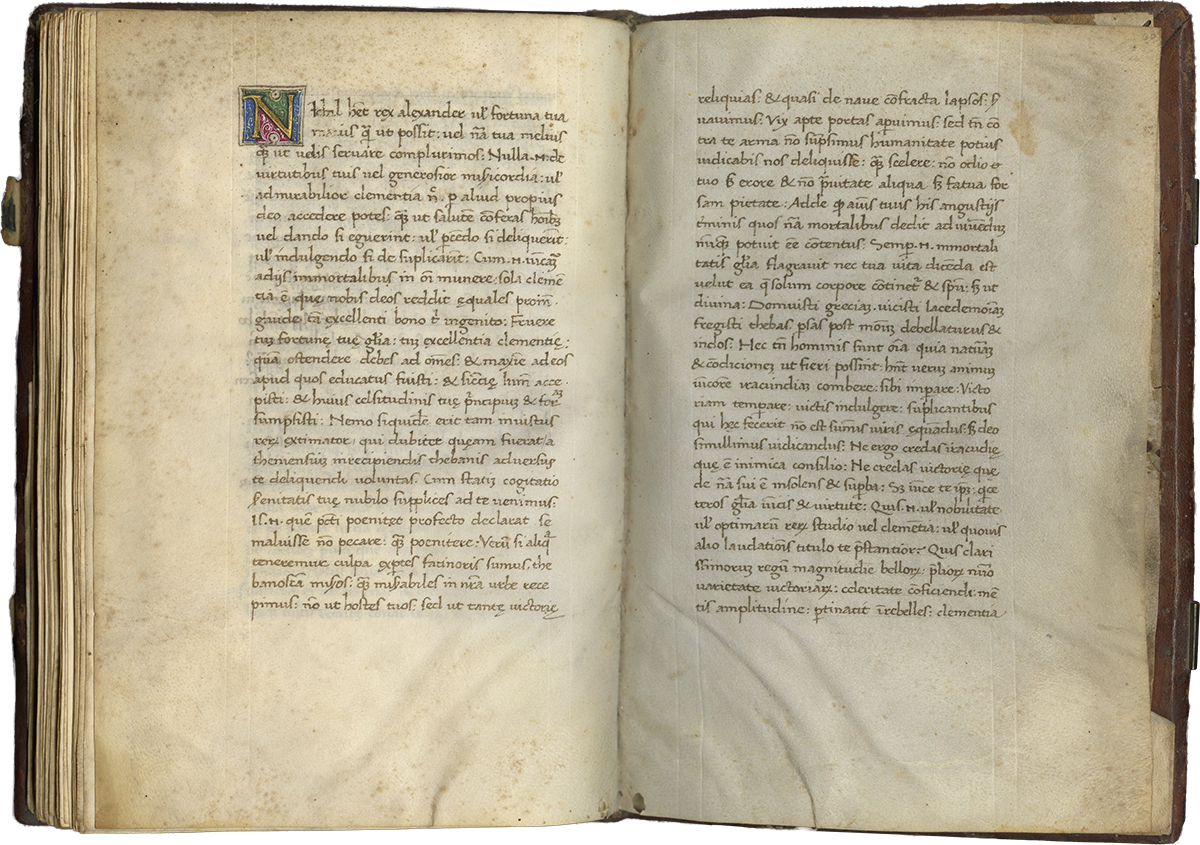
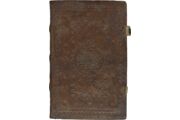
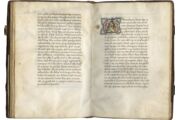
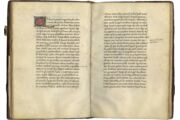
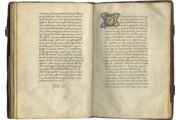
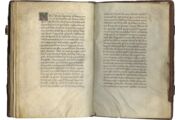
i+60+i parchment leaves, foliated in pencil in upper right corner, complete, (collation: i-vi10), horizontal catchwords, 26 lines, ruled in drypoint, (justification 130 × 75 mm), written in brown ink in a small humanistic script, spaces for rubrics, 2-3-line champs (ff. 21v, 59v), 4-line bianchi girari with marginal extensions and decorated bezants (ff. 1r, 45, 56), slight worming in blank inner margin of ff. 35–39. Early binding of blind-tooled brown leather over wood boards, rebacked, upper cover a bit rubbed, brass clasps stamped with the agnus dei, but only stubs of leather hasps present, one with remnant of metal clasp-end reading ‘a.’ Dimensions 205 x 135 mm.
This is a quintessential humanist manuscript, with a twist. This volume features Ciceronian works that were often copied together, supplemented by other texts. These works would have appealed to humanists for their rhetorical, pedagogical, and linguistic ideals. Setting off its elegant bianchi girari initials, the present manuscript displays generous clean margins. The twist arrives with the non-Ciceronian material. One of the two additional texts is both extremely rare and unusually religious for a humanist anthology, and this inclusion reminds us that many humanists were in fact in holy orders, and that they sometimes viewed classical works through a religious lens.
Provenance
1. The illumination points to northeastern Italy as the origin for the manuscript, and the very rare fourth text suggests that it may have been produced in Verona.
2. Sold at Sotheby’s, 18 June 1991, lot 87; bought by Core (see 3 below).
3. Massimiliano Favia del Core (1927–1994), of Lugano, a noted art collector and bibliophile; sold at Christie's, 3 April 1996, lot 4 (SDBM MS 166, see Online Resources); bought by:
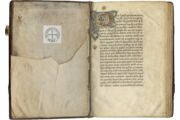
4. Martin Schøyen, Oslo, Norway and London, UK (born January 31, 1940), a Norwegian businessman, traveler, historian, and collector of books; The Schøyen Collection, MS 2104, sticker on front pastedown.
Text
ff. 1-21, Cicero, De senectute, incipit, “O Tite si quid ego adiuto...probare possitis. FINIS”;
Marcus Tullius Cicero (106-43 BCE) wrote the De senectute in 44 BCE as a dialogue, with P. Cornelius Scipio Africanus, Gaius Laelius Sapiens, and Marcus Porcius Cato as the main characters. In this work, Cicero argued that maturity and morality determine one’s response to growing old and dying. Therefore, he argued that one’s life should be used to cultivate wisdom in order to overcome the miseries of old age, disease, and death.
ff. 21v-44v, Cicero, De amicitia, “Quintus mutius augur scevola…prestabilius putetis”;
Written for his friend Titus Pomponius Atticus in 44 BCE, Cicero’s Laelius de amicitia is a fictional dialogue set in 129 BC between Gaius Laelius, a Roman general and orator, and his sons-in-law, Gaius Fannius and Quintus Mucius Scaevola about what makes a true friend.
De amicitia survives in many manuscripts but has not yet been the subject of a complete census. Over 100 manuscripts of the work are listed on the Mirabile database (Online Resources). The first printing was part of Alexander Minutianus’s Opera omnia (1498, Milan, ISTC ic00498000; Powell, 2006, p. lix). Powell notes that manuscripts later than the twelfth century are frequently contaminated and corrupt, so it is difficult, if not impossible, to locate them within the textual tradition of the work (Powell, 1998, pp. 516-17). The standard edition is Powell (2006).
ff. 45-55v, Cicero, Paradoxica Stoicorum, “Animadvorti [sic] Brute sepe Catonem...existimanda sunt &c. FINIS”;
Cicero’s introductory Paradoxa stoicorum (46 BCE) allowed Cicero to explain six basic principles of Stoicism. The Paradoxa stoicorum survives in over four hundred manuscripts (Ronnick, 1991, p. 70). Recent editions include Ronnick (1991) and Galli (2019).
ff. 56-59, Celsus Maffeus (Celso Maffei, c.1425-1508), of Verona, Dialogus de contemptu mundi, “Dorias civis Athicus iter faciens...advesperascit. FINIS”;
This marks the rarest work in this anthology. Mirabile lists just a half-dozen manuscripts, four of which remain in Verona, and none are known in North America. Even the attribution to Maffeus is tentative, and more research may reveal how this work relates to the larger family of works in the De contemptu mundi tradition.
ff. 59v-60v, Pseudo-Demosthenes (ps-Leonardo Bruni, transl.), Epistola ad Alexandrum Magnum, “Nichil habet rex alexander vel fortuna tua...consecutus es. FINIS.”
In Latin and often attributed to Bruni as one of his translations from the Greek, the Epistola ad Alexandrum contains spurious letters or orations by Demosthenes about Alexander the Great. The work spread widely during the fifteenth century.
Marcus Tullius Cicero (106-43 BC) is the best-known author of classical Latin. A statesman, orator, and philosopher, his voluminous output is unmatched by any other author of the Classical Latin period. His influence on later Latin literature and especially the Italian Renaissance cannot be overstated. In fact, the start of the Italian Renaissance is often attributed to the rediscovery of Cicero’s epistolary corpus by Petrarch in the fourteenth century.
The collection of three of Cicero’s philosophical works in this manuscript represents a later medieval grouping which can trace its roots back to Petrarch, who listed Cicero’s De amicitia, De officiis, De senectute, and Paradoxa Stoicorum among his favorite works (Ronnick, 1991, pp. 66-8). Petrarch’s grouping came to replace an older corpus of Cicero’s philosophical works. For a brief overview of the diverse ways that Cicero’s philosophical works were grouped together in medieval manuscripts and early print sources, see Ronnick’s lists (1991, pp. 153-199).
The final two short texts flavor this otherwise traditional Ciceronian anthology in unique ways. The final work, the spurious Alexandrian work, circulated widely in humanist circles, but Maffeus’ approach to the De contemptu mundi tradition is exceptionally rare, surviving in only a handful of copies. This humanist collection therefore offers an unusual illustration of how the humanist philosophical and ethical tradition might be read through late medieval traditions of affective piety, and does so in a fine, clean manuscript bearing iconically humanist bianchi girari initials.
Literature
Botley, Paul. Latin Translation in the Renaissance: The Theory and Practice of Leonardo Bruni, Giannozzo Manetti and Desiderius Erasmus, Cambridge, 2004.
Cicero. De re publica; De legibus; Cato maior de senectute; Laelius de amicitia, ed. J. G. F. Powell, Oxford, 2006.
Galli, Daniela. Cicero’s Paradoxa stoicorum: Text and Philological Commentary, Rome, 2019.
MacKendrick, Paul Lachlan. The Philosophical Books of Cicero, London, 1989.
Martines, L. The Social World of the Florentine Humanists, 1390-1460, London, 1963.
Powell, J.G.F. “The Manuscripts and Text of Cicero’s Laelius de Amicitia,” Classical Quarterly n.s., 48 (1998), pp. 506-518.
Ronnick, Michele V. Cicero’s “Paradoxa Stoicorum”: A Commentary, an Interpretation, and a Study of Its Influence, Frankfurt am Main, 1991.
Ullman, B.L. The Origin and Development of Humanistic Script, Rome, 1960.
Vogel, Grace Sybil. The Major Manuscripts of Cicero’s “De senectute,” Chicago, 1939.
Wood, Neal. Cicero’s Social and Political Thought, Berkeley, 1988.
Online Resources
Anon. Epistola ad Alexandrum manuscripts https://www.mirabileweb.it/title/oratio-demosthenis-ad-alexandrum-title/202078
Biography and introduction to Cicero by The Internet Encyclopedia of Philosophy
http://www.iep.utm.edu/c/cicero.htm
Celso, Maffei. Dialogus de contemptu mundi manuscripts. https://www.mirabileweb.it/title/dialogus-de-contemptu-mundi-celsus-maffeus-n-1425--title/433
Celso, Maffei. https://www.treccani.it/enciclopedia/celso-maffei/
Cicero, Marcus Tullius. De amicitia (Latin) http://www.thelatinlibrary.com/cicero/amic.shtml
Cicero, Marcus Tullius. De amicitia manuscripts https://www.mirabileweb.it/title/de-amicitia-title/16516
Cicero, Marcus Tullius. Paradoxa stoicorum (Latin) http://www.thelatinlibrary.com/cicero/paradoxa.shtml
Cicero, Marcus Tullius. De senectute (Latin) http://www.thelatinlibrary.com/cicero/senectute.shtml
Schoenberg Database of Manuscripts https://sdbm.library.upenn.edu/manuscripts/166
TM 1396