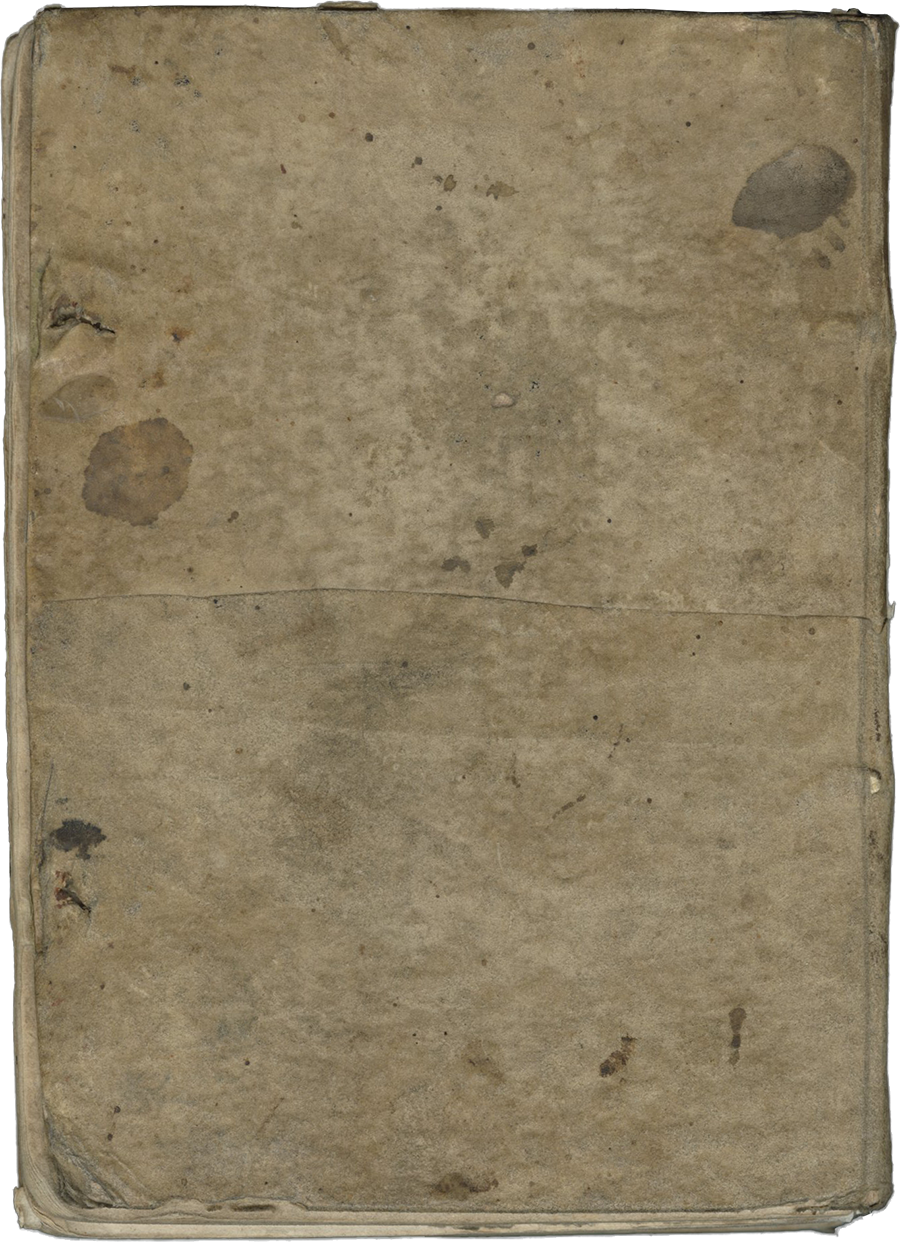
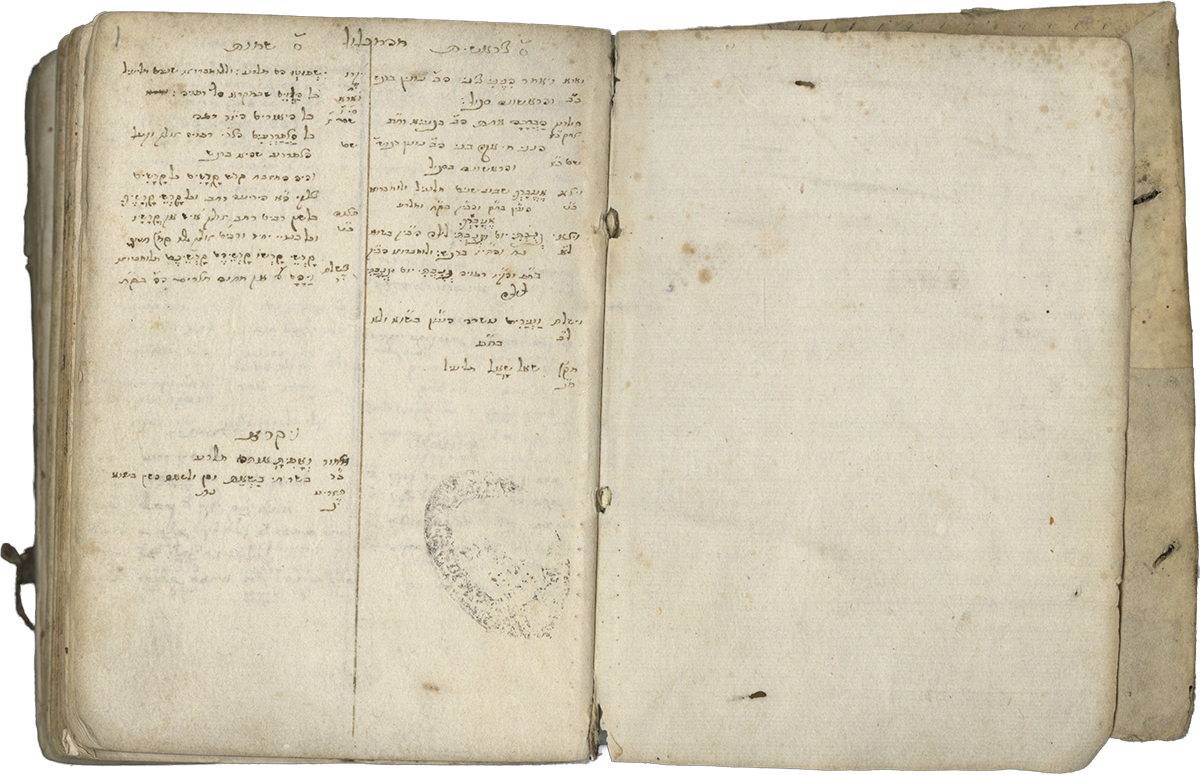
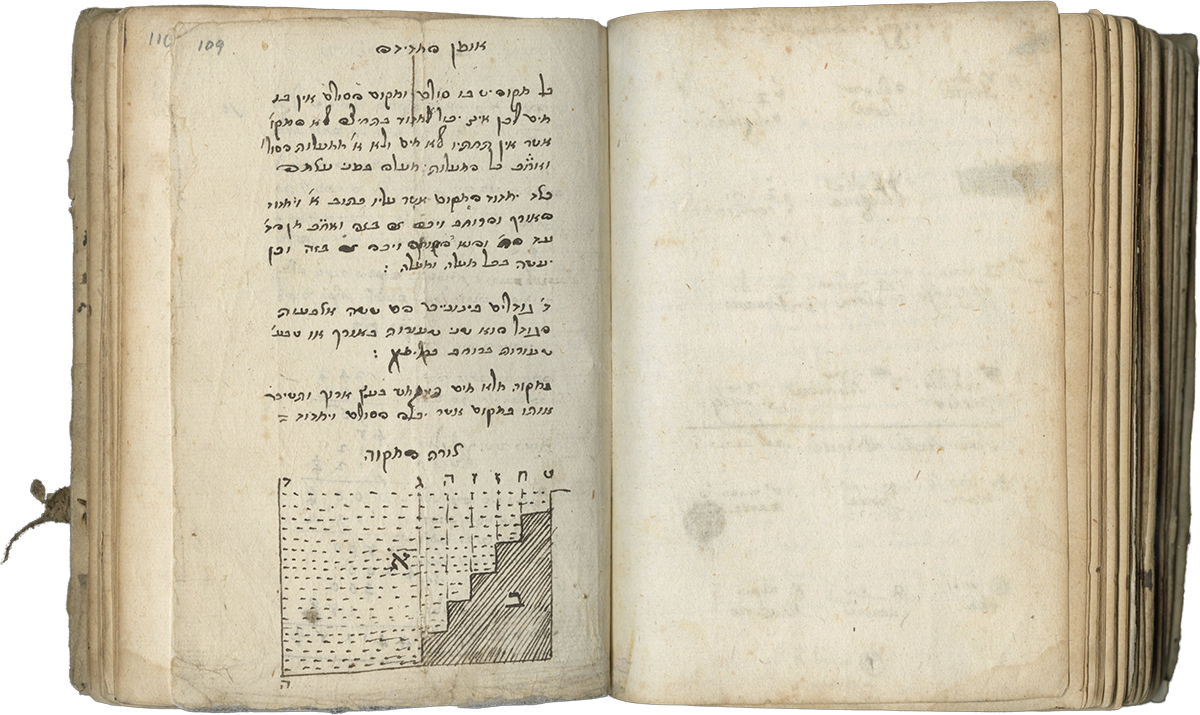
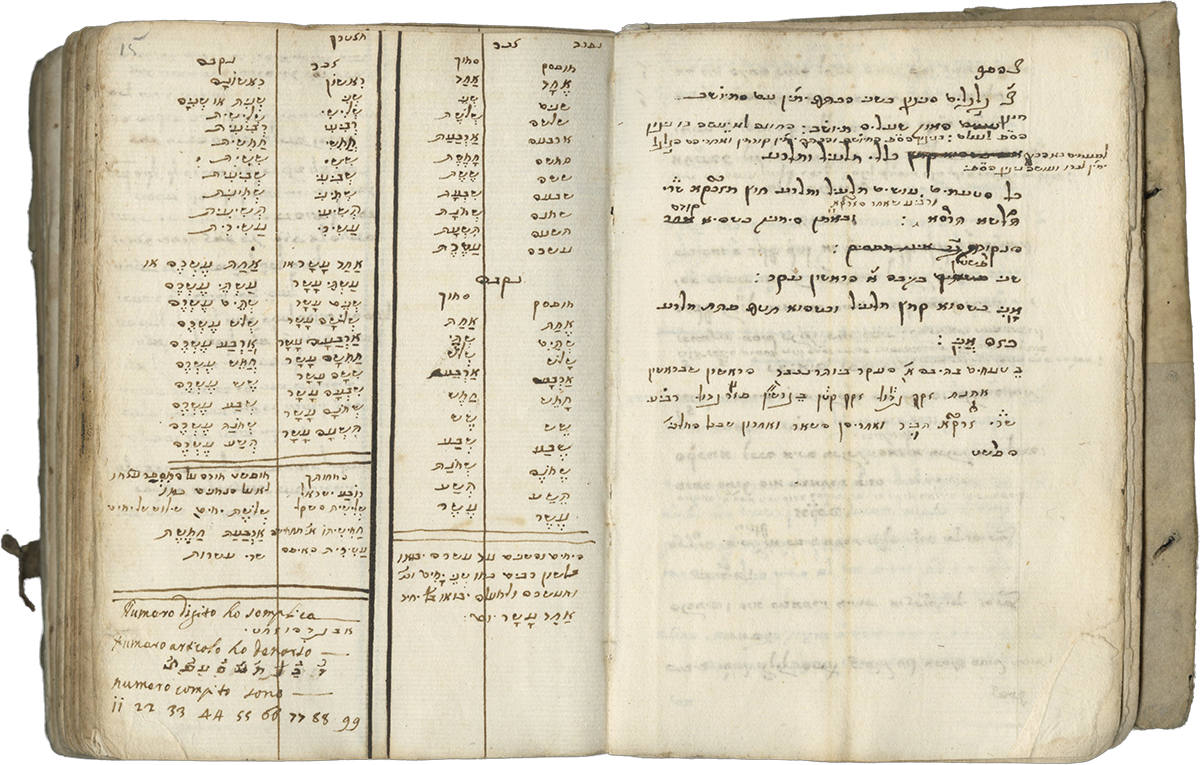
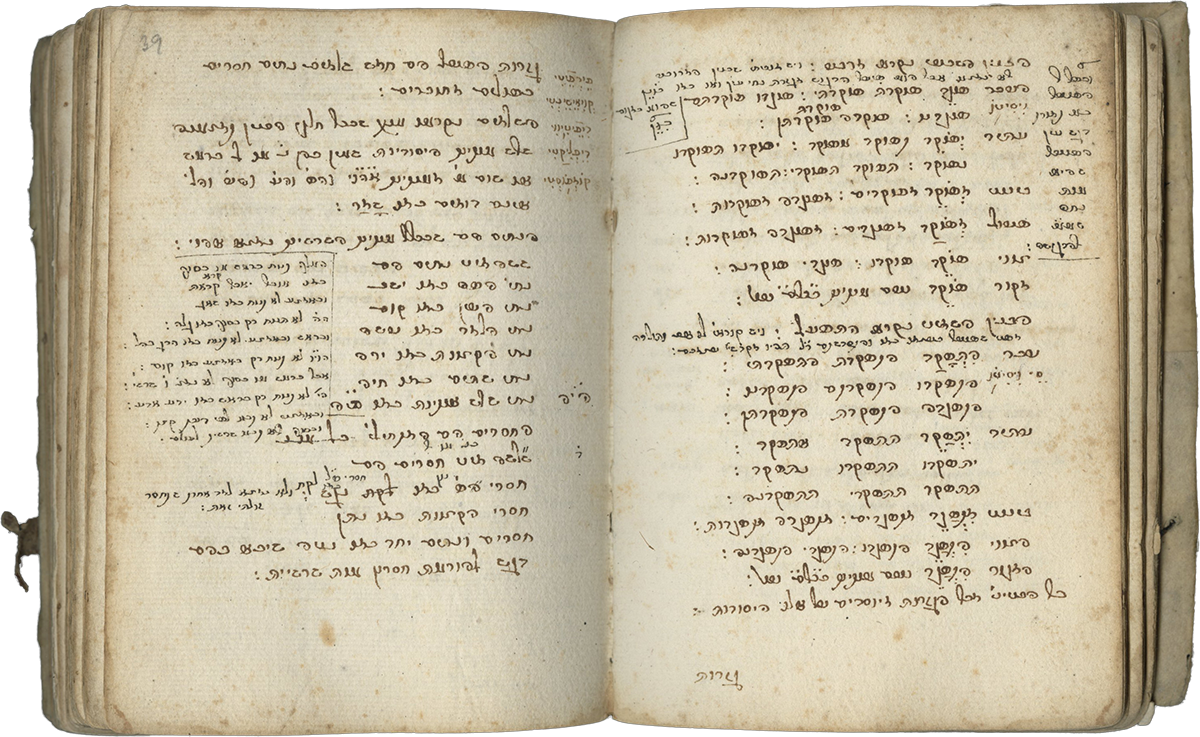
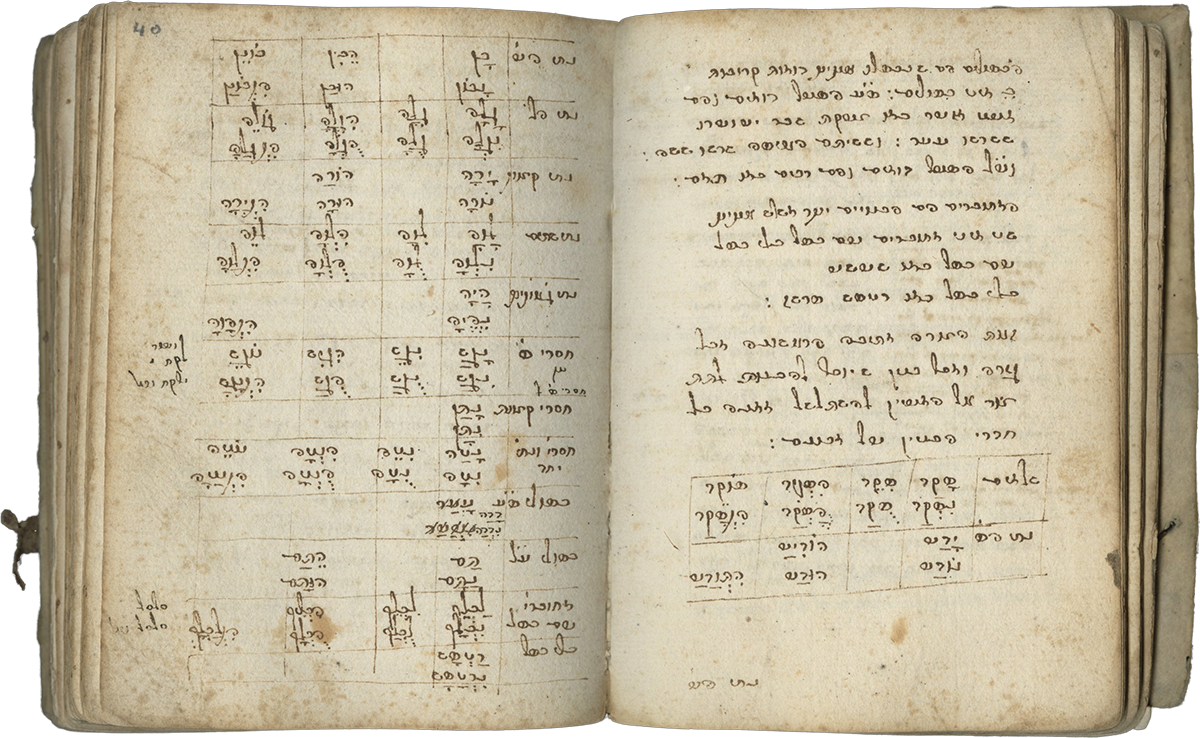
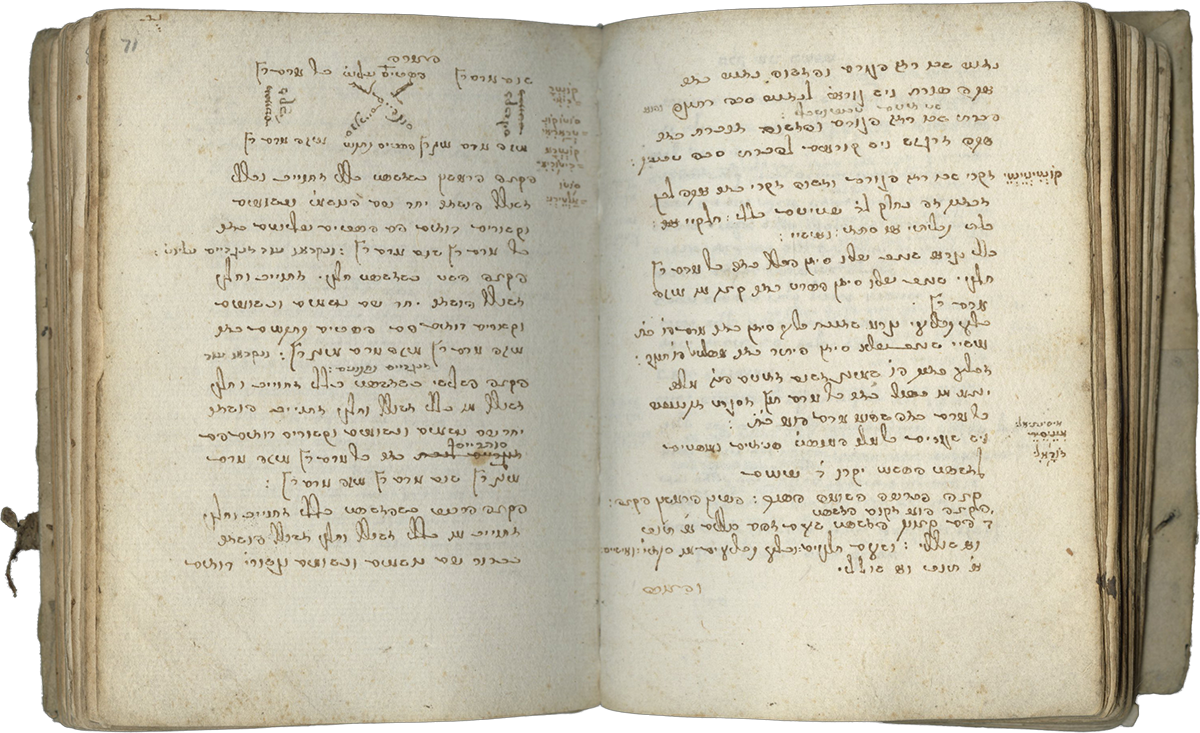
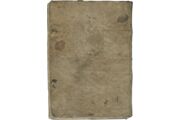
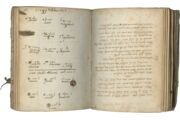
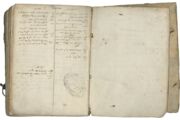
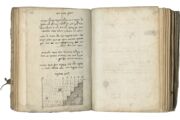
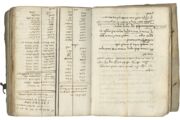
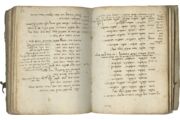
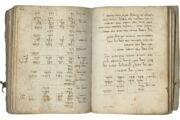
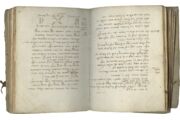
132 folios on paper, premodern foliation (1-53, 55-60, 62-66) in pen in Hebrew characters in upper-outer corner of rectos of ff. 20-83 only (sometimes cropped or obscured), modern foliation (0-53, 55-101, 101a-131) in pencil in Arabic numerals in upper-outer corner of rectos (cited), paper extension attached to f. 58 (not foliated separately), incomplete (collation i11 [i1 canceled] ii6 iii13 [iii13 lacking, with missing text inscribed on iii12] iv10 v10 +1 vi12 vii8 viii8 [viii2,9 lacking] ix4 x9 [x1 canceled] xi8 xii8 xiii6 +1 xiv4 xv7 [xv8 canceled] xvi6), some horizontal catchwords, mostly unruled (though prickings visible in inner margins toward front of volume), generally single-column text written in Italian cursive script in brown ink in 19-22 lines, justification via insertion of space fillers, abbreviation, use of anticipatory letters, and dilation or contraction of final letters, marginalia, strikethroughs, and/or corrections in primary and secondary hands throughout (divine names surviving erasure on f. 50v), various charts, tables on ff. 21v, 39v-40v, manicules on f. 42, 77v, diagram on f. 109, slight scattered staining, more extensive on ff. 17-31v, 108, 115, foxing, some corners rounded, one folio lacking between ff. 28-29 (apparently without loss of text), ff. 72-73, and ff. 78-79 (the latter likely a blank), ff. 9-10, 83-85 strengthened along gutter, small worm tracks in lower edge near gutters of ff. 87-106 and in outer edges of ff. 88-106, f. 109 creased. Premodern stiff boards, worn and stained, upper hinge loose, spine in three compartments with slightly raised bands, title (“dikduk le-ha-mevin ba-devarim[?]”) inked in uppermost compartment, remnants of clasps visible on outer edges, premodern paper pastedowns. Dimensions 151 x 110 mm.
With the expulsions of the Jews from the Iberian Peninsula at the end of the fifteenth century, the center of Hebrew linguistic and philosophical scholarship shifted to other parts of the Mediterranean basin, particularly Italy. Contemporary Italian Jewry’s economic prosperity and the Renaissance spirit of the sixteenth century facilitated the development of an elite class drawn toward a wide range of intellectual pursuits, many of them manifest in the present manuscript. Studying this codex reveals much about the specific interests of a particular savant, as well as about the broader climate among Italian Jewish cognoscenti.
Provenance
1. In a note on f. 126, Jair ben Shabbetai da Correggio mentions that he purchased the book (presumably in the form of blank folios) “with the sweat of my brow.” His colophon on f. 57v reads as follows: “Completed and finished—praise be to God—on 14 Shevat [5]327 [January 24, 1567]. Written and compiled by Jair, son of our honorable teacher Shabbetai da Correggio, may his Rock and Redeemer keep him.” No place name is given, but the da Correggio family is known to have been active in Northern and Central Italy in the sixteenth century. From another note on f. 107v we deduce that the scribe was at least aware that the book would eventually come into another’s possession: “Says the copyist, the humble Jair, son of our honorable teacher Shabbetai, may his Rock and Redeemer keep him: Let the reader not blame me if I have taken the short route in copying the philosophical treatises that require greater explanation in order to be comprehensible, for I have toiled on behalf of those who have read [the philosophers’] works multiple times, for whom hinted speech suffices. Praise and glory be to the One of awesome deeds.”
2. At some point in the seventeenth century (see f. 3), the first two quires (ff. 0-16) were added by another, anonymous Italian scribe with similar interests to those of da Correggio. At least one other owner appears to have added material as well (see, e.g., ff. 17v, 58v-60v, 62v).
3. In Marheshvan 5631 (October-November 1870), Solomon Joachim Halberstam (1832-1900), a wealthy Polish Jewish scholar and bibliophile, bought this codex from the Jerusalem author and bookseller Rabbi Nahman Nathan Coronel (1810-1890) in Budapest (New York, The Library of the Jewish Theological Seminary of America, Ms. 2823, f. 25v). Halberstam inscribed the manuscript’s shelf mark (229) in pen on f. 0 and provided a brief overview of its contents when he printed the catalog of his collection in 1890.
4. The Judith Lady Montefiore College in Ramsgate, England, purchased 412 manuscripts from Halberstam’s collection, including the present one. The transaction was carried out by Rabbi Moses Gaster (1856-1939), principal of the college between 1891 and 1896. The codex bears the library stamp of the institution, known in Hebrew as Yeshivat Ohel Mosheh vi-Yehudit, on ff. 1, 131, as well as paper tickets with the Halberstam (229) and Montefiore (413) shelf marks on the spine and upper pastedown (Hirschfeld, 1904).
5. Between 1898 and 2001, most of the Montefiore manuscripts, including ours, were placed on permanent loan at Jews’ College in London. In 2001, they were returned to the Montefiore Endowment Committee.
6. The volume was offered at Sotheby’s New York on October 28, 2004 (lot 300), without result.
Text
[f. 0 largely blank];
ff. 1-2v, notes on the proper vocalization and/or pronunciation of various words appearing in the Bible and in the liturgy;
f. 3, a poem that uses only biblical words containing the letter sin, composed by Rabbi Moses Zacuto (c. 1625-1697), who appears to have been alive at the time of copying, incipit, “ha-niskad be-sar‘apei ha-esek… yasgi ve-yisgim[?] ba-esev.” It is not known whether another copy of this poem exists; [f. 3v blank];
ff. 4-15v, an anonymous, basic Hebrew grammar, covering rules of pronunciation and vocalization, among other topics, incipit, “otiyyot leshon ha-kodesh hem 22 ve-im menatspakh ha-kefulot hem 27… millah[?] aharonah she-be-kol ha-binyanim tesharet li-nekevot nistarot o le-nimtsa’ot be-edot[?] va-tehayyena et ha-yeladim bon ve-teda.” A version of this treatise was printed as the front matter of some Italian editions of the Hebrew Bible, e.g., Sefer arba‘ah ve-esrim (Venice, 1730); [f. 16r-v largely blank];
ff. 17-57v, Sefer ha-dikduk, a six-part anthological grammatical work by a certain Rabbi Eliezer, with a table of contents, including folio numbers using the aforementioned premodern foliation, on f. 17. After some preliminary material, on f. 20 the treatise is styled Sefer leshon zahav, incipit, “ha-dikduk nikr[a] melekhet ha-dibbur she-melammed le-dabber tsahot… ve-yesh mosif al ha-minim ha-me‘atim[?] le-kol hok aval aleihem ein le-hosif u-me-hem ein ligroa.” Sefer leshon zahav is preserved in at least four other known manuscripts, all in institutional collections and postdating our codex: Los Angeles, University of California Library, Ms. 779 bx. 10.8 (1631); Berlin, State Library, Ms. Or. Oct. 2371 (1635); Budapest, Library of the Hungarian Academy of Sciences, Ms. Kaufmann A 46 (17th-18th century); and Jerusalem, National Library of Israel, Ms. Heb. Oct. 64 (1753[?]);
f. 57v, scribal colophon (see Provenance);
ff. 58-60v, a commentary on the Thirteen Principles of Rabbi Ishmael resembling (but shorter than) that of Rabbi Judah ben Asher (c. 1250-1327) (Shoshana, 2014);
ff. 61-63v, a brief list of masoretic terms and their explanation. The aforementioned Budapest manuscript, pp. 89-94, contains a parallel list under the title Massoret seyag la-torah;
ff. 64-78v, the anonymously authored Sefer hegyun[!] libbi, a three-part explanation of technical terms in logic and psychology, incipit, “ha-higgayon mafteah ha-hokhmot kullam ha-poteah pi ha-medabber li-she’ol le-hashiv le-hakshot u-le-tarets be-kitsur ve-yosher… yashuvu le-4 ha-rishonim me-ha-temunah ha-rishonah, li-heyot levaddam yesod kol minei ha-hekkesh, ve-dai ba-zeh le-mevin,” followed by some similar material. The aforementioned Budapest manuscript, pp. 105-128, contains another copy of this work under the title Sefer mafteah sefatayim; [f. 79r-v largely blank];
ff. 80-83, a series of short treatments of the divisions of the soul, the nature of rabbinic exegesis, and the main components of both the Written and the Oral Torah; [ff. 83v-85v blank];
ff. 86-107v, Lev mevin, a collection of philosophical statements composed of: 1) a three-part discussion of logic (ff. 86-88v), incipit, “ha-higgayon hu haysharat mishpat ha-ma’amar kelomar seder ha-she’elah ve-ha-teshuvah ha-kashya ve-ha-teiruts… ve-ha-mashal le-adam she-noten einav be-ishah she-einah hogenet lo”; 2) an epitomized version of Aristotle’s ten-part Nicomachean Ethics (ff. 89-100), incipit, “ma’amarei sefer ha-middot sefer rishon… ki me-ha-e-l huseget[?] le-mattah ve-kol anshei ma‘alah ha-medabbekim be-yotseram u-medammim[?] li-shevudato[?],” followed by a brief postscript (f. 100v); and 3) an epitomized version of Alessandro Piccolomini’s (1508-1578) four-part La prima parte della filosofia naturale (Rome, 1551), incipit, “ma’amarei sefer filosofiya tiv‘it sefer rishon… ve-ha-esh einah mekhallah otam ve-ha-avani[m] ha-melakhutiyyim hem ke-hefekh zeh” (ff. 101-107v). On f. 107v, da Correggio notes the brevity of these epitomes (see Provenance);
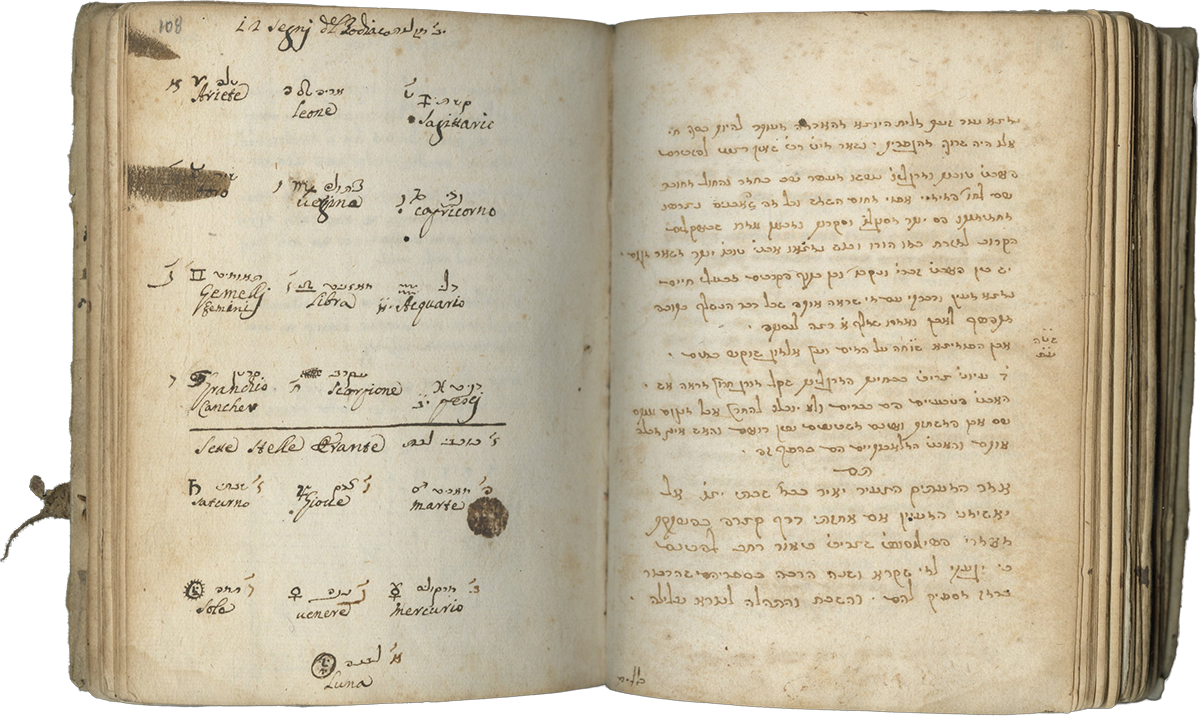
f. 108, the names and symbols of the twelve signs of the Zodiac and the seven planets in both Hebrew and Italian; [f. 108v blank];
f. 109r-v, a short discussion of the procedure for measuring the water necessary for constructing a mikveh (ritual bath); [ff. 110-114v blank];
ff. 115-119v, lists of concepts relating to each of the six Orders of the Mishnah, followed by ten questions concerning the rabbinic dictum that the world will exist for six thousand years, as well as definitions of the coins and measures mentioned in rabbinic literature; [ff. 120-125v blank];
f. 126r-v, the (apparently) unicum copy of Keter elyon reshit le-kol nivra, a kabbalistically inflected poem by Rabbi Solomon Alkabetz (c. 1505-1584), published from this manuscript by Raphael Cohen in 2010;
ff. 127-131, the poem Yigdal e-lohim hai, a reformulation of Rabbi Moses Maimonides’ (1138-1204) Thirteen Principles of Faith, followed by seventeen questions about the Thirteen Principles and their resolution, based on Rabbi Joseph Albo’s (c. 1380-c. 1444) Sefer ha-ikkarim, as well as nine principles for understanding the commandments by Rabbi Levi Gersonides (1288-1344) from the introduction to his commentary on the Pentateuch.
The Renaissance was a period of intense Hebrew manuscript production in Italy. Jewish humanists and intellectuals often supported themselves by traveling to various locales and either teaching or copying books for local patrons, resulting in an explosion of texts (Shulvass, 1949).
One such humanist was Jair ben Shabbetai da Correggio (d. 1575; see Budapest, Library of the Hungarian Academy of Sciences, Ms. Kaufmann A 539, f. 10), scion of a prominent, wealthy Italian merchant family. Jair was well educated in a manner typical of contemporary Italy (Lelli, 2013; Sirat, 2025) and had apparently mastered Latin enough to be able to write a book in that language (title and subject unknown). While his most famous composition is an anti-Christian polemic, Herev pifiyyot (A Double-Edged Sword) (Da Correggio, 1958), the present manuscript testifies to his wide intellectual interests, ranging from traditional rabbinics and Jewish law to masoretic and Hebrew linguistic studies, Kabbalah, Jewish and general philosophy, and astrology. (His ownership of a copy of Rabbi Nathan ben Jehiel of Rome’s Sefer he-arukh dictionary [Florence, Laurentian Library, Ms. Or. 149] speaks further to his devotion to the Hebrew language.)
The manuscript itself preserves at least one otherwise-unattested text (Keter elyon reshit le-kol nivra) and bears a strong resemblance in content—and in the order of that content—to Budapest, Library of the Hungarian Academy of Sciences, Ms. Kaufmann A 46. It also contains numerous glosses in Italian written in both Hebrew and Latin characters and, most importantly, grants us insight into the intellectual interests of sixteenth-century Italian Jewish humanists.
Literature
Cohen, Raphael. Sefer beri’ot, [Jerusalem], 2010 (section three).
Da Correggio, Jair ben Shabbetai. Herev pifiyyot, ed. by Judah Rosenthal, Jerusalem, 1958.
Gentili, Hanna and Yoav Meyrav, “Medieval Hebrew Readers of the Nicomachean Ethics: Encounters on the Manuscript Page,” in Mesótēs – At the Intersection of Textuality and Materiality: Papers on Textual Criticism, Manuscript Studies, and Scholarly Practices Presented to Christian Brockmann on his 65th Birthday, ed. by José Maksimczuk et al., pp. 131-156, Berlin, 2025.
Halberstam, Solomon Joachim. Kohelet shelomoh, pp. 40, 138 (no. 229), Vienna, 1890.
Hirschfeld, Hartwig. Descriptive Catalogue of the Hebrew MSS. of the Montefiore Library, p. 123 (no. 413), London and New York, 1904.
Lelli, Fabrizio. “Italy: Pre-Modern Period (1500-1700),” in Encyclopedia of Hebrew Language and Linguistics, vol. 2, ed. by Geoffrey Khan et al., pp. 374-378, Leiden, 2013.
Shoshana, Avraham. Baraita de-rabbi yishma‘el… be-tseiruf massoret ve-tsiyyunim, shinnuyyei nusseha’ot, ve-he‘arot girsa ve-lashon, 2nd ed., pp. 112-125, Wickliffe and Jerusalem, 2014.
Shulvass, Moses. “Sefarim ve-sifriyyot etsel yehudei italyah bi-tekufat ha-renesans,” Talpiyyot 4,3-4 (Kislev 1949), pp. 591-605.
Sirat, Colette. Teaching and Studying Philosophy in Jewish Culture during the Middle Ages, pp. 92-104, Turnhout, Belgium, 2025.
Online Resources
Our MS
https://www.nli.org.il/he/manuscripts/NNL_ALEPH990001686490205171/NLI#$FL31371032
Sotheby’s New York sale, October 28, 2004 (lot 300)
https://www.sothebys.com/en/auctions/ecatalogue/2004/important-hebrew-manuscripts-from-the-montefiore-endowment-n08040/lot.300.html
An elegy composed by Abraham of Buttrio upon da Correggio’s death (Budapest, Library of the Hungarian Academy of Sciences, Ms. Kaufmann A 539, ff. 9v-10v)
https://www.nli.org.il/he/manuscripts/NNL_ALEPH990001983080205171/NLI#$FL53192874
TM 1466