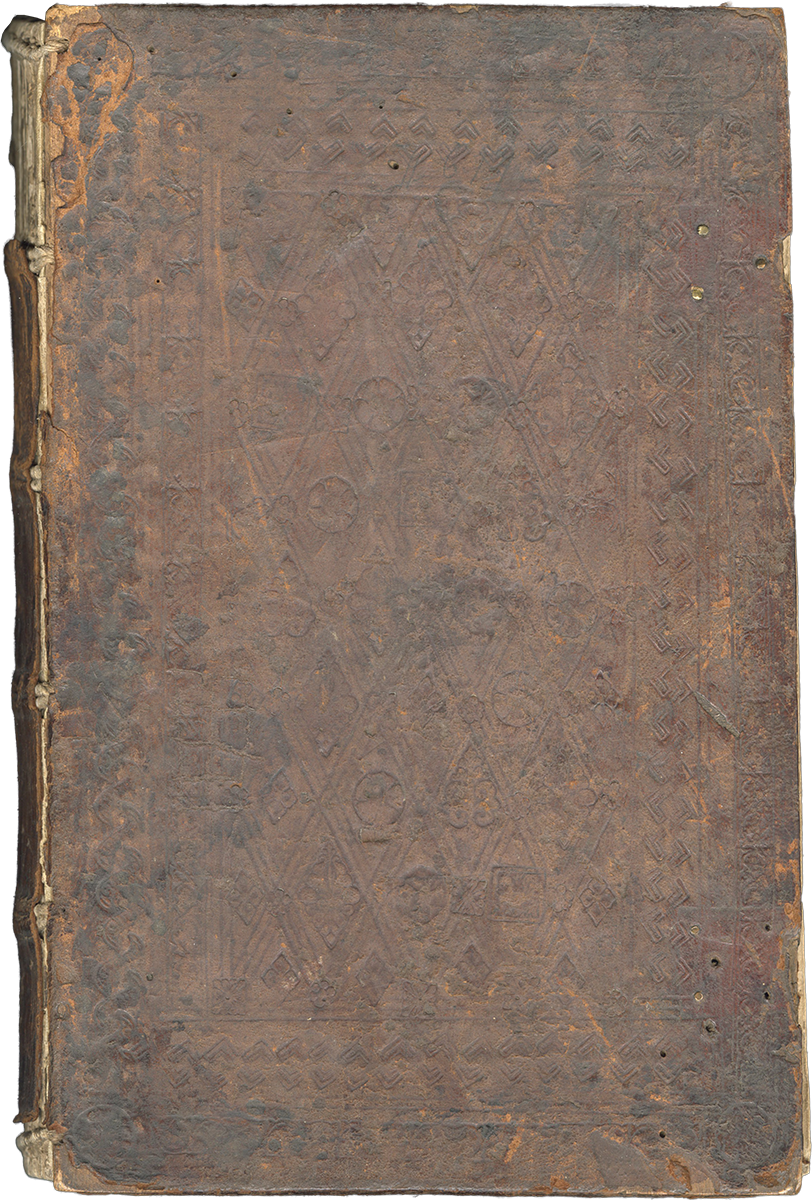
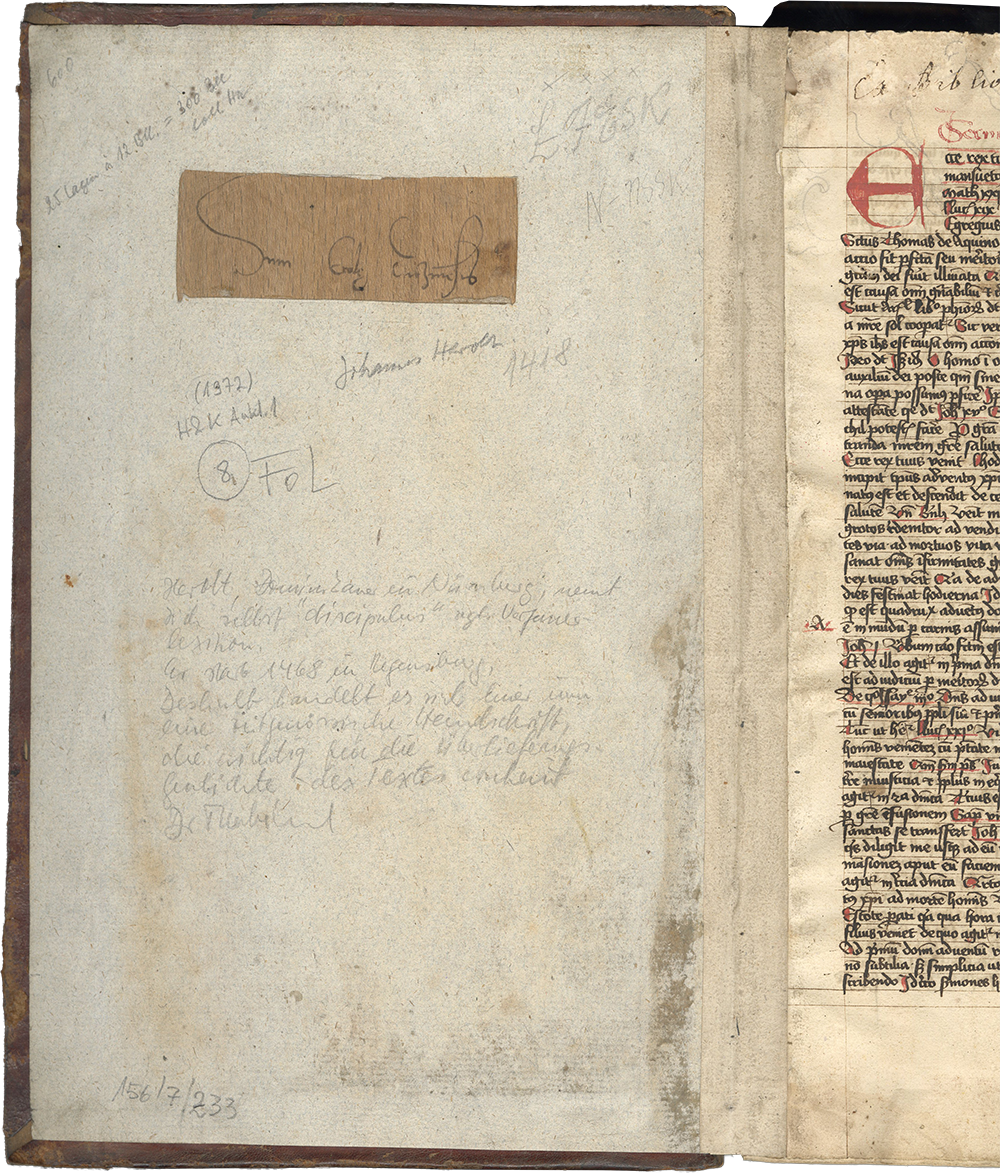
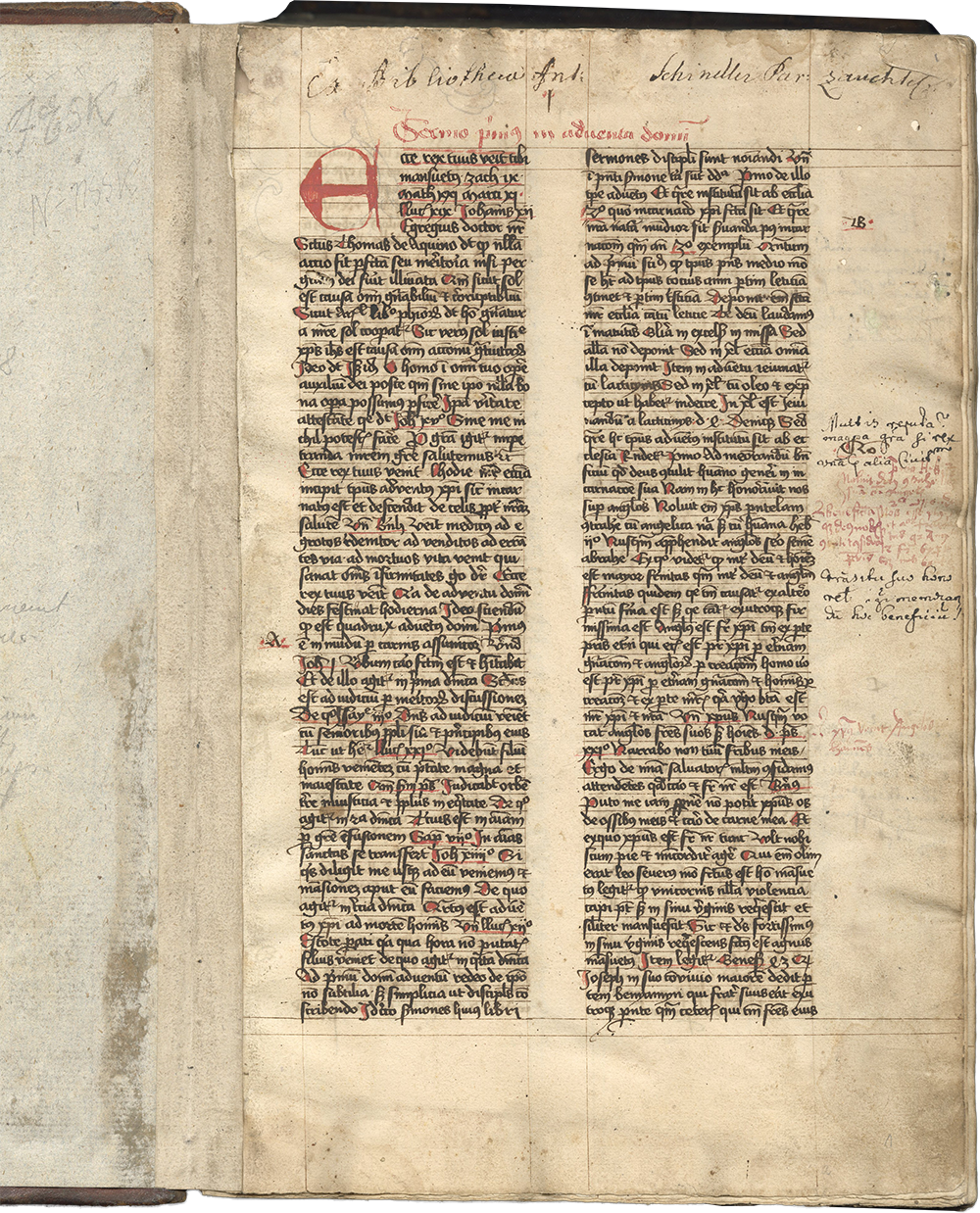
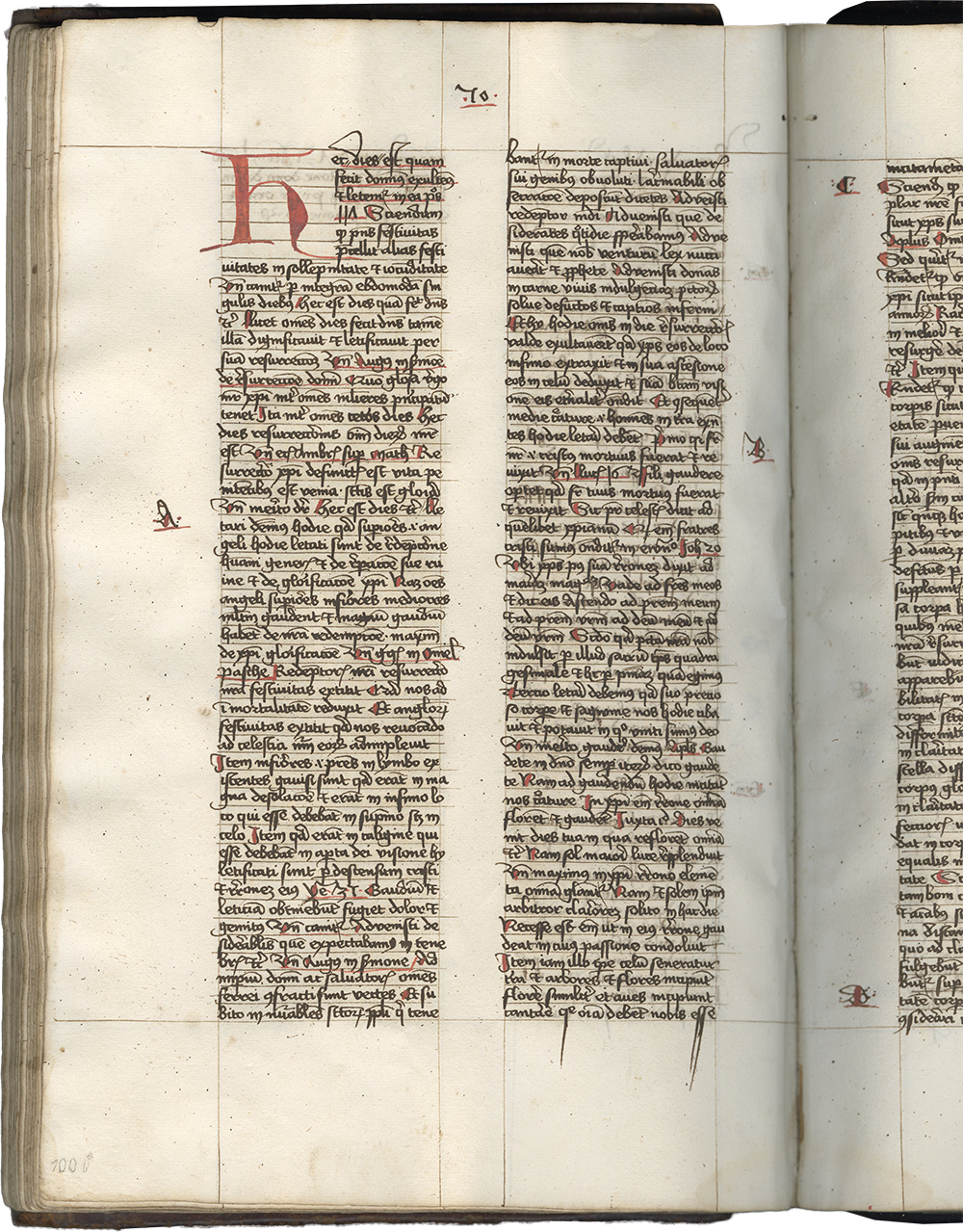
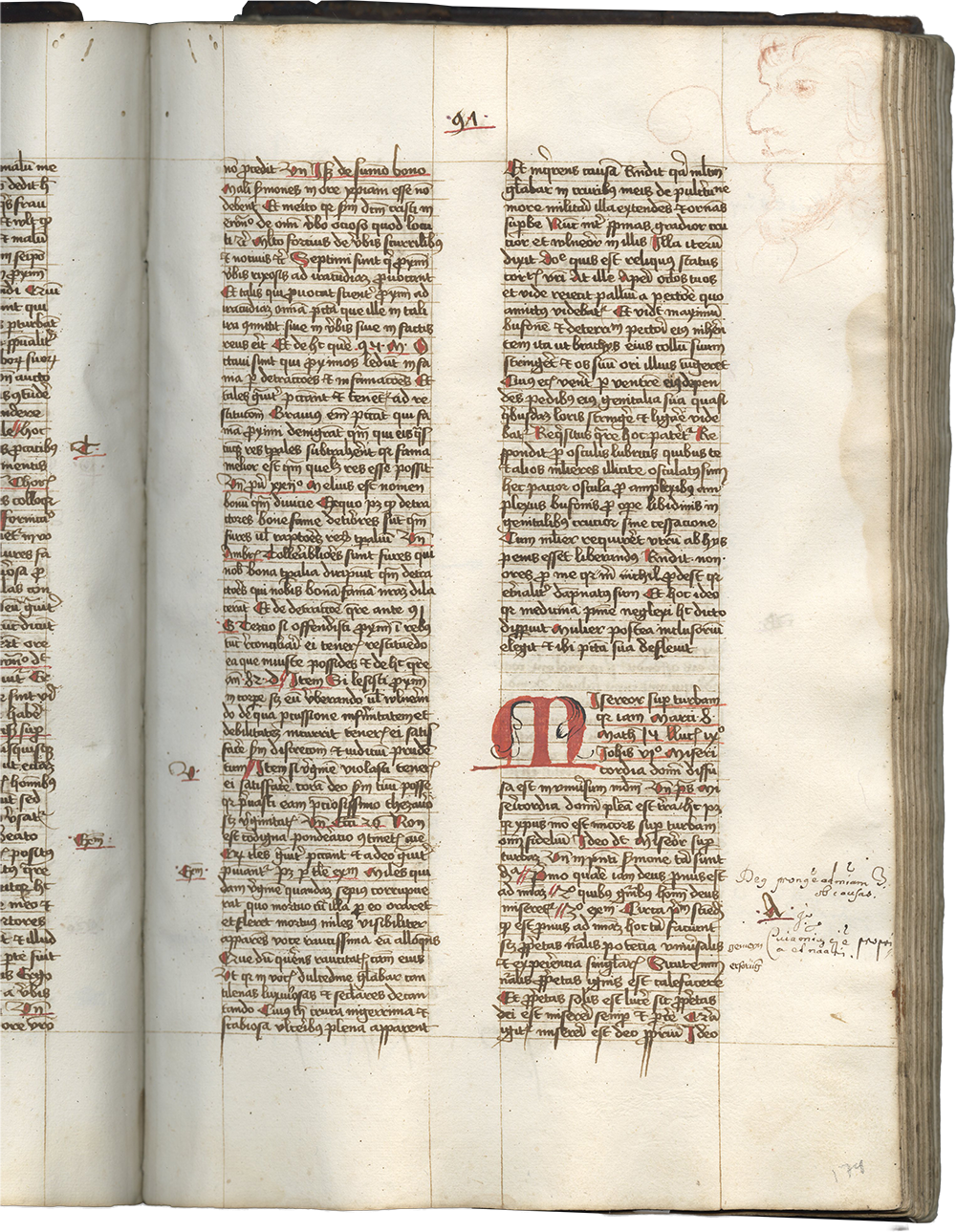
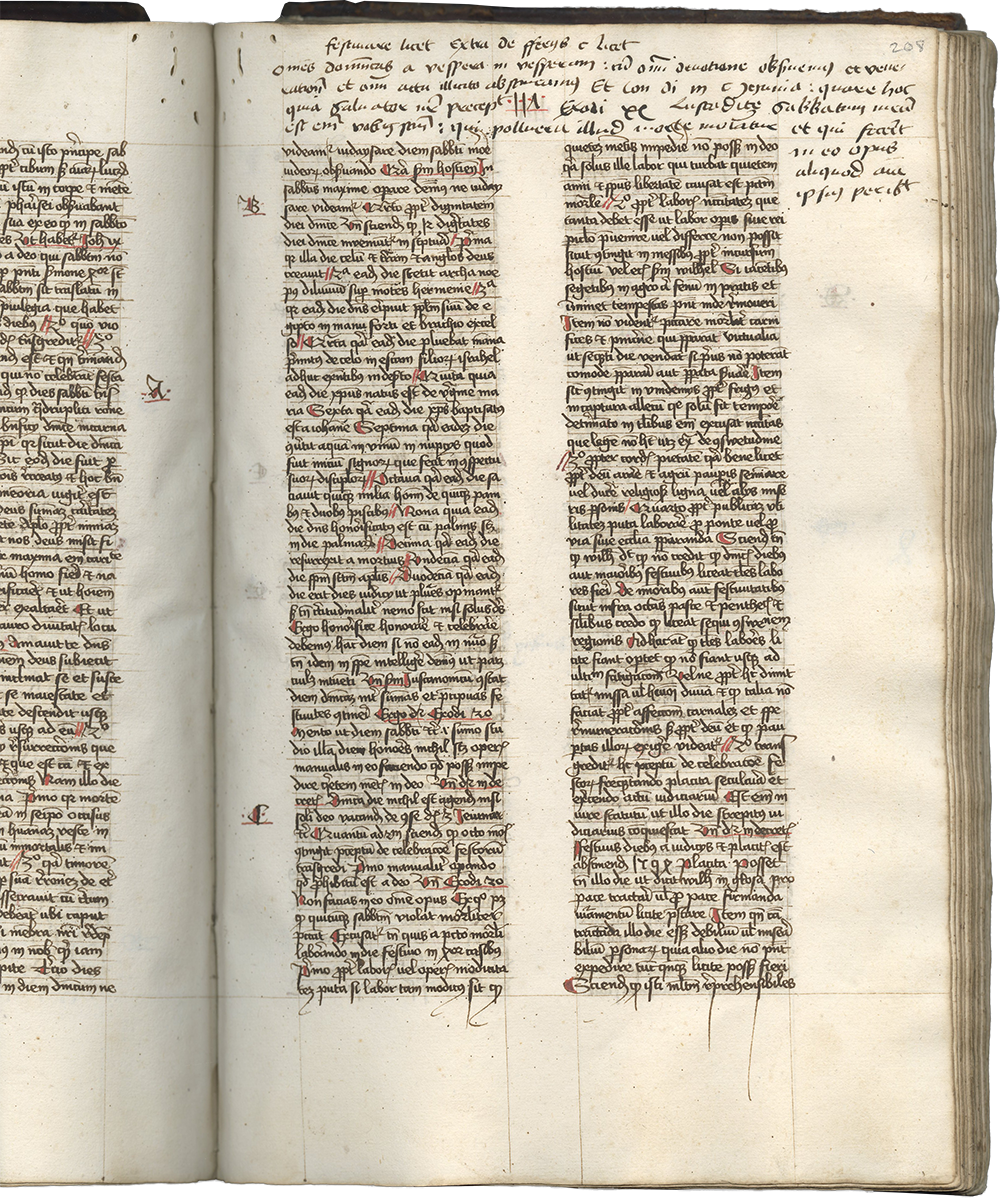
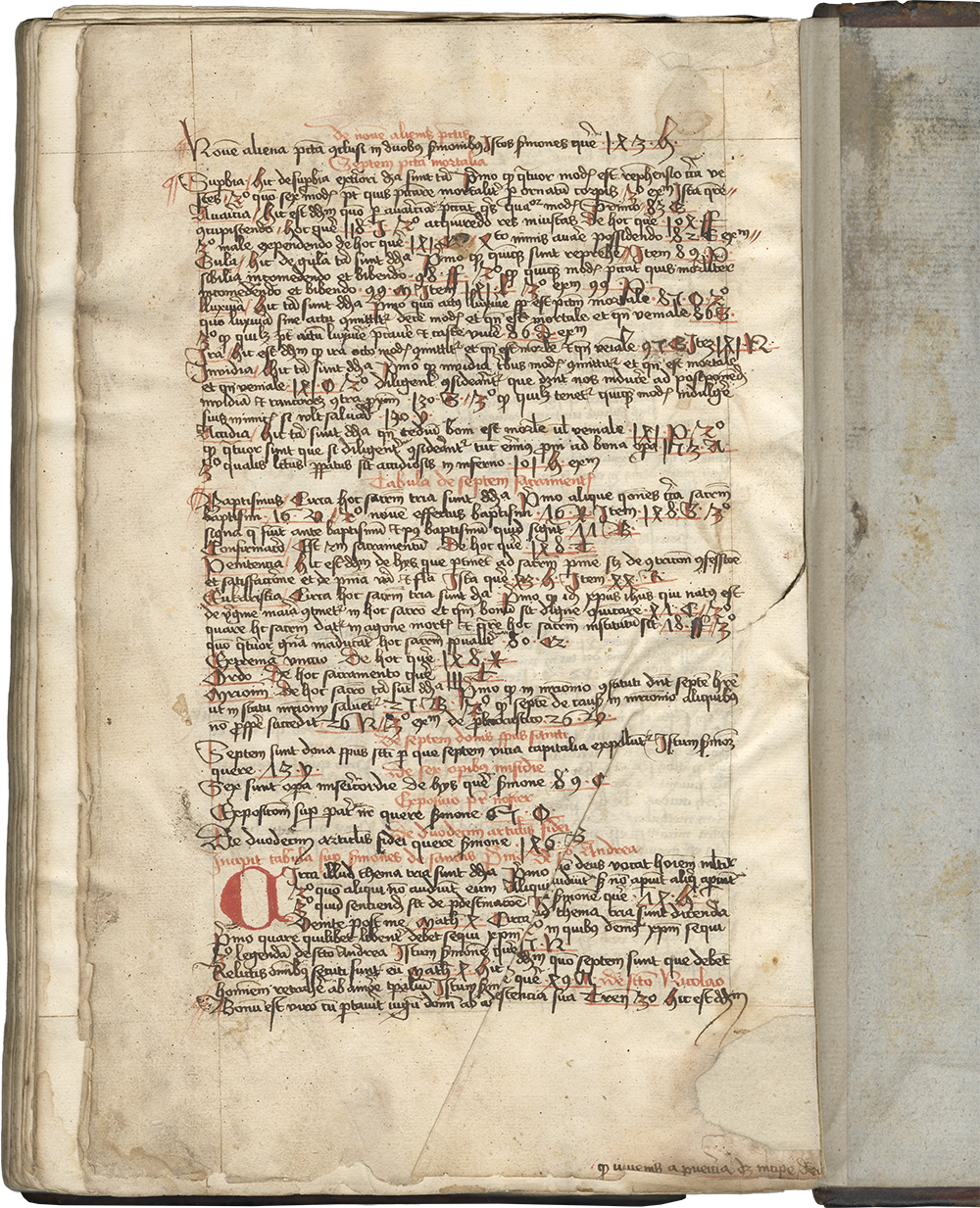
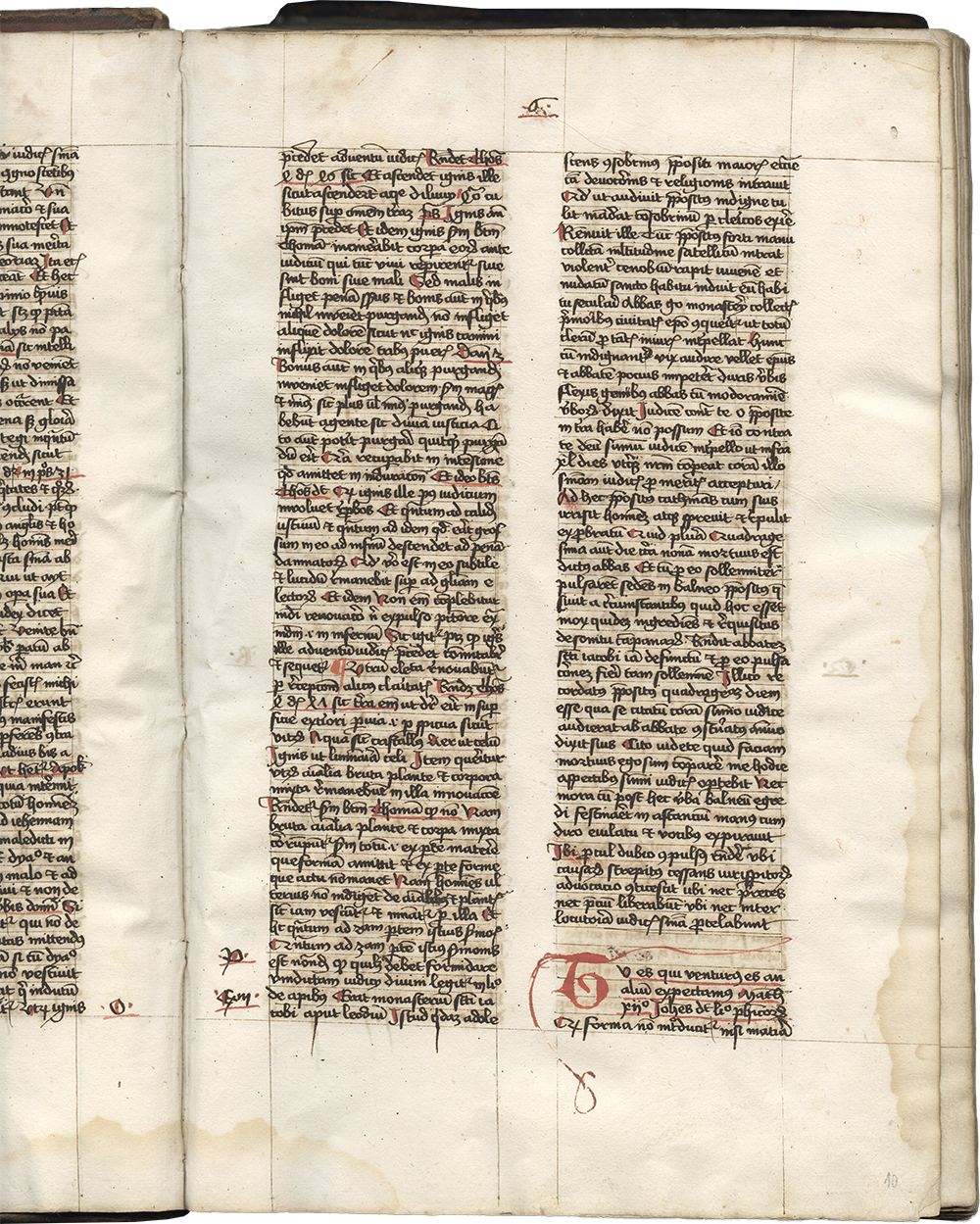
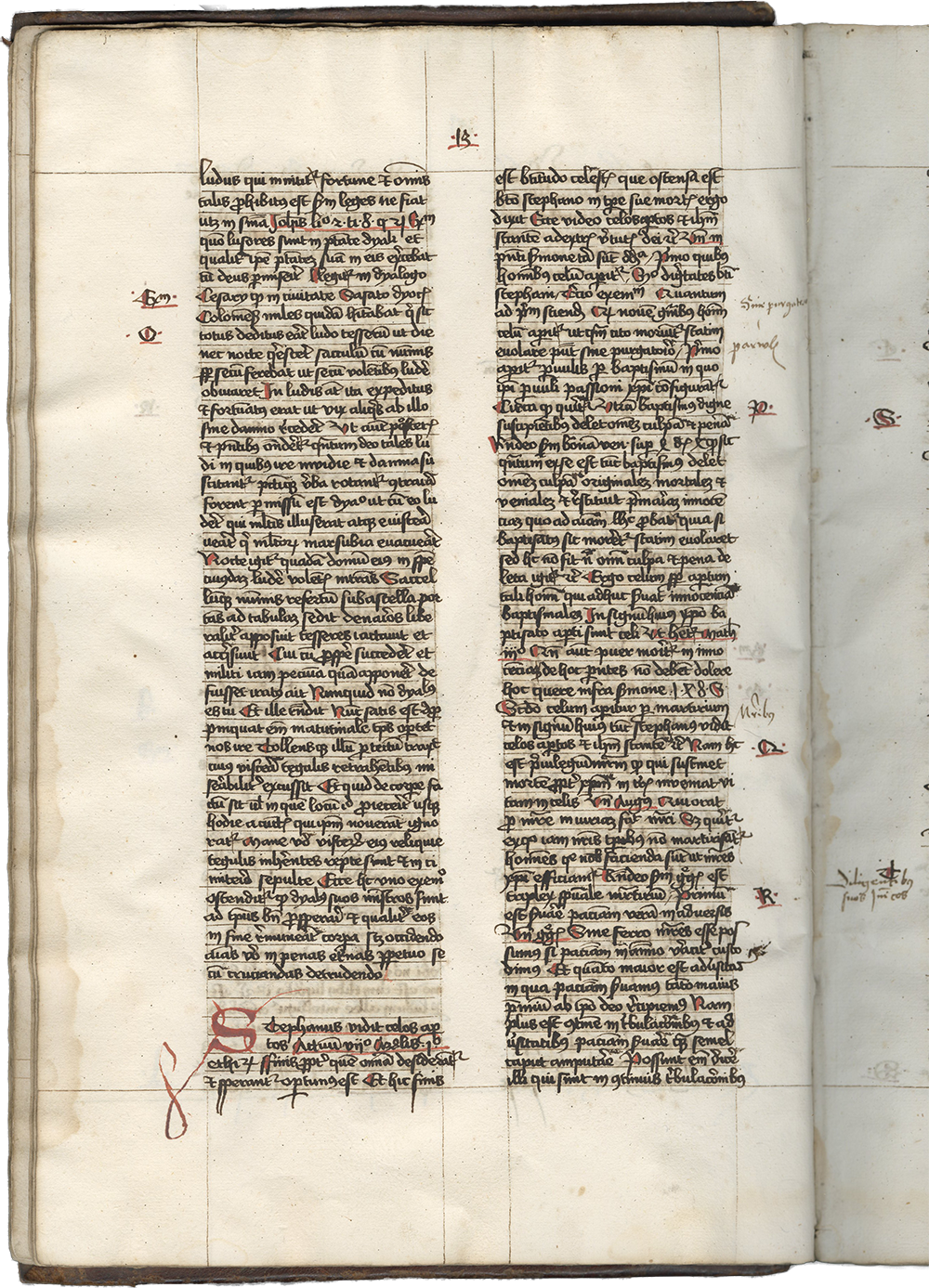
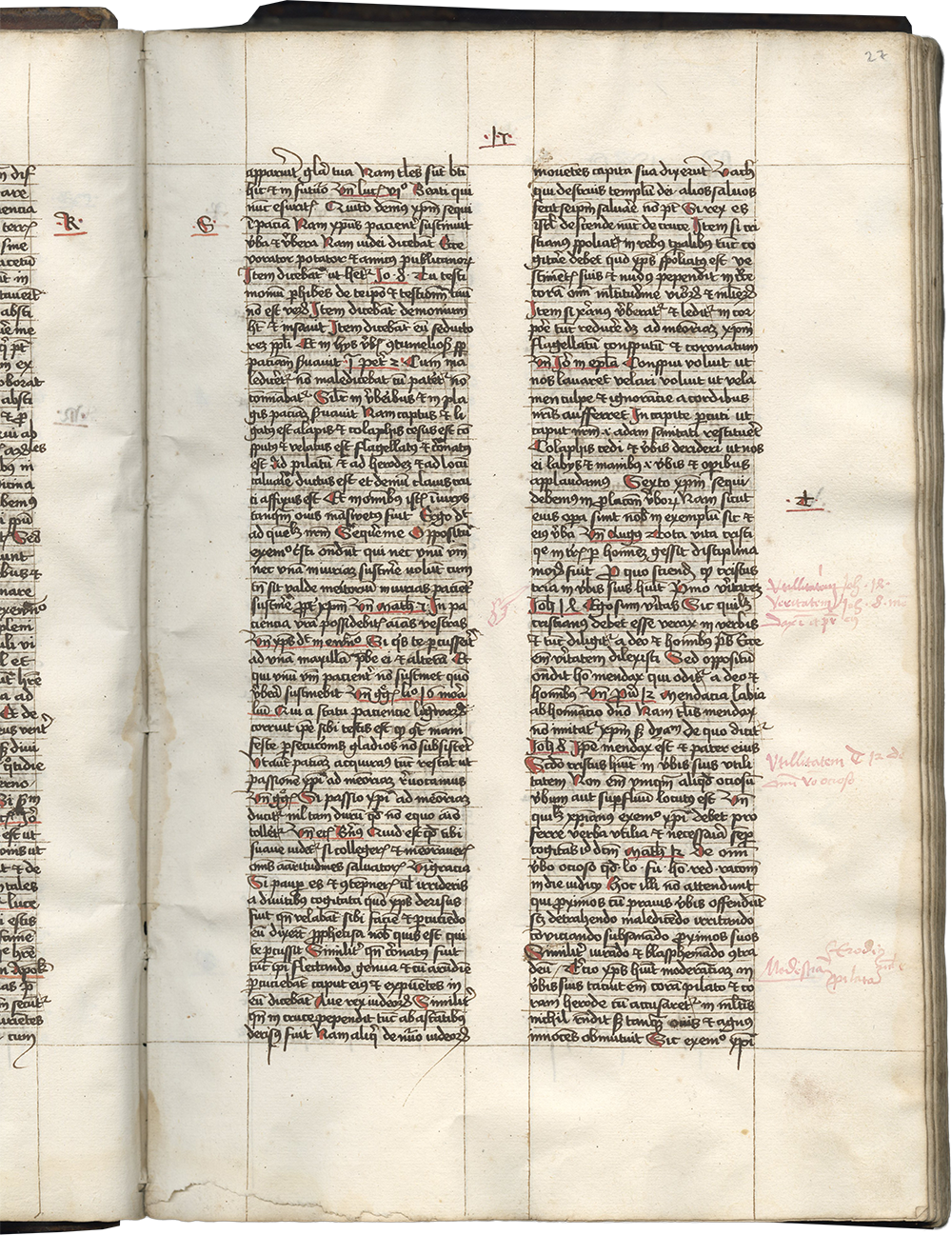
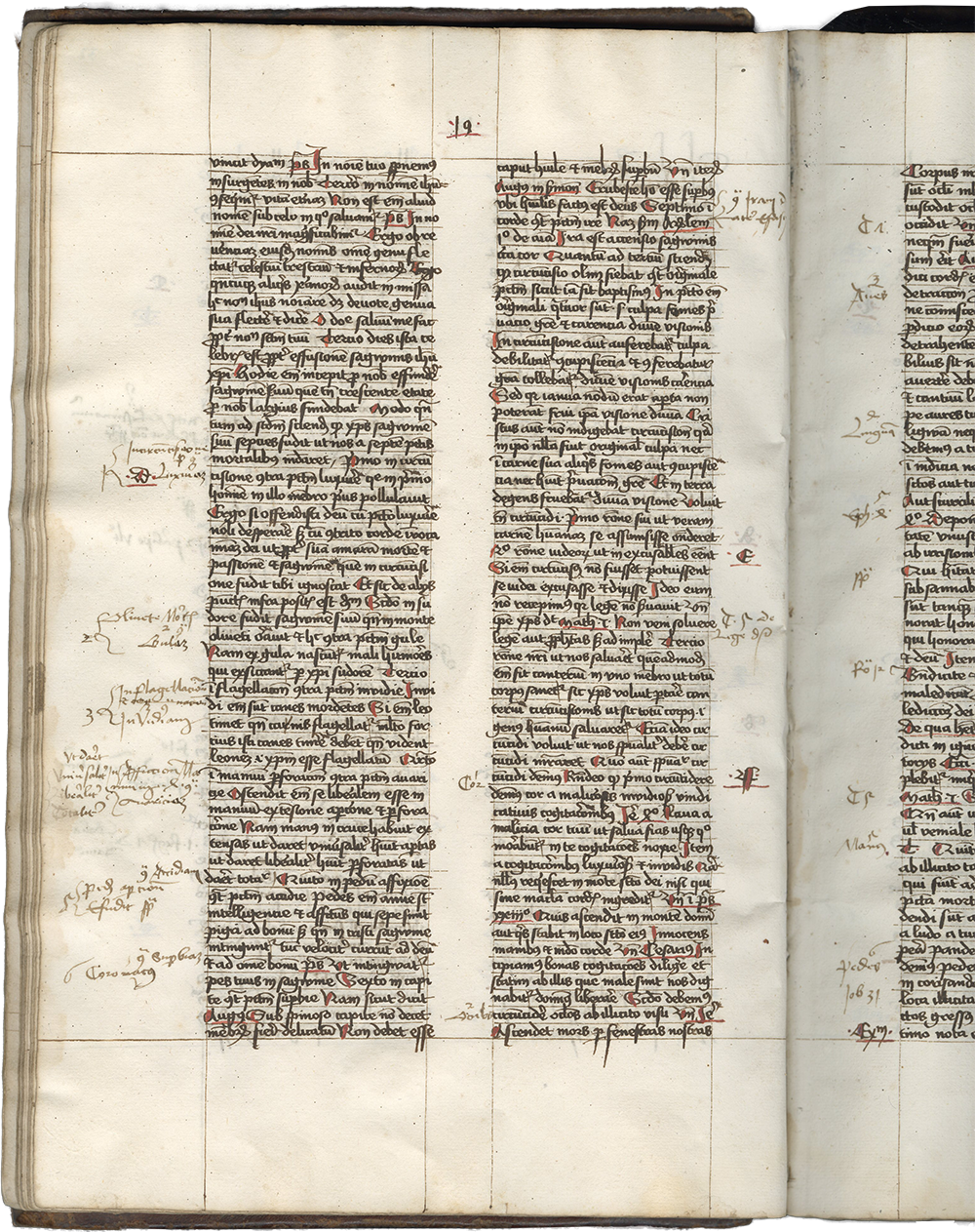
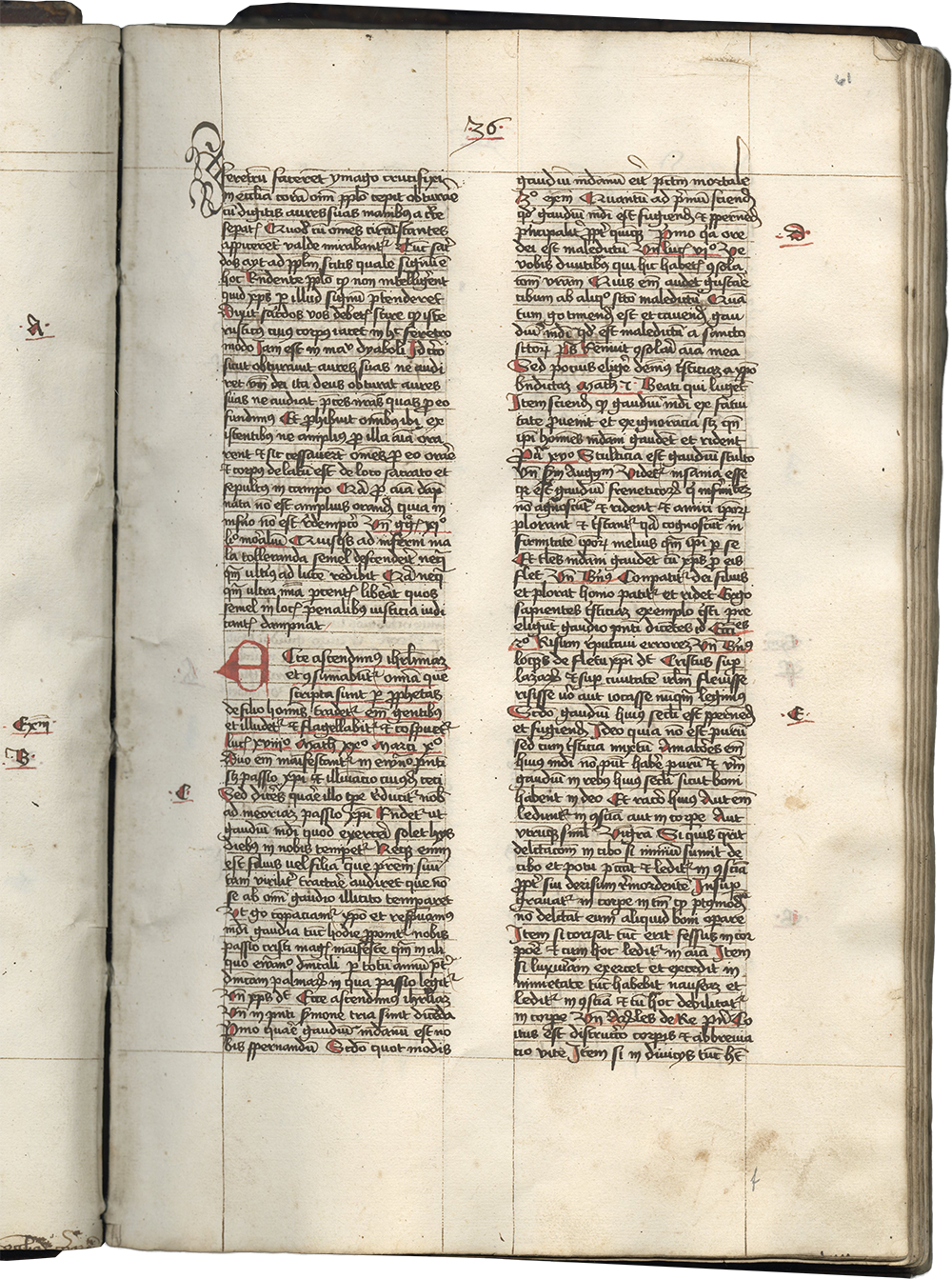
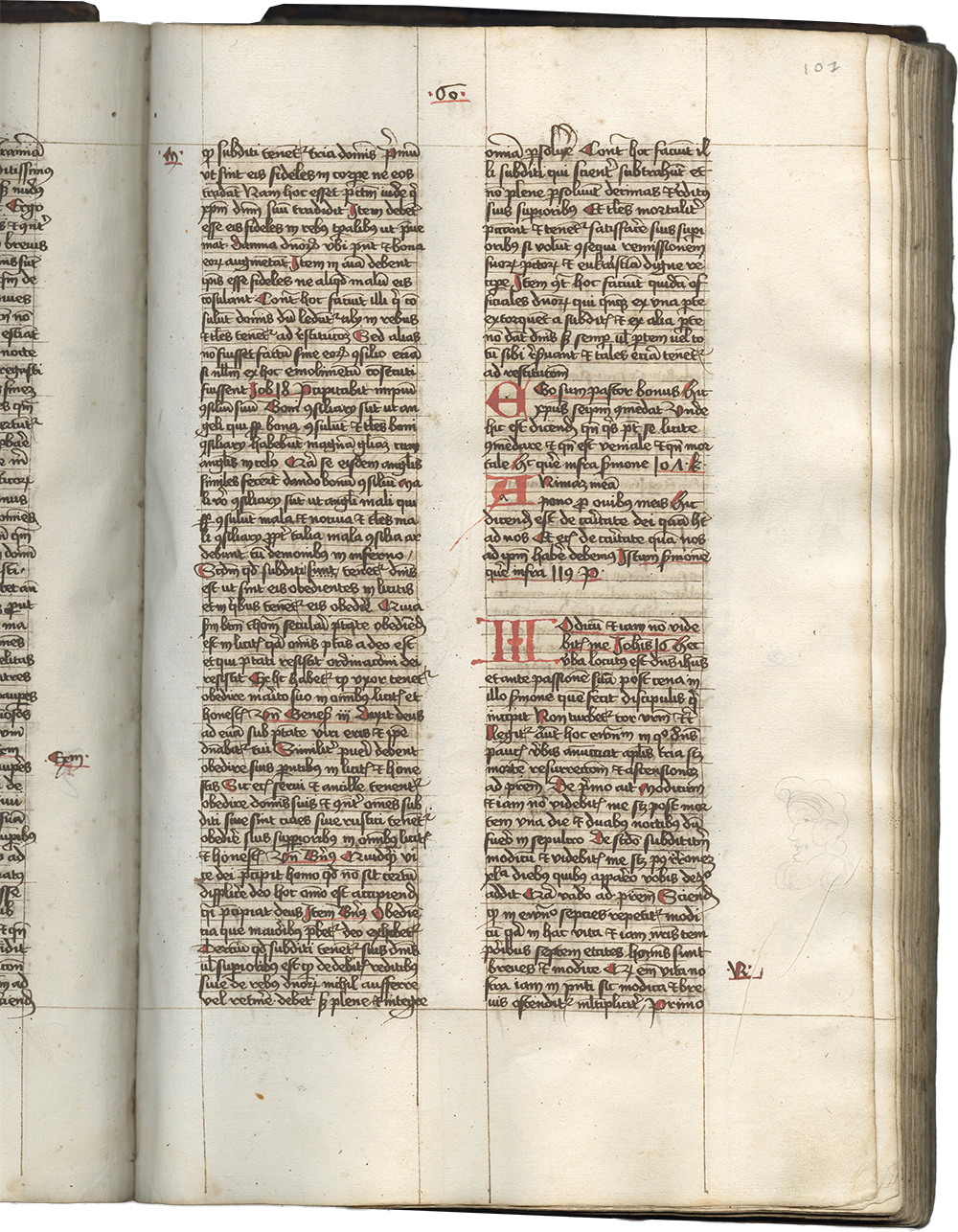
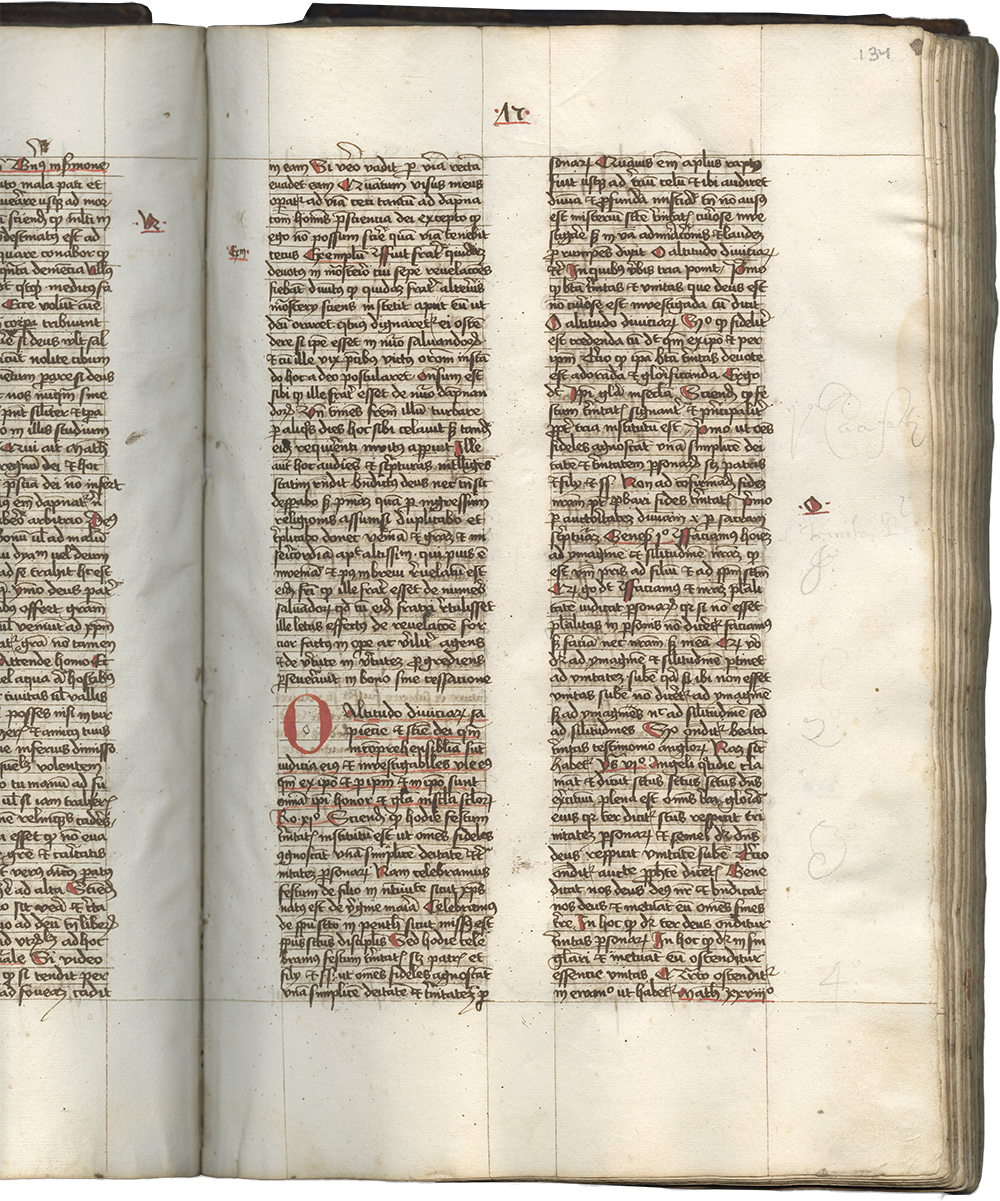
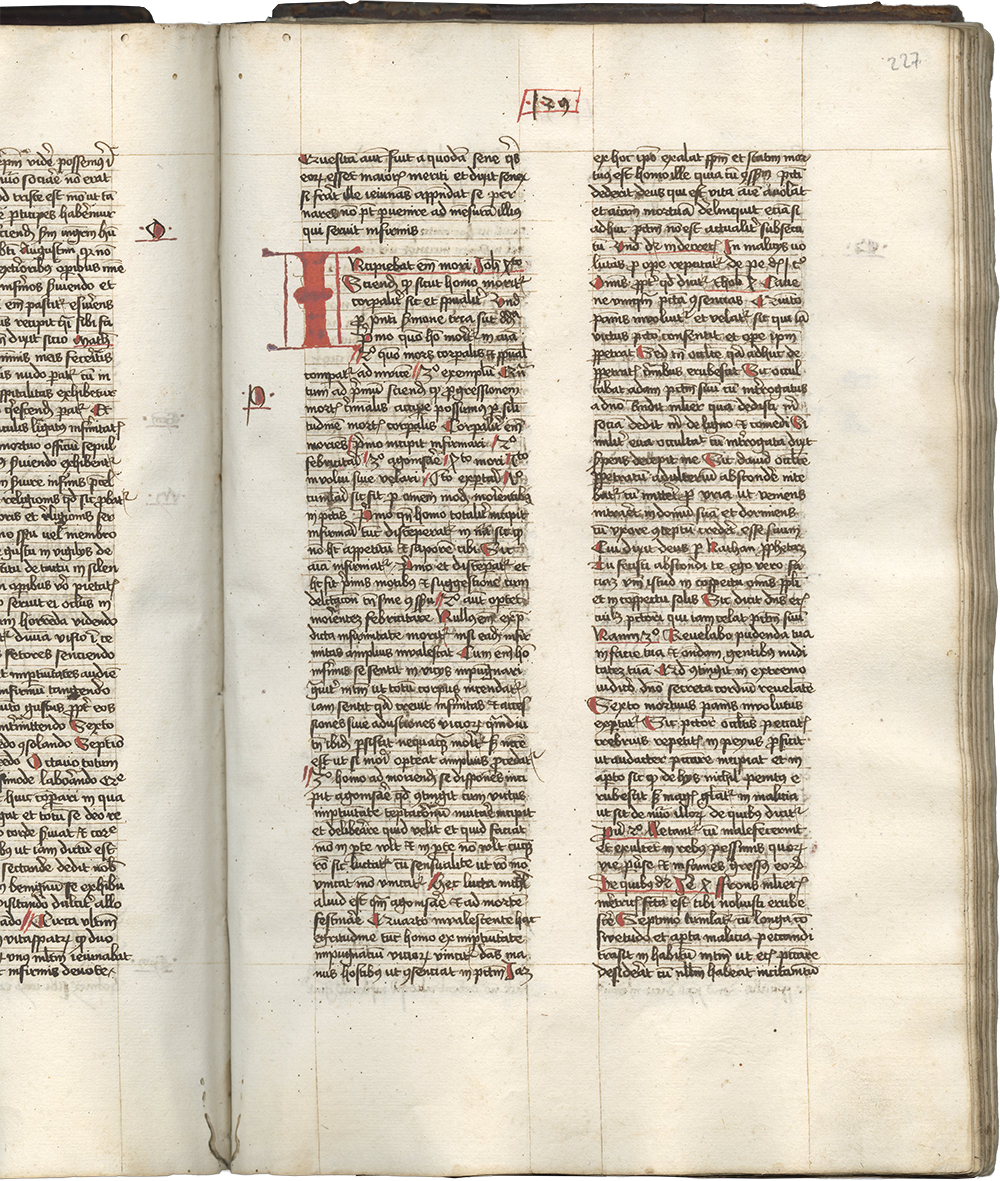
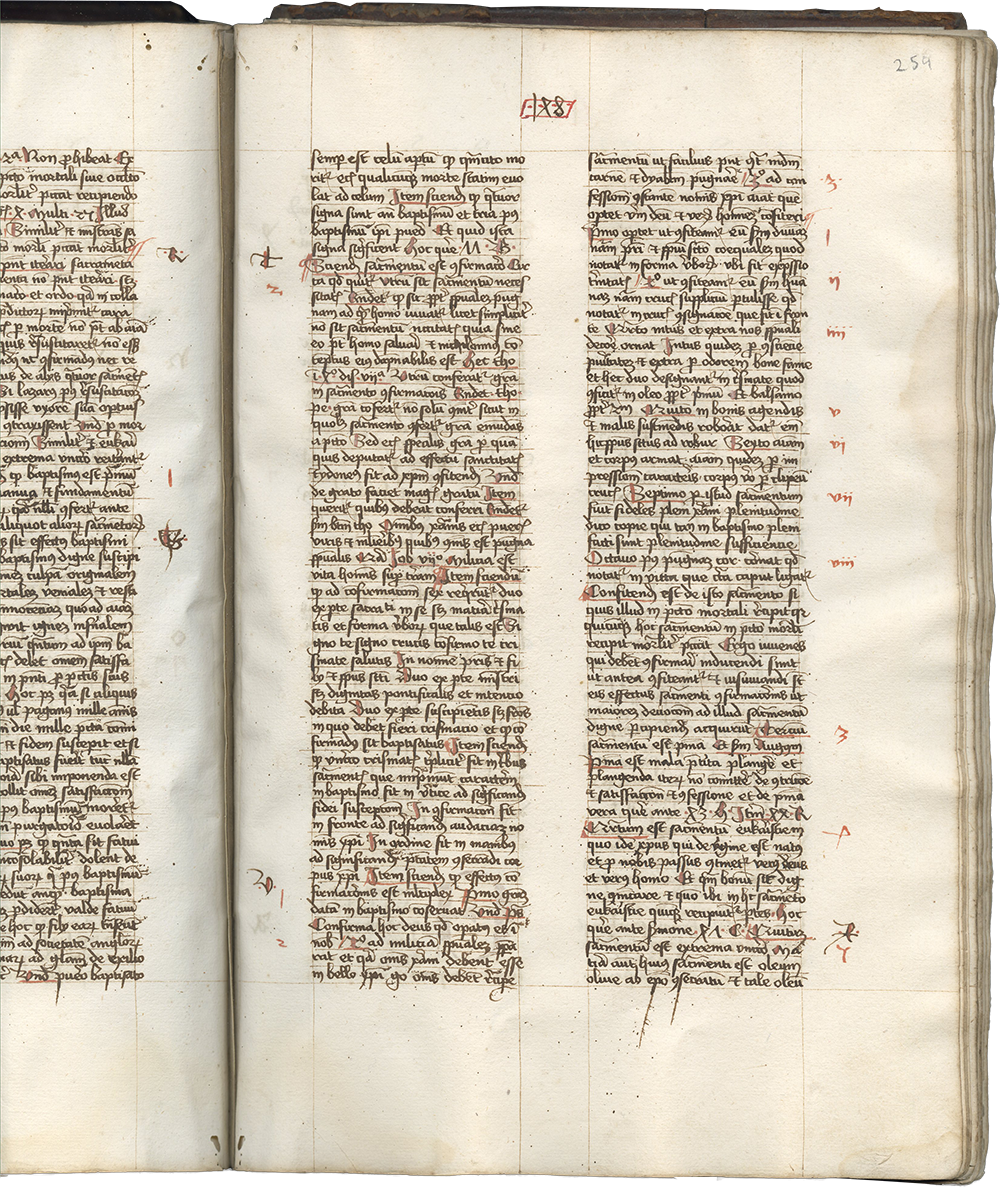
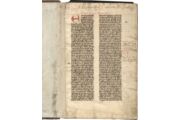
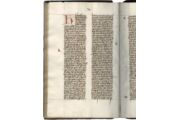
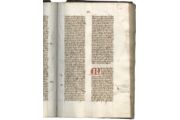
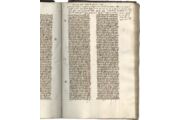
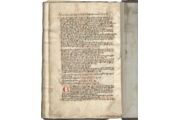
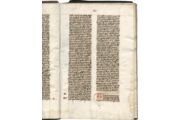
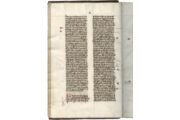
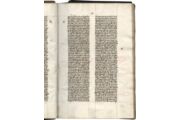
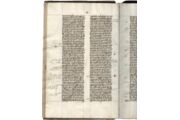
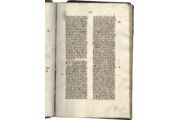
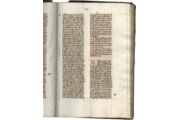
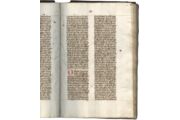
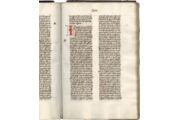
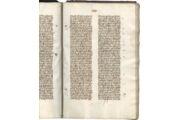
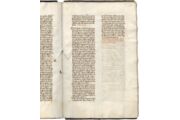
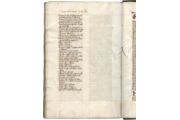
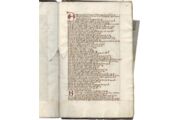
300 paper leaves, four bull’s head watermarks are found in the paper stock: (i) quires i-xv and xxii, a pair of the type Piccard, Ochsenkopf, XII 753 (with specific measurements corresponding to 1475-77), (ii) quires xvi-xxi, a pair of the type Piccard, Ochsenkopf, XV 221+222 (1474-78), (iii) quires xxiii and xxv, a pair of the type Piccard, Ochsenkopf, XII 727 (1476-81), (iv) quire xxiv, a type not recorded by Piccard or elsewhere, a bull’s head with eyes, with a double-contoured staff surmounted by a crown, above which a single-contoured staff surmounted by a star, modern pencil foliation, commencing in lower right margin, but then predominantly in upper right margin, catchwords, complete, (collation: i-xxv12), ruled in black ink, (justification c.235 x c.140 mm), 48-50 lines in two columns, in one hand, an elegant and highly regular semihybrida libraria, rubricated throughout, although the rubrics identifying the feasts are only executed for sermons 1, 2, 10, 16, 163 and the concluding exempla, with space otherwise left blank for the purpose; red initials of 3-5 lines at the start of each sermon. Bound in blind-stamped and tooled brown calfskin over wooden boards, now much worn and flattened, using very many small stamps, remnants of two clasps (nails, nail-holes, and part of one mounting-plate) on front and rear, the uppermost compartment of the spine lost, revealing the book-block beneath, sewn on four double cords, blank parchment sewing guards at the centre of quires, a parchment strip, apparently cut from a papal bull, follows quire i, now between ff. 12-13, and remains from the binding before its modern restoration, a printed paper leaf, 270 x 165 mm, loose inside rear cover, bears traces of paste indicating that it may have served as an earlier pastedown, prior to modern restoration. Dimensions 325 x 215 mm.
One of the most widely circulated works of the later Middle Ages, the Sermones Discipuli de tempore of the Nuremberg Dominican friar Johannes Herolt (d. 1468) offer an exceptional window onto the lives of the urban laity in the fifteenth-century city. This example was produced at the cusp of the transition from manuscript to print and will have been one of the last of its kind to be copied by hand. Its origin is to be sought in Moravia, probably in or around Olomouc (Olmütz), and it served generations of Catholic Moravian preachers into the eighteenth century.
Provenance
1. As stamps Einbanddatenbank s022375, s022377, s022383, s022386, s022387, s022393 and s022399 demonstrate, the binding was undertaken at a workshop w002858 (‘Kopfstempel I a’) active in Moravia c.1475-92 and probably located in Olomouc (Olmütz), modern day Czech Republic. The presence of a single tool, EBDB s011152, from workshop w000136 (‘Gotische Dachbekronung frei II’, active in Moravia c.1474-1500) within the ensemble of stamps found on this binding offers confirmation, for this, second Moravian workshop, also probably located in Olomouc, was active at the same time. (Binding tools are known to be occasionally mobile in this way, as they were sold or exchanged). This town may have been where the manuscript was written. The evidence of the paper stocks indicates production in c.1474-78, entirely consonant with the known period of operation of both binding workshops. The aspect of the script is also characteristic of the Bohemian-Moravian region, the manuscripts from which “seem commonly to display bold script tightly written on lines close to each other” (Derolez, 2003, p. 169). The earliest ownership inscription, in a sixteenth-century hand in black ink directly onto the wood of the inside front cover, exposed in a cut-out from the modern paper pastedown, “sum ? Tißinensis,” indicates an owner from Těšín/ Cieszyn (Teschen) in eastern Moravia. The crucial, illegible second word might conceivably read “eccl(esi)e,” but in that case, which of the many churches in Těšín/ Cieszyn is intended is uncertain.
2. Annotations in at least four different hands, from the late fifteenth/ early sixteenth century through at least to the seventeenth century (that to f. 141 dated 1640), to sermons 1, 3, 13, 15, 17, 19, 23, 25, 26, 33, 34, 38, 43, 44, 65, 68, 75, 78, 79, 85, 87, 93, 97, 101, 102, 107, 111, 117, 125, 126, 130, 131, 146, 152 and 155. Annotations to sermons 1, 15, 23, 25, 26, 33, 34, 38, 85, 125, 126 and 146 in red ink by one early sixteenth-century hand.
3. Anton Dominik Schindler, parish priest in Suchdol nad Odrou (Zauchtel) in eastern Moravia: his ownership inscription, in an eighteenth-century hand, on f. 1, upper margin, Ex Bibliotheca Ant: Schindler Par: Zauchtel:. Schindler, born 1722 in Nový Jičín (Neutitschein) served 1754-77 as parish priest in Suchdol. Highly regarded as a theologian, Schindler was appointed in 1777 to lead the seminary in Olomouc (Mannsbart, 2002, p. 89). The incorporation of the printed sheet, now loose at rear, with engraved scenes from the life of Joseph and his brothers, and German text in verse, very probably dates from this same period.
4. Hartung & Karl, Munich, their sale, 29 May 1972, lot 8; pencil notes on the inside front cover also appear to relate to that sale. Corresponding entry for this manuscript in Schoenberg Database SDBM_2750.
Text
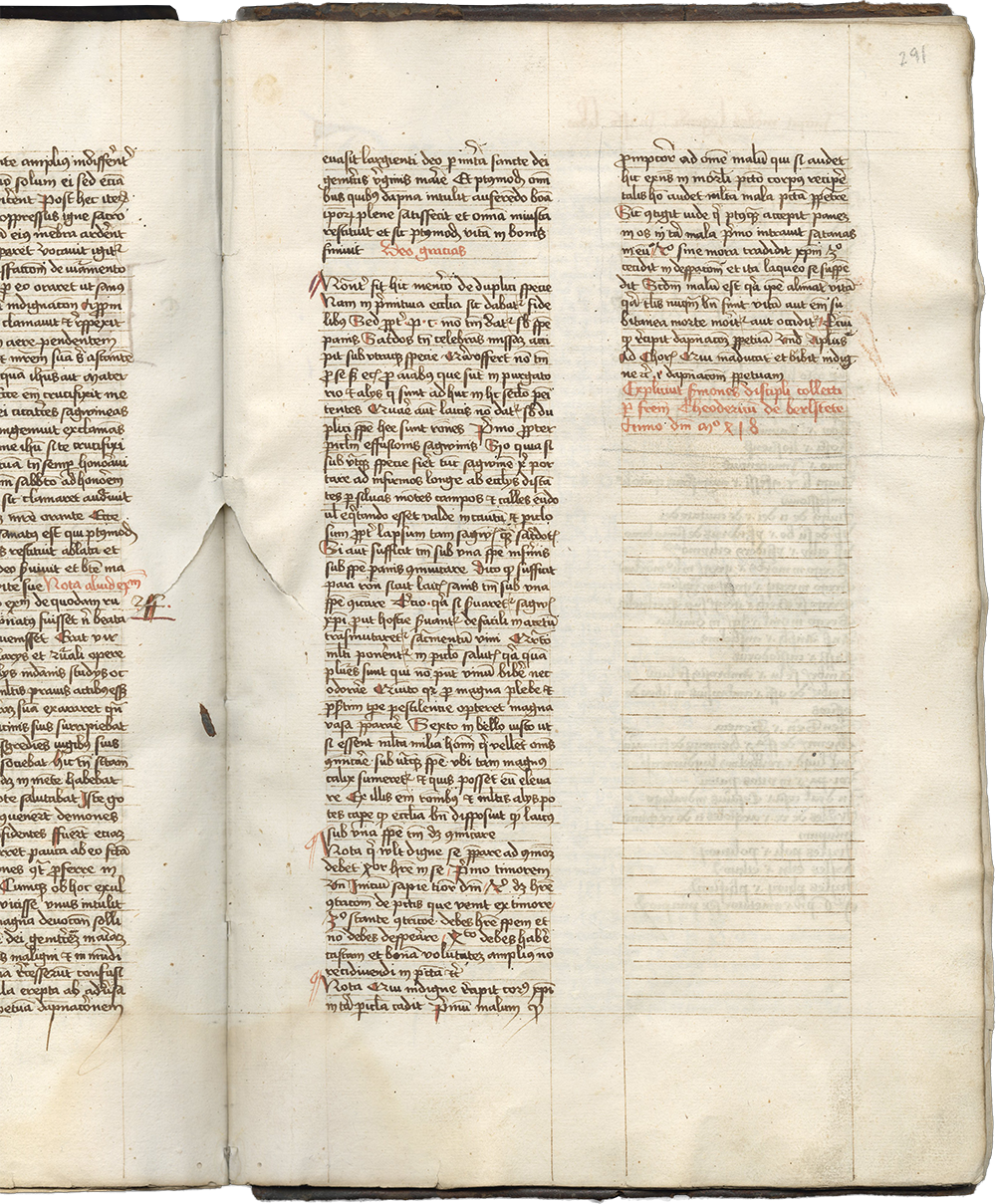
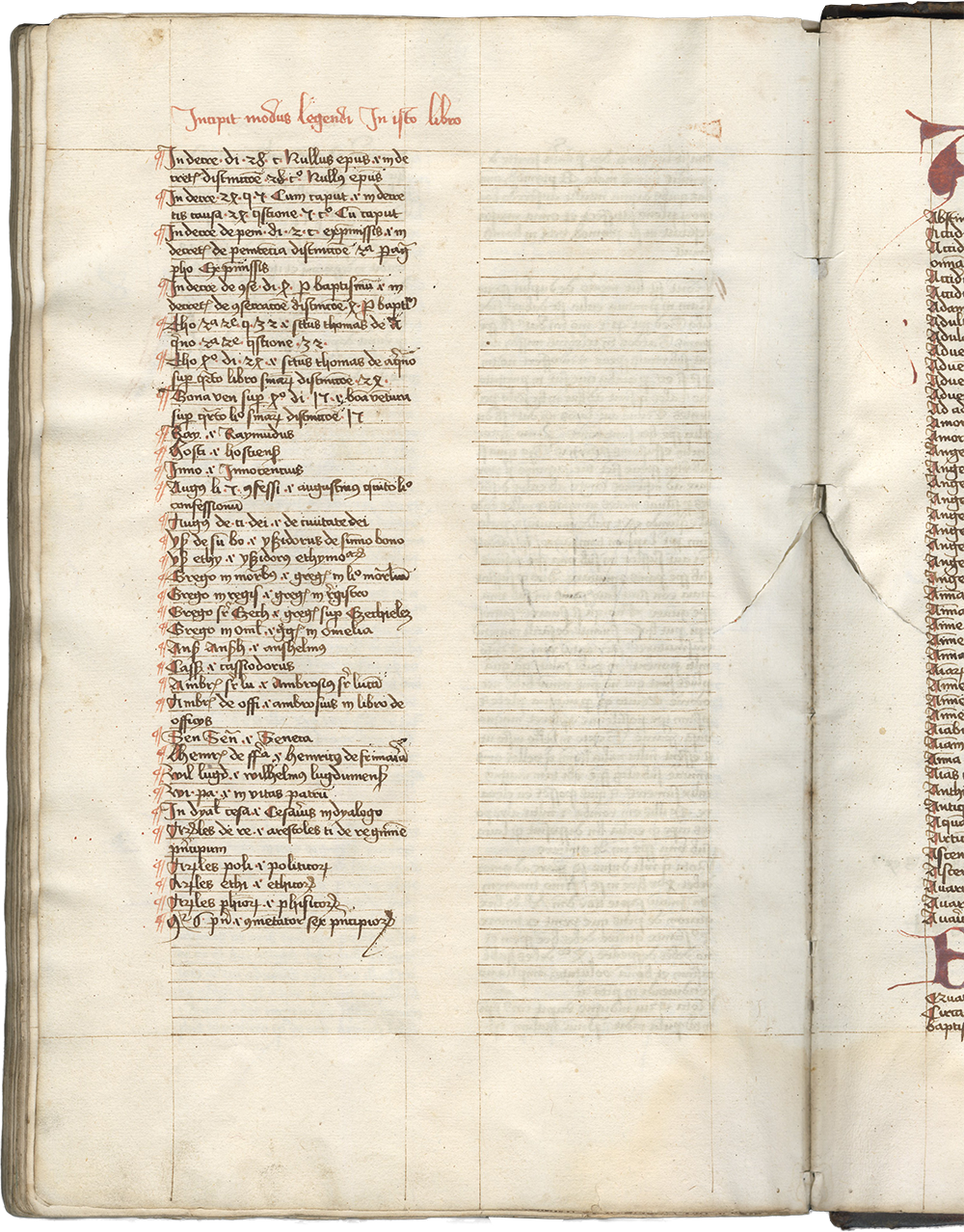
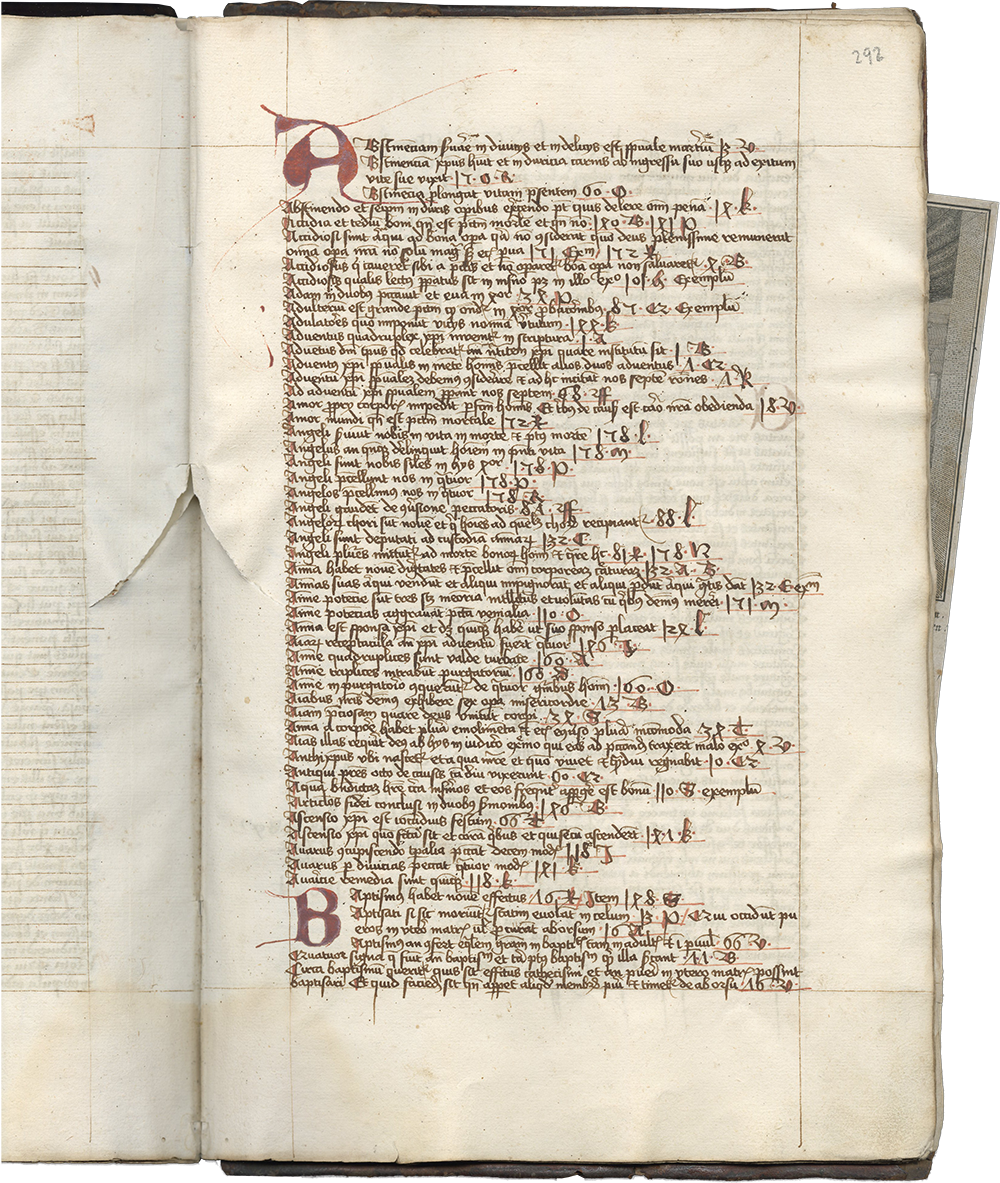
ff. 1-300v, Johannes Herolt, Sermones Discipuli de tempore, rubric, Sermo primus in aduentu domini, incipit (f. 1, sermon 1), “Ecce rex tuus venit tibi mansuetus. Zach ix. Mathei xxj Marci xj. Luce xix Johannis xii. [Za 9,9 and Mt 21,5; cf. Mc 11,1-10, Lc 19,28-38, and Io 12,15] Egregius doctor noster Sanctus Thomas de Aquino dicit quod nulla actio fit perfecta seu meritoria nisi per gratiam dei fuerit illuminata...”; incipit (f. 240v, sermon 137), “Cogitacio eorum aput altissimum Sapientie 5 [Sap 5,16] Sciendum quod tria sunt principaliter cum quibus meremur et peccamus scilicet cogitacione locucione et opere Vnde tres sermones sunt hic formandi...”; incipit (f. 259v, sermon 149), “EGo vos elegi de mundo Johannes 15 [Io 15,19] Ex quo dicit Christus in ewangelio vt habetur Mathei 20. Multi sunt vocati pauci vero electi [Mt 20,16] et nullus (f. 260) scit an sit electus...”; rubric (f. 289v), Sequuntur bona exempla de beata virgine, incipit, “NOta exemplum quomodo beata virgo maria iuuat hominem in vita legitur in dyalogo Cesarij quod iuuenis quidam cui pater moriens multas diuicias dimiserat...”, explicit (f. 291), “...expliciunt sermones discipuli collecti per fratrem Theodoricum de Berlstete Anno domini Mo 418”; rubric (f. 291v), Incipit modus legendi in isto libro, incipit, “In decre. di. 28 c. Nullus episcopus = in decretis distinctione 28 capitulo Nullus episcopus. In decre. 24. q. 5 Cum caput = in decretis causa 24 questione 5 capitulo Cum caput...”; incipit register (f. 292), “Abstinenciam seruare in diuicijs et in delicijs est spirituale martirium...”
This volume offers the complete set of 163 sermons of Johannes Herolt’s Sermones Discipuli de tempore: the de tempore cycle proper (sermons 1-136, ff. 1-240), followed by the sermones communes omni tempore praedicabiles (sermons 137-148, ff. 240v-259v), the sermones communes de sanctis (sermons 149-163, ff. 259v-289v), and the additional Marian exempla (ff. 289v-291), which together form a coherent set throughout the manuscript and print transmission. This copy is among those which ascribe the compilation of Herolt’s Sermones de tempore to the Nuremberg Dominican friar Theodoricus Herolt de Berlstete (d. 1448) in 1418 (see Kaeppeli, 1975, p. 450). The Sermones de tempore must themselves have been composed in 1418, because of the reference in sermon 85 (in our manuscript at f. 153v) to that many years having passed since the birth of Christ (see Paulus, 1902, pp. 420-21).
The Dominican friar Johannes Herolt must have been born in the later fourteenth century, perhaps around 1380. The sparse archival record of his life places him consistently in Nuremberg, in a series of offices associated with the Dominican friary and the female convent of St. Katharina, from the mid-1410s through to his death while visiting the Regensburg friary in 1468. In his auctorial capacity he referred to himself consistently as Discipulus, in explicit contradistinction to the learned magistri upon whose works he drew extensively (Worstbrock, 1981, col. 1123). The Sermones Discipuli, especially the de tempore cycle, enjoyed an enormous transmission in manuscript and print. Well over 200 manuscripts survive, and 48 editions were printed before 1500 (for the manuscripts see Kaeppeli, 1975, no. 2387, pp. 451-54, and Worstbrock, 1981, cols. 1124-25, with additions; the printed editions are GW 12340-88).
Herolt’s Sermones Discipuli de tempore provide a good illustration of the principle that the most well-read works of the later Middle Ages are today the least studied. He wrote for an audience of priests required to preach to urban laity, hence the many exempla integral to his sermons. Though strongly ascetic in his approach, perhaps influenced by his proximity to the nuns of St. Katharina (though he is first recorded as their confessor in 1436, and they had not accepted the Observant reform until 1428, thus well after the composition of the de tempore cycle), his sermons de tempore expressed a certain empathy towards the concerns of the lay estate and an understanding of the realities of their lives. He was quite open to the possibility of lay salvation in a way that some of his more exclusionary contemporaries were not, and more sympathetic towards the exigencies of urban living, especially for those without opportunity to cultivate an elaborate devotional life. His sermons range widely in their references to artisanal occupations and to the ways of the late medieval city (see for all this Dahmus, 1980, pp. 122-27 and 130-32, and Dahmus, 1996, pp. 310-16). They are full of rich and interesting detail, ripe for scholarly exploration.
The text of the Sermones Discipuli de tempore in this manuscript, including the paratextual elements – the expansion of abbreviations referring to other works and authors (f. 291v), the registers and indices (ff. 292-300v), and the marking-up of the sermons with letters, corresponding to the entries in those indices – corresponds, with the exception of the final three Marian exempla (ff. 290v-291) and three short notes on the eucharist (f. 291), exactly to that found in the early printed editions. Comparison was made to the earliest edition conveniently accessible in digital form (Reutlingen: Michael Greyff, c. 1478/79; ISTC ih00103000, GW 12344, and see Online Resources below); the editio princeps was published by Ulrich Zell in Cologne on 7 March 1474 (GW 12340, ISTC ih00098000). This manuscript, therefore, must stand in close relationship to the textual version that entered into print. It will have been among the last of its kind to be made, given the general shift from manuscript to print production that took place c.1480, and the early and ready availability of the Sermones Discipuli de tempore in print, with six editions – from Cologne, Rostock, Reutlingen, and Strasbourg – already published before 1480.
The indices at the end of this manuscript break off at the start of the register to the Sermones de sanctis (f. 300v) and the presence of a catchword appears to indicate that a final quire has been lost, but this may not necessarily be so. The register to the Sermones de sanctis is irrelevant to the content of this volume: the start may have been copied in error, the scribe working mechanically, and having then taken a decision not to continue and begin a new quire at all.
Literature
Dahmus, John W. “Dormi secure: The Lazy Preacher’s Model of Holiness for his Flock,” in Beverly Mayne Kienzle et al., eds, Models of Holiness in Medieval Sermons: Proceedings of the International Symposium (Kalamazoo, 4-7 May 1995), Textes et Études du Moyen Âge 5, Louvain-la-neuve, 1996, pp. 301-16.
Dalmus, John W. “Late Medieval Preachers and Lay Perfection: The Case of Johannes Herolt, O.P.,” Medieval Perspectives 1 (1986), pp. 122-34.
Derolez, Albert. The Palaeography of Gothic Manuscript Books: From the Twelfth to the Early Sixteenth Century, Cambridge, 2003.
Kaeppeli, Thomas. Scriptores Ordinis Praedicatorum medii aevi, vol. 2, Rome, 1975.
Mannsbart, Claus. Chronik der Marktgemeinde Zauchtel (Mähren), Norderstedt, 2002.
Paulus, Nikolaus. “Johannes Herolt und seine Lehre: Ein Beitrag zur Geschichte des religiösen Volksunterrichts am Ausgang des Mittelalters,” Zeitschrift für katholische Theologie 26 (1902), pp. 417-47.
Piccard, Gerhard. Die Ochsenkopf-Wasserzeichen, 3 vols, Die Wasserzeichenkartei Piccard im Hauptstaatsarchiv Stuttgart Findbuch 2/1-3, Stuttgart, 1966.
Worstbrock, F. J. “Herolt, Johannes (Discipulus),” in 2Verfasserlexikon, vol. 3, 1981, cols 1123-27.
Online Resources
Einbanddatenbank
https://www.hist-einband.de/de/
Gesamtkatalog der Wiegendrucke
https://www.gesamtkatalogderwiegendrucke.de/
Herolt, Johannes. Sermones Discipuli de tempore et de sanctis (Reutlingen: Michael Greyff, c.1478-79), GW 12344, ISTC ih00103000
https://mdz-nbn-resolving.de/urn:nbn:de:bvb:12-bsb00043195-4
Schoenberg Database of Manuscripts
https://sdbm.library.upenn.edu/