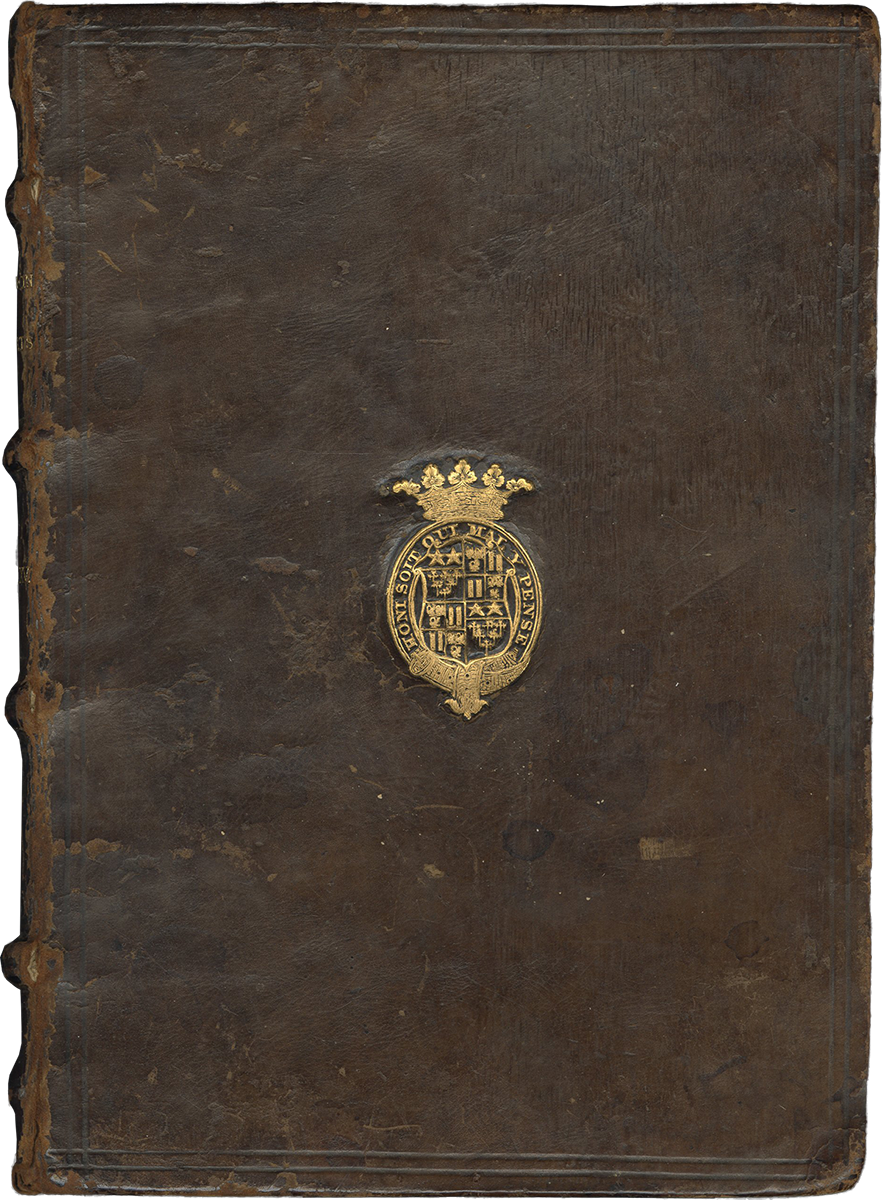
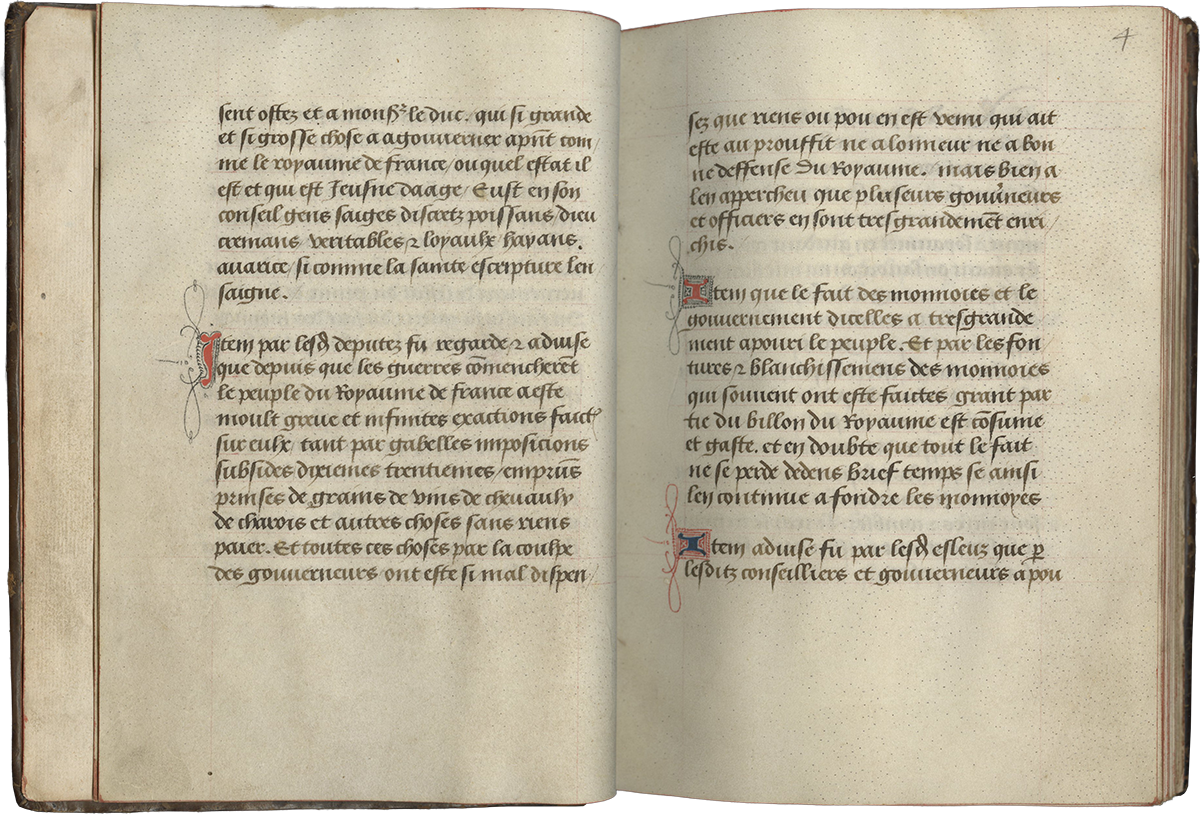
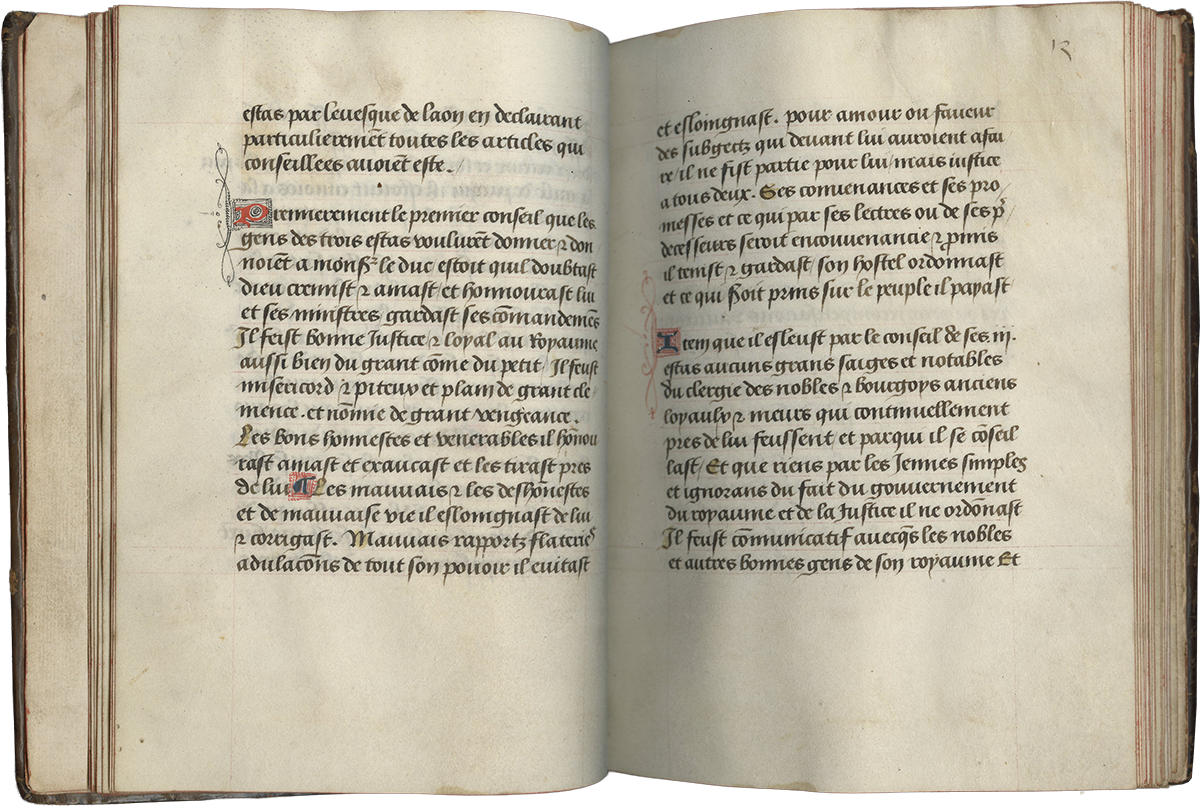
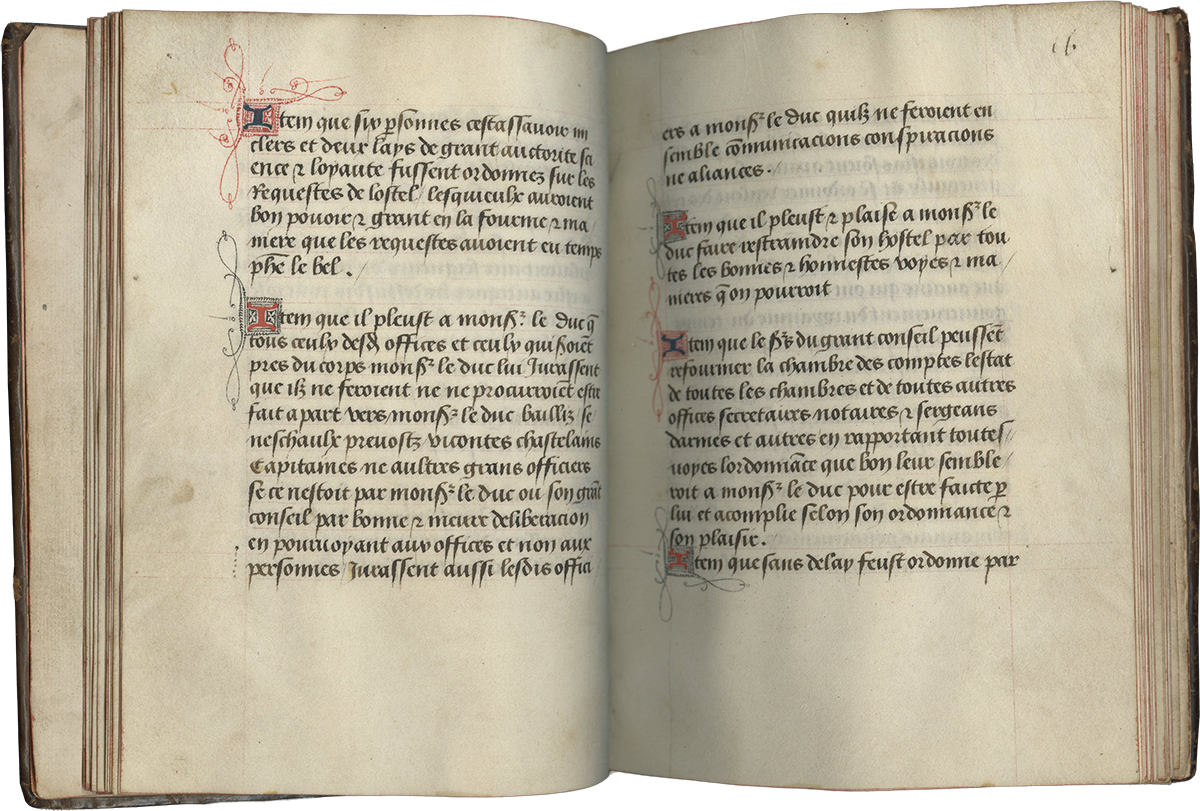
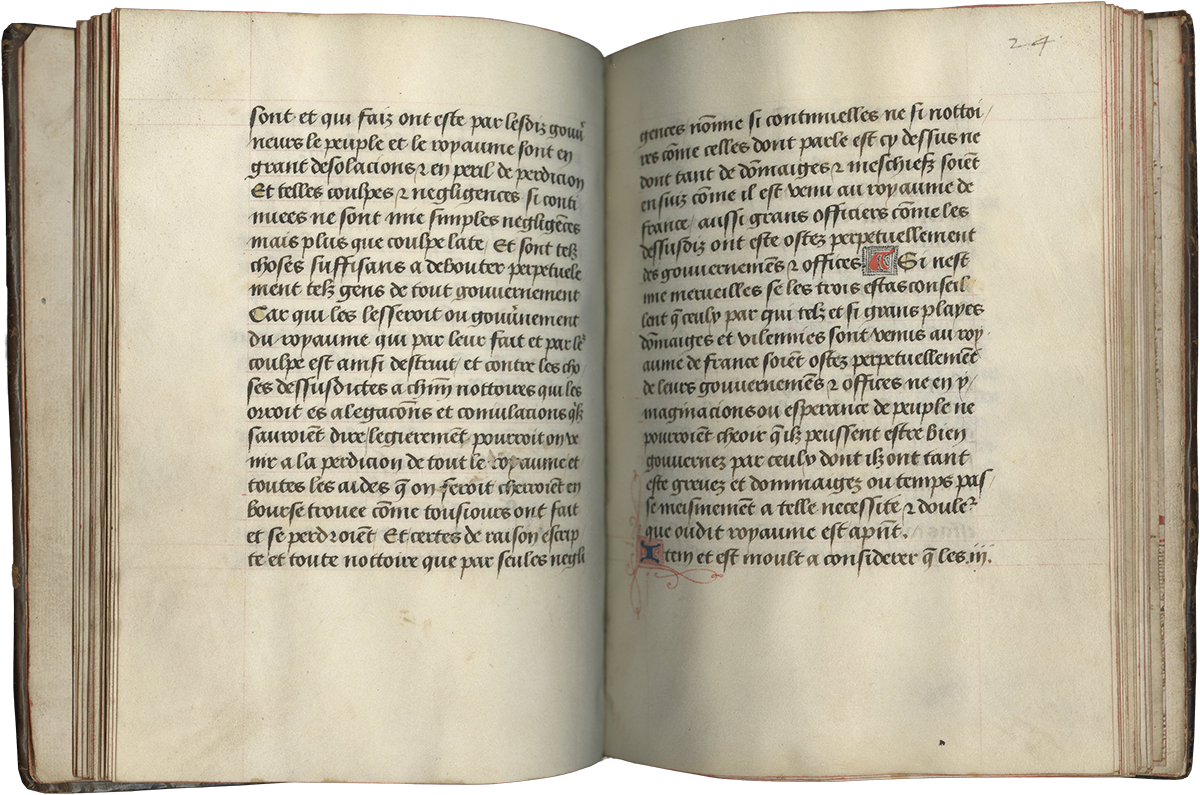
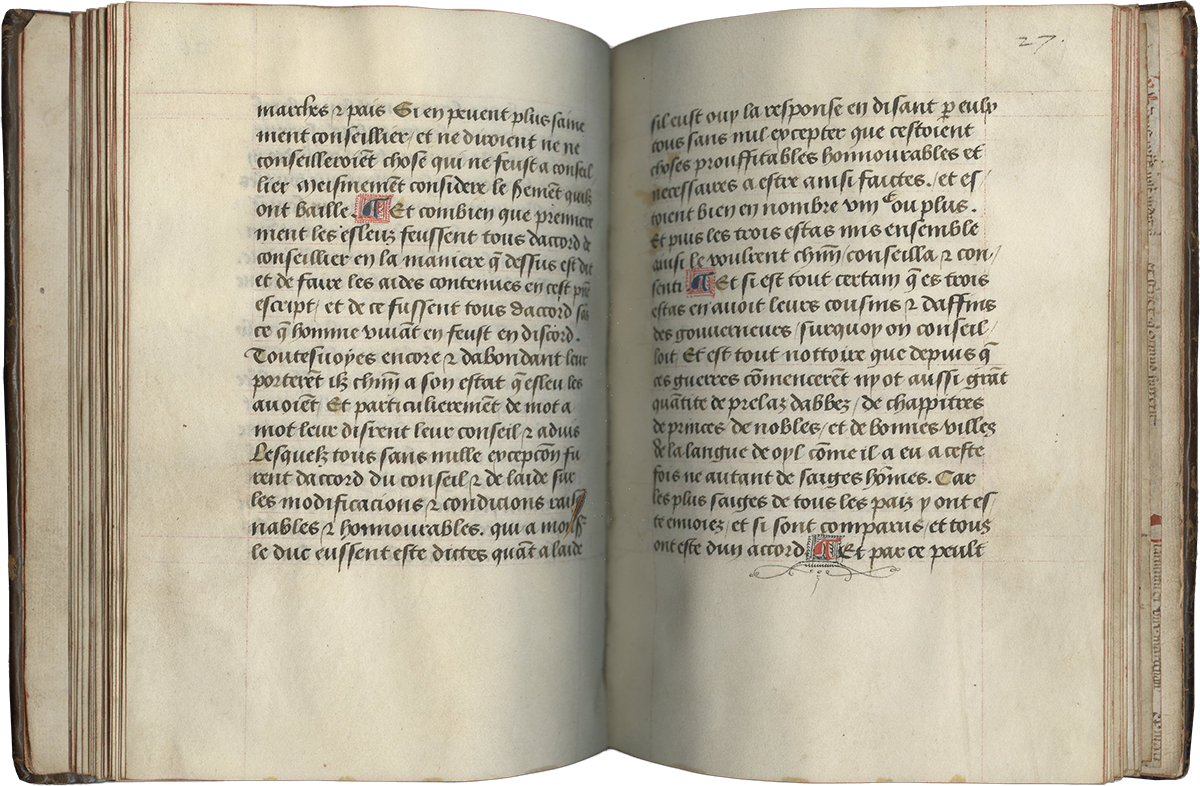
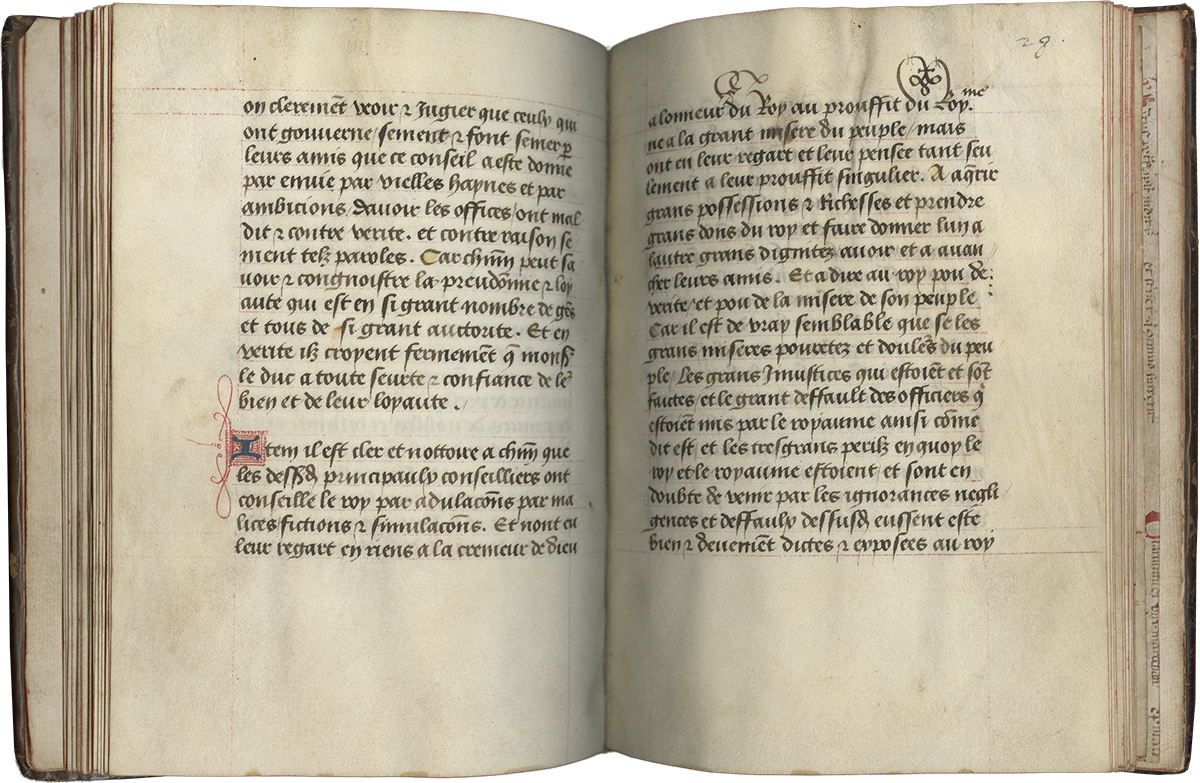
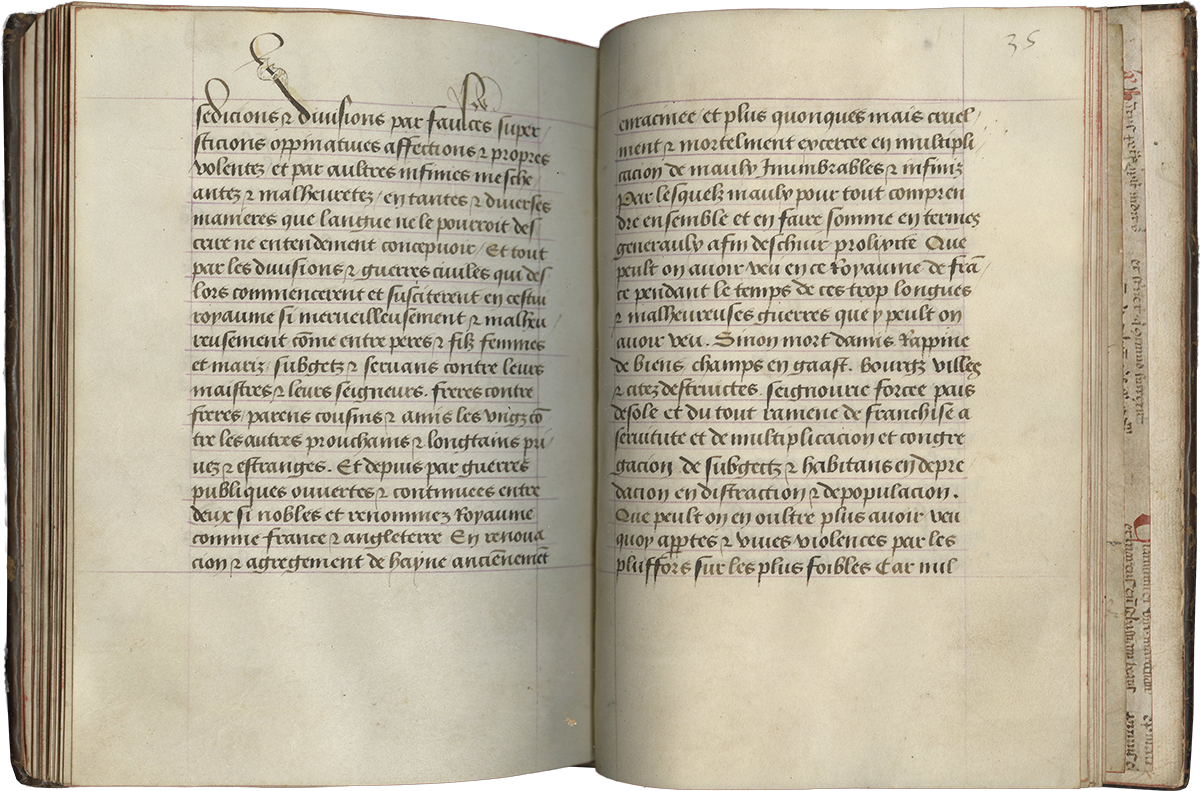
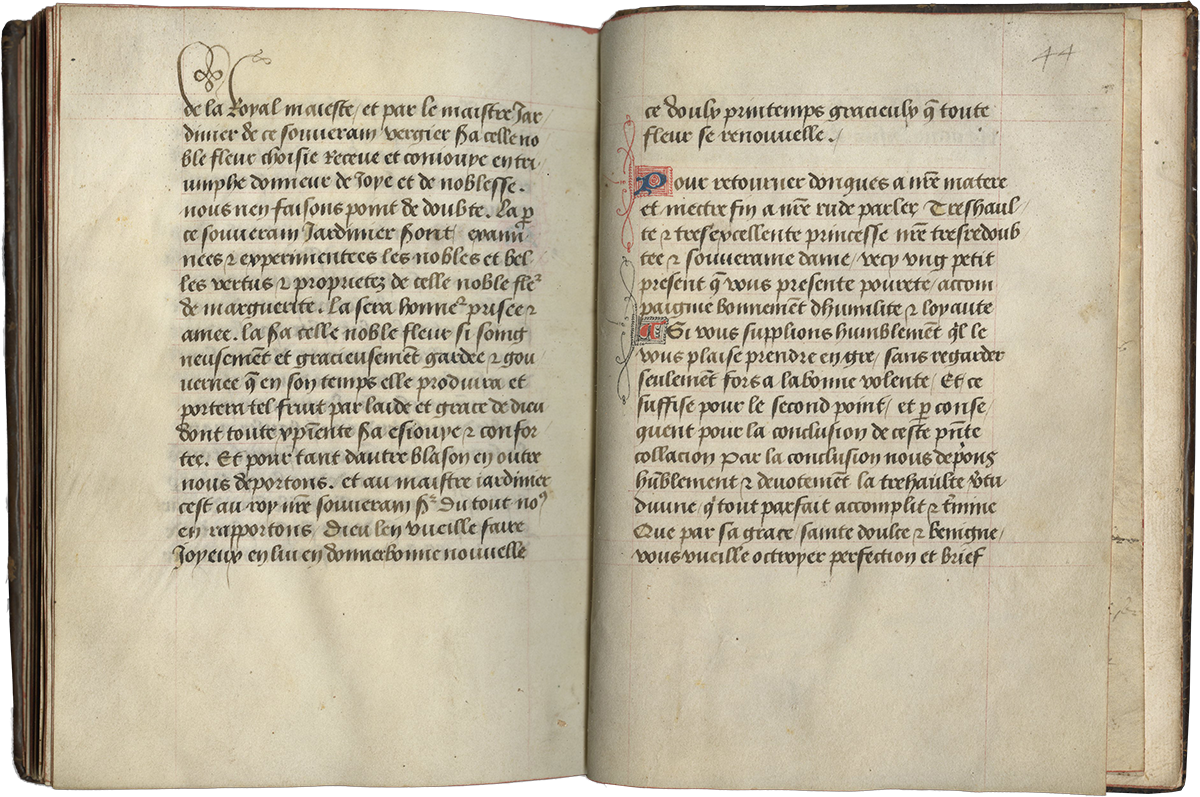
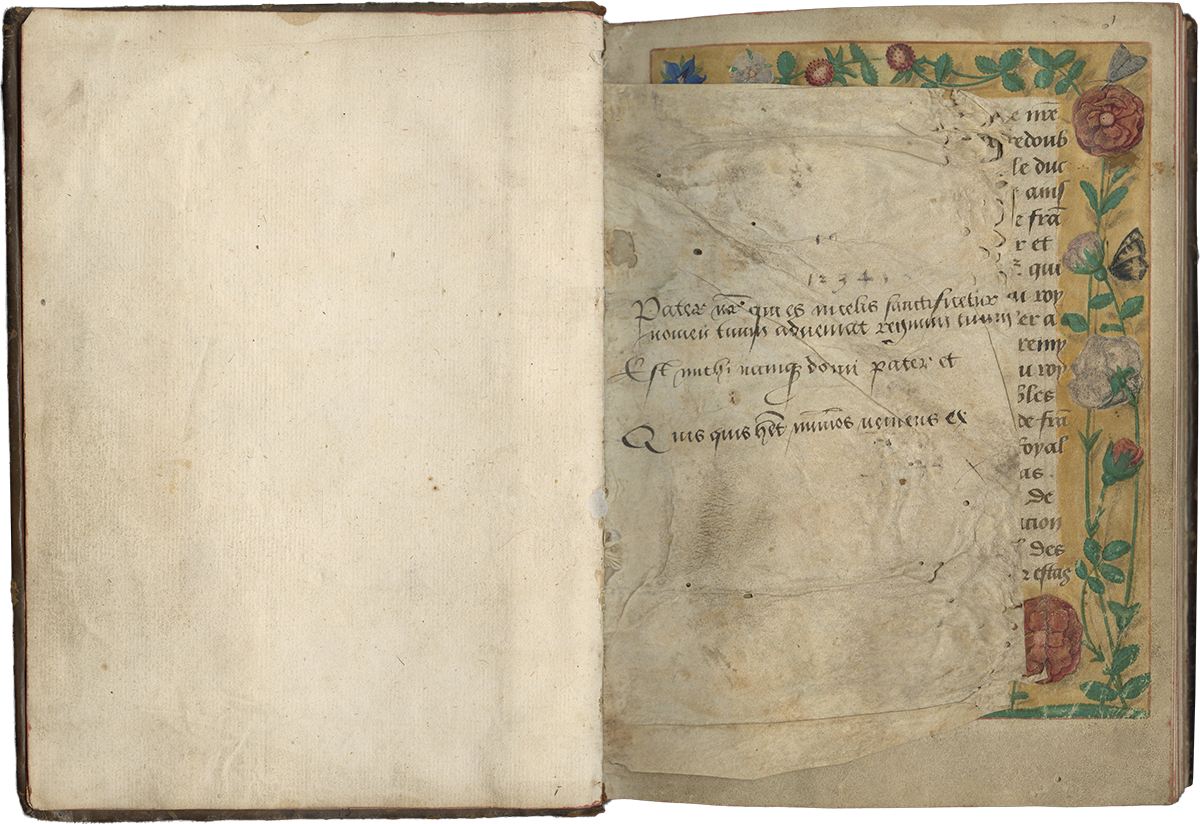
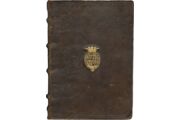
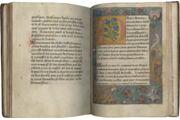
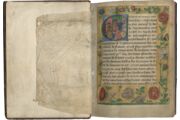
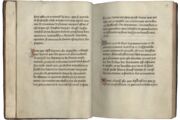
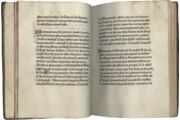
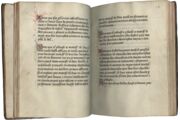
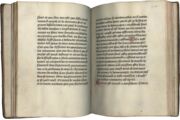
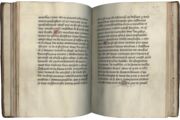
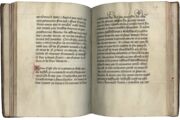
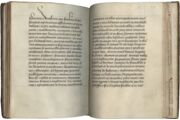
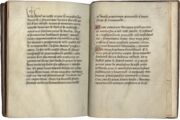
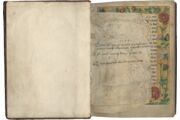
ii paper + i (middle section of former pastedown, bound sideways) + 44 folios + i (bifolium lacking i) + i (former pastedown) + iii paper, foliated in a sixteenth-century hand in arabic numerals, no catchwords or quire signatures (collation: i-v8, vi4), first text ruled in red, second in plummet (justification 125 x 94 mm), 19 long lines, fine bâtarde script, likely the hand of Quentin Poulet, majuscules flashed in yellow, one-line initials and paraph marks in blue flourished with red or red flourished with dark blue, two full strewn borders, ONE HISTORIATED INITIAL (f. 1), some wear to borders and initials ff. 1 and 33, part of end parchment flyleaf excised at top, cutting slightly into the former pastedown. 17th-century British brown calf over pasteboard tooled in blind with a double fillet, recased probably for Henry Pelham-Clinton, 4th Duke of Newcastle (1785-1851), his arms gilt on upper cover, title gilt on spine; the lower former pastedown is part of a bifolium from the Sanctorale of a breviary, with red and brown initials, celebrating feasts in June, including Marcus and Marcellianus, Gervase and Protasius, and Peter and Paul (joints rubbed, light scuffing to covers). Dimensions 208 x 147 mm.
The present description places this unique manuscript within both the Tudor and the Stuart courts for the first time. Newly identified, the volume marks one of fewer than a handful of works apparently copied by King Henry VII’s librarian Quentin Poulet, and it was compiled for Margaret Tudor in advance of her marriage to James IV of Scotland. The gift book reveals Henry VII’s concerns for his young daughter, leaving England to spend the rest of her life running a foreign, often antagonistic, court and provides important new insights into women’s history and the history of queenship.
Provenance
1. Script seems to match that of Quentin Poulet (active 1477-1506), Henry VII’s librarian, stationer, and copyist who worked from Richmond, outside of London. The border art suggests that this volume was among those Poulet sent across the Channel for decoration in Bruges in advance of Margaret Tudor’s marriage in 1502.
2. On the parchment endleaf the sixteenth-century hand that foliated the leaves has provided a list of contents, the opening lost with the excised leaf.
3. “William Adamson burges of Edinburgh anno 1526”: inscribed on the breviary bifolium flyleaf. Probably William Adamson the Elder, merchant and burgess of Edinburgh (d. by May 1528), whose biography is confused with that of his son, also William, intermittently Bailie of Edinburgh between 1513 and 1536. The father married Jonet Turing, whose kinswoman, Katherine Turing was wife to Patrick Creighton or Crichton of Cranston Riddell (see Durkan, 1985). A different sixteenth-century hand has written on the final end leaf, verso: “Monsur de Horsle est en Edinbroucht en la maison de Jacques Hug/Hog prisoner de monsur le cappetyne amene(?) Cranston.” Captain Cranston could be one of the Creightons of Cranston Riddell, Adamson’s wife’s relations and Captains of Edinburgh Castle: Patrick, from 1514 to his death in 1521, or his son, James, 1523-1540; Hug or Hog(g) is a common Scottish name; (de) Horsle or Horsley is a name borne by several gentry families in Northumberland, many of whom served in English armies against Scotland or were involved in Anglo-Scottish relations. As Bailies of Edinburgh with connections with Edinburgh Castle, the Adamsons certainly worked within the larger royal, courtly orbit.
4. The name “ffayrfax,” written several times on the former pastedown was not restricted to one family. It is in a sixteenth-century-hand and the -y spelling was largely abandoned in the early 17th century, which rules out the antiquarian Colonel Charles Fairfax (1597-1673). If ever owned by a member of this family, it was not in the sale of their library, kept at Leeds Castle, Christie’s, 10 January 1831.
5. Henry Pelham-Clinton, 4th Duke of Newcastle (1785-1851): arms on the binding include the Order of the Garter, conferred in 1812. He added considerably to the books collected by his grandfather, the 2nd Duke, and in 1833 purchased the library of William Johnes of Hafod (1748-1816), the likely sources of the present manuscript. Johnes, the translator of Froissart and other French chroniclers, had an impressive collection of manuscripts. The Newcastle library was housed at Clumber Park, passing by descent until sold in 1937-1938 by the future 9th Duke of Newcastle (1907- 1988): Sotheby’s, The Clumber Library […], IV, 14-16 February 1938, lot 1297, bought by Maggs, Catalogue 697, 1940, p. 39.
6. James Patrick Ronaldson Lyell (1871-1948), London, solicitor, author, book collector, and biographer, his book label inside upper cover, bought from Maggs 29 May 1941, pencil note inside upper cover. Sold by his executors to Quaritch, Catalogue 699, 1952, no 49: cutting pasted onto first front flyleaf.
7. Sotheby’s, 19 June 1990, lot 96.
8. Martin Schøyen, Oslo, Norway and London, UK (born January 31, 1940), a Norwegian businessman, traveler, historian, and collector of books; The Schøyen Collection, MS 678, his ex-libris, pencil shelfmark on final flyleaf.
Text
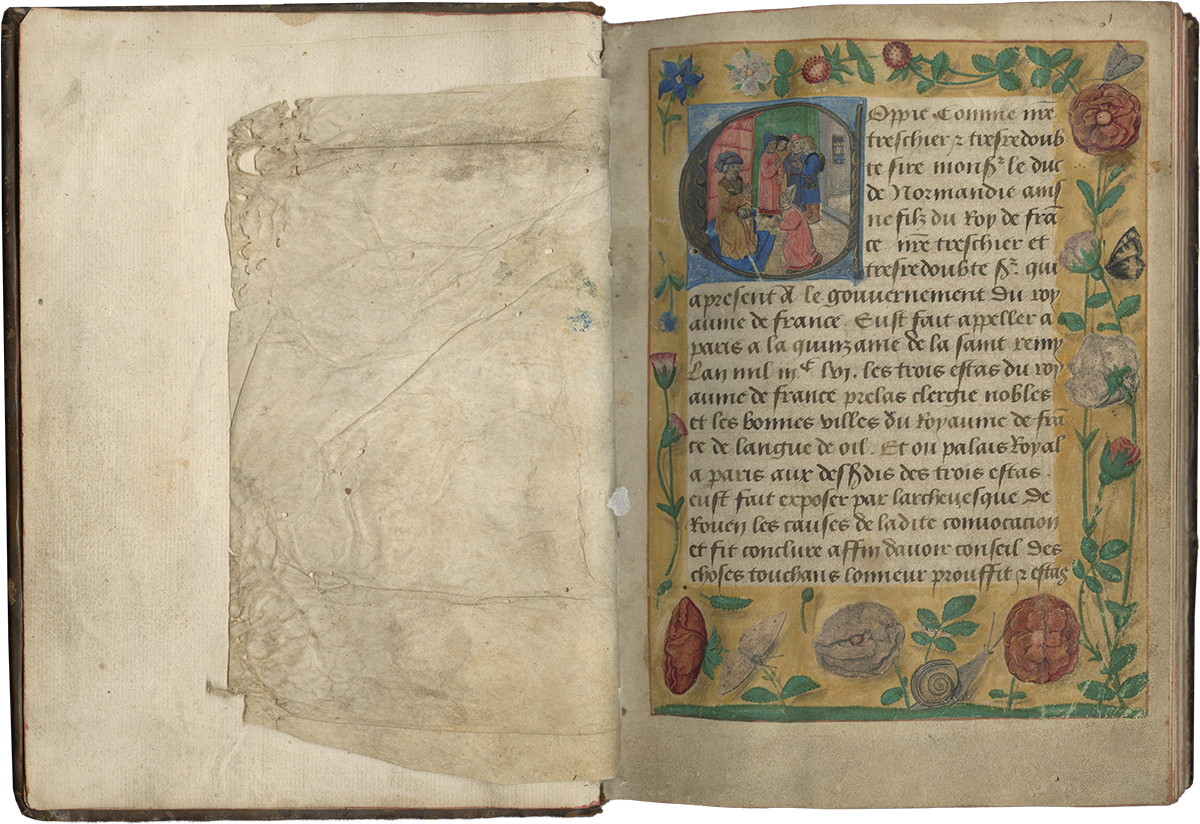
ff. 1-32v; Journal of the Estates-General of Northern France (Langue d’oil) held in Paris, October, 1356, incipit, “Coppie. Comme nostre treschier et tresredoubte sire le duc de normandie […] quilz eussent acquittez leur loyaultez se ledit conseil ne lui donnassent”;
With John II prisoner in England since the defeat at Poitiers on 19 September, the Dauphin, Charles, the Duke of Normandy, called the Estates-General to meet in Paris on 15 October 1356. The competing desires of each party remain familiar to this day. The future Charles V needed men and money to continue the war. In contrast, the three estates of clergy, nobility and burgesses, wished for redress of their grievances in exchange for any levies. Their demands, presented by Jean de Craon, Archbishop of Reims and recounted here in the Journal, were unacceptable to the Dauphin, who effectively dissolved the meeting by leaving Paris. Despite its failure, the Estates’ bid for a greater role in government remains a significant moment in French history.
Though not an official record, the Journal is the fullest record of this important meeting. The earliest surviving copy from the first half of the fifteenth century is incomplete, opening at the end of f. 17v of the present manuscript (Paris, Bibliothèque nationale de France, MS fr. 5273, ff. 15-21). The earliest complete copy is in a miscellany assembled for Sir Robert Cotton (1571-1631), paired there also with the address to Margaret of Anjou, written and illuminated to the same format, and so presumably made just after her English marriage in 1445 (London, British Library, Cotton MS Titus D XII, ff. 58-74). The Cotton manuscript was the basis of the edition (Delachenal, 1900). From a sampling of the Journal text, variations between Cotton and the present copy seem to go beyond scribal error or choice, and only sometimes coincide with variants in the earliest fragmentary copy. Nevertheless, the present copy seems generally closer to Cotton than to the edition prepared from two later manuscripts (Recueil général des anciennes lois françaises, 1821, pp. 771-795).
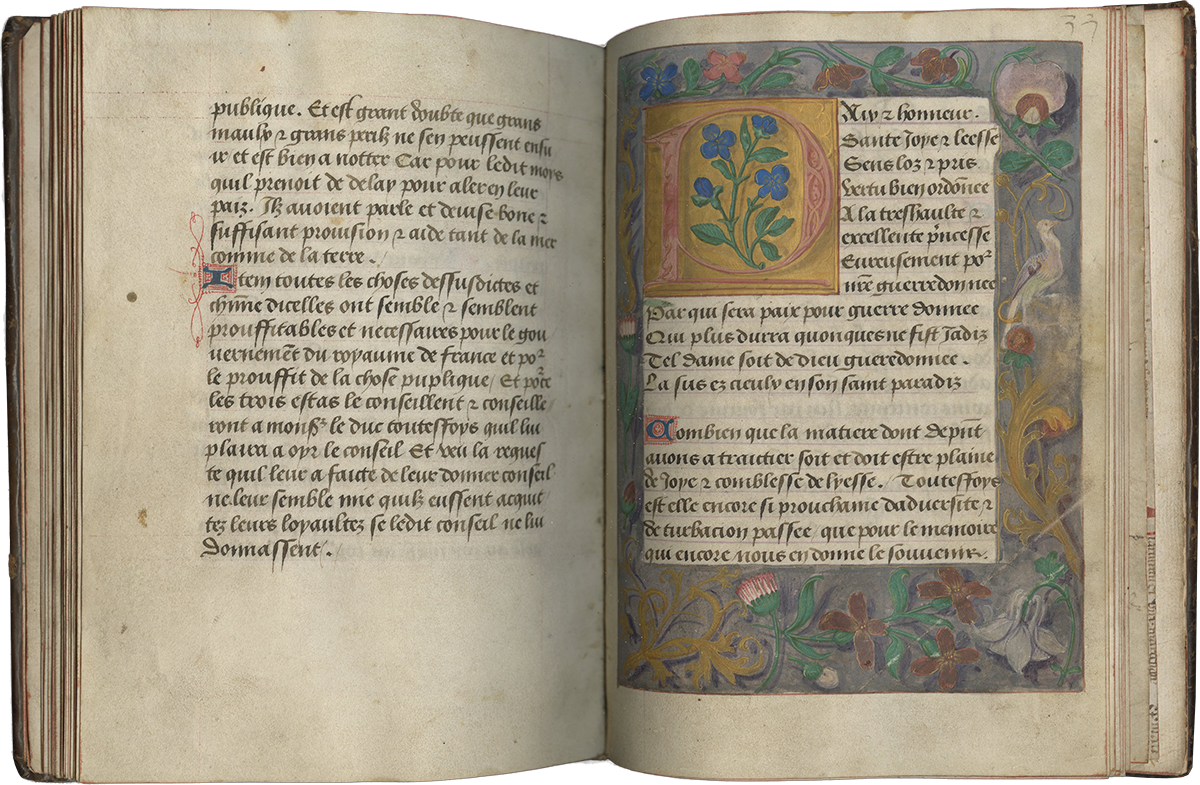
ff. 33-44v, Address from the city of Rouen to Margaret of Anjou, Queen of England and France, on the occasion of her Entry 22 March 1445, incipit, “Paix et honneur Sante Joye et leesse Sens loz et pris vertu bien ordonee A la tres haulte excellente princesse […] and ending […] vous vueille octroyer perfection et brief accomplissement de tout ce que vostre tres noble cueur desire Amen.”
Though Margaret of Anjou (1430-1482) is not explicitly named in the address by the city of Rouen, the text lauds the virtues of a French princess who is marrying the King of England and France, a marriage that the author hopes will bring longed-for peace to both realms. Both this desire and the exposition on the virtues symbolised by the flower called ‘marguerite,’ the daisy, suggest that the new Queen is Margaret, daughter of René, Duke of Anjou, who married Henry VI of England (and France) by proxy in May 1444 before journeying to join her husband in England in 1445. The accompanying Truce of Tours meant that Margaret was heralded as a bringer of peace in England and English-held France, through which she passed on her way to England. Rouen staged a formal welcome for her, including this address that stressed the need for peace and the importance of Margaret’s role in ending the wars.
The Address has not been edited. The only other copy known to us is that in the Cotton manuscript, where it is also paired with the Journal. The borders opening the two Cotton texts indicate a shared French origin close to 1445, probably in Rouen. However, names and inscriptions show that the two were in England from an early date and perhaps remained within Lancastrian circles (Tite, 2003, p.199). A Peter Weston signed the final leaf of the pair of texts in the Cotton copy (f. 80), and a Peter Weston served as receiver for Henry Percy, earl of Northumberland and staunch Lancastrian, and earlier a Peter Weston served as bailiff of Coventry, a Lancastrian stronghold where the Weston family was strong, with close ties to Lancastrian Richard Neville, earl of Warwick (Tite, 2003, 199, TNA, West Sussex Record Office, History of Parliament). Thus, the present copy would repay further study to elucidate the evident history of these texts in England after Margaret’s arrival in 1445 and their possible circulation within the Lancastrian court.
Illustration
f. 1, the future Charles V receives the demands of the Estates from Jean de Craon, Archbishop of Reims; in the background, his father John II, crowned and in a surcoat of gold fleur de lys on blue, is seen behind the bars of his English prison.
The small scale of the historiated initial makes precise attribution difficult. The Workshop of the Master of the First Prayerbook of Maximilian, active in Ghent and named from the manuscript made for the future Emperor (Vienna, ÖNB cod. 1907) produced similarly stocky figures, for instance in the Breviary of Eleanor Portugal dated 1500-1510 (New York, Morgan Library, MS M.52). It bears stating that the subject, and therefore the iconography, was entirely unique to this manuscript, and the inclusion of John II in prison in this scene may argue for an English commission.
The attractive strewn borders were popular from their origin in the Burgundian court c. 1480 (the earliest datable were gifts from Margaret, Duchess of Burgundy and sister to English kings Edward IV and Richard III to English religious institutions) well into the 16th century and beyond.
Whilst earlier understanding of this manuscript identified it as a Flemish product ordered for reasons unknown around 1490 and later acquired by the Scottish merchant Adamson, the present description proposes instead that the volume was commissioned in England Margaret Tudor (1489-1541) herself, or someone in her court in advance of her marriage to James IV of Scotland following the Treaty of Perpetual Peace (1502). Like Anjou, Tudor was married by proxy, and joined her husband in Scotland only later, in 1503, after a grand progress north. The treaty followed a truce of several years’ standing, during which time the marriage and other stipulations of the agreement were decided, and during which this volume, a kind of “Mirror for Princesses on Their Foreign Marriages” might have been arranged. Such a scenario fits the present manuscript thematically, textually, and artistically.
Like Margaret of Anjou before her, Margaret Tudor was married off as part of a peace treaty between traditional foes. (Sadly, neither peace held long.) The Address might easily be read as voicing both English and Scottish hopes for the new, foreign queen. Likewise, medieval wars were costly, and had forced both England’s Edward III and France’s Dauphin Charles, and many kings after them, to negotiate taxation with legislative bodies. Thus, whilst the 1356 Estates General was famous in France as a step toward representative government and taxation, the same financial demands of war were equally famous in England for empowering a robust Parliament. From a royal perspective, this was not desirable. Therefore, from a royal perspective, peace helped to prevent a further erosion of royal prerogatives by removing the necessity of cooperating with Parliament (and the Estates). Thus the two texts within the volume thematically reinforce each other. In 1444 the paired texts had provided a necessary caution to a new French queen in England, and in 1502, they offered a vivid reminder for a new English queen in Scotland, too. Textually as well the present copy seems closest to the Cotton copy, suggesting that the copytext was English, even if the copyist and limner were not.
These borders are notable for their careful inclusion of Margaret Tudor’s royal tokens, the red and white roses claimed by Henry VII (1457-1509), and Margaret’s daisies (shared with both her grandmother, Margaret Beaufort, and the earlier foreign queen Margaret of Anjou). Indeed, the flowers infilling the initial beginning the Address are forget-me-nots: the reader is called to remember an earlier foreign queen Margaret who brought peace as a dowry. Notably lacking are James IV’s Scottish thistles, an absence suggesting that the book was intended for Margaret or her circle in advance of the marriage, rather than for the royals as a couple. (This absence further argues against this being a Scottish commission from Flanders on Margaret's behalf.) After their brief popularity late in Edward IV’s court, there was a boom in royal English commissions of Flemish strewn borders as Henry VII began to settle his childrens’ marriages in the later 1490s and early 1500s (Kennedy, 2026). At least one other Flemish manuscript was likely commissioned for Margaret’s marriage, an Anglo-Scottish chronicle copied by Henry VII’s French librarian, stationer, and scribe Quentin Poulet (s.1492-1506) and illuminated by the Flemish Master of the Prayer Books Around 1500 (London, British Library, Lansdowne Charter MS 4; Gay, 2003, p. 520). Members of the Dutch Masters of the Dark Eyes emigrated to England and began working for the Tudor court, including painting strewn borders on volumes intended for Prince Arthur (1486-1502), around 1500, but the present volume’s borders do not bear their signature motifs or techniques, arguing for a production date after the truce with Scotland (1497), but before the arrival of the Masters, as negotiations, including marriage negotiations, were ongoing through this period (Broekhuijsen, 2009).
Whilst the bâtarde script is known to be uniquely French and Flemish, Poulet copied manuscripts in that hand in England. Although the different ruling colors evince two different stints of work, Poulet seems to have copied both texts, as letterforms and aspect evince identity with his signed holograph (and a more standard mirror for princes dated 1496), London, British Library, Royal MS 19 C VIII, and also seem similar to those in the English Lansdowne Charter 4. Further, we also know that Poulet sometimes shipped undecorated books to Flanders for illumination (including both the Royal volume and the roll). Only further research into the limner and further study of the textual stemma can resolve the puzzles presented by this fascinating book.
Literature
Backhouse, Janet. “Founders of the Royal Library: Edward IV and Henry VII as Collectors of Illuminated Manuscripts,” in England in the Fifteenth Century: Proceedings of the 1986 Harlaxton Conference, ed. Daniel Williams, Woodbridge, 1987, pp. 23-42.
Broekhuijsen, Klara. The Masters of the Dark Eyes: Late Medieval Manuscript Painting in Holland, Turnhout, 2009.
Chichester, West Sussex Record Office, PHA/7215.
Delachenal, R. “Journal des États généraux réunis à Paris au mois d’octobre 1356,” Nouvelle revue historique de droit français et étranger, 24 (1900), pp. 415–465.
Durkan, J. ed. The Protocol Book of John Foular, 1528-1534, Scottish Record Society, 1985.
Gay, Richard. “Selected Scribe Biographies,” in Illuminating the Renaissance: The Triumph of Flemish Manuscript Painting in Europe, ed. Thomas Kren and Scot McKendrick, Los Angeles, 2003, pp. 518-21.
Kennedy, Kathleen E. “Inventing English Renaissance Art: Henry VII’s Cosmopolitan Chapel Indentures,” The Open Book: Essays on Manuscripts and Early Printed Books in Honour of Martha W. Driver, eds. Carrie Griffin, Michael P. Kuczynski, and Niamh Pattwell, Turnhout, 2026.
Kew, The National Archives, E40/8446.
Morrison, Elizabeth. “To Have and to Hold: Marriage, Politics, and Iconography in the Prayer Book of Margaret Tudor,” ed. Joyce Coleman, Mark Cruse, and Kathryn Smith, The Social Life of Illumination: Manuscripts, Images, and Communities in the Late Middle Ages, Turnhout, 2013, pp. 473-504.
Tite, Colin. The Early Records of Sir Robert Cotton’s Library, London, 2003.
Wingfield, Emily. Scotland’s Royal Women and European Literary Culture, 1424-1587, Turnhout, 2024.
Online Resources
Faral, E. “Robert le Coq et les États genéraux d’octobre 1356,” Revue historique de droit français et étranger, 23 (1945), pp.171–214. https://gallica.bnf.fr/ark:/12148/bpt6k163295
Hannay, R. K. “Shipping and the Staple, A.D. 1515-1531,” The Book of the Old Edinburgh Club, 9 (1916), pp.49-77. https://oldedinburghclub.org.uk/wp-content/uploads/2024/12/BOEC_OS9_1916_R.K._Hannay_Shipping-and-the-Staple-1513-1523.pdf
Kren, Thomas, and Scot McKendrick, ed. Illuminating the Renaissance: The Triumph of Flemish Manuscript Painting in Europe, Los Angeles, 2003. https://www.getty.edu/publications/virtuallibrary/0892367040.html
de la Mare, A. C. Catalogue of the collection of medieval manuscripts bequeathed to the Bodleian Library, Oxford by James P. R. Lyell, Oxford, 1971. https://ora.ox.ac.uk/objects/uuid:90fa886b-11a1-4e98-b587-00d11e8095ff
Recueil général des anciennes lois françaises. IV, Paris, 1821, pp. 771-795. https://gallica.bnf.fr/ark:/12148/bpt6k6503915w?rk=987129;2
Woodgar, L. S. “WESTON, John (d.c.1433), of Coventry, Warwick and Worcester,” in The History of Parliament: the House of Commons 1386-1421, ed. J.S. Roskell, L. Clark, C. Rawcliffe., Woodbridge, 1993. https://www.historyofparliamentonline.org/volume/1386-1421/member/weston-john-1433