


Monastic Choir Miscellany, including a selected Tonary and Processional
In Latin, illuminated manuscript on parchment
Italy, c. 1450
TM 1473
- $15,000.00
 Textmanuscripts - Les Enluminures
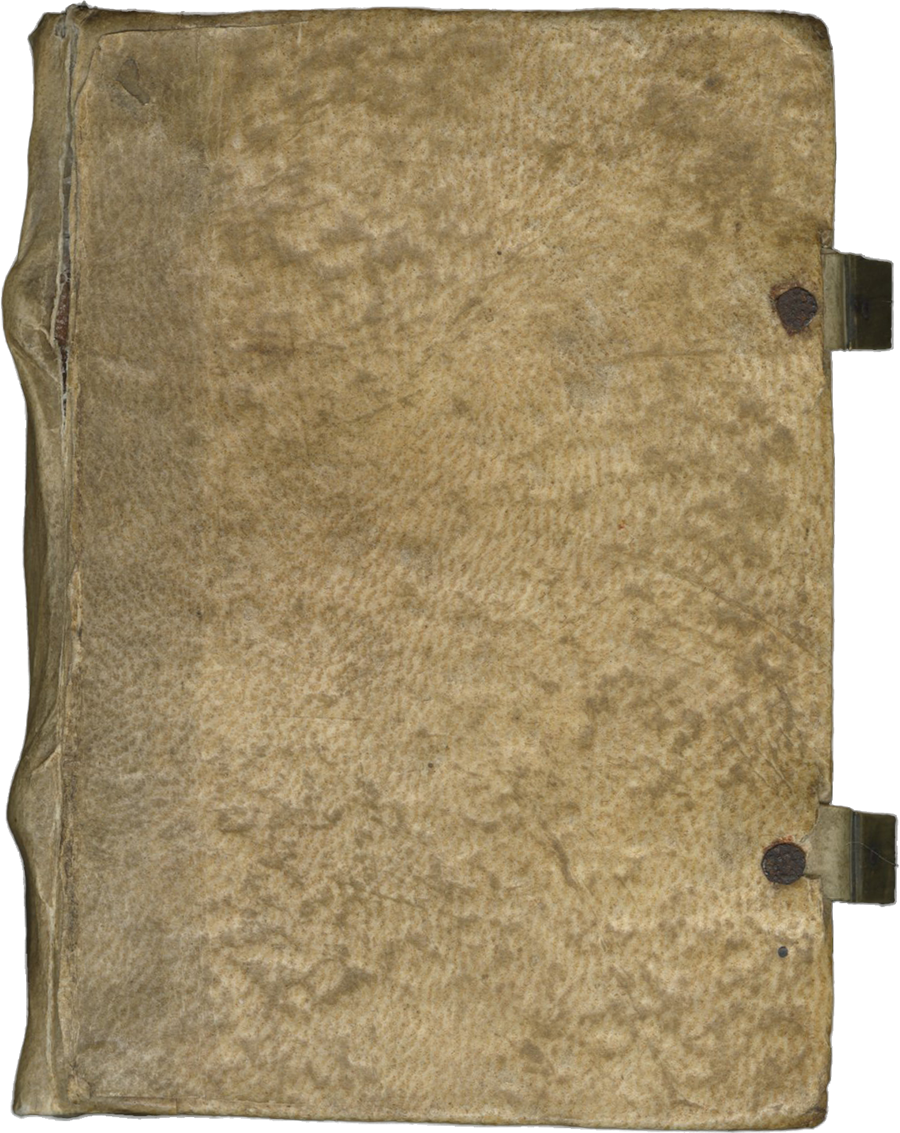
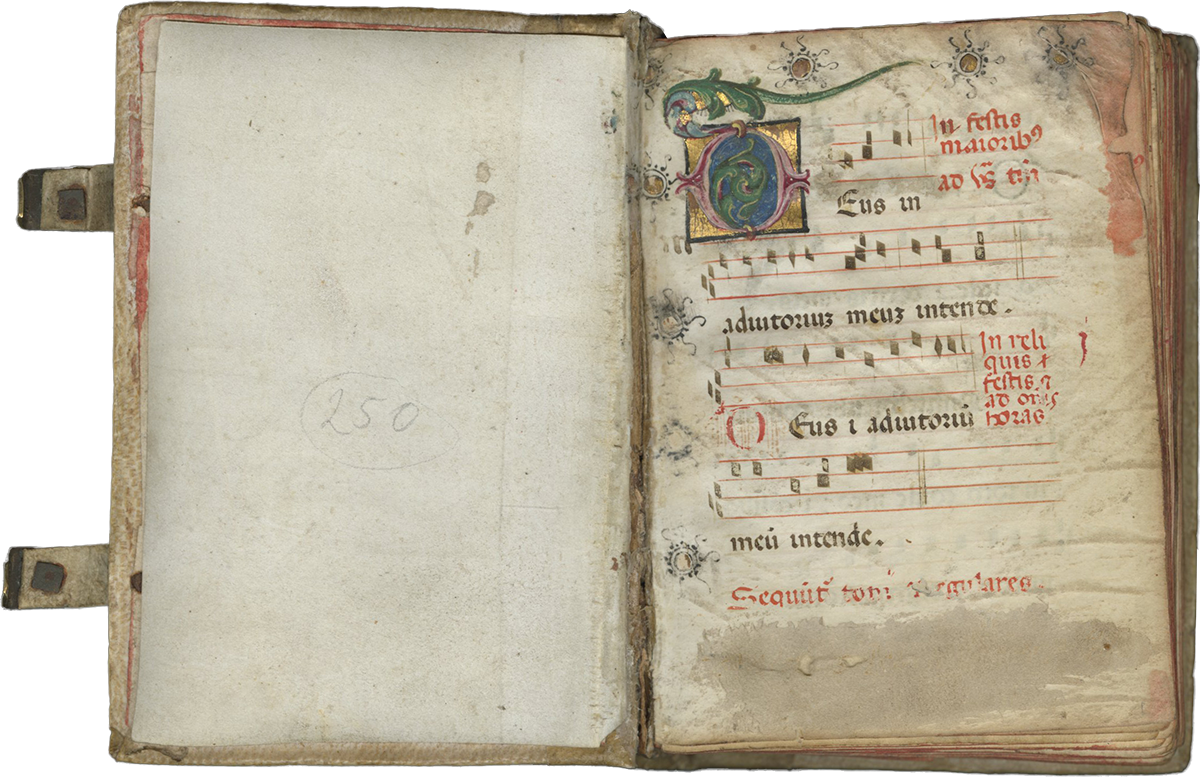
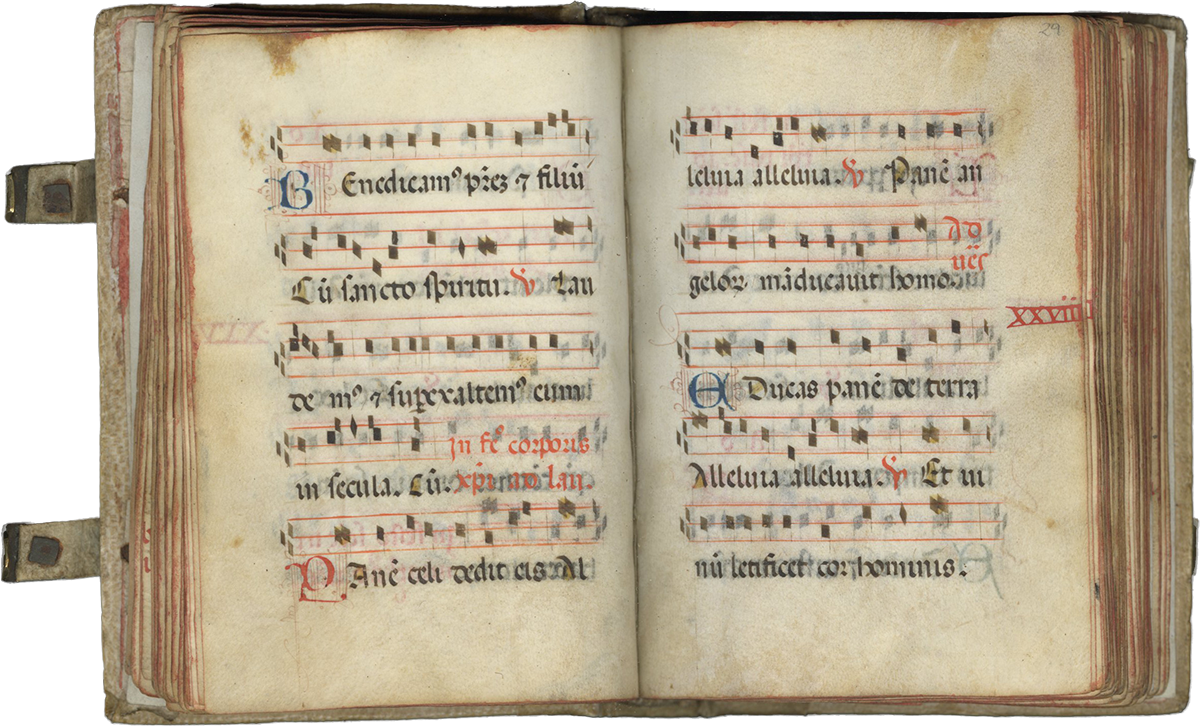
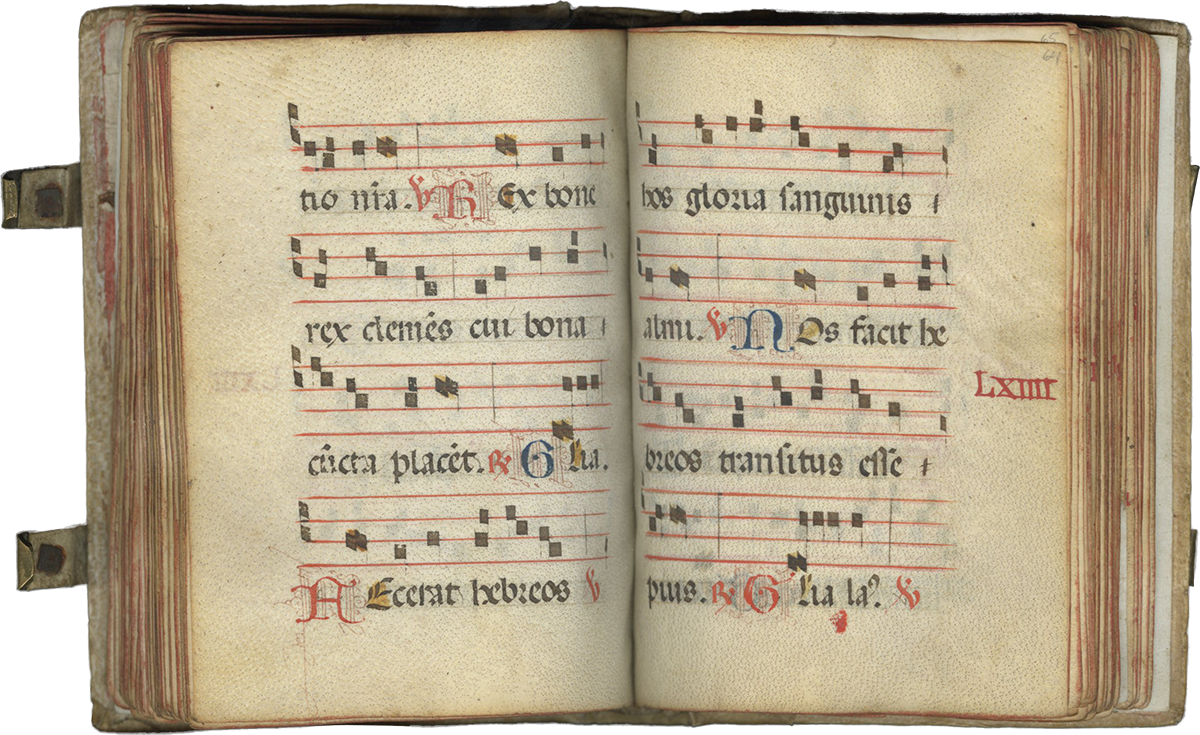
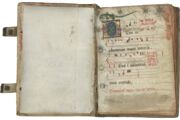
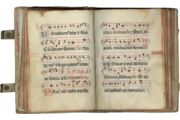
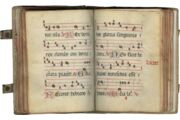
i+97+i parchment folios, original foliation in red in right margin I-LXXXVII, CXXVIII-CXXXI, CLV-CLX and in pencil in upper right corner (used here), no catchwords, incomplete, (collation: i-x8 xi8-8 [quires missing] xii4 [apparently missing 3 quires] xiii8-7, 8), ruled in ink in 22 lines, single column, (justification 80 x 52 mm) in several rotunda scripts, square notes on three- or four-line staves, majuscules flashed in yellow, one-line ink initials in red and blue flourished in red, three-line foliate initial with marginal extensions and bezants (f. 1), occasional stains and marginal defects, some cut folios, 2 leaves repaired, first leaf rubbed. Later parchment binding with two clasps, rebacked. Dimensions 115 x 80 mm.
This charming hand-held book includes an exceptionally rare and complex music text – a Tonary, of which evidently only four have appeared on the market since 1900. It also includes a Processional. It was certainly a personalized book, no doubt carried about by a medieval monk to help him remember the dizzying array of specific notation necessary for a range of occasions, including the solemn processions around the monastery’s church during liturgical feasts.
1. Both script and decoration point to this book’s origin in mid-late fifteenth-century Italy. A number of other features demonstrate use in a monastery: the volume references twelve lections rather than the nine employed in secular use (including by the Franciscans, Dominicans, and Augustinians), the diminutive size and extreme level of personalization suggests a volume carried on the person and used frequently, and a reference to “duo fratres vel quatuor” (either two or four brothers) in one set of processional instructions suggests monks rather than nuns (Hughes, 1982, p. 62; f. 59v).
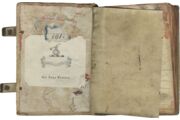
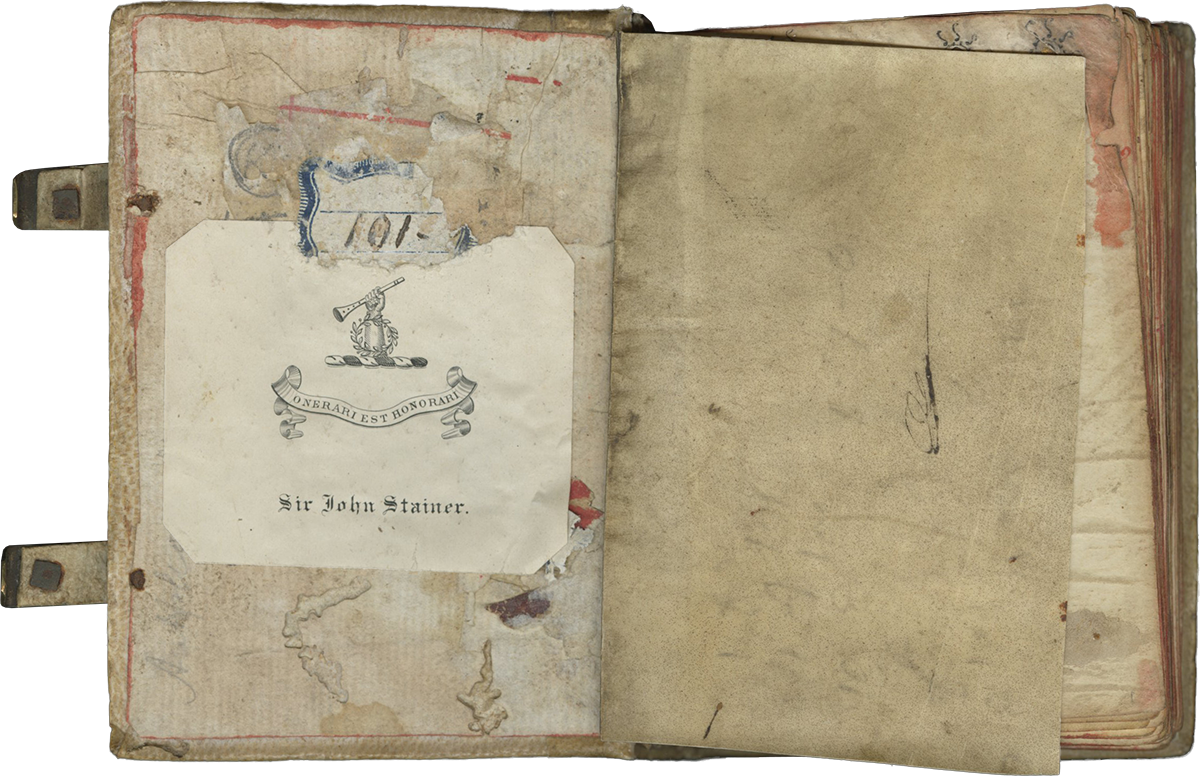
2. A library sticker partly effaced on the front pastedown, reading in part “101,” partly underneath John Stainer’s bookplate. This sticker overlaps an earlier mark, a pencil K inside a circle, with writing underneath now obscured by Stainer’s bookplate (see 3 below).
3. From the collection of the English organist, composer, Oxford professor, and book collector Sir John Stainer (1840-1901); his bookplate on the front pastedown. Stainer’s books were left in the care of his eldest son and fellow musician and scholar, John Frederick Randall Stainer (1866-1939) (Dibble, 2007, p. 309).
4. J. F. R. Stainer sold parts of Stainer’s music library in several tranches. The earliest were offered in 1919 (Quaritch’s no. 355, see Online Resources). In 1932 the largest portion of the library was sold in a single lot to the Anglo-American ragtime pianist Walter Newton Henry Harding of Chicago, who willed the entire thing to the Bodleian Library at his death in 1973 (Dibble, 2007, p. 310).
5. The present manuscript was among the last of Stainer’s collection to be sold by J. R. F. Stainer, evidently through Hôtel Drouot, Paris, Livres anciens, romantiques et modernes. Jolies reliures romantiques, 12 July, 1934 (Dibble, 2007, p. 310; SDBM MS 1100).
6. Sold by Sotheby's 5 July, 1976, Western Manuscripts and Miniatures, lot 92 (SDBM MS 1100).
7. Private European Collection.
ff. 1-21v, Tonary, a miscellaneous set of tones, with rubrics indicating “regular,” “irregular,” “for the choir lessons,” “for the martyrology,” and more, and including settings for the Nunc sancte for use during various Advent and Christmastide feasts through to Pentecost and throughout the Temporale of the year and the Common of the saints, of the Benedicamus, again for a range of feasts, and for the office lections from the epistles followed by the gospels, and more;
ff. 22-44v, Antiphonal and Gradual, including select Lauds and Vespers responsories and versicles through Advent and feasts of the Temporale, ending with the Dedication of a Church and followed by the Common of the Saints; various settings for the Gloria and Ite missa; antiphons for the Office of the Dead;
ff. 44v-68, Processional, including antiphons and instructions for the processions for the Purification of the Virgin and Palm Sunday;
ff. 68-91v, Sequentiary, containing sequences for various hours of the Office of the Dead
ff. 92-97v, (fragmentary), a portion of the Office of the Dead itself, with noted antiphons, missing much due to lost quires.
The musicologist and liturgist Andrew Hughes called Tonaries “complicated book[s]” with “greatly variable” contents, and the present example certainly bears out both assertions (Hughes, 1982, p. 114). In their fullest form, Tonaries contained the notes of the modes at which the psalms of the office were sung, with all the necessary variations depending on mode and liturgical season. Whilst the basics were easy enough to remember for those who sang Mass and Divine Office daily, as Hughes puts it, sometimes the details were “complex enough that some reminders were convenient to have at hand” (Hughes, 1982, p. 114). The examples he gives are the comprehensive noted books familiar to any medieval musicologist that were used for singing both the Mass and Divine Office: Antiphonals, Graduals, and Noted Breviaries and Noted Missals.
The present book offers an even more complex and personalized demonstration of this phenomenon, providing selections from each of these kinds of volume, and more. Its highly abbreviated rubrics insist that it contains a Tonary, though certainly only a very selected one. Likewise, it contains a selection of antiphons, and a selected Sequentiary too. It may once have contained a complete Office of the Dead, but enough quires are missing that this section's original comprehensiveness can no longer be certain. It also contains a select Processional, with antiphons and instructions for two different processions: Candlemas (Purification of the Virgin) and Palm Sunday. Processionals include the texts and chants necessary for liturgical processions. Like Tonaries, Processionals are of special interest to musicologists, since they sometimes include texts and music not found in other liturgical manuscripts. Each person within a religious order (whether friars, monks, or nuns) had his or her own Processional, usually small books like the present example.
Further research may determine which order employed the Processional shown in this volume, but Processionals of any kind do not appear for sale very frequently. Tonaries are even more uncommon on the market, and the most recent sales listed in the Schoenberg Database of Manuscripts lists just four sold since 1900, making the present volume a unique opportunity, as a former owner, the composer John Stainer, once recognized.
Dibble, Jeremy. John Stainer: A Life in Music. Woodbridge, 2007.
Hughes, Andrew. Medieval Manuscripts for Mass and Office: A Guide to Their Organization and Terminology, Toronto, 1982.
Huglo, Michel. Les livres de chant liturgique, Turnhout, 1988
Huglo, Michel. Les manuscrits du Processional, Volume I-II, Munich, 1999, 2004.
Bernard Quaritch. A catalogue of manuscripts and books relating to music from the libraries of Dr. W. H. Cummings, A. Huth, A. H. Littleton, Sir John Stainer and other sources (Catalogue no. 355), London, 1919. https://archive.org/details/quaritchcatalogue355/page/n5/mode/2up
Schoenberg Database of Manuscripts, SDBM MS 1100 https://sdbm.library.upenn.edu/manuscripts/1100
“The Harding Collection,” Digital Miscellanies Index, http://digitalmiscellaniesindex.org/about/harding-collection.php
TM 1473