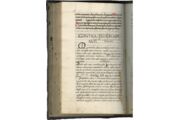


Missal (Use of Wrocław?)
In Latin, illuminated manuscript on paper
Czechia, (Prague?), 1475-1500
TM 1389
- $105,000.00
 Textmanuscripts - Les Enluminures
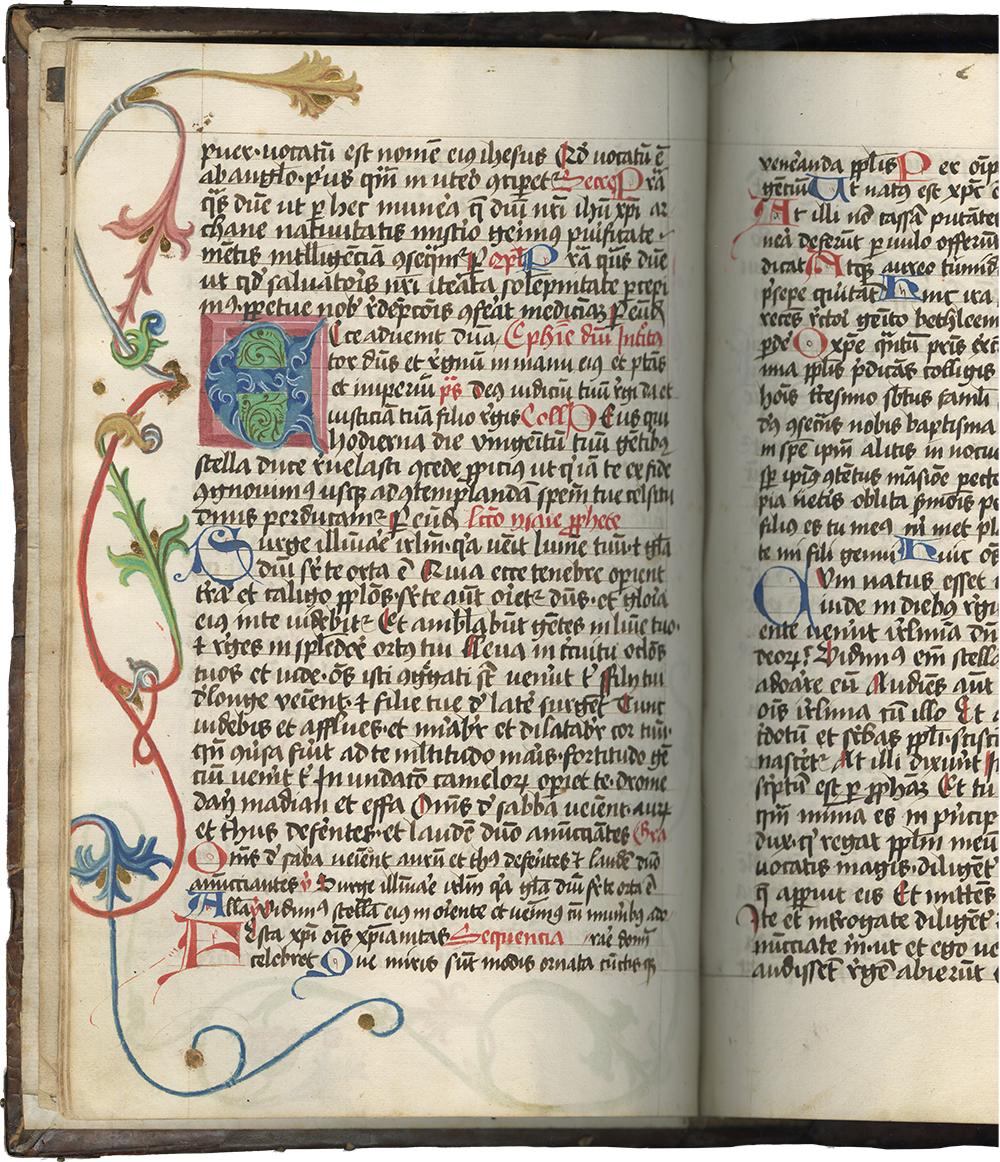
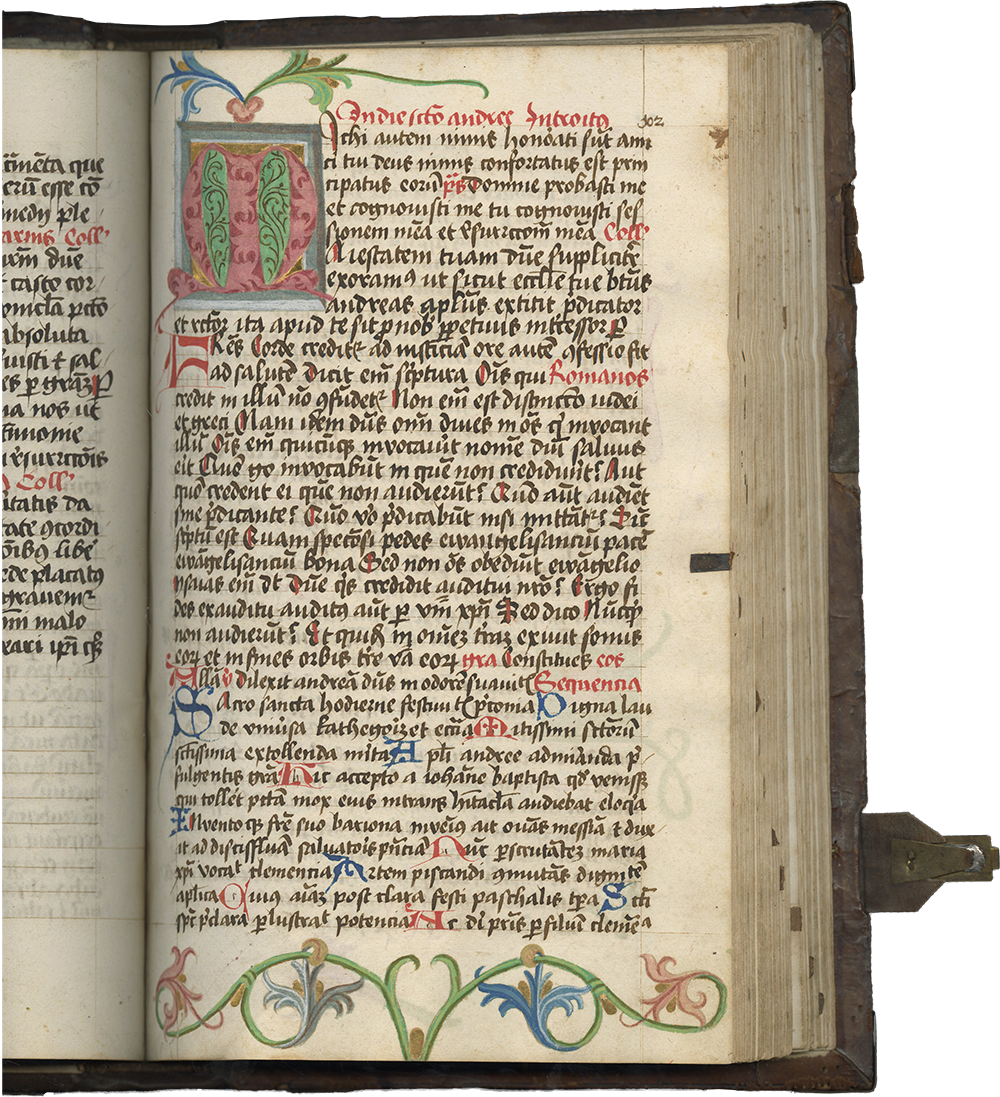
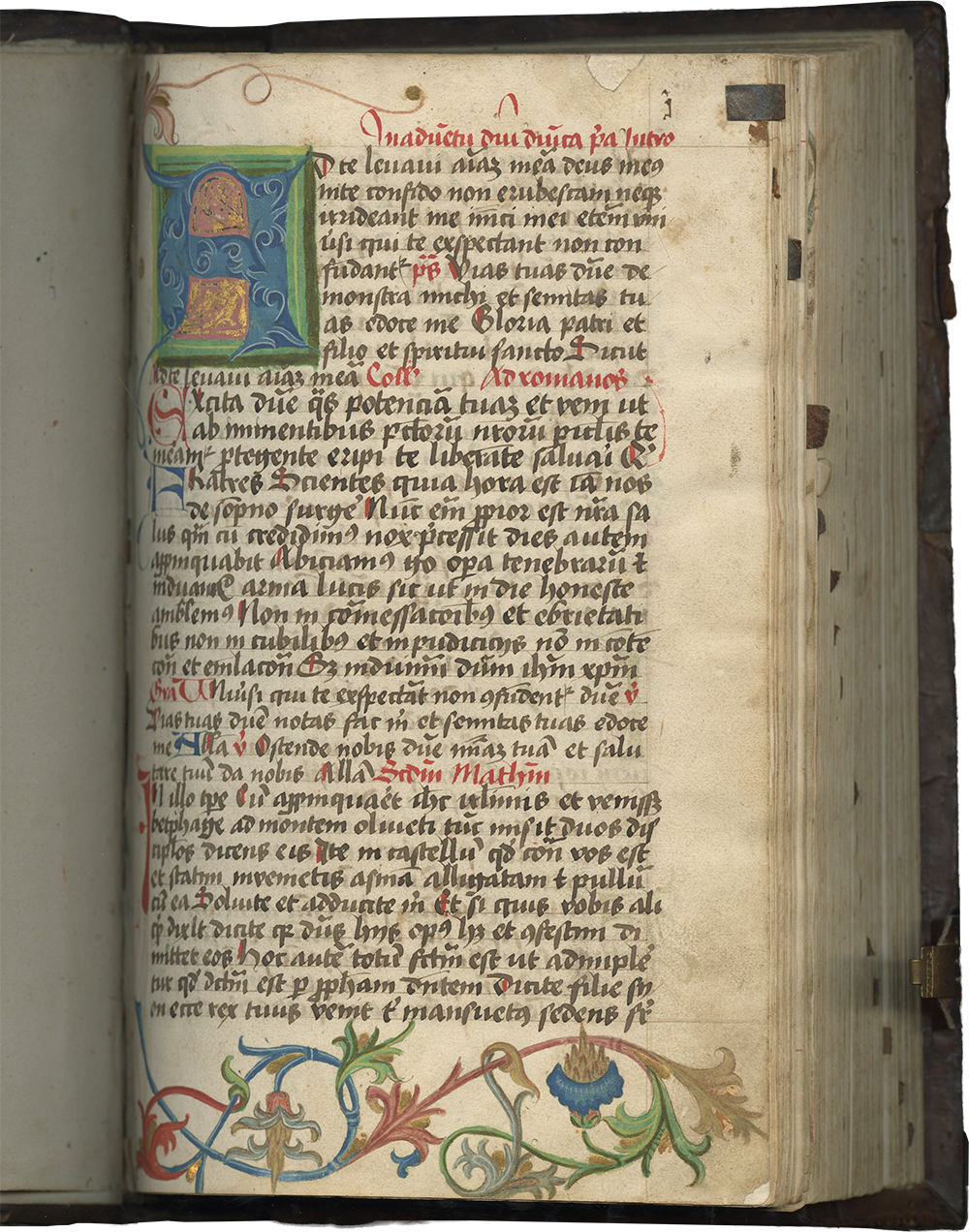
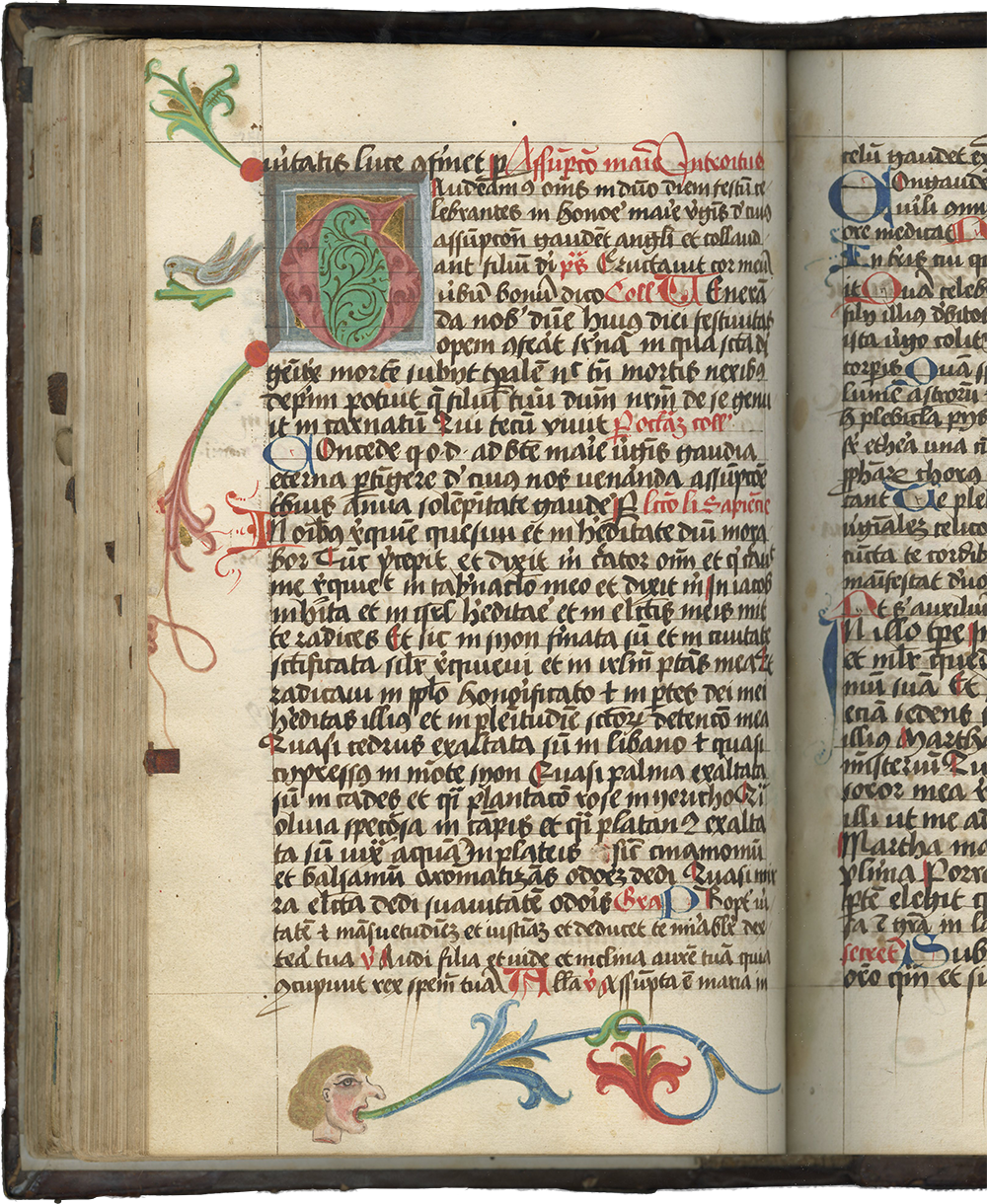
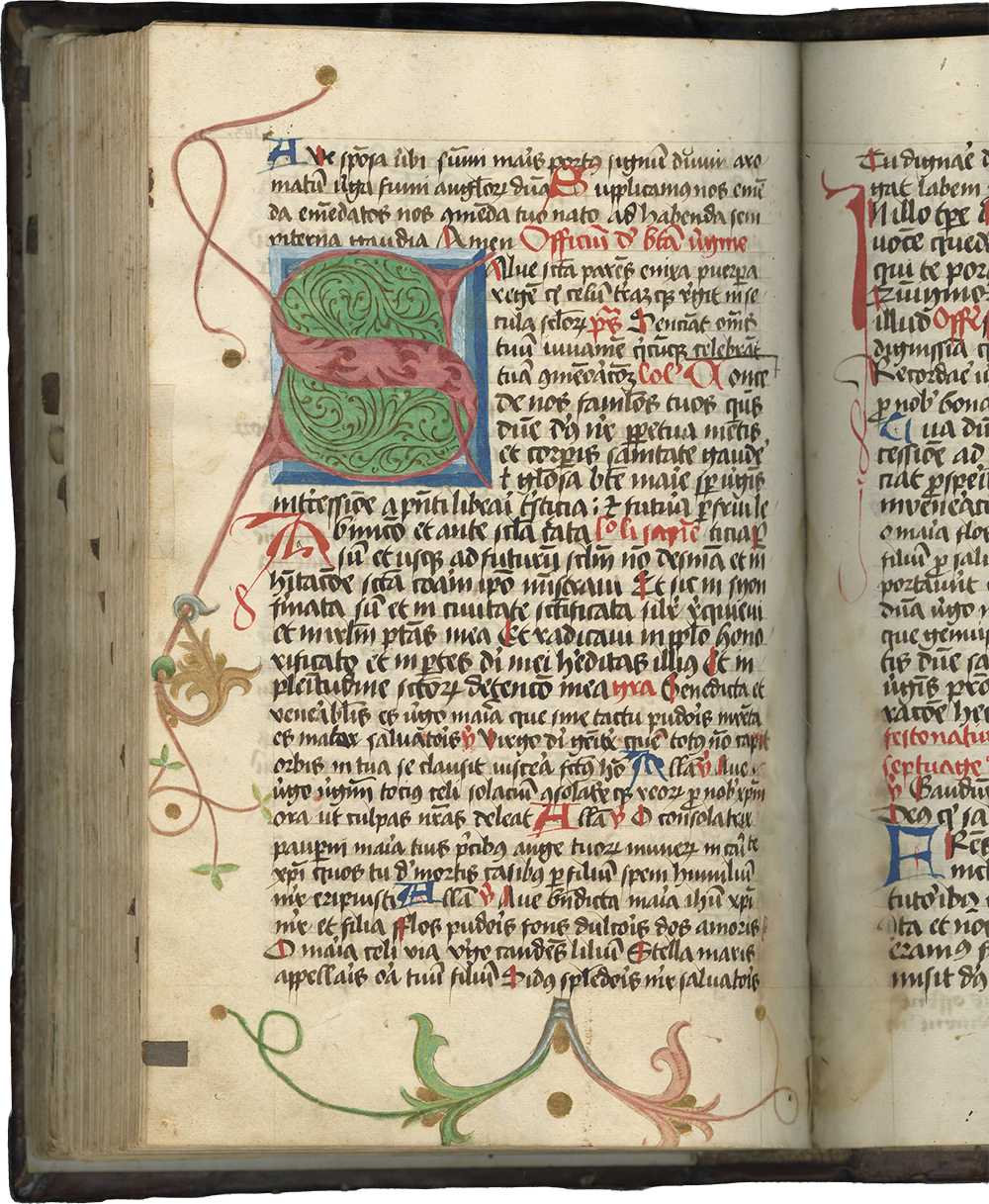
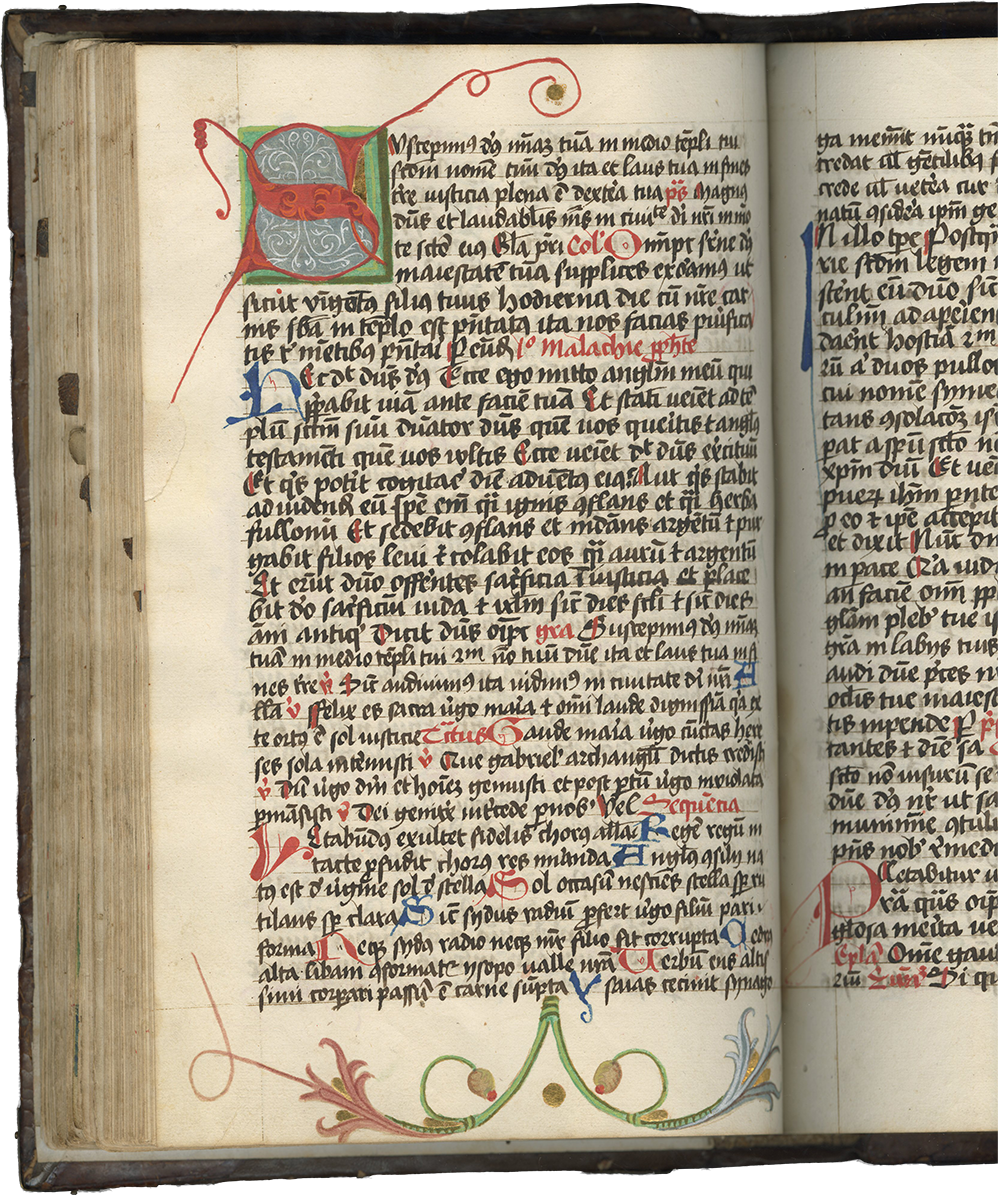
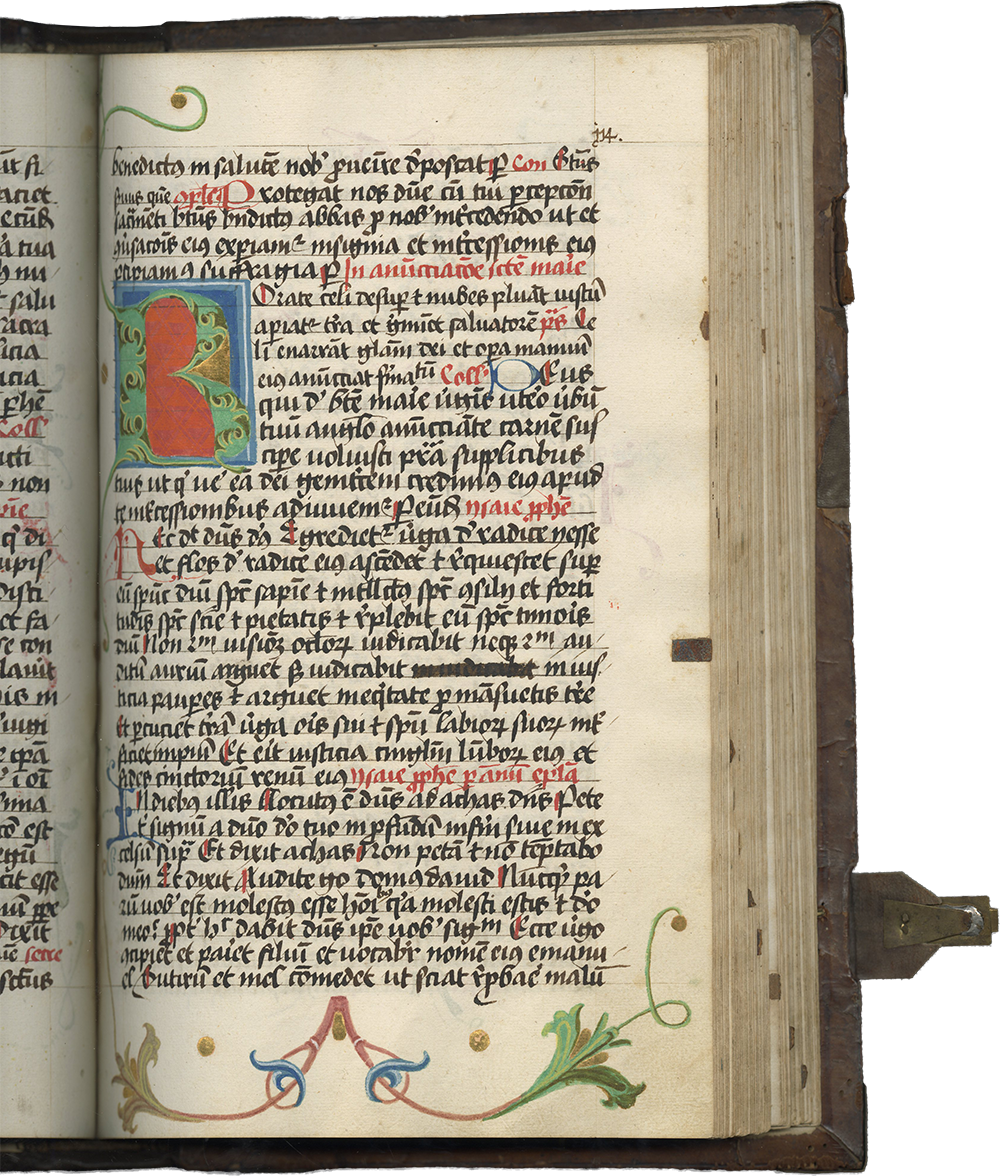
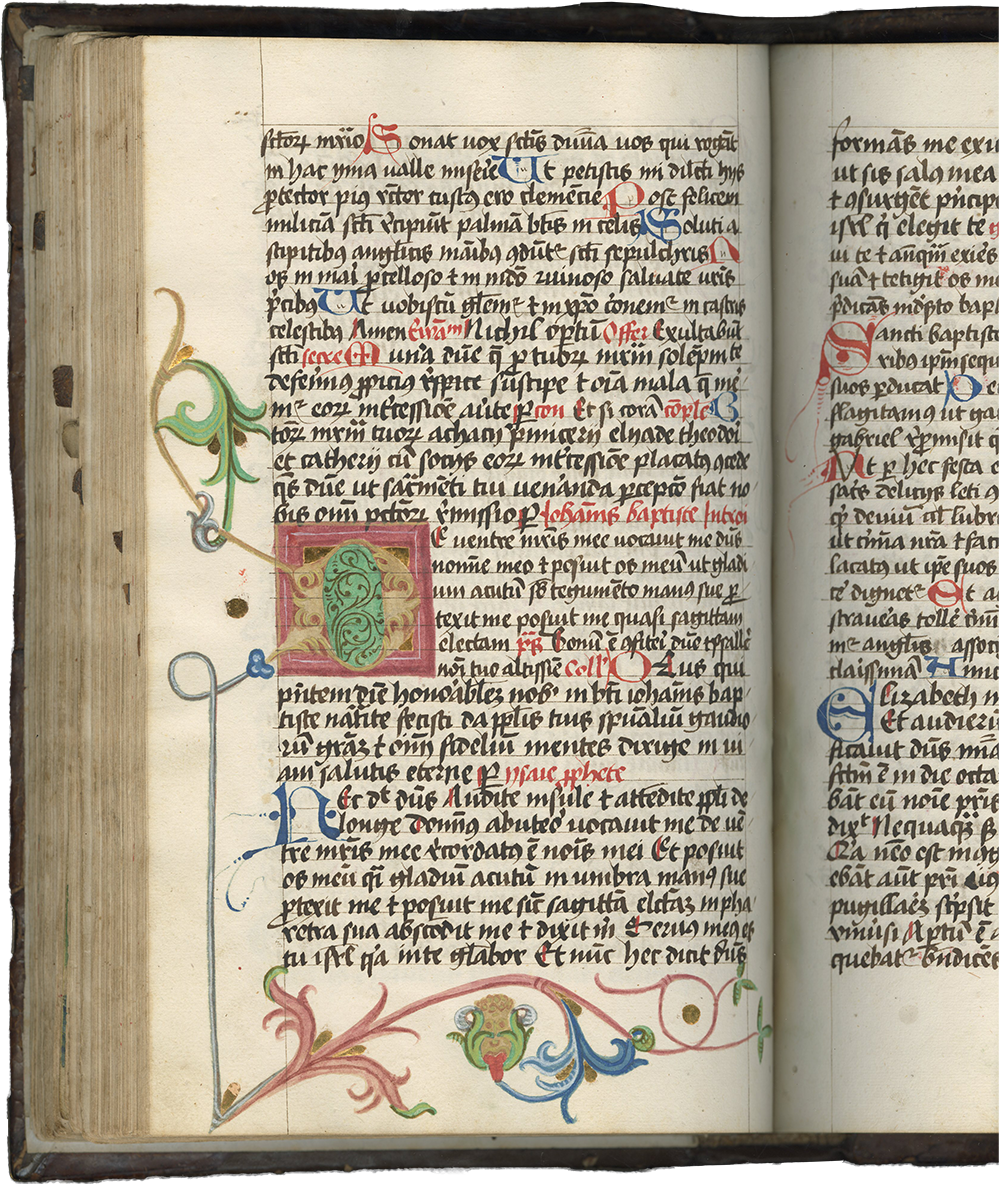
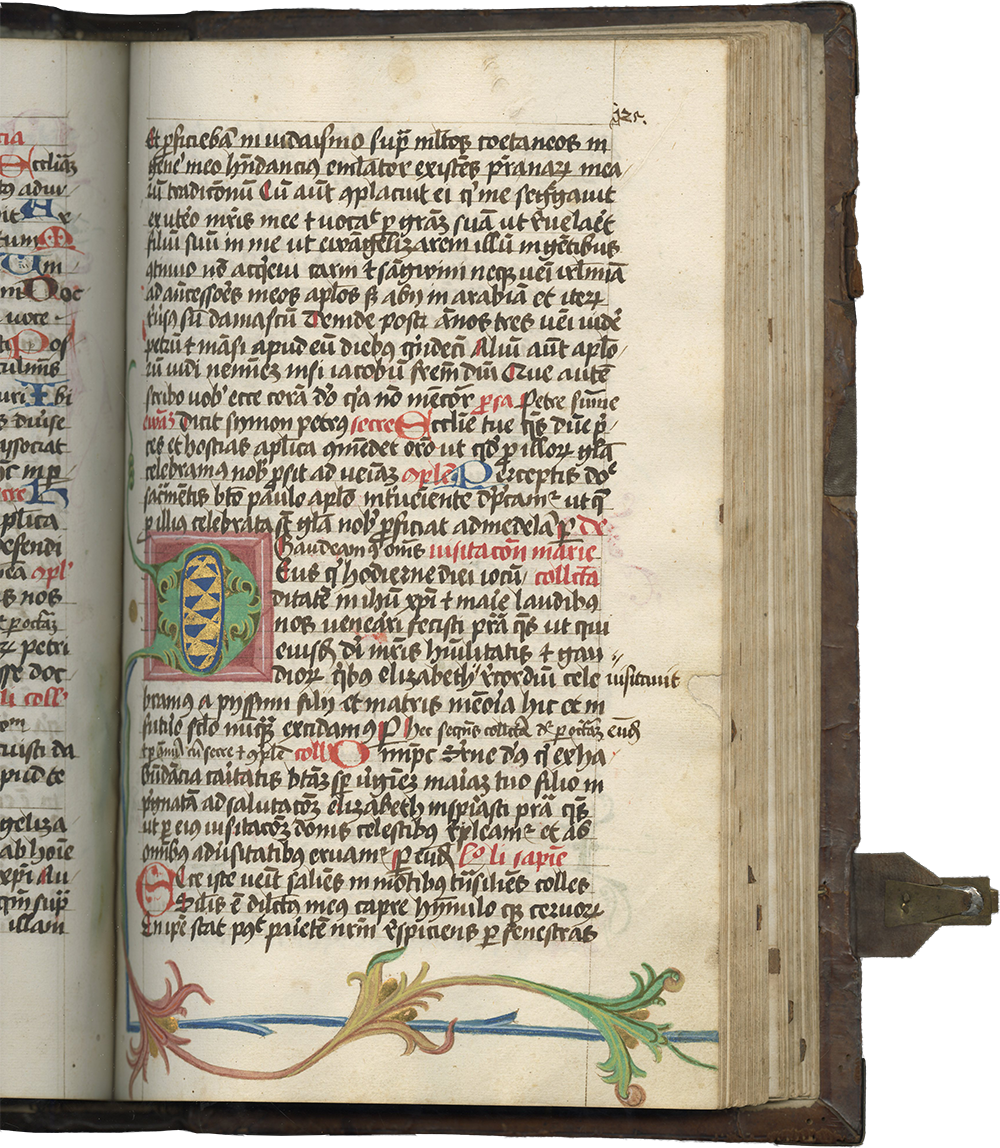
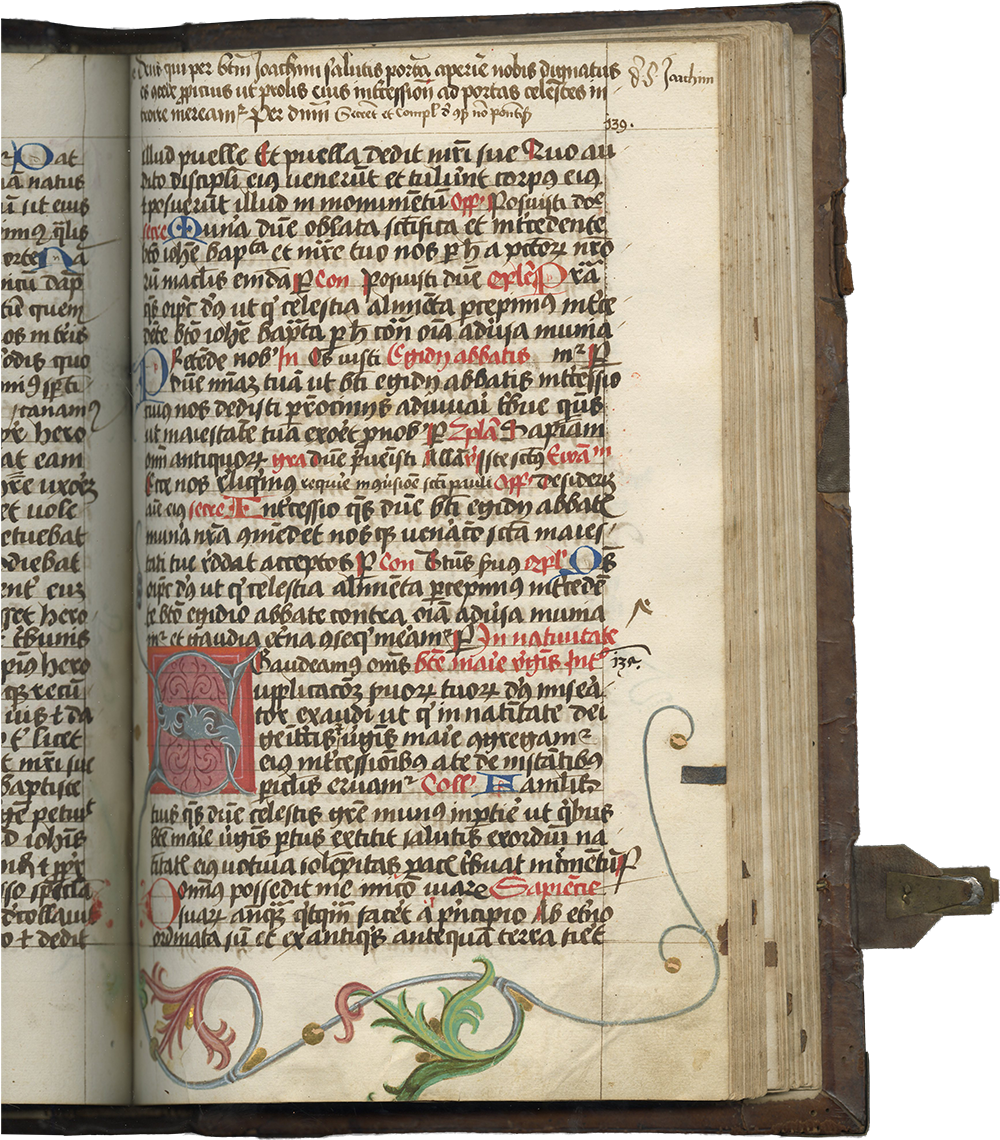
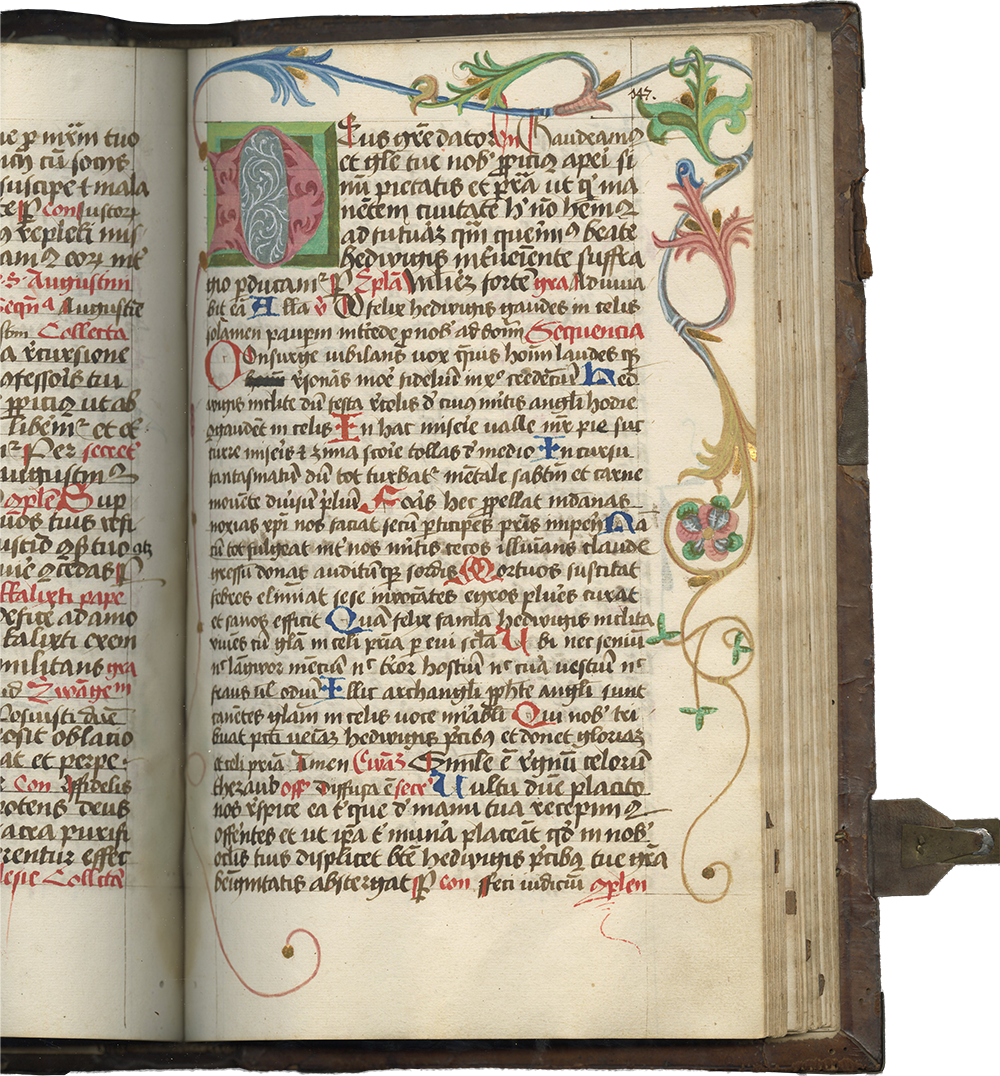
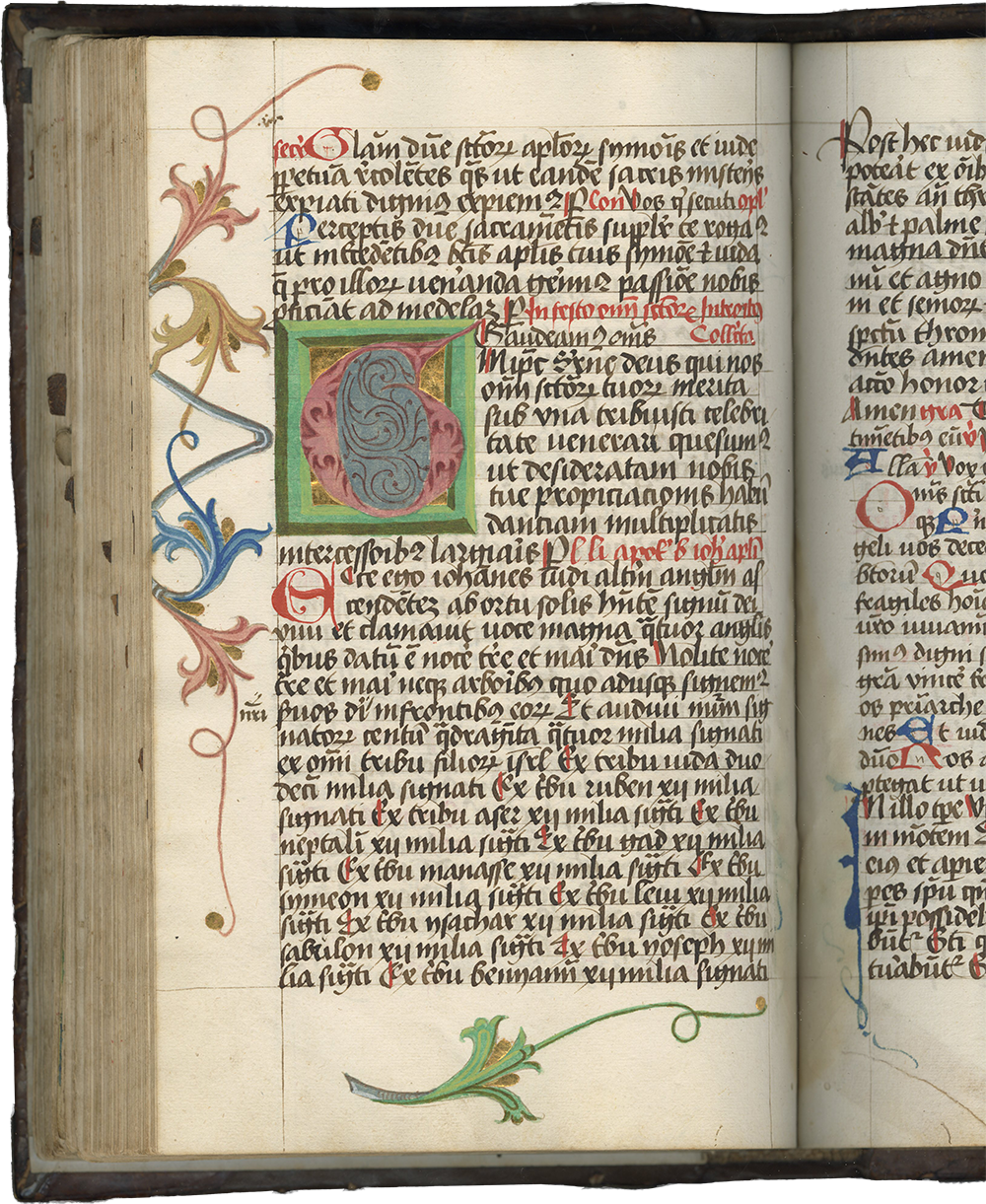
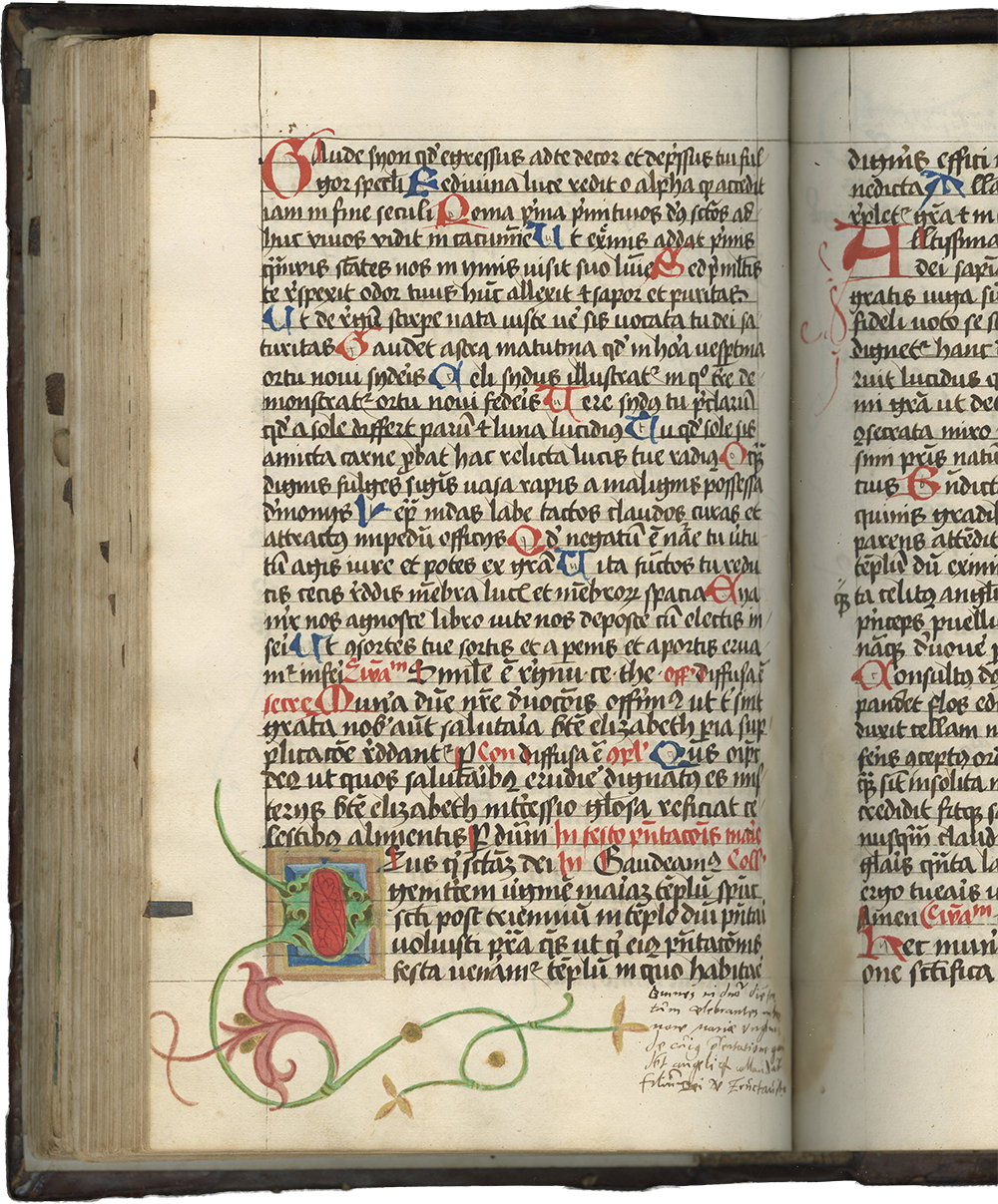
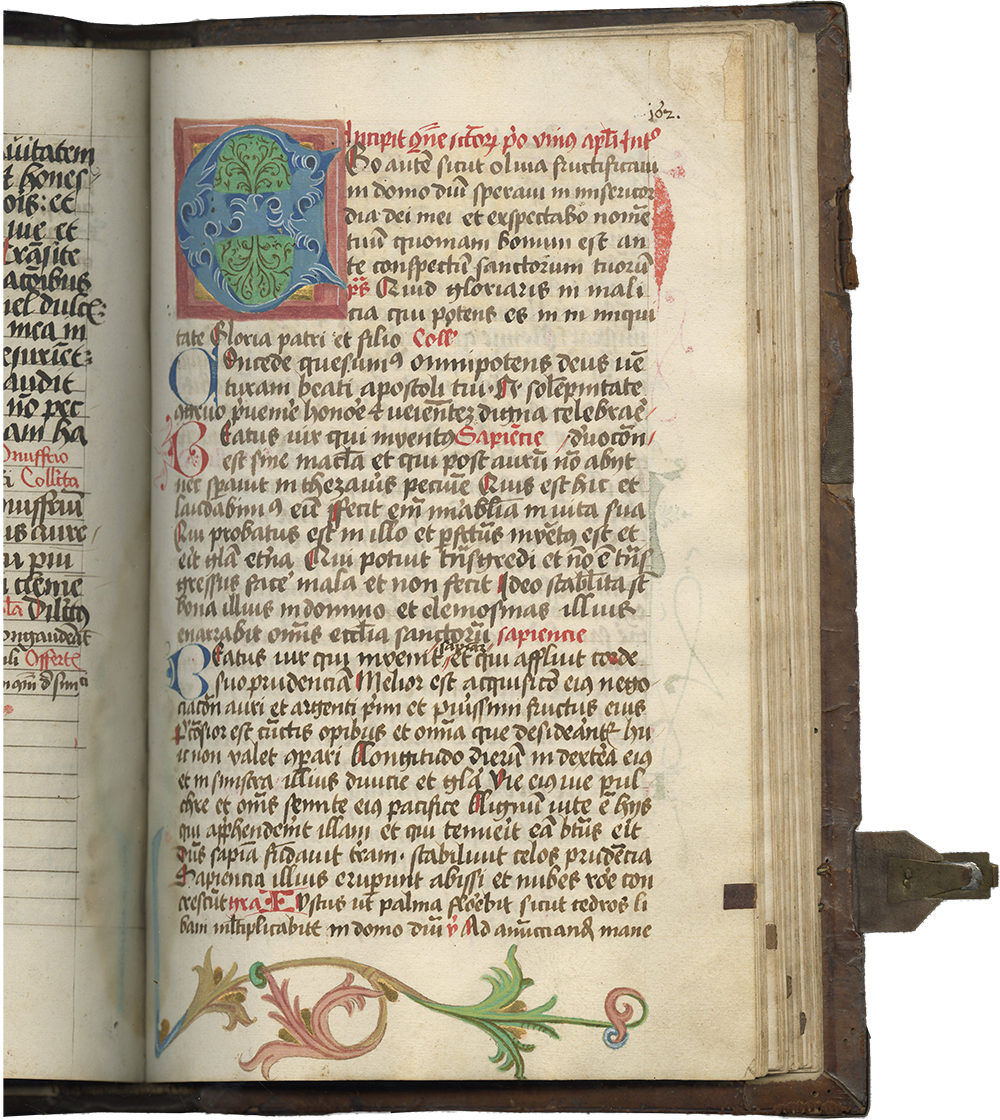
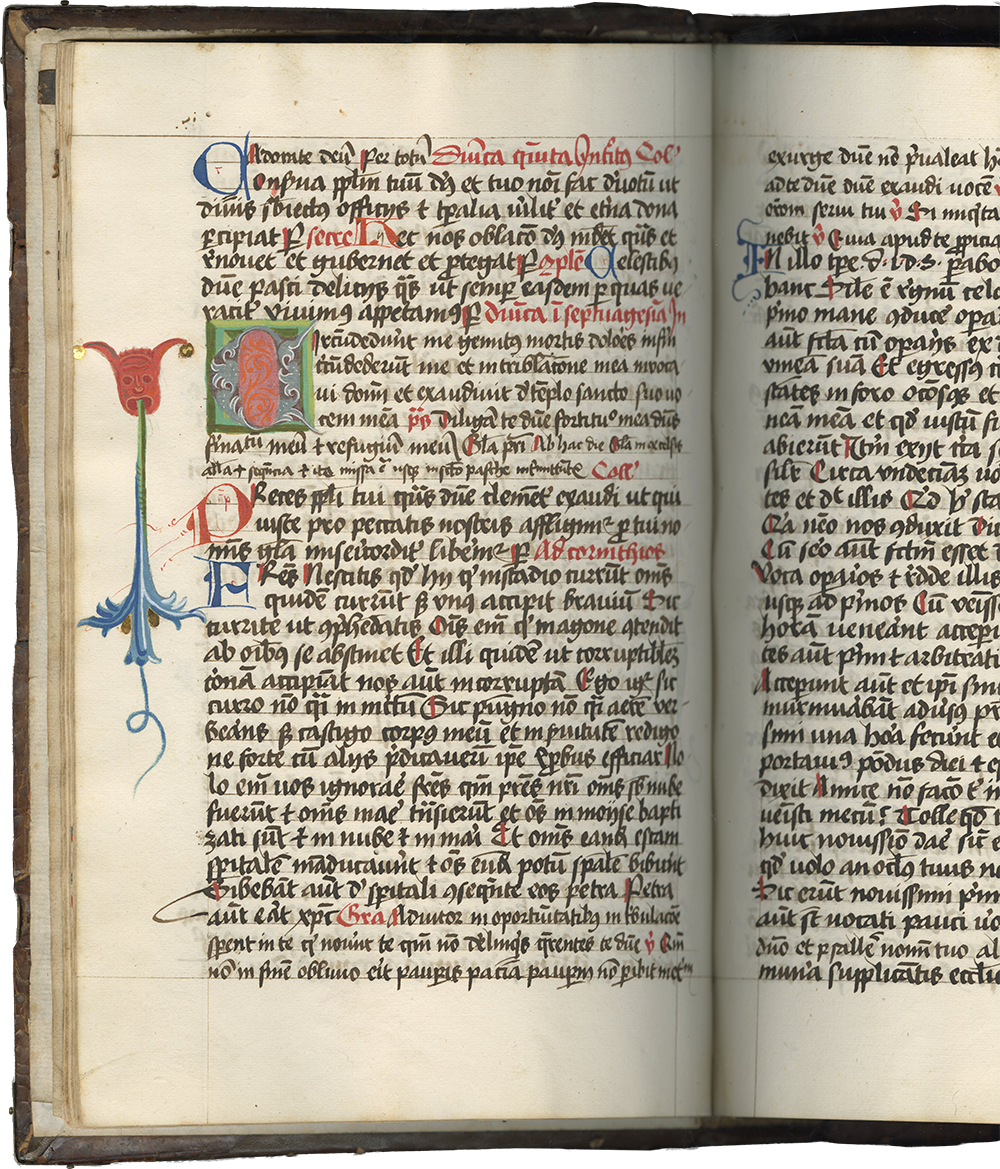
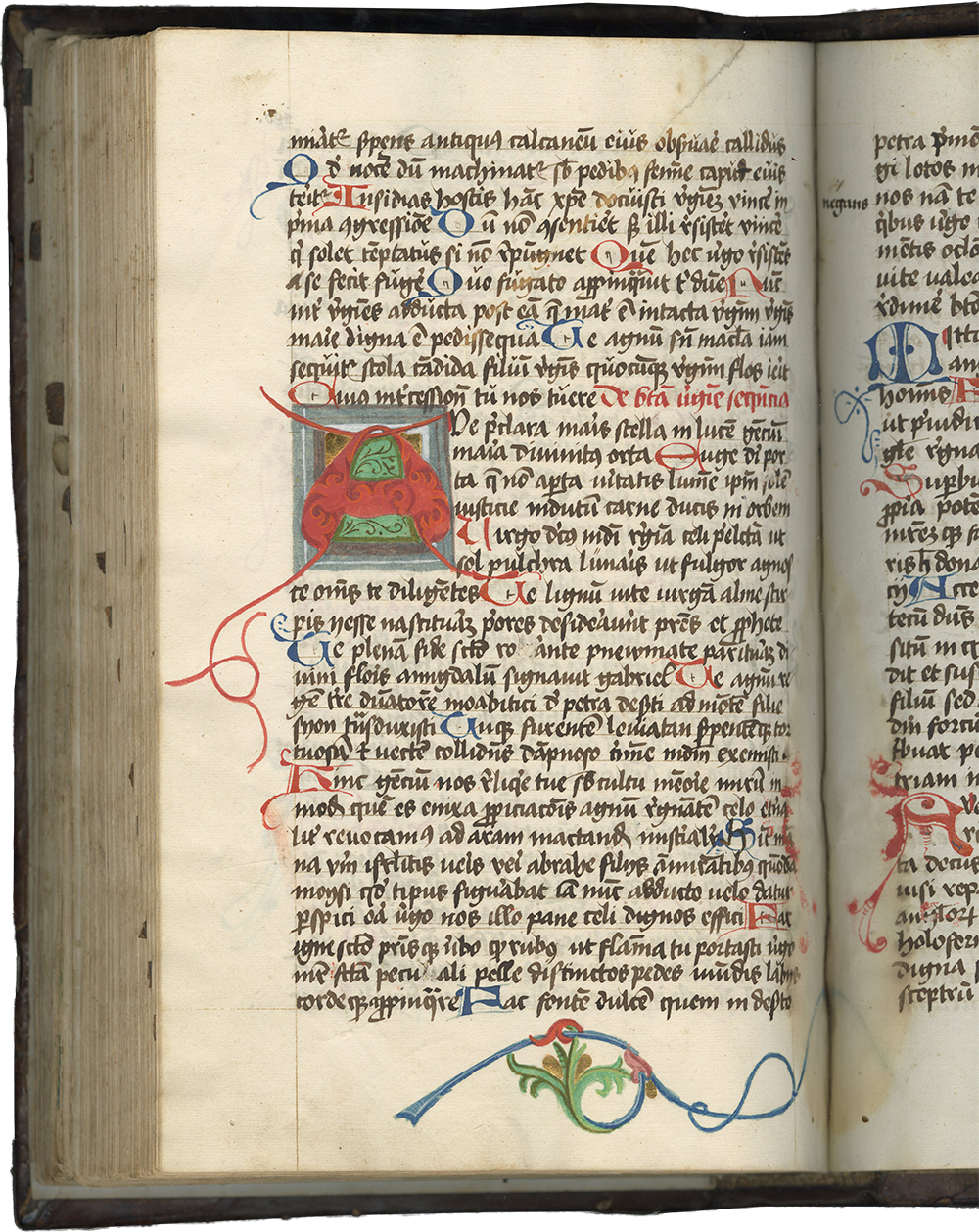
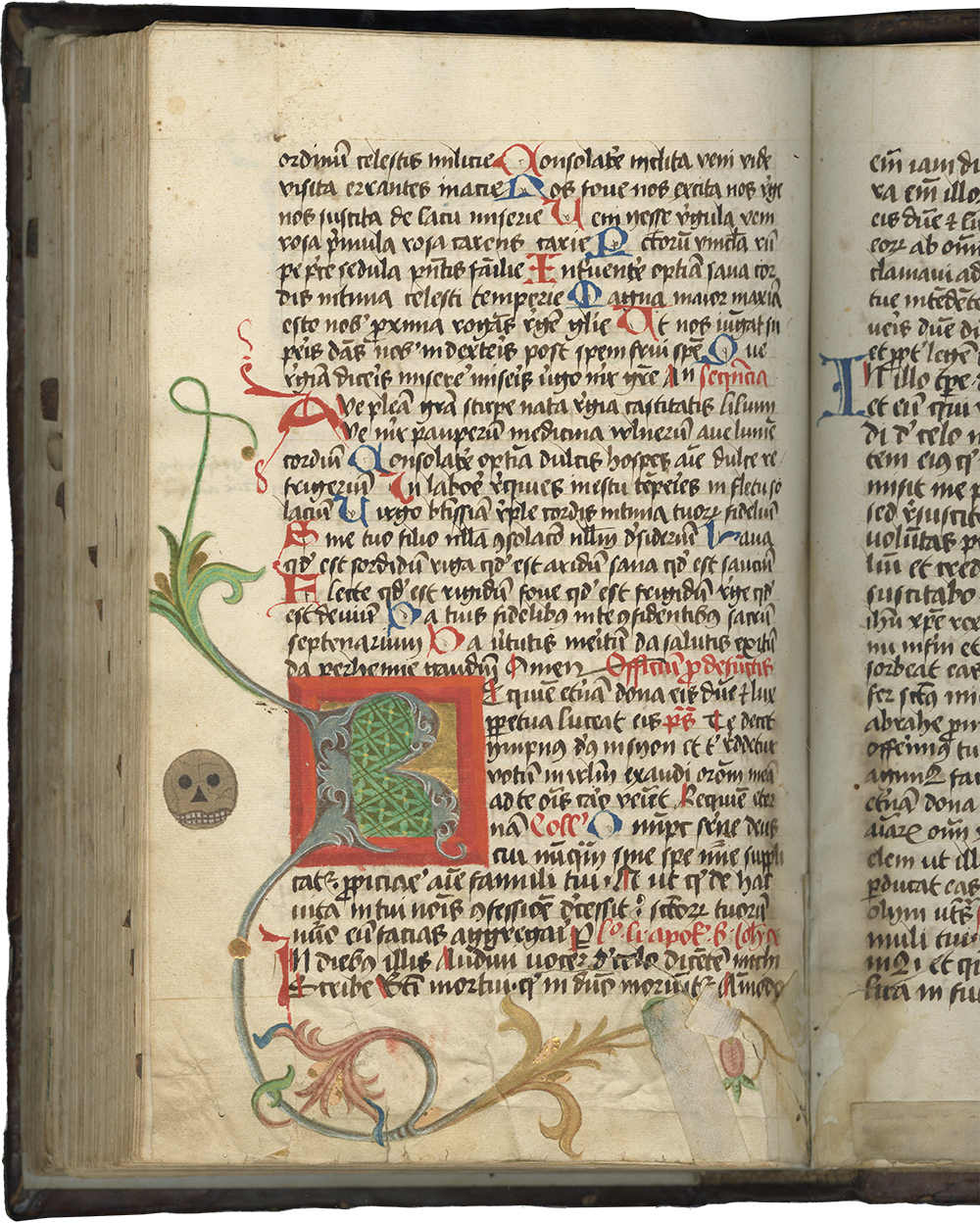
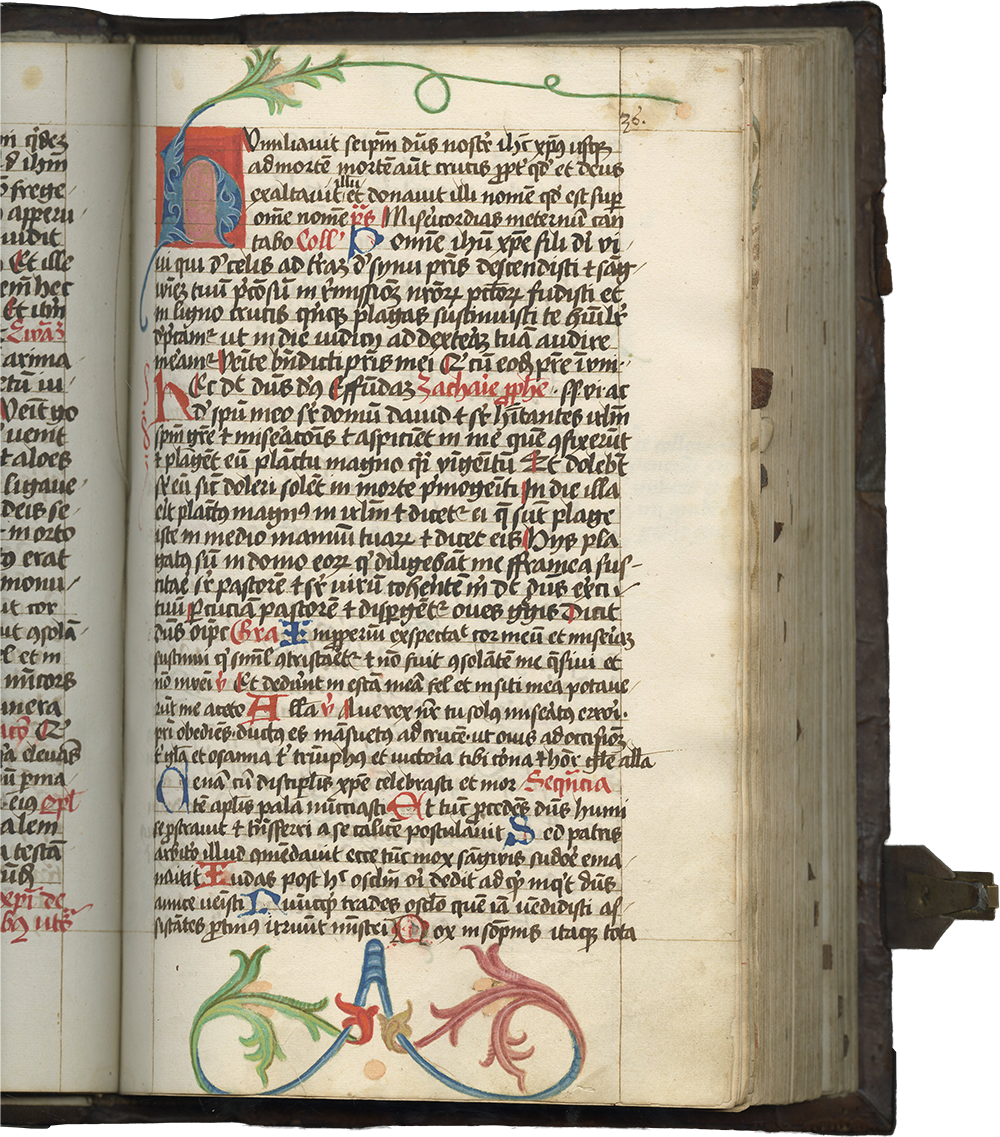
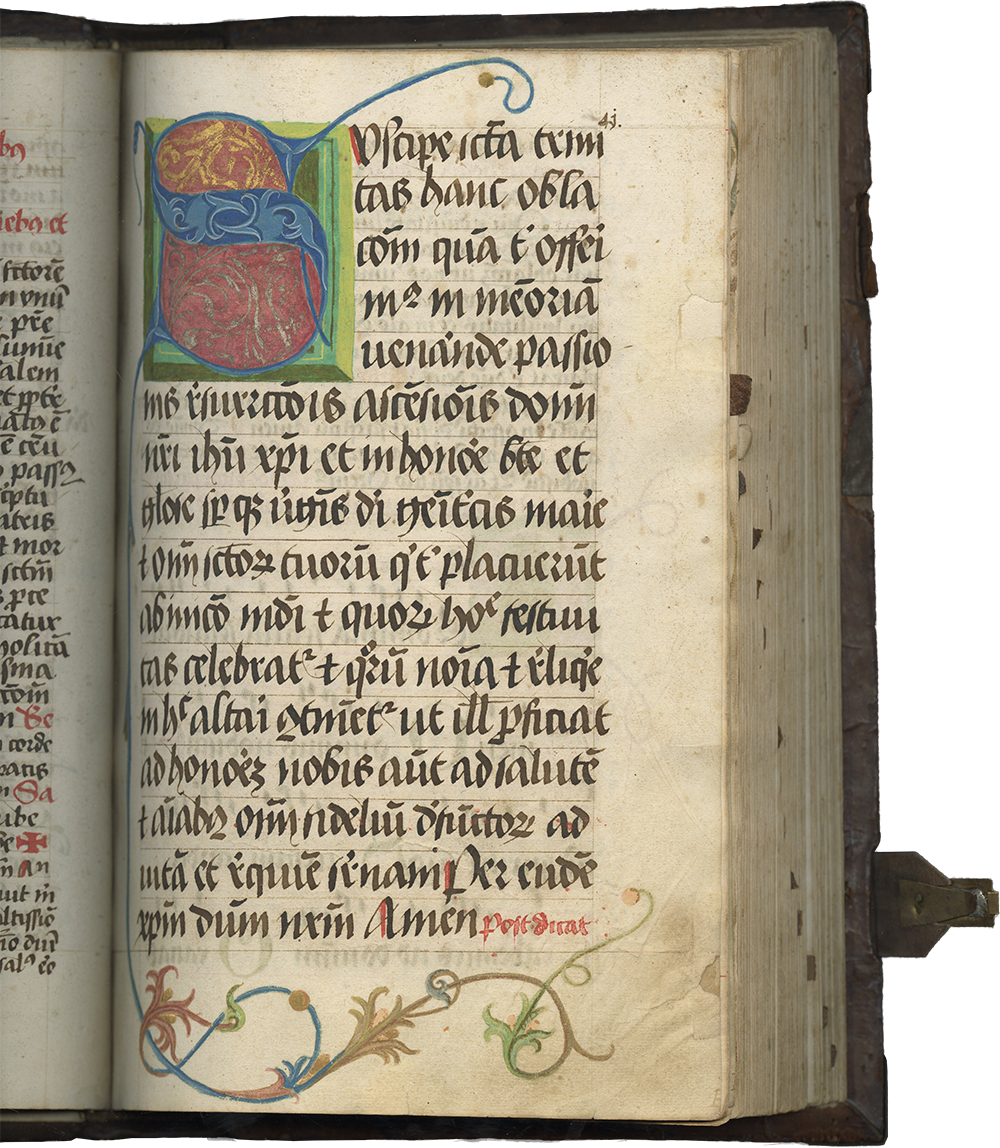
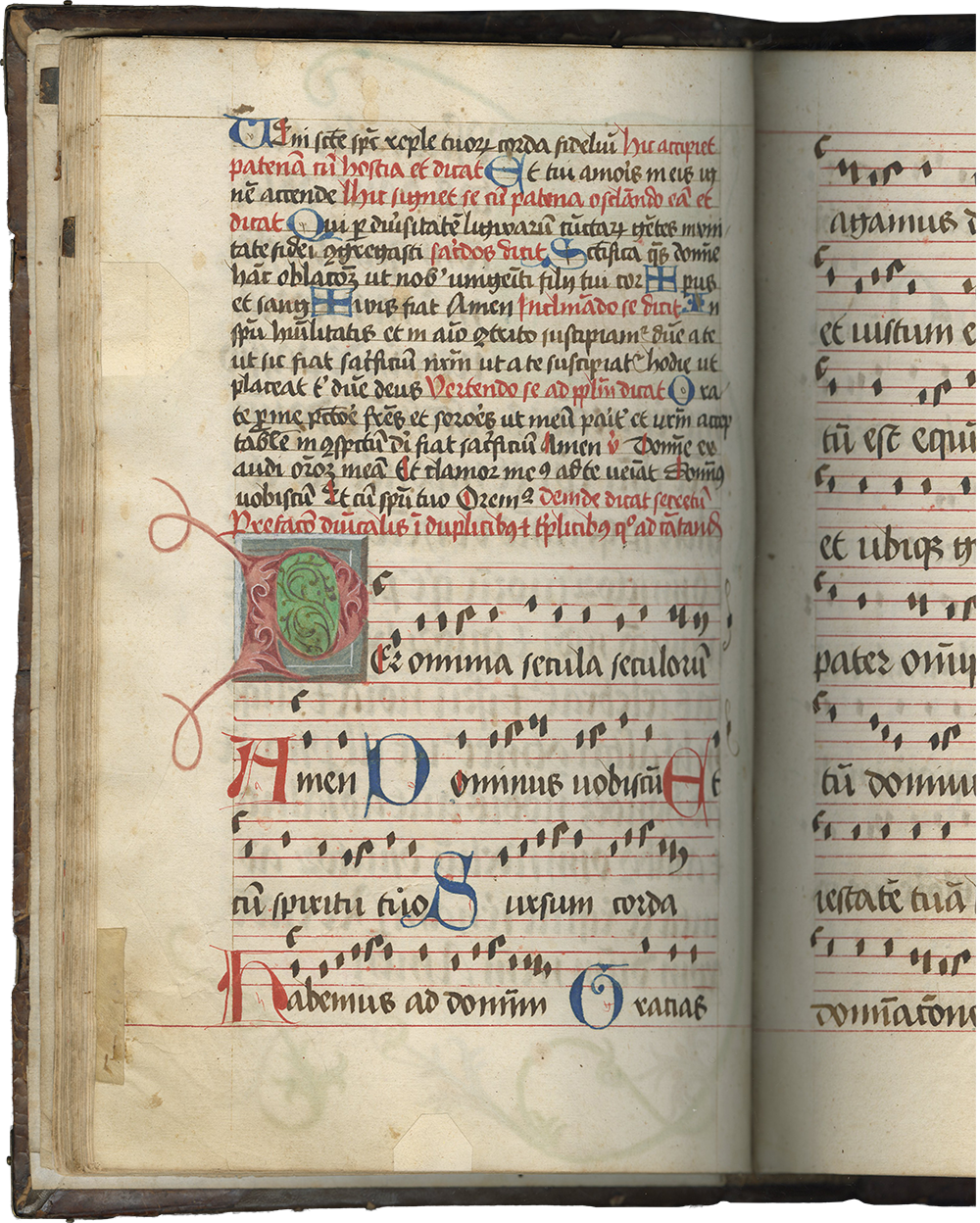
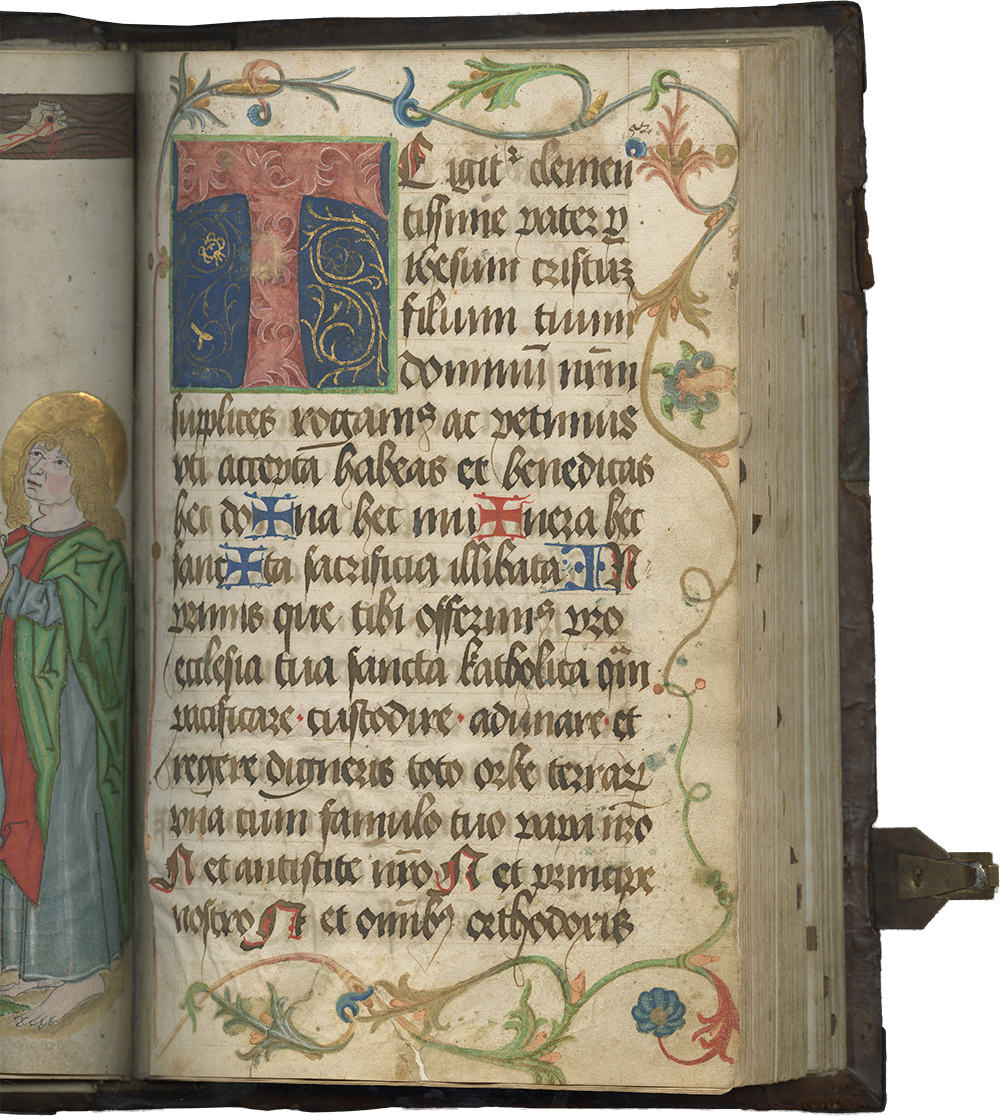
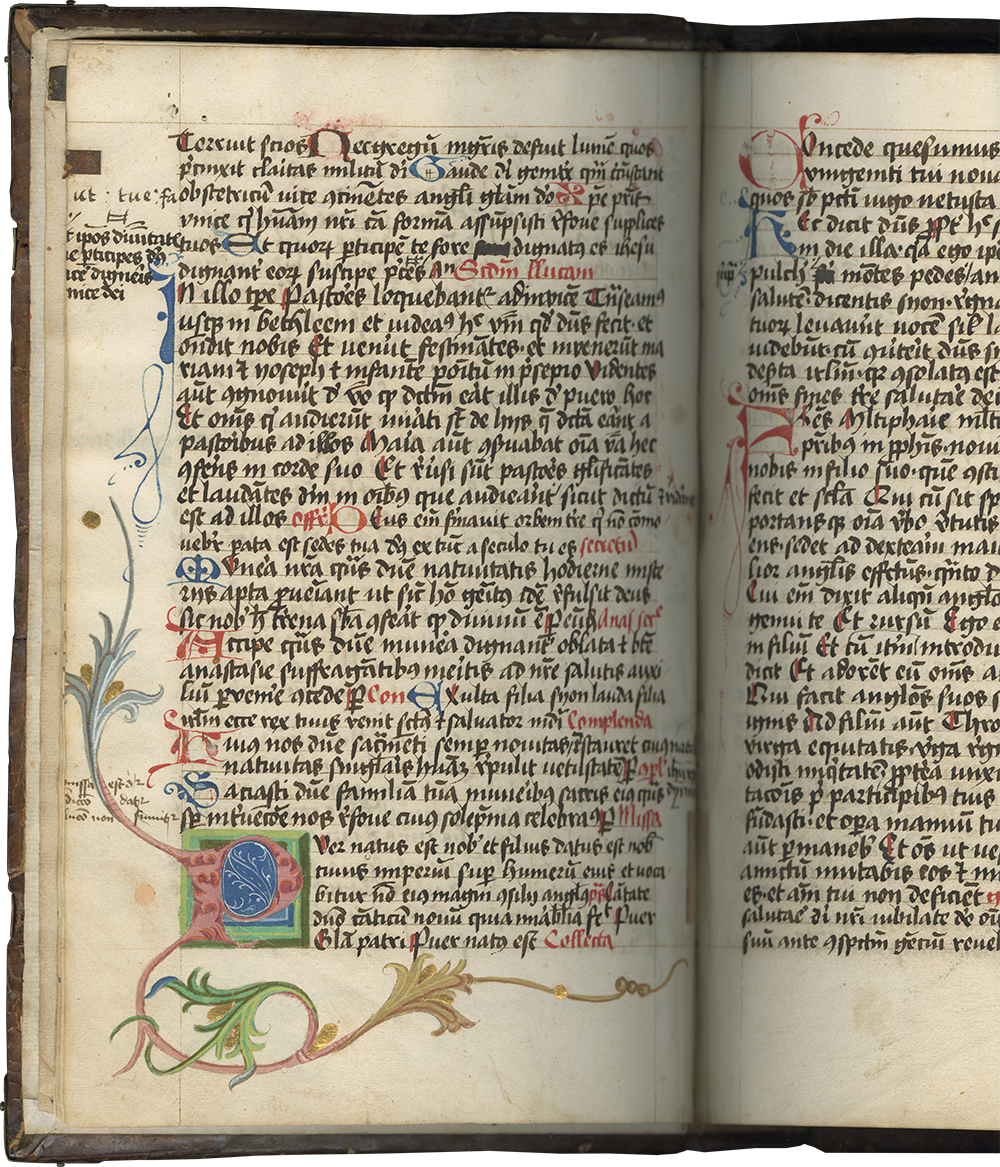
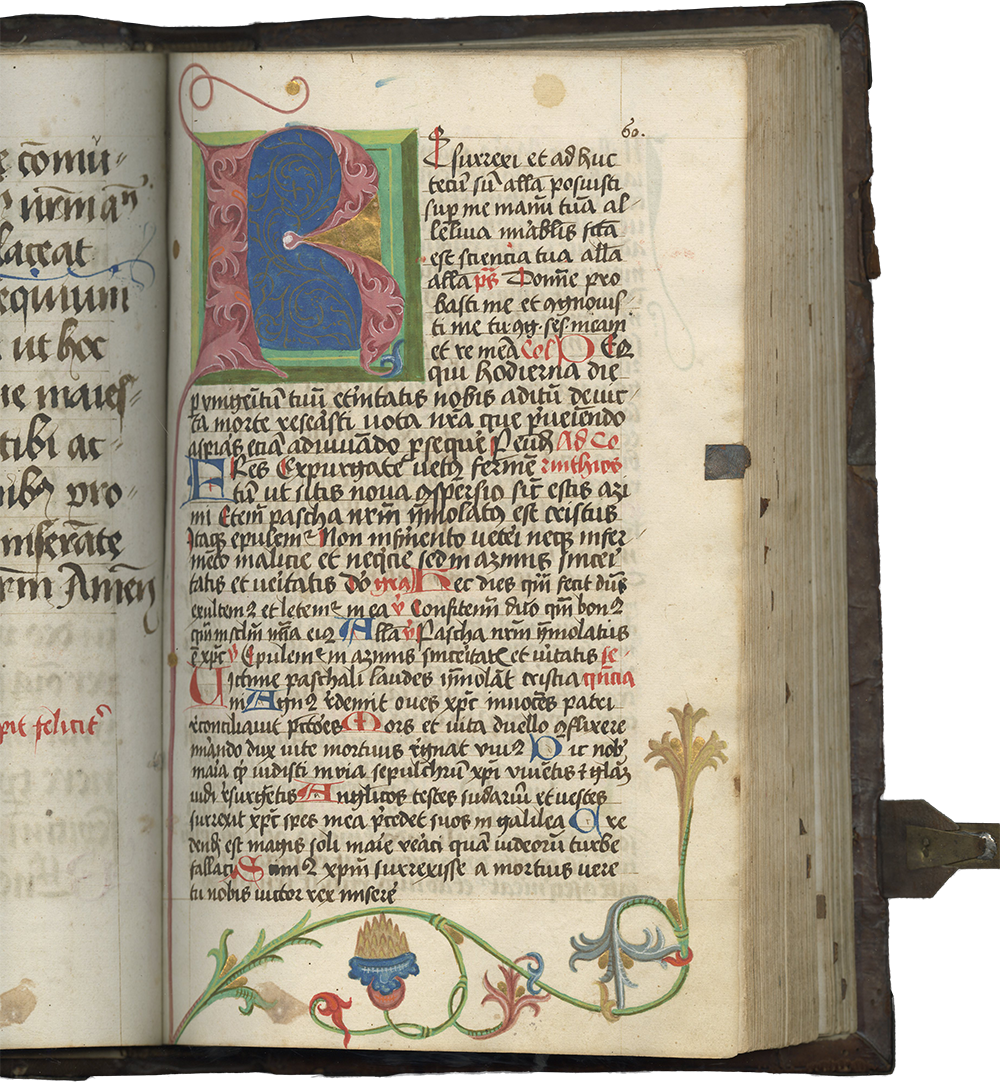
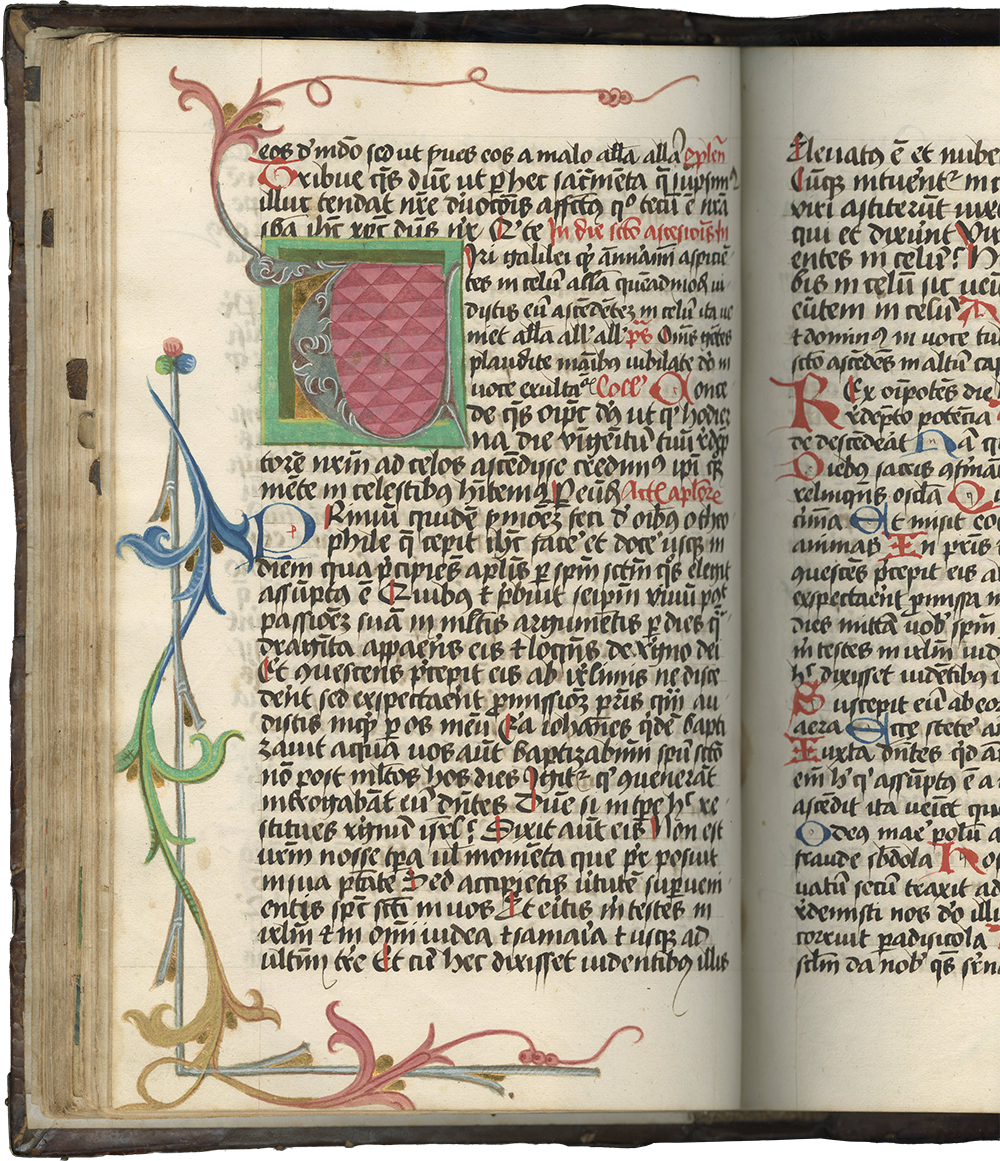
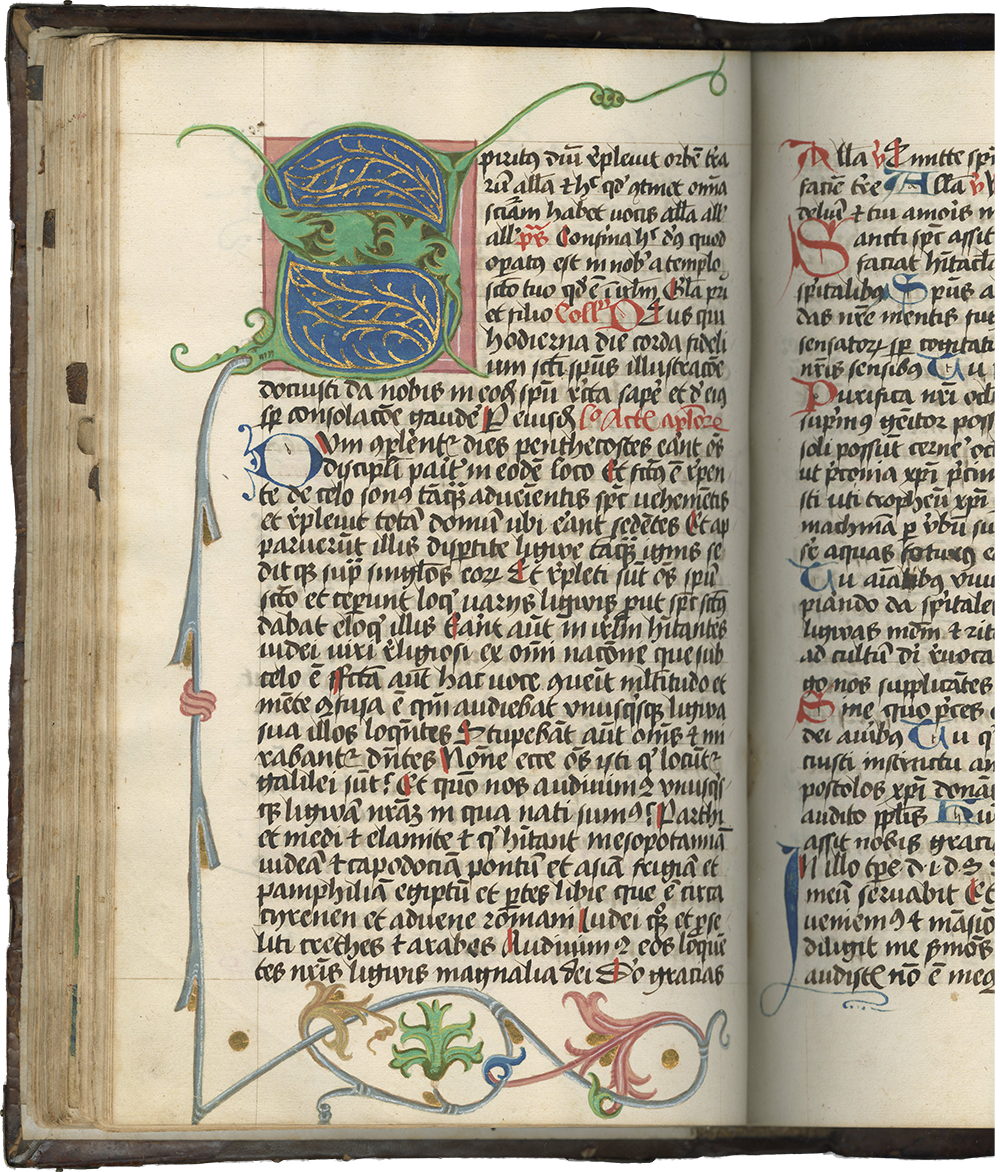
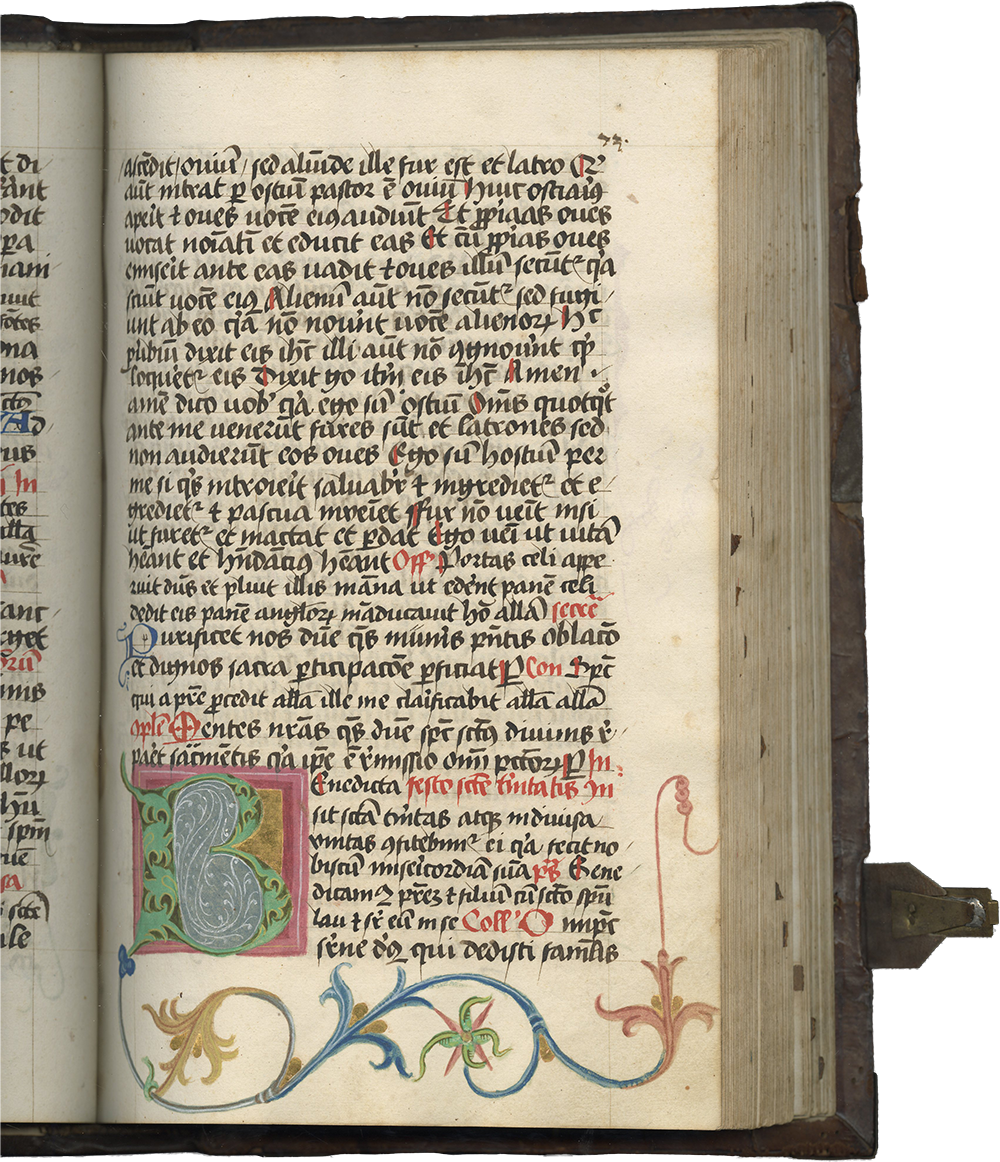
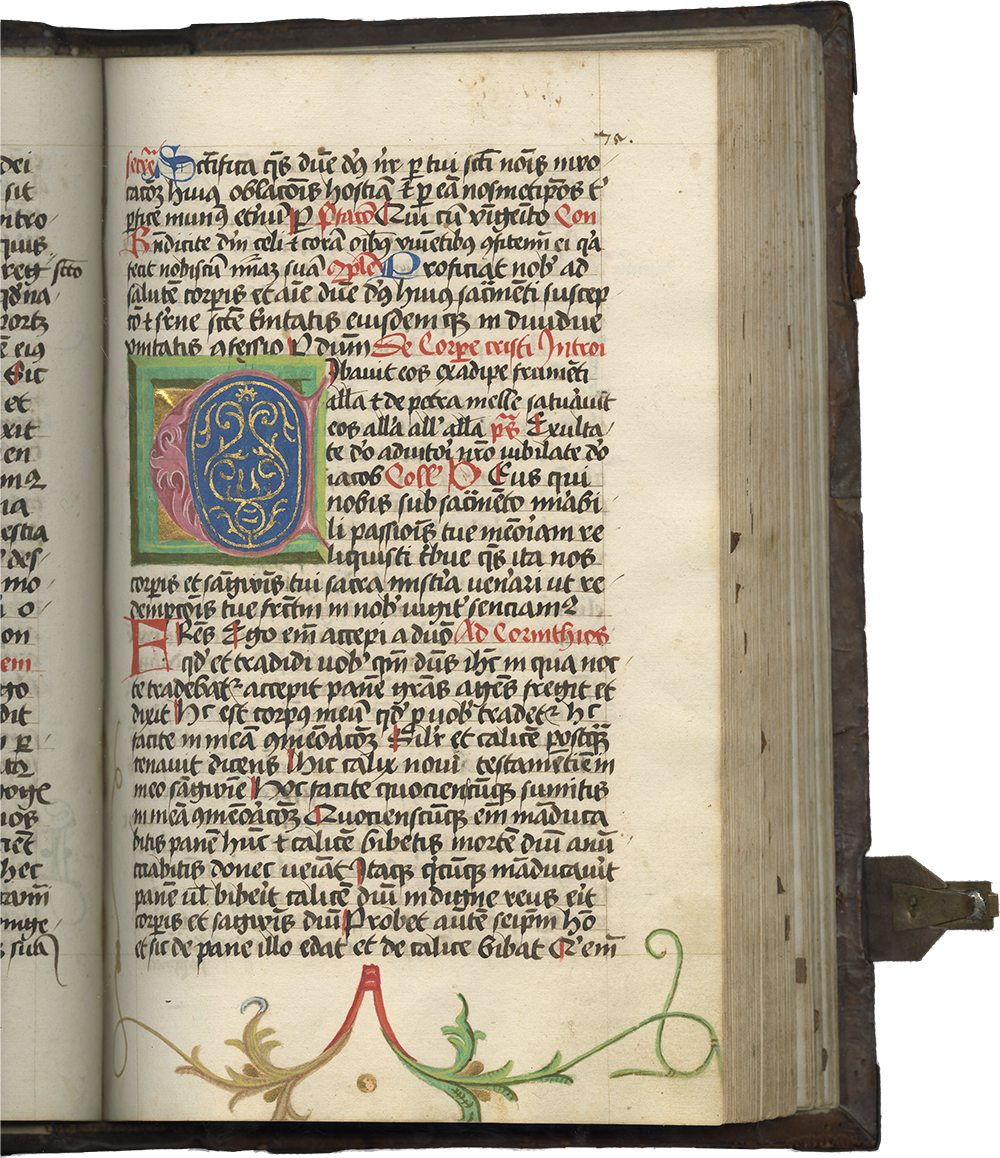
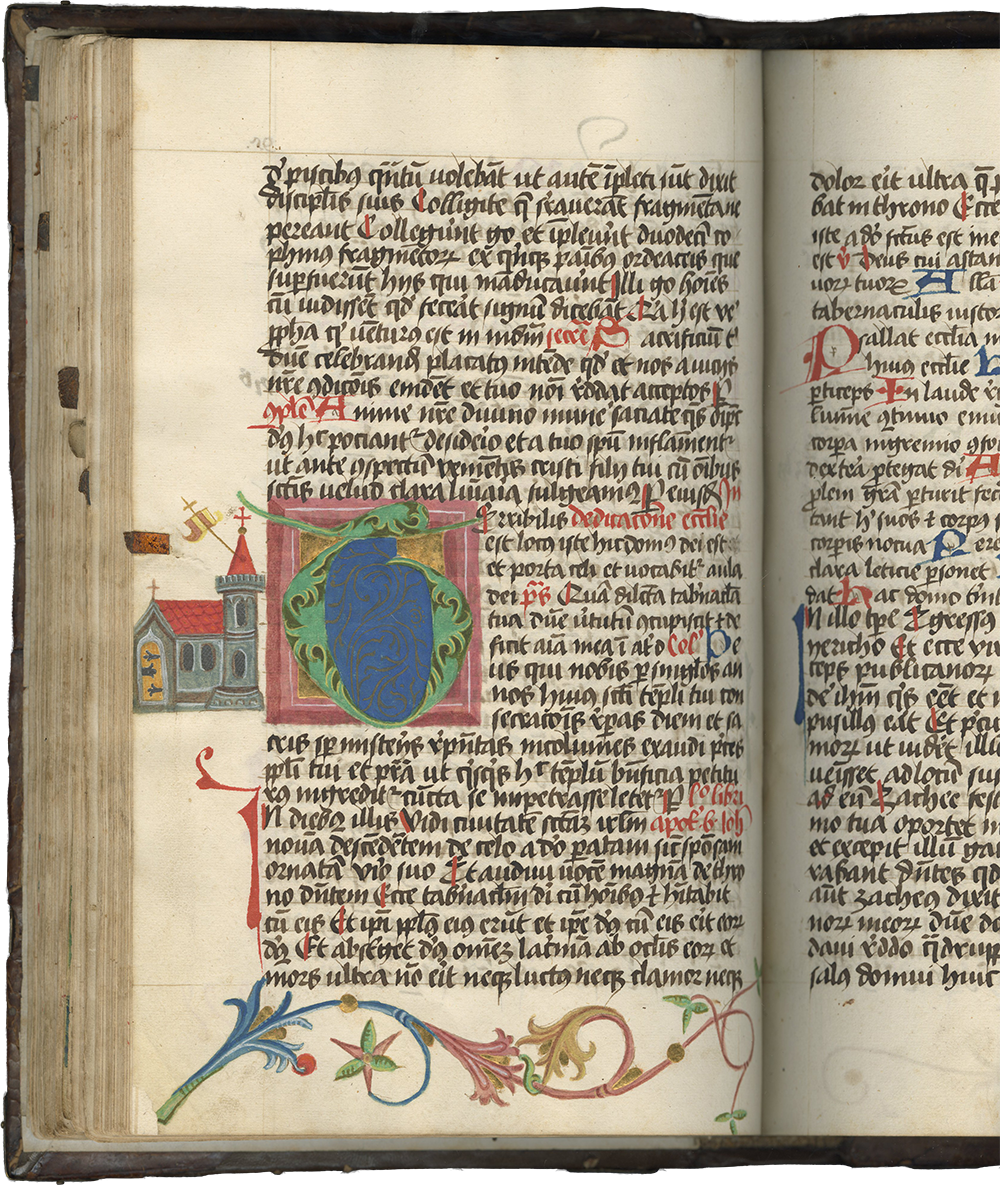
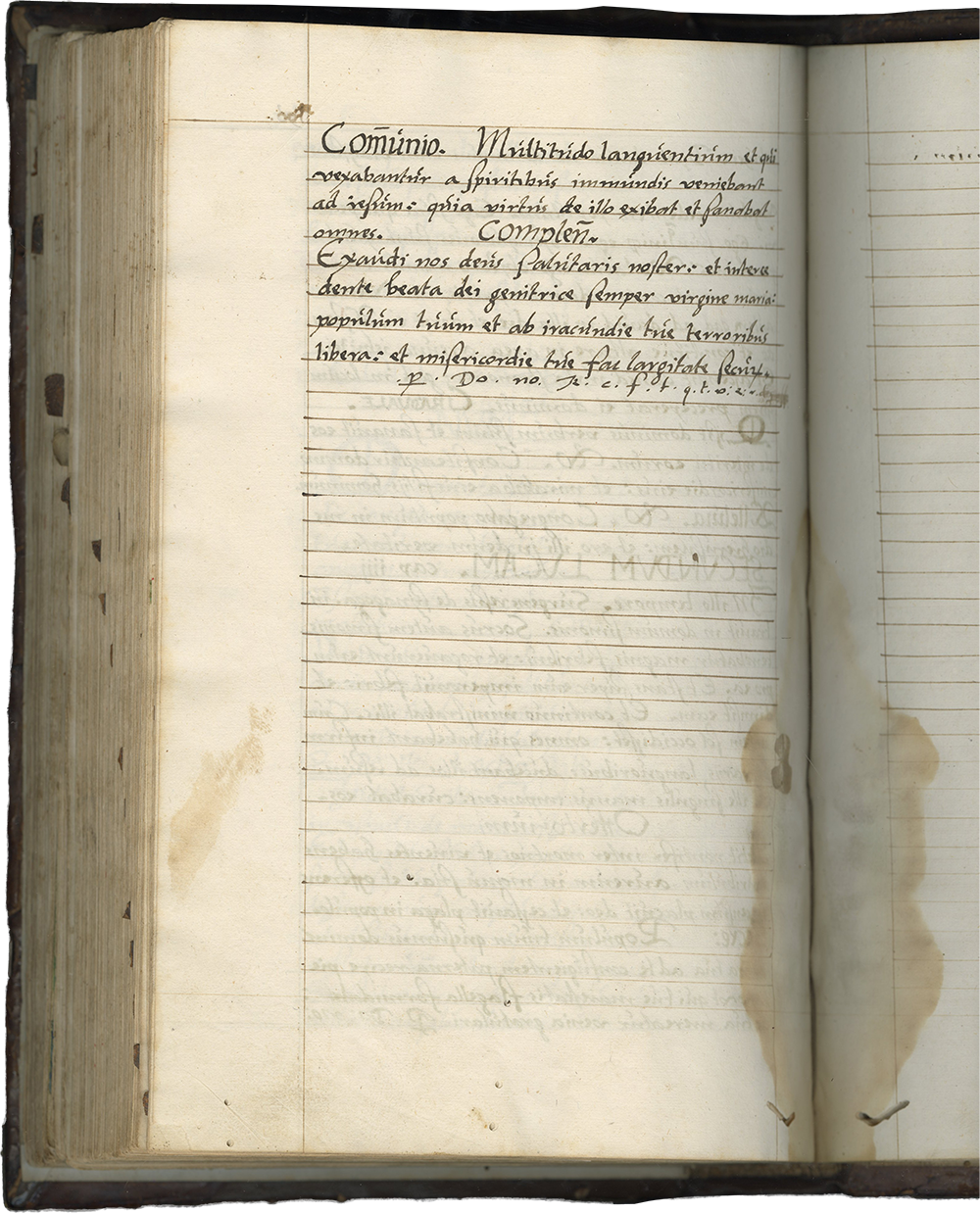
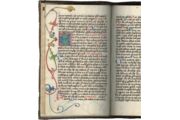
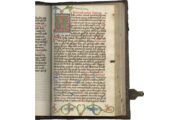
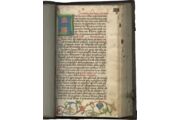
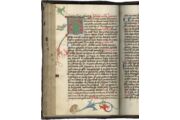
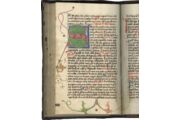
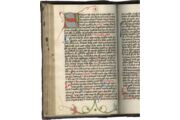
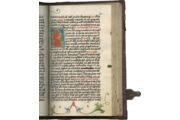
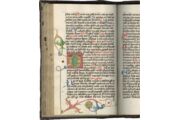
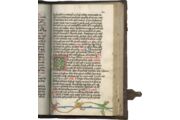
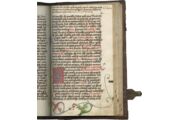
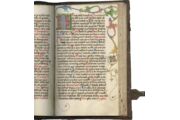
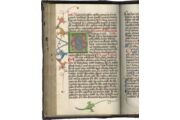
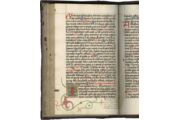
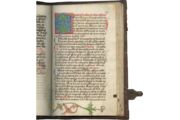
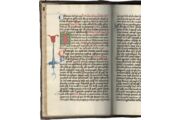
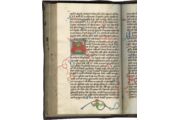
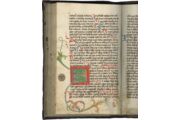
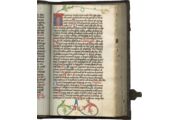
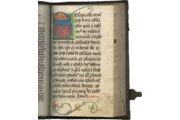
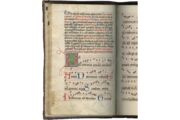
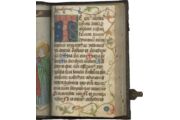
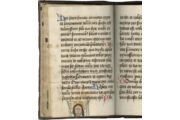
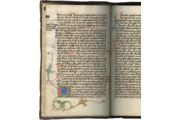
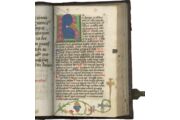
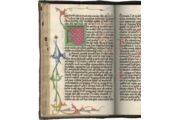
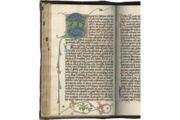
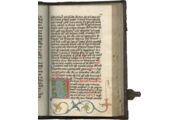
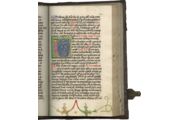
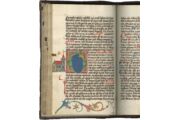
i+209 folios on paper, at least two watermarks: (i) a bull’s head, with eyes, ears, and horns but no mouth or nostrils, above which rises a serpent overlapping a cross (of which hundreds of examples are recorded), and (ii) a similar bull’s head, above which is a five-petalled flower, and below which is a line terminating in a triangular shield with a chevron and three dots, very similar to Piccard nos. 65941– 43, ff. 1–199 foliated in 16th(?)-century arabic numerals in ink, no catchwords, quires after the first signed B-X on lower right corner, (collation: i-v10, vi11 (of 10, i added), vii-xx10, xxi8), (justification 245 × 145mm) ruled in brown ink in 34 lines (16 for the Ordinary and Canon), written in several hybrida hands, alternating red and blue initials, some flourished in like color, 3-5-line puzzle initials in blue and red, forty-five 3-10 line illuminated initials, most with sprays, some sprays detached in lower or side margin, FOUR MARGINAL ILLUSTRATIONS (ff. 57v, 95v, 135v, 186v), ONE MINIATURE of the Crucifixion painted on parchment and inserted (f. 51v), red, blue, and gold leather tabs mark major texts, some wear to edges of pages but overall in good condition. Dated, blind-stamped binding with some original hardware, in places worn, dated 1549. Dimensions 310 × 205 mm.
Because Missals were heavily used, sometimes over centuries, they are rarer than many other types of liturgical manuscripts, and they rarely survive in good condition. Indeed, they were the very backbone of medieval religious ritual, providing the words that priests said and the gestures they made in every Mass of the year. This Missal is in beautiful condition, presenting extensive and lovely Bohemian illumination. It’s Polish Catholic texts, revealing updating for use from the 1470s until the advent of the Tridentine Mass in 1570, provide, along with its illumination, a colorful snapshot of European Catholicism in its last medieval decades.
1. Several feasts in the Sanctorale point to the region around present-day Czechia, and the special treatment of St. Hedwig, Duchess of Silesia (“ducisse Slesie”), as a major feast, suggests an origin in Silesia. Likewise, special attention to Augustine may suggest that the volume was originally produced for an Augustinian priory there.
2. The near-contemporary additions at the very end of the volume suggest early use at an abbey, somewhere where St. Oswald was venerated, including southern Germanic areas and into Poland.
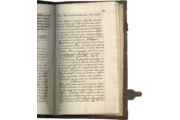
3. Rebound in Czechia in 1549. Sewn on five bands and bound in wood boards covered with lavishly blind- and gilt-tooled polished leather, both covers with metal corner-pieces, the front lettered in large capitals ‘Missale / renovatum / anno domini / MDXLIX’ in gaps between panels of Renaissance ornament including roundels with portrait profiles, busts, standing figures, acorns, cherub heads, and a central stamped gilt panel signed ‘F P’ at the top (perhaps depicting the Adoration of the Shepherds: apparently three men playing woodwind instruments, perhaps behind the crib), with a legend in capitals ‘Nudus egressus sum ex utero matris et nudus revertar’ (Job 1:21), the back cover with different tools and a central boss. Several of the tools (including those depicting David, Goliath, Appollo, Thalia, and Caliope, identified by captions) are represented in the online Einbanddatenbank (workshop ID w004639) from a binding of a book printed in 1554 and owned by the Premonstratensians of Windberg, Bavaria, near the border with present-day Czechia.
4. Acquired “from the hands of heretics” in 1669 for 15 silver coins (“Hoc Missale 17 Octobr. 1669 ex manibus hæreticorum redemi 15 argenteis. [signed:] J:H: ab Oberg”(?), front flyleaf).
5. Martin Schøyen, Oslo, Norway and London, UK (born January 31, 1940), a Norwegian businessman, traveler, historian, and collector of books; The Schøyen Collection, MS 195, acquired from Bruce P. Ferrini (1949–2010), of Akron, Ohio, in December 1988.
ff. 1-35v, Temporale, from Advent to Easter Saturday;
ff. 36-37, Office of the Passion;
ff. 37-38v, Office of the Sorrows of the Virgin;
ff. 38v-39v, Office of the Name of Jesus;
ff. 39v-40, Office of the Seven Joys of the Virgin;
ff. 40r-v, Gloria and Credo;
ff. 41-50v, Ordinary of the Mass, from “Suscipe sancta trinitas,” in much larger script, followed by Kyries, f. 51 blank;
ff. 52-59v, Canon of the Mass;
ff. 60-101v, Temporale continued, from Easter Day, including Ascension (f. 68v), Pentecost (f. 70v), Trinity Sunday (f. 73), Corpus Christi (f. 75), followed by the Dedication of a church (f. 95v), and votive masses beginning on f. 96v, including for the Holy Spirit, Holy Cross, Five Wounds of Christ, for rain, for peace, etc.;
ff. 102-161v, Sanctorale, from Andrew to Saturninus (from 30 November to 29 November the following year), including the Immaculate Conception (recognized as an official feast in 1476, f. 104), and Transfiguration (elevated to a feast after Hungarian victory in 1456, f. 132v). Includes Augustine (f. 136v) and his translation (f. 146v), and Mass of St. Augustine (f. 157v) perhaps arguing for an Augustinian provenance. Includes Casaria (venerated at Wrocław and Kraków, f. 103v), Wenceslas of Bohemia (f. 143v) and his translation (f. 122v), Cunegunda (Kinga, venerated in Poland and Hungary, f. 112), Adalbert of Prague (f. 115) King Sigismund (relics at Prague cathedral, f. 117v), Florian (patron saint of Poland, f. 188v), Gotthard (venerated at Passau and Wrocław, f. 118v), Stanislaus (bishop of Kraków, also venerated in Silesia, f. 119), Sophia and her daughters (f. 120), Hedwig (patron saint of Silesia, f. 147) and translation (f. 136v); special masses including for Ludwig (f. 160), and a near-contemporary addition for St Onuphrius, f.161v;
ff. 162-183v, Common of Saints;
ff. 183v-186v, Office of the Virgin;
ff. 186v-189v, Office of the Dead with funeral masses;
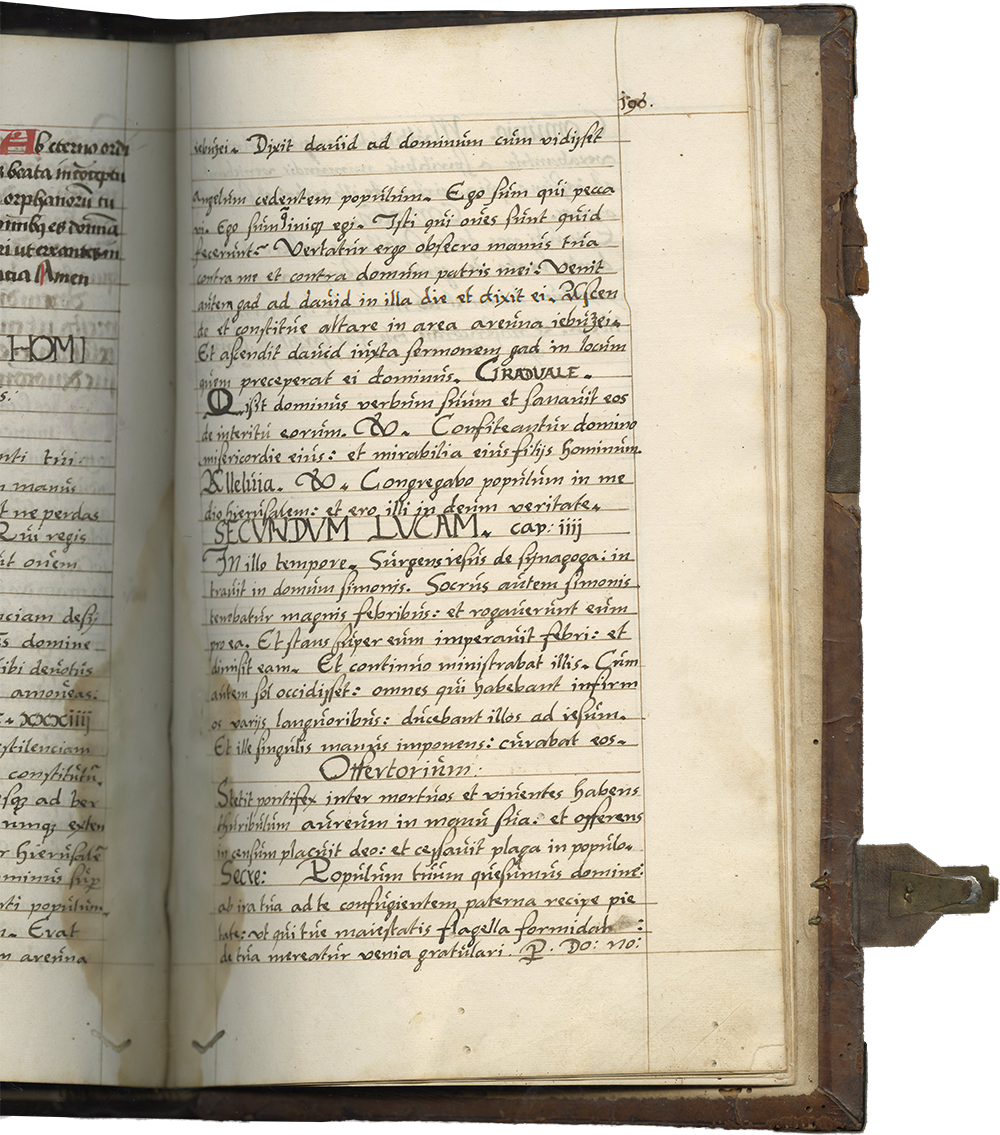
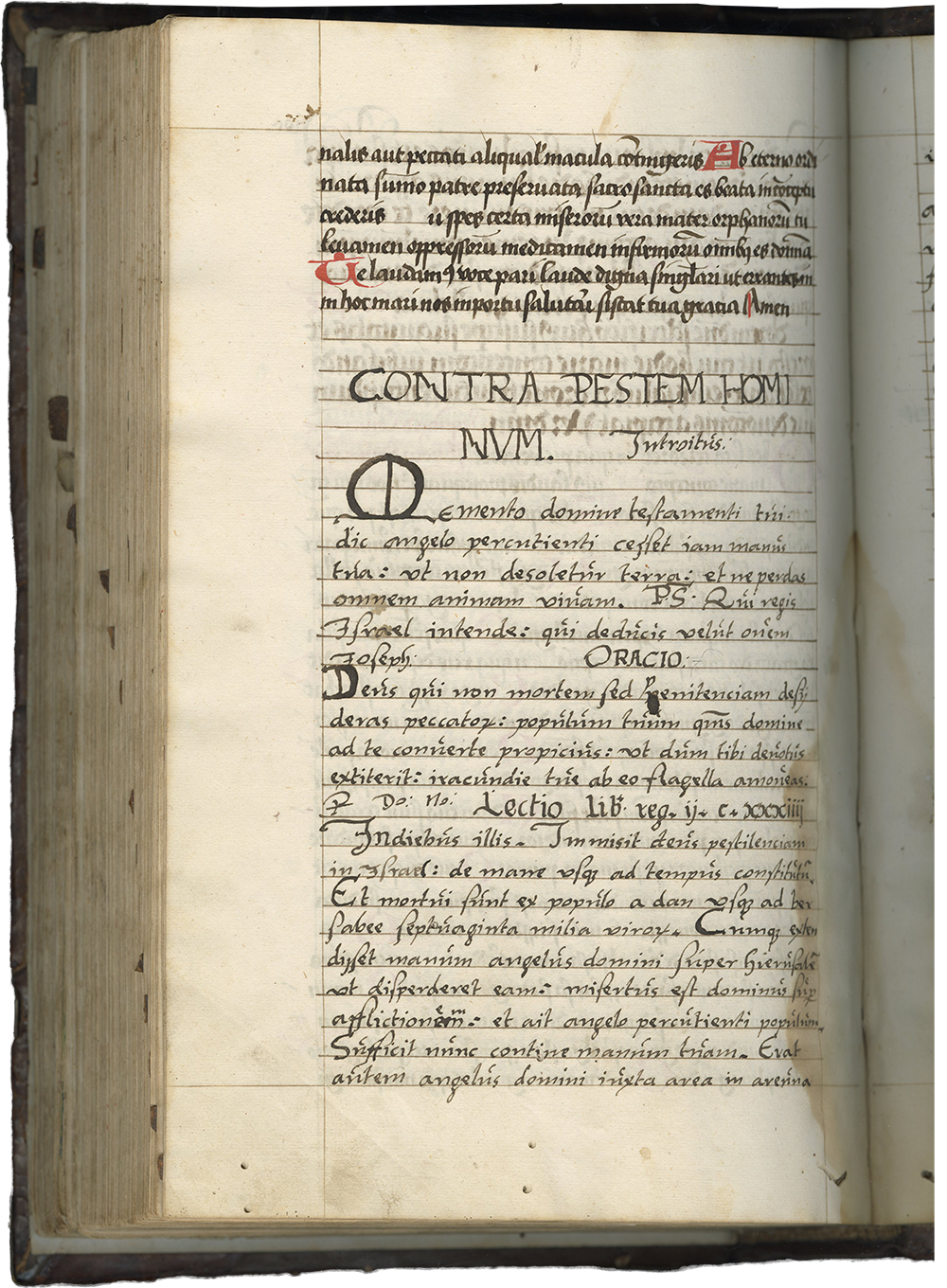
ff. 189v-196v, Votive masses, added in a near-contemporary hand St. Jerome (f. 193), Anne (f. 193), Immaculate Conception (f. 193v); added in a significantly later hand is a mass against plague (f. 195v); ff. 196–209 ruled, otherwise blank;
The script suggests that the plague mass was added much later, but it was known from at least 1483 in Silesia (Missale Vratislaviense, Mainz, 1483).
f. 209v, an abbreviated office for a bishop, contemporary with the main text, with added marginal notes adapting it for an abbot; below this in a later hand, an added mass for St Oswald.
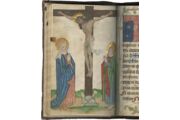
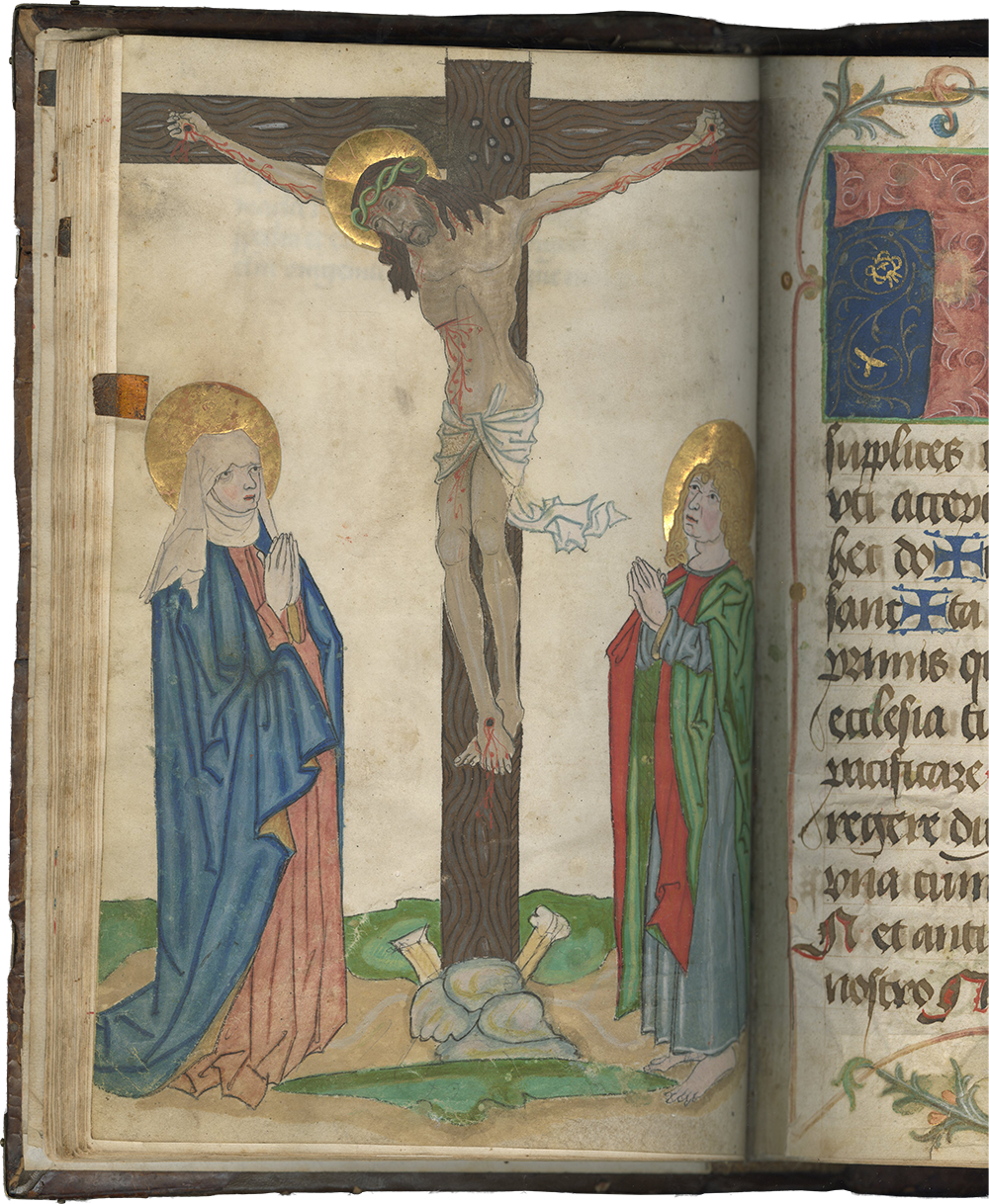
f. 51v, a full-page miniature of the Crucifixion, with Mary and John, painted on a parchment leaf tipped into the quire. The colors are bold, the background reserved parchment, the main draperies are delineated with straight, dark lines for the folds, and two lighter tones are used to represent highlights and shadows. Christ’s gold halo is rayed, while Mary’s contains stars. The overall effect is similar to over-painted woodcuts, and in an eastern European context, should also surely be compared to Orthodox icons.
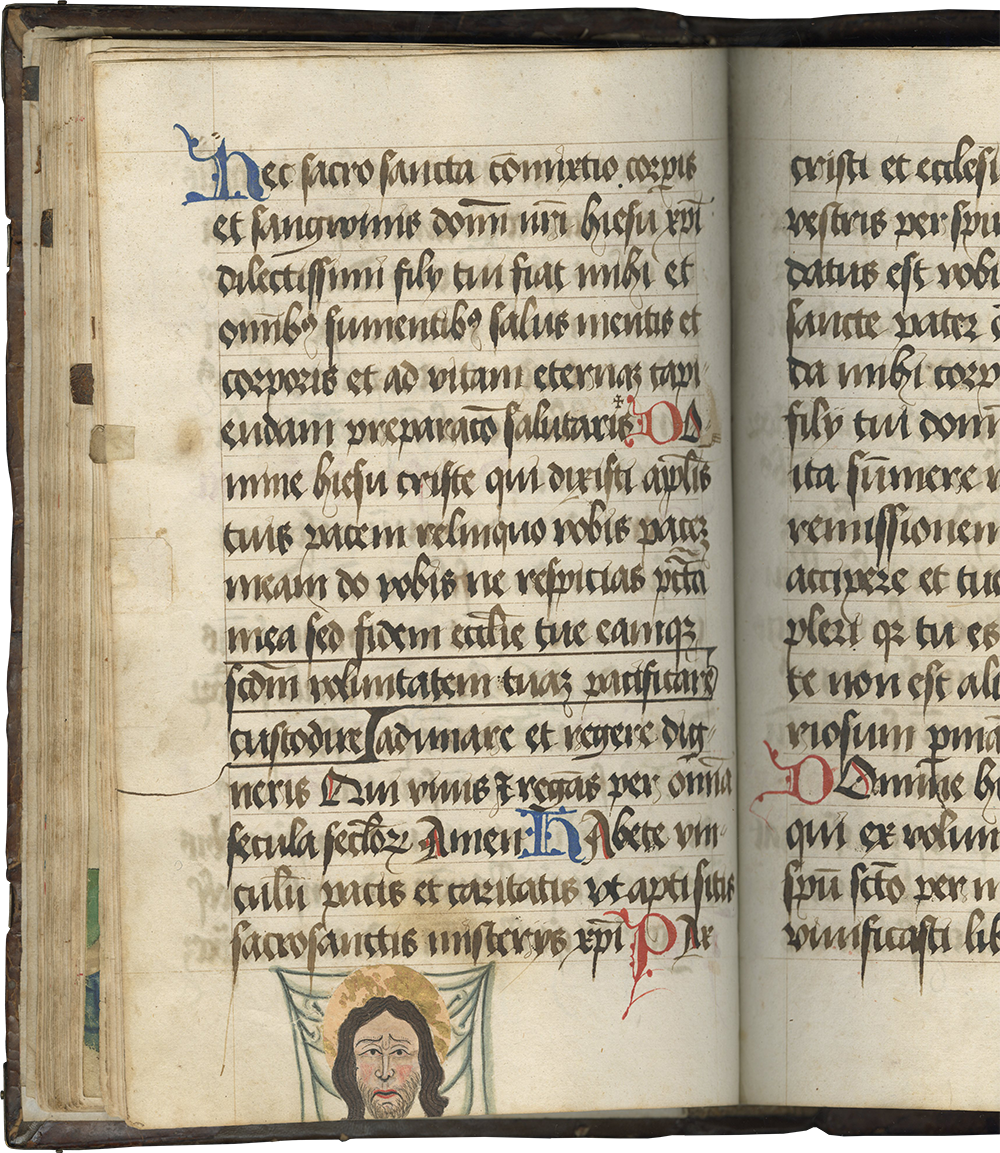
Illuminated marginal illustrations indicate several feasts, including Corpus Christi (the face of Christ on Veronica's veil, f. 57v); Dedication of a Church (a church, f. 95v); Feast of the Assumption (a dove with an olive branch, f. 135v); and the Office of the Dead (a skull, f. 186v).
The decorative illumination is very similar to that found in the Missal, also paper, Prague, National Library of the Czech Republic, MS XXIII.F.56, made in Prague in the final third of the fifteenth century for an Augustinian priory founded in that period in Prague. Moreover, MS XXIII.F.56 demonstrates the same modular construction as the present Missal, with major sections ending at the end of quires, suggesting workshop practices in Prague in the final quarter of the fifteenth century. For digitized examples of Polish missals with similar illumination, see Online Resources.
Missals were the backbone of medieval religious ritual and contain the words and the gestures that priests used to say daily mass year-round, together with all the many feasts, saints days, and special masses necessary to medieval religious life. As such, Missals were strangely both eternal and ephemeral. Missals were so frequently used that they commonly simply wore to tatters. Moreover, feasts were continuously added to the liturgical year, necessitating constant updates even when a volume was otherwise in good condition. Famously, in the mid-sixteenth century, the Council of Trent reviewed the text of the entire Missal, renewing it in response to the rise of Protestantism.
A testament to the durability of early paper, the present volume offers a lovely example of an illuminated, paper Missal updated for use from the 1470s until the advent of the Tridentine Mass in 1570. Throughout the volume additions were made on blank ends of quires and in margins, adding masses and updating music wherever necessary to extend the working life of the book. Moreover, the book was not made in Paris or Cologne, but in Prague, for use in Silesia (parts of present-day Poland, Czechia, and Germany). The “heretics” from whom a seventeenth-century owner bought the book could therefore have been Protestants, Orthodox Christians, Jews, or even Catholics in this complex religious border zone. This volume provides a magnificent final snapshot of European Catholicism in its last medieval decades.
Hughes, Andrew. Medieval Manuscripts for Mass and Office: A Guide to Their Organization and Terminology, Toronto, 1982.
Van Dijk, S. Sources of the Modern Roman Liturgy: The Ordinals of Haymo of Faversham and Related Documents (1243-1307), 2 vols, Leiden, 1963.
Einbanddatenbank. https://www.hist-einband.de/en/
“Liturgical Books.” https://liturgical.columbia.edu/
Liturgia Latina. http://www.liturgialatina.org/
Manuscripta.pl https://manuscripta.pl/en/manuscripts/60611/
(formerly) The Schoyen Collection MS 195 https://www.schoyencollection.com/liturgy-introduction/roman-catholic/missal-with-additional-offices-ms-195
Prague, National Library of the Czech Republic, MS XXIII.F.56,
Usuarium: A Digital Library and Database for the Study of Latin Liturgical History in the Middle Ages and Early Modern Period, Missale Vratislaviense, https://usuarium.elte.hu/book/98/view
Wrocław, University of Wrocławiu Library, MS I F 363 https://manuscripta.pl/en/manuscripts/47528/
Wrocław, University of Wrocławiu Library, MS R 3057 https://manuscripta.pl/en/manuscripts/49460/