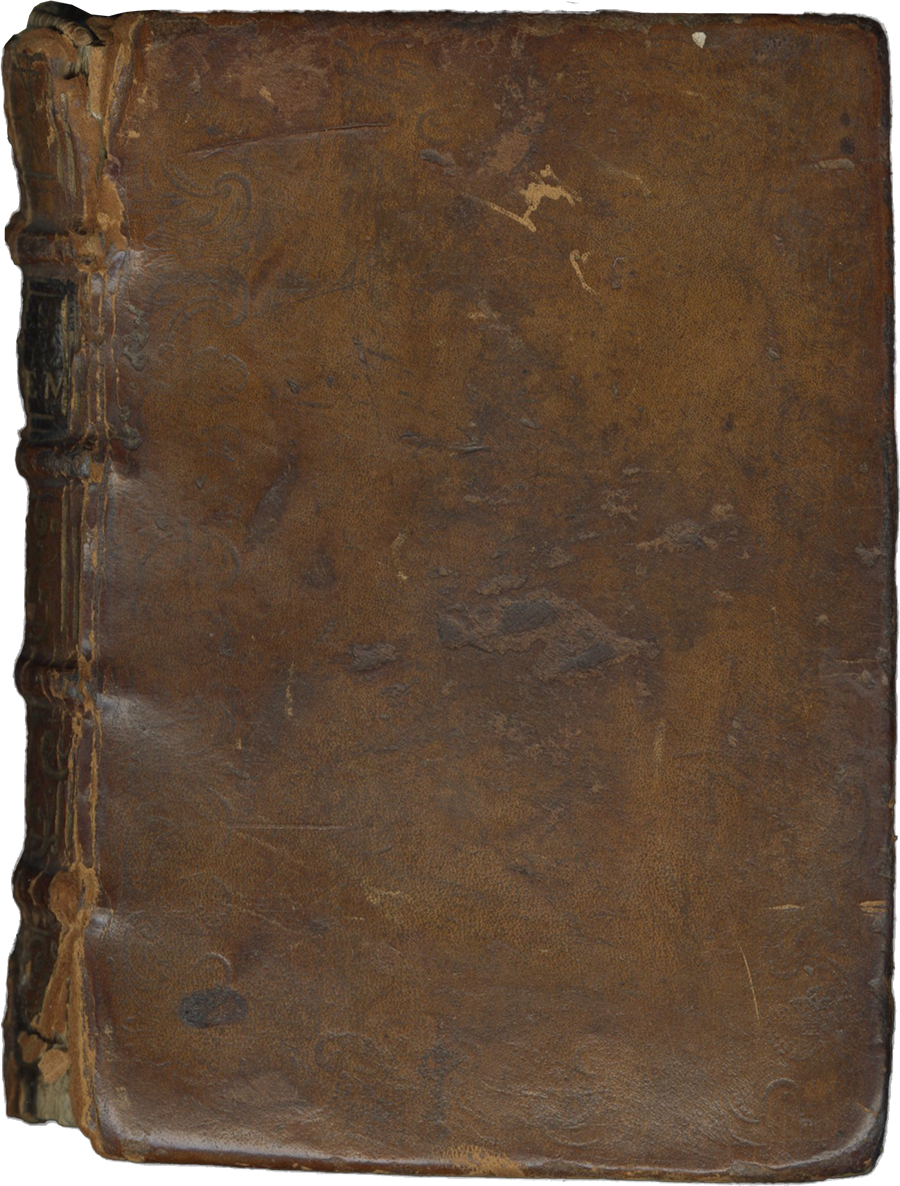
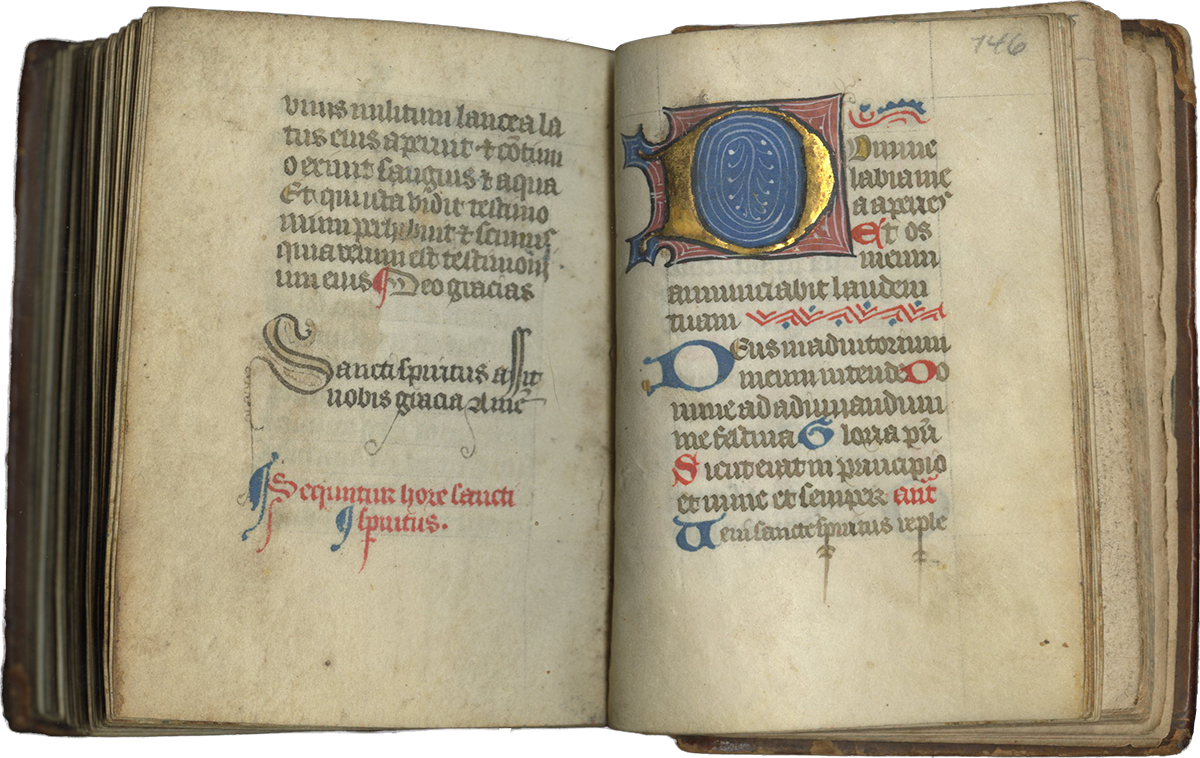
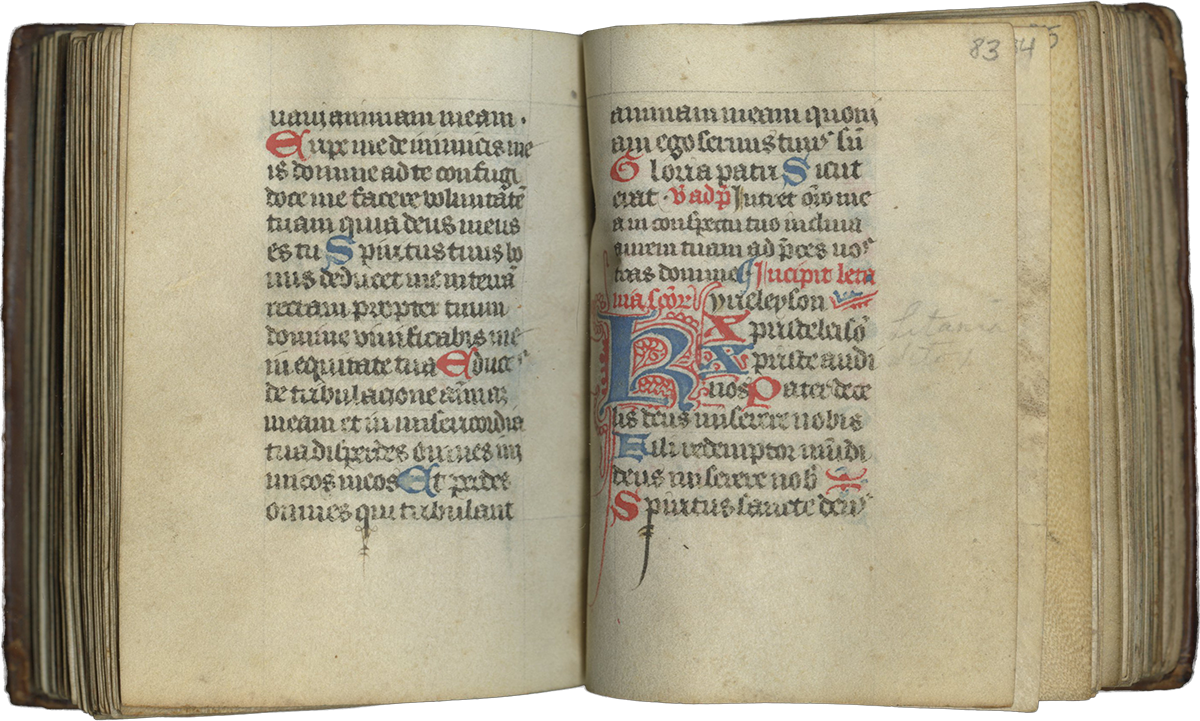
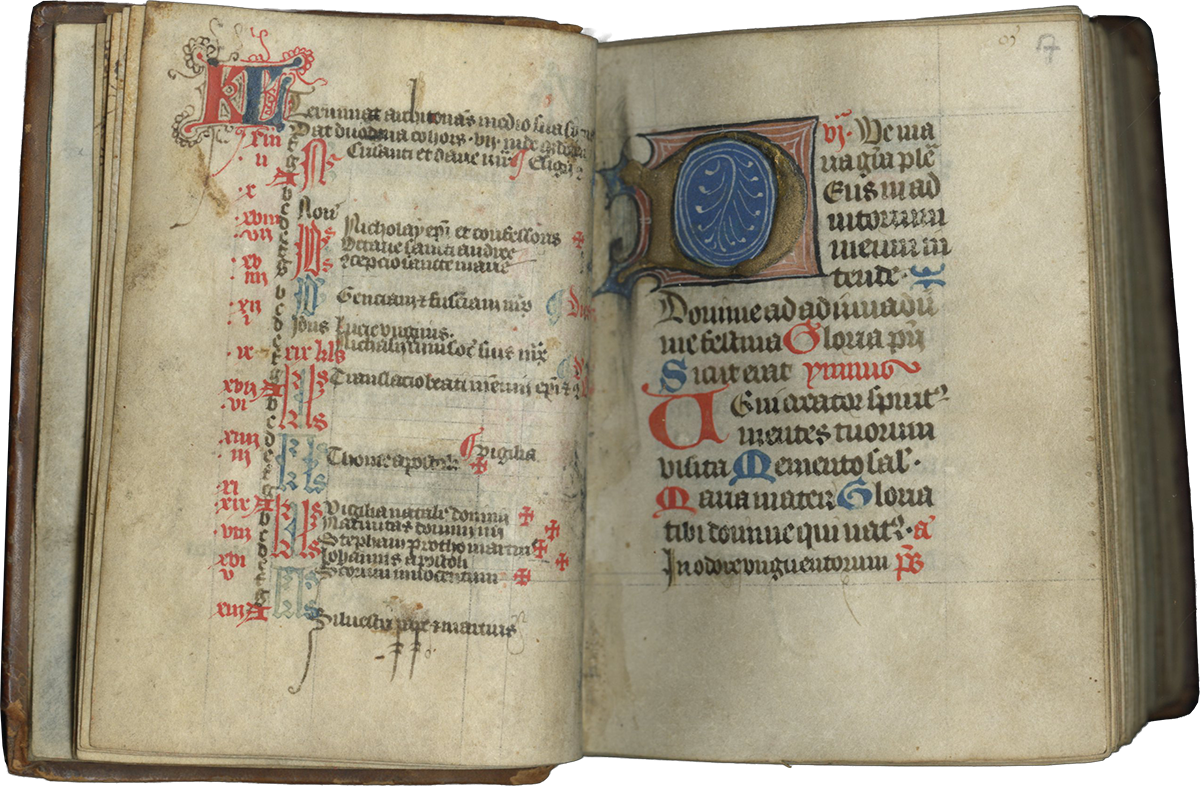
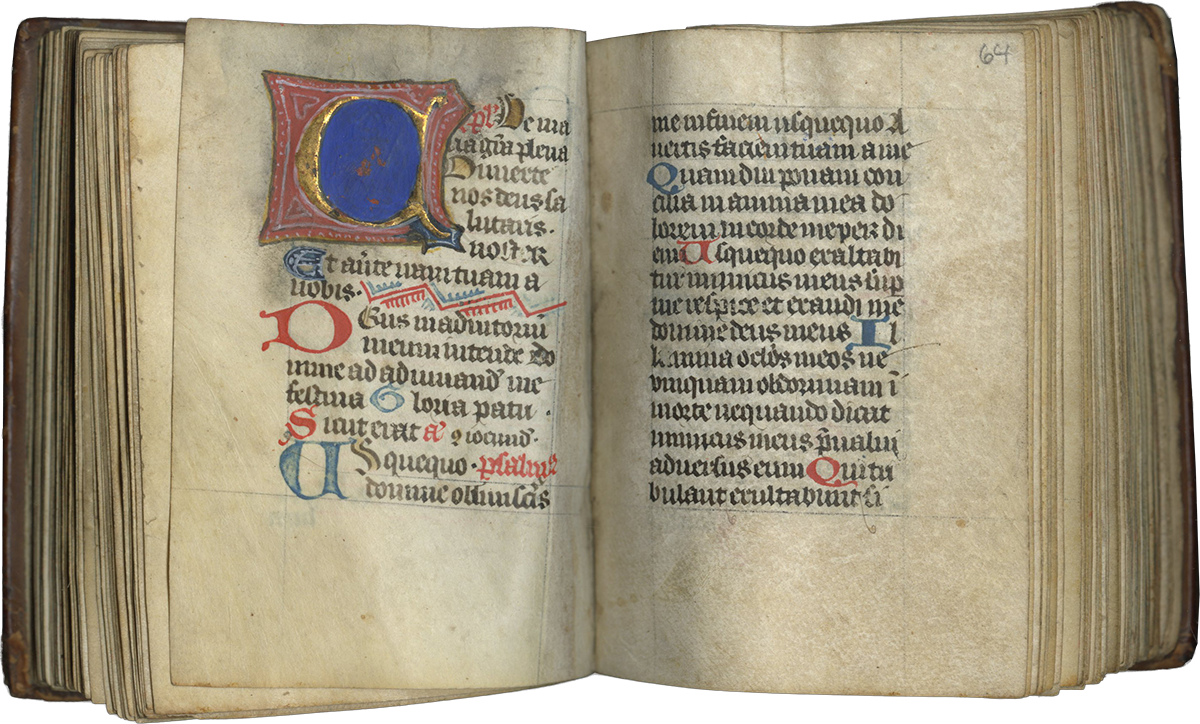
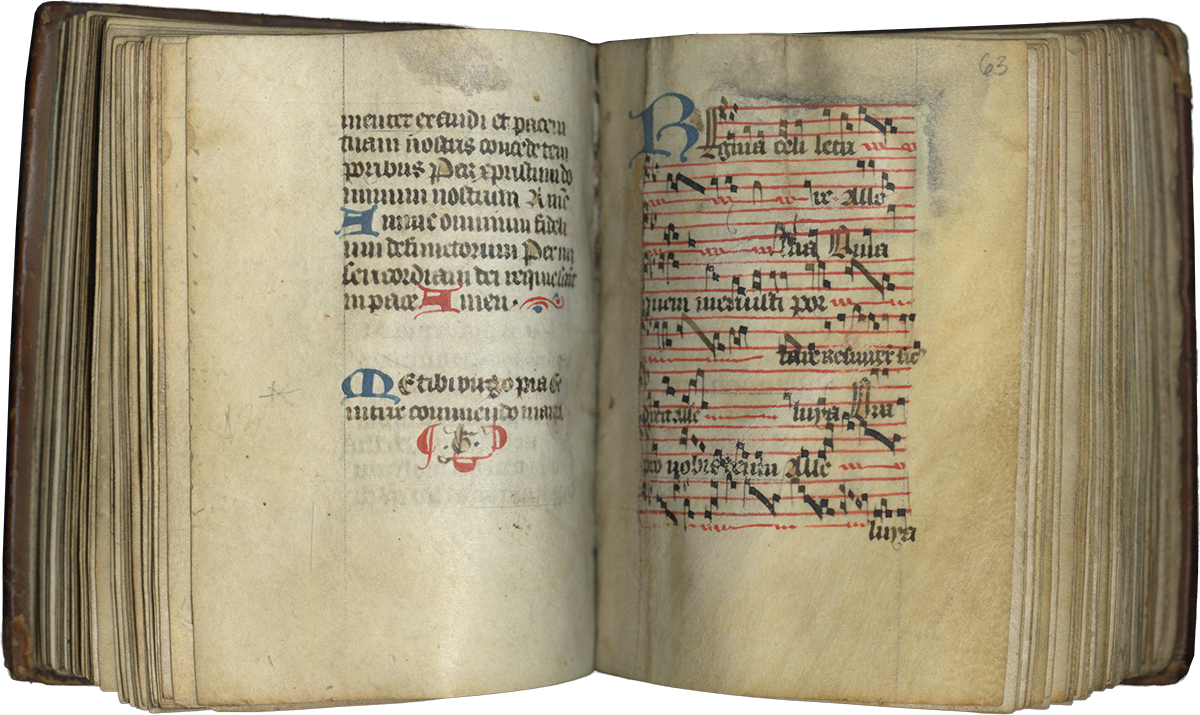
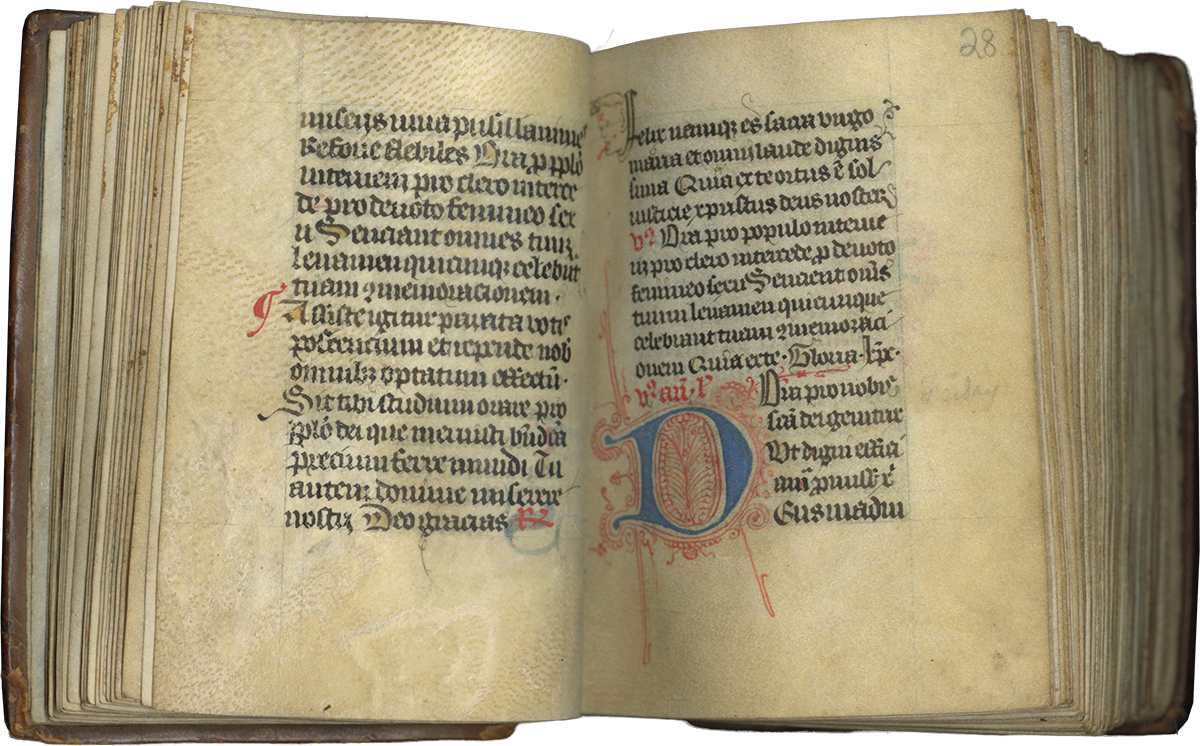
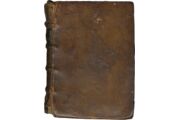
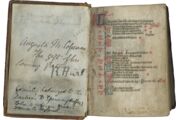
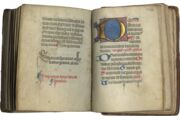
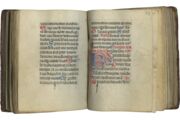
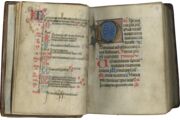
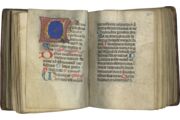
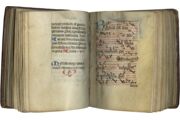
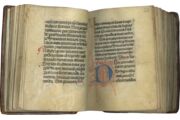
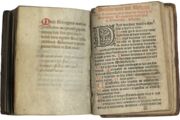
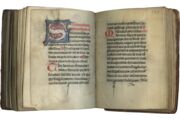
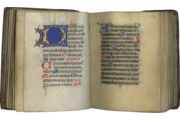
i+186+i paper and parchment folios, no visible watermarks, some quire signatures extant, and a few J-G monograms in place of catchwords remain, incomplete, (collation: i-ii6 iii8 iv6 v6-6 vi6 vii-viii4 ix6-6 x4-1 xi4-1 xii8-1 xiii8(8 cancelled and replaced) xiv6-1 xv-xvi8 [quire missing] xvii4 xviii10 xix6 xx8+9 xxi6+7 xxii-xxiii6 xiv6-1 xv8-7,8 xvi4 A-C8), ruled in ink, justification 64 x 42 mm, text in single column of 15 lines in textualis, some extended ascenders and descenders, additional text sections in similar contemporary or near-contemporary hands, red rubrics, majuscules flashed in yellow, one page of music on a 4-line red stave, one- and 2-line initials in red or blue, some 2- to 4-line initials in red or blue with contrasting flourishing, red and blue ink line-fillers, several 5-6-line overpainted champ initials, some small repairs, a few spots and stains, else good condition. Bound in nineteenth-century tooled calf over pasteboards, spine tooled and gilded and a title in gilt on black leather panel (“Heures de N. Dame M[arie]”), blue silk doublures, scuffing and tears to extremities of spine, binding becoming loose in places, overall sound. Dimensions 140 x 79 mm.
A fascinating, plain Book of Hours copied for a provincial liturgical use and bearing evidence of use well into the sixteenth century. The addition of quires of unidentified printed material provides further research potential in this volume. Indeed, it was this sort of devotional book, undecorated, manuscript hybridized with print, that was by far the most normal in its time. Yet these books were consulted so often and for so long that they were simply read to pieces—originally commonplace, today they remain comparatively uncommon.
Provenance
1. Copied in northeastern France and perhaps used in a female monastic institution. The saints in the calendar and litany all point to the northeastern diocese of Châlons-sur-Marne (now Châlons-sur-Champagne)—in particular bishops Memmius (ff. 3v translation and f. 4v feast, 85v) and Alpinus (f. 3, translation, f. 5 feast), Donatianus, Domicianus, Elaphius, Leudomarus (ff. 85-86), but also Gibrian (ff. 3, 85v), Bercharius of Hautvillers (f. 5v), and Tanche of Troyes (f. 86). The collation of the humble volume betrays substantial variability even before it was pilfered for initials, and this often characterizes local, monastic production even late in the Middle Ages. The J-G monogram catchwords may provide a further clue to the original provenance.
2. The volume may have continued in use later in the fifteenth century, as an inscription in another textualis hand recounts that the book was copied on 25 April 1411 in “Viasne” seemingly before being refreshed for use by another generation of nun (f. 139v, “Escript a viasne le jour de la saint marc evangelistre l’an mil iiijc et xi et regnou[velait?] pour la journee [de?] la fille [de?] S[aint] P[ierre]” “Written in Viasne the day of St. Mark the Evangelist, 1411 and [renewed?] for the monastic day of the daughter of St. Pierre (possibly St-Pierre-d’Avenay between Châlons-sur-Champagne and Reims, or St-Pierre-des-Dames in Reims itself, though none of the founders are in the calendar). However, this inscription, and others in its hand, also raise questions. The town of Vienne is in the southeast, not in Champagne, and whilst there are parishes in the Châlons-sur-Marne diocese called Vienne, sometimes spelled Viasne, it remains unclear where, precisely, the book was made. Moreover, this hand provides an obviously incorrect incipit for the beginning of Compline at the end of Compline, complete with a misleading catchword of the first word of Compline. The same ink used in this inscription was added to decorate several of the J-G monogram-catchwords, and above the inscription the decoration adds the further letters m, p, j, and y. This “renewal” (if that’s what it was) included the inscriptions, some additional catchword decoration, and perhaps also overpainting the champ initials. XRF analysis might help date these interventions.
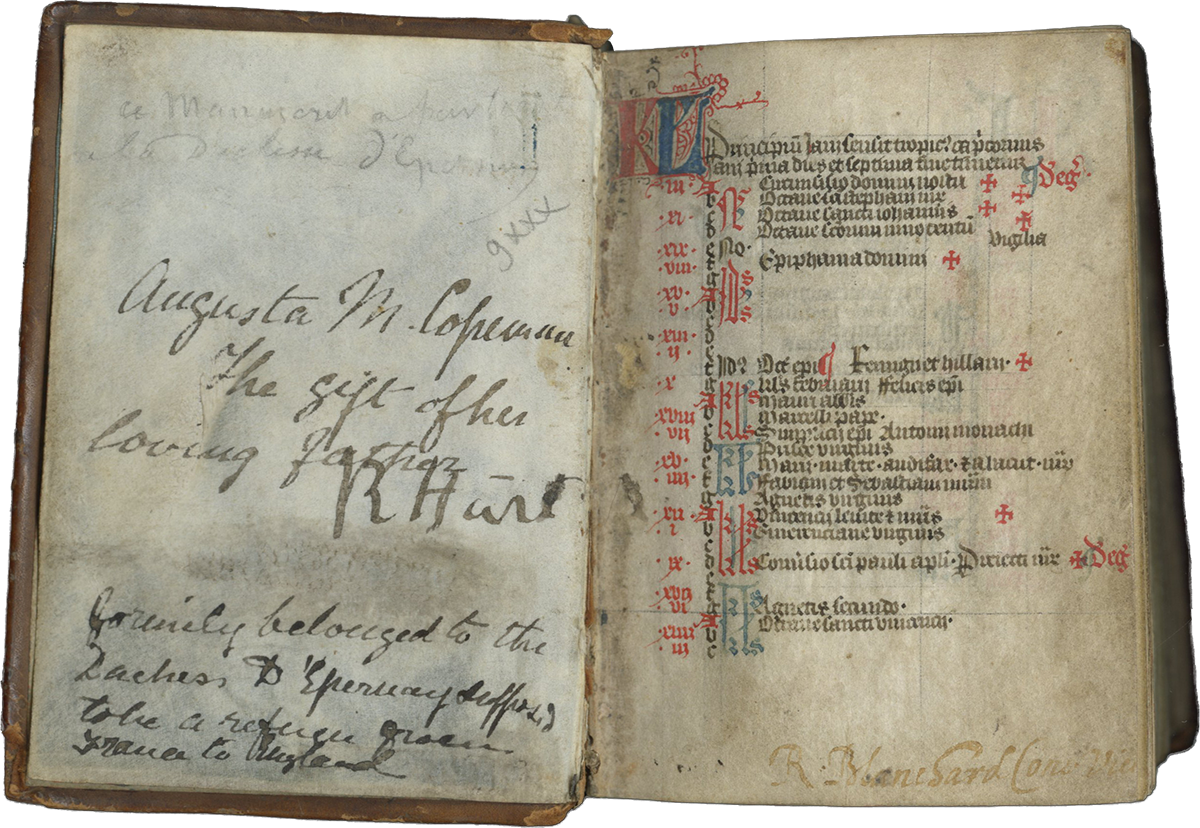
3. A seventeenth-century inscription “R. Blanesard [possibly Manesard] Cons. Vie[trimmed]” (f. 1 lower margin).
4. On nineteenth-century flyleaf, “Augusta M. Copeman the gift of her loving father.” On lower flyleaf, in Augusta’s hand, “Formerly belonged to the Duchess D’Epernay supposed to be a refugee from France to England.” There has never been such a title, and it must be a spurious association, as Copeman suspected. It is, however, a plausible fiction, as Épernay is in Champagne.
5. Inscribed over the above inscription “R Hart.”
6. On upper flyleaf in modern pencil “Ce manuscrit la Duchesse d’Epernay.”
Text
ff. 1-6, Calendar;
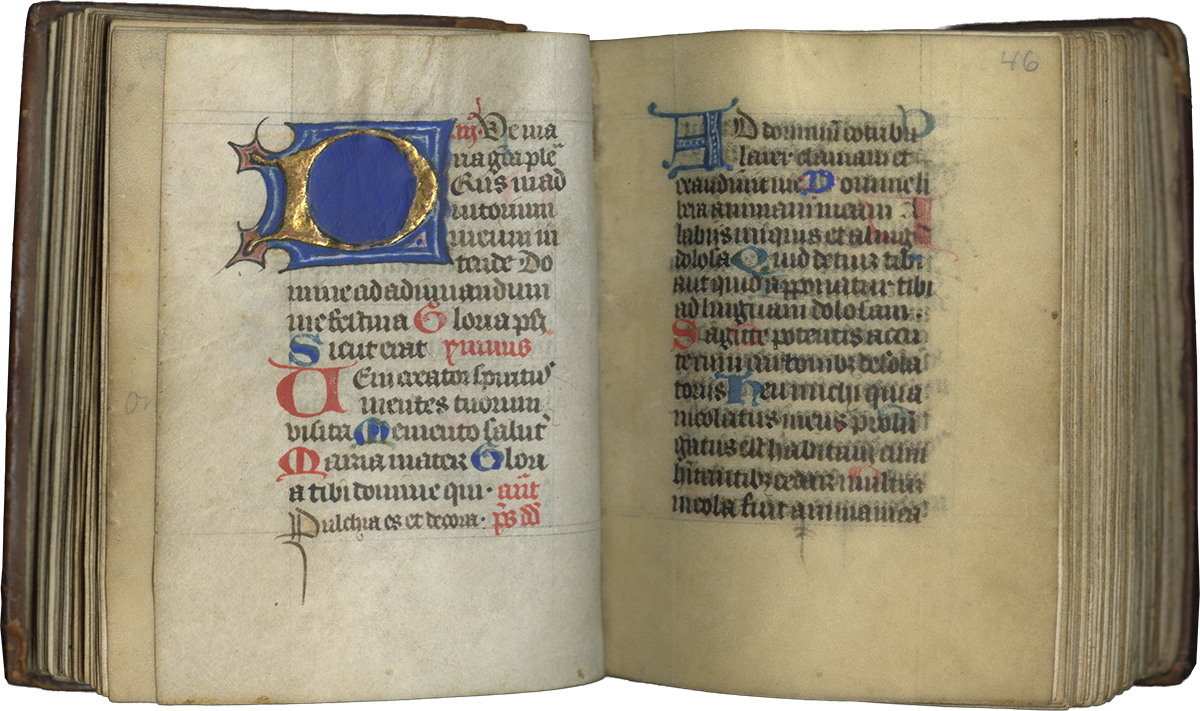
ff. 7-69v, Hours of the Virgin, Matins (f. 7), Lauds (f. 28), Prime (incomplete at the beginning, now begins f. 41), Terce (f. 45v), Sext (incomplete at the beginning, now begins f. 50), Nones (incomplete at the beginning, incipit on f. 52v), Vespers (incomplete at the beginning, incipit on f. 55v), Compline, (f. 63v, f. 63 noted copy of the Marian antiphon Regina celi) (added incorrect incipit f. 69v for Compline);
ff. 70-91, Penitential Psalms and Litany;
The first leaf of the Penitential Psalms was removed and replaced at some point in the fifteenth or early sixteenth century.
ff. 92-128, Office of the Dead (incomplete at the beginning);
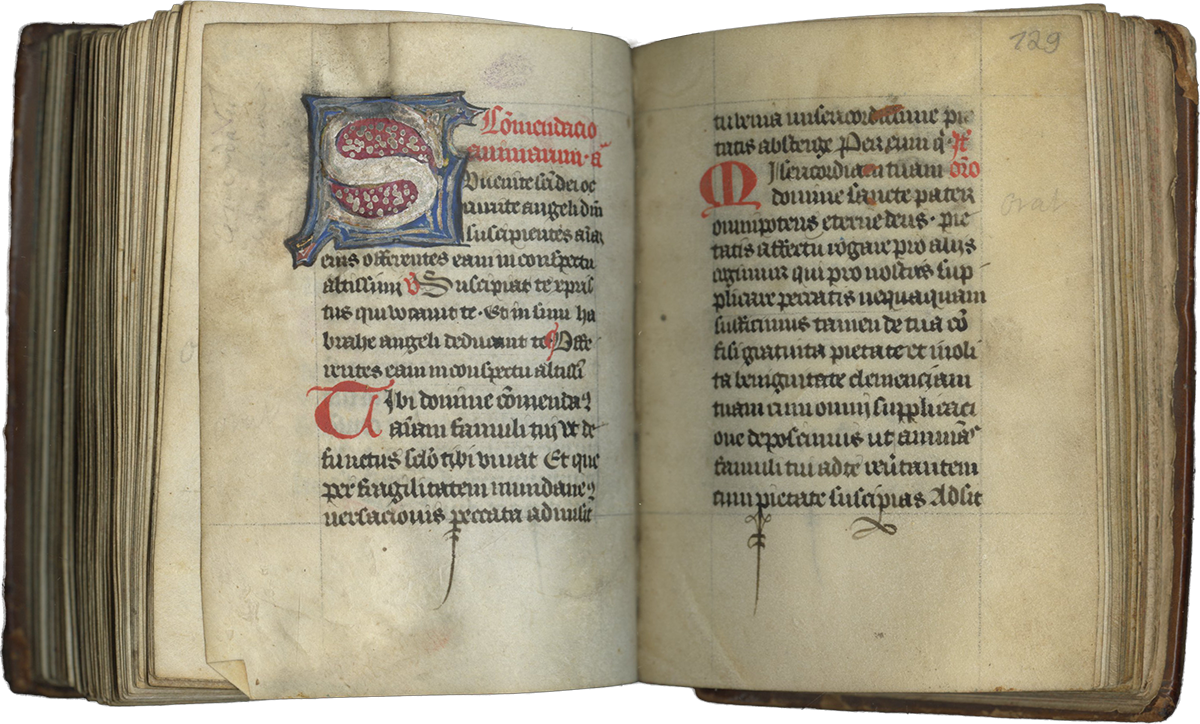
ff. 128v-133, Commendation of the Soul, f. 133v ruled but blank;
ff. 134-145, Occasional prayers;
ff. 145v-150v, Short Hours of the Holy Spirit;
ff. 151-154v, (incomplete at the beginning) Occasional prayers;
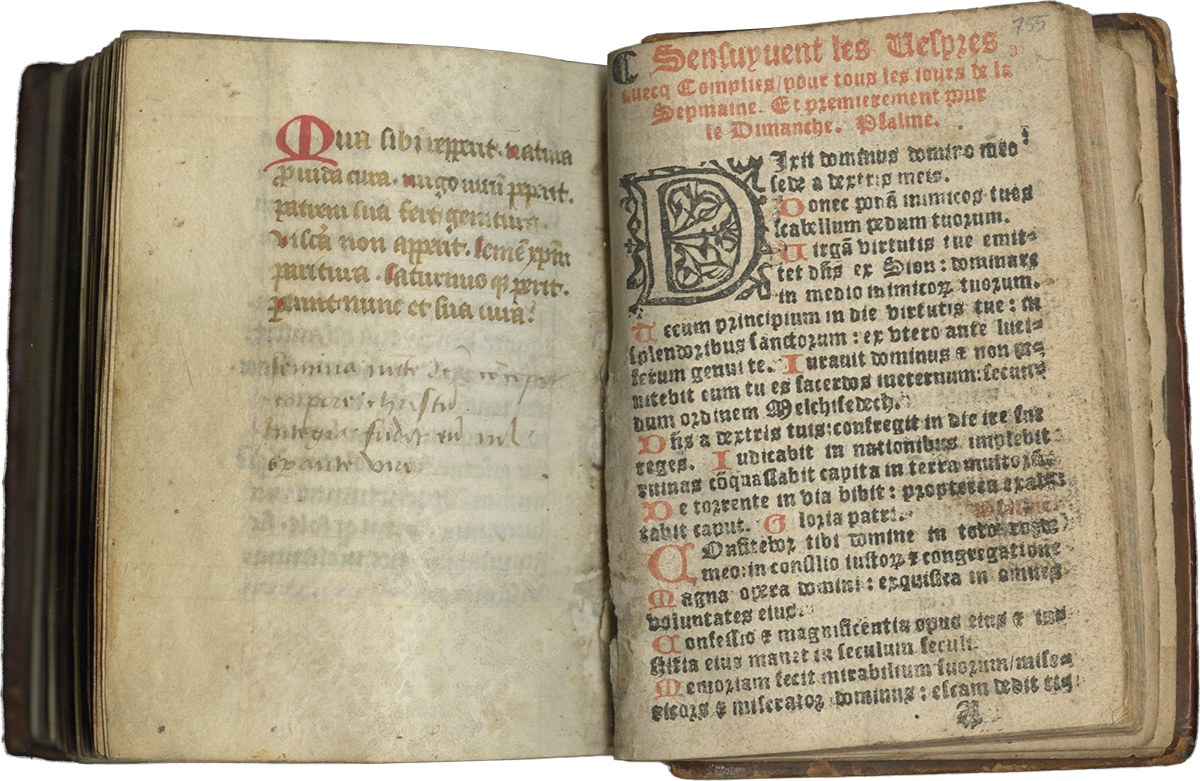
ff. 155-186, printed, ff. 155-179, Sensuyuent les Vespres, bicolor, A-B8; ff. 180-186, Sensuyent les Hymnes Communes pour toute l’annee, black only, C8, both apparently complete.
Unidentified edition: the Universal Short Title Catalogue lists a range of similarly titled sixteenth- and early seventeenth-century editions, all extant in very small numbers and none digitized or with precisely matching titles. There are no titles like this listed in the Incunabula Short Title Catalogue, and the page layout suggests a later imprint. The pages are printed too closely to make watermark identification possible.
Books of Hours survive in greater numbers than any other type of manuscript from the Middle Ages and the Renaissance. Made to support private prayer, by the fifteenth century Books of Hours were copied for a very wide audience indeed, and surviving examples range from some of the most luxurious and famous illuminated manuscripts like the Très Riches Heures belonging to Jean, Duc de Berry, to more utilitarian examples made for the use of simple merchants. If a family in the fifteenth century owned a book at all, there is a very good chance that the book they owned was a Book of Hours.
This Book of Hours reminds us that not all Books of Hours, even illuminated Books of Hours, were luxurious productions. Though missing many of the leaves that might once have born art, the remaining volume illustrates quiet humility—entirely consistent with the possibility that it was made and used locally, and perhaps in a conventual setting. Yet, despite its lack of decoration, the volume seems to have been used for some time, bearing leaves replaced in the fifteenth century, and then having quires of further printed material added later on. For these readers, the prayers were sufficient unto themselves without additional miniatures or much decorative illumination.
Books of Hours for use in the diocese of Châlons-sur-Marne are relatively uncommon. Leroquais lists just one, and notably that one features different saints in its calendar than the one catalogued more recently by Consuela Dutschke, San Marino, Huntington Library, MS 1265 (1927, Vol. 1, p. 94, Online Resources). The Schoenberg Manuscript Database lists a dozen Books of Hours of this liturgical use, including those now held in institutional collections such as that at the Huntington Library in San Marino California.
Literature
Leroquais, Victor, Les livres d’heures manuscrits de le Bibliothèque nationale, 3 vols. Paris, 1927.
Reinburg, Virginia. French Books of Hours: Making an Archive of Prayer, c. 1400-1600, Cambridge, 2012.
Wieck, Roger. Time Sanctified: The Book of Hours in Medieval Art and Life, London, 1988.
Wieck, Roger. Painted Prayers: The Book of Hours in Medieval and Renaissance Art, New York, 1997.
Online Resources
Baltimore, Walters Art Museum, MS W.93, Book of Hours, use of Châlons-sur-Marne, https://art.thewalters.org/object/W.93/
Gunhouse, Glenn, A Hypertext Book of Hours, https://www.medievalist.net/hourstxt/home.htm
New York, Morgan Library, MS M.960, Book of Hours, use of Châlons-sur-Marne,
https://www.themorgan.org/manuscript/145501
Philadelphia, Free Library, MS Lewis E 89, Book of Hours, use of Mons (similar to Châlons), https://bibliophilly.library.upenn.edu/viewer.php?id=Lewis%20E%2089#page/4/mode/2up
San Marino, Huntington Library, MS 1265, Book of Hours, use of Châlons-sur-Marne
https://hdl.huntington.org/digital/collection/p15150coll7/id/52489/rec/15
TM 1497