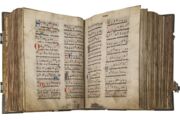
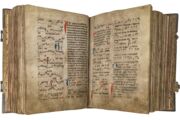
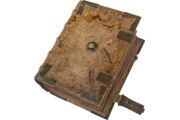


Noted Missal with Sequentiary
In Latin and German, decorated manuscript on parchment
Germany, Cologne?, 1475-1500
TM 1344
- $45,000.00
 Textmanuscripts - Les Enluminures
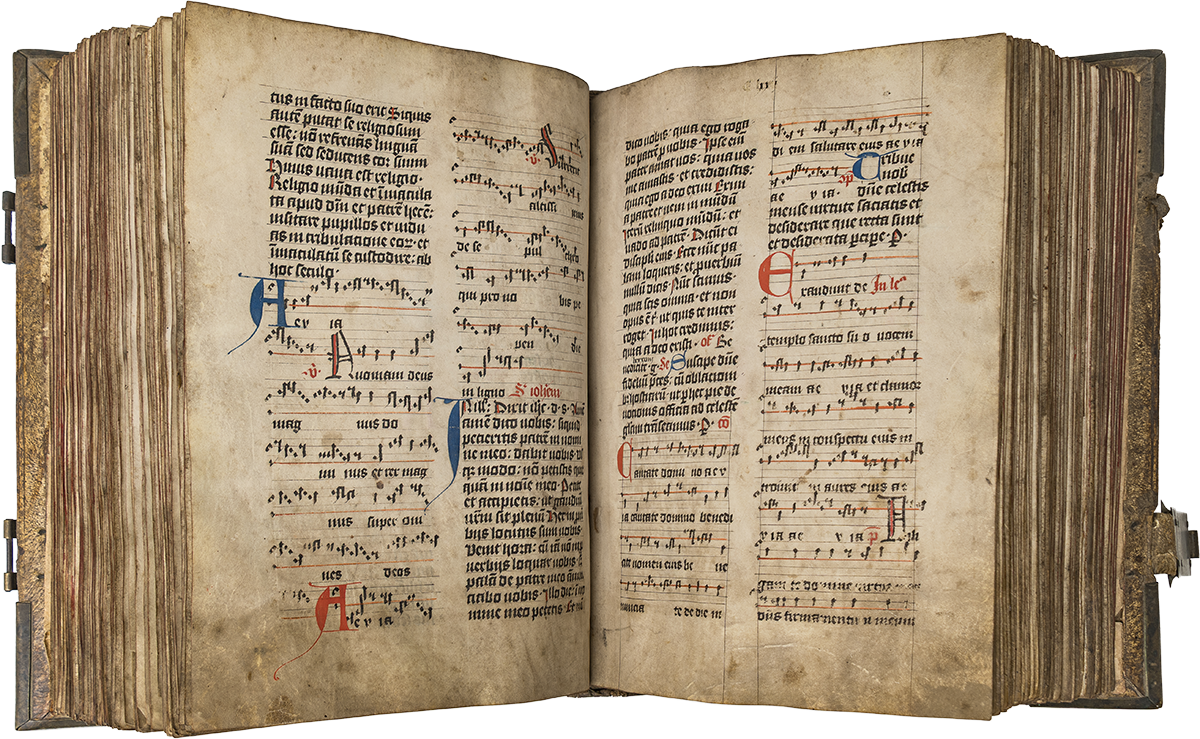
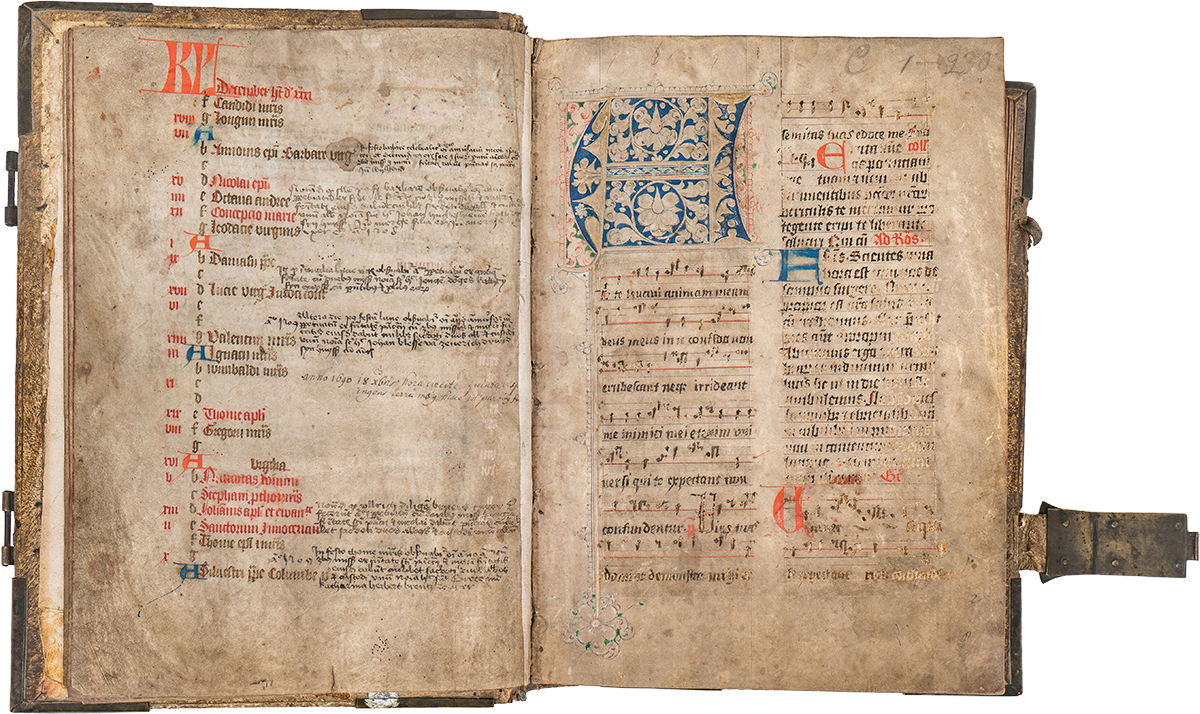
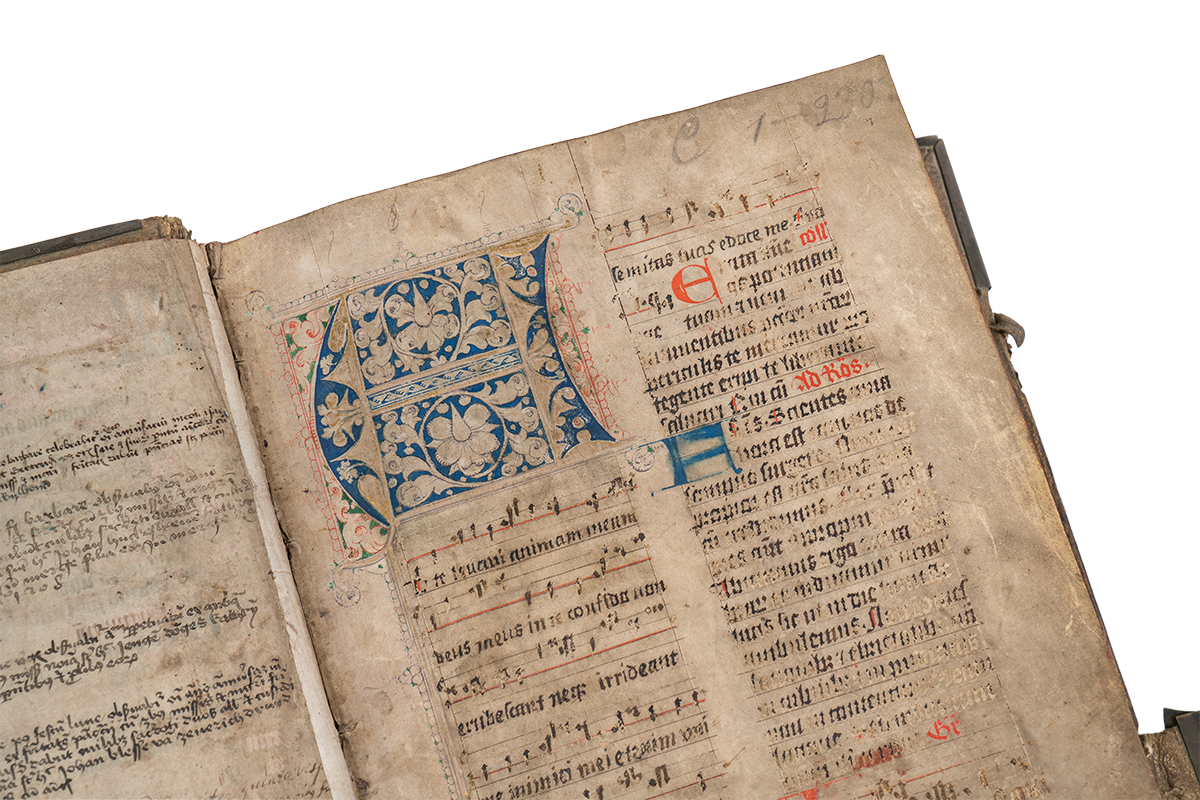
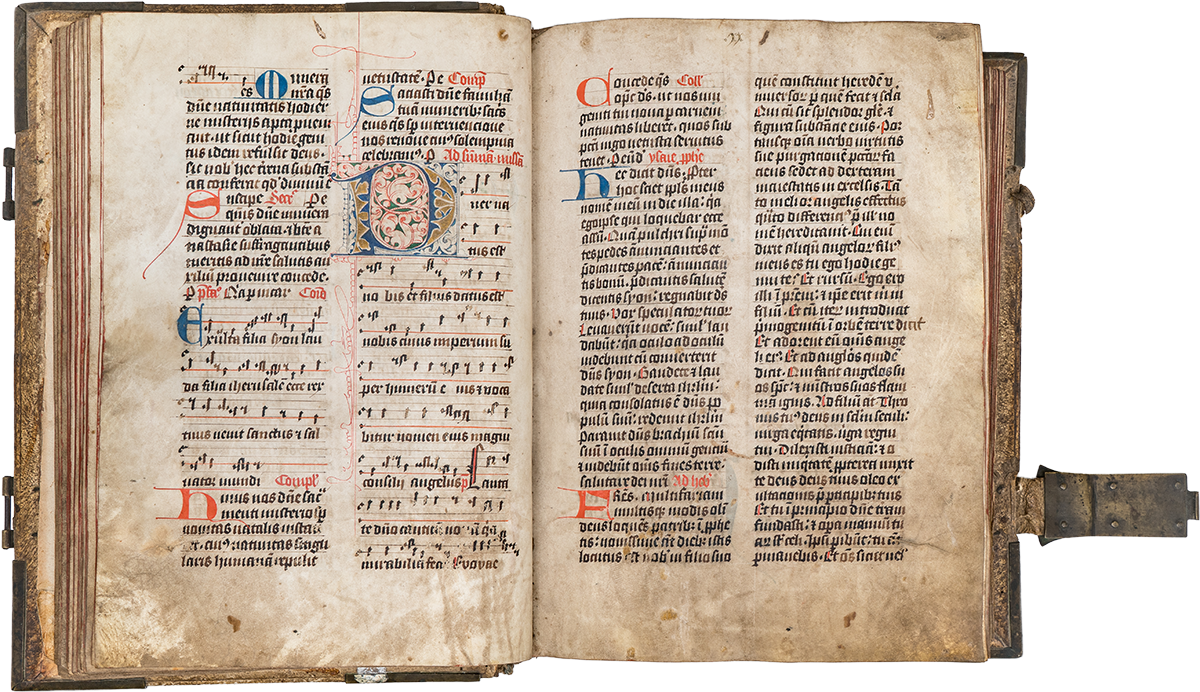
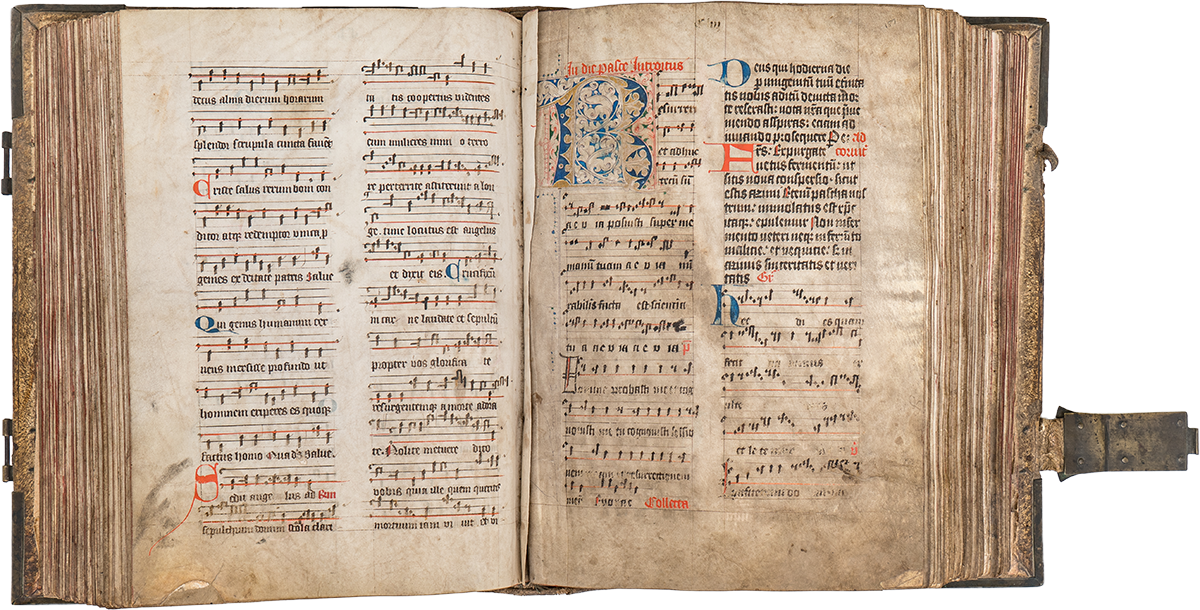
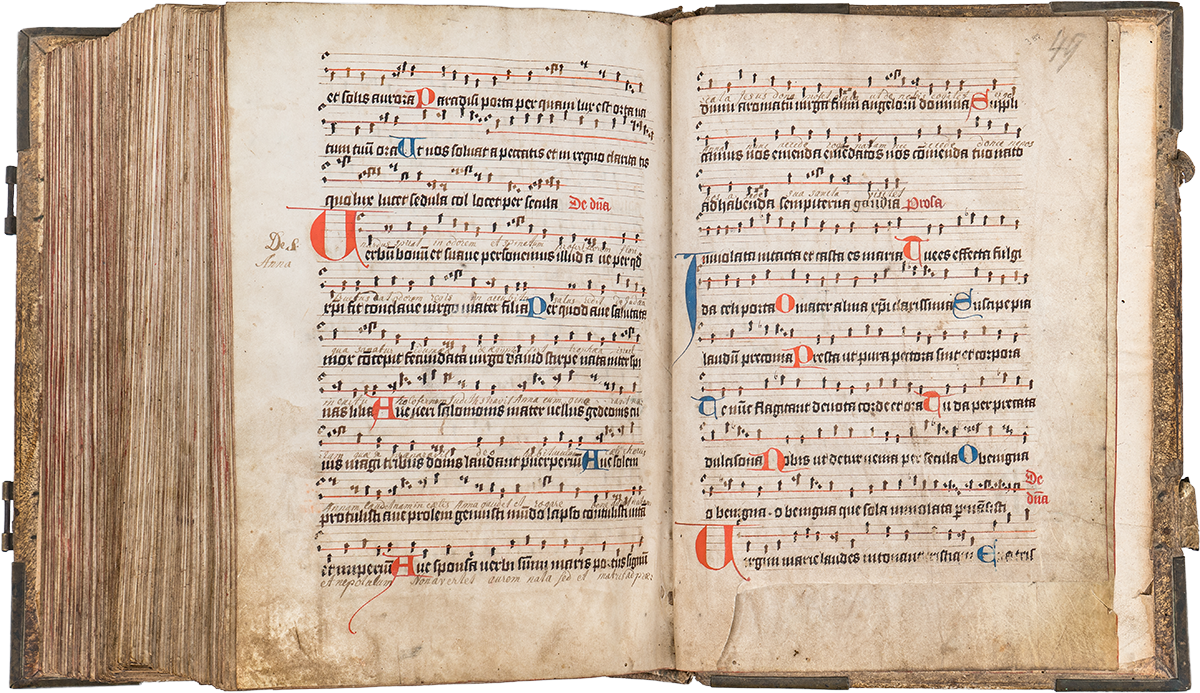
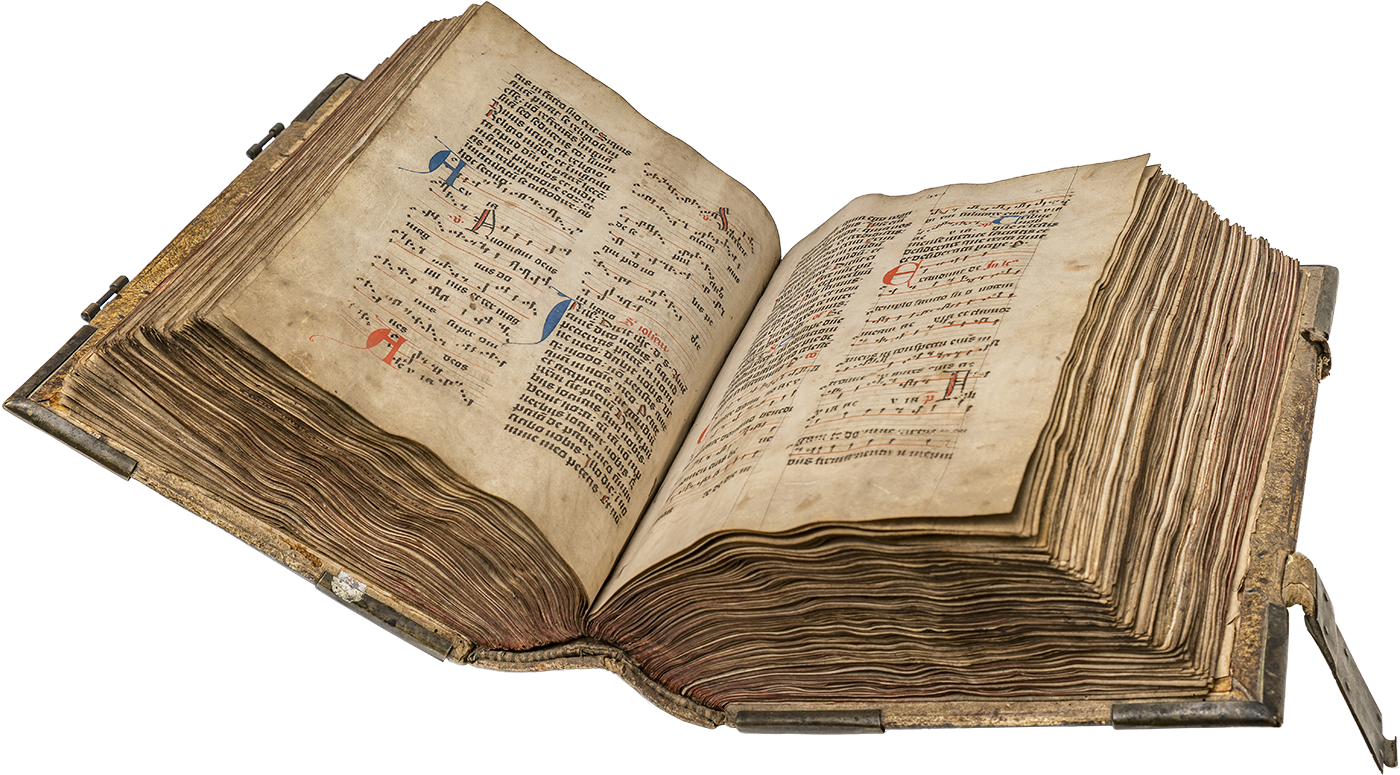
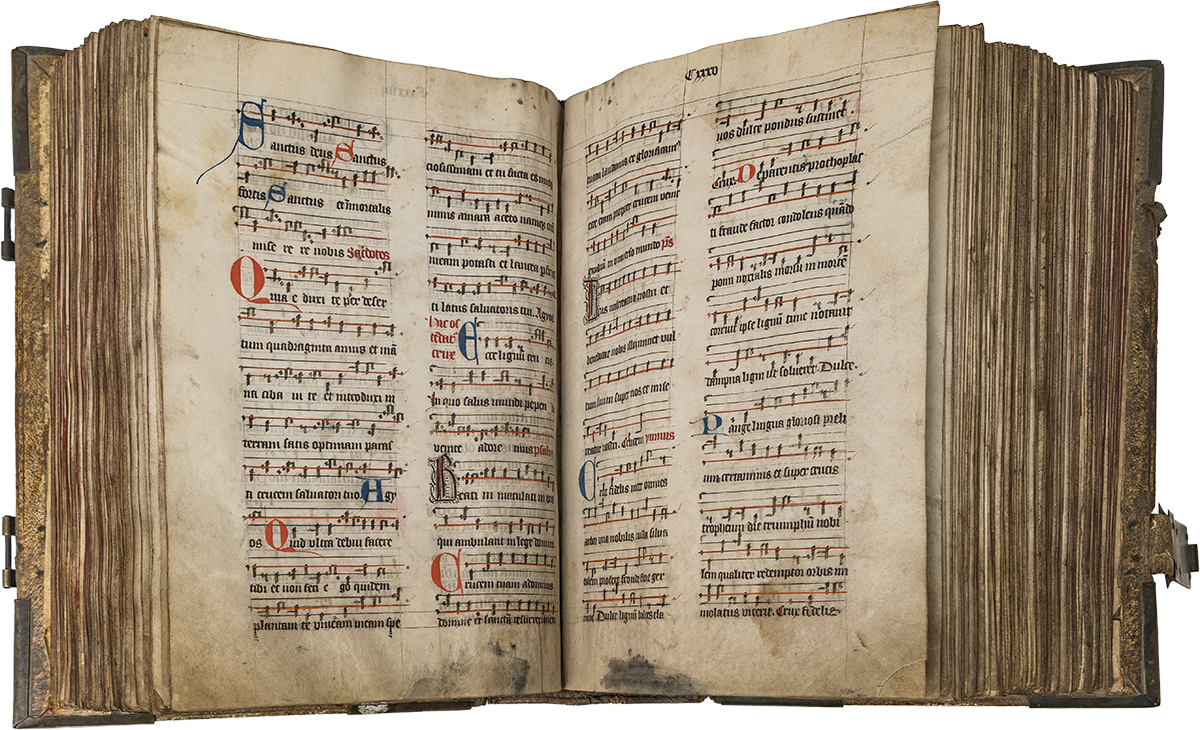
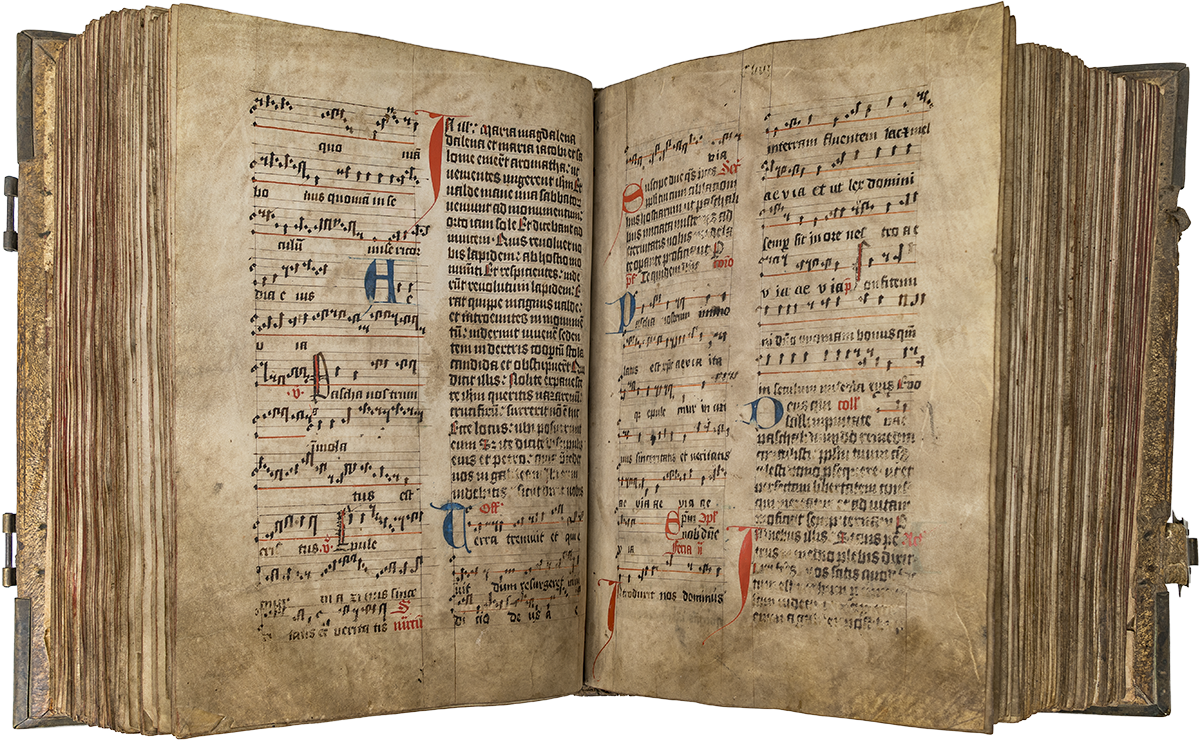
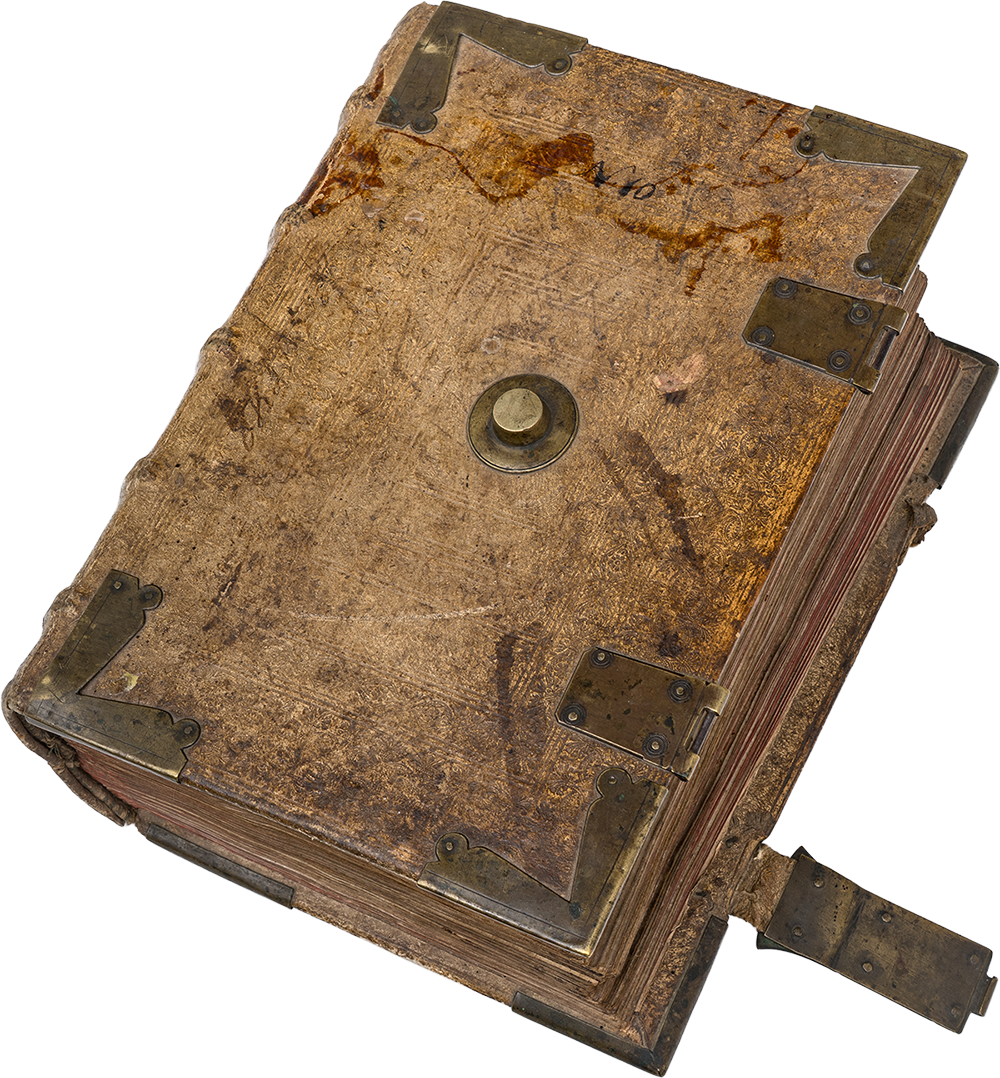
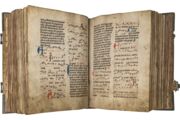
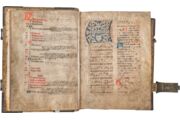
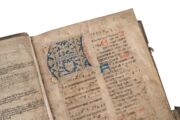
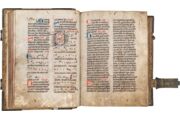
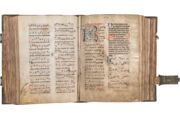
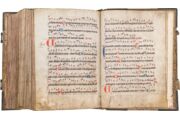
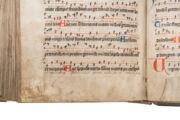
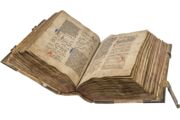
i (parchment)+390+iv (paper, unwatermarked) parchment leaves, modern foliation in upper right corner (used here), original foliation in center top margin incomplete and disordered, incomplete, (collation: i6 ii-xvi8 xvii6 xviii-xxx8 [quires missing] xxxi-xxxvi8 xxxvii8-7 xxxviii-xli8 xlii8-8 xliii10 xliv-xlviii8 xlix10), no catchwords, ruled in brown ink mostly in 2 columns (justification ~270 x 170 mm), 32 lines, copied in several textualis hands with hufnagel notation on 4-line staves, 2-line lombard initials alternating in red and blue, 2-line decorated majuscules in brown and red in music, eleven 4-12-line puzzle initials in gold and blue or red and blue, flourished in some combination of red, blue, purple, and green, much course parchment, a lot of original holes, some trimmed margins, some pages mangled and missing script, and also smudging, worn script, dirty margins, but good overall condition. Early modern stamped calfskin binding over wooden boards, brass bosses and corner guards, one clasp remaining. Dimensions 335 x 230 mm.
Medieval Missals are surprisingly rare relative to other types of liturgical volumes, like Breviaries, Processionals, etc., because they were often used until they wore out. This massive volume bears physical witness to how a Missal was used in a local community at the end of the Middle Ages. It bears evidence of its initial construction, its renewal for further use, and finally its rebinding before the Council of Trent in 1575. The core texts continued in use for some time, attesting to the deep importance of such volumes to the parish community—in this case likely in Paffendorf, Germany.
1. Saints include Panteleonus and the Translation of the Three Kings in red (f. 4), Severinus and Gereonus (f. 5v), suggesting the Diocese of Cologne, and others point to Westphalia more broadly, including Ludger (f. 3) and the Two Hewalds (f. 5v), among others. The front flyleaf and calendar are densely filled with memorials, some quoting directly from wills, and would pay dividends for any prosopographical study. The parish where the volume was used was likely in the vicinity of the villages of Paffendorf, Glesch, and Elsdorf, to the west of Cologne in the Duchy of Jülich, which stretched north into the present-day Netherlands. Whilst each of these villages is frequently mentioned in the memorials, the most likely location is Paffendorf, home of the Church of St. Pancras, as Pancras was added to the calendar in May (f. 3). The Calendar (f. 6v) and Sequences (f. 318) include the Immaculate Conception, formally added to the Roman calendar in 1477, reinforcing that the manuscript likely dates to the final quarter of the fifteenth century. Calendar notes include dates from the 1490s into the sixteenth and even seventeenth centuries, and these, together with an added quire of sequences and annotations and updating throughout suggest an extended life for the book in the Paffendorf area. Front cover inscribed N. 10 in dark ink.
ff. 1-6, Calendar, (see PROVENANCE above);
ff. 7-236, Temporale, 1st Sunday of Advent to the twenty-fifth Sunday after Pentecost, incomplete, breaks off in the middle of verse 7 in the reading Matthew 10:3-7, some number of quires missing afterwards, likely including the Canon, original foliation 1-230;
ff. 237-318v, Sanctorale, from Lucy (13 Dec.) to Damasus (11 Dec.), including Pancras (f. 268), original foliation restarts here, 1-88;
ff. 318v-324, Feast of John the Evangelist (27 Dec.), unnoted;
ff. 324-330v, Mass for the Dead, with the usual special instances for bishops, priests, and others, and ending with a votive mass for plague, incomplete, and final verso is badly rubbed;
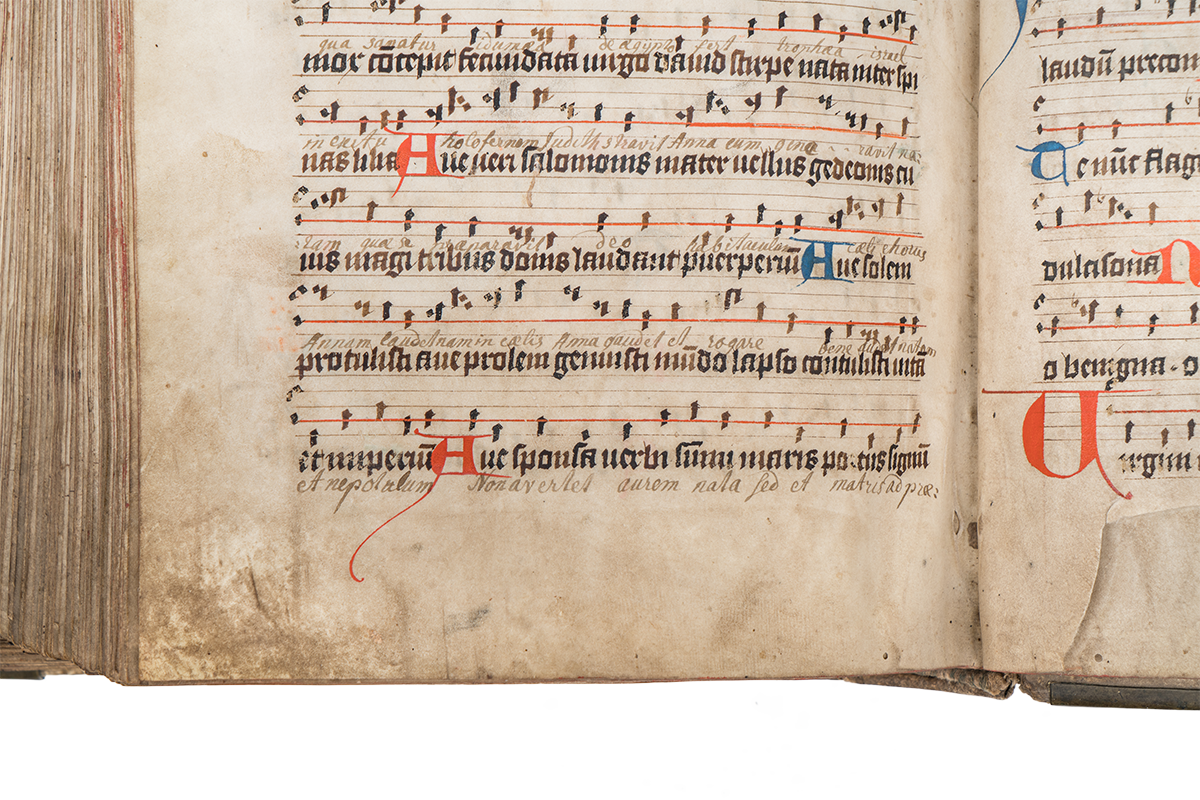
ff. 331-390, short Kyriale (ff. 331-340) added in the sixteenth century or later, followed by a Sequentiar (ff. 341-390) that was part of the original project, containing a selection of Sequences for the Temporale, Sanctorale, and Common of the Saints, beginning with the Nativity (f. 341) and including, among many others, Feast of the Holy Lance (in Nuremberg from 1424, f. 353), Translation of the Three Kings (f. 364), Immaculate Conception of Mary (f. 381; 1477 onward); f. 388v features a sequence for the Virgin Mary, but the text is rewritten in a sixteenth-century hand for Anna.
This manuscript is a Missal, the liturgical book used by the priest celebrating Mass that includes all the prayers and readings spoken or sung during Mass, and it was therefore central to Christian worship in the Middle Ages (and Catholic worship today). That is, Missals included the prayers said by the priest together with the biblical readings delivered during Mass, and instructions on the gestures the priest was to make throughout Mass. In addition, noted Missals like the present book included the wide range of musical settings within which much of the mass was chanted or sung. Moreover, Missals achieved this not only for daily mass, but for the annual round of holy days and saints’ feasts, and a range of other special masses. They could be truly compendious volumes. Thanks to this everyday utility, Missals were used so frequently that they wore out quickly, and medieval parish records are full of orders for repair of worn Missals, and replacement when books could no longer be repaired. Moreover, the liturgy was not static, but changing, as archbishops and popes added new feasts, and as Church councils made decisions about theology and liturgy, so Missals also required regular updating, and sometimes books might be replaced when they simply became too out of date to update any longer.
The present volume highlights each of these facets as experienced in a German village, possibly at the Church of St. Pancras that still stands in Paffendorf. Today this Missal is bound in a single, substantial volume, but it did not begin that way. The Temporale, Sanctorale, and Sequentiary all seem to have been made in the same tranche of work by a set of scribes. However, these sections may have originally been bound in separate volumes, a scenario suggested by the different original foliation systems displayed in the Temporale and Sanctorale. In the sixteenth century, all of these materials were bound together. However, the important quires containing the Canon of the Mass were removed, perhaps suggesting that those heavily used pages were already entirely worn out. At this time an additional quire of music was added, updating the volume in ways that kept it useful to the parish.
That added quire offers more clues to the history of this volume. It contains a range of music, all in the Hufnagel notation used throughout the volume, so-called from the shape of the notes that resemble horseshoe nails. Among other material, that addition contained Sequences, liturgical poems set to music that were sung after the Alleluia during the Mass, just like the following section of the volume, which contained the original Sequentiary. Sequences were an important genre during the Middle Ages, but all but five Sequences were eliminated from the Mass by the liturgical reforms produced by the Council of Trent in the sixteenth century (Iverson, 2010). Therefore, by the end of the sixteenth century, much of the final third of the volume was no longer useful.
Yet, the increasingly modern script in small marginal updates throughout the book demonstrates that the volume continued to see use. The continued vitality of the Mass texts is certainly a central reason for this endurance, but we should also not discount the extensive memorial notices contained at the very beginning of the volume on the front fly leaf and calendar. Here was an important duty of the parish priest and community to their departed members: memorial prayer. From first to last, then, this Missal offers insight into the changes in one parish liturgy and community for hundreds of years from the late Middle Ages into the early modern period.
Hughes, Andrews. Medieval Manuscripts for Mass and Office, Toronto, 1982.
Iversen, Gunilla. Laus Angelica: Poetry in the Medieval Mass, ed. Jane Flynn, tr. William T. Flynn, Turnhout, Belgium, 2010.
Palazzo, Eric. A History of Liturgical Books from the Beginning to the Thirteenth Century, tr. Madeline Beaumont, Collegeville, Minnesota, 1998.
Dyer, Joseph. “The Medieval Mass and Its Music”
https://www.arlima.net/the-orb/encyclop/culture/music/orbdyer.htm
Thurston, Herbert. “Missal,” in The Catholic Encyclopedia, vol. 10, New York, 1911.
http://www.newadvent.org/cathen/10354c.htm
TM 1344