

Noted Psalter
In Latin, manuscript on parchment
Alsace or Upper Rhine, c. 1450
TM 1343
sold
 Textmanuscripts - Les Enluminures
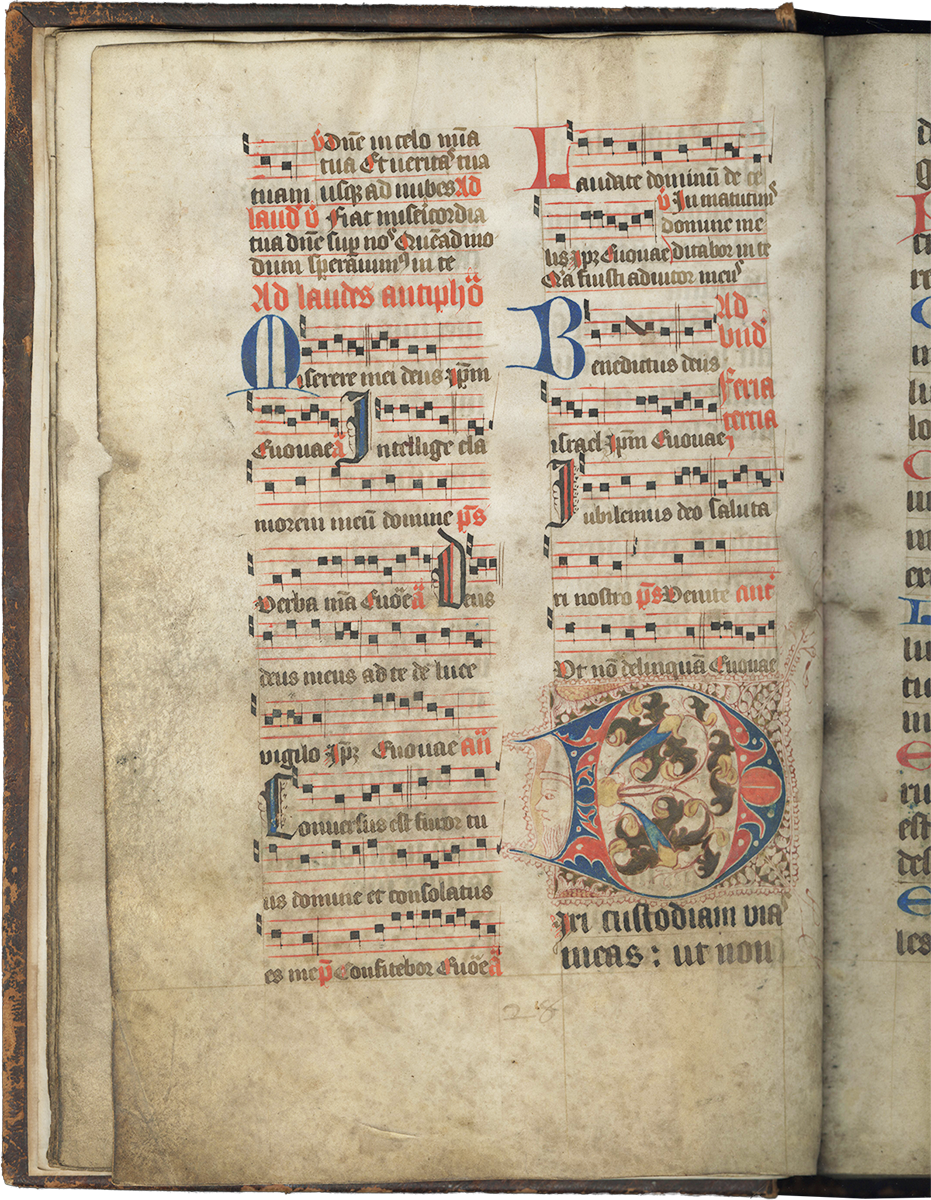
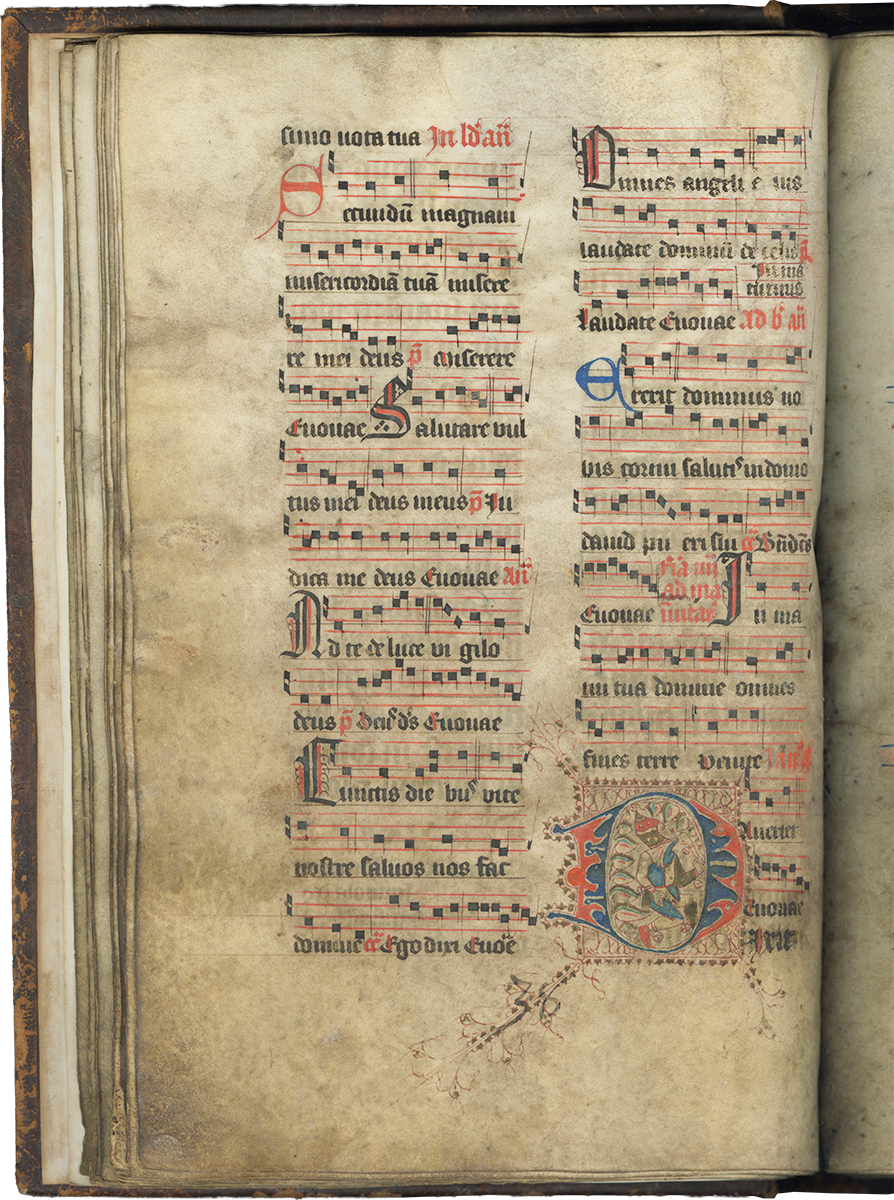
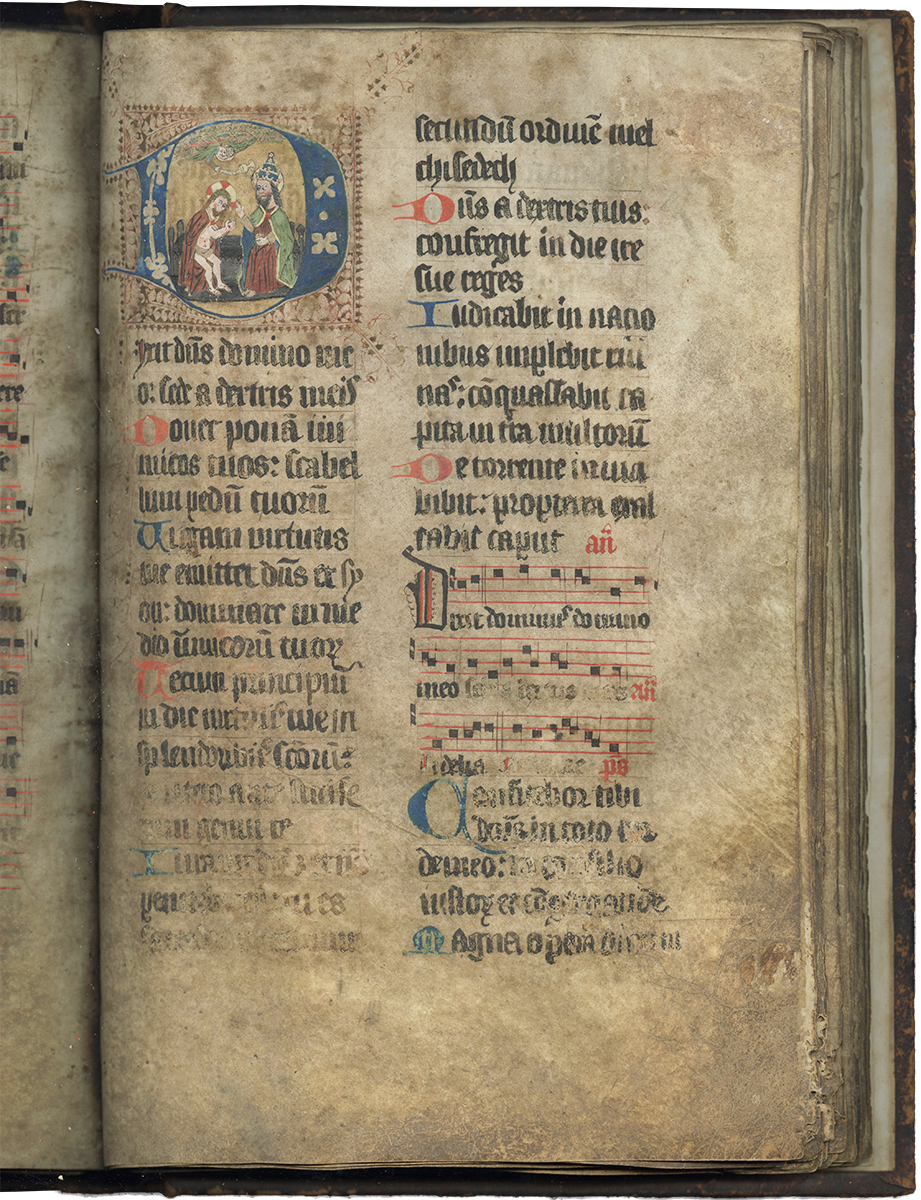
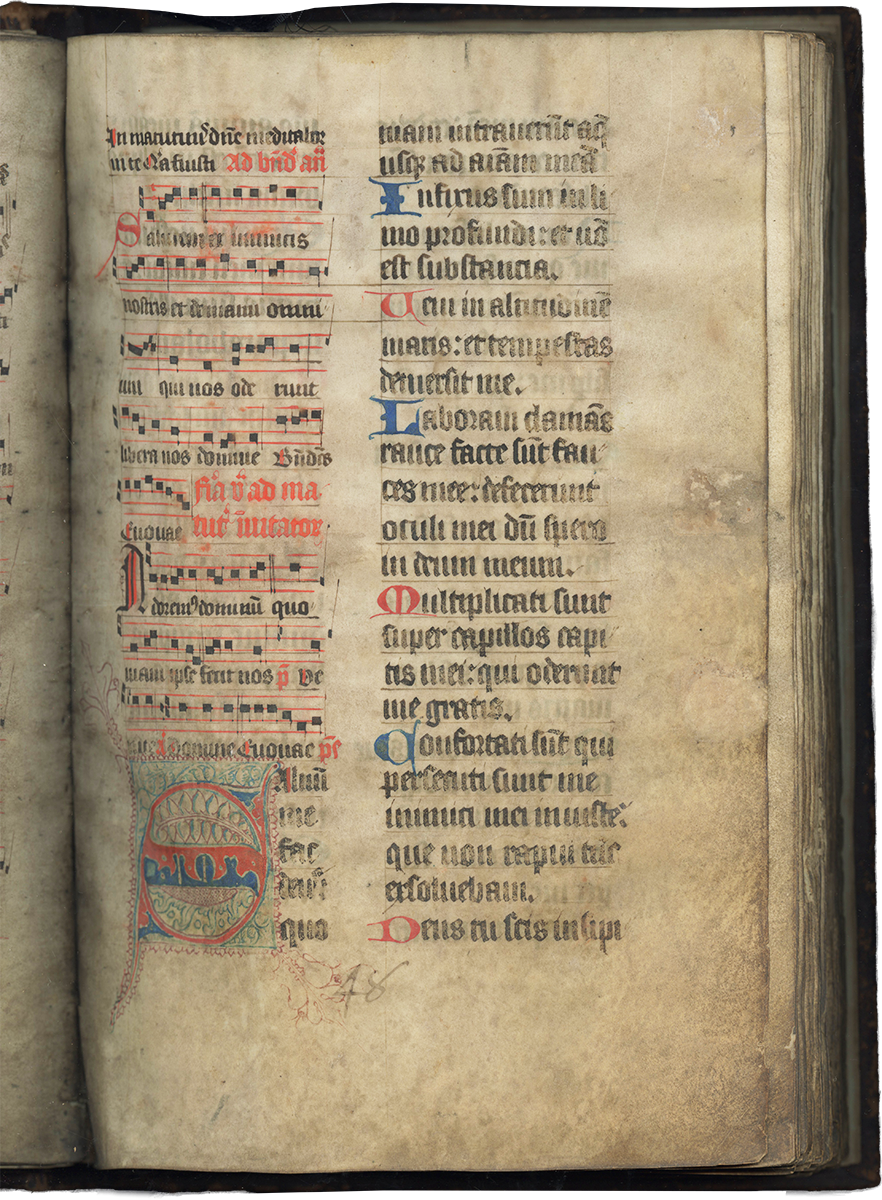
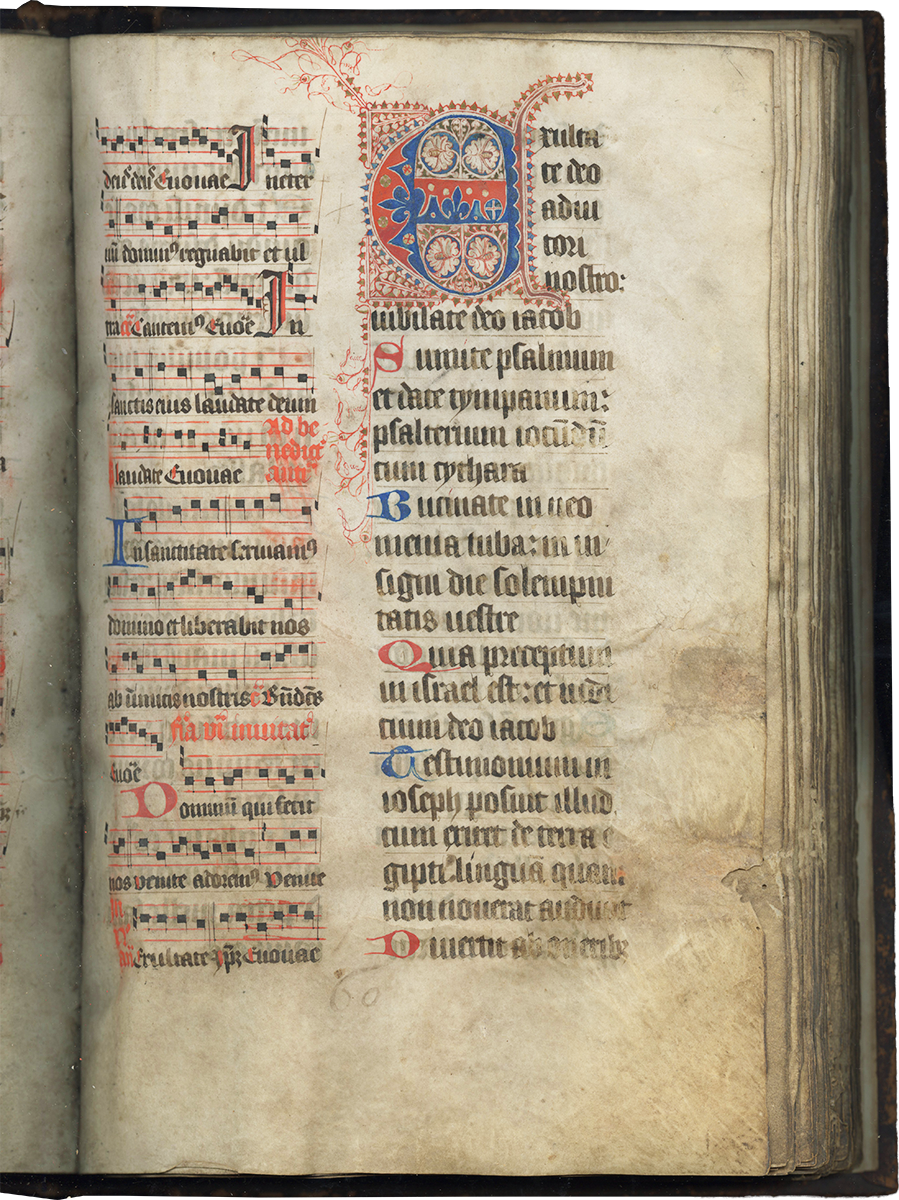
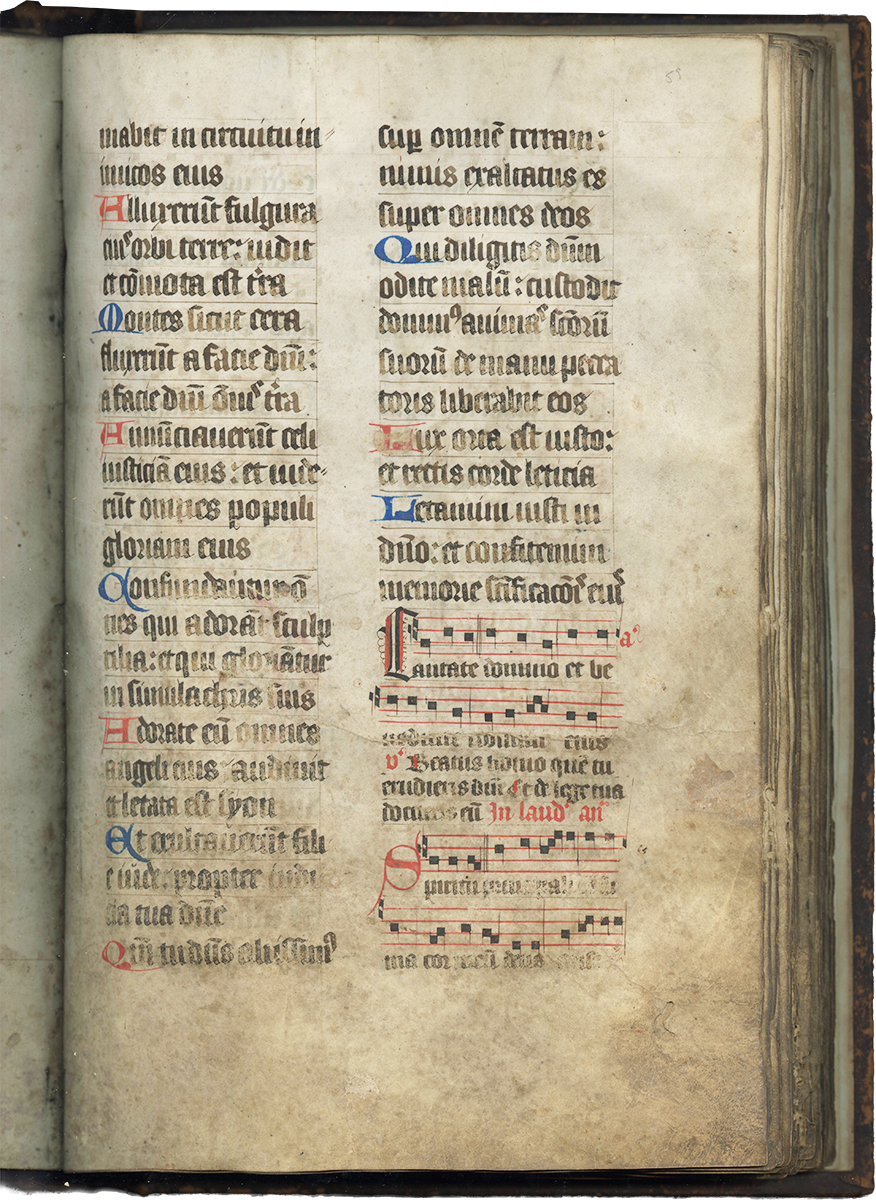
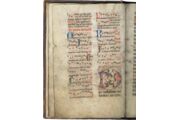
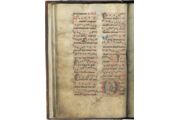
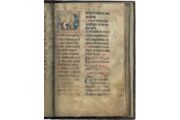
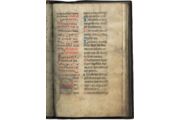
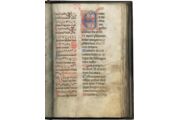
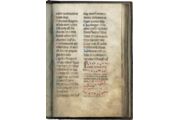
i (paper) +110+i (paper) parchment leaves, numbered in pencil in upper right corner, earlier pen foliation in center lower margin, acephalous, beginning on f. 1 as 22 but otherwise complete, no catchwords, (collation: i8, ii8+1, iii6, iv2, v6+1, vi8+1, vii6, viii10, ix6, x2, xi6, xii10, xiii6, xiv2, xv6, xvi2, xvii6, xviii2, xix4+1), ruled in brown ink and drypoint in two columns of twenty-three lines, (justification 250 x 155mm), textualis script, five 5-8-line puzzle initials flourished in blue, red, yellow, green, and purple (ff. 9v, 21v, 33, 47, 59), and a sixth also in ink but containing a HISTORIATED TRINITY in pigments (f. 73), formerly tabbed throughout, parchment often darkened with use, some pages worn to illegibility, but generally good condition. Eighteenth-century brown calf binding, remnants of blind-stamping along fore-edge, flyleaves watermarked J. Honig & Zoon, binding repaired in twentieth century, fair condition. Dimensions 345 x 240 mm.
“To little children it is safety, to men in their prime an adornment, to the old a solace, to women their most fitting ornament,” so wrote the fourth-century prelate Basil of Caesarea about the importance of the psalms. This delightful Psalter contains both the text of the psalms and the music for antiphons sung throughout the week as part of the Divine Office used by all clergy and monks in the Middle Ages. The intricate ink initials and saints in the Litany indicate that this Psalter was made in northeastern France or southwestern Germany, an area with few surviving manuscripts. It shows significant signs of continued (daily?) use through the centuries.
1. Made for secular liturgical use in Alsace or the Upper Rhineland. Lacking the calendar, the Litany is instructive, and includes St. Odile, an Alsatian saint, along with several of the Rhineland Four Marshals (Cornelius, Hubert, Anthony). Therefore, even inclusions that might appear to be Flemish, such as Hubert and Lambert, are certainly Rhineland instead (Lambert’s skull furnished a major relic in Freiberg im Breisgau). The brief litany also includes Augustine, Francis, and Dominic, and this may possibly point to a house of canons or friars, all of whom prayed the secular use.
2. Rebound in the eighteenth century. The flyleaves bear the watermark of J. Honig & Zoon, who made paper in the Netherlands in the eighteenth-century. Nevertheless, they were a major papermaker, and therefore this does not on its own prove the manuscript had moved to the Netherlands by this period.
3. Apparently twentieth-century French advertising was used under the pastedown on the rear board and remains visible through the pastedown, which has a different watermark than the flyleaves.
ff.1-100, Liturgical Psalter with many noted antiphons on staves of four red lines. Further research on the antiphons might identify a local use.
ff. 100-107v, Canticles to be said at Lauds on Sundays and throughout the week, including: Benedicite omnia opera (Daniel 3: 57-88, 56, Sunday), Confitebor tibi domine (Isaiah 12: 1-6, Monday), Ego dixi in dimidio (Isaiah 38: 10-21, Tuesday), Exultavit cor meum (1 Samuel 2: 1-10, Wednesday), Cantemus domino (Exodus 15: 1-19, Thursday), Domine audivi (Habakkuk 3: 1-19, Friday), Audite celi que loquar (Deut. 32: 1-43, Saturday), followed by the Magnificat sung at Vespers, Benedictus dominus deus sung at Lauds, Nunc dimittis sung at Compline, and the Athanasian Creed, Quicunque Vult;”
ff. 108-110v, Litany;
ff. 110r-v, Canticle, Te Deum, sung at Matins.
Originally written in Hebrew and traditionally attributed to King David, the psalms actually evolved over five hundred years written by many different poets as sacred songs that were eventually brought together as an anthology of 150 poems. The longest and perhaps the most popular biblical book, the Psalter contains expressions of lament, joy, fear, revenge, forgiveness, thanksgiving, or as Roger Wieck, the former Curator at the Morgan Library and Museum, exclaims “they cover the gamut of human emotion, and that is one of the reasons they are so popular today.” From the days of the early Church in the fourth century, they became part of daily prayer in monastic communities. By the fifth century, they were chanted as part of the Divine Office, augmented, as they are here, with antiphons, versicles, responses, and sometimes hymns that offered Christian glosses to the Old Testament texts.
Psalters survive, thus, from the early Middle Ages through the late Renaissance and beyond. They were among the first books to be printed, and they were used not only in the Divine Office but by the laity to teach children to read. In Hebrew communities, as well as in the early years of the Church, the psalms were meant to be sung. Stressing their musical component, Saint Jerome wrote in the fourth century: “Wherever you turn, the laborer at the plough sings Alleluia; the toiling reaper beguiles his work with Psalms; the vine-dresser as he prunes the vine sings something of David’s.” Not all liturgical Psalters include the music, which until the late Gothic period consisted of monotonal Gregorian chant, perhaps since many knew it by heart. This one includes extensive musical notation on four-line staves.
In the present Psalter, the inclusion of antiphons following many of the psalms complete with their musical settings, suggests that the manuscript was made for use either by professed religious, or by a very devout layperson. If it was designed for use by clergy, these would have been priests, Augustinian canons, or Dominican or Franciscan friars—these were the only clergy who were allowed to use this arrangement. The regular orders, Benedictines, Carthusians, and the like, prayed a different arrangement of psalms.
The fourth-century prelate, Basil of Caesarea, expresses just how important the Psalms were: “A psalm drives away demons, summons the help of angels, furnishes arms against nightly terrors, and gives respite from daily toil; to little children it is safety, to men in their prime an adornment, to the old a solace, to women their most fitting ornament … A psalm is the voice of the Church.”
f. 73, Historiated initial of the Trinity
The large puzzle initials follow a tradition of marking the psalms said at Matins on each day of the week and Sunday vespers (f. 9v, Psalm 38; f. 21v, Psalm 52; f. 33, Psalm 68; f. 47, Psalm 80; f. 59, Psalm 97; f. 73, Psalm 109), all according to secular use. While the other initials feature exuberant ink flourishing typical of this region, including an anthromorph (f. 9v, a visual reference to the human body indexed in Psalm 38, normal iconography for this psalm) and jester (f. 21v, a visual reference to the deceitful person of Psalm 52, again, normal for this psalm), the initial for Psalm 109, the psalm used for Sunday Vespers, is instead infilled with a pigment historiation of the Trinity, the standard iconographical choice for this psalm. In this Trinity, the seated Father blesses the crucified Son, while the Holy Spirit appears like an angel in the clouds above, censing the pair below. In conception it is not unlike the Mercy Seat iconography, yet here the members of the Trinity are arranged separately, rather than gathered tightly together as usual in almost all figurations of the Trinity. It is possible that this arrangement may borrow from the iconography used to depict Augustine’s Miracle of the Trinity, which might add further to the likelihood that this psalter was made for Augustinian canons, though if so, it is by no means a direct reference to that iconography.
While the specific liturgical use presented here is not yet identified, the lovely ink initials, together with the single historiated initial and the saints in the Litany, help to identify this Psalter as made in Alsace or the Upper Rhine region directly east across the Rhine from Alsace. There are relatively few Psalters that remain from this region, and the Schoenberg Database of Manuscripts lists just two Psalters made in Strasbourg, the Alsatian capital, as ever having been sold. Another from the neighboring German province, present-day Baden-Württemberg, sold over a hundred years ago. It is exciting to bring such an unusual offering to market.
Leroquais, V. Les psautiers, manuscripts latins des bibliothèques publiques de France, 3 vols., Paris/ Mâcon, 1940-41.
Solopova, Elizabeth. “The Liturgical Psalter in Medieval Europe,” in Jewish and Christian Approaches to the Psalms: Conflict and Convergence, ed. Susan Gillingham, Oxford, 2013, pp. 89-104.
Solopova, Elizabeth. Latin Liturgical Psalters in the Bodleian Library: A Select Catalogue, Oxford, 2013.
Van Deusen, Nancy, ed. The Place of the Psalms in the Intellectual Culture of the Middle Ages, Albany, 1999.
Wieck, Roger, ed. Sing a New Song: the Psalms in Medieval Art and Life, New York, 2025.
The Book of Psalms in Latin and English from the Latin Vulgate and the Douai Translation A. D. MDCIX, Worcester, 1917. https://archive.org/details/bookofpsalmsinla00unse
Roger Wieck, Sing a New Song, The Psalms in Medieval Art and Life
https://www.youtube.com/shorts/dkn-si4ahN4