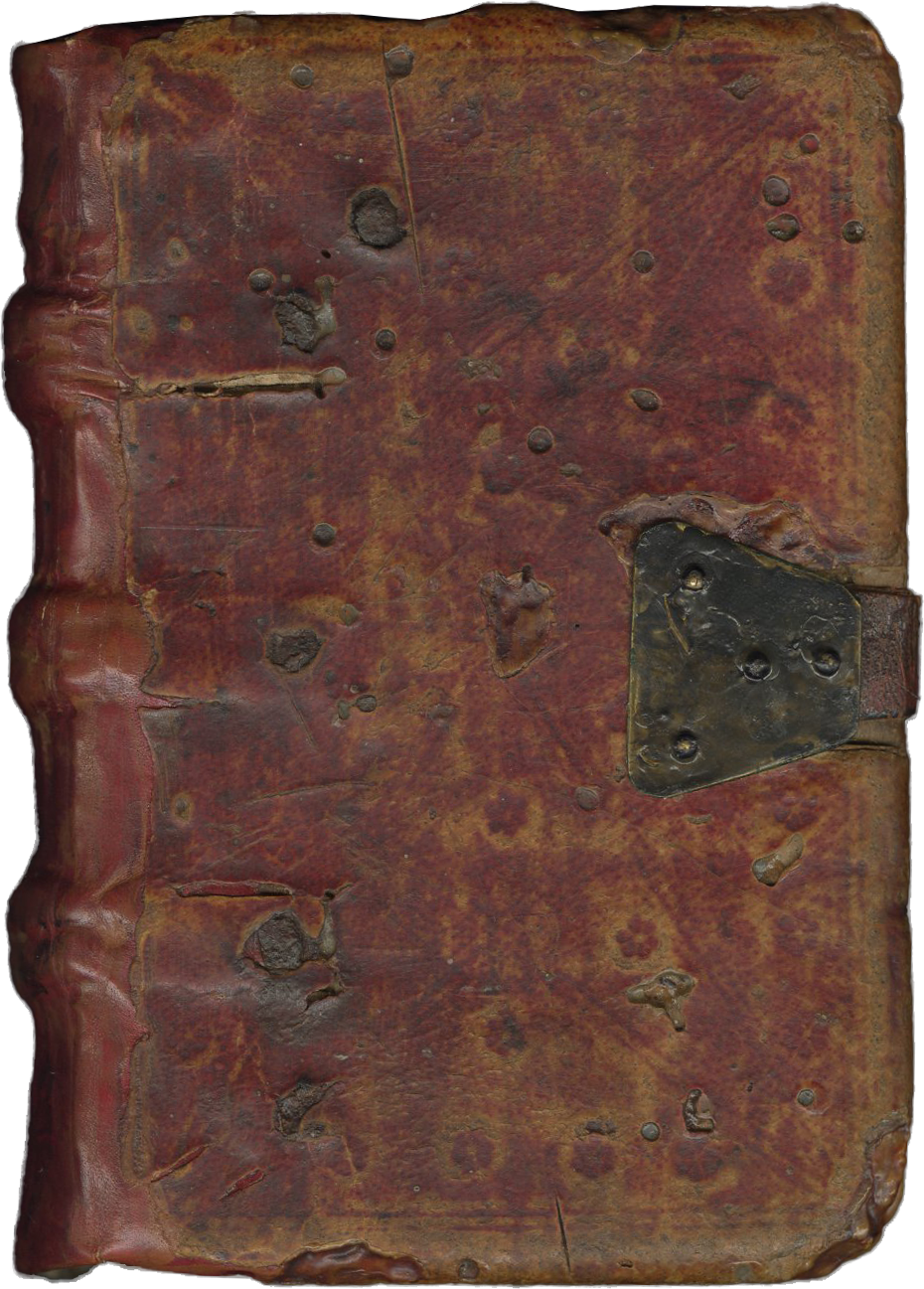
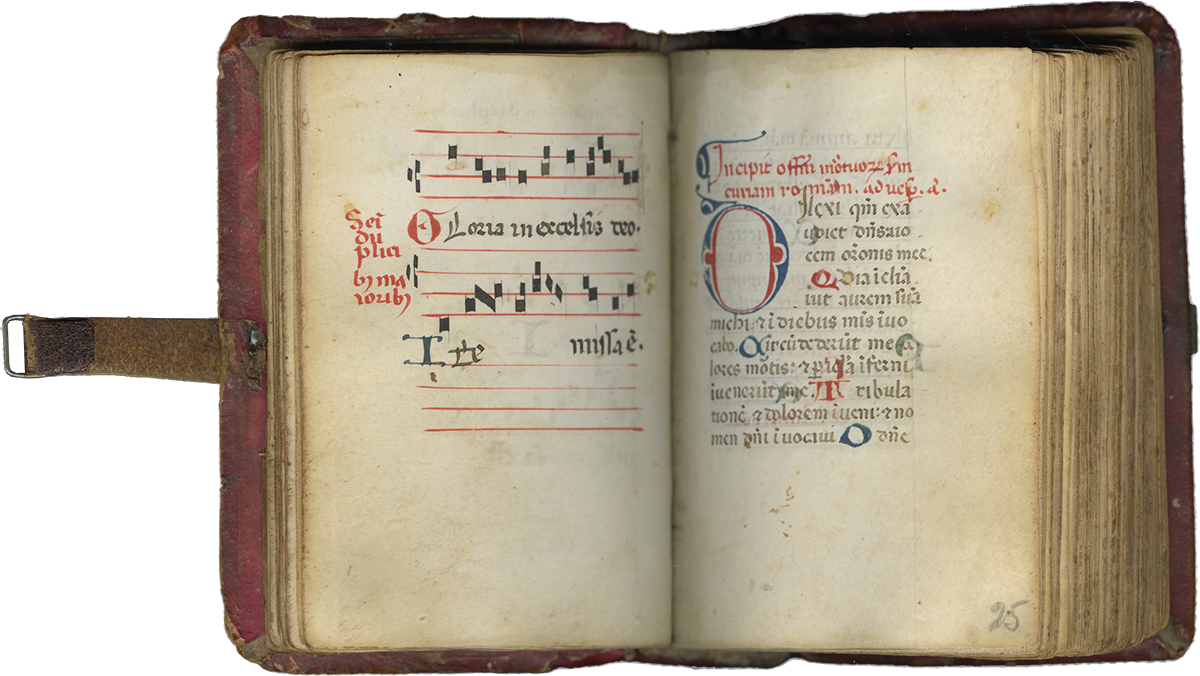
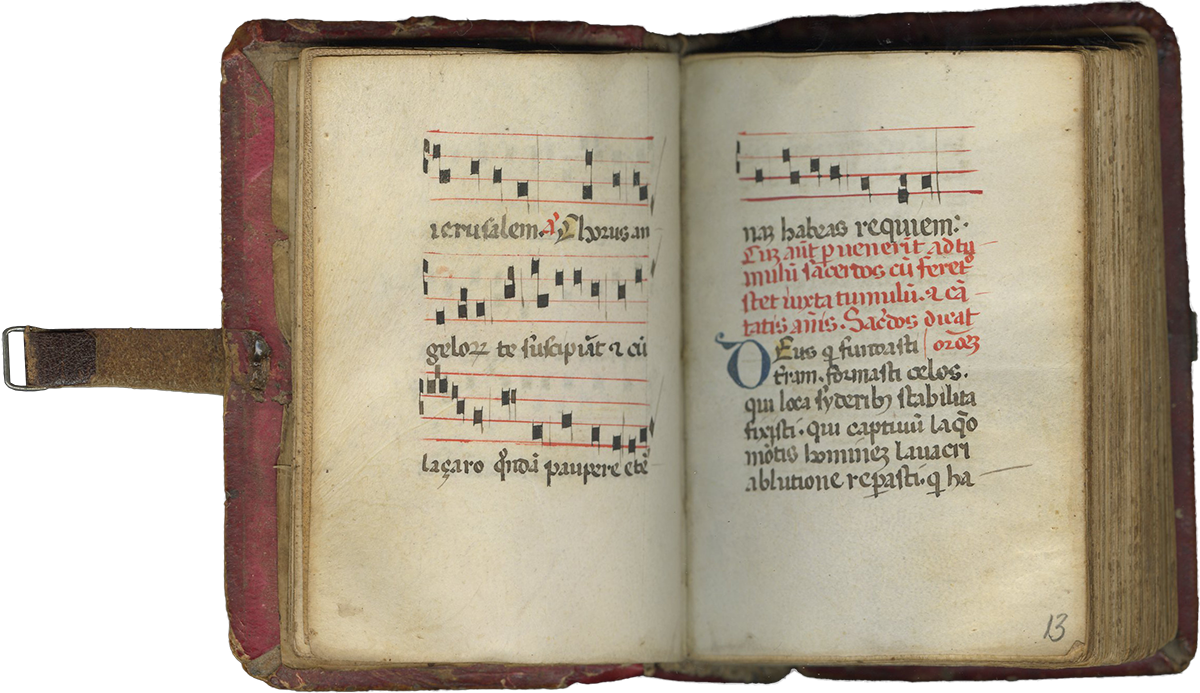
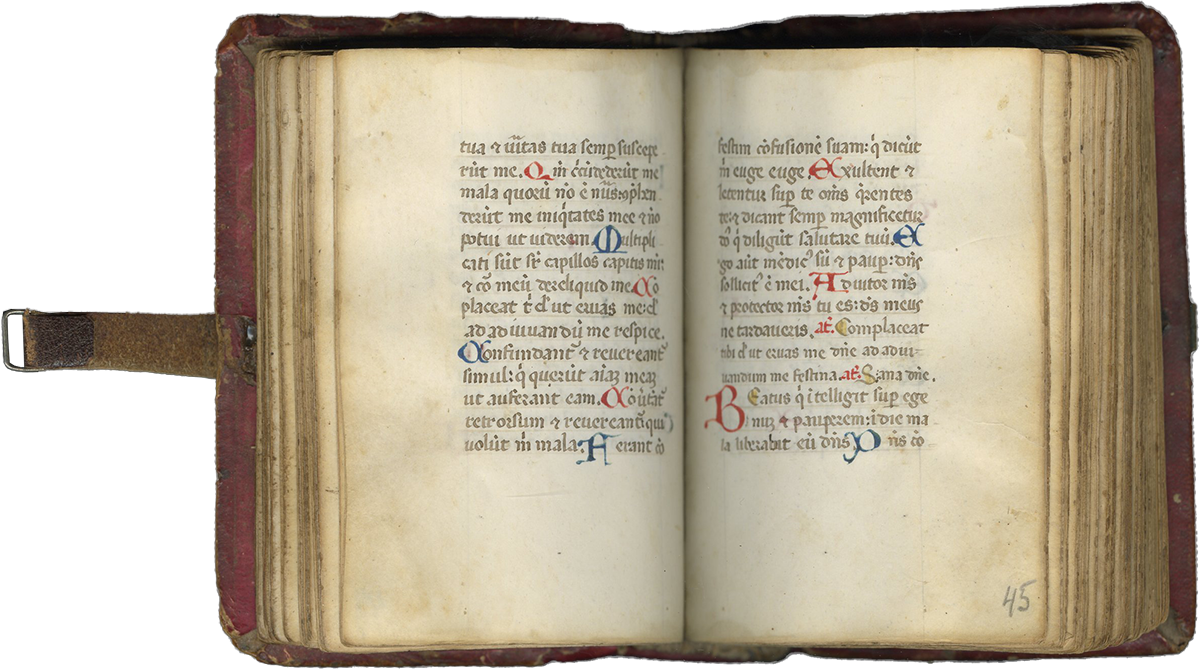
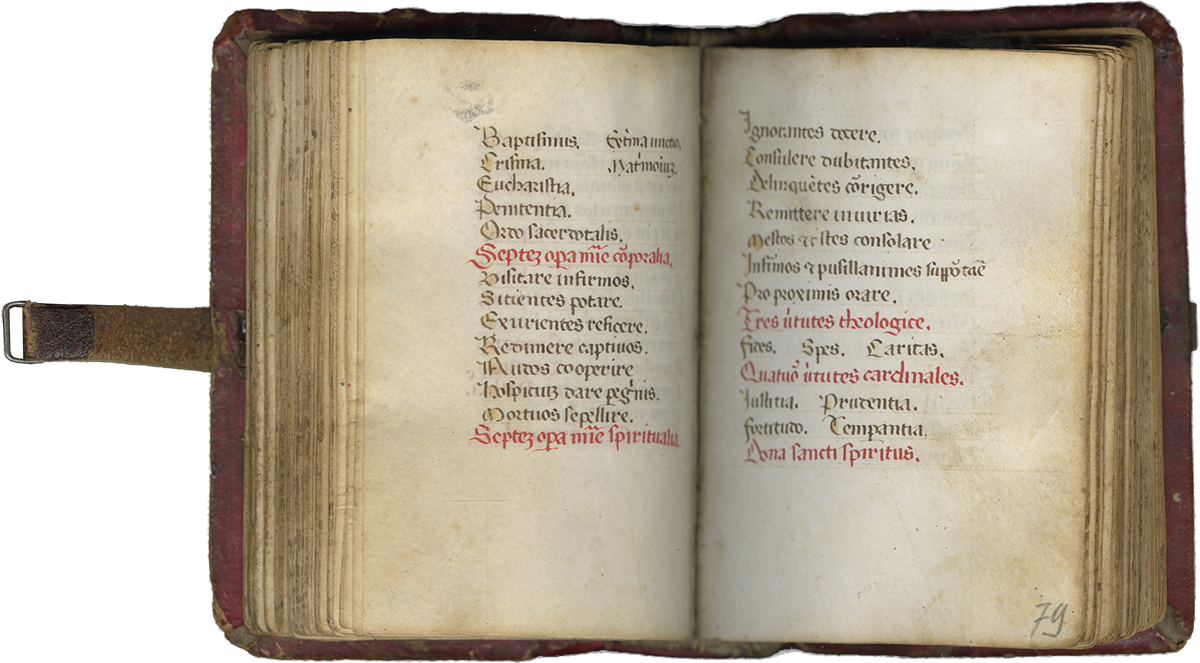
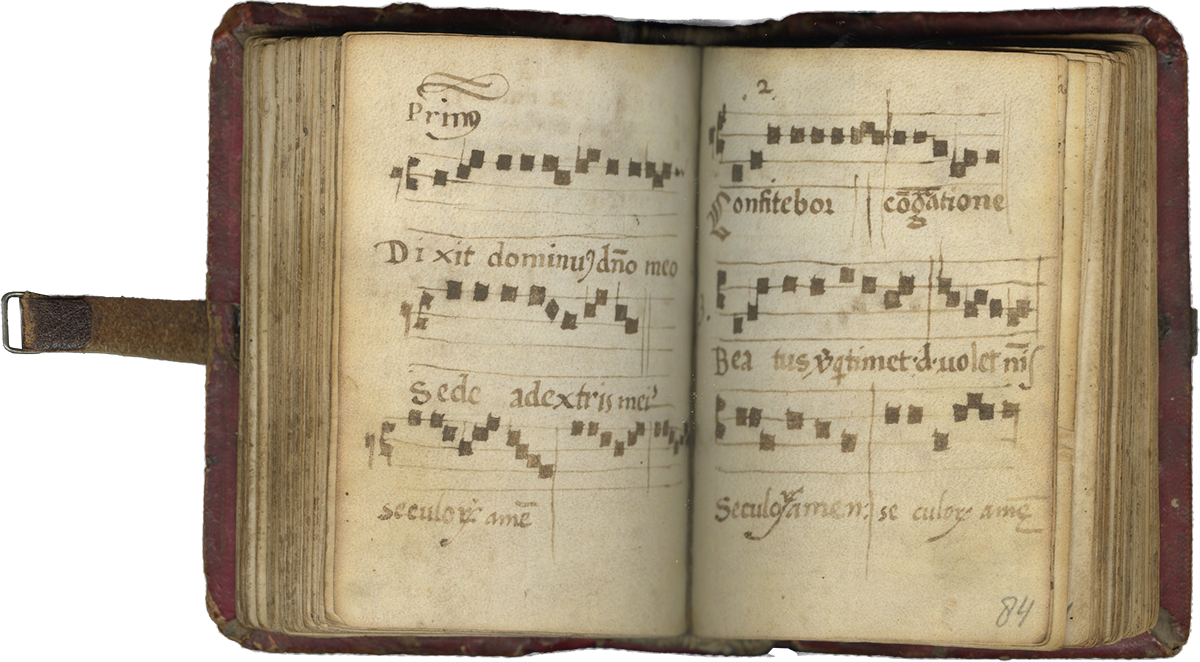
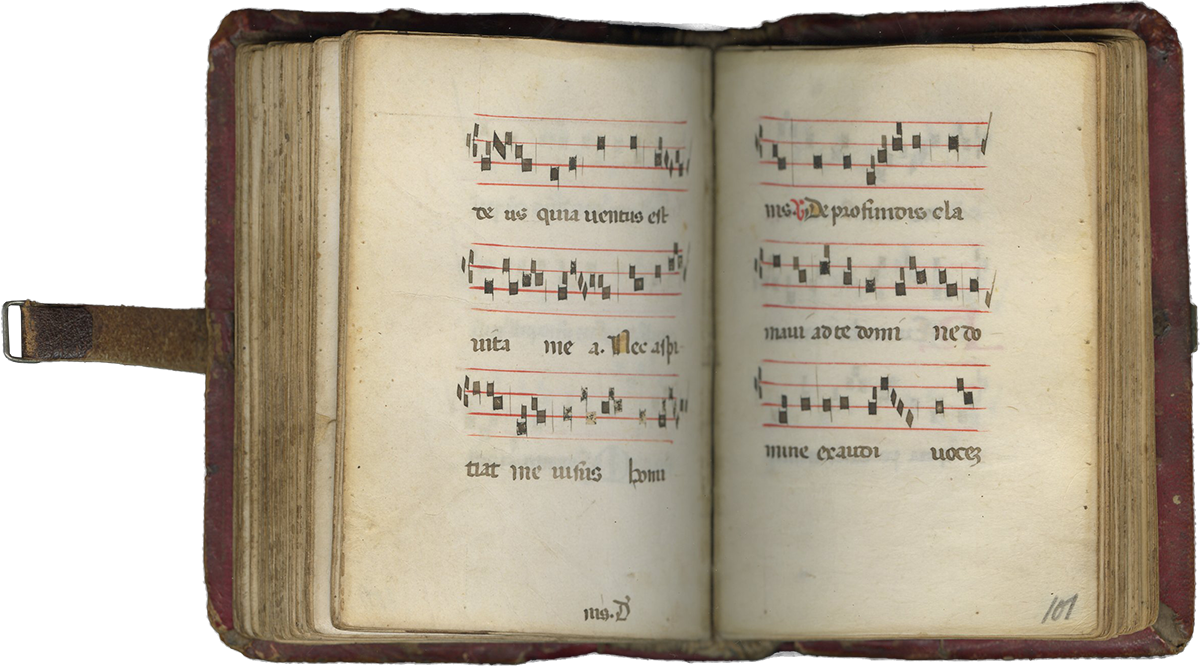
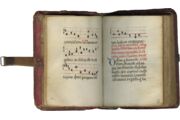
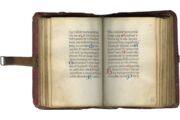
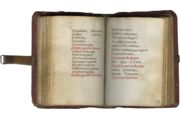
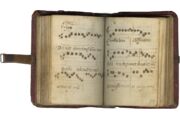
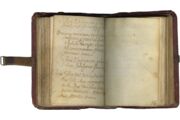
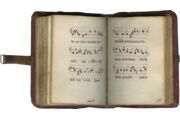
iii (parchment) + 151 + ii (parchment), front flyleaves and pastedowns (present and former) repurposed from a contemporary book of hours (Matins from the Hours of the Virgin), rear flyleaves with Papal decree and a date of 1456, foliated in pencil 1–151 in lower right corners, (collation: i-ii10, iii12, iv-v8, vi-viii10, ix6+2, x4, xi-xv10, xvi10+1), occasional catchwords, ruled in single column of 13 lines (justification 57 × 38mm), notation in 3 staves per page, written in rotunda script by several hands, seventeenth-century additions between ff. 83–85, rubrication in red, majuscules flashed in yellow, 1-2-line initials in alternating red or blue, two 5-line puzzle initials in red and blue at ff. 25 and 59 introducing the Office of the Dead and the Penitential Psalms, worming to flyleaves, minor cockling and staining throughout, else in good condition. Early red stamped calf binding, three fiber bands laced into oak boards with brass catch on lower board, strap attached to upper board with metal plate, strap replaced, slight cracking and some worming to boards, else in good condition. Dimensions 108 × 76 mm.
Studies of Rituals from the later Middle Ages explore their relationship to the more visceral aspects of death and dying, emphasizing their paraliturgical content and reminding us that music played a privileged role at the time of death. In nearly its original condition, this small Ritual underscores the continuity of Franciscan care for the dead from the Middle Ages straight though into the seventeenth century and beyond. In the early modern period, the manuscript found use in a house of Poor Clares, perhaps even in Turin itself.
Provenance
1. Likely made for Franciscan use as the Litany includes Bernardino of Siena, Louis of Toulouse, Anthony of Padua, Dominic, and Francis of Assisi. As Bernardino was canonized in 1450, the volume cannot date much before then. A fragmentary text on the rear flyleaves refers to a papal document issued by Pope Callixtus III on 10 March 1456 describing a planned crusade against the Ottomans after the fall of Constantinople in 1453.
2. The two final women in the Litany were erased and replaced by Clare (founder of the order of Franciscan nuns the Poor Clares) and Elizabeth (f. 71). As Elizabeth (Queen of Portugal and Franciscan tertiary) was not beatified until 1516 and not canonized until 1626, we might imagine this volume moving from a Franciscan friary to the priest ministering to a convent of Poor Clares in the early modern period. Whilst the martyr St. Agnes is normally included in Roman Litanies, her name was also touched up at the same time as the other two were replaced and it is possible that the intended saint may have shifted to St. Agnes of Assisi, sister to Clare, and another founder of the Poor Clares, though she was not canonized until 1753.
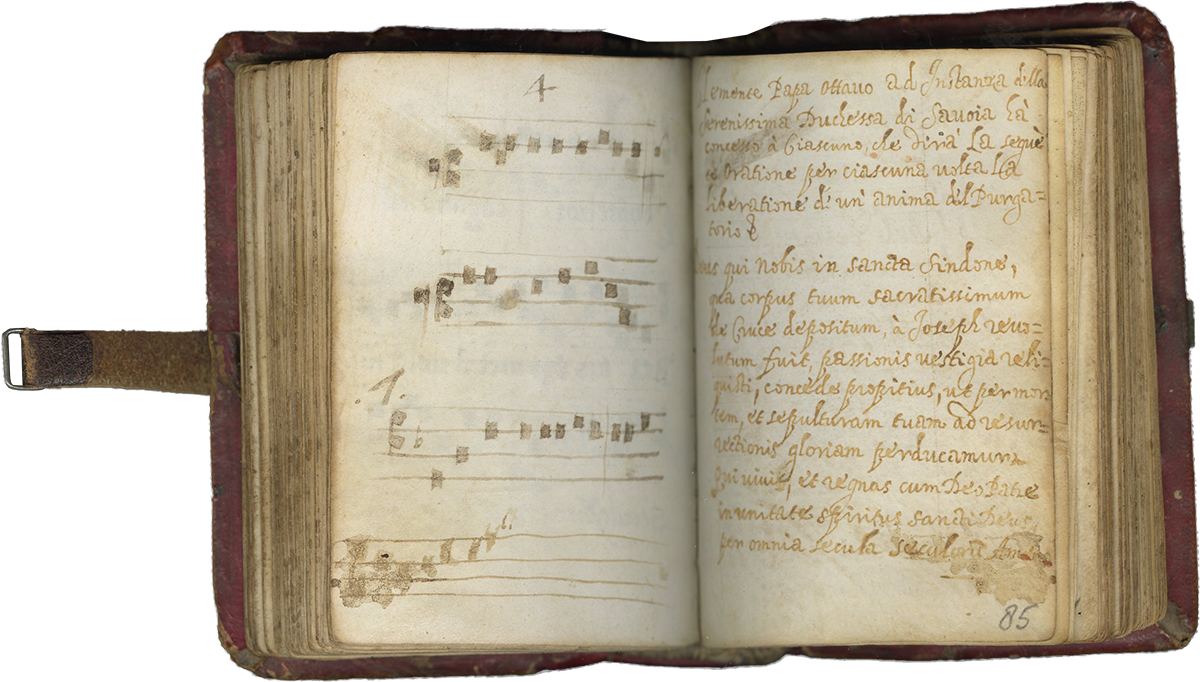
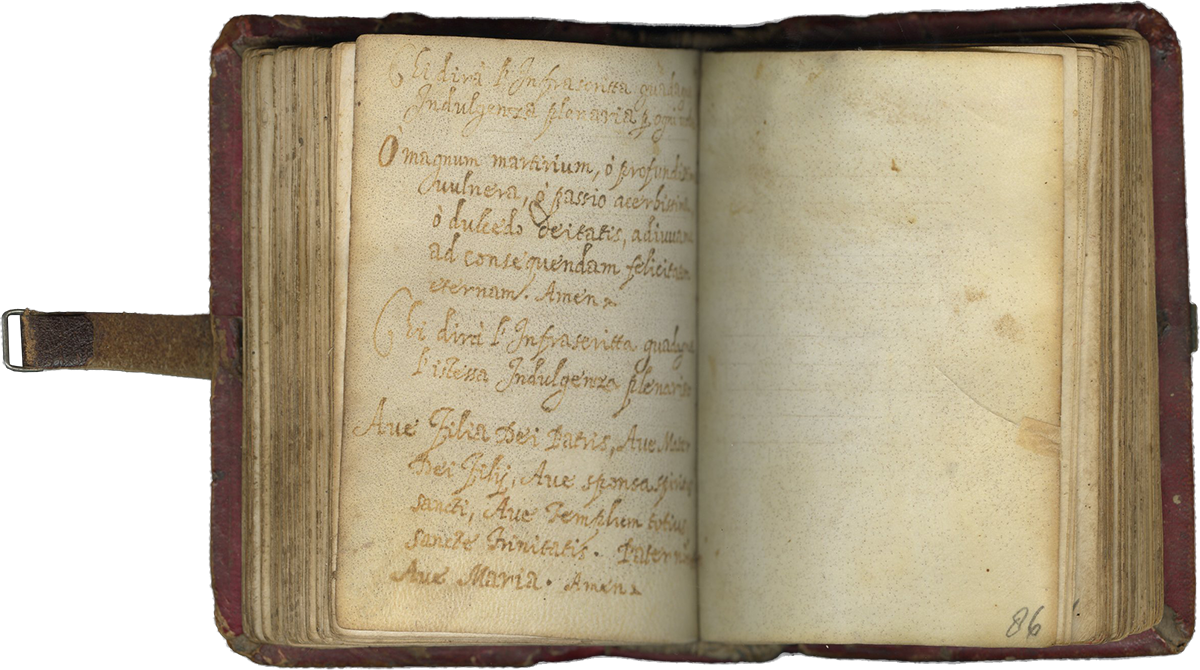
3. Indulgence added to f. 85r-v in a late sixteenth- or seventeenth-century hand issued by Pope Clement VIII (s. 1592-1605) and sponsored by the Duchess of Savoy, who must be Catalina Micaela of Spain (m. 1585-1597), dating the indulgence to some year between 1592-1597. This indulgence was connected with a prayer to the Shroud of Turin, newly installed in Turin in 1578 and closely associated both with both the Poor Clares (who had repaired it in 1534) and with the House of Savoy. It is possible that a priest for the Poor Clares at Santa Chiara in Turin updated this book.
4. Owner inscription of “Don Giovanni Caccini Gilotraneta” on rear flyleaf, faded now but legible in the 1980s when Schwartz transcribed it.
5. Albert Van Loock (b. 1917), a Belgian bookseller and art dealer active in Brussels during the mid-twentieth century, mark (“Kenteken”), and inventory number “16” on front pastedown.
6. Dr. Scott Schwartz, New York, his book plate and manuscript number “31” on front pastedown. Schwartz is also responsible for the slip with a partial description of the manuscript pasted onto the first flyleaf, noting that he bought the volume from van Loock in 1988.
Text
ff. 1r–24r, Burial Service, incipit, Incipit officium exequea corpus, with responsories;
ff. 25–58v, Office of the Dead (Incipit officium mortuorum secundum cursum Romanum ad vesperas);
ff. 59r–77r, Penitential Psalms and Litany;
ff. 77r–82v, Lists of theological precepts (Ten Commandments; Apostles Creed; Seven Sacraments: Seven Corporal Works of Mercy; Spiritual Works of Mercy; Three Theological Virtues, Four Cardinal Virtues: Gifts of the Holy Spirit; Seven Deadly Sins; Five Bodily Senses);
ff. 83r–84v, (added, seventeenth century), Antiphons: Dixit dominus domino meo; Sede ad dextris meis;
ff. 85r-v, (added, seventeenth century), Indulgenced prayers, indulgences in Italian, Deus qui nobis in sancta sindone, O magnum martirium, and Ave filia Dei patris, f. 83r blank, f. 86r-v blank;
Rather than the more usual Holy Vernicle, the first indulgenced prayer refers to the Shroud of Turin. The Dukes of Savoy gained possession of the Shroud in the fifteenth century and it became an important element of their religious and political observance thereafter (Varallo, 2019). Poor Clares repaired it after a fire in 1532 in the ducal chapel in Chambéry, then moved it to Turin in 1578. It seems likely that Catalina Micaela’s request of Clement, mentioned in the indulgence’s rubric, was for an indulgence for the Shroud. Given the likely association of the present volume with the Poor Clares in the early modern period, it is not impossible that it was used in Santa Chiara in Turin itself, even if it was originally made for friary elsewhere.
ff. 87r–151v, Antiphons for the Office of the Dead (Incipit officium mortuorum cum nota).
One of the central duties of medieval religious life was to pray for the souls of the dead, to reduce their time in purgatory. This manuscript includes texts and music for funeral services and, in a seventeenth-century addition, an indulgence for the relief of souls in purgatory. Its annotations and later additions attest to over a century of continuous use, an appealing feature in a practical devotional book. The core of the manuscript focuses on the rituals associated with funerary offices, particularly the burial service (Exequiae corporis) with accompanying antiphons, and the Office of the Dead (Officium mortuorum), including only Vespers (typically sung before the burial) and corresponding antiphons. Rubrics, marked in red, are specifically addressed to the officiating priest (sacerdos).
These texts belong to a category of books known to liturgical scholars as Rituals, which contain the rites for occasional sacraments and sacramentals performed by priests, such as funerals, baptism, confirmation, or extreme unction (Gy 1990, pp. 108–20). This abbreviated Ritual, limited to funeral services, is designed for portability. Small independent liturgical volumes—known as libelli or “little books”—such as this one, could be easily carried by a priest when administering specific rites (Gy 1991; Palazzo 1993, pp. 187–94). In the Middle Ages, such booklets were often left unbound or housed in lightweight parchment wrappers and were sometimes later bound together with related material, as seen with this manuscript. Often left unbound, their survival is relatively rare. The manuscript’s adaptation and accumulation of additions over time vividly illustrates the enduring importance of burial rites and the efficacy of prayers to aid the souls of the dead in the afterlife.
Recent studies of Rituals from the later Middle Ages explore their relationship to the more visceral aspects of death and dying, emphasizing their paraliturgical content and reminding us that music held a privileged position at the time of death (see Hild, 2024).
Literature
Gy, Pierre-Marie. “The Different Forms of Liturgical Libelli,” in Fountain of Life, ed. Gerard Austin, Washington, 1991, pp. 22-34.
Gy, Pierre-Marie. “Collectaire, rituel, processional,” in La liturgie dans l’histoire, Paris, 1990, pp. 91–126.
Hild, Elaine Stratton. Music in Medieval Rituals for the End of Life, Oxford, 2024.
Palazzo, Eric. A History of Liturgical Books from the Beginning to the Thirteenth Century, trans. Madeline Beaumont, Collegeville (MN), 1998.
Rouillard, Philippe. Histoire des liturgies chrétiennes de la mort et des funérailles, Paris, 1999.
Rowell, Geoffrey. The Liturgy of Christian Burial: An Introductory Survey of the Historical Development of Christian Burial Rites, London, 1977.
Varallo, Franca, “The Shroud in the Ceremonial Policy of the House of Savoy between the End of the 16th Century and the 18th Century,” in The Shroud at Court: History, Usages, Places, and Images of a Dynastic Relic, ed. Paolo Cozzo, Andrea Merlotti, and Andrea Nicoletti, Leiden, 2019, pp. 238-71.
Online Resources
Knud Ottosen, The Responsories and Versicles of the Latin Office of the Dead, Aarhus, 1993. https://www.cantusplanus.de/databases/Ottosen/index.html
Schola Cantorum Karolus Magnus, Placebo Domino https://www.youtube.com/watch?v=rZWWbeXEAfo