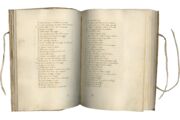
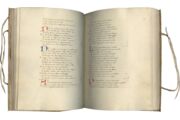
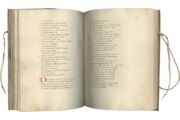
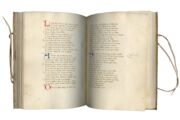
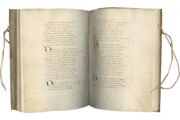
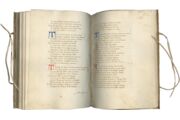


FRANCESCO PETRARCH (b. Arezzo, 20 July 1304; d. Arqua Petrarca, 19 July 1374), Il Canzoniere (The Songbook)
In Italian, manuscript on paper
Italy, c. 1475
TM 1468
sold
 Textmanuscripts - Les Enluminures
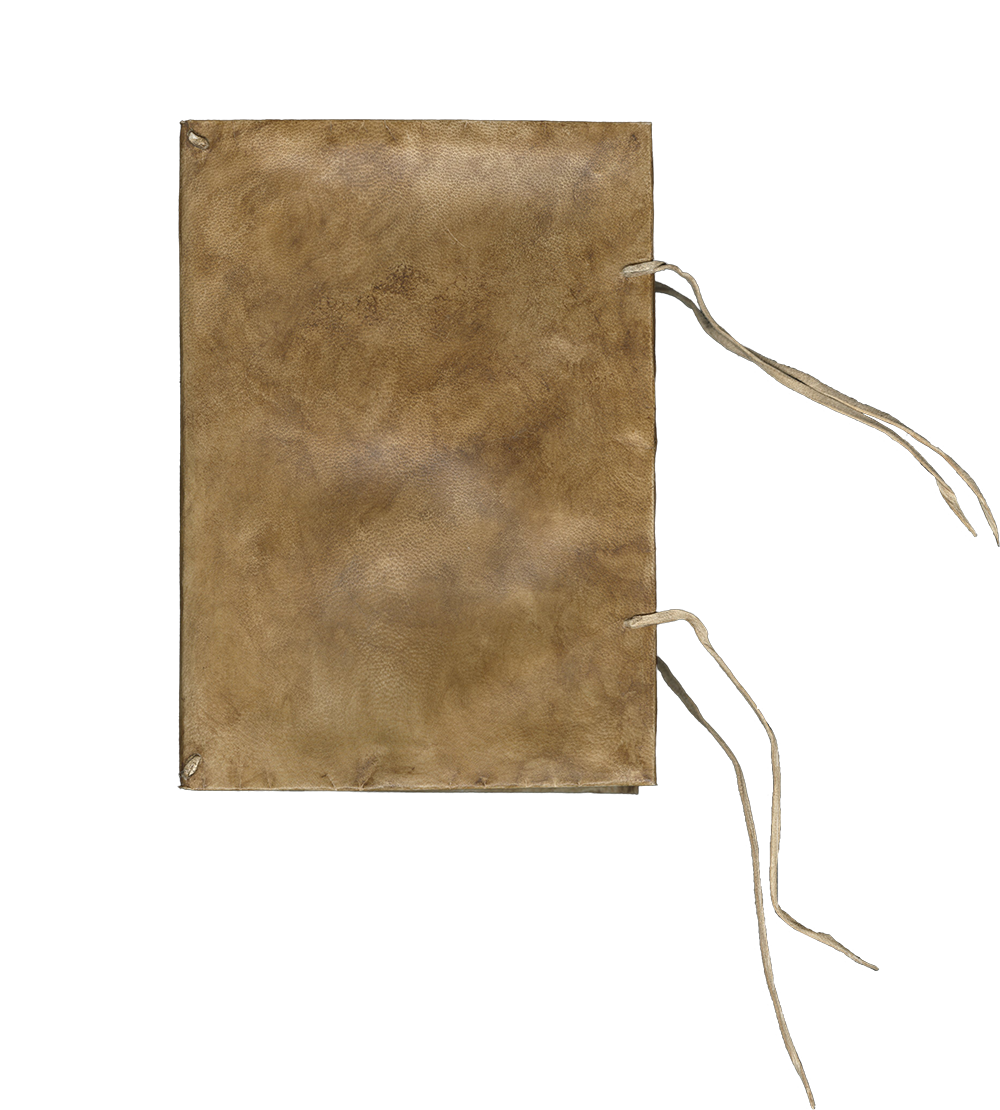
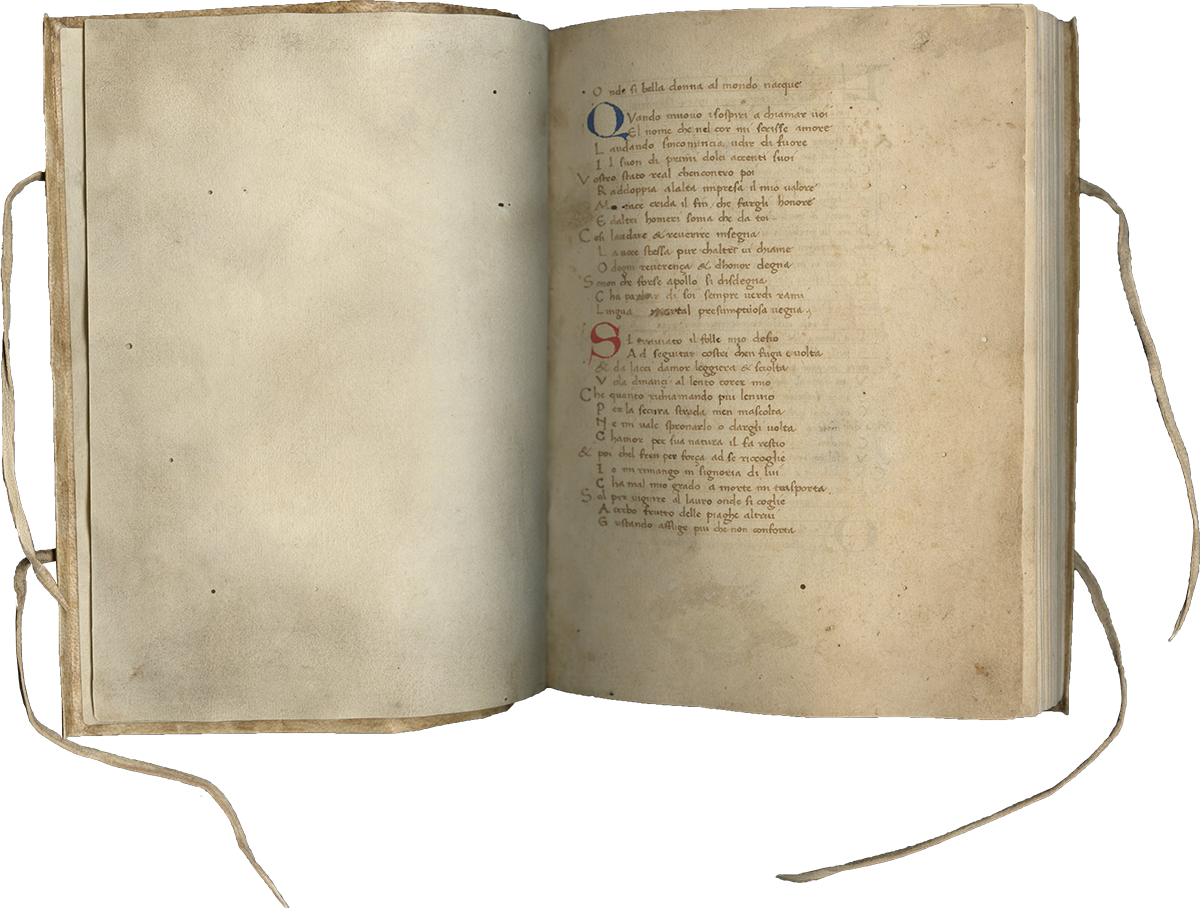
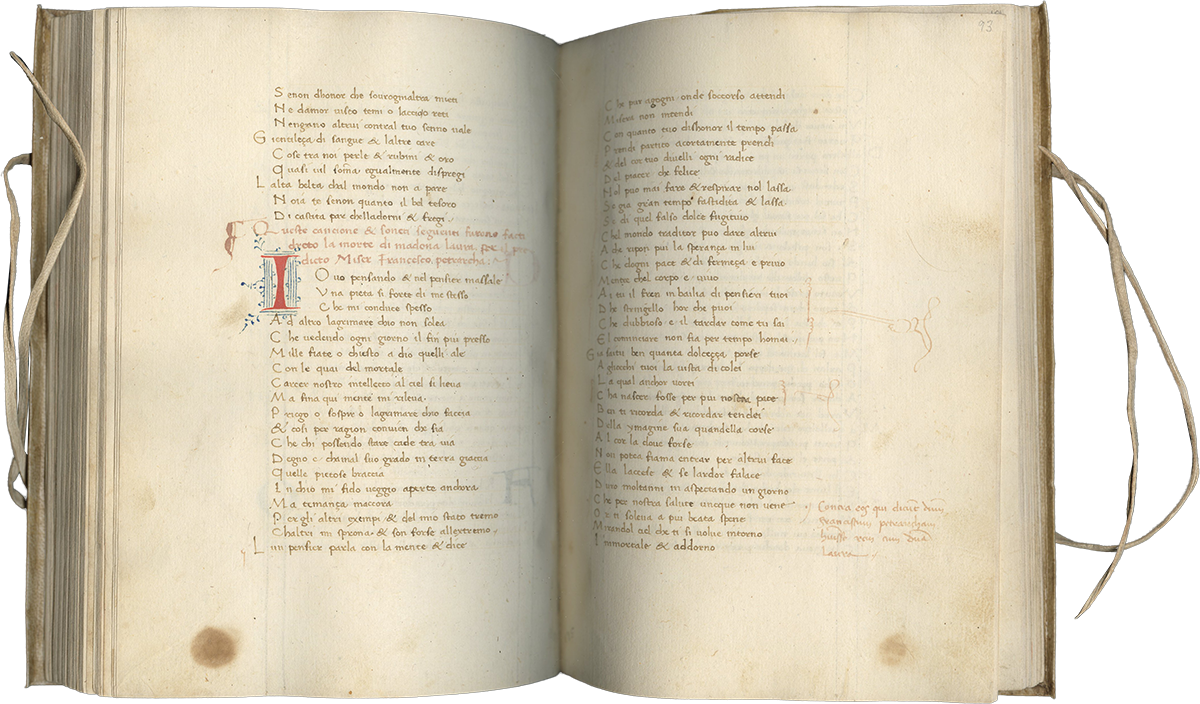
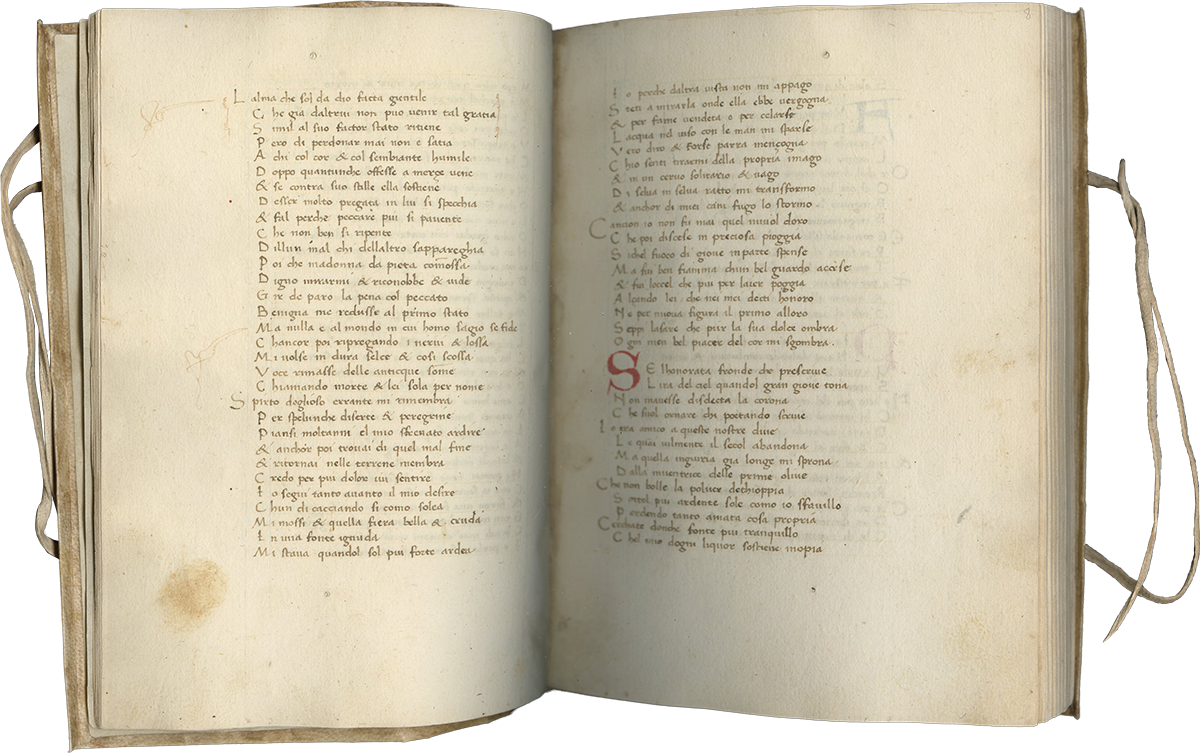
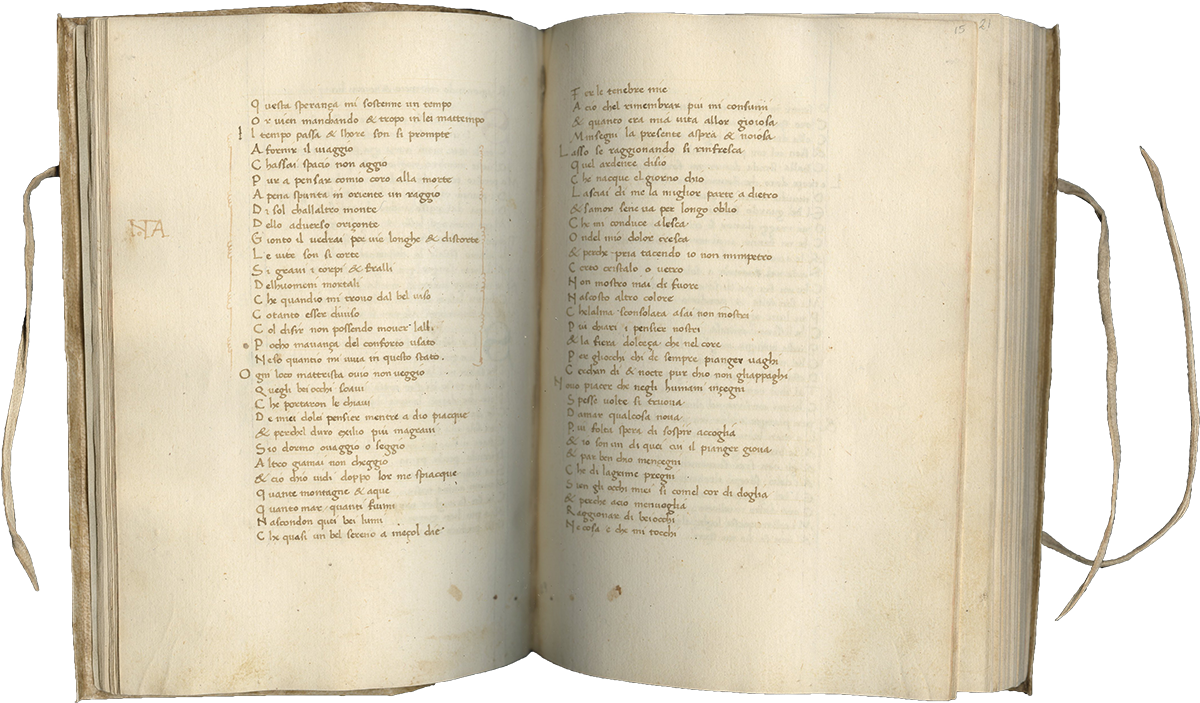
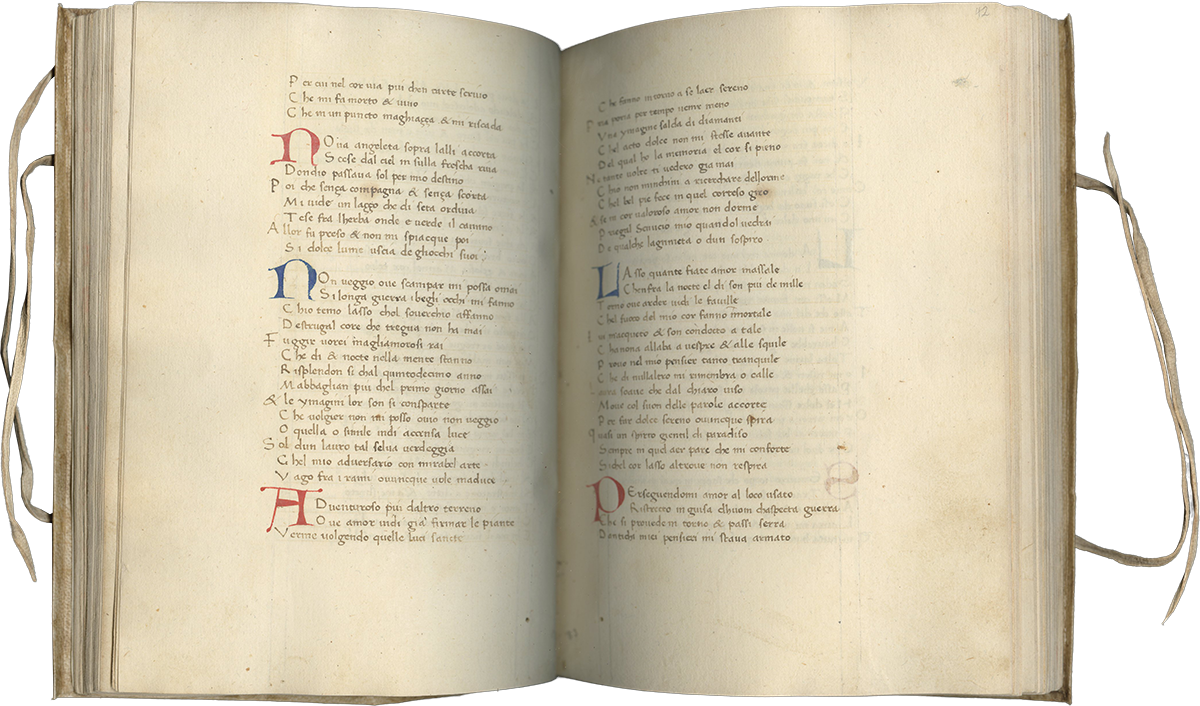
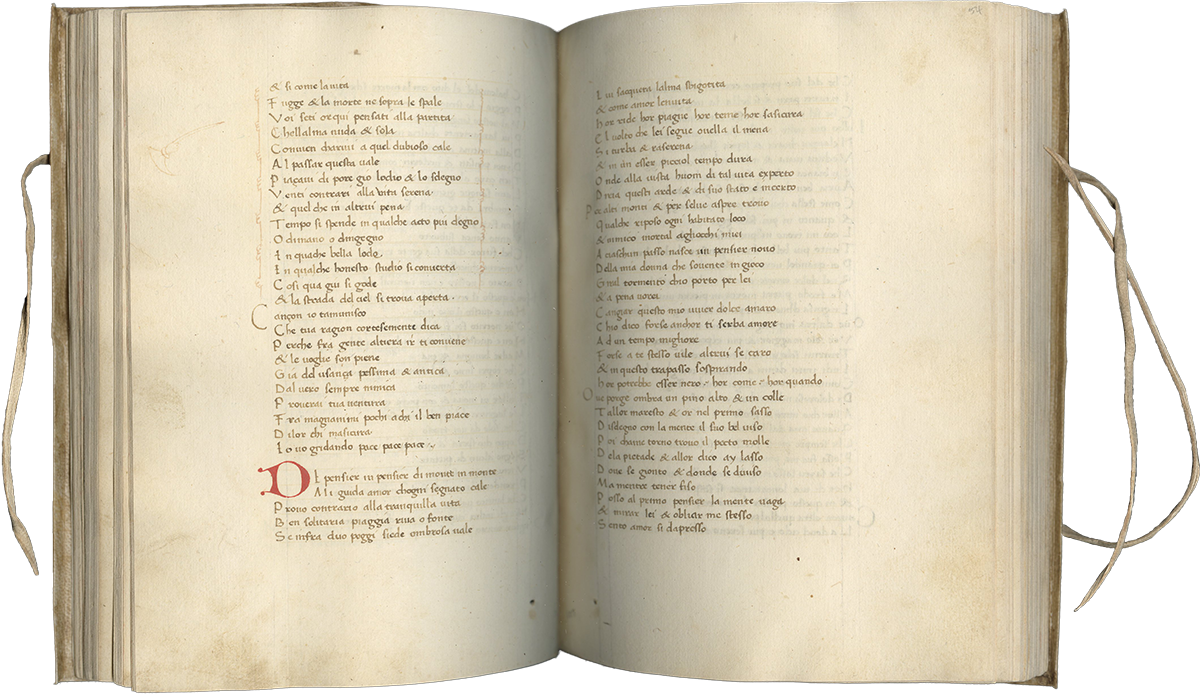
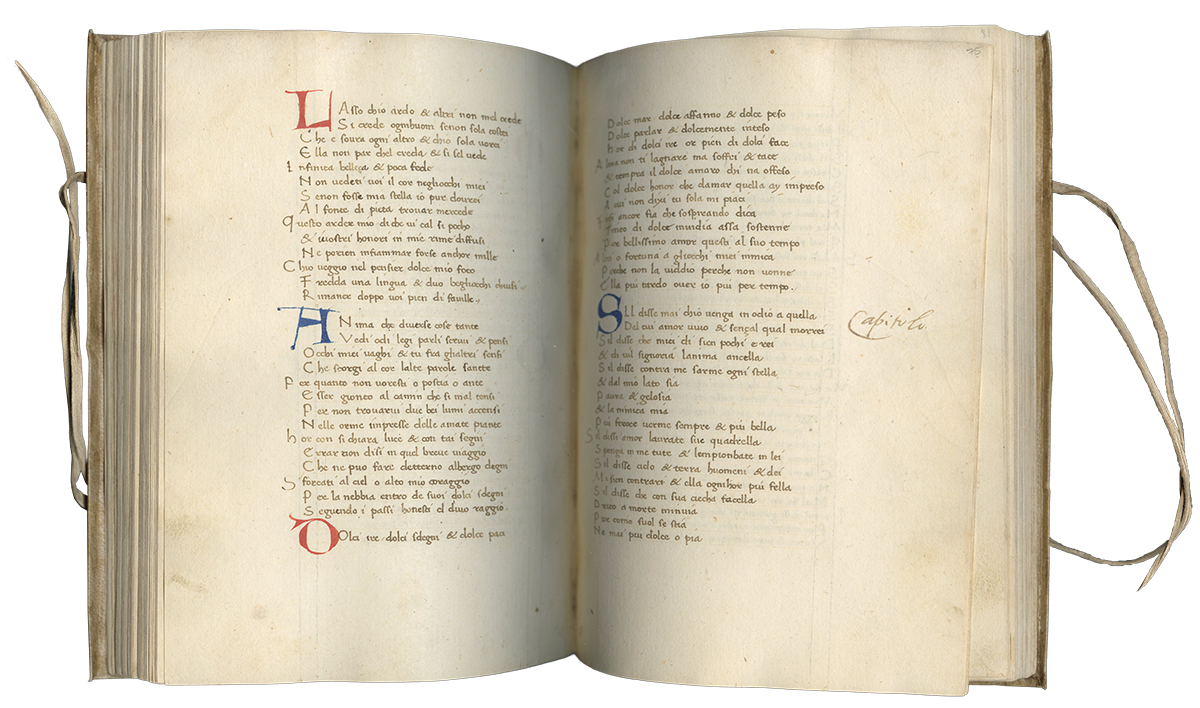
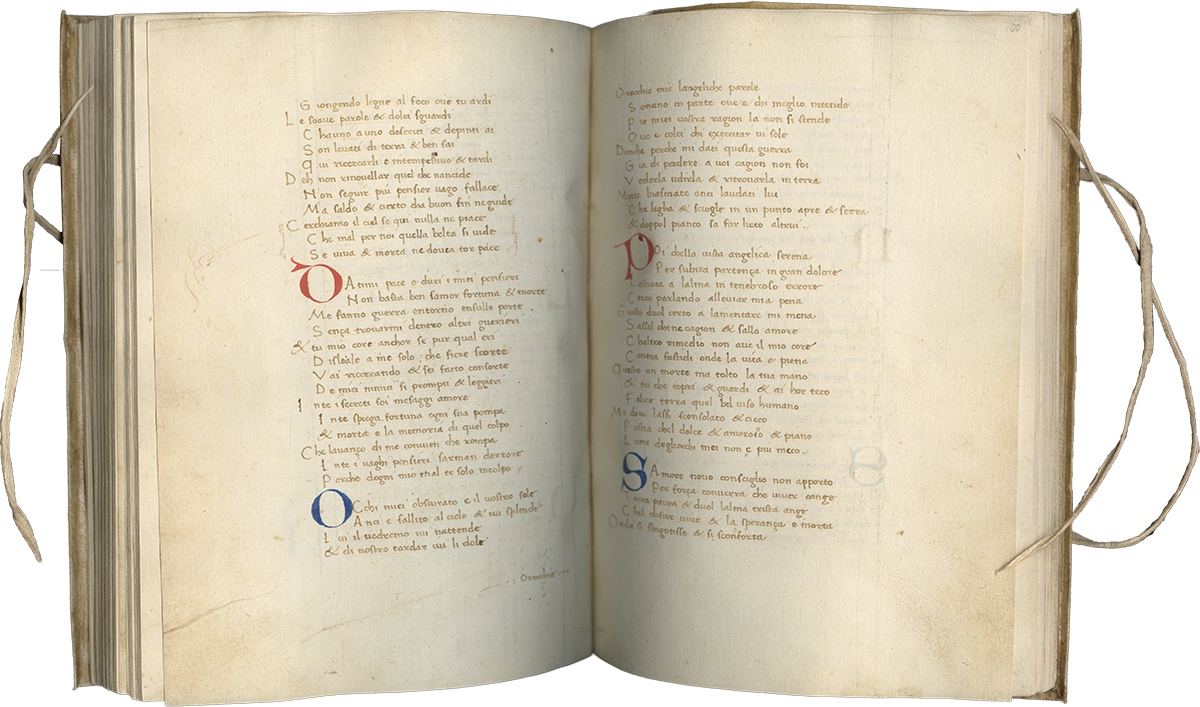
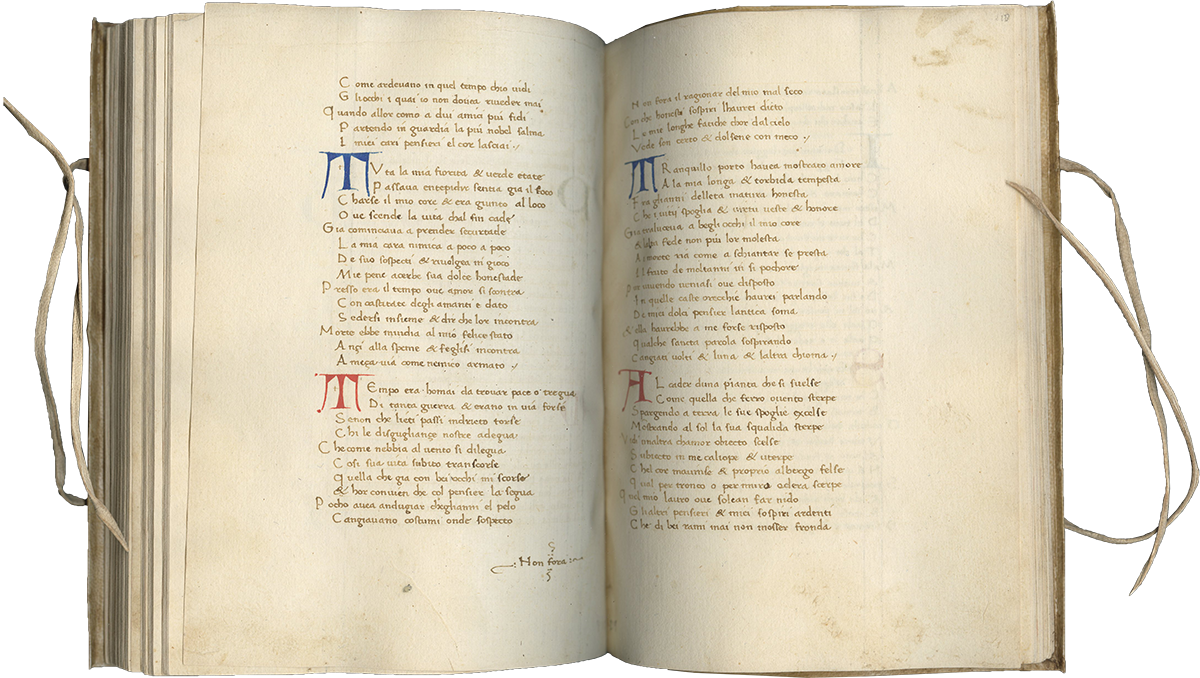
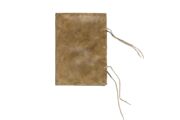
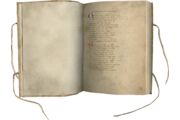
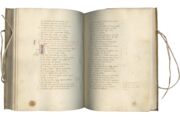
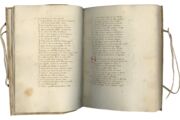
i+132 paper folios, no visible watermarks, foliated in pencil in upper right, pagination in pencil on lower rectos deep in the gutter, acephalous, decorated horizontal catchwords, (collation: i10-1, ii-xiii10, xiv4), single column of thirty-one lines, horizontally ruled in brown ink, vertically in silverpoint, erased, (justification 75 x 140mm), humanist script, three-line lombard initials alternating in red and blue, one three-line initial in red flourished in blue (f. 92v, begins Part II), marginalia throughout; minor worming to lower margins and inner gutters, primarily at the beginning, with a few early repairs, light browning and occasional small stains, not affecting legibility. Bound in modern limp vellum. Dimensions 209 × 149 mm.
One of the foundational texts of Italian vernacular literature and a cornerstone of Renaissance humanism, Petrarch’s Canzoniere (The Songbook), celebrates his love for Laura as the idealized woman. Their wide influence extends from Boccaccio to Shakespeare and Donne. This remarkably clean and well-preserved manuscript, wide margined and beautifully written, of Petrarch’s poems preserves nearly the entire poetic cycle and featuring several rarely included poems. Many manuscripts are extant, including about 30 in American collections, but each newly identified fifteenth-century survival, like this one, enables further understanding of the context and circumstances of the production of Petrarch manuscripts at the height of the Renaissance.
1. Copied in Italy, as the language, script, and style of the single flourished initial suggests. Many marginal comments in Latin in a lighter ink than the text, but in a similar hand, also many maniculae throughout.
2. f. 132 bears an ink inscription dated 1577, accompanied by a transcription of the last ten verses of the text in an italic script, followed by partial a vernacular astrological prognostication: “Dominacione nascerà in questo dì homo grasso e pieno di carne e ben membrito con alacuno colore palido & die esser...” (“Under the dominion [of the day], a man will be born, full-figured and well-formed, with a pale complexion, and he will be...”).
3. f. 131v after the text ends there are alphabetical pentrials and a poorly spelled Latin inscription in a rough, blocky script that begins with a biblical allusion.
4. Sold at Forum Auctions, London, 30 September 2021, lot 223, rebound since above, in a modern parchment binding (Schoenberg Database of Manuscripts SDBM 272959).
5. Sold at Christie’s, London, 13 July 2022, Auction 21033, Valuable Books and Manuscripts, Lot 28 (Schoenberg Database of Manuscripts SDBM 272959).
6. Private UK Collection.
Ff. 1-131v, Il Canzoniere, beginning v.14 of Rvf 4: “Onde si bella donna al mondo nacque...” Part Two (Rvf 264) opens with a rubric on f. 92v: “Queste cancione & soneti seguenti furono facti dreto la morte di madona Laura per il predicto Miser Fracesco petrarcha,” and ends “...Spirito ultimo in pace. FINIT LAUS DEO.”
Despite the loss of the first leaf, which contained Rvf 1–3 and most of 4, the manuscript largely follows the final redaction established by Petrarch himself, albeit in the usual single-column rather than the double column that the poet employed. The text appears in the following sequence (reflecting the physical order in the present manuscript): [one leaf missing], 4 (v.14), 5–37, 39, 38, 40–79, 81–82, 80, 83–120, 122, Disp. 1, 123, 121, 124–242, 121b (repeat), 243–327, 329, 328, 330–339, 342, 340, 350–355, 359, 341, 343, 356, 344–349, 357–358, 360–366. Such a complex ordering is characteristic of the manuscript tradition of the Canzoniere, where textual rearrangements, duplications, and interpolations reflect both the fluid transmission of Petrarch’s corpus and the preferences of individual scribes or commissioning readers.
Even within this context, however, the present manuscript displays noticeable textual irregularities. For example, the madrigal Or vedi Amor, che giovanetta donna (Rvf 121) appears not only between Rvf 242 and 243, but also between Rvf 123 and 124. Wilkins records eleven manuscripts in which this madrigal appears with or near the dispersa ballad Donna mi viene spesso nella mente, but only in two manuscripts is it repeated between Rvf 242 and 243: Berlin, Staatsbibliothek, MSS Hamilton 498 and Hamilton 500 (see Online Resources, Wilkins, 1943). Modern critical editions of what Petrarch himself called the Rerum vulgarium fragmenta are based on Petrarch’s holograph copies, Vatican, MS Vat. lat. 3195 (final version) and lat. 3196 (early draft) (see Online Resources).
The earliest of the great Renaissance humanists, Francesco Petrarch (1304-1374) wrote widely on the classics, but he is best known for the series of love poems addressed to Laura, the Canzoniere, written in vernacular Italian. Laura, whom he first glimpsed in 1327 at Avignon (possibly Laure de Noves, married in 1325 to Hugo de Sade), inspired him with a passion that has become proverbial and is placed at the center of his vernacular poetic opus.
Petrarch first assembled the Canzoniere himself and initially circulated it under the title of Rerum vulgarium fragmenta or “Fragments of vernacular matters.” The collection of 366 poems consists predominately of sonnets, but also includes a range of other poetic forms, including canzoni, sestinas, ballads, and madrigals. Intensely self-reflective, the majority of the poems concern the topic of love, especially the Poet’s love for Laura as the idealized woman. Nevertheless, as the range of poetic forms employed suggests, underlying themes vary widely, ranging from politics to moral and religious themes. The work represents one of the foundational texts of Italian vernacular literature and a cornerstone of Renaissance humanism. Petrarch’s fusion of classical ideals with personal introspection shaped the development of lyric poetry across Europe, influencing writers from Boccaccio to Shakespeare and Donne. The present manuscript testifies to the continued transmission and readership of the Canzoniere into the late Quattrocento, at a time when its status as a literary model was firmly established.
An important census of all extant Petrarch manuscripts in public collections is underway, the results of which are being published under the title “Censimento dei Codici Petrarcheschi” (Antenore). There are over 30 copies of the Canzoniere in the United States alone (Dutschke, 1986). To our knowledge, the present manuscript is hitherto unrecorded and thus should be compared with other later fifteenth-century copies of the Canzoniere to determine better the context and circumstances of its production. Further inquiry into the incunable tradition of the Canzoniere might also be revealing (Venice, 1470, ISTC ip00371000; Rome, 1471, ISTC ip00372000; Padua, 1472, ISTC ip00373000; Wilkins, 1943).
Editions:
Blanc, Pierre, ed. and trans. Pétrarque, Le Chansonnier / Canzionere. Paris, 2020.
Contini, Gianfranco, ed. Il Canzoniere, Turin, 1964.
Durling, Robert, ed. and trans. Petrarch’s Lyric Poems: The Rime Sparse and Other Lyrics, Cambridge (MA), 1976.
Mestici, G., ed. Le Rime di Francesco Petrarca, restituite nell' ordine e nella lezione del testo originario sugli autografi col sussidio di altri codici e di stampe e corredate di varianti e note da Giovanni Mestica, Florence, 1896.
Solerti, A., ed. Rime disperse di Francesco Petrarca o a lui attribuite, per la prima volta raccolte a cura di A. Solerti, Florence, 1909.
Other:
Aresu, Francesco Marco. Manuscript Poetics: Materiality and Textuality in Medieval Italian Literature, Notre Dame, IN, 2023.
Belloni Peressutti, Gino. “Nota sulla storia del Vat. lat. 3195,” G. Belloni, F. Brugnolo, H. Wayne Storey et al. (eds.), Rerum vulgarium fragmenta. Codice Vat. Lat. 3195. Commentario all’edizione in facsimile, Roma-Padova 2004, pp. 73-104.
Benghi, Giulia. “Transcribing Petrarch's Genres in the Late Fourteenth Century: Ongoing Conversation with the Observations from MSS Cologny Bodmer 131 and Gambalunga SC-Ms. 93,” Textual Cultures 13 (2020), pp. 106-127.
Dutschke, Dennis, ed. Census of Petrarch Manuscripts in the United States, Padua, Editrice Antenore, 1986 [Censimento dei codici Petrarcheschi, 9].
Pellegrin, E. Manuscrits de Pétrarque dans les bibliothèques de France, Padua, Editrice Antenore, 1986 [Censimento dei codici Petrarcheschi, 2].
Del Puppo, Dario. “Remaking Petrarch's Canzoniere in the Fifteenth Century,” Medioevo letterario d’Italia 1 (2004), pp. 115-139.
Santagata, Marco. I frammenti dell’anima: Storia e racconto nel Canzoniere di Petrarca, Bologna, 1992.
Storey, Wayne H. Petrarch’s Canzoniere in the English Renaissance, Amsterdam, 2005.
Storey, Wayne, H. Translating the Past: Laurent de Premierfait and Petrarch’s Canzoniere in France, New York, 1993.
Thornton, Peter. Petrarch’s Canzoniere: Scattered Rhymes in a New Verse Translation, London, 2023.
Wilkins, Ernest Hatch, The Making of the Canzoniere and other Petrarchan Studies, Roma 1951.
Wilkins, Ernest Hatch. “The Fifteenth-century Editions of the Italian Poems of Petrarch,” in Modern Philology 40 (1943), pp. 225-39.
Edition:
Magni, Isabella, H. Wayne Storey, John A. Walsh, and Francesco Marco Aresu, eds. Petrarchive: An edition of Petrarch’s songbook Rerum vulgarium fragmenta
https://dcl.luddy.indiana.edu/petrarchive/
Other:
Berlin, Staatsbibliothek, MS Ham. 500 https://www.deutsche-digitale-bibliothek.de/item/BLUFRLYJRYER54VNBA66WG73IT2AJ2V2
Petrarch, Franceso https://www.poetryfoundation.org/poets/petrarch
Vatican, Biblioteca Apostolica Vaticana, MS Vat. Lat. 3195, https://digi.vatlib.it/mss/detail/Vat.lat.3195
Vatican, Biblioteca Apostolica Vaticana, Vat. Lat. 3196, https://digi.vatlib.it/mss/detail/Vat.lat.3196