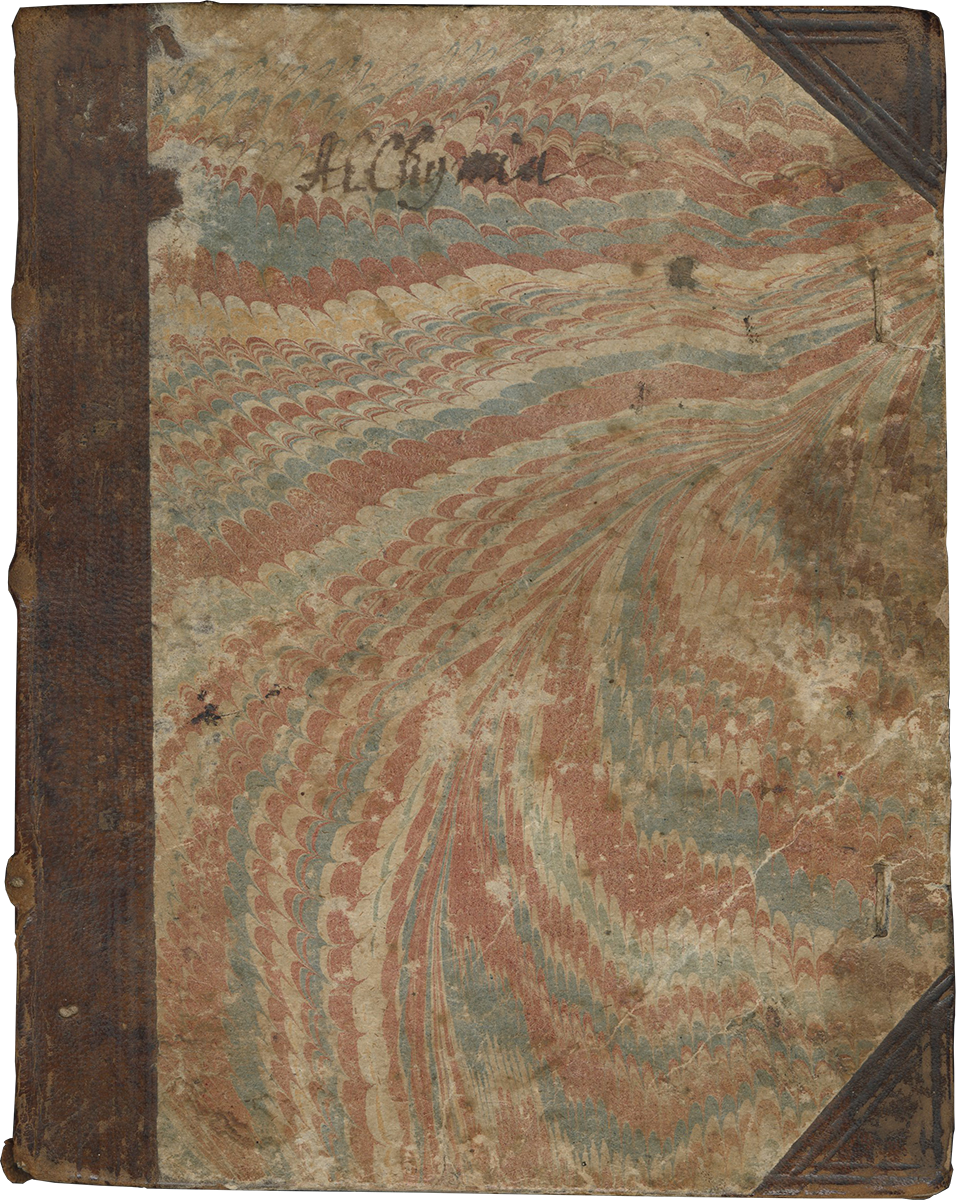
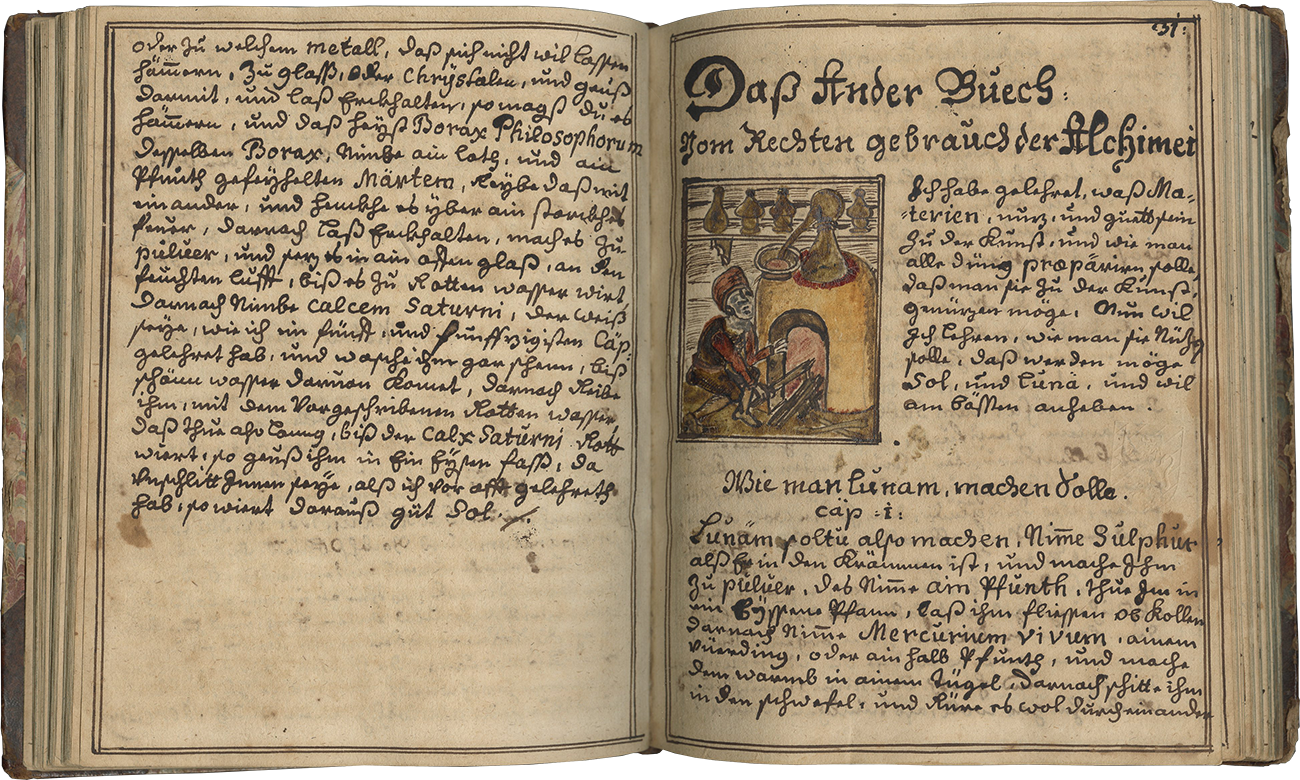
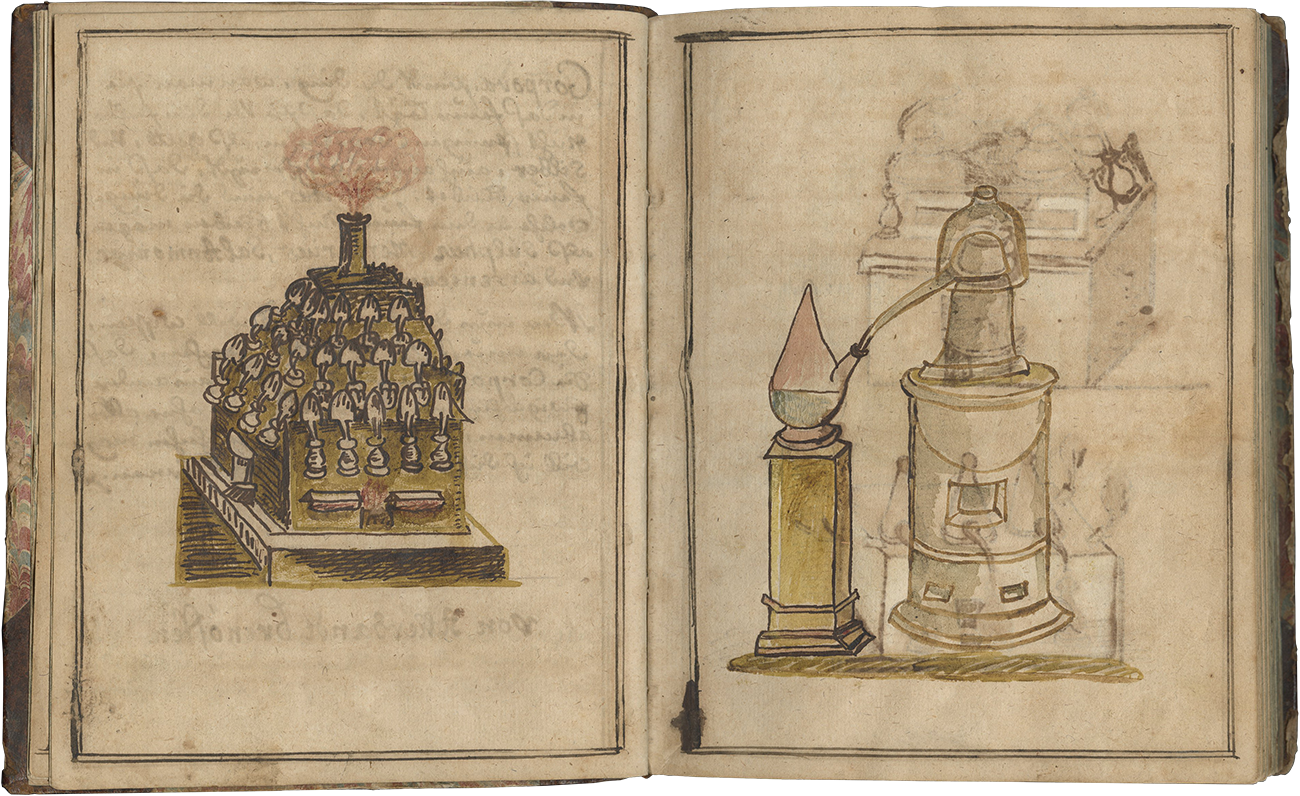
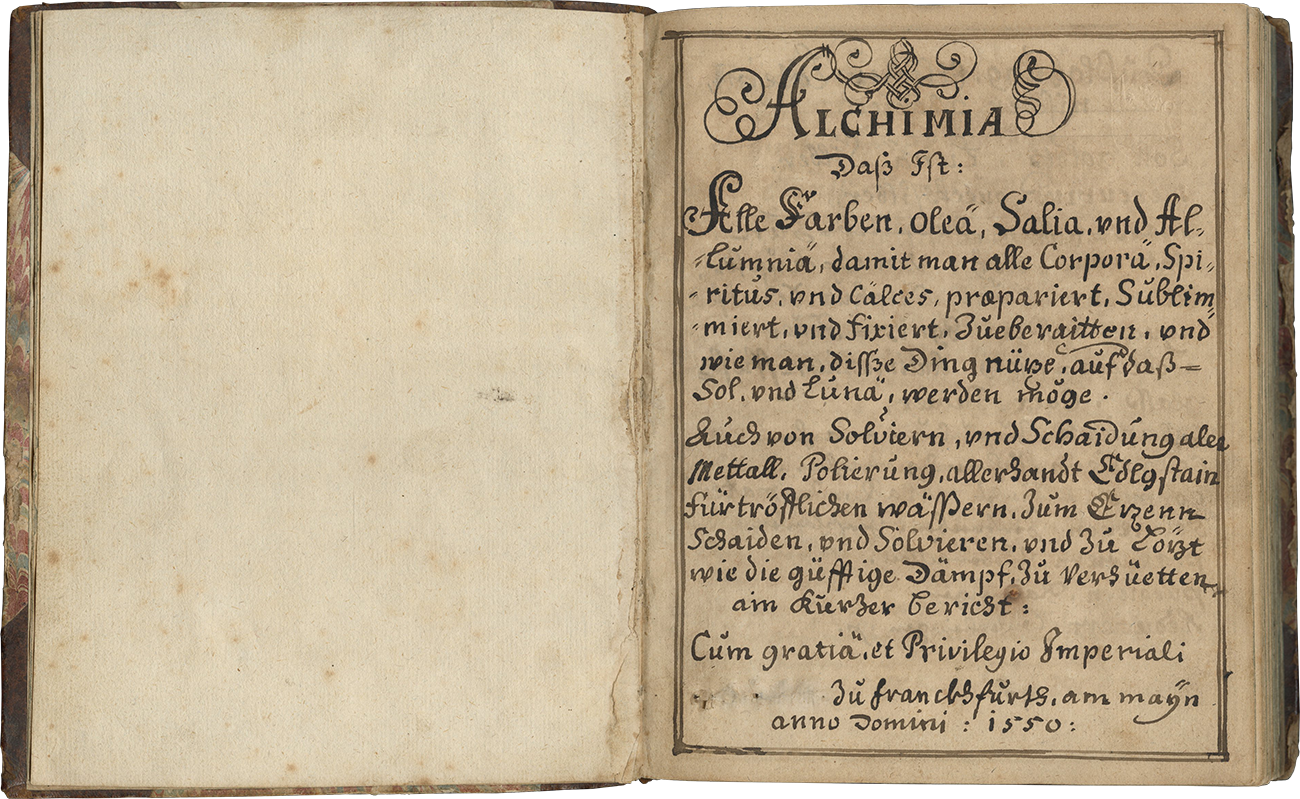
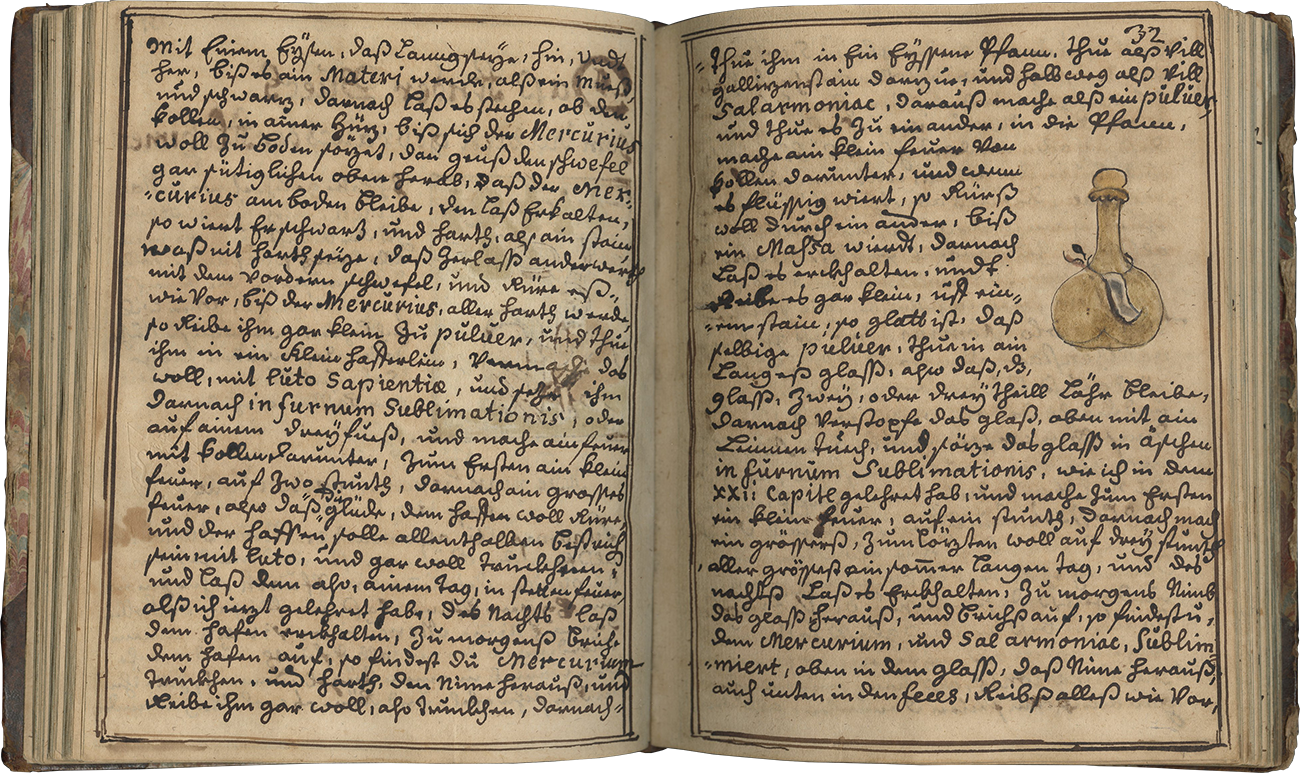
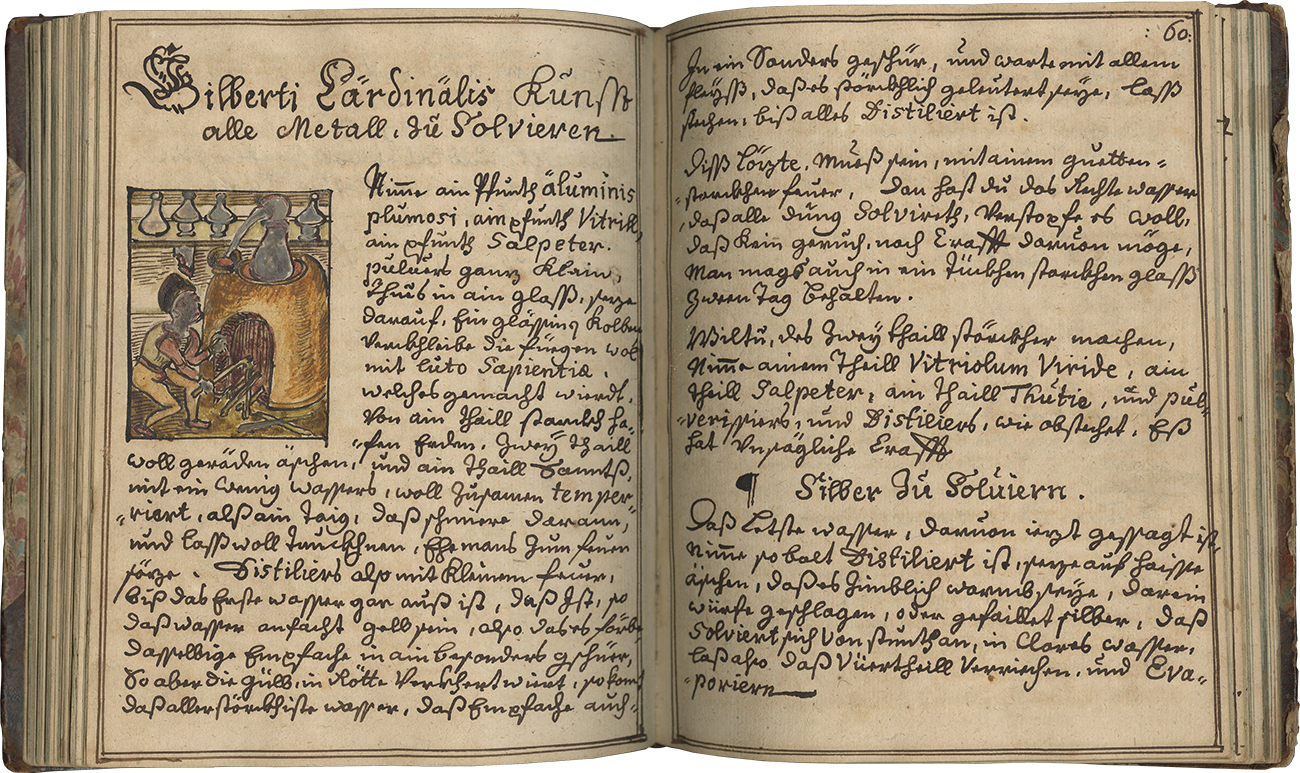
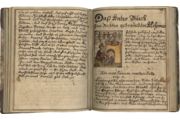
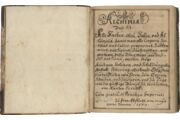
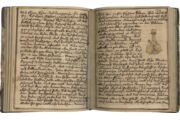
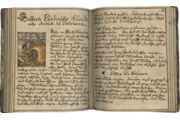
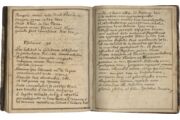
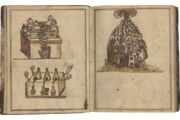
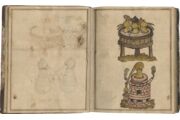
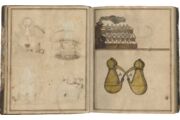
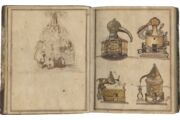
ii + 106 folios, paper, watermark is close in style to Briquet nos. 2169-2177 armoiries salière, contemporary foliation in ink top right (1-78 on ff. 9-86), modern foliation in pencil top right, complete, (collation: i16 ii8 iii16 iv8 v16 vi8 vii16 viii8 ix14-4[-11, -12, -13, -14]), single column, frame ruled in ink, 23-29 lines (justification 180 x 135mm), written by a single scribe with display majuscules (f. 1), a script imitating Fraktur for titles (f. 9), German Kurrentschrift and a humanist cursive for Latin phrases used for main text and the Latin charm and psalm on ff. 105v-106, pencil sketches of alchemical equipment ff. 67 and 87v, pen flourishes on title page (f. 1) ink drawing of flask in blue, brown, and green ff. 25, 40, 43, and 49, ink drawing of man tending furnaces with a still in red, yellow, and brown ff. 30v, 39, and 67v, sequence of ink drawings in brown, red, yellow, and blue “of all kinds of furnaces” (von allerhandt brenöffen, f. 3) ff. 3v-8, minor smudging and staining throughout, small hole on f. 87, otherwise good condition. Early modern quarter-calf binding over marbled cardboard, 3 bands on spine, “Alchymia” written on the front cover in brown ink, some scuffing on outer edges, top and bottom of spine slightly chipped, otherwise good condition. Dimensions 200 x 150 mm.
A unique copy of an unattested edition of Petrus Kerzenmacher’s Alchimia, this manuscript is an important witness to the changing status of alchemy from an abstruse kind of sorcery to scientific praxis in the Early Modern period. The detailed color illustrations demonstrate the artistic and scientific skills of the scribe, while the added hymn, charm, and psalm copied at the end of the manuscript reflect the continuing links between science and faith in the sixteenth century. The scribe has added several alchemical recipes to Kerzenmacher’s treatise which may be original to this manuscript, giving us a glimpse into the experimental development of alchemy in situ.
Provenance
1. The title page of the manuscript gives the place and date “Zu Franckhfurth am Mayn Anno Domini 1550,” but this poses a couple of problems. First, this manuscript is a close copy of the edition published in Frankfurt-am-Main in 1570, and it reproduces the text of the title page exactly, excluding the date. Hence, the place of production of this manuscript may not be Frankfurt. Second, if the date of 1550 is correct, then this manuscript represents a manuscript copy of an otherwise unattested 1550 (or earlier) edition of Petrus Kerzenmacher’s text. The fragmentary watermark on the paper resembles Briquet’s “Armoiries. Salière” (nos. 2169-77), which Briquet notes is primarily found in Bavaria. Thus, the manuscript was likely produced in Southern Germany in the middle of the sixteenth century.
2. A later owner, perhaps in the seventeenth century, supplied the manuscript with quarter-calf binding over marbled cardboard.
3. At the top of f. 106v a previous owner, probably from the nineteenth century, has written in cursive with pencil “Ich habe die Ehre” (literally, ‘I have the honor’). The expression is used in Bavaria as an informal greeting.
4. A small (25 x 17 mm) embossed modern book stamp on ff. 1 and 39 depicts a coat of arms featuring a lion rampant holding a sword on a striped shield.
Text
ff. 1-67, Alchimia, daß ist Alle Farben, Olea, Salia, und Alumnia, damit man alle Corpora, Spiritus und Calces, praepariert, sublimiert, und fixiert. Zuberaitten und wie man disße Dingnüße, auf daß Sol und Luna werden möge, incipit, “Außlegung etlicher Lateinnischer Wörter…silber ausainander thaill”;
ff. 67v-76, Gliberti Cardinalis Kunsst alle Metall zu Solvieren, incipit, “Nimme ain pfunth aluminis plumosi…damit spare uns gott, alle gesunth. Amen”;
ff. 76v-77, Register disßes Buechs, incipit, “A. alaun calciniren…Weinstein calcioniren. Ende disses Registers,” f. 77v, [blank];
First published in 1531 and without Kerzenmacher’s name, the alchemical treatise, Rechter Gebrauch der Alchimei (Correct Use of Alchemy), was the first of several Kunstbüchlein (“Skills-booklets”) printed by Christian Egenolff (1502-1555) in Frankfurt for lay-readers in German with sets of recipes and methods, used as introductions to practical arts like alchemy or mining (Eamon, 1994, pp. 112-16). The collection of alchemical recipes was modified in subsequent editions of the text. In 1534, 1538, and 1539, Jakob Cammerlander (d. 1549) printed two editions of the alchemical compilation, now titled Alchimia, with an added preface by Petrus Kerzenmacher of Mainz (a shadowy historical figure unknown outside of this text) and a small treatise on metallurgy by Gilbertus Cardinalis. Another edition of the Alchimia was printed in Augsburg in 1546 by Heinrich Steiner. The next printed edition of the Alchimia appears in Frankfurt in 1570 (USTC, 610655), likely printed by the heirs of Egenolff (see Ferguson, 1888, pp. 16-19).
The text in this manuscript follows the 1570 Frankfurt edition of Petrus Kerzenmacher’s Alchimia very closely (see ILLUSTRATION), excluding orthographical variants. Given the date of 1550 written on f. 1, it is also possible that this manuscript is a witness to an otherwise lost 1550 Frankfurt edition of the Alchimia, printed during Egenolff’s lifetime. The reissue of the 1570 edition in 1574, 1589, 1613, and 1720, suggests a ready audience that may also have supported earlier, now-lost editions. This is the only known manuscript copy of Kerzenmacher’s Alchimia and likely a unique witness to a lost printed edition of the text.
ff. 78-86, [Miscellany of Alchemical Recipes], incipit, “Naturliches Goldth von dem Alchymistischen zu erckhenen…so wierts scheun,” ff. 86v-103v, [blank];
An anonymous collection of recipes for a variety of practical alchemical applications. The first recipe concerns distinguishing “natural gold” from its alchemical variety (f. 78). There is also a recipe relevant to scribal practice with the title “How to make golden letters without gold” (Wie man guldene buechstaben ohne golth mache) (f. 80). Another recipe records “To make silver brilliant white” (Daß Silber schön Weisß zu machen) (f. 82). These recipes are not recorded elsewhere and could represent recently developed recipes for the practice of manuscript illumination.
ff. 104-105, [Hymn], incipit, “Auß meines Herzens grundte…In meinem Beruff und Stanth. Amen”;
Made famous by a choral arrangement of Bach (BWV 269), this hymn was written by Georg Niege (d. 1589). The “Morgengesang” is his most popular work by far. The copy of the hymn in this manuscript contains many variants not recorded in the standard edition (see Bei der Wieden, 1996, pp. 27-30). The lines “Mein Seell, mein leib, mein löben…und alles was ich hab,” (f. 104v) and “Gott, will ich lassen walten…vor ihrtnimb(?) und korperei(?)” (ff. 104v-105) are original to this manuscript and do not appear in the printed version of the hymn. Thus, this could be a local version of the hymn familiar to the scribe of the manuscript.
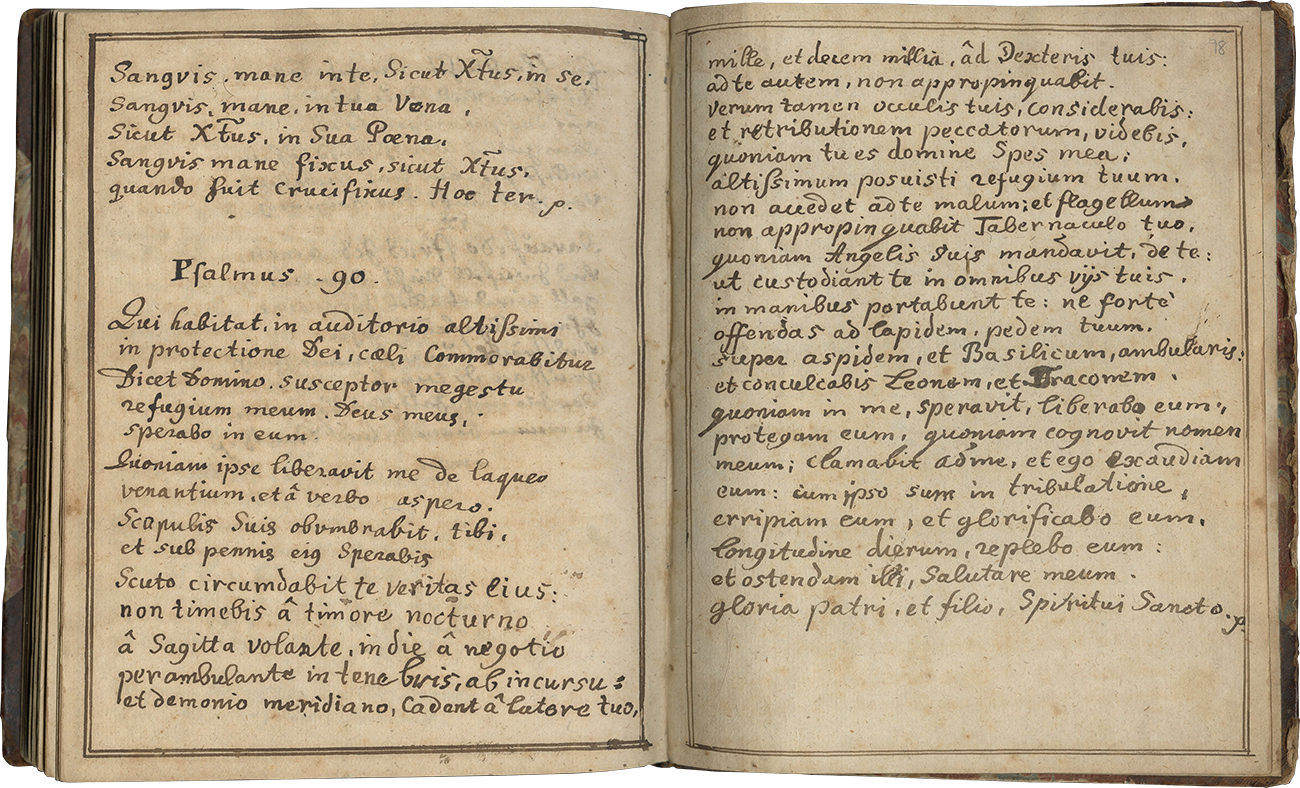
f. 105v, [Charm for Staunching Blood], incipit, “Sanguis mane in te…Fuit crucifixus. Hoc ter”;
This Latin charm appears in several English sources in the seventeenth century, notably in the Diary of Samuel Pepys (Saturday, December 31st, 1664).
ff. 105v-106, Psalmus 90, incipit, “Qui habitat in auditorio altissimi…salutare meum. Gloria patri et filio et spiritui sancto,” f. 106v, [blank].
The text of psalm 90 in Latin following Jerome’s Septuagint translation.
Illustration
General note: all of the illustrations are line drawings in black ink and colored with different tones noted below.
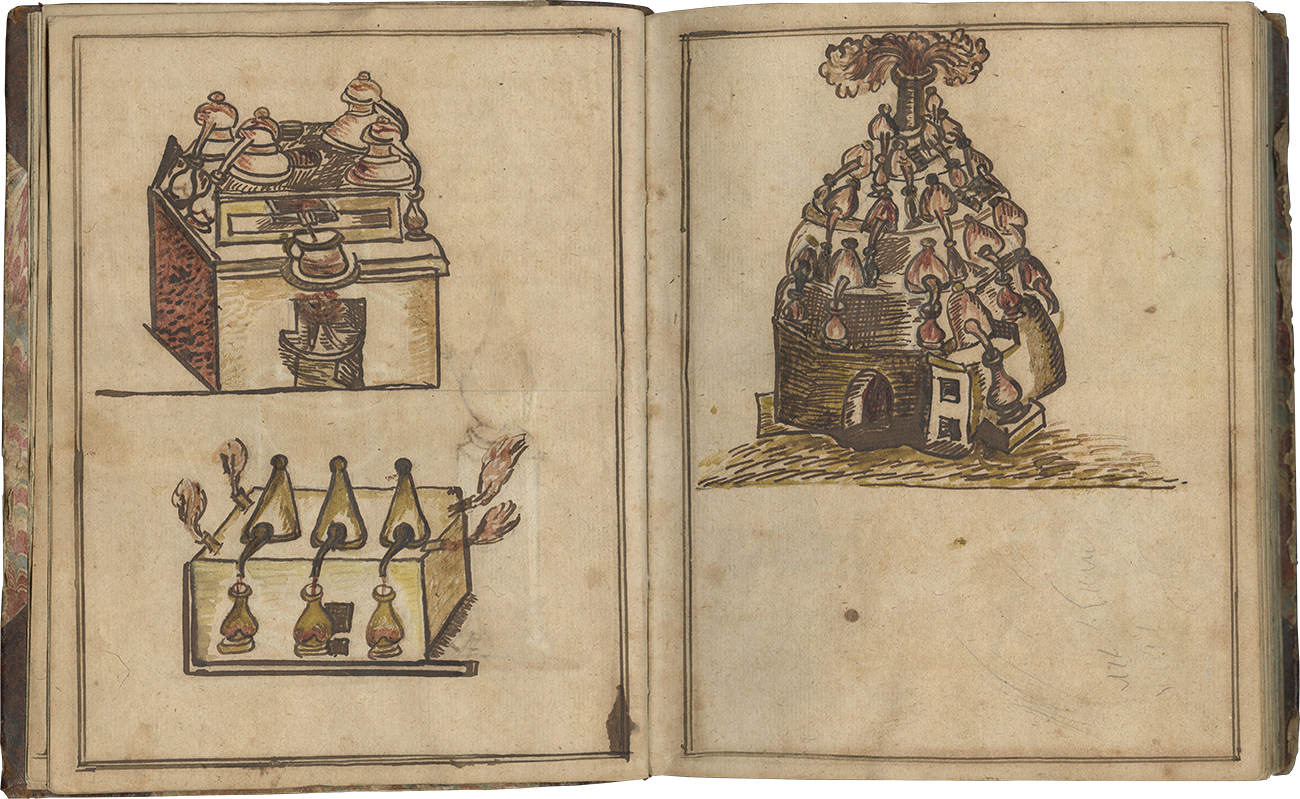
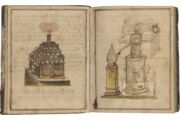
f. 3v, a large square furnace with many alembics stilling into vials in yellow, brown, and red ink;
f. 4, a tall cylindrical furnace topped with an alembic stilling into a vial on a square pedestal in yellow brown, and red ink;
f. 4v, top, a square furnace with four alembics stilling into vials, along with a central spout pouring into an urn in yellow, brown, and red ink; bottom, a square furnace with three alembics stilling into vials in yellow brown and red ink;
f. 5, a large circular furnace with four tiers containing many alembics stilling into vials in yellow brown, and red ink;
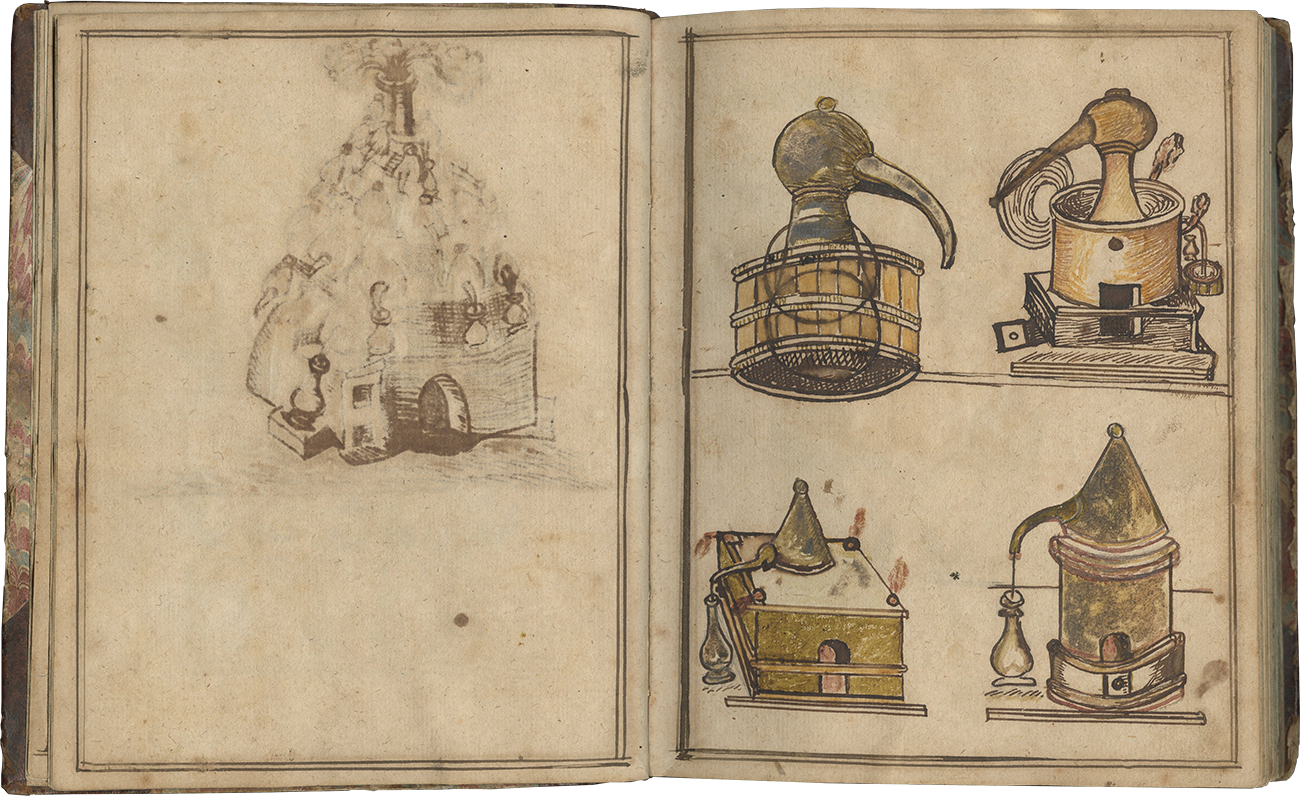
f. 6, top left, an alembic with cucurbit show in diagram below in yellow brown and blue; top right, an alembic placed in a circular furnace atop a square pedestal in yellow and red ink; bottom left, an alembic in a square furnace stilling into a vial in yellow and red ink; bottom right, an alembic in a cylindrical furnace stilling into a vial in yellow and brown ink;
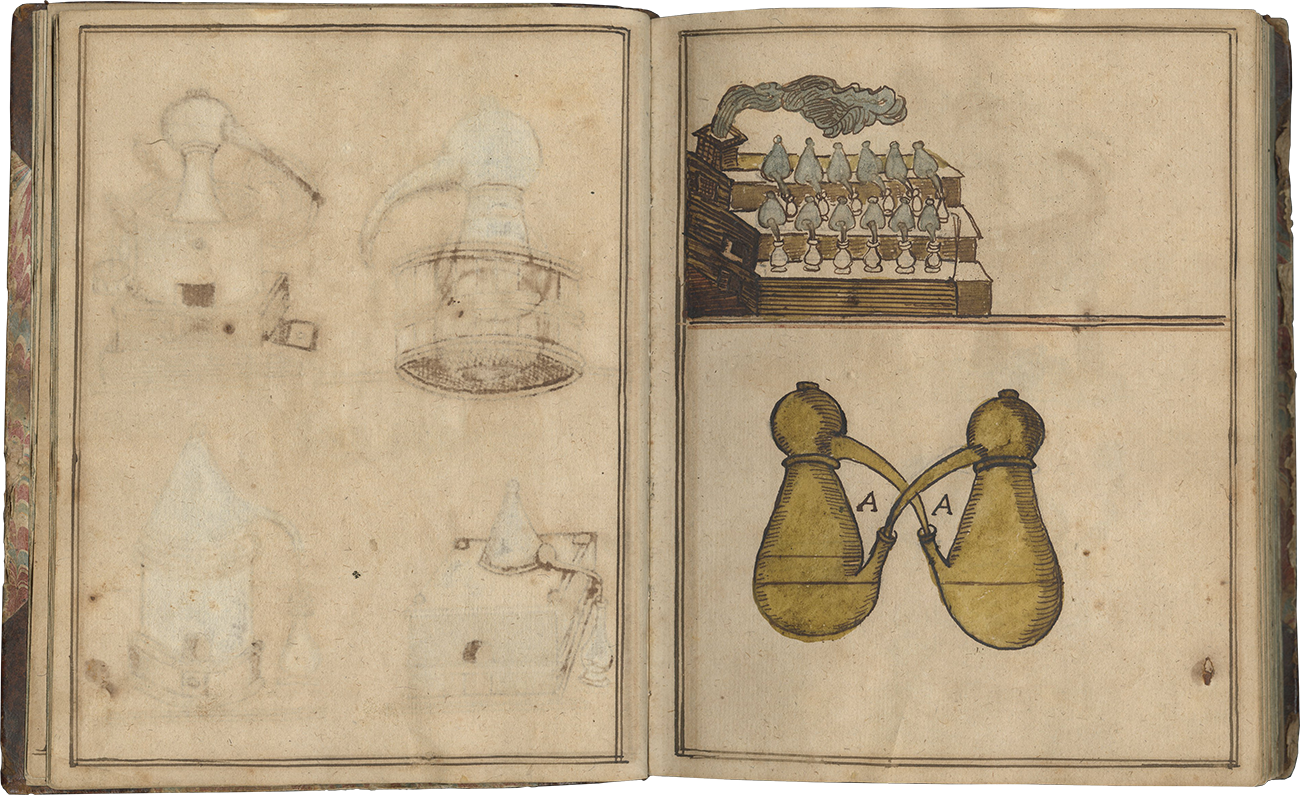
f. 7, top, a three-tiered square furnace with twelve alembics stilling into vials in brown and blue ink; bottom, a pelican, i.e. an apparatus with two alembics stilling into one another's cucurbits, with an "A" marked on either side in yellow ink;
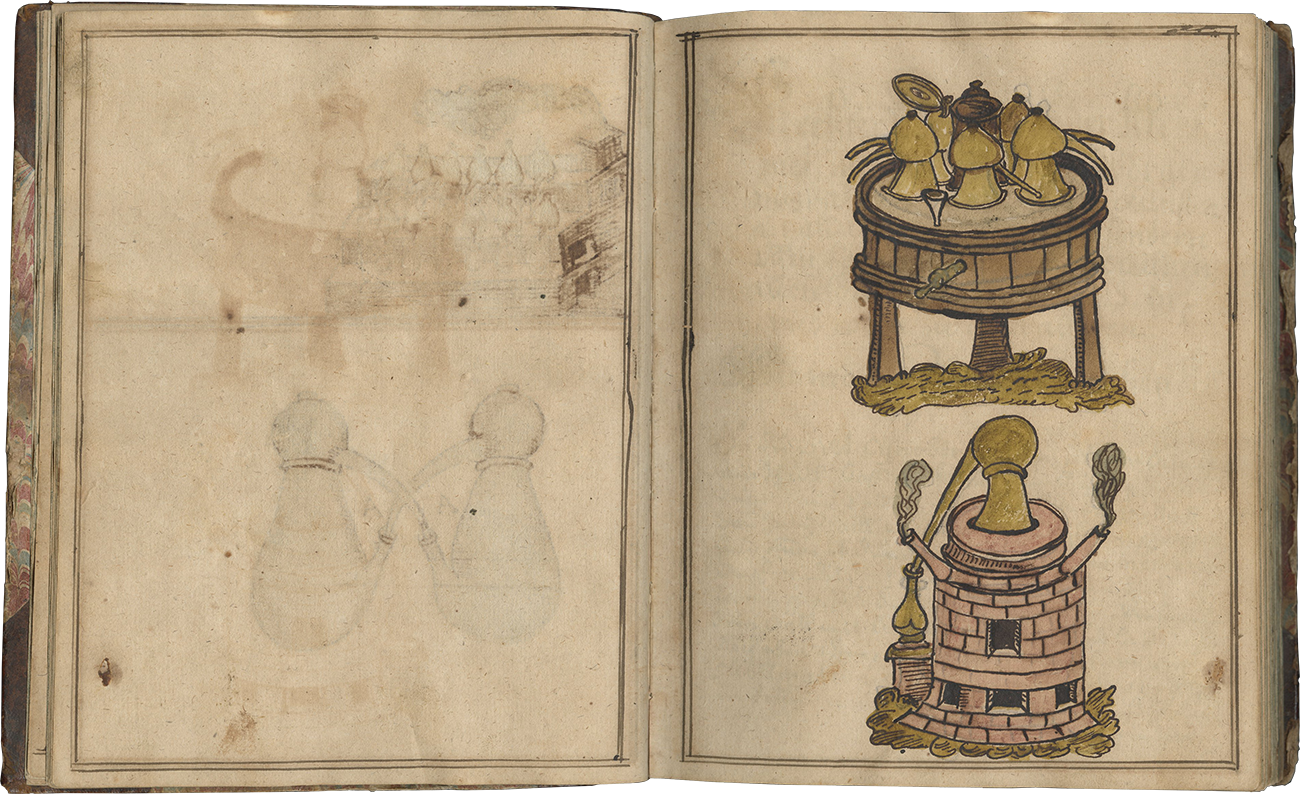
f. 8, top, a circular apparatus with six alembics atop in brown an yellow ink; bottom, a cylindrical brick oven with a single alembic stilling into a vial in yellow and brown ink.
ff. 25, 40, 43, and 49, ink drawing of flasks in blue, brown, and green;
ff. 30v, 39, and 67v, ink drawing of man tending furnaces with stills in red, yellow, and brown;
The scribe and the artist of this manuscript are likely the same individual. The sequence of illustrations follows the woodcuts of the 1570 Frankfurt edition of the Alchimia almost exactly, only slightly differing in the placement of some of the alchemical furnaces depicted on ff. 3v-8. The artist has also added color to the pen work illustrations using muted blues, browns, reds, yellows, and greens in watercolor. In a few of the illustrations, there also appears some metallic paint, such as the still on f. 4. The depictions of tools and craftsmen at work emphasize the importance of the practice and labor involved in alchemical work and also distinguish it sharply from the theoretical sciences of the universities. The illustrations give a livelier impression than their woodcut counterparts and the addition of metallic paints suggests the artist may have put practical alchemy to use.
At the turn of the sixteenth century, Germany experienced a rapid growth in the production of alchemical manuscripts and printed books, so much that an early historian of alchemy, Nicolas Lenglet du Fresnoy, remarked that Germany produced a greater quantity of alchemical treatises than the rest of Europe combined (quoted in Telle, 1992, p. 162). The profusion of alchemical treatises in the vernacular can be traced back to the first half of the fourteenth century, when “the development of alchemical knowledge took place in scientific and scholarly, albeit not academic environments, and not—or not primarily—in popular ones,” influenced primarily by the exclusion of alchemy from university curricula (Pereira, 1999, p. 356). In this vernacular, scientific, and scholarly vein, the Rechter Gebrauch and Kerzenmacher’s Alchimia compiled alchemical recipes which were “entirely practical and have little or nothing to do with speculative or transcendental alchemy” (Ferguson, 1888, p. 3). This approach differed greatly from the abstruse, Latinate, metaphysical tradition of alchemy exemplified by the Rosarium Philosophorum (Philosophers’ Rose Garden) also published in Frankfurt in 1550, which centered on the transmutation of base metals into gold and likened this process to inward spiritual transformation. By the turn of the seventeenth century, practical alchemy, or chymistry, began to find academic proponents in the medical faculties of universities (Frietsch, 2021).
This manuscript attests to the growing demand for simple, practical, and vernacular introductions to alchemy in the sixteenth century. The scribe, probably a practicing alchemist, left ample space in the manuscript after Kerzenmacher’s Alchimia, where several recipes have been added, perhaps the results of personal experimentation. The addition of a hymn, a charm, and a psalm at the end of the manuscript shows the scribe’s interest in song, folk magic, and hints at how faith blended with folk magic. The scribe also shows a concern for the technical equipment involved in alchemical processes in the exact reproduction of woodcuts found in the printed edition of the Alchimia. Altogether, this manuscript offers a rare glimpse into the professional and confessional interests of an alchemist in sixteenth century Germany.
Literature
Bei der Wieden, Brage. Leben im 16. Jahrhundert: Lebenslauf und Lieder des Hauptmanns Georg Niege, Berlin, 1996.
Eamon, William. Science and the Secrets of Nature: Books of Secrets in Medieval and Early Modern Culture, Princeton, 1994.
Ferguson, John. Some Early Treatises on Technological Chemistry, Glasgow, 1888.
Ferguson, John. Some Early Treatises on Technological Chemistry. Supplement II, Glasgow, 1910.
Frietsch, Ute. “Alchemy and the Early Modern University: An Introduction,” Ambix 68.2/3 (2021): 119-134.
Frietsch, Ute. Epistemischer Wandel: Eine Geschichte der Alchemie in der Frühen Neuzeit, Leiden, 2024.
Neubecker, Ottfried. Großes Wappen-Bilder-Lexicon: Der bürgerlichen Geschlechter Deutschlands, Österreichs und der Schweiz, Battenburg, 1992.
Nummedal, Tara. Alchemy and Authority in the Holy Roman Empire, Chicago, 2007.
Pereira, Michela. “Alchemy and the Use of the Vernacular in the Late Middle Ages,” Speculum 74.2 (1999), pp. 336-56.
Rosarium Philosophorum: Ein alchemisches Florilegium des Spätmittelalters, 2 vol., ed. Joachim Telle, Weinheim, 1992.
Schriftbeispiele: Handschriften des 15. Bis 20. Jahrhunderts, ed. Gerhart Marckhgott, Willibald Mayrhofer, Josef Weichenberger, Linz, 2014.
Smith, Pamela H. The Body of the Artisan: Art and Experience in the Scientific Revolution, Chicago, 2004.
Telle, Joachim. “Bemerkungen zum ‘Rosarium Philosophorum’,” in Rosarium Philosophorum, vol. 2, pp. 161-202.
Zuber, Mike A. Spiritual Alchemy: from Jacob Boehme to Mary Anne Atwood, Oxford, 2021
Online Resources
“Alchimia,” The Universal Short Title Catalog, https://www.ustc.ac.uk/editions/610655
Benzing, Josef. “Cammerlander, Jakob,” Deutsche Biographie, 1957, https://www.deutsche-biographie.de/sfz7800.html#ndbcontent
Benzing, Josef. “Egenolff (Egenolph), Christian,” Deutsche Biographie, 1959, https://www.deutsche-biographie.de/sfz52855.html#ndbcontent
“Georg Niege (Hymn-Writer),” Bach Cantatas Website, July 1 2025, https://www.bach-cantatas.com/Lib/Niege-Georg.htm
Kerzenmacher, Petrus. Alchimia, Frankfurt-am-Main, 1570. https://www.digitale-sammlungen.de/en/view/bsb00084871?page=,1