


JUSTINIAN, Institutes, and JOHANNES DE DEO, Decretum abbreviatum
In Latin, manuscript on paper
Italy, 1430
TM 1376
- $48,000.00
 Textmanuscripts - Les Enluminures
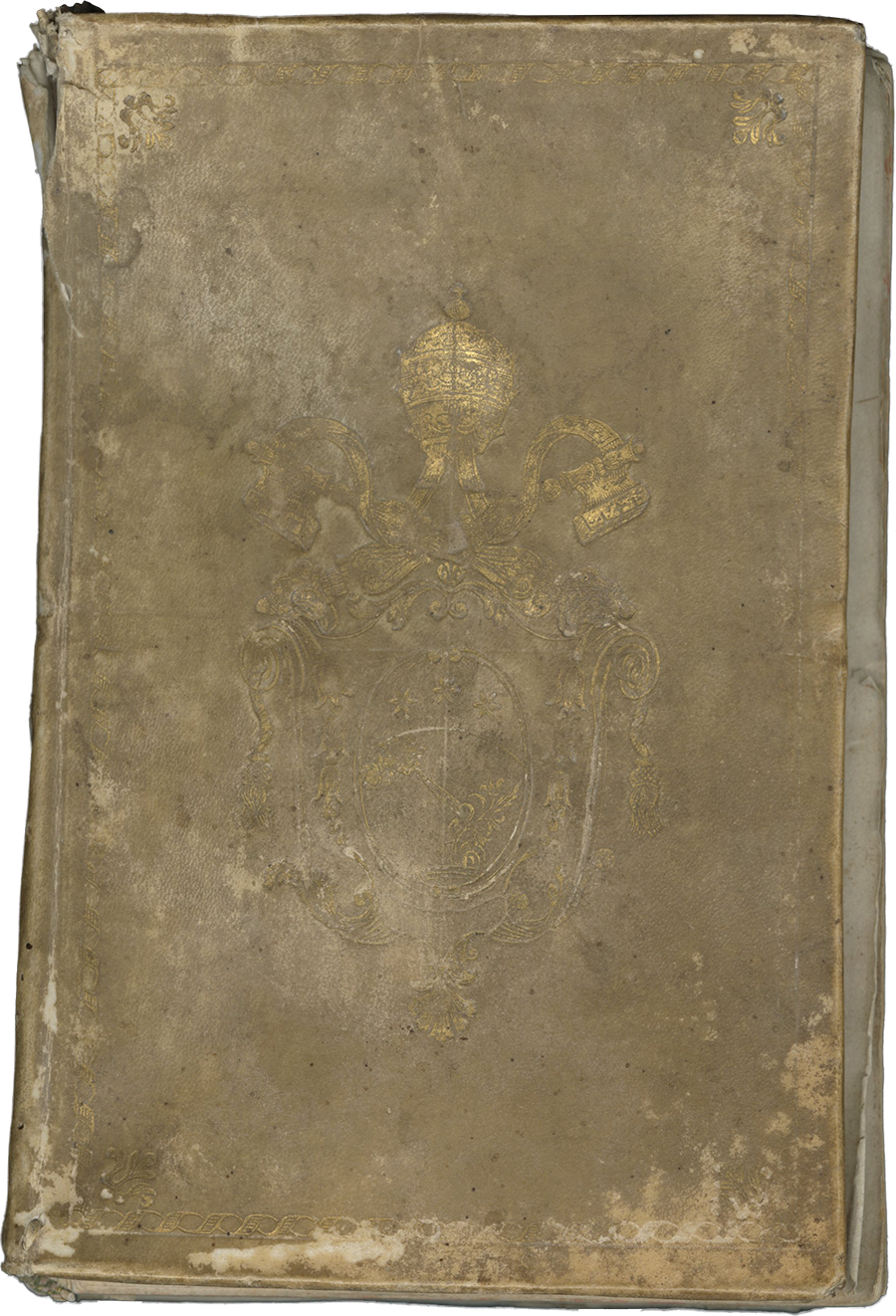
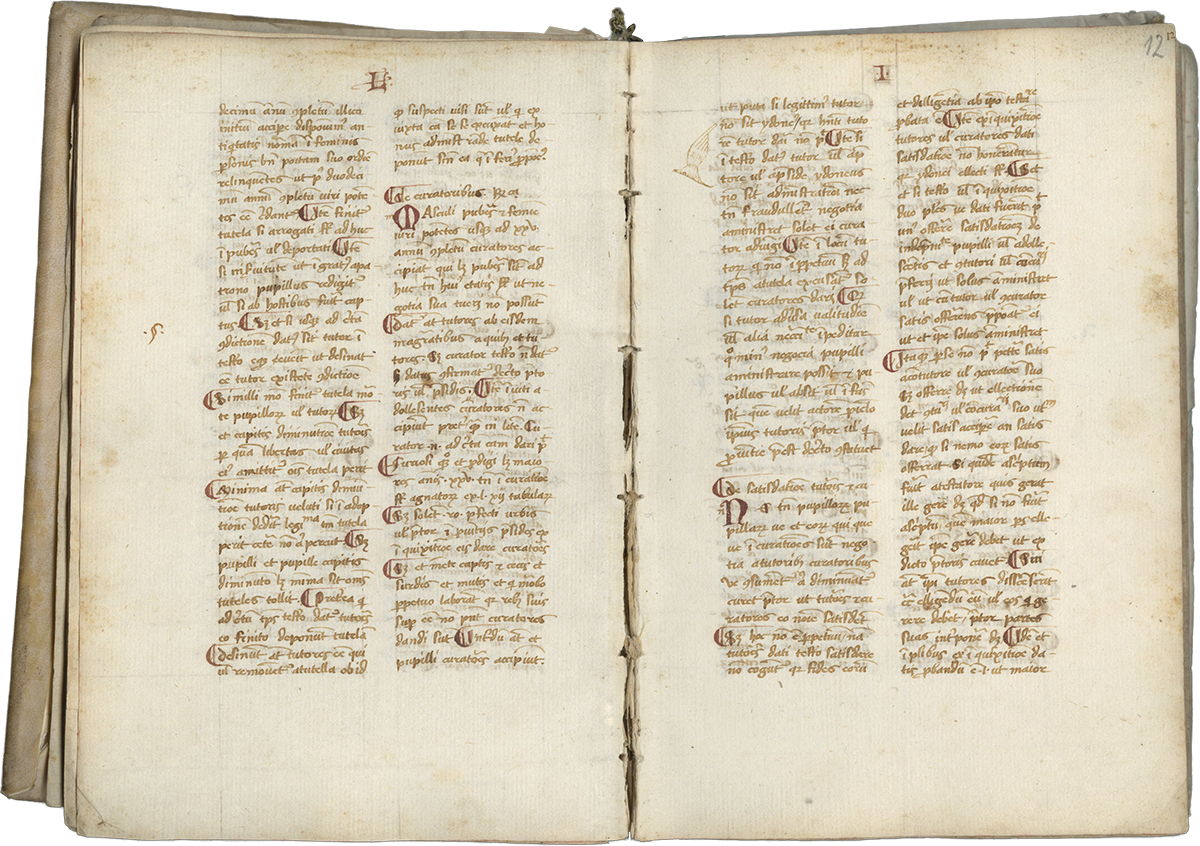
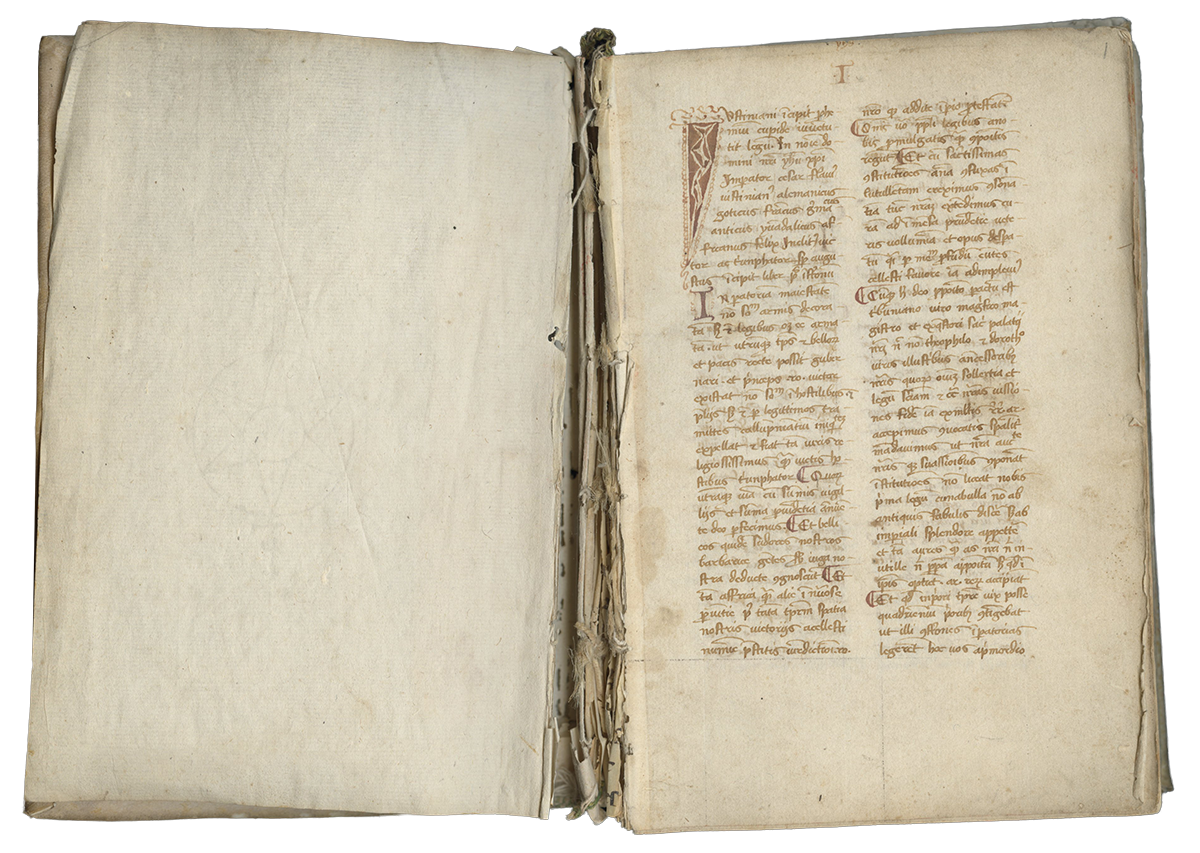
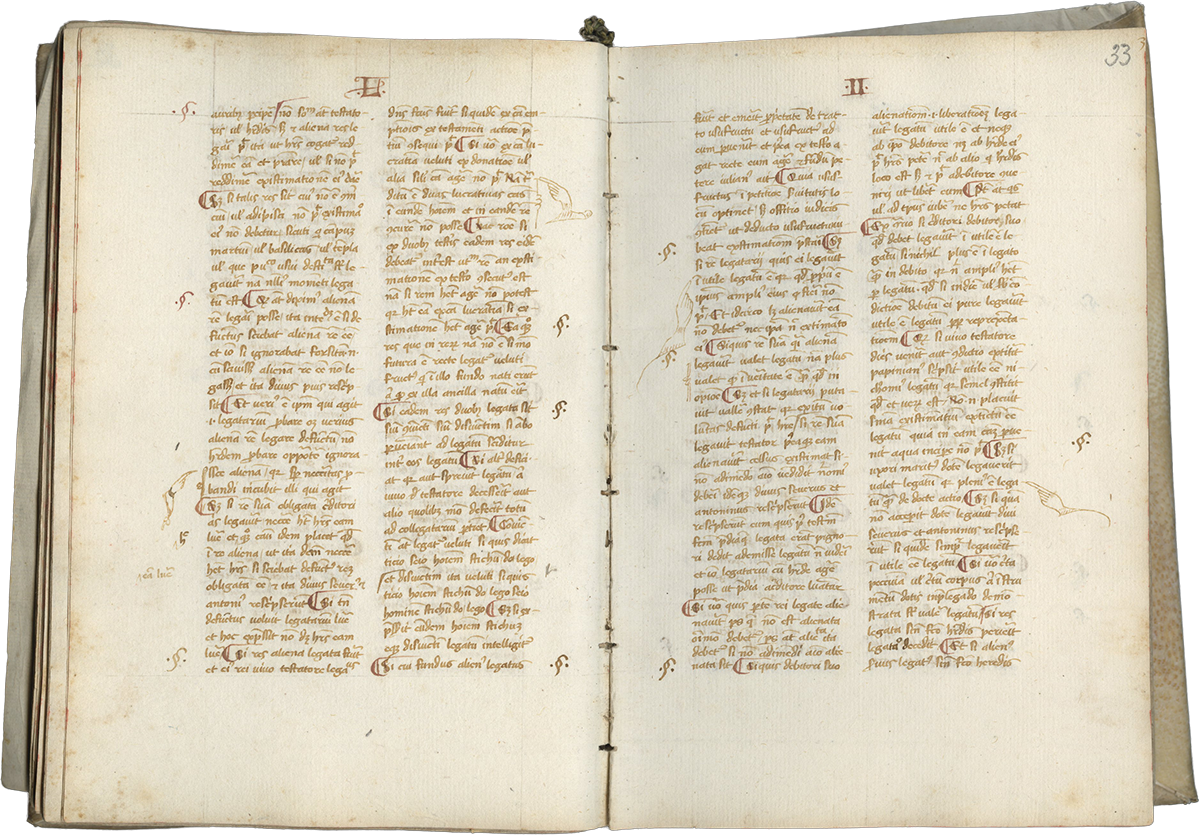
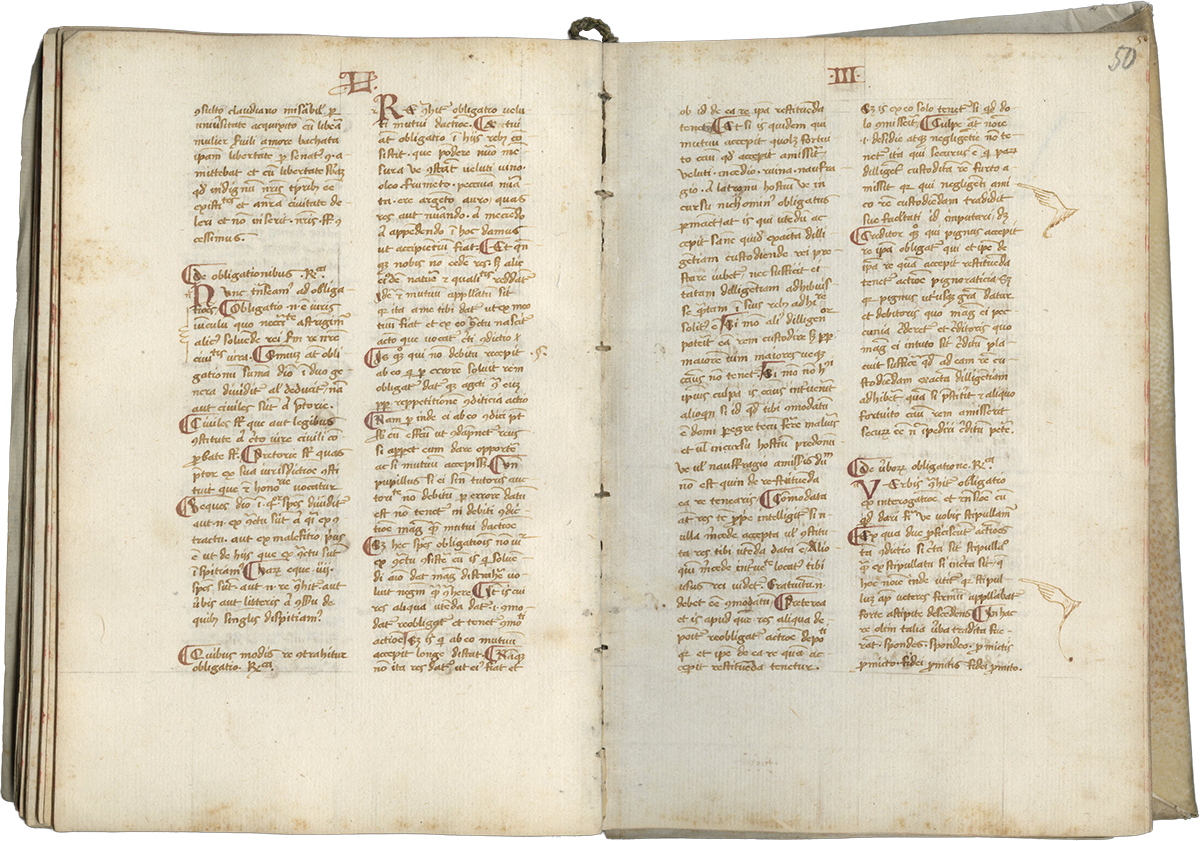
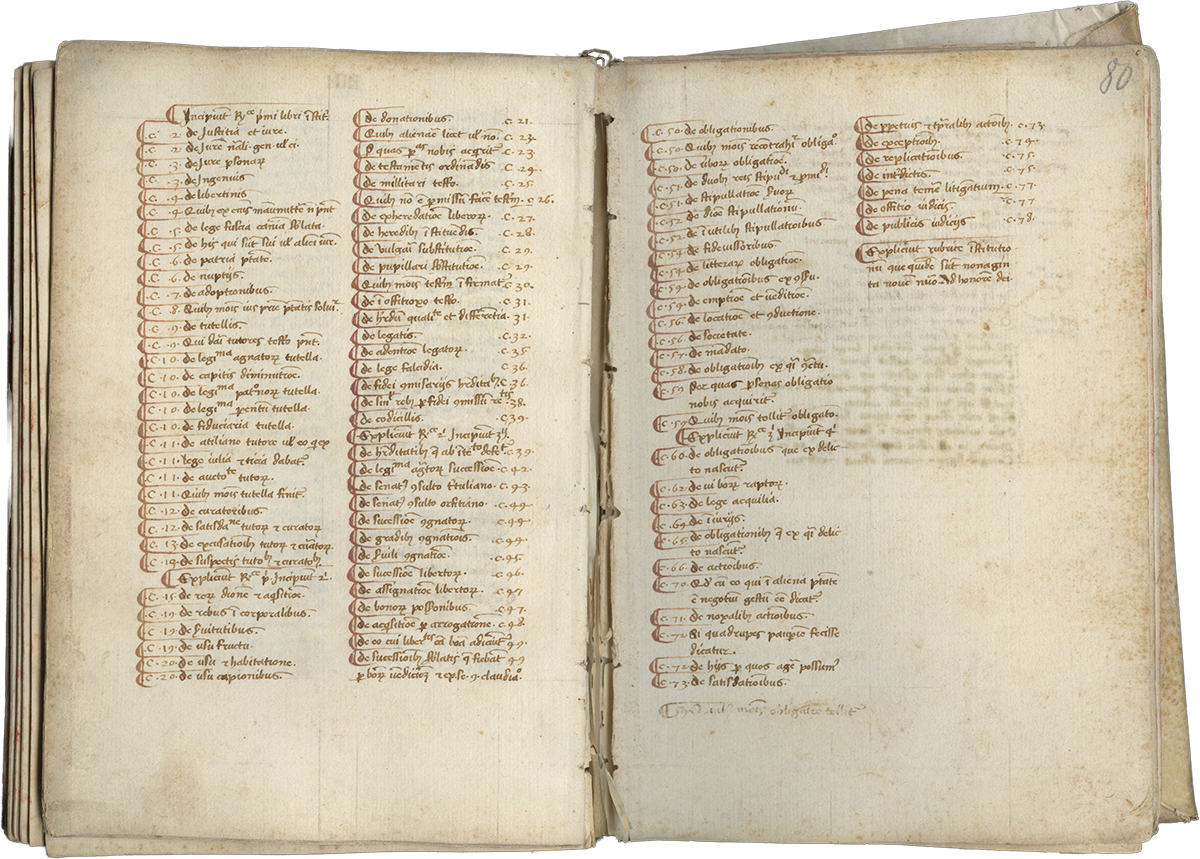
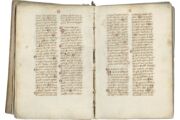
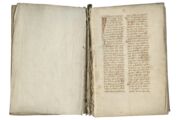
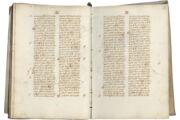
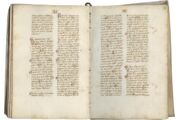
ii (loose) + 88 + ii paper leaves (at least 2 different watermarks in the form of a triple mount surmounted by a cross, Briquet 11664-11916), foliation in modern pencil in upper right corner, (collation: i-viii10 ix8), original quire numbering in upper right hand corner, inner and outer bifolia strengthened with strips cut from a vellum manuscript written in a rotunda script, horizontal catchwords in the first seven gatherings, ruled in plummet (justification 150 × 90 mm), written in fairly cursive humanistica in two columns of 33–34 lines, paraphs and 1-line initials in dark red, textblock detached from the binding and the sewing loose, with some foxing of the edges of some leaves. Binding of Pope Pius VI: worn vellum over pasteboards, each cover with his gilt arms (a personification of the wind, blowing through lilies, three stars in chief) in a central oval, surmounted by the papal tiara and crossed keys, the covers with gilt frame and corner ornaments, the top of the spine inscribed “46.” Dimensions 215 x 145 mm.
Pope Pius VI’s copy of an important medieval law school text. Dating to the sixth century, the rediscovery of the Institutes both galvanized and structured medieval legal education beginning in the eleventh century. Just as Justinian had hoped it would do in his late Roman empire, the Institutes played a role in increasing centralization in governments across Europe, and, beginning in the fifteenth century when this manuscript was copied, the larger world as European colonial empires began to form. The present manuscript displays design features common to text books: paper quires reinforced with parchment for durability, a small size, and lack of ponderous glosses.
1. The scribe finished writing the book on 5 February 1430: “Explicit liber Institutiones anno Mo cccco xxxo. die .v. Februarii ad honorem dei & genitricis eius Marie tociusque cellestis curie triumphantis amen” (Thus ends the book the Institutions, 1430, the fifth day of February, to the honor of god and Mary his mother, and of the triumphant heavenly court, amen) (f. 79).
2. Maniculae throughout, from readers in the fifteenth and sixteenth century.
3. Pope Pius VI (s. 1775–1799): books bound in these custom armorial covers – either in leather or limp vellum as here – were either official presentation copies commissioned or gifted by the Pope himself, or personal volumes belonging to his private library or prominent ecclesiastical figures of the era. It would be interesting to trace this route this book took from Rome to Austria, for although it cannot have been gifted directly to Graf Ludwig von Paar, perhaps it reached him through another, slightly earlier Austrian diplomat. Perhaps records in the Vatican could establish a link in this chain of provenance.
The Vatican Library was first established by Pope Sixtus VI (1471-1484). Pope Pius VI was instrumental in expanding the Vatican collections to include important holdings of prints and numismatics. Anticipating the privileged access to rare material characteristic of our modern age, Pope Pius VI for the first time limited access to rare material to the extent that a Spanish priest accused him of overseeing “a cemetery of books not a library.”
4. Graf Ludwig von Paar (1817–1893), Austrian diplomat to various Italian states and art collector: sold by Samuel Kende, Vienna, Katalog der rechhaltigen Sammlungen weiland Sr. Excellenz des Herrn Botschafters Grafen Ludwig Paar, 20 February 1896, lot 241 (Schoenberg Database of Manuscripts, SDBM 270492).
5. Consigned with an export license from Austria, Lot 44, Sotheby’s sale, Western Manuscripts and Miniatures [LO9741], 8 December 2009 (Schoenberg, SDBM MS 28336), bought by:
6. Martin Schøyen, Oslo, Norway and London, UK (born January 31, 1940), a Norwegian businessman, traveler, historian, and collector of books; The Schøyen Collection, MS 5436.
ff.1-80, Justinian’s Institutes, followed by table of rubrics, incipit, “Iustiniani incipit prohemium cupide iuventutit [sic] legum.... Ad honorem dei”; f. 80v originally left blank, notes added concerning the election, confirmation, and consecration of bishops, etc., f. 81 blank;
ff. 81v-87v, Johannes de Deo, Decretum abbreviatum, incipit, “Incipit decretorem abbreiatio. Liber decretorum distinguitur in tres partes...In 5. de confirmacione et ieunio, &c finiatur et finitur”;
ff. 87v-88, lists of the rubrics of the five books of the Decretals of Gregory IX, incipit, “Rubrice primi libri decretalium...Deo gracias”; f. 88v blank.
Justinian I (Flavius Anicius Justinianus) was proclaimed sole emperor of both eastern and western halves of the Roman empire and crowned along with his wife Theodora in 527. His greatest legacy was as a legislator and promoter of the codification of Roman law. The Institutiones is one of three parts of the great Corpus Juris Civilis, compiled and promulgated at Justinian’s order in a bid to unify a far-flung, diverse empire with a single body of Roman law that could be used throughout the Empire, and one that expressed a common history, legal culture, and language. Along with the Institutes, the Corpus of Civil Law included the Codex, a compilation of imperial edicts, and the Digesta, a compilation of legal extracts (a fourth book, the Novellae Constitutiones, containing edicts of Justinian himself, was later added). Forgotten for most of the early Middle Ages, the Corpus became the center of a revival in Roman law starting at the nascent university in Bologna in the eleventh century. The texts were copied widely for centuries, often with an explanatory marginal gloss, and they continue to underlay some of the differences between European and Anglo-American law to this day.
The Institutes (535 C. E.) was intended as a sort of legal textbook for law schools and included extracts from both the Codex and the Digest. With this goal in mind, the Institutes displays a clear structure. Book I covers legal issues associated with establishing the rule of law in areas new or returning to Roman law. Book II covers the law of different kinds of things. Book III handles the fraught issues of succession and inheritance. Book IV addresses the obligations arising from wrongdoing.
Several features of the present manuscript set it apart from many extant law books from the Middle Ages, including its small format and lack of marginal gloss. Clearly, this manuscript was designed for the portability, ease of use, and with its parchment-reinforced quires, durability, necessary in textbooks. According to the Schoenberg Database of Manuscripts, just over a half-dozen copies of the Institutes have surfaced on the market in the past fifty years: the present manuscript is the latest of these rarities and has the potential to bolster further study of European law.
Joannes de Deo or Johannes de Deus (c. 1190-15 March 1267) was a Portuguese priest and scholar of canon law who taught for over twenty years at the premier school of legal studies, the University of Bologna. He was a prolific writer. His Breviarium decretorum or Decretum abbreviatum (written before 1238), mentioned in the Liber iudicum, constitutes a table of contents for the Decretum. Although it is difficult to be sure, since being a sort of index the present work may have escaped description by cataloguers, it nonetheless seems to be rare upon consultation of the Schoenberg Database.
Barker, J. W. Justinian and the Later Roman Empire, Madison, WI, 1966.
Dolezalek, Gero. Repertorium manuscriptorum veterum Codicis Iustiniani, unter Mitarbeit von Laurent Mayali, Frankfurt am Main, 1985.
Krueger, P. and T. Mommsen, eds. Corpus Iuris Civilis. Volumen Primum. Novellae Institutiones..., Hildesheim, 2000.
L’Engle, Susan. “The Pro-active Reader: Learning to learn the law,” in Medieval Manuscripts, Their Makers and Users. A Special Issue of Viator in Honor of Richard and Mary Rouse, ed. Henry Ansgar Kelly, Turnhout, 2011, pp. 51-75.
Radding, C. M. And A. Ciarelli. The Corpus Iuris Civilis in the Middle Ages. Manuscripts and Transmission from the Sixth Century to the Justice Revival, Leiden, 2007.
Stein, Peter. Roman Law in European History, Cambridge, 1999.
Thomas, J.A.C. The Institutes of Justinian. Text, Translation and Commentary, Amsterdam Oxford, 1975.
Medieval Manuscripts of Canon Law and Roman Law,
https://home.uni-leipzig.de/jurarom/manuscr/
Project Gutenberg, Justinian, Institutes (in English)
http://www.gutenberg.org/files/5983/5983-h/5983-h.htm
Roman Legal Tradition and the Compilation of Justinian
The Medieval Law School
https://www.law.berkeley.edu/research/the-robbins-collection/exhibitions/medieval-law-school/
TM 1376