

PRAYERBOOK
In Latin, manuscript on parchment
North-eastern Germany, probably Middle Rhine, c. 1400
TM 1461
sold
 Textmanuscripts - Les Enluminures
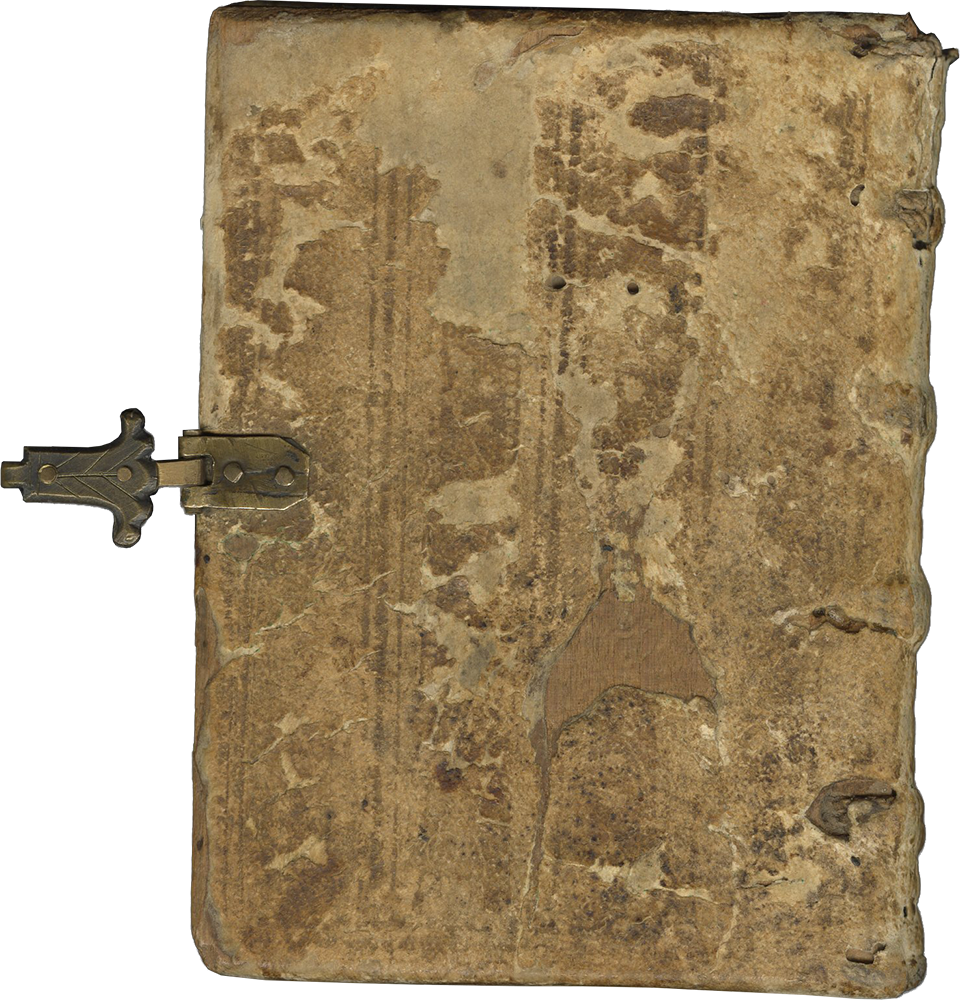
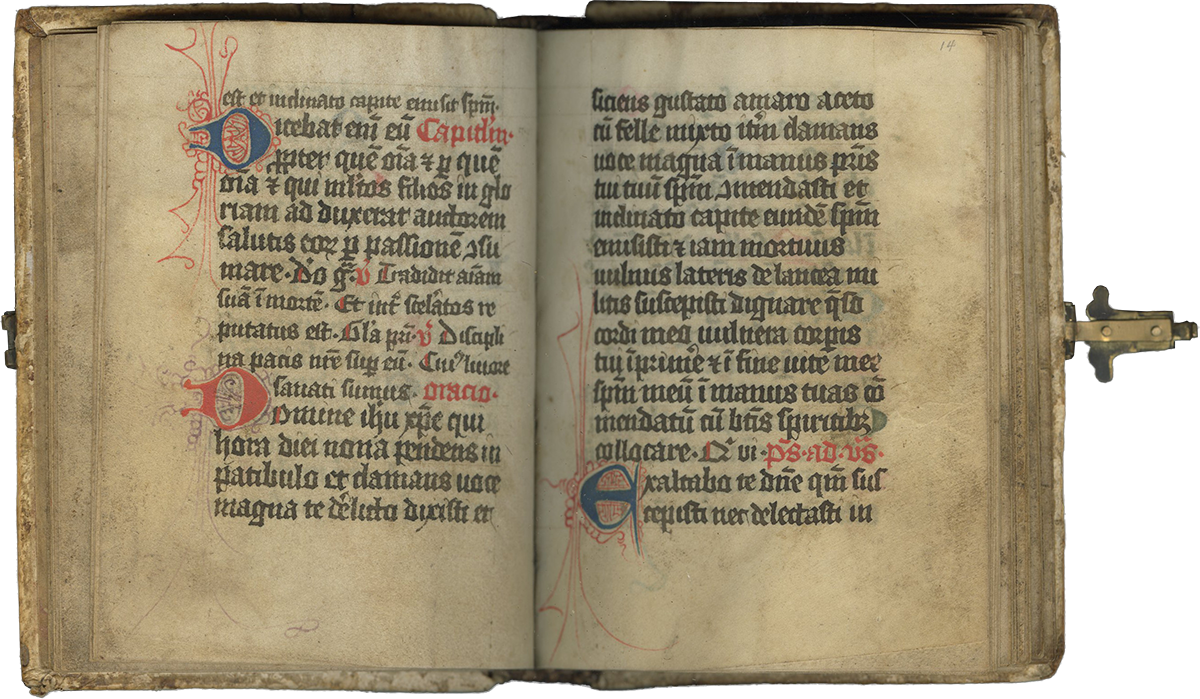
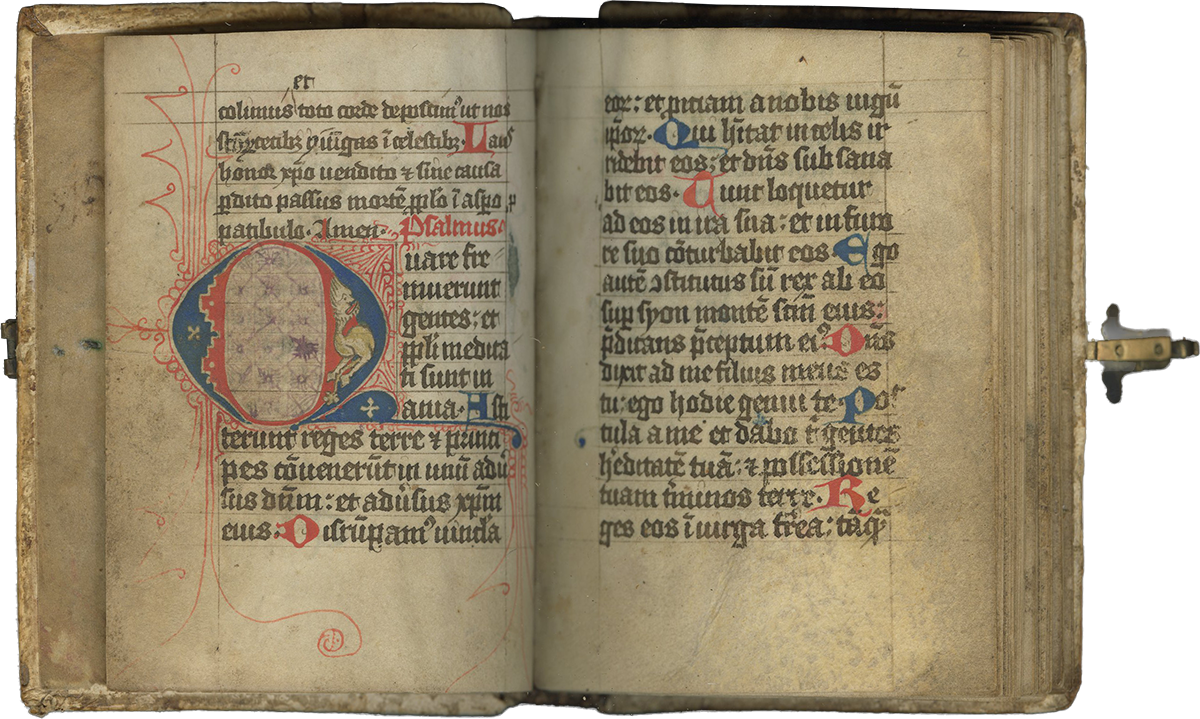
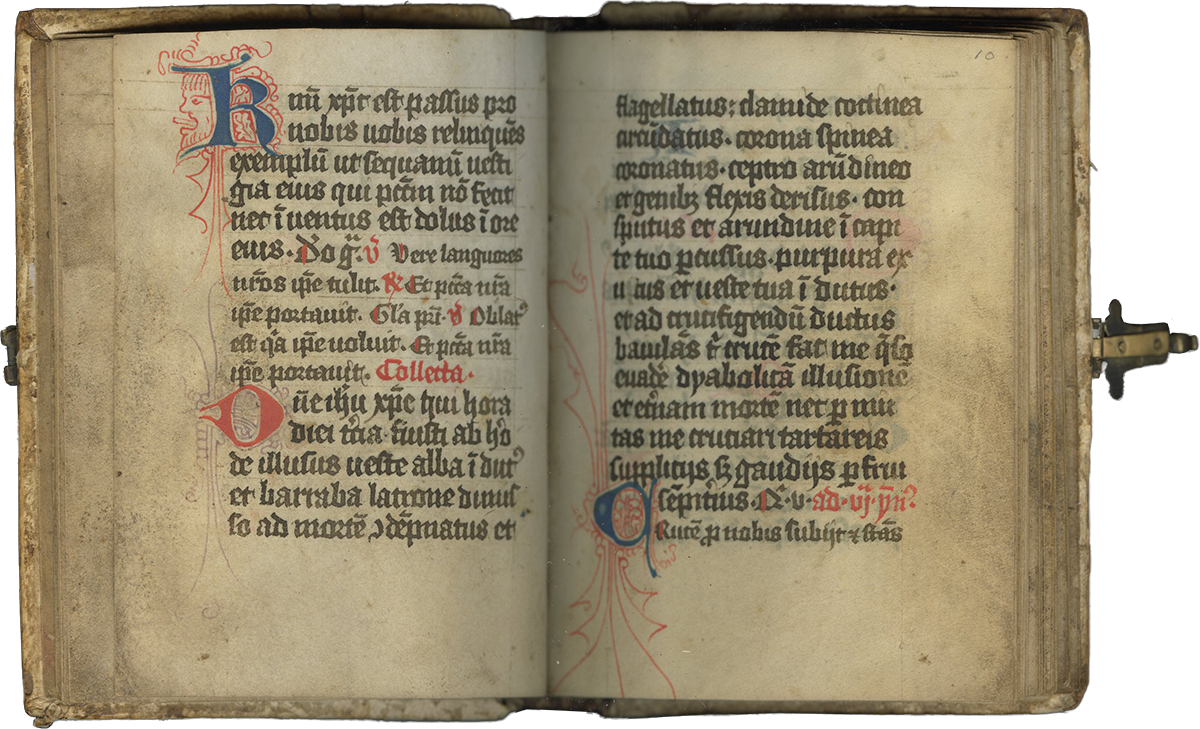
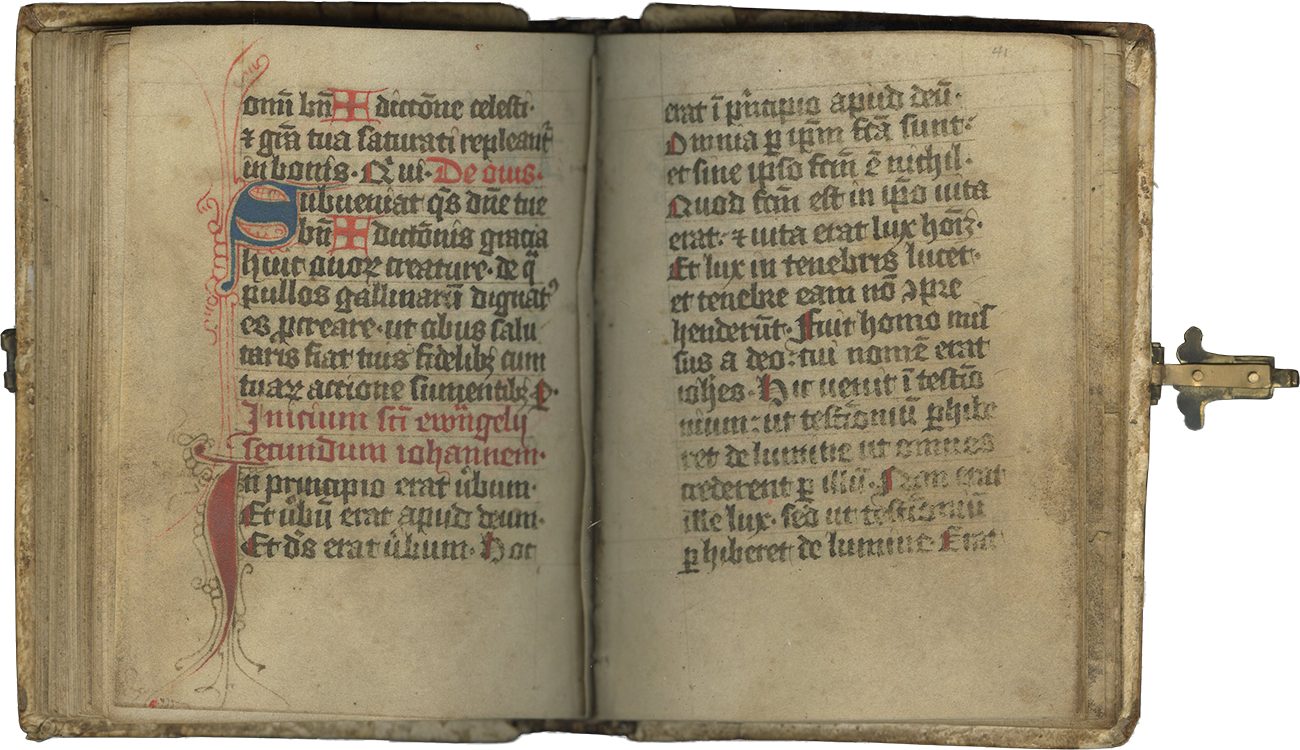
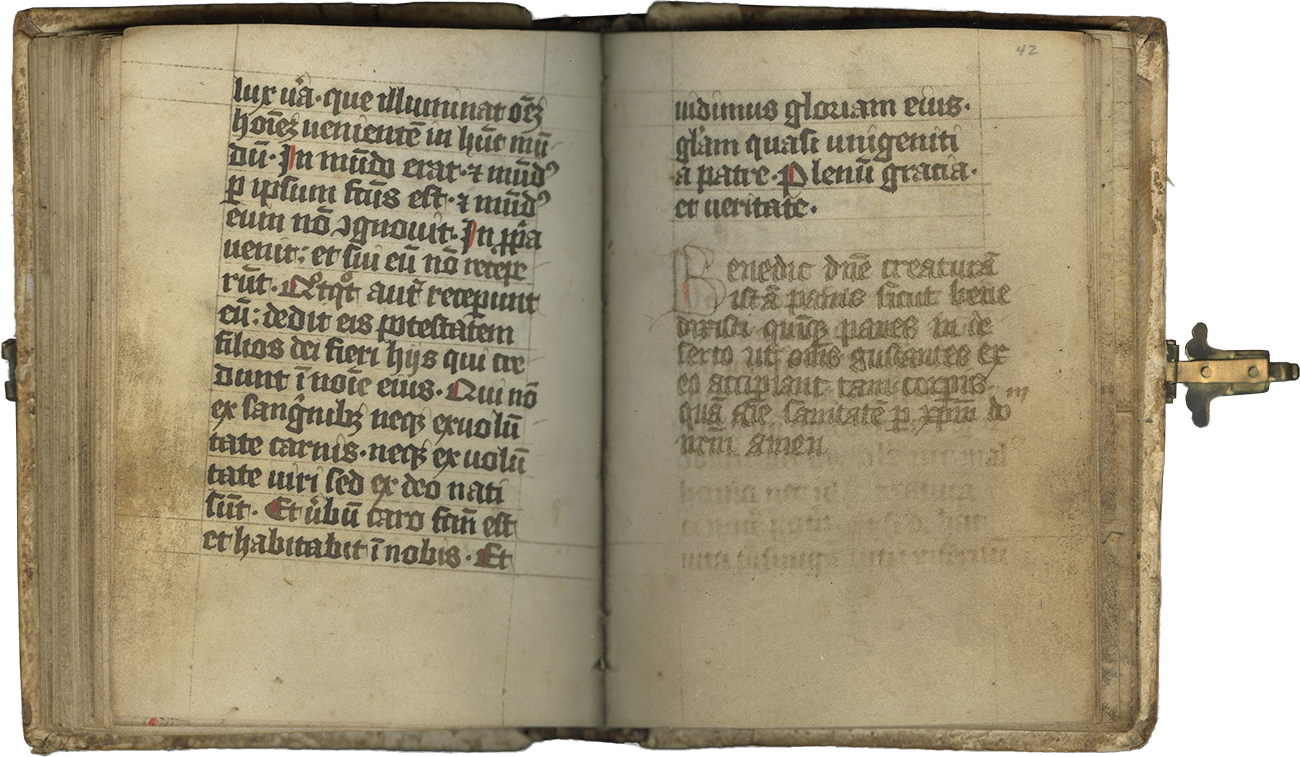
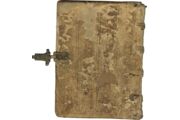
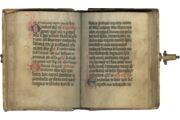
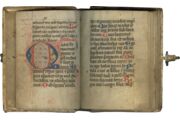
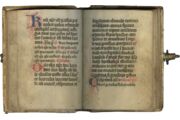
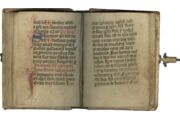
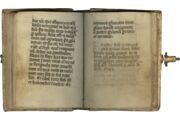
56 parchment leaves, complete, foliated in pencil, catchwords trimmed, (collation: i-v8, vi8[of 10, lacking i and vi, both cancelled with no loss of text], vii7 [of 8?]), ruled in brown ink (justification 80 x 55 mm), copied in a textualis script, 14-15 lines per page, blank spaces for initials (ff. 43-46v), majuscules touched with red, red rubrics, 1-line alternately red and blue initials within the text, 2-line red initials (ff. 47-end), 2-3 line alternately red and blue initials with contrasting flourishing in violet or blue (ff. 1-40v), 3-line puzzle initial in red and blue with flourishing in both colors and violet (f. 19v), 6-line puzzle initial in parted red and blue, flourished in red and violet, inhabited by a yellow zoomorph (f. 1v), good condition overall, although with many signs of use, especially soiling in the outer, bottom margins throughout, with some damage due to damp ff. 43 to end. Bound in an early German binding of white pigskin over wooden boards, tooled in blind, very worn, front and back covers with traces of simple vertical tooling and small round stamps, square boards extend slightly beyond the bookblock, spine with four raised bands, brass catch, fastening back to front later in date, covers are quite worn, exposing part of the wood, upper board, as well as the cords. Dimensions 129 x 97 mm.
This pocket-sized prayerbook would have been carried by a priest as he went about his daily life, ministering to his parishioners. In a contemporary binding, the volume hides a lively zoomorphic initial and shows signs it was well, if carefully, used. The book contains many short prayers common to Books of Hours, but also blessings on festival foods that only a priest could bestow. Volumes of any kind that can be traced to medieval parishes are extremely rare today, and this prayerbook gives a tantalizing glimpse into both the prayer life and work life of a medieval parish priest.
1. The manuscript includes a rubric on f. 30v mentioning “Bernhardus dictus von dem Schalksberg,” bishop of Hildesheim; this is Gerhard von (Schalks-)Berge, bishop of Hildesheim from 1365 until 1398 (Kruppa and Wilke, 2006, pp. 481-604). The script and decoration of this manuscript support an origin in Germany in the Middle Rhine region in the first half of the 15th century, probably earlier rather than later. The use of Latin throughout and the inclusion of liturgical blessings suggests that the original owner of the book was likely a parish priest.
2. Sixteenth-century inscription, on front pastedown, “Jacob <A?>ller 1.5.6.6.” and what may be a costing but is now too faint to make out.
ff. 1-19v, Office of the Passion, incipit, “Christum capiam et derisum flagellatum..Qui vivis et regnas”;
Matins (f. 1), Lauds (f. 4v), Prime (f. 6v), Terce (f. 8, variant collect), Sext (f. 10), Nones (f. 12), Vespers (f. 14), (Compline, f. 16v) of the Office of the Lord’s Passion, found in many German Books of Hours. The Office has been attributed to Bonaventure, composed on request of King Louis of France and dated between 1242-1247. The present text resembles the published edition (Quaracchi, pp. 152-158).
ff. 19v-29, Oracio bona, incipit, “Summe sacerdos et uere pontifex qui te obtuilisti deo patri hostiam puram et immaculatum …”;
Prayers to be said before Mass for each day of the week.
ff. 29r-v, Oracio, incipit, “Domine ihesu christe filii dei uiui te supplex queso ut in hac die et in hora exitus mei sanctum corpus et sanguinem tuam …”;
ff. 29v-30, Oratio, incipit, “Anima Christi sanctifica me, Corpus Christi salua me …”;
Said after the Eucharist portion of the mass, the “Anima Christi” was also a very popular charm-prayer in the later Middle Ages, see Richards, 2016.
ff. 30-33v, Verses of St. Bernard, incipit, “Omnipotens splendor eterne...Omnipotens reconcilator”;
On the Verses in both English and Latin traditions of abbreviated psalters, see Morey, 2019, pp. 17-18. The version in this manuscript adds a long, unusual rubric in which “Bernhardus dictus von dem Schalksberg,” bishop of Hildesheim, granted an indulgence of forty days for the faithful who recite these verses, and added prayers to be recited between each Psalm verse.
ff. 33v-35, Salve regina;
f. 35r-v, incipit, “Saluto te sancta et perpetua uirgo maria domina angelorum...”;
ff. 35v-37v, incipit, “Saluto te beatissima uirgo maria. Illa laudabili salutatione qua te salutavit Gabriel...”;
ff. 37v-40v, a series of short blessings, including for St. John’s Wine (blessed 27 December, St. John’s Day), the Pascal Lamb (blessed Easter morning), blessings for bacon and other meat, cheese, and eggs.
These texts are found in missals, rituals, benedictionals, and the like across Europe and throughout the Middle Ages.
ff. 40v-42, Gospel of John, 1:1-14, incipit, “In principium erat uerbum....Plena gratia et ueritate”;
f. 42 [added in a contemporary hand] Blessing of bread, incipit, “Benedic domine creaturam istam panis sicut benedixisti quinque pannes in deserto...”;
f. 42v, incipit, “non intrabit. Crux Christi sit mecum. Crux Christi sit semper adorat. Crux Christi …”;
The text was a common apotropaic charm in the Middle Ages. For similar see Duffy, 1992, especially pp. 269-273 and on charms in the Middle Ages in general, see Skemer, 2006. It originally begun on f. 42, but was erased there and the bread blessing was copied over the top, so that only a fragmentary conclusion remains on f. 42v.
f. 43r-v, incipit, “Oriens lucis eterne sol iusticie qui omnem hominem …”;
ff. 43v-45, incipit, “[D]ominem conuersacionum mearum cursum et finem vite mee …”;
ff. 45-46v, incipit, “[In] hora succurre misererrime anime mee...et proteccio ab omnibus hostibus meis visibilibus et invisibilibus. Amen,” followed by a stub, with several letters in red; there is no evidence of loss of text, and it is most likely that this folio was cancelled;
ff. 47-49, Innocent III, De vita et passione domini iesu christi;
ff. 49-52v, Obsecro te;
ff. 52v-54v, Psalm 138, incipit, “Domine probasti me et cognuisti me …”;
ff. 54v-55, incipit, “Benedicat me imperialis maiestatis, protegat me regalis divinitatis...”;
ff. 55-56v Suffrages to Barbara and Dorothy;
f. 56v, Prayer to Anthony, ending imperfectly.
The volume functions as a very customized Book of Hours, containing not the usual Hours of the Virgin, but instead the Office of the Passion, together with a range of other short texts common in Books of Hours, including the Stabat Mater, Obsecro te, Verses of St. Bernard, suffrages to saints, apotropeic charms, and prayers to be said before mass, among much else. These are joined in this prayerbook with a set of texts rarely found in Books of Hours: blessings for food associated with a range of feast days, including wine, bread, eggs, cheese, and more. These blessings could only have been used by someone with cure of souls: most likely a parish priest.
Identifying the commissioner as a parish priest marks this makes this a very unusual prayerbook. Since Books of Hours developed out of the clerical Divine Office and were intentionally abridged for lay use, we tend to associate them today with lay owners. Yet, clergy of all kinds owned Books of Hours and prayerbooks. Members of the Brigettine order were even required to pray from the Book of Hours and prayerbooks including the Hours of the Holy Spirit rather than or in addition to the Hours of the Virgin owned by English Brigettines are well known (see for example London, British Library, MSS Harley 487, Cotton Appendix XIV, and prayerbooks London, Lambeth Palace Library, MSS 546, 560). Many other extant prayerbooks are known to have been owned by clergy. Tudor official and canon, Christopher Urswich willed his “book of prayers” to Bishop Cuthbert Tunstall (the volume is now London, British Library, MS Burney 290, see Kennedy, 2024, p. 204). The penultimate abbot of Westminster, John Islip, commissioned a uniquely multimedia prayerbook (Manchester, John Rylands Library, MS Lat. 165, see Kennedy, 2023). Nevertheless, these volumes do not reflect the direct pastoral work that this present book does, containing these simple blessings of festival foods. This humble prayerbook furnished everyday prayers for a priest to keep in his pocket, as well as feast-day blessings to cheer his parishioners’ hearts through the liturgical year.
Duffy, Eamon. The Stripping of the Altars: Traditional Religion in England 1400-1580. New Haven, 1992.
Hindley, Katherine. Textual Magic: Charms and Written Amulets in Medieval England. Chicago, 2023.
Kennedy, Kathleen E. “The Masters of the Dark Eyes in England: Forgotten Tudor Court Artists.” The Literature and History of Anglo-Dutch Relations, Medieval to Modern, eds.
Liesbeth van Houts, Moreed Arbabzadah Sjoerd Levelt, Ad Putter. London, 2024, pp. 196-214.
Kruppa, Nathalie, and Jürgen Wilke, ed. Das Bistum Hildesheim, 4. Die Hildesheimer Bischöfe von 1221 bis 1398, Das Bistümer der Kirchenprovinz Mainz, 2006.
Morey, James H. Jerome’s Abbreviated Psalter: The Middle English and Latin Versions. Leeds, 2019.
Richards, Earl Jeffrey. “The Prayer Anima Christi and Dominican Popular Devotion,” in Poverty and Devotion in Mendicant Cultures, 1200-1450, ed. Constant J. Mews and Anna Welch, London, 2016, pp. 105-27.
Skemer, Don C. Binding Words: Textual Amulets in the Middle Ages, University Park, PA, 2006.Wieck, Roger. Time Sanctified: The Book of Hours in Medieval Art and Life. New York, 1988.
Kennedy, Kathleen E. “A Tudor Abbot’s Prayerbook and Multimedia Marian Devotion on the Eve of the Reformation.” Reformation 28 (2023), pp. 50-62. https://doi.org/10.1080/13574175.2023.2187933
Quaracchi. Bonaventurae Opera Omnia, vol. 8, 1898, pp. 152-158.
https://archive.org/details/doctorisseraphic08bona/page/152/mode/2up
TM 1461 digitized at https://arca.irht.cnrs.fr/ark:/63955/md601z40pm9q
Patrologia Latina Database
https://artflsrv04.uchicago.edu/philologic4.7/PLD/navigate/5998/table-of-contents