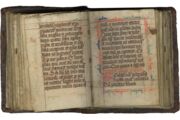
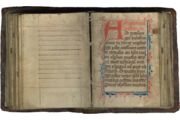
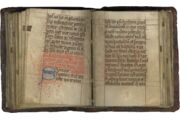


Prayerbook
In Latin, decorated manuscript on parchment
Germany, c.1400
TM 1464
- $32,000.00
 Textmanuscripts - Les Enluminures

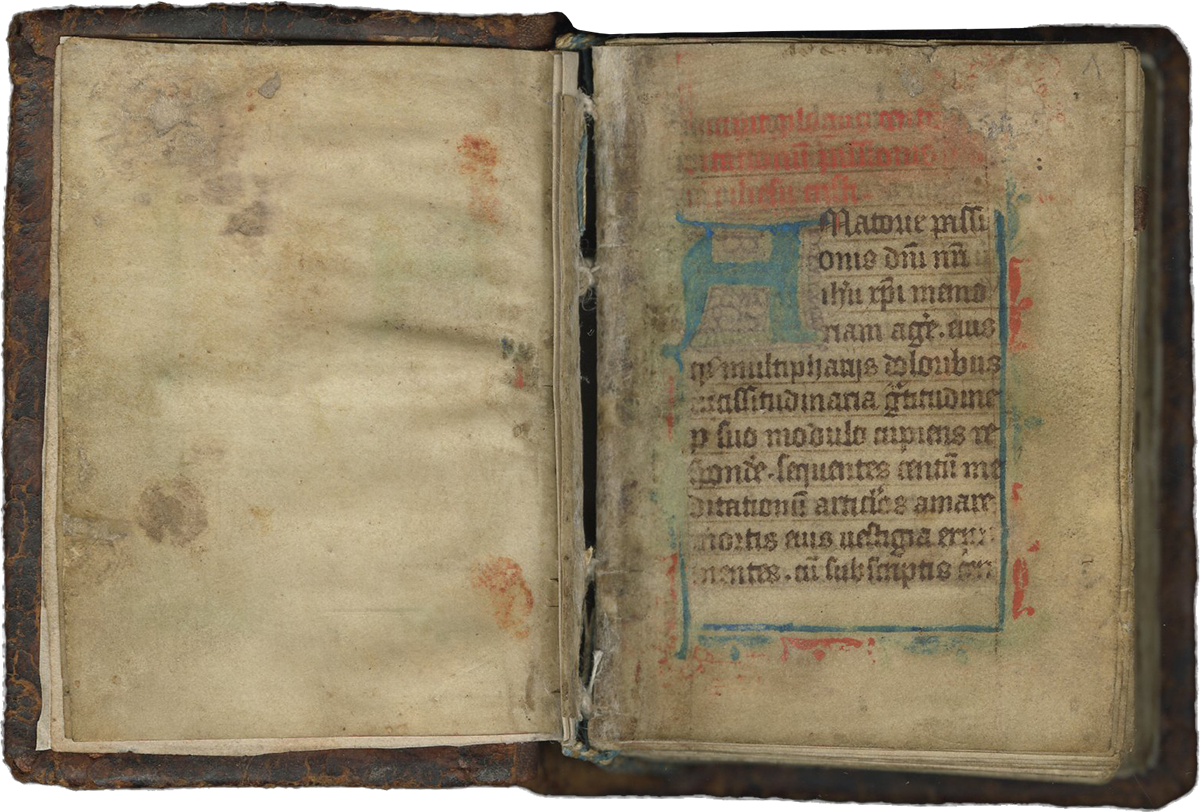
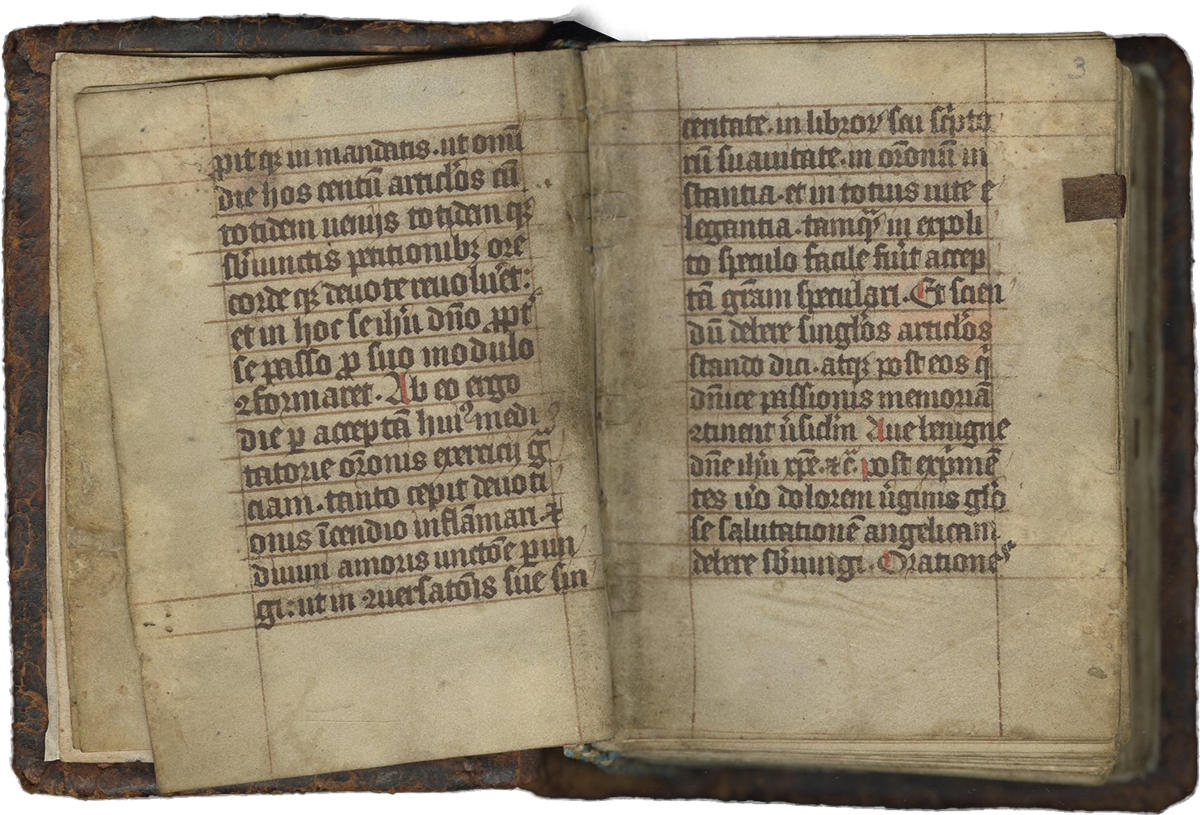
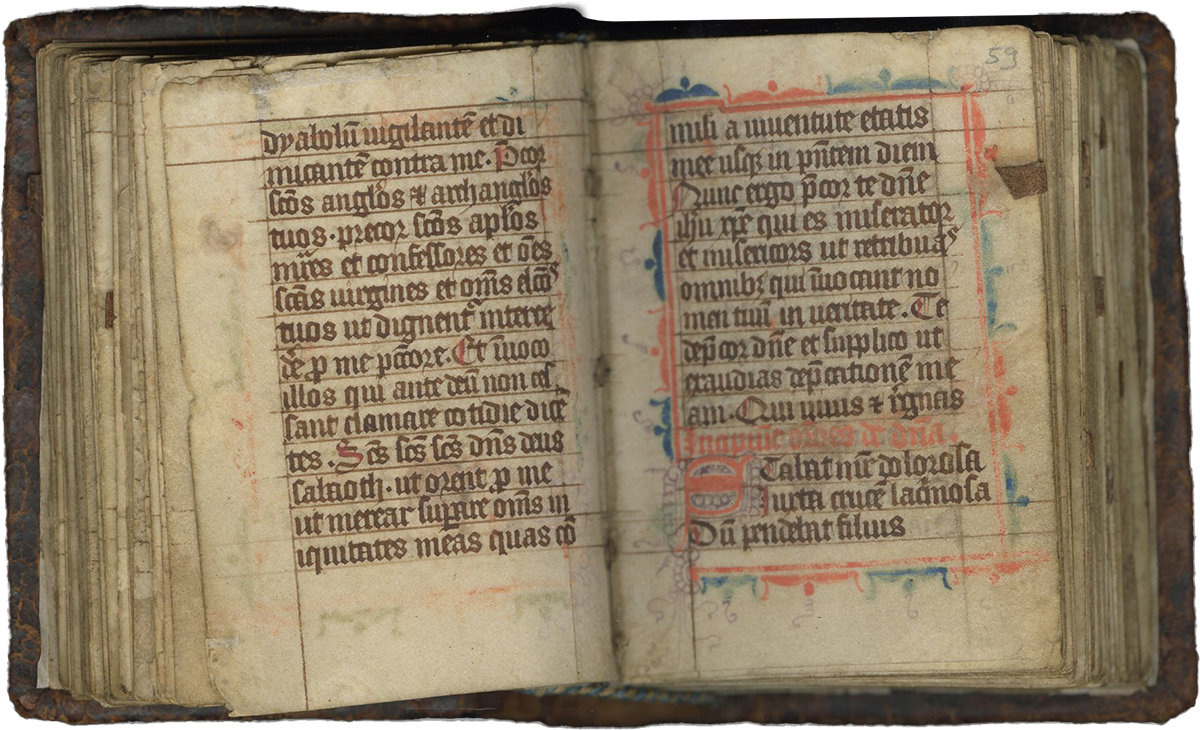
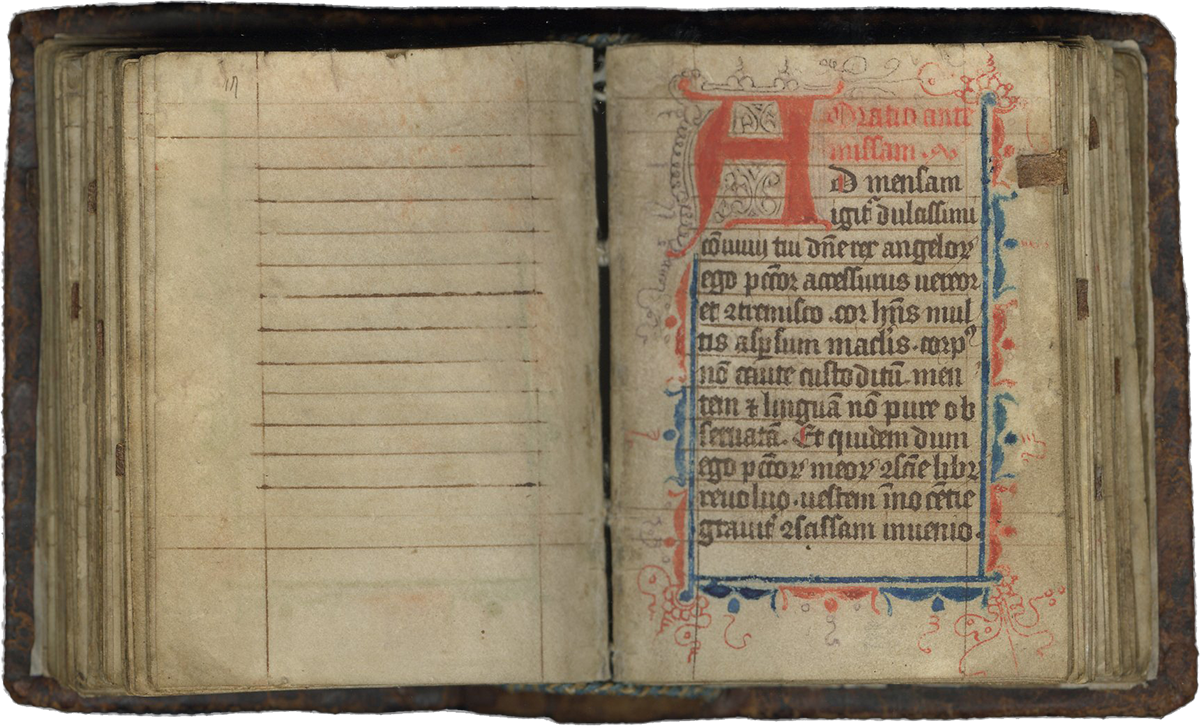
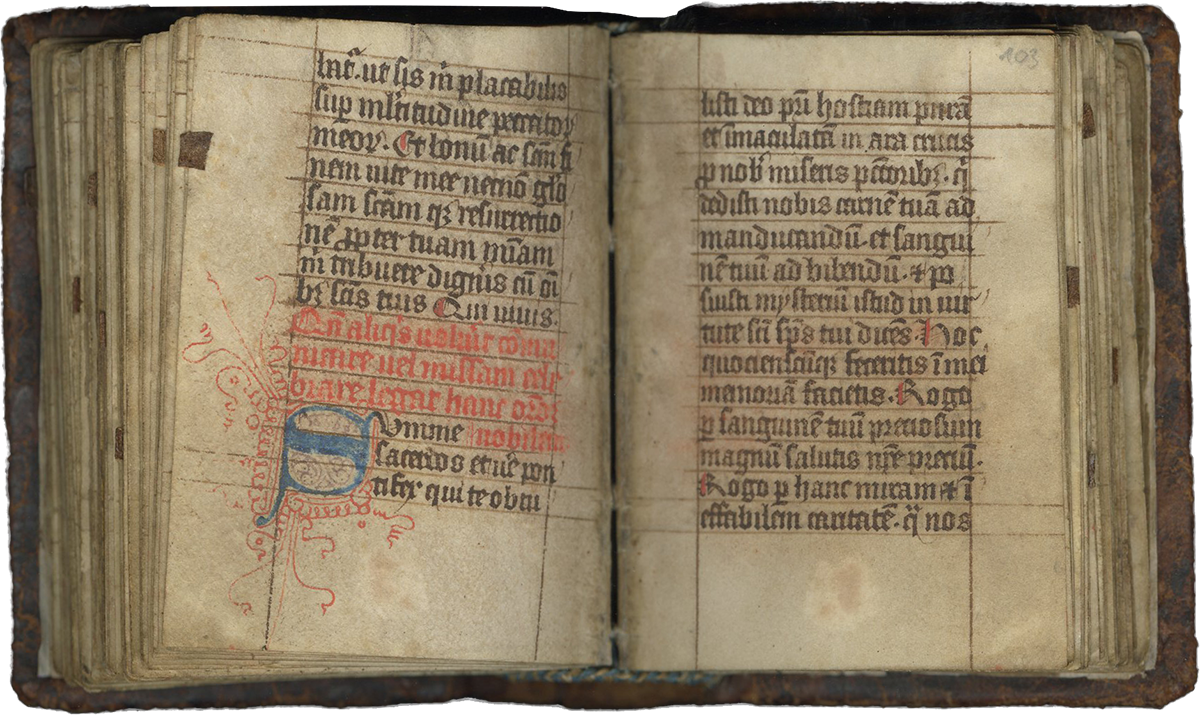
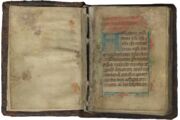
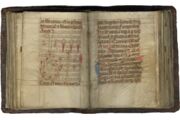
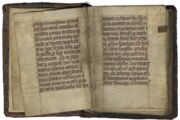
i (modern paper) + 161 + iii (parchment) + iii (modern paper) parchment leaves, foliated in modern pencil in upper right corner, complete, (collation: i-xi8 xii6 xiii-xix8 xx4 (2, 4 cancelled) xxi7(-8)), no catchwords, pricking, ruling in brown ink, single column of 14 lines in textualis, extended ascenders and descenders flashed in red, majuscules flashed in red and decorated, some red paraph marks, red rubrics, 1-line red or blue initials, 3-4-line red or blue initials with alternating flourishing, full blue and red ink borders (ff. 1, 59, 95), drawings of the instruments of the passion in black and red ink (f. 46v), fully tabbed, two quires loose, spots, stains and slight water damage throughout, first leaf with small hole, marks on edges of last leaves, but overall good and presentable condition. Early modern binding with gilt-tooled spine. Dimensions 80 x 55 mm.
This charming tiny prayerbook contains a range of devotions common to late medieval affective piety, including an illustration of the Instruments of the Passion. The volume's diminutive size makes it certain that it was designed to be carried on the owner’s person and was most likely taken to Mass, an activity around which the balance of its prayers revolves. Most unusual are the range of metrical prayers, providing a tantalizing glimpse into a medieval music-lover's interests, perhaps a female owner with special interest in St. Katherine or in a foundation dedicated to St. Katherine.
1. The majority of localizations are concentrated in Bavaria and the Rhineland. Notable especially are the unusual Anastasia (relics at Benediktbeuern Abbey) and her spiritual father Chrysogonus; however, present also are Lambert (Muenster, Freiburg-im-Breisgau), Ludger (Muenster), Cunibert (Cologne), Willibrord (Luxembourg), Lebuinus (Westphalia), Gall (Switzerland), Maternus (Cologne, Trier), Severinus (Bavaria), Eugenia (Fulda), and Walburgis (Bavaria).
2. In the fifteenth century, further prayers were added to blank leaves in the volume.
3. Eighteenth- or nineteenth-century French inscription on a front flyleaf incorrectly identifies this as a Book of Hours.
4. Roman Kaczmar, acquired 1985: his MS.10.85 and inkstamp (rear pastedown).
5. Lot 6246 at Auktionsverk, Stockholm, 21 November 2017 (see Online Resources).
6. Private Continental Collection
ff. 1-44, from Henry Suso, Centum meditationes passionis domini nostri Iesu Christi, beginning with the second prologue, incipit, “Amatorie passionis domini nostri Jesu Christi memoriam agere...Amen;
ff. 44-46v, Occasional, short prayers;
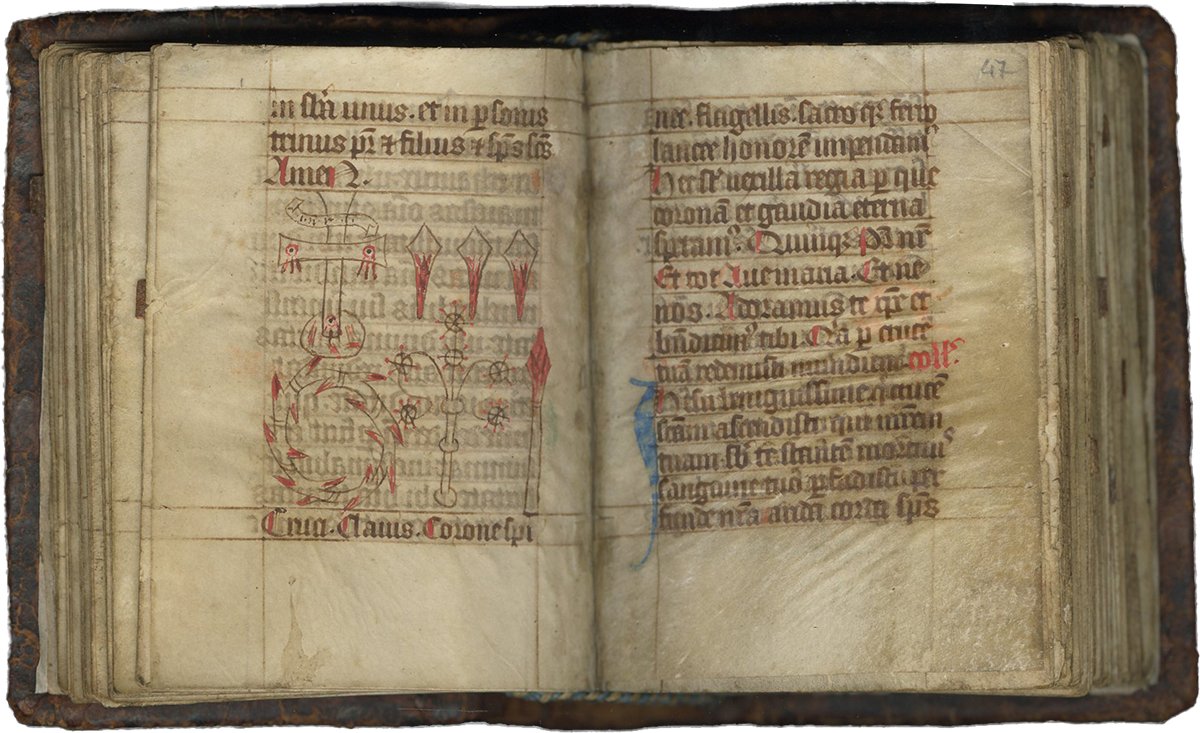
ff. 46v-48v, “Cruci, Clavis, Corone Spinee,” metrical antiphon, followed by collect and oratio;
ff. 48v-51, Seven Last Words of Christ;
ff. 51-59, Occasional, short prayers;
ff. 59-61v, Stabat Mater, copied as a metrical prayer;
ff. 61v-84v, Occasional, short prayers;
ff. 84-88v, Obsecro te;
ff. 88v-90v, Metrical hymn Vale virgo flores rosa; ff. 91-93v ruled but left blank, additional prayers added later, f. 94rv remains ruled and blank;
ff. 95-139, Prayers for before, during, and after mass;
ff. 139-142, Metrical prayer to St. Katherine, Ave virgo Katerina, followed by versicle and collect;
ff. 142-154, Litany followed by collects;
ff. 155-161v, originally ruled but blank, later filled with further occasional prayers.
f. 46v, Instruments of the Passion
This small line drawing carefully depicts the instruments of the Passion (three nails, crown of thorns, scourge, and spear) together with the Cross, all touched with red. The drawing offers a simple, but effective meditative aid. Devotees concentrated on each instrument in turn, and on the tortures each committed on the various body parts of Christ, in an effort to experience the pain of the Crucifixion virtually, as it was believed that Mary experienced them. Our modern concept of “compassion” derives from this belief, as “com” “passio” in Latin means to experience the Passion along with Christ.
This carefully produced, diminutive prayerbook could easily have been carried in a pocket or hung from a belt and contains prayers of special importance to the pious patron who wished to keep them even closer than their book of hours. With important texts tabbed to make them easy to find, the tiny volume is organized into roughly four main sections. The first concentrates on devotion to the Passion and includes a small drawing of the instruments of the passion. The second turns to the Virgin, but even here, devotion centers on her compassion with the crucified Christ. The third, long section bears a wide range of prayers to be said before, during, and after mass, and the final section contains the Litany, which also featured during Mass. Taken together, these final two sections ensure that half the book concerns itself with the Mass, and that is where we must imagine the original owner making use of it.
Any Prayerbook bears the unique stamp of the commissioner’s piety, and this one displays the owner’s special devotion to St. Katherine. Whilst it is possible that the owner’s name was Katherine, it’s also possible that the owner lived in a monastery or attended a church dedicated to St. Katherine. Finally, the owner’s attention to metrical hymns is noteworthy, and may suggest her deep interest in music. Even the Stabat Mater, a common prayer in books of hours, is rarely set out as poetry in the way that it is here. Swaying, perhaps, at the end of a chain hanging from a belt, the prayers in this book often reminded its owner of song.
Dinzelbacher, Peter. “Spätmittelalterliche Askesepraktiken als Ausdruck des epochentypischen Dolorismus,” Saeculum 69 (2019), pp. 3-38.
Duffy, Eamon. The Stripping of the Altars: Traditional Religion in England 1400-1580. New Haven, 1992.
Manuwald, Henrike. “Virtuelle Realitäten als Beschreibungsmodell. Zur Wirkkraft von Texten zur Christusmeditation (insbesondere der Vita Christi Ludolfs von Sachsen),” Zeitschrift für deutsche Philologie 143 (2024), pp. 125-59.
McNamer, Sarah, ed. Affective Meditation and the Invention of Medieval Compassion, Philadelphia, 2010.
Wieck, R. S. The Medieval Calendar: Locating Time in the Middle Ages, New York, 2017.
ARCA, Collection Particulière, CP 386 https://arca.irht.cnrs.fr/ark:/63955/md24wh249t0b
Arvay, Susan. Private Passions: the Contemplation of Suffering in Medieval Affective Devotions, PhD Rutgers, 2008. https://rucore.libraries.rutgers.edu/rutgers-lib/24503/PDF/1/play/
Jones, Jasmine. “Three Christological Devotions, Part 1: Wounds,” https://introducingmedievalchristianity.wordpress.com/2020/07/01/three-christological-devotions-part-1-wounds/
Lot 6246, Auktionsverk, Stockholm, 21 November, 2017 https://stockholmsauktionsverk.com/arkiv/fine-art/rare-books/2017-11-21/163-miniature-prayerbook-low-countires-after-1230
TM 1464