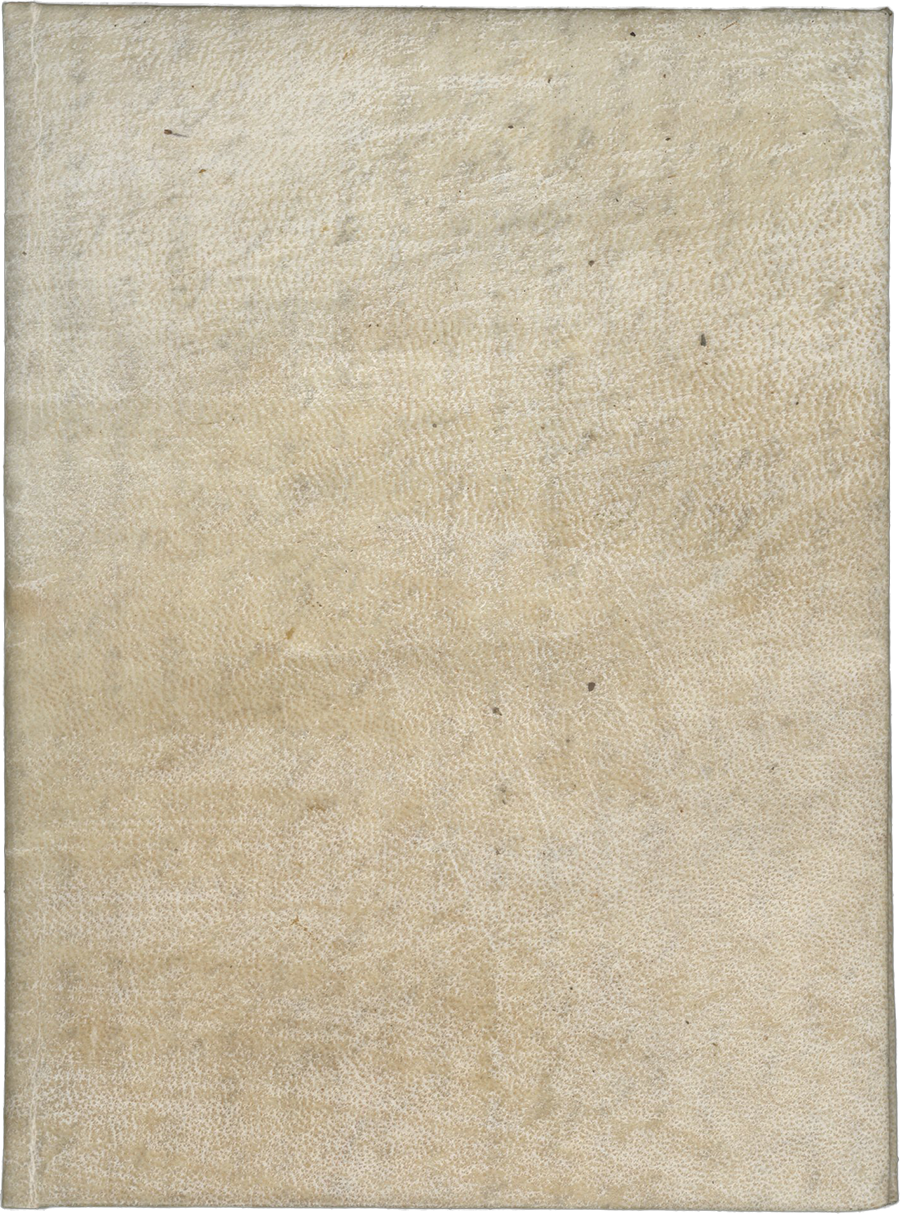
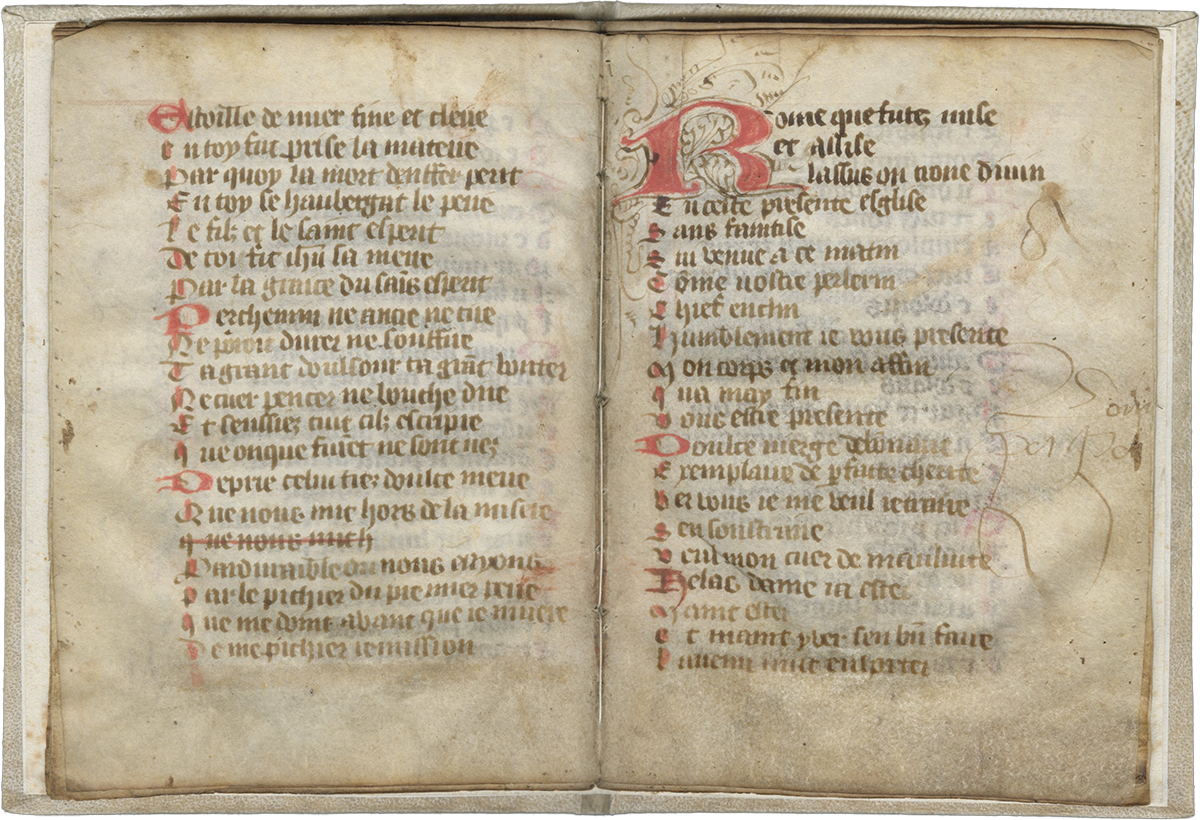
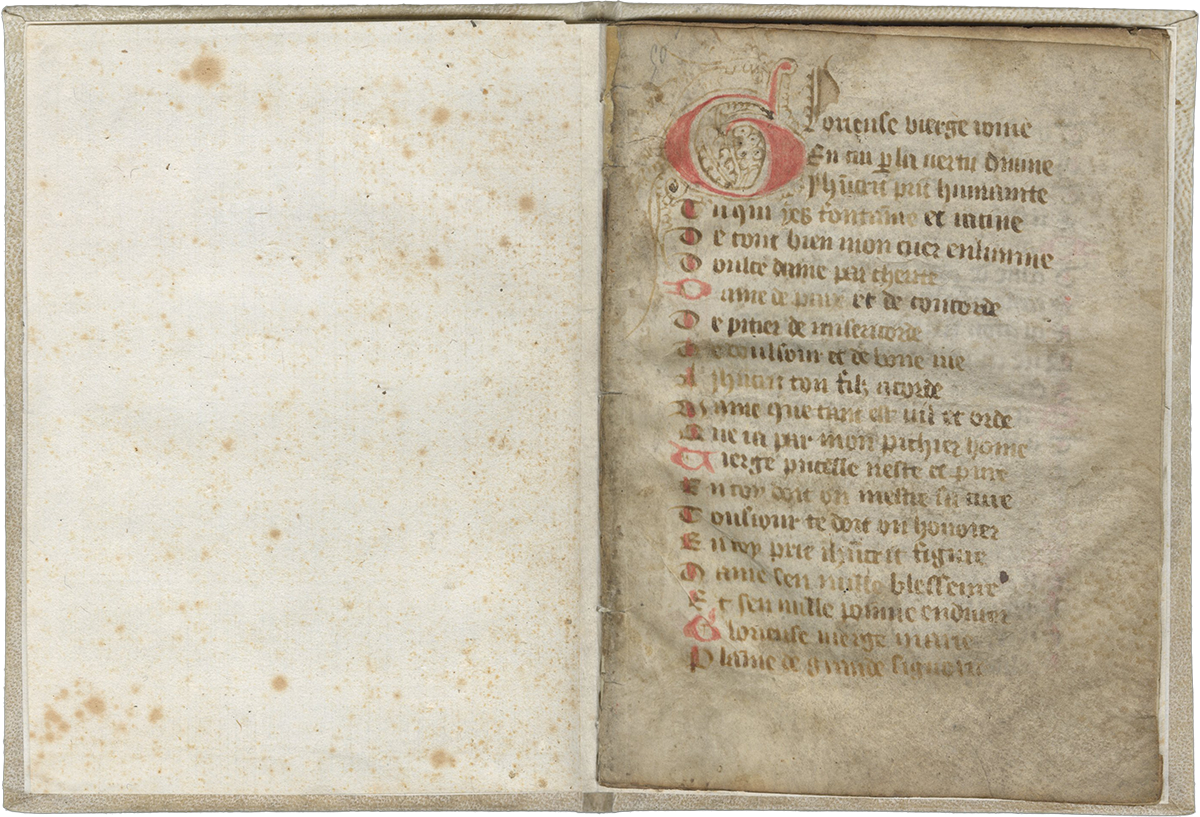
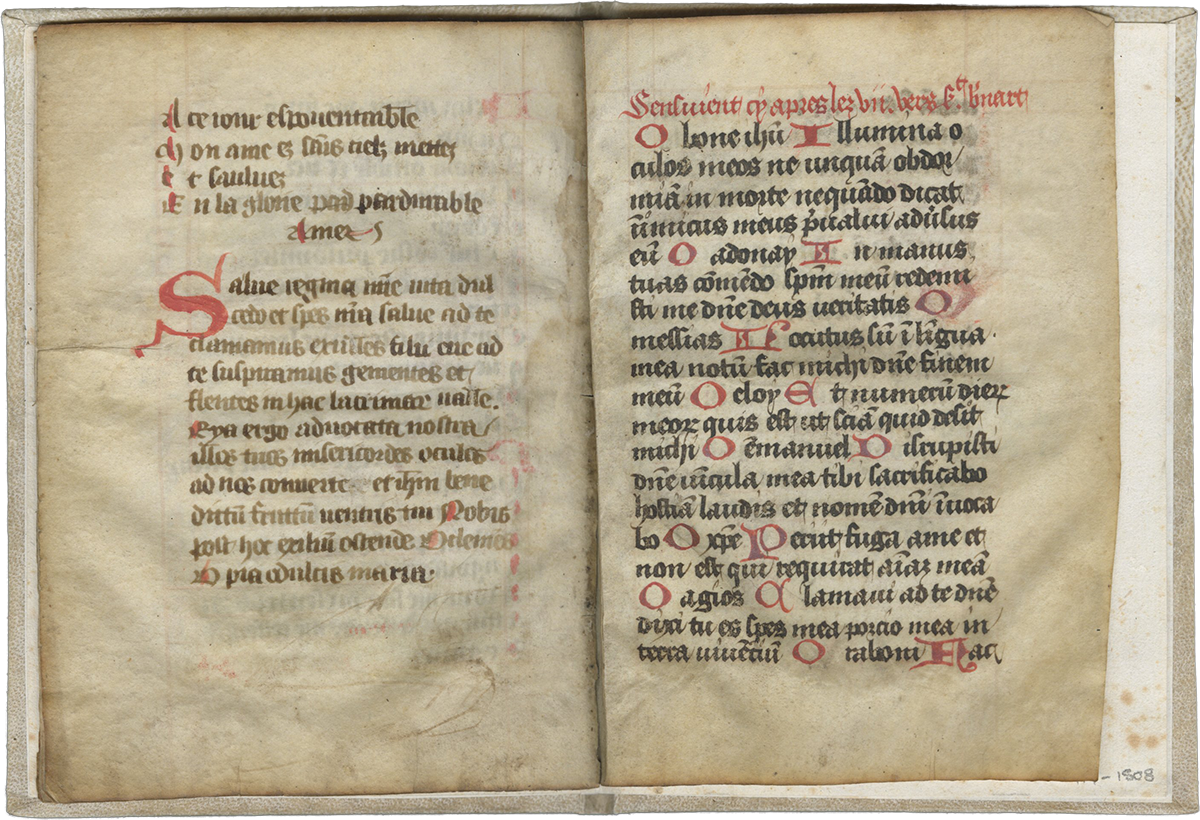
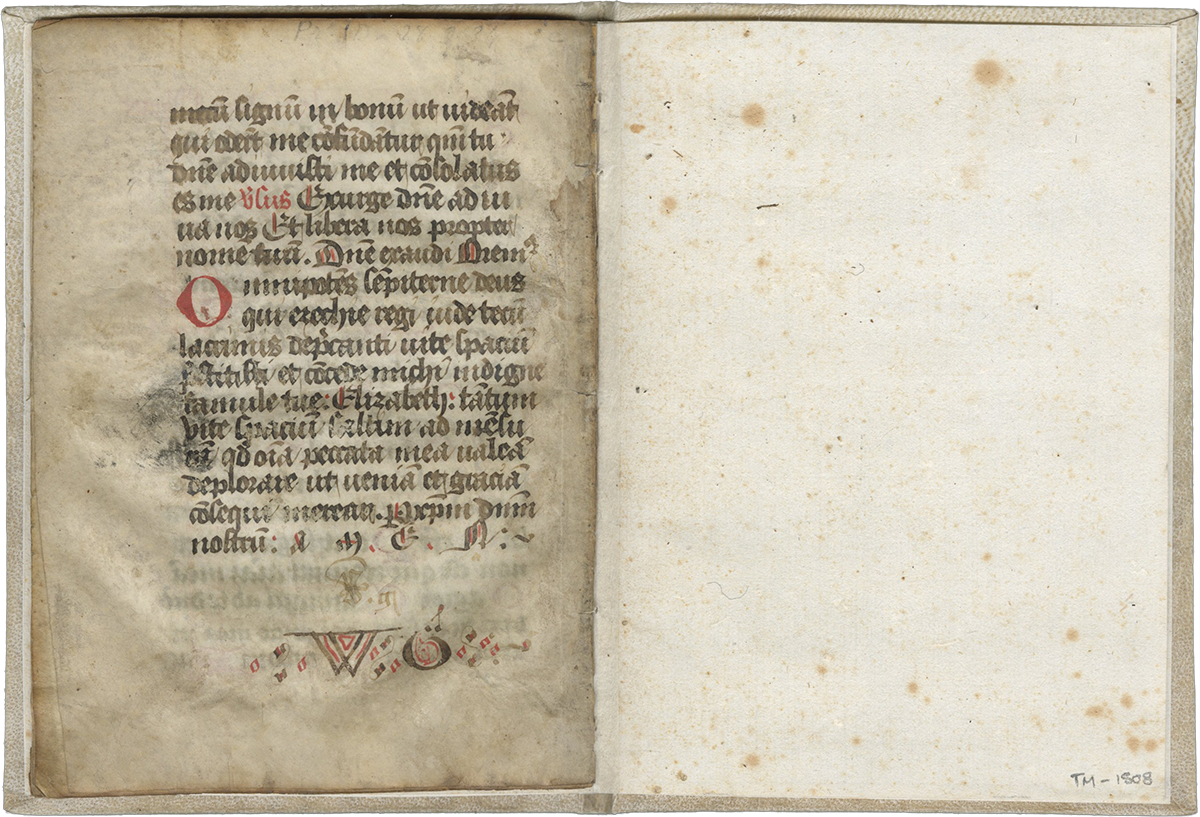
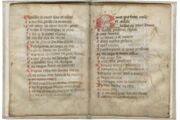
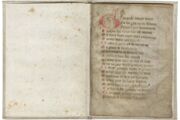
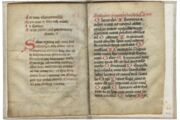
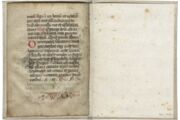
I (modern paper) +12+I (modern paper) parchment folios, foliated in pencil in upper right corner, complete in itself, no catchwords, (collation: i12), ruled in very pale ink in single column of twenty lines (justification: 110 x 72-80 mm), in textualis, 1-line red initials throughout, 3-line red initials flourished in brown (ff. 1, 7), waterstaining throughout. Bound in modern parchment over pasteboard. Dimensions 150 x 110 mm.
Complete in itself, although quite possibly a fragment extracted from a Book of Hours or a Prayerbook, this charming quire contains a variety of French and Latin devotional poetry. It also includes a textual puzzle. Is the second poem by the Burgundian diplomat and poet Georges Chastellain? Or did the Benedictine monk Guillaume Alecis write it instead? Similar poems are credited to both men, and this copy show features of both versions—offering a tantalizing poetic knot for someone to untie.
Provenance
1. The diffusion of the prayer sometimes attributed to George Chastellain and that attributed to Guillaume Alecis occurred across the second half of the fifteenth century, and the poem found in this present manuscript drew from both versions, suggesting a date around 1500 rather than earlier. This date is consonant with the copies known to Leroquais (see Online Resources).
2. The final leaf is copied in a second hand, and this ends with a W. G. monogram, copied twice in two scripts and two inks, neither matching those of the prayer.
3. The front pastedown bears a pasted on nineteenth- or early twentieth-century French auction listing. The Chastellain/Alecis prayer was unknown to these cataloguers.
4. The same flyleaf includes citations to Leroquais for both main prayers in pencil in French, from the later twentieth or twenty-first century (see Online Resources).
Text
ff. 1-6v, “Gloriouse virge royne / En cui par lai vertu divine”;
A common prayer with many variations. Whilst the prayer may have originated in the thirteenth century, the vast majority of copies extant date to the fifteenth.
ff. 7-11v, interpellated version of pseudo-Georges Chastellain, and Guillaume Alecis, “Royne qui fust mise / Et assise”;
Chastellain’s editor includes this lai among his doubtful works, and indeed, the text he publishes is different from that by Alecis, but not greatly so (Lettenhove, v. 8, p. xix; Piaget and Picot, v. 3 1908, pp. 181-88; see Online Resources). The two poems vary in occasional wording and in a few unique stanzas only. The present interpellated copy generally follows that published as Chastellain’s, with some unique wording, but adds Alecis’ final stanza.
f. 11v, Salve regina, in Latin;
ff. 12r-v, (added) Verses of St. Bernard, rubric in French, text in Latin.
On the Verses of St. Bernard and their textual identity with the Psalter of St. Jerome (as far as psalm selection goes), see Morey, 2019, pp. 17-18 (Literature).
Of the two poets in question here, the Burgundian Georges Chastellain (c.1415-1475) is better known today. Chastellain served as a soldier and diplomat, then a chronicler and poet, in the Burgundian and French courts and as a writer is known for keen political observation and ornate rhetorical flourishes. Guillaume d’Alecis (d. 1486) was instead a Norman, Benedictine monk who wrote a range of vivid works and in his own day was celebrated for developing several verse forms, including that demonstrated in “Royne qui fust mise.”
JONAS offers just two copies of Chastellain’s poem and dozens of Alecis’, and it seems certain that there is a larger story to be told here, as Sinclair recognized when he called for a new edition of the poem in 1980, and listed copies of both versions, attributing them all to Alecis (Sinclair, 1980, p. 432 n. 14). Given the importance that Chastellain holds for critics of Burgundian French poetry of this era, and the respect in which Alecis is held as a Norman poet, disentangling the origins of this poem may yield provocative new information concerning regional poetic developments during a vibrant moment of French poetic history.
Such textual work may also shed greater light on the imbrication of manuscript and print in the later fifteenth century, as Alecis’ corpus is known from both sources, and the transmission history of individual works has yet to be fully worked out. The remaining prayers in this manuscript quire appear among the miscellaneous prayers found in countless Books of Hours of the period, and the complete original volume might equally have been a Book of Hours or Prayerbook as a devotional literary compilation. Indeed, as “Royne qui fust mise” is known in both printed Marian collections and editions of Books of Hours, it is not impossible that the whole of the present quire was copied from print, though textual work remains to be done to assess that likelihood (Piaget and Picot, 1908, vol. 3, pp. 176-178).
Literature
Lefèvre, Sylvie. “Guillaume Alecis. Une œuvre entre manuscrits et imprimés,” in Au prisme du manuscrit: Regards sur la littérature française du Moyen Age (1300-1550), ed. by Sandra L. Hindman and Elliot Adam, Turnhout, 2019, pp. 271-287.
Morey, James. Jerome’s Abbreviated Psalter: The Middle English and Latin Versions, Leeds, 2019.
Sinclair, Keith, “The Need for a New Critical Edition of an Important Devotional Text by Guillaume Alexis,” Romance Notes 20 (1980), pp. 430-34.
Small, Graeme. George Chastelain and the Shaping of Valois Burgundy: Political and Historical Culture at Court in the Fifteenth Century, Woodbridge, 1997.
Online Resources
Gros, Gerard, “Guillaume Alecis et Jean Bouchet: pour un style français de l’oraison mariale?” Moyen Age 102 (1996), pp. 81-92.
https://shs.cairn.info/revue-le-moyen-age-1996-1-page-81?lang=fr&ref=doi
JONAS, George Chastellain https://jonas.irht.cnrs.fr/intervenant/241
JONAS, Guillaume Alecis http://jonas.irht.cnrs.fr/intervenant/300
JONAS, “Gloriouse virge royne / En cui par lai vertu divine” https://jonas.irht.cnrs.fr/oeuvre/9125
JONAS, “Royne qui fust mise / Et assise” (Chastellain) https://jonas.irht.cnrs.fr/oeuvre/10853
JONAS, “Royne qui fust mise / Et assise” (Alecis) http://jonas.irht.cnrs.fr/oeuvre/11162
Leroquais, Victor. Les livres d'heures manuscrits de la Bibliothèque nationale, Paris, 1927, vol. II, p. 314 https://archive.org/details/leslivresdheures0002abbe/page/324/mode/2up
Lettenhove, Kervyn. Oeuvres de Georges Chastellain, Bruxelles, 1863-1868, vol. 8, pp. 293-7. https://archive.org/details/oeuvrespubparleb08chasuoft/page/292/mode/2up
Piaget, Arthur and Emile Picot, Oeuvres poétiques de Guillaume Alexis, Paris, vol. 3, 1908. https://archive.org/details/oeuvrespotique03alexuoft/page/180
TM 1508