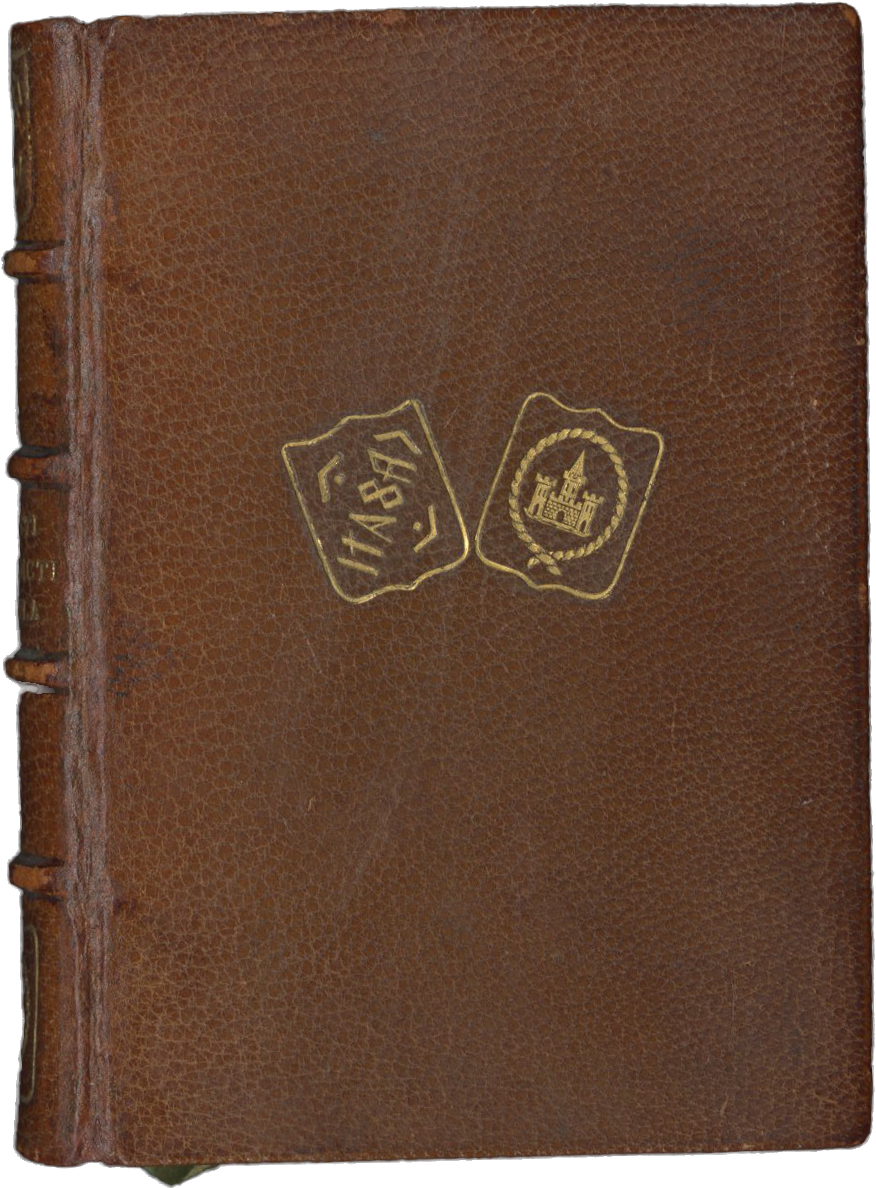
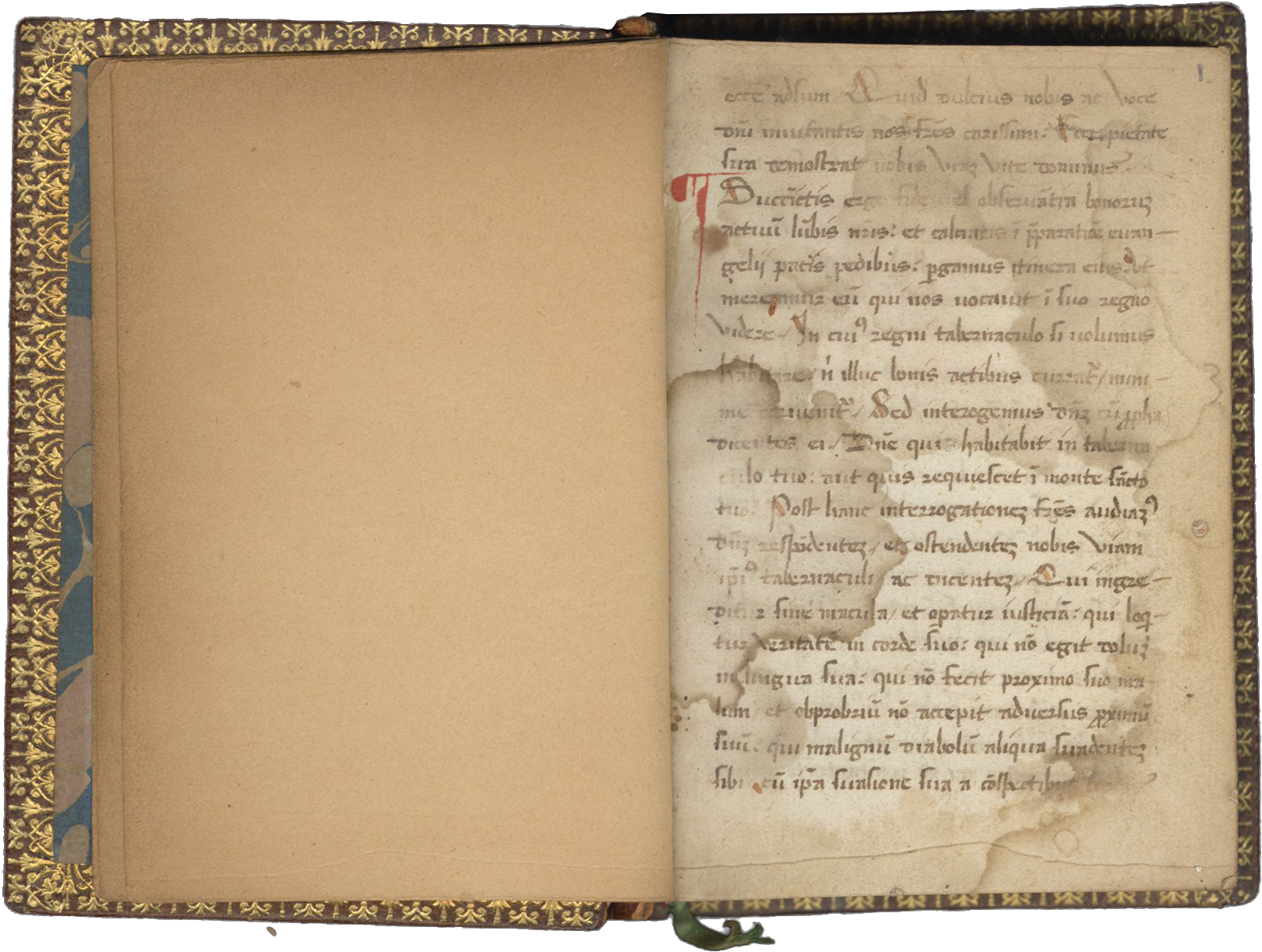
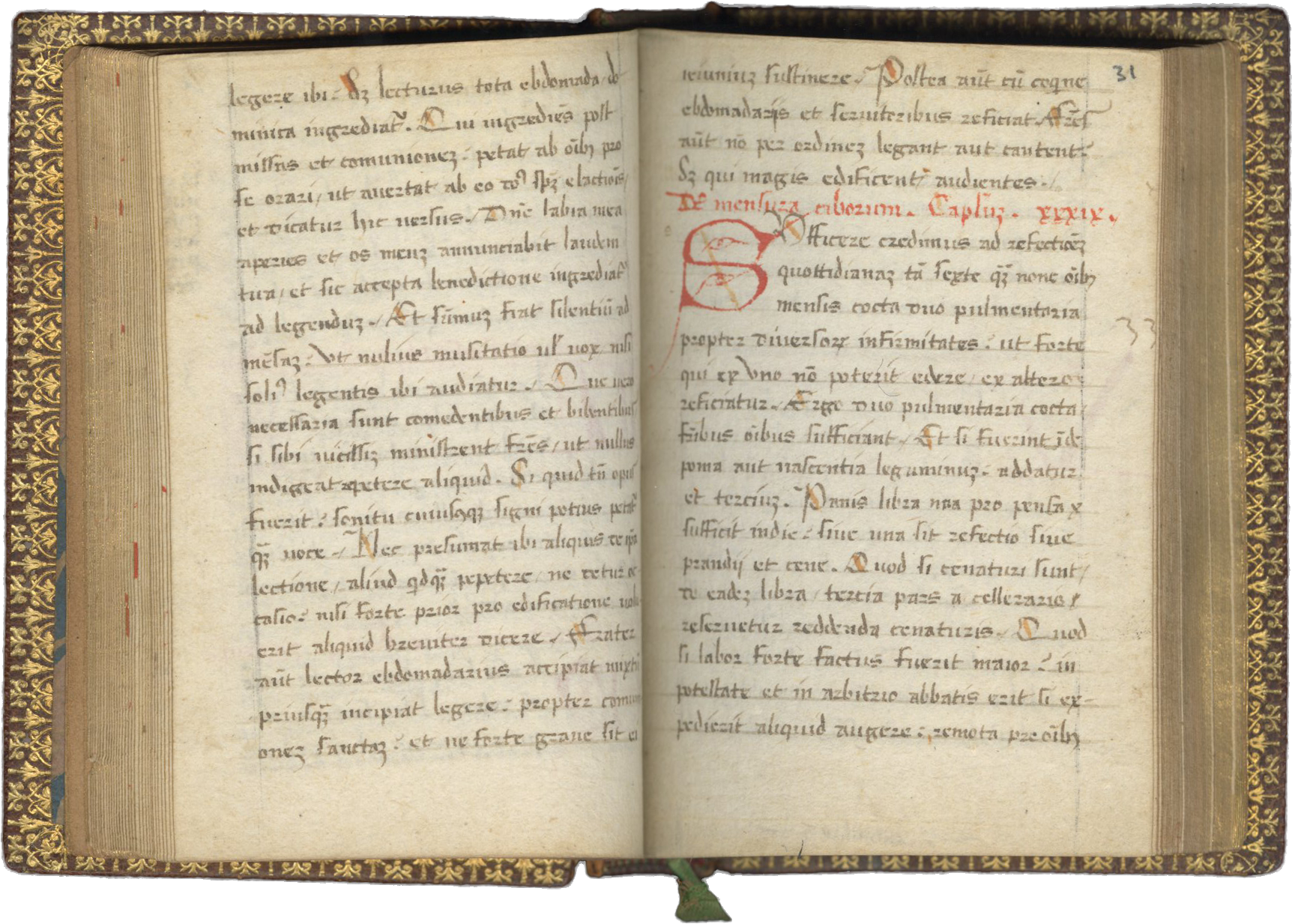
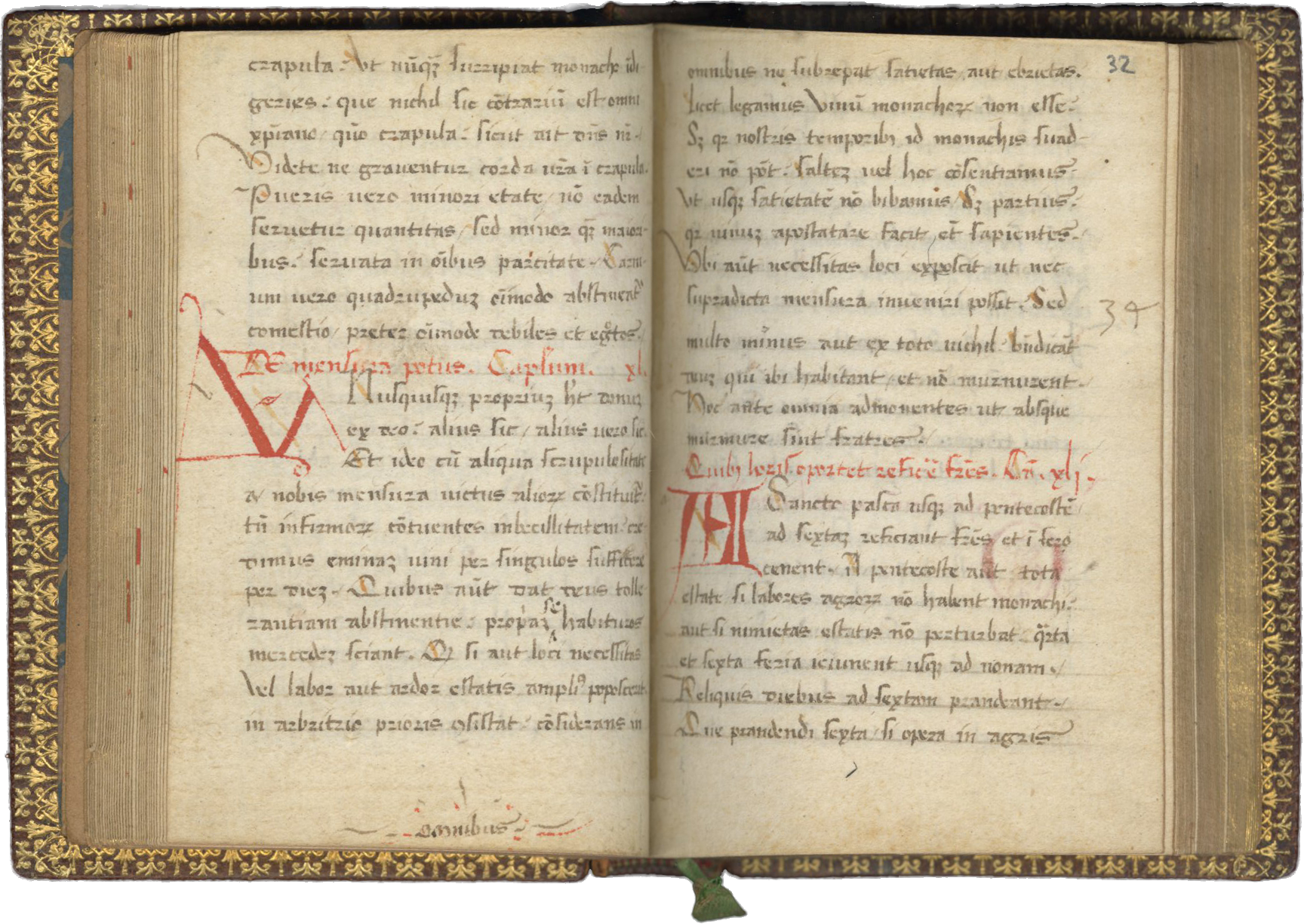
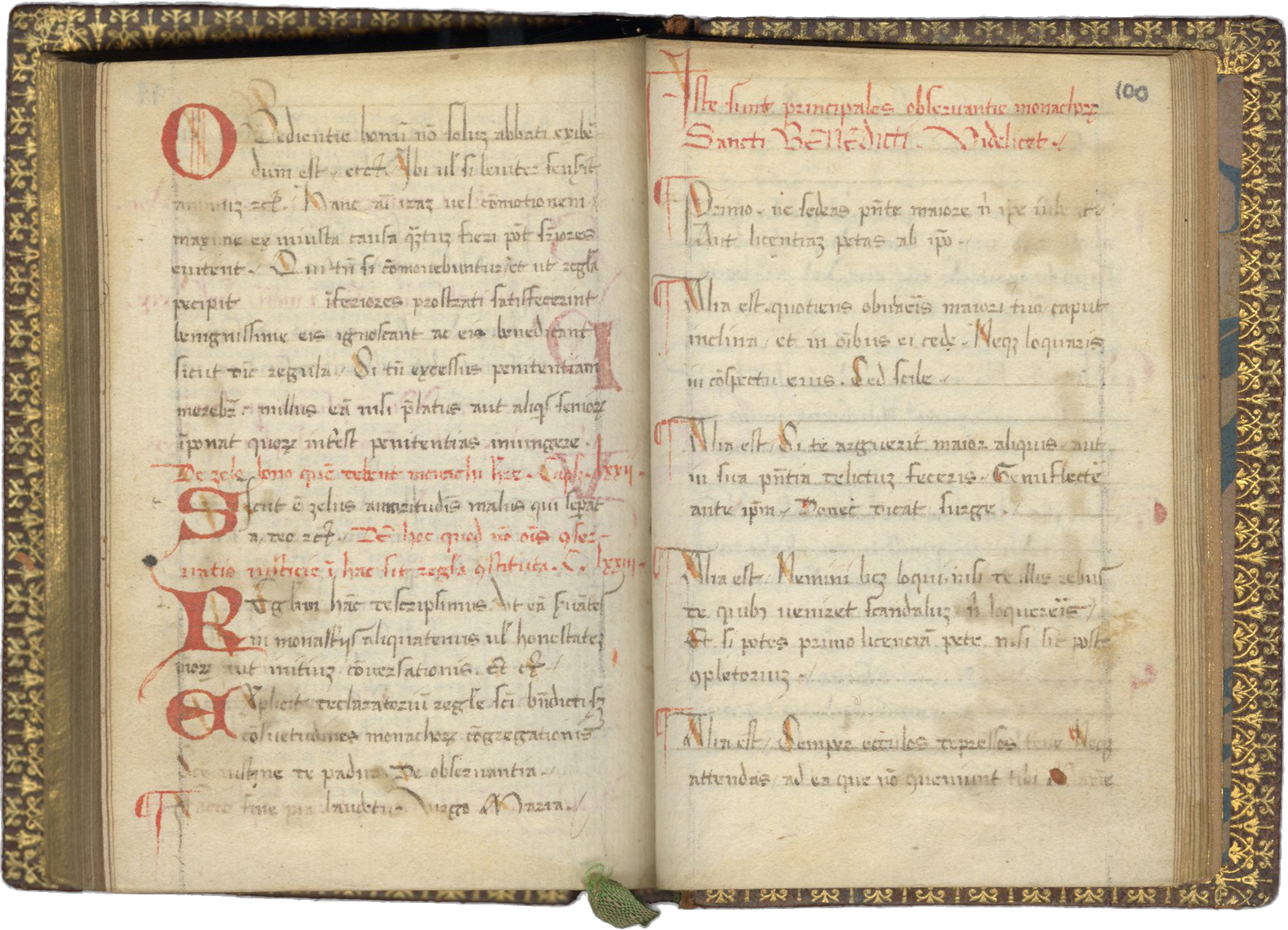
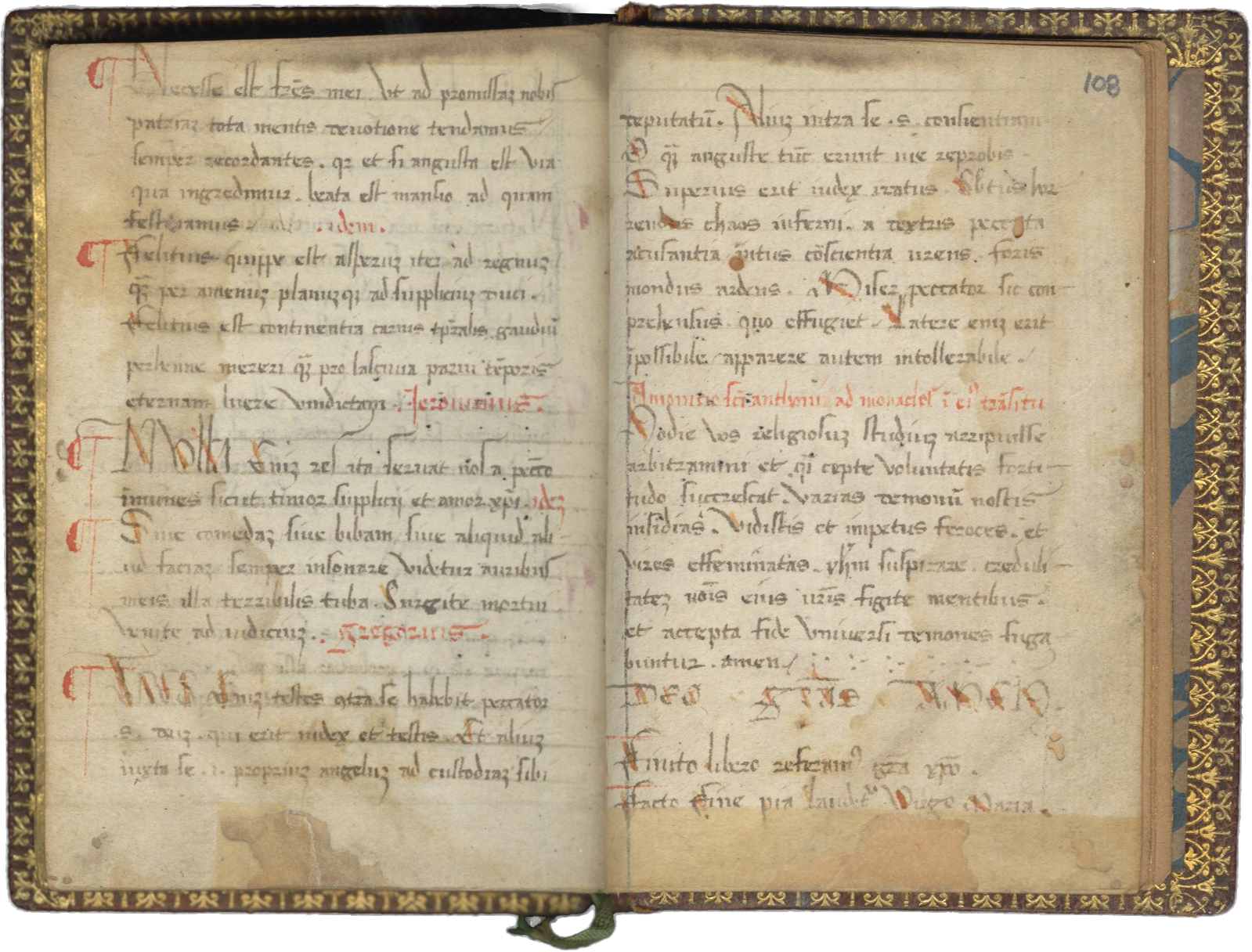
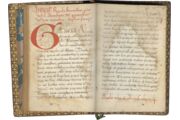
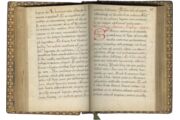
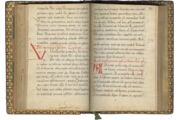
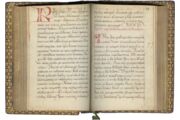
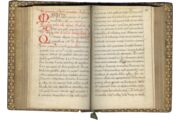
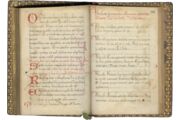
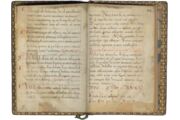
iii (nineteenth-century paper) + 108 + iii (nineteenth-century paper) folios on paper, watermark only partially visible in the upper outer corner of f. 8 (circular form, unidentified), old foliation in brown ink in the middle of the outer margin, 3-(cropped after 55), modern foliation in pencil, 1-108, lacking two leaves in the beginning: a foliated front flyleaf and the first leaf of text, (collation: i8[-1, lacking one leaf before f. 1, with loss of text] ii-xiii8 xiv5), no signatures, horizontal catchwords in the middle of the lower margin decorated with simple penwork of dots and tendrils in brown and red ink (many cropped, but visible on ff. 15v, 31v, 47v, 63v, 79v), ruled in plummet (justification 77 x 45 mm), written in very small hybrida script in brown ink in single column on 21 lines, rubrics and paragraph marks (pieds-de-mouche) in red, capitals touched in yellow, 2-5-line initials in red decorated with areas left in reserve and penwork in red and a line drawn across the initial in yellow, major water damage on ff. 1-18 and 101-108 but text legible, other minor stains and signs of use, in overall very good condition. Bound in the nineteenth century in light brown morocco over pasteboards, both covers stamped with gilt arms, gilt lace borders inside the covers, composed of a repeating fleur-de-lys and foliate pattern, spine with four raised bands stamped with gilt arms and title in gilt “Sancti Benedicti Regula,” marbled endpapers and pastedowns, gilt edges, both covers loose, otherwise in very good condition. Dimensions 91 x 63 mm.
This manuscript contains the Rule of St. Benedict (composed 529), the foundational “how to” text on which nearly all later monastic rules are based, followed by an exceptionally early, and possibly unique, version of the Declarations of the newly founded Congregation of Santa Giustina of Padua, making it nearly contemporary with the reform initiated by Ludovico Barbo around 1419. The tiny volume, written in a hybrida script and decorated with red initials with occasional distinctive eye-motifs, is very handsome. Its text preserves an early form of the Cassinese Declarations that predates the printed editions, offering rare evidence of the earliest phase of the Santa Giustina reform.
Provenance
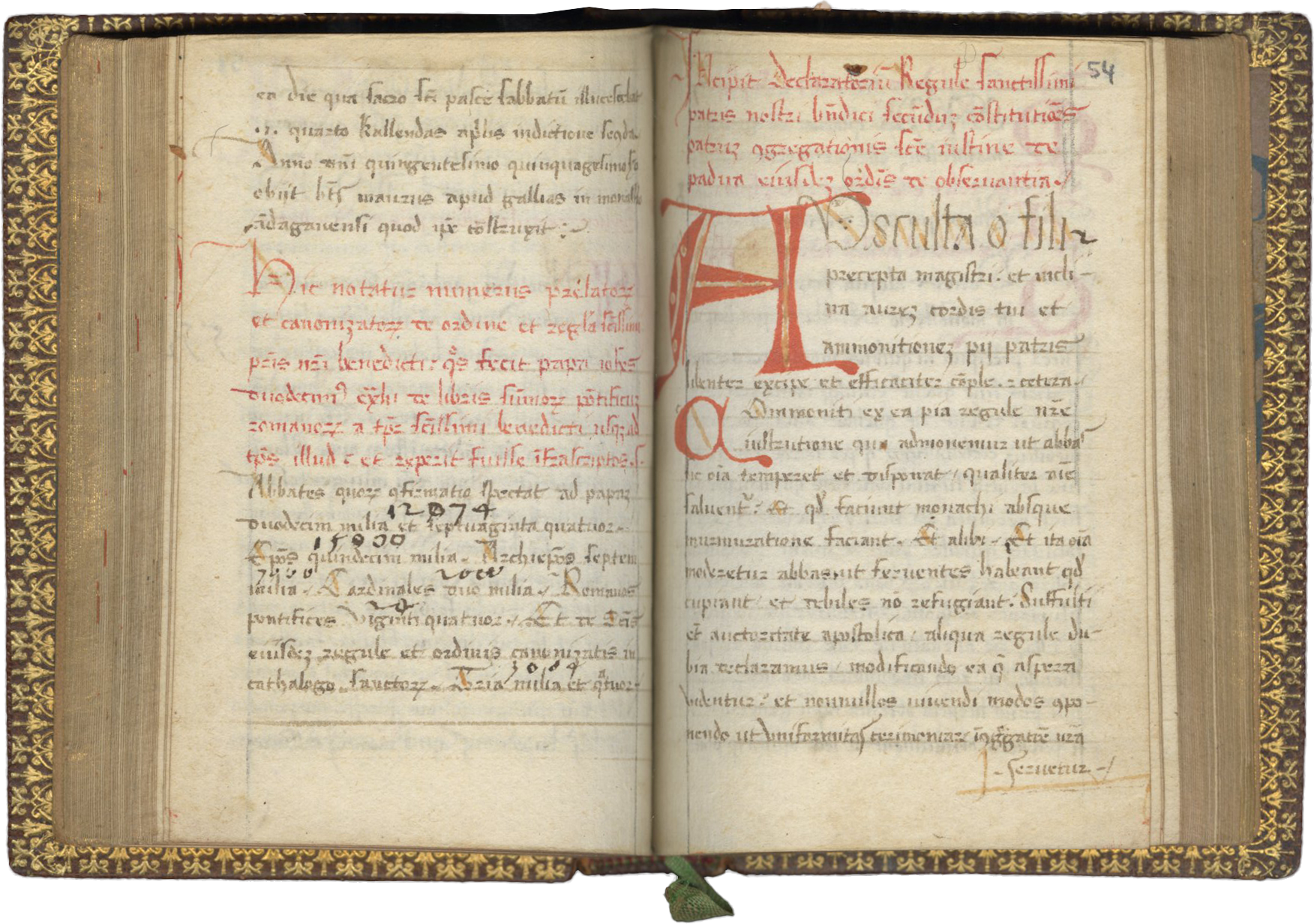
1. The manuscript was made for a monastery that belonged to the Congregatio Sanctae Justinae de Padua, as indicated in the rubric on f. 54: “Incipit Declarationem Regule sanctissime patris nostri benedici secundum constitutionis patrum congregationis sancte justine de padua eiusdem ordinis de observantia.” (Here begins the Declaration of the Rule of our most holy father Benedict, following the constitutions of the congregation of Saint Justina of Padua, observant of the same order). It could have been made for the Mother House, Abbazia di Santa Giustina of Padua, but more likely for one of the first houses to adopt the reform, such as San Giorgio Maggiore in Venice, San Benedetto Po (Polirone Abbey) near Mantua (reforms adopted 1420), San Pietro in Modena (reforms adopted 1434), San Pietro in Perugia (reforms adopted 1436), or San Niccolo del Lido in Venice (reforms adopted 1451).
2. In the collection of the French bibliophile Charles Casati (1833-1919), a lawyer and judge originally from Lyon. Casati’s coats of arms, as he imagined and designed them, are stamped in gilt on both covers of the book. In one of these fictional arms his name “Casati” is spelled from right to left in an Etruscan-style alphabet, reflecting his scholarly interests in the Etruscan civilization. The other arms, representing a castle, are designed as canting arms (armes parlantes) derived from his name and reflecting his pretentions to belong to the Italian noble family of the Marquess Casati. He bequeathed his collection of books and manuscripts to Auguste Casati, a son of his cousin; about 15 books from this collection were sold in 1924. Before his death, however, in 1888 and 1891 Casati had already given over 70 books and manuscripts to the École nationale des chartes in Paris, where he studied before his career in law; this institution has recently prepared for the collection to be digitized and studied. For more information on Casati, see a video of a conference organized at the École des chartes (Online Resources).
Text
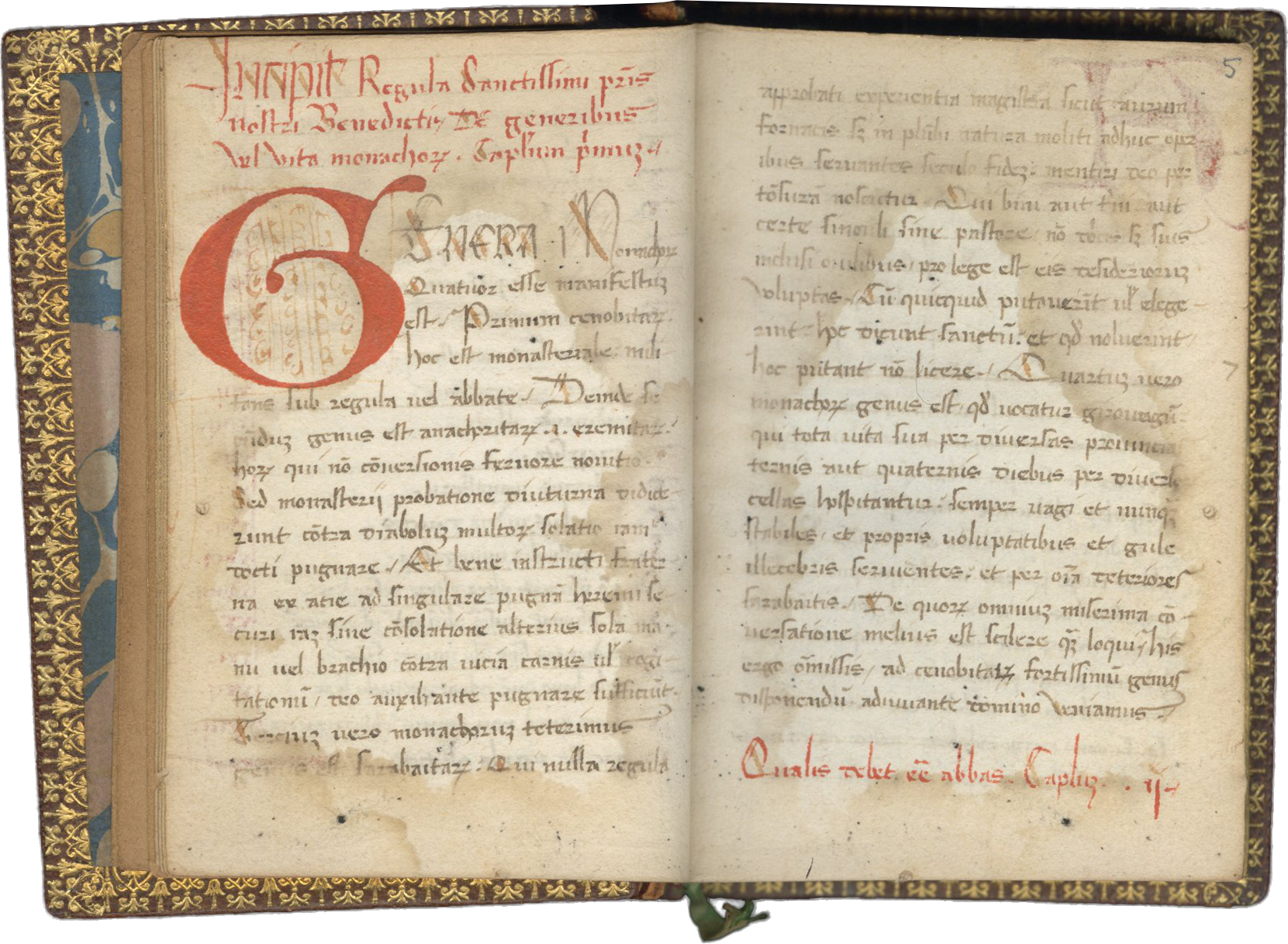
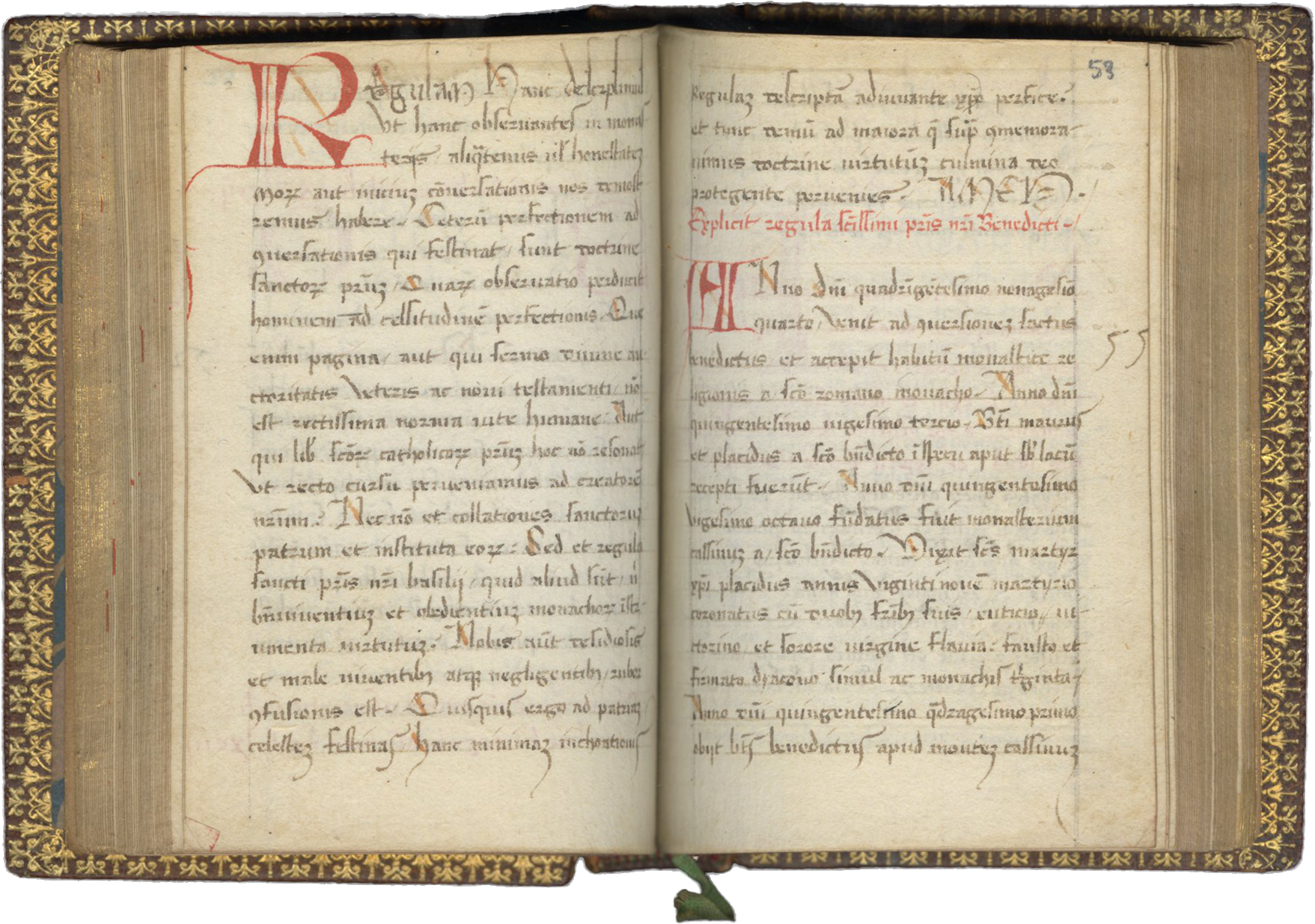
ff. 1-53, Rule of St. Benedict, ff. 1-2v, Prologue, begins imperfectly (lacking the first leaf of manuscript), incipit, “...ecce adsum. Quid dulcius nobis ab (hac) voce domini invitantis nos fratres carissimi. Ecce pietate sua demonstrat nobis viam vite dominus” ... “esse consortes. Amen”; ff. 2v-4, list of contents; text proper complete with 73 chapters begins with Chapter 1 on f. 4v, rubric, “Incipit Regula Sanctissimi patris nostri Benedicti, De generibus vel vita monachorum. Capitulum primum,” incipit, “Genera Monachorum Quatuor esse manifestum est. Primum cenobitarum hoc est monasteriale militans sub regula vel abbate” ... “culmina deo protegente pervenies. Amen. Explicit regula sanctissimi patris nostri Benedicti”;
CPL 1852, edited most recently by Venarde (2011);
f. 53r-v, a chronological digest of Saint Benedict’s life, “Anno Domini quadringentesimo nonagesimo quarto, venit ad conversionem sanctus Benedictus et accepit habitum monasticae religionis a sancto Romano monacho. Anno Domini quingentesimo vigesimo tertio, beati Maurus et Placidus a sancto Benedicto in Nurcia apud [Sub]iacum recepti fuerunt. Anno Domini quingentesimo vigesimo octavo, fundatum fuit monasterium Cassinum a sancto Benedicto ... Anno domini quingentesimo quinquagesimo obiit beatus maurus apud gallias in monasterio (Glannafolio) Andegavensi quod ipse construxit”;
f. 53v, a rubric introducing a list of Benedictine abbots and monasteries said to have been drawn up by Pope John XII (r. 955-964), “Hic notatur numerus prelatorum et canonum [canonum materum = monasteriorum] de ordine et regula sanctissimi patris nostri benedicti, quos fecit papa ioannes duodecimus, exiit de libris summorum pontificum romanorum a tempore sanctissimi benedicti usque ad tempus illud et reperit fuisse inscriptos,” (“Here is recorded the number of prelates and monasteries of the Order and Rule of our most holy Father Benedict, which Pope John XII compiled, having taken [them] from the books of the supreme Roman pontiffs from the time of Saint Benedict up to his own time, and he found that they had been entered therein [i.e. listed].”), incipit, “Abbates quorum...”;
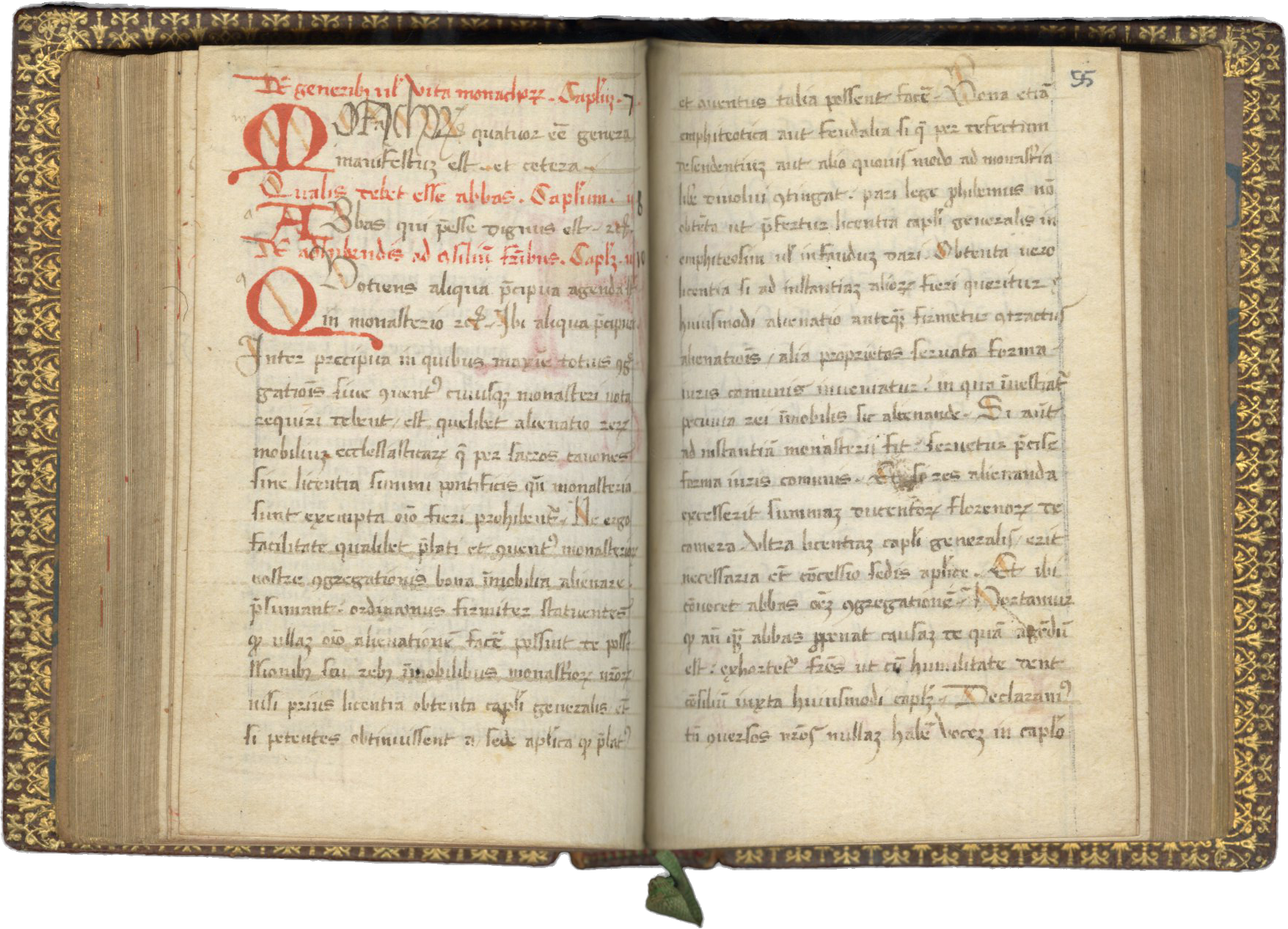
ff. 54-99v, Declarations of the Congregation of Santa Giustina of Padua, “Incipit Declarationem Regule sanctissime patris nostri benedici secundum constitutionis patrum congregationis sancte justine de padua eiusdem ordinis de observantia,” f. 54, Prologue, incipit, “Auscula o fili precepta magistri”...“ut uniformitas cerimoniarum in congregatione nostra servetur”; f. 54v, rubric, “De generibus vita monachorum. Capitulum .i.,” incipit, Monachorum quatuor esse genera manifestum est et cetera...”;
This is an early version of the text eventually printed in Florence in 1520, see Online Resources;
ff. 100-108, list of observances, rubric, “Iste sunt principales observationes monachorum Sancti Benedicti. Videlicet,” incipit, “Primo. ne sedeas presente maiore...” (“These are the principal observances of the monks of Saint Benedict, namely: First: do not sit in the presence of your superior”); f. 108v, blank.
The earliest Christian rule for monastic life, Benedict wrote the Regula Benedicti, in 529 at Monte Cassino, and divided it into 73 chapters. These chapters attempt to provide guidelines for every aspect of monastic life, from daily prayer to clothing and food. The first three chapters concern the kinds of monks and monastic authority, after which the Rule deals with spiritual and moral formation (ch. 4-7), Divine Office and worship (chapters 8-20), governance and community order (ch. 21-30), discipline and interpersonal conduct (ch. 31-46), admission and formation of monks (ch. 58-66), and monastic hierarchy and external relations (ch. 67-71), finally ending with a spiritual conclusion (ch. 72-73). While Benedict’s Rule offers guidelines to many of the things we might expect, like what and when the monks were to pray, the monk-author was also sensitive to everyday practicalities – where the monks slept, what they ate and drank, and even what they wore, down to when they should and should not wear socks.
On f. 53r-v, the scribe copied notes summarizing Saint Benedict’s life and placing the Rule in a historical context, a common preface to the Rule in many Cassinese monastic manuscripts. The text is derived from Leo Marsicanus’ Chronicon Monasterii Casinensis (eleventh century) and summarizes Gregory the Great’s Dialogues II.
If the Benedictine rule was common throughout Latin Christendom, the following text, the Declarations of the Congregation of Santa Giustina of Padua, is far rarer. These Declarations offer a commentary on (or explanation of) the Rule of Saint Benedict specific to the new Congregation of Santa Giustina of Padua, later known as the Cassinese Congregation, first printed in Florence in 1520 as Regula sanctissimi patris nostri Benedicti cum declarationibus editis a patribus congregationis Casinensis per directione & conseruatione regularis obseruantiae & salubris regiminis dictae congregationis (see Online Resources).
The Congregation of Santa Giustina emerged in the early fifteenth century as part of the broader monastic reform wave sweeping Europe, focused on restoring strict observance of the original Benedictine ideals. In 1408, Pope Gregory XII appointed Ludovico Barbo as commendatory abbot of Santa Giustina. Barbo became convinced that only a return to authentic Benedictine observance could renew Santa Giustina, and he recruited reform-minded monks, many of whom came from the Monastery of San Giorgio Maggiore in Venice, and other houses sympathetic to reform. Around 1414-1416, the reformed community adopted a strict observance of common life and restoration of the full Divine Office. In 1419, Pope Martin V formally recognized the community and encouraged its expansion, and houses could affiliate with Santa Giustina. Barbo introduced centralized governance that became the model for the entire Cassinese Benedictine system, and by the sixteenth century, the Santa Giustina / Cassinese Congregation was the most powerful and disciplined Benedictine reform movement in Europe.
The text of the new reformed Rule specific to the congregation that is copied on ff. 54-99v in our manuscript agrees only partially with that printed in Florence in 1520. This suggests that it is an early version of it, predating the first printed edition (compare, for instance, the Prologue on f. a4 recto-verso in the printed edition in Online Resources with the Prologue on f. 54 in our manuscript). There are only three manuscript copies of the Declarations listed in the Schoenberg database and no records of any having changed hands in the last century.
Small guide letters were written in brown ink in the margins; they gave instruction to the illuminator on which initial he was to paint in the space left for that purpose. Only red ink was used for the initials, but they are painted in a wide variety of elegant forms. The initials are decorated with areas of parchment left in reserve and a narrow line in yellow that runs across the initial (or on occasion, several lines). There is a distinctive ornamental detail included by the illuminator that may in further research allow identifying his work in other manuscripts: a motif of an eye. One or two eyes (as for ‘S’ – one in each compartment) inhabit the space inside the body of the initial, with the corners of the eyes being attached to the initial’s contours with very fine lines; see the decorated initials on ff. 31 and 31v.
Literature
Cantoni Alzati, G. La biblioteca di S. Giustina di Padova: Libri e cultura i benedettini padovani in età umanistica (Medioevo e umanesimo 48), Padua, 1982.
Righetti, M. Santa Giustina di Padova: Storia e arte, Padua, 1979.
Venarde, B. The Rule of Saint Benedict, Cambridge, MA, 2011.
Online Resources
Manus Online: Manuscripts in Italian libraries:
https://manus.iccu.sbn.it/en/manus-home
Regula Benedicti (Monastic Manuscript Project):
https://www.earlymedievalmonasticism.org/texts/Regula-Benedicti.html
“La bibliothèque d’un polygraphe bibliophile, Charles Casati,” conference at the Ecole nationale des chartes, 13 May 2025 (video):
https://www.youtube.com/watch?v=q0E3BqumQtI
Regula sanctissimi patris nostri Benedicti cum declarationibus ..., Florence, 1520:
https://archive.org/details/bub_gb_hZvKriTwsRkC
Schoenberg Database of Manuscripts https://sdbm.library.upenn.edu/