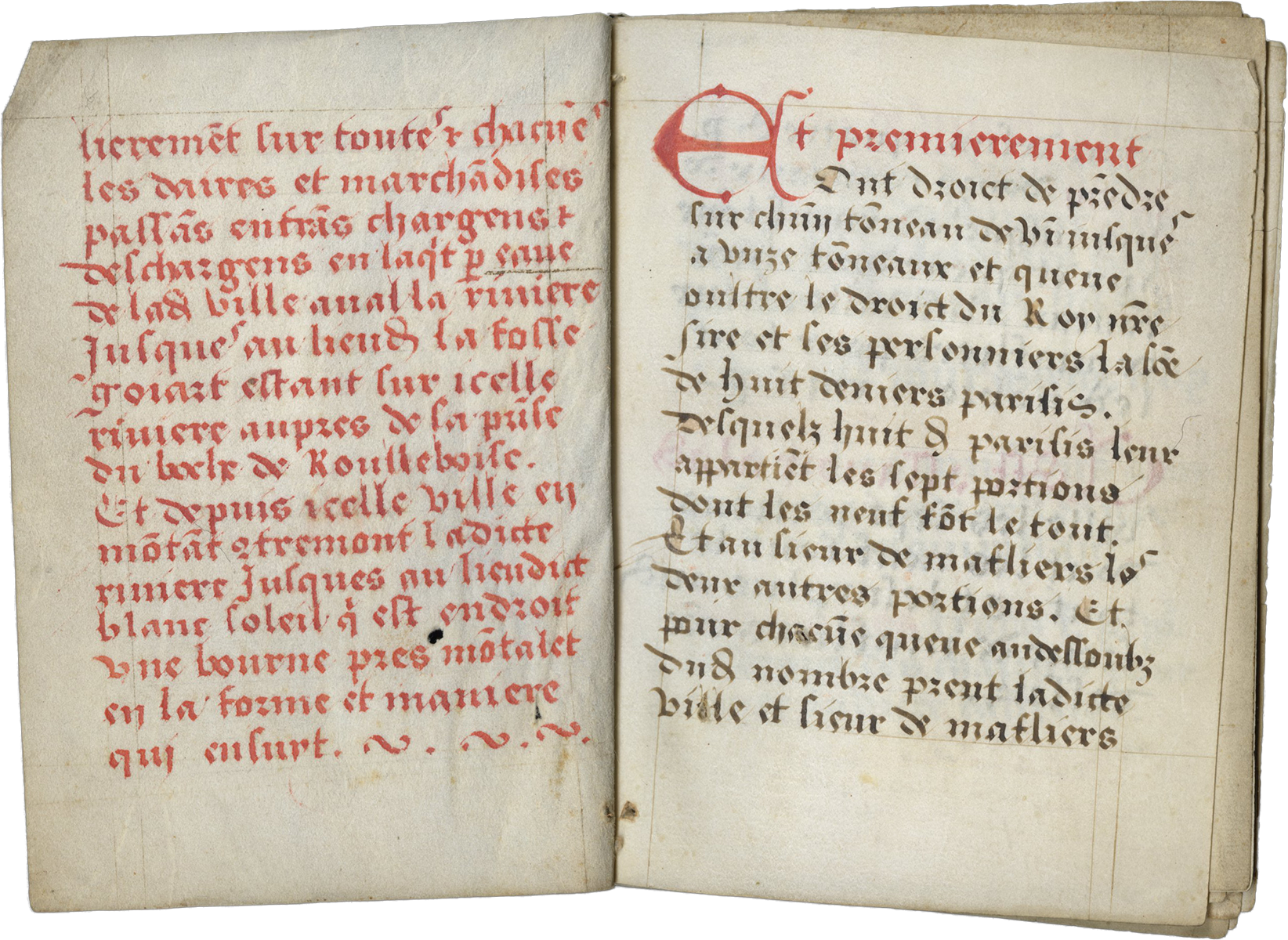
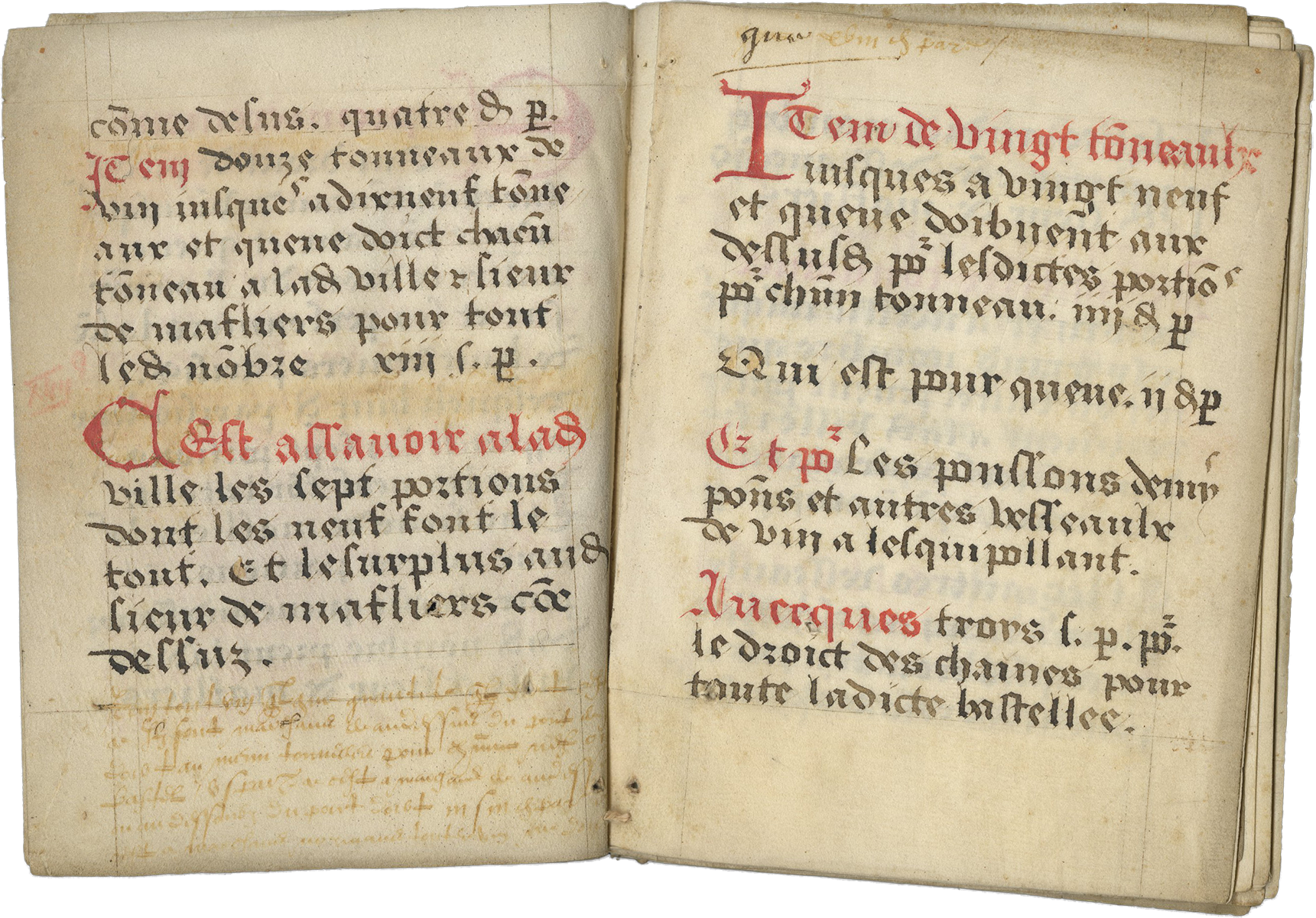
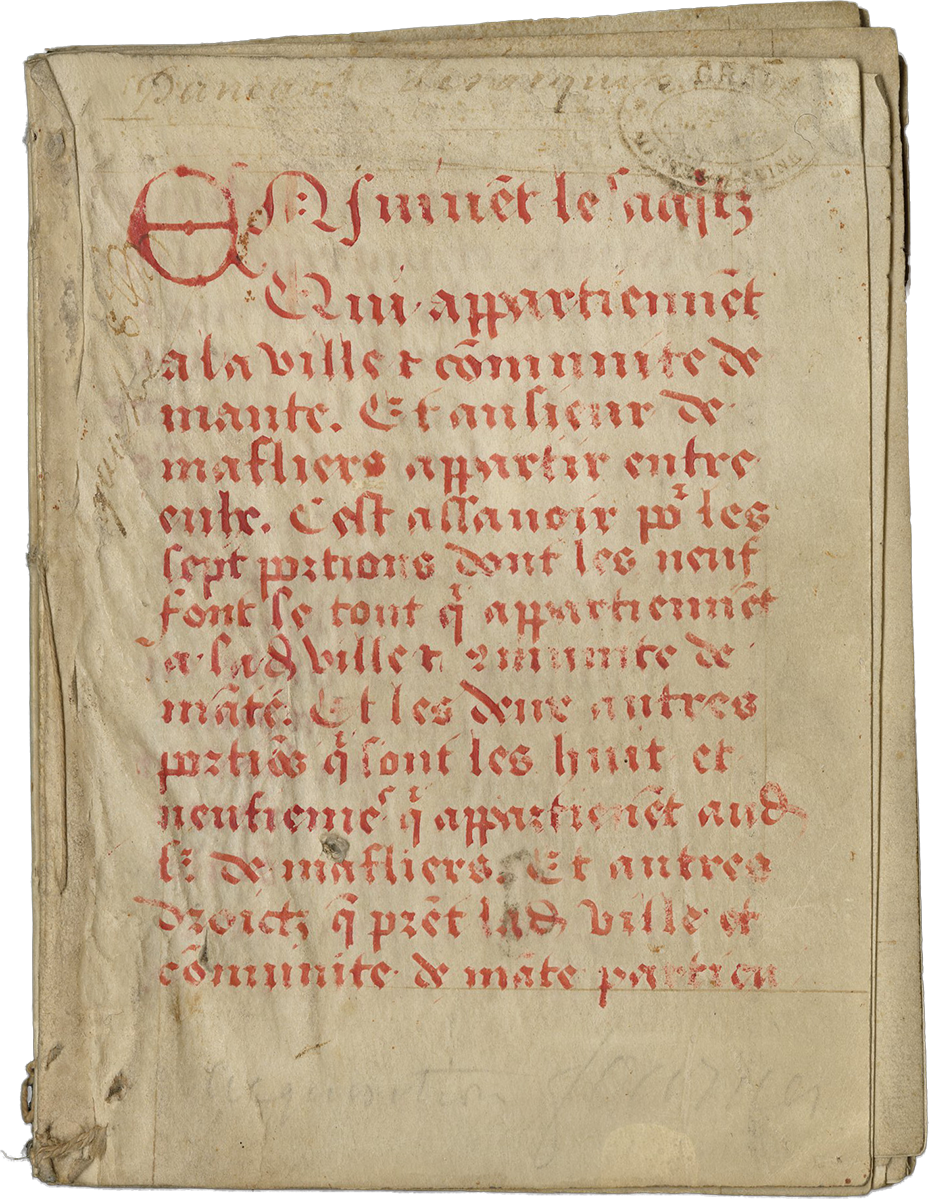
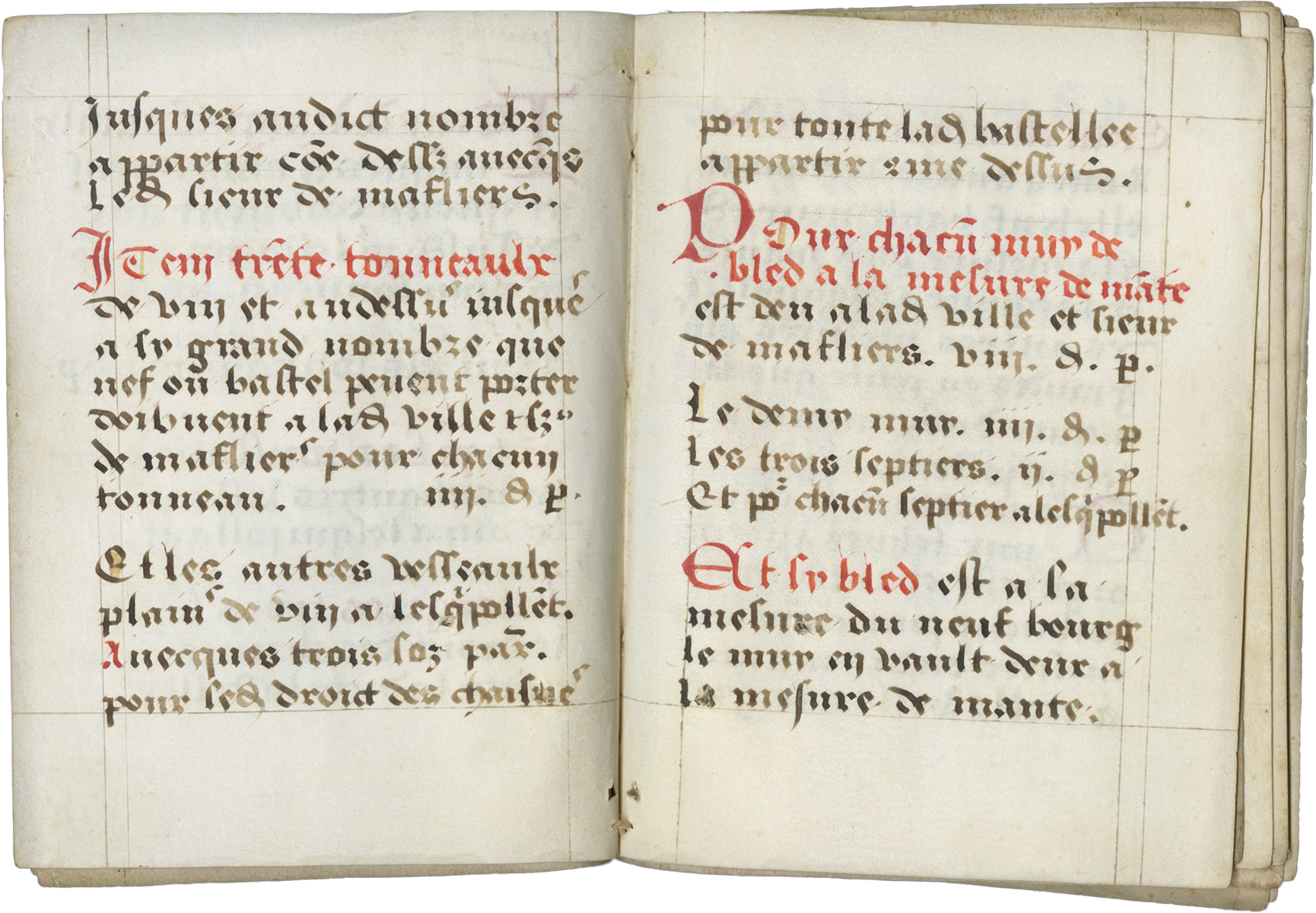
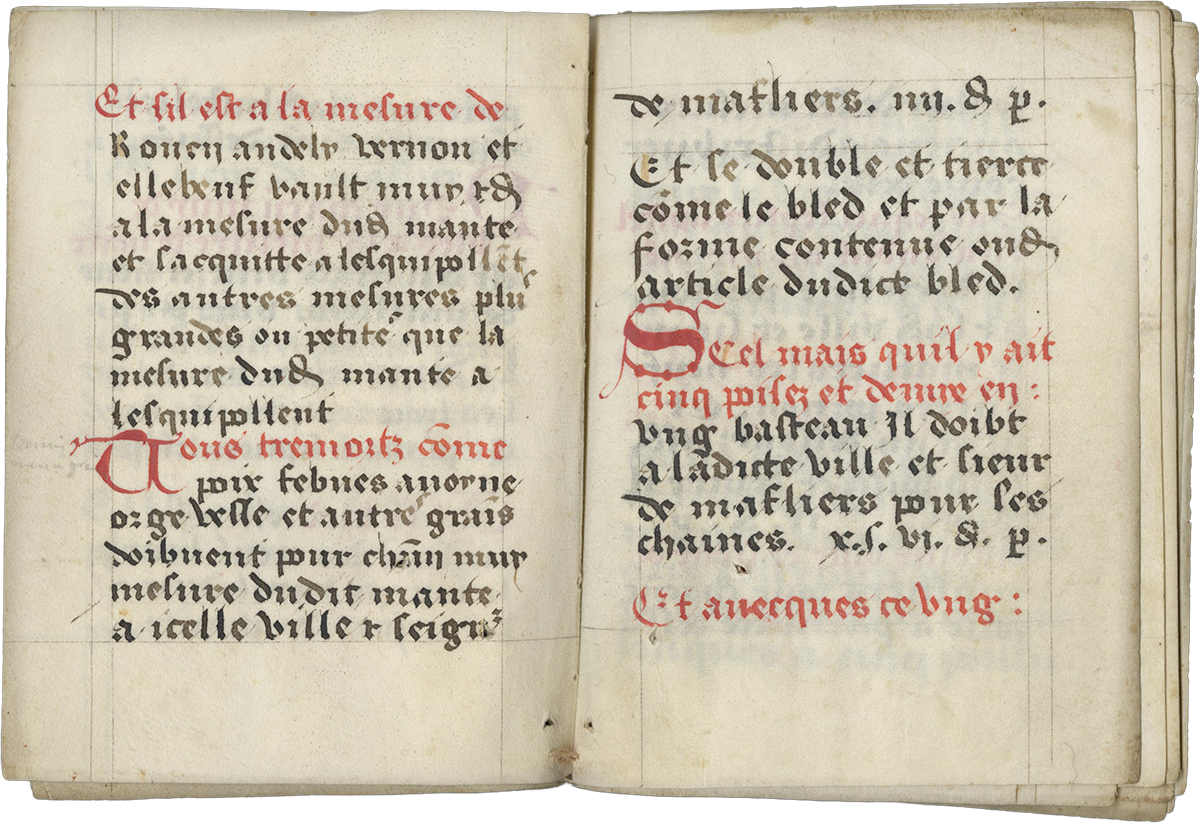
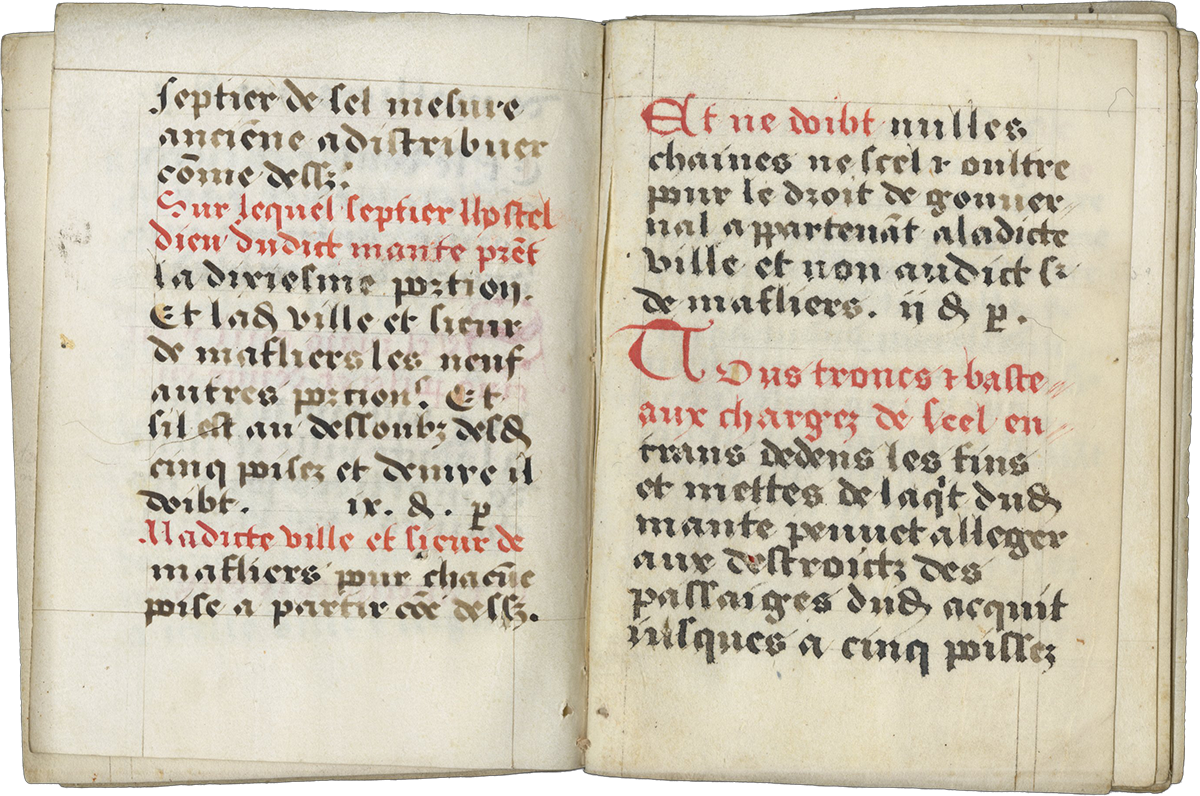
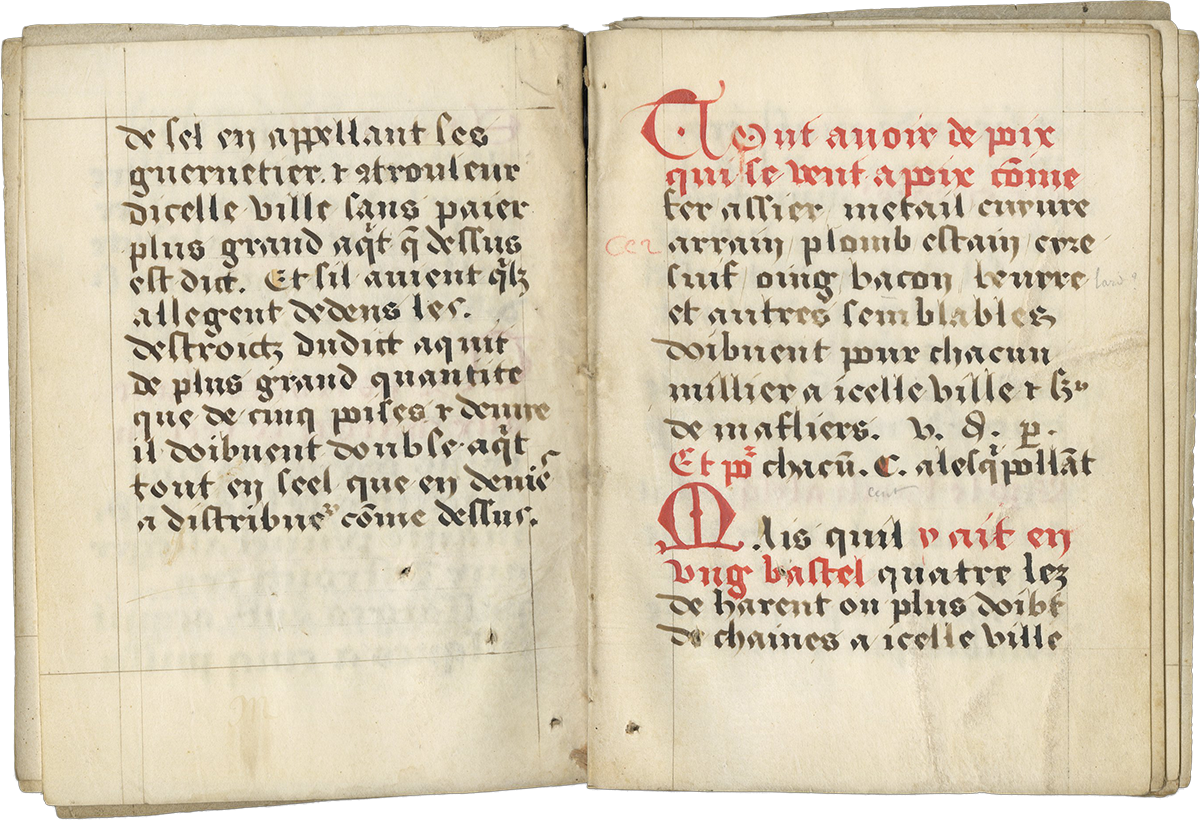
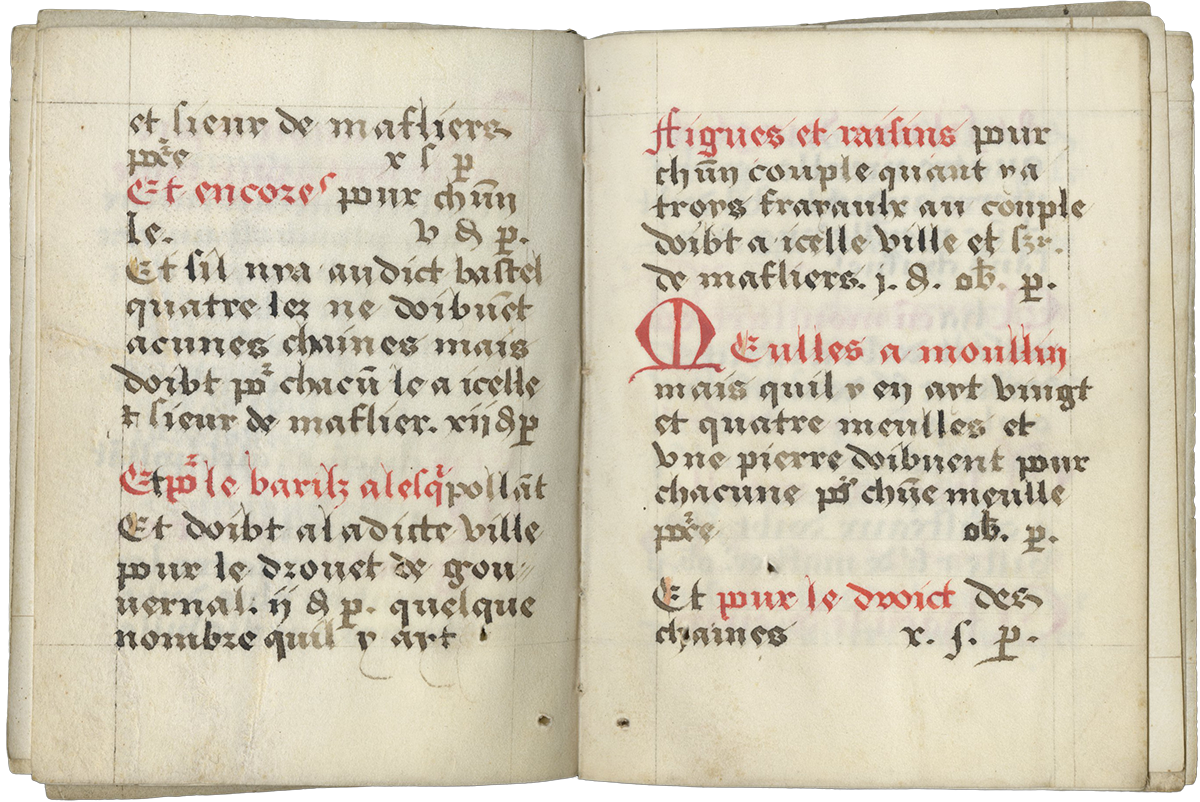
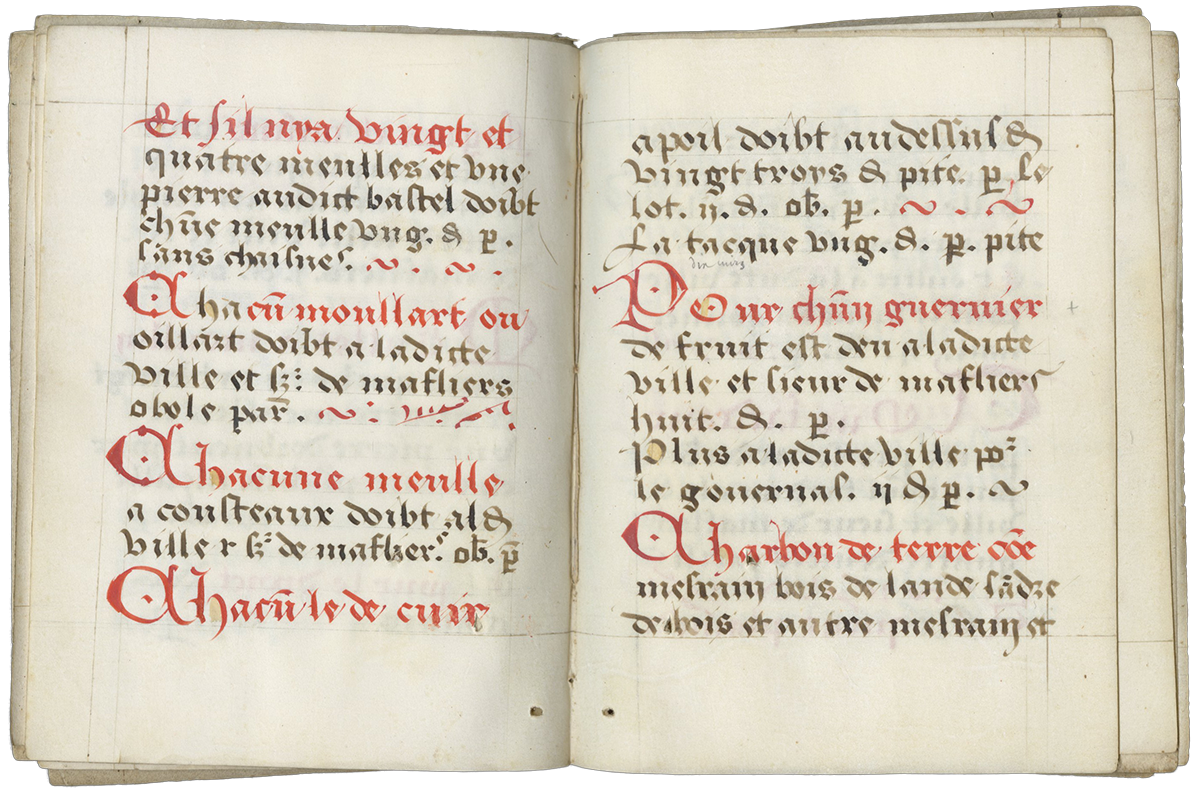
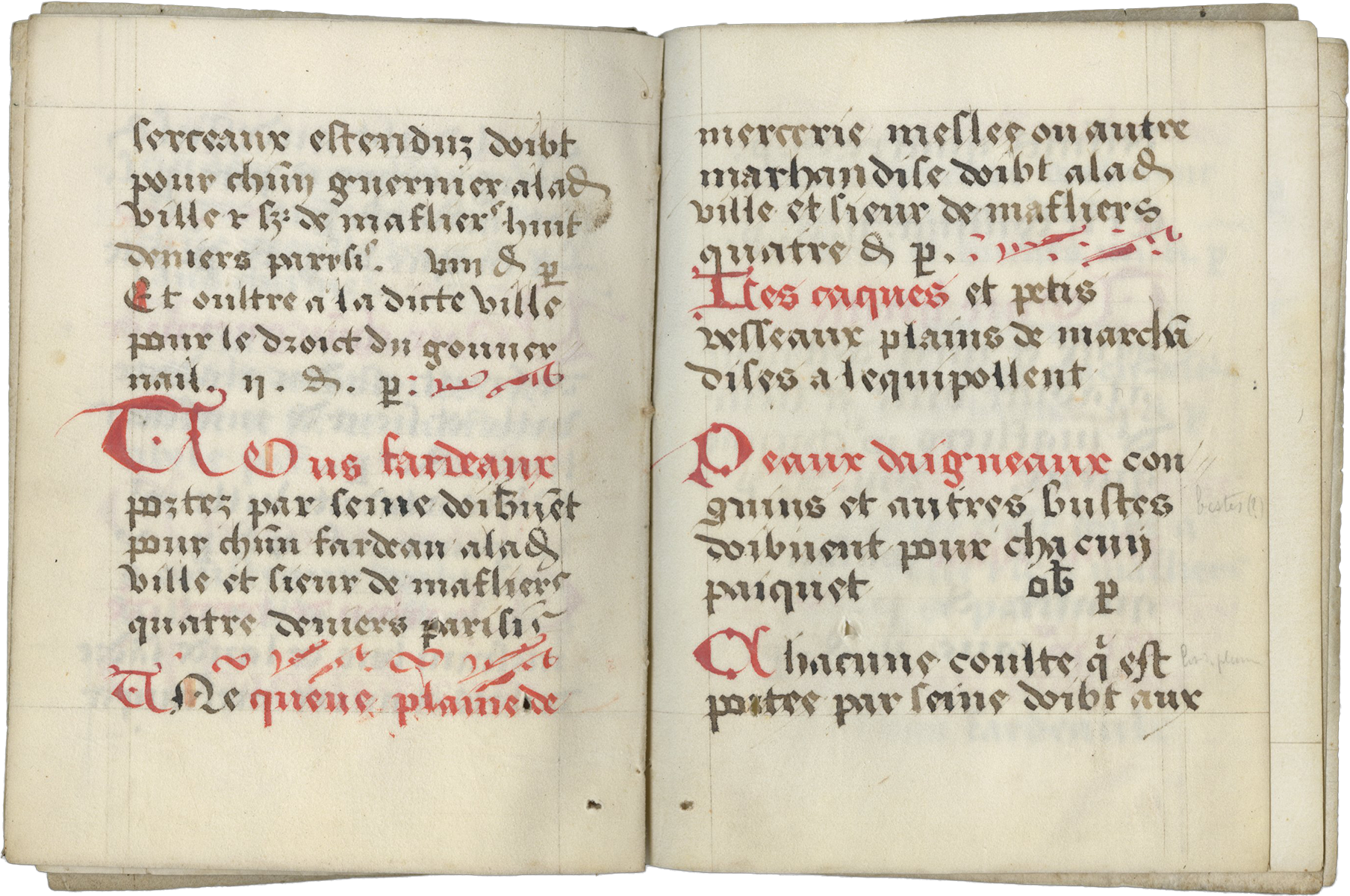
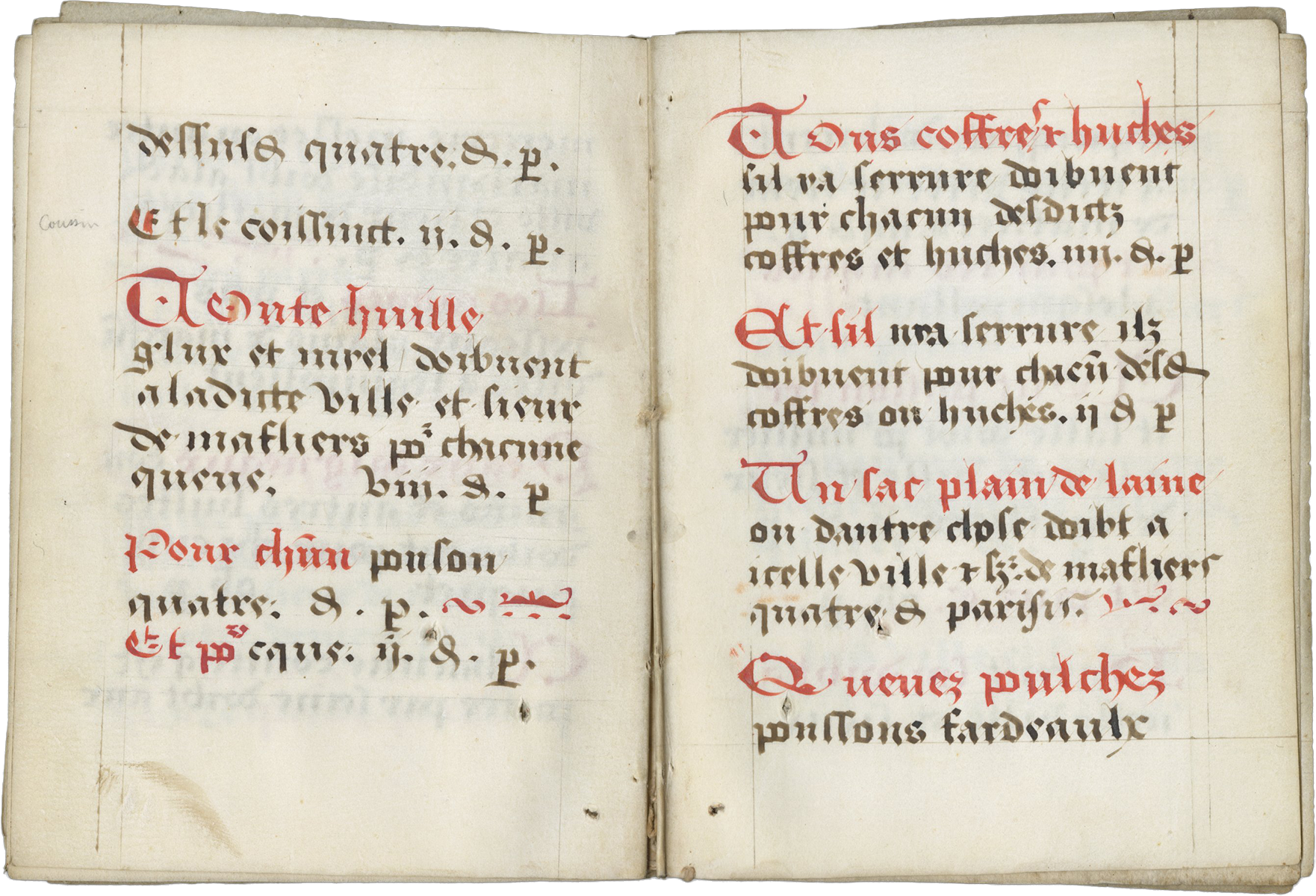
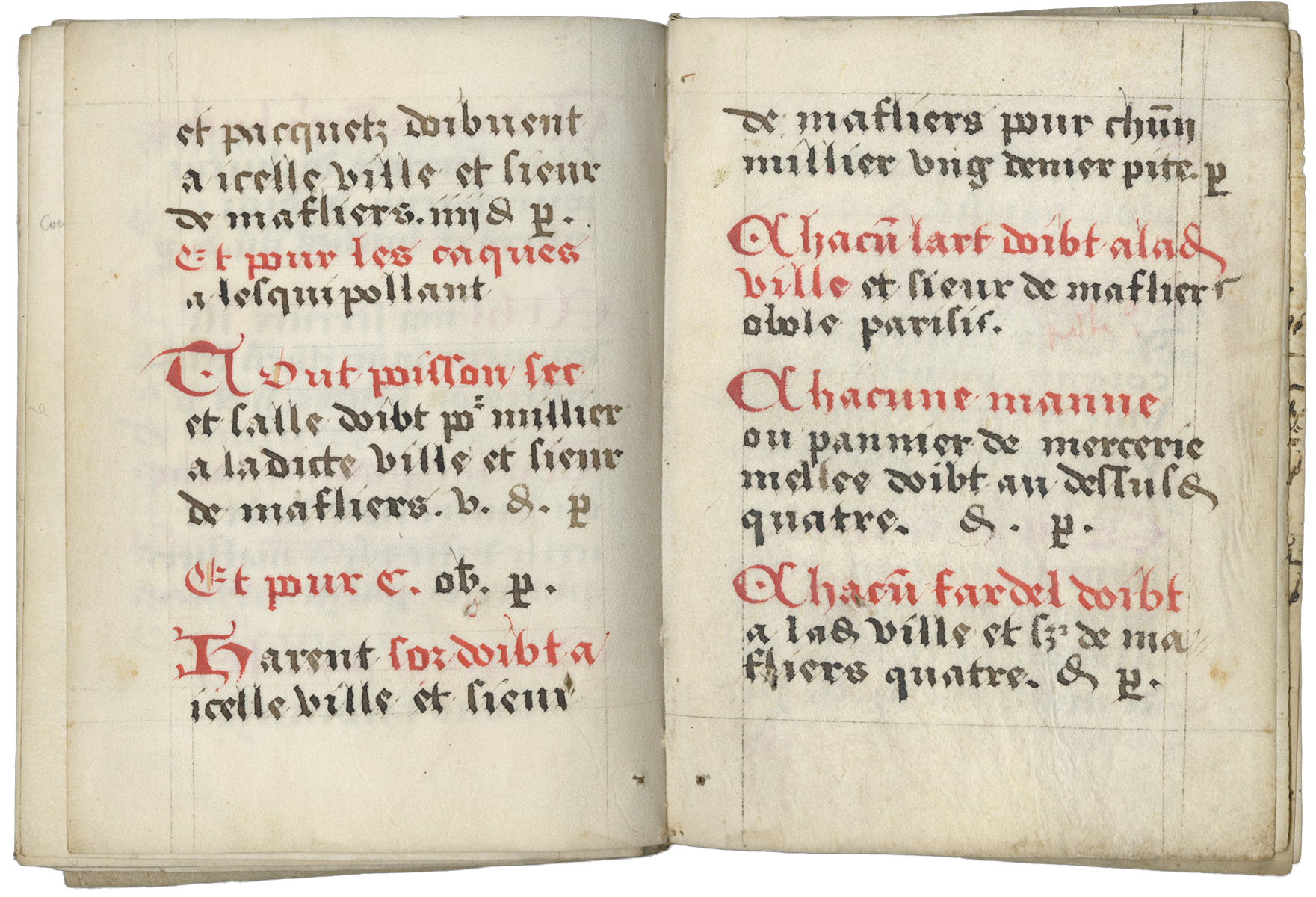
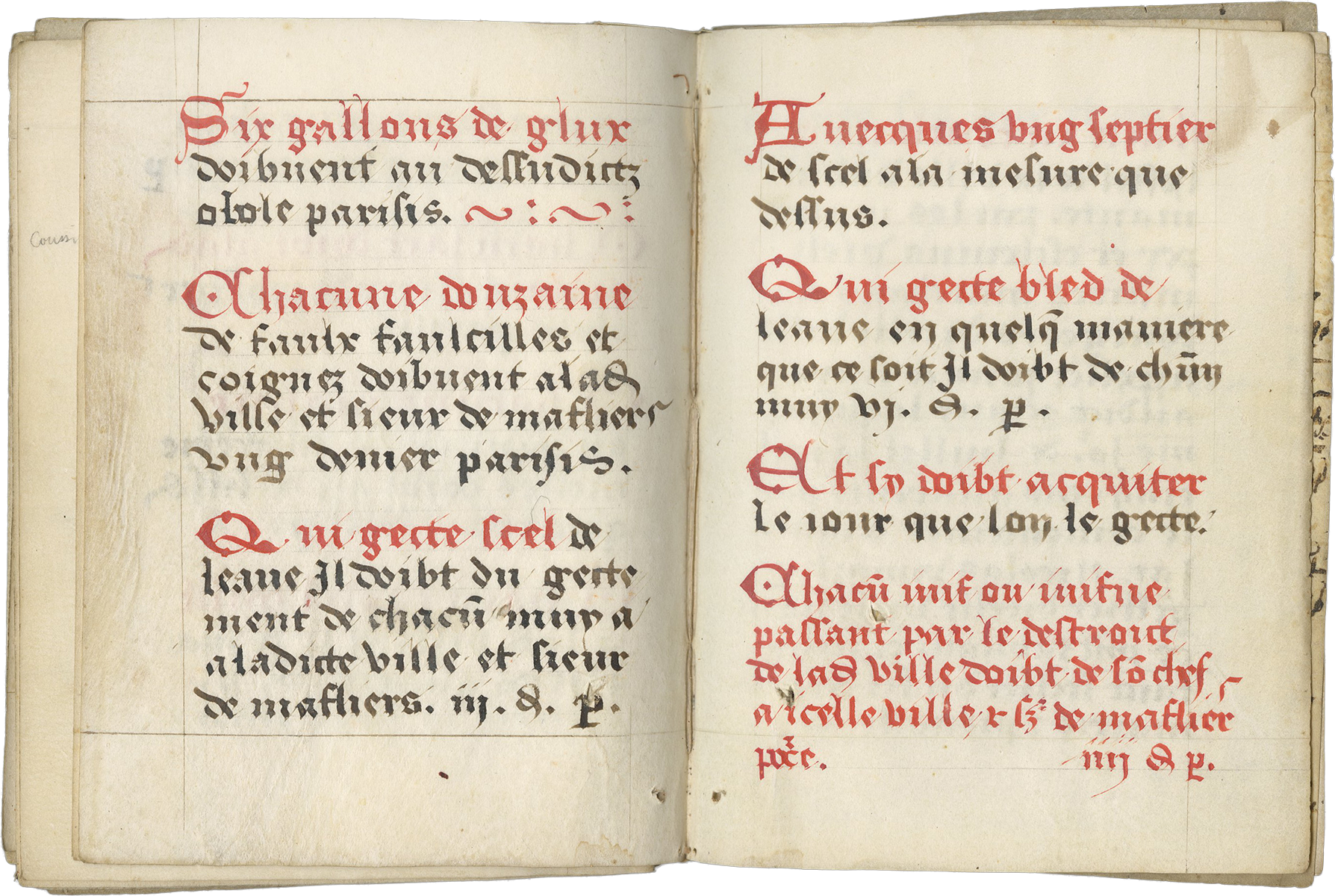
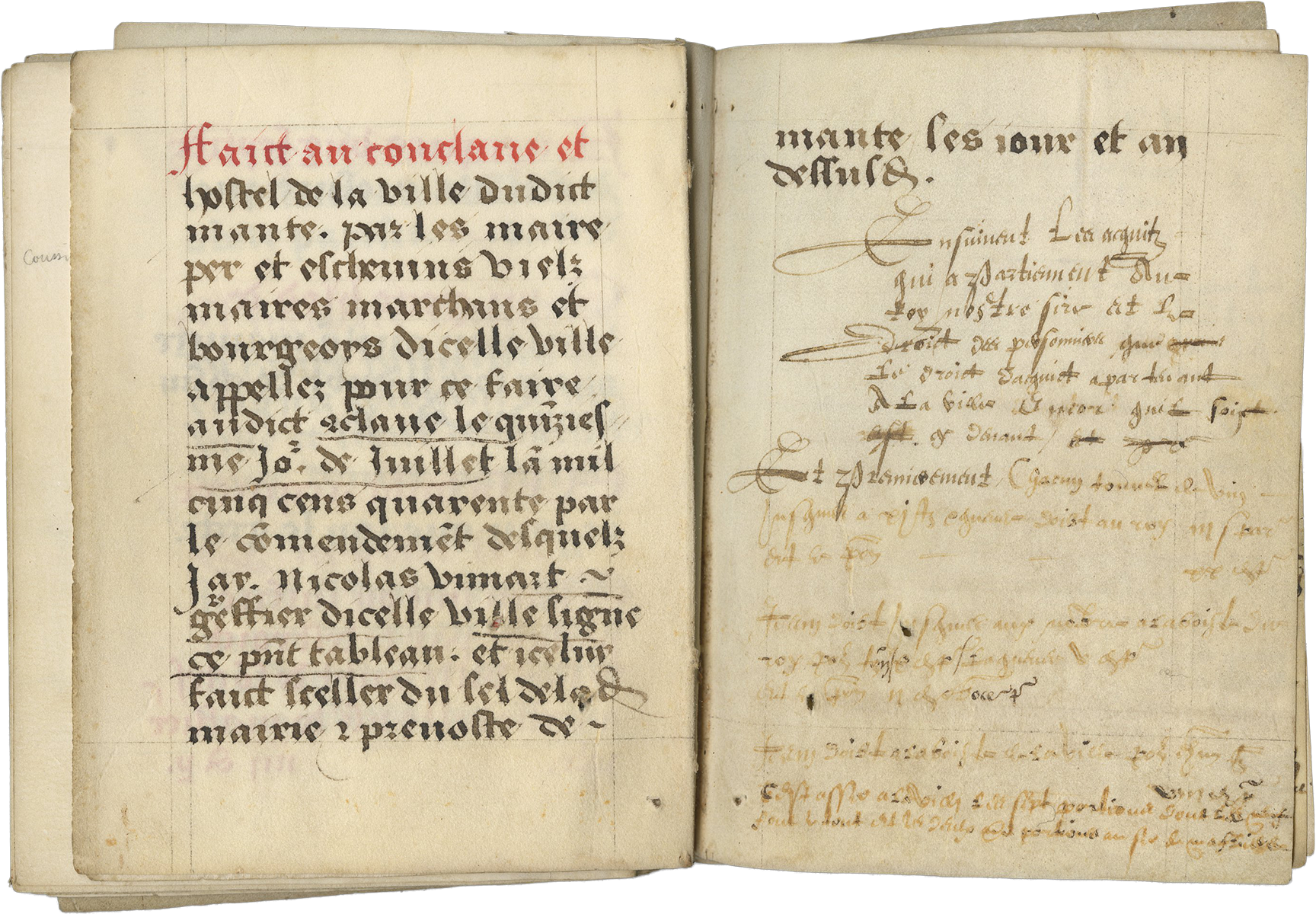
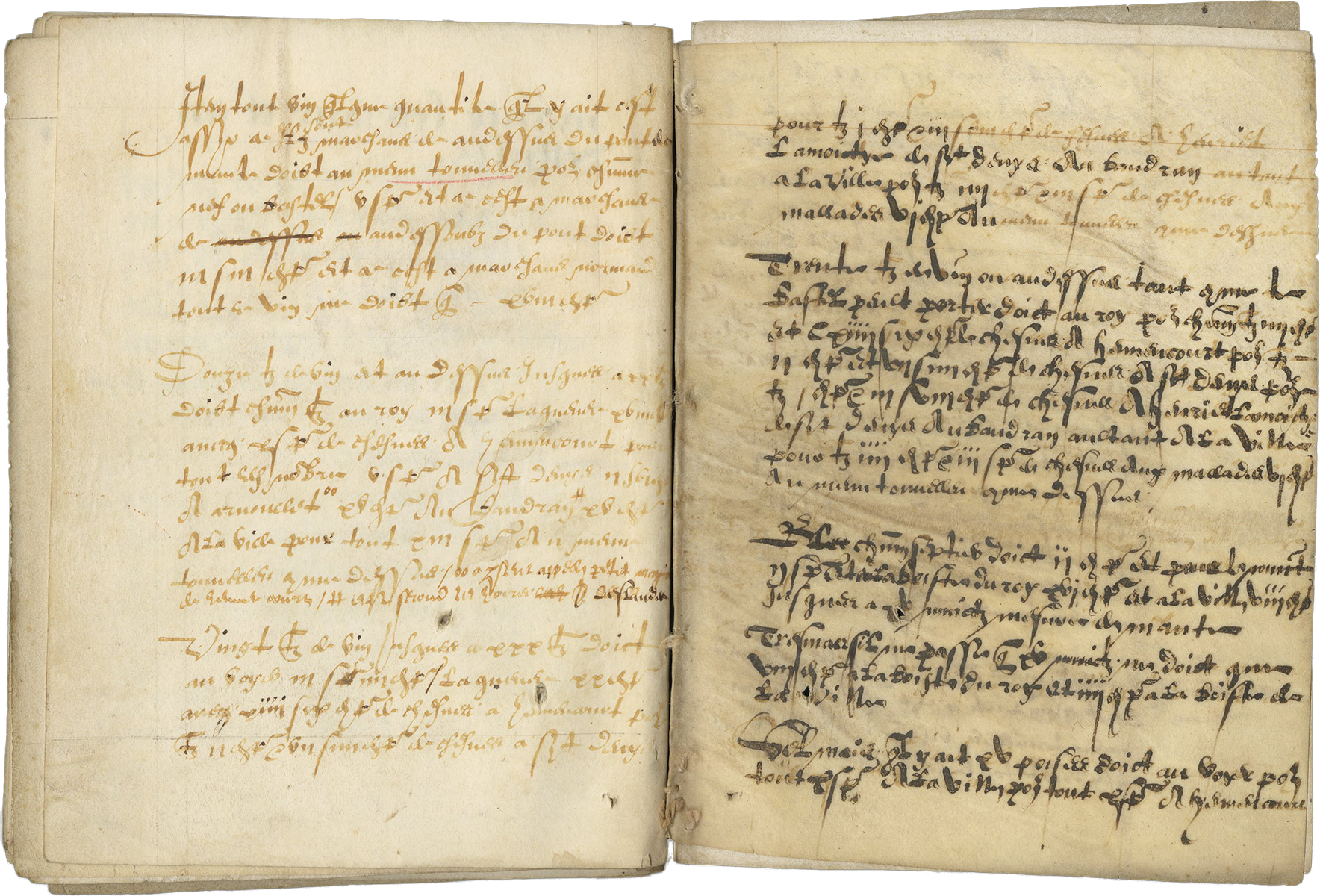
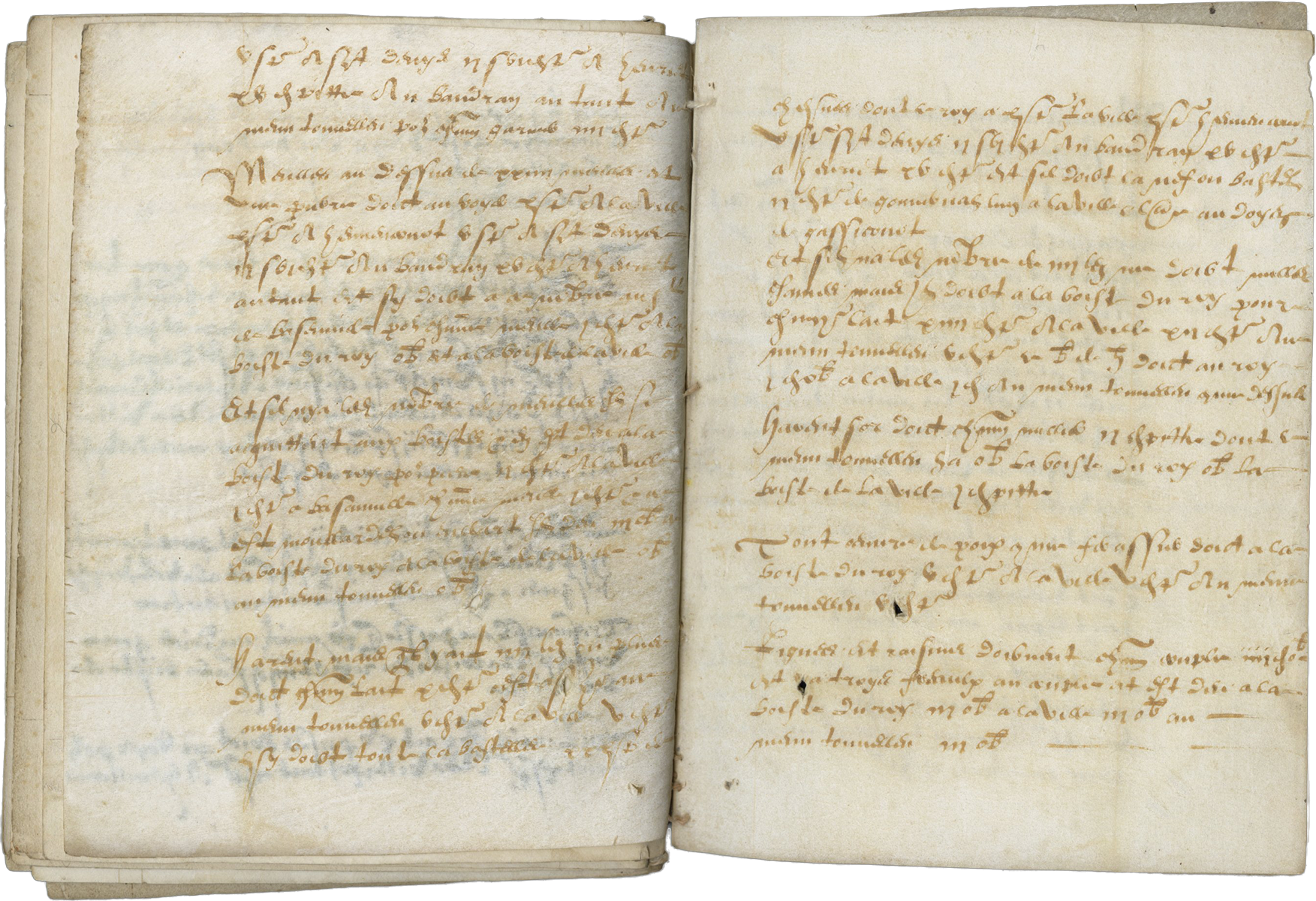
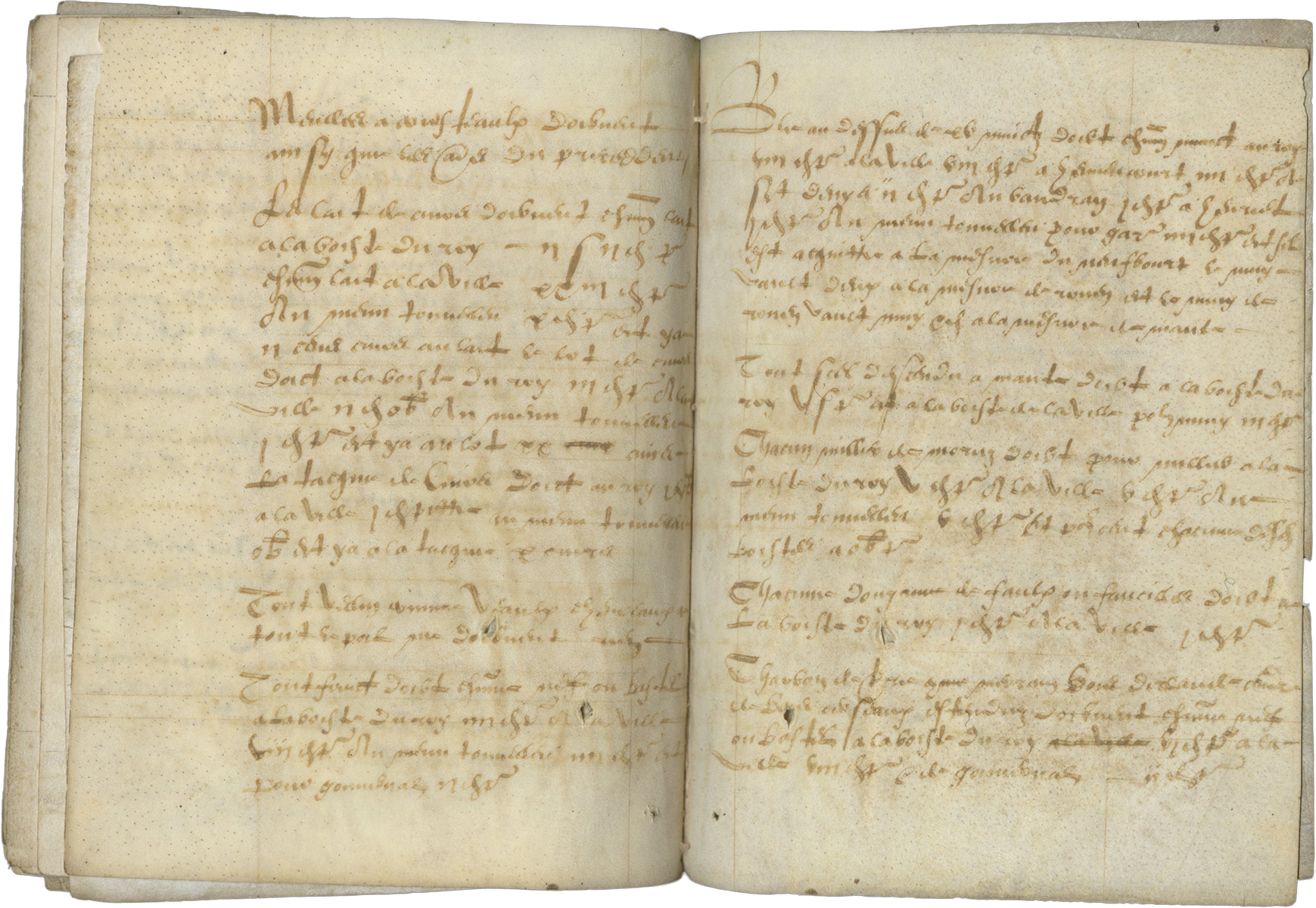
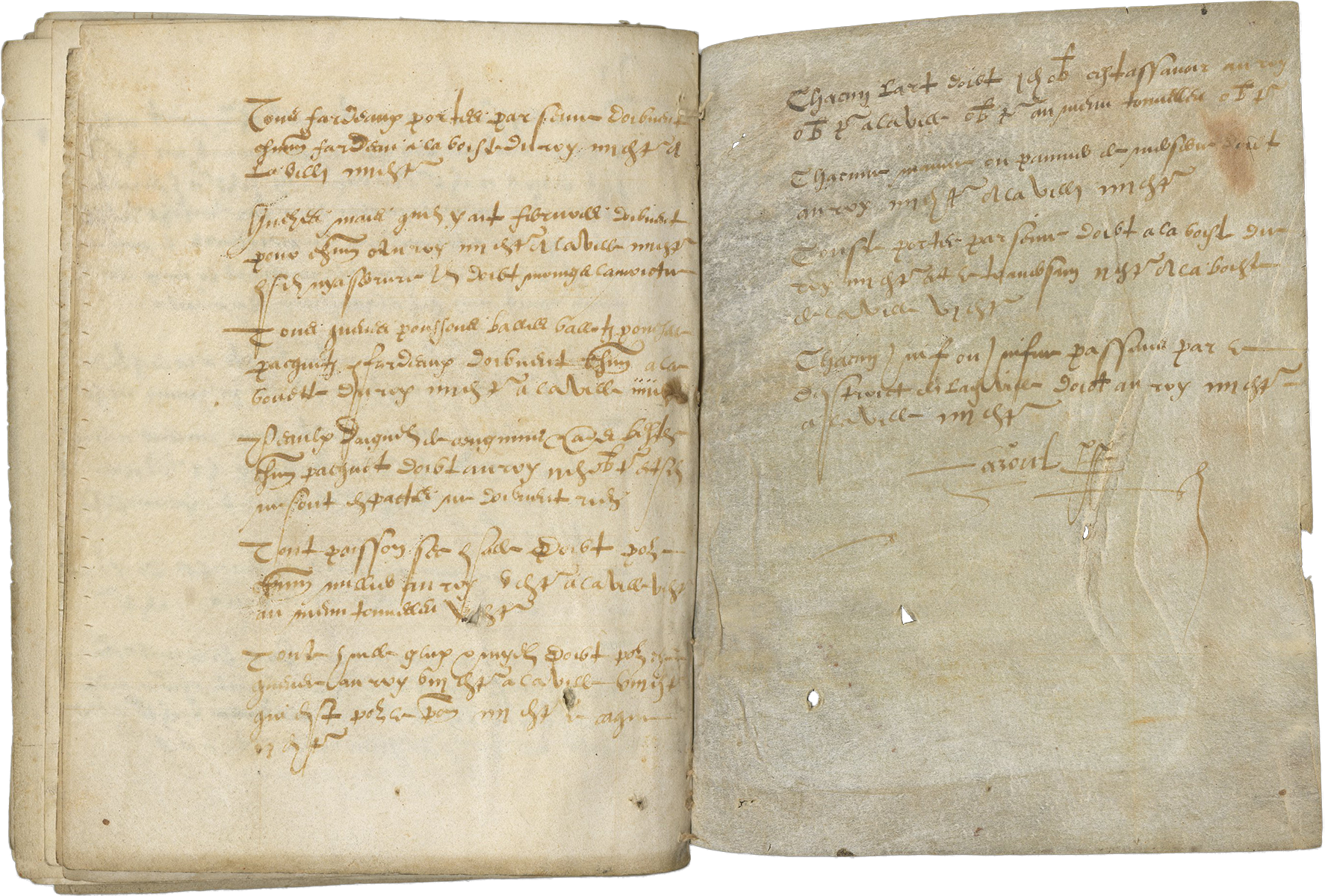
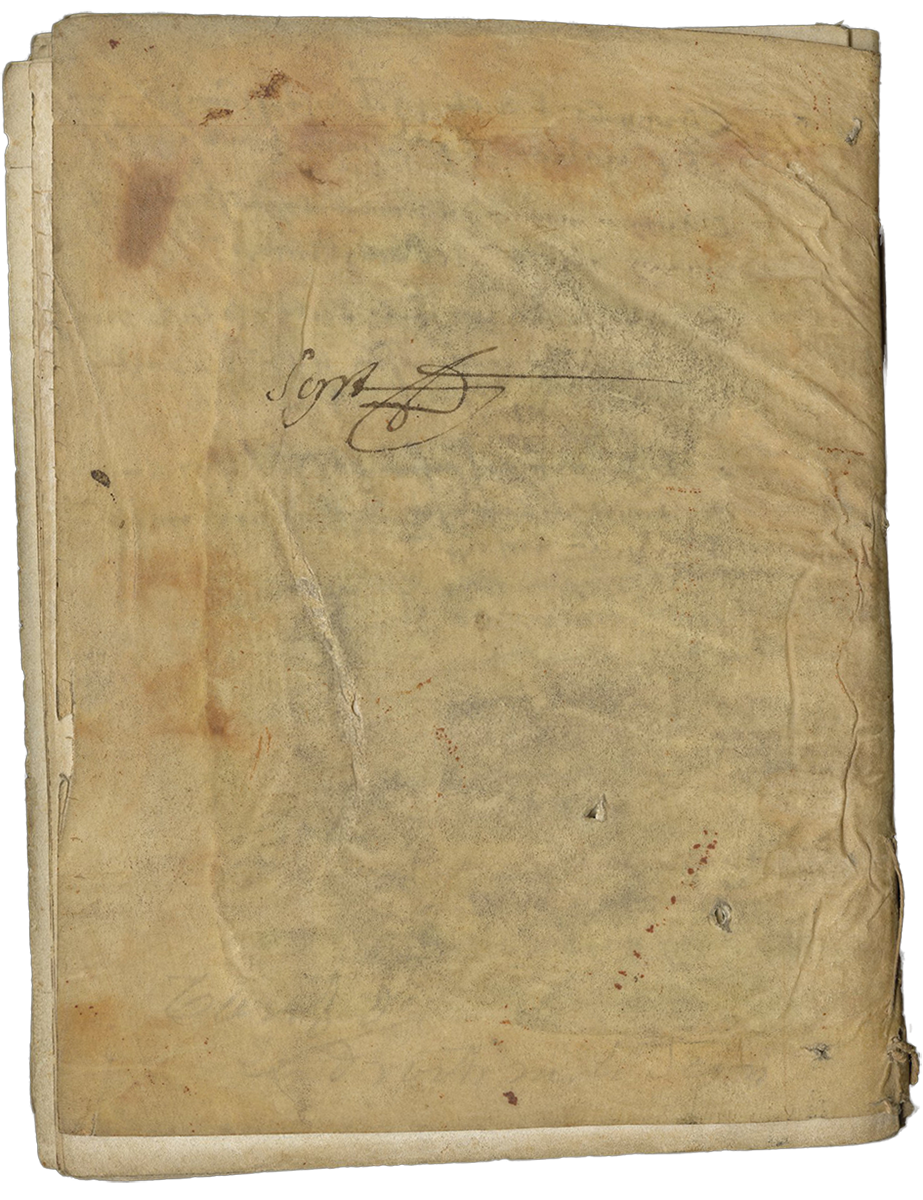
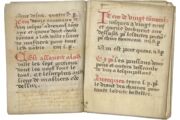
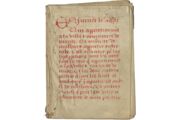
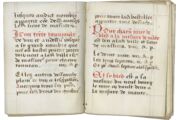
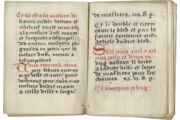
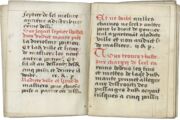
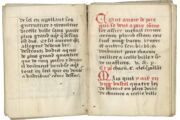
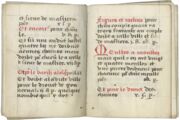
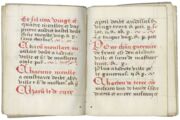
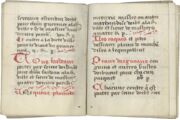
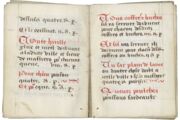
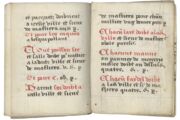
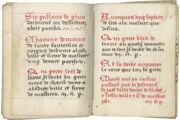
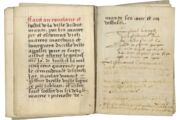
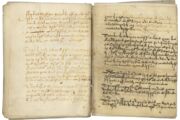
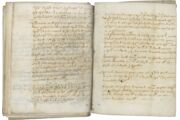
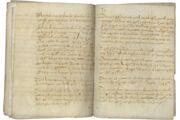
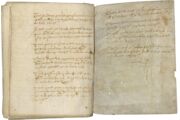
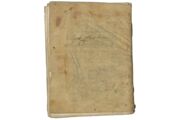
18 folios on parchment, modern foliation in pencil, 1-18, complete, (collation: i6 ii-iv4), no signatures or catchwords, frame ruled in brown ink (justification c. 103 x 78 mm), ff. 1-14 written in loopless hybrida script in brown ink in a single column on c. 16 lines, rubrics in red, 1-2-line initials in red, ff. 14-18 written in secretary script in different brown inks, some stains, small holes and signs of use, quire sewing partially detached, in overall good condition. Unbound. Dimensions 144 x 106 mm.
This manuscript is of exceptional rarity and presents details on navigation on the Seine between Paris and downstream ports, and more precisely the practice of water-merchants’ Hanse law at Mantes-la-Jolie in the mid-sixteenth century. Tolls levied include those on barrels of wine, and toward the end of the short volume tariffs levied on Jews are specifically singled out. The small, easily portable booklet was likely used by a local toll collector around 1540, when the bourgeois authorities of Mantes had recently revised the tariff schedule.
Provenance
1. According to its contents the manuscript was made in Mantes-la-Jolie (some 40 km west of Paris), most probably soon after the toll tariff was fixed at the Mantes council on 15 July 1540.
2. Collection of Eugène Grave (1841–1916), pharmacist and historian; see his stamp at the head of folio 1: “E. GRAVE / Mantes (Seine).”
Text
In two sections:
ff. 1-14, rubric, “Ensuivent les acqits qui appartiennent à la ville et communaute de Mante. Et au sieur de Mafliers appartir entre eulx. Cest assavoir pour les sept portions dont les neuf font le tout qui appartiennent a ladite ville et communaute de Mante. Et les deux autres portions qui sont les huit et neufiemes qui appartiennent au dit Sr de Mafliers. Et autres droictz ... sur toutes et chacune les daires et marchandises passans, entrans, chargens et deschargens en l’acquit par eau de ladite ville, aval la riviere jusqu’au lieu la Folle Goiart estant sur icelle riviere auprès de la prise du boelx de Roulleboise. Et depuis icelle ville en montant ladite riviere jusques au lieudit Blanc Soleil a cet endroit une bourne pres Montalet en la forme et maniere qui ensuit. Et premièrement,” incipit, “Ont droict de prendre sur chacun tonneau de vin jusque a unze tonneaux … Faict au conclave et hostel de la ville dudict mante ... le quinziesme jour de juillet lan mil cina cens quarante par comendement desquelz Jay. Nicolas Vimart, greffier dicelle ville signee ce present tableau. Et iceluy faict sceller du sel deladit mairie et prevoste de mante les jour et an dessusdit”;
ff. 14-18, (added) incipit, “Ensuivent les acquits qui appartiennent au Roy notre Sire et le droit des parsonniers que le droict d’acquit appartenant a la ville … Chacun juif ou juifve passant par cet endroict de ladite ville doict au roy iiii d.p. (denier parisiis), à la ville vi d.p.”; f. 18v, signed “Sgn(?) D”, otherwise blank.
This manuscript contains a register of toll tariffs for the bridges of Mantes on the Seine. From at least the twelfth century, merchants, boatmen, and river carriers were required to pay acquit duties, divided between the town community of Mantes, the lord of the barony of Maffliers, and the Crown. The compact format of the small, portable booklet strongly suggests practical use by one of these toll collectors, or perhaps a merchant or trader operating along the Seine.
The first section, written in a formal hybrida script and fully rubricated, defines the division of revenues (seven-ninths to the town, two-ninths to the lord of Maffliers) and the geographical limits of the toll zone along the river, from La Folle Goiart downstream to Blanc Soleil upstream near Montalet. It then proceeds by itemizing duties levied on barrels and a wide range of goods, as fixed by a conclave of the town’s merchant-bourgeois on 15 July 1540. The date, place, and name of the greffier who recorded the act, are given on f. 13v-14: “Faict au conclave et hostel de la ville dudict mante ... le quinziesme jour de juillet lan mil cina cens quarante par comendement desquelz Jay. Nicolas Vimart, greffier dicelle ville signee ce present tableau. Et iceluy faict sceller du sel deladit mairie et prevoste de mante les jour et an dessusdit” (Done at the council and town hall of the said Mantes, on the fifteenth day of July in the year one thousand five hundred forty, by order of those aforementioned. I, Nicolas Vimart, clerk of the said town, have signed this present record, and caused it to be sealed with the seal of the said town hall and provostship of Mantes, on the day and year above written).
The second section seems to have been written about the same time, but in a faster, less formal hand. This addition outlines the Crown’s share of the tolls and associated rights, and concludes with specific levies, including per-person charges for travelers passing through the town.
The manuscript sheds light on the central role of river trade in supplying Paris. The Mantes toll was a major fiscal and commercial checkpoint that existed since at least the twelfth century. Located at a key point on the Seine, Mantes functioned as a commercial boundary between Norman merchants coming from downstream (Rouen) and Parisian traders upstream. It was also a major regional hub connected to surrounding agricultural and wine-producing areas. Tolls were dues tied to passage or services, such as navigating bridges, and were divided among numerous beneficiaries: the Crown, local lords, religious institutions, and private individuals. Ultimately, the Mantes toll illustrates how economic growth, privatization of fiscal rights, and administrative layering transformed a straightforward medieval levy into a complicated and contested fiscal system (cf. Cahen 1931).
By the 1540s, handwritten manuscripts were made for specific purposes, generally when printing a work was not commercially viable (as for local law, for example). The fine design of the Mantes tolls, copied in a formal script and rubricated, suggests that this portion of the manuscript was copied for official use in the area, probably by one of the toll collectors. However, not all the tolls were local, and so the official added the royal tolls himself into the second half of the manuscript. This manuscript comes from the collection of Eugène Grave (1841–1916), pharmacist and noted historian of the Mantois region. Grave refers to this very manuscript in his study “Un tarif du péage de Mantes au XIIIe siècle,” noting that while a tariff of 1532 had been studied by Guilmoto, he himself possessed an original “pancarte” from 1540 already somewhat different: “M. Guilmoto (...) a surtout eu en vue un tarif de 1532. J’en possède un en original de 1540, déjà un peu différent.” (Grave c. 1890, p. 100). While local toll registers remain in institutional collections, local rate books like this one are far rarer, and only occasionally land on the market, according to the Schoenberg Database of Manuscripts.
Literature
Cahen, L. “Ce qu’enseigne un péage du XVIIIe siècle: la Seine, entre Rouen et Paris, et les caractères de l’économie parisienne,” Annales d’histoire économique et sociale 12 (1931), pp. 487-518.
Caron, J.-J. “Notice sur les arts et métiers de Paris au XIVe siècle, et notamment sur la Hanse parisienne,” Mémoires de la Société des sciences morales de Seine-et-Oise, 1853, pp. 93-112.
Grave, E. “Un tarif du péage de Mantes au XIIIe siècle,” Bulletin de la Commission des antiquités et des arts du département de Seine-et-Oise, c. 1890 (likely c. 1892–1894) (The exact year, volume number and page numbers are not consistently indexed online and vary depending on the bulletin series; we have not been able to locate the article, the information comes from a previous sales record.)
Philippe, A. Le péage par eau de la ville de Mantes dans la première moitié du XVe siècle. [Mantes-la-Jolie ou Mantes-la-Ville (Yvelines)], Thèse de l'École des chartes, Paris, 1968.
Picarda, É. Les marchands de l'eau: Hanse parisienne et compagnie française, Paris, 1901.
Available online:
https://archive.org/details/lesmarchandsdele00pica/page/n7/mode/2up
Online Resources
Hanse parisienne des marchands d’eau:
https://fr.wikipedia.org/wiki/Hanse_parisienne_des_marchands_de_l%27eau