


Grant of Arms to Heinrich Scholtz
In German, illuminated manuscript on parchment
Austria, Vienna, 1650
TM 1531
- $3,500.00
 Textmanuscripts - Les Enluminures
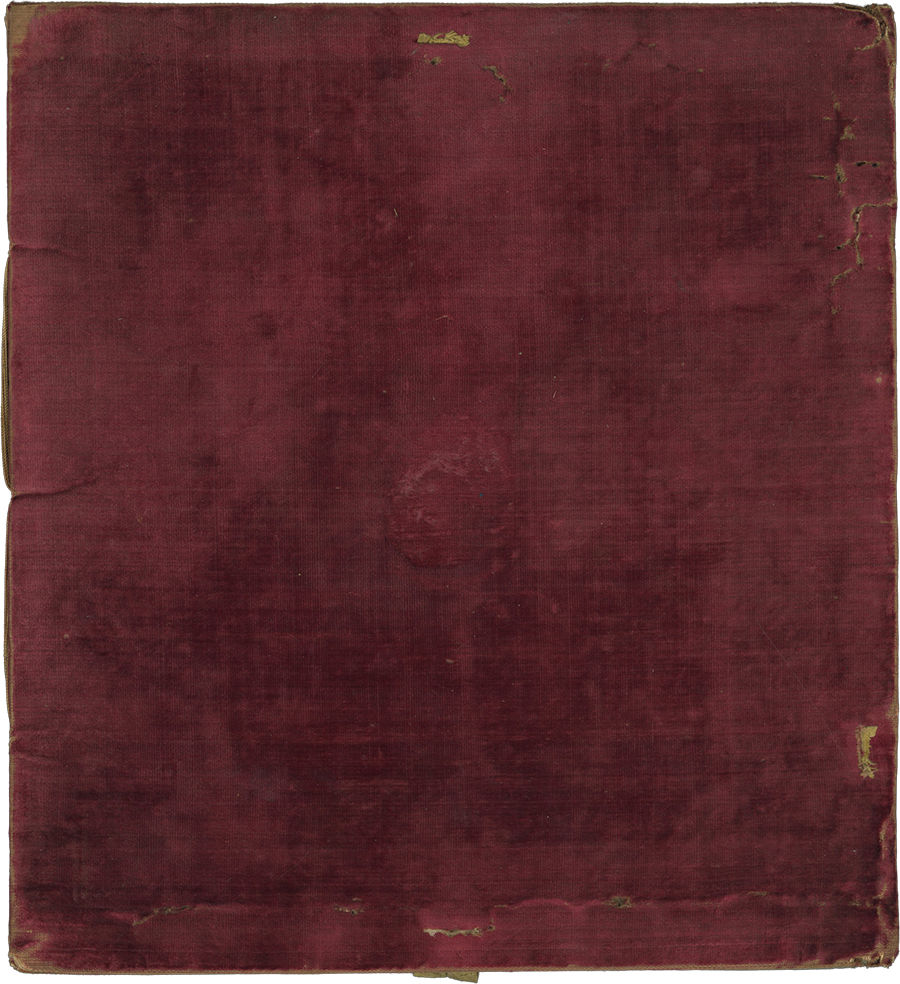
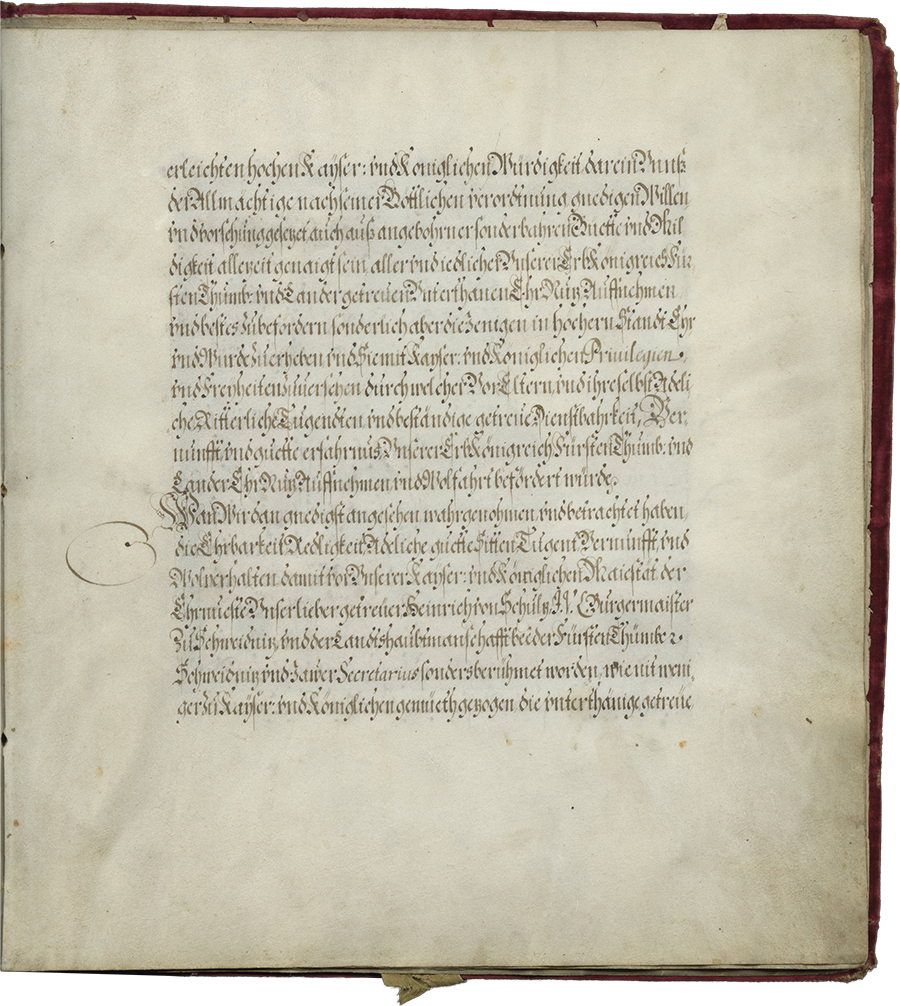
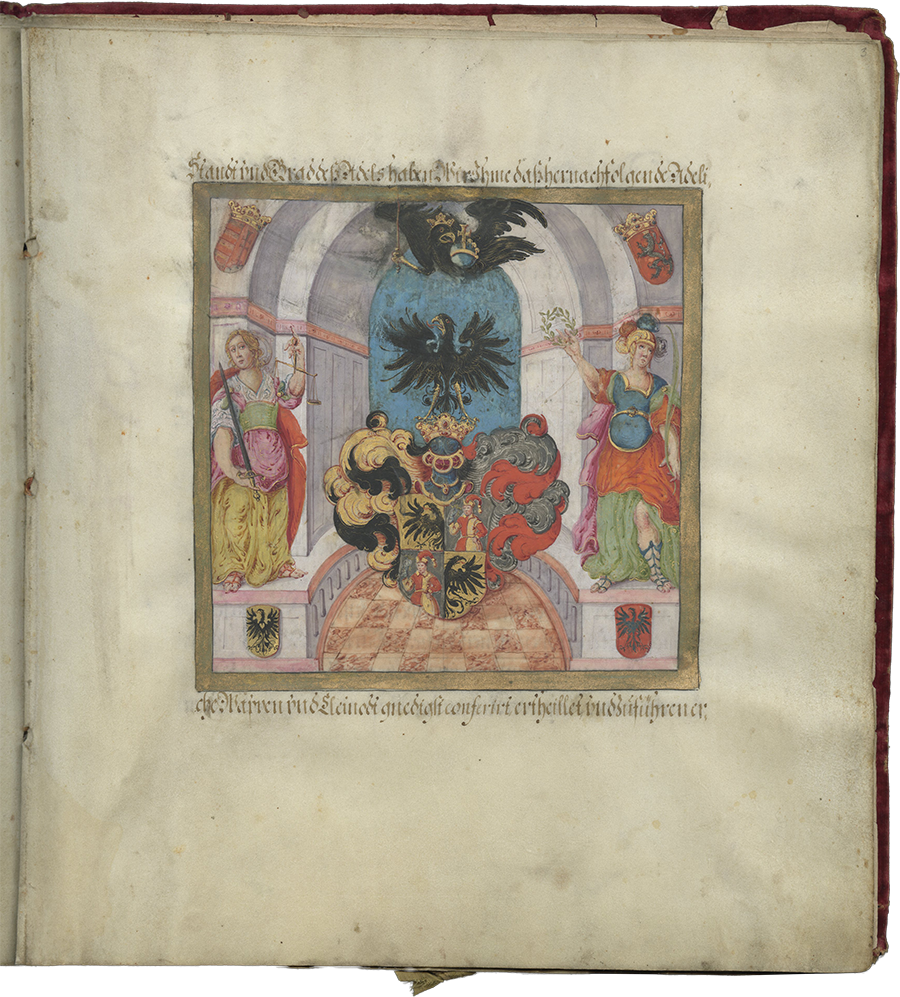
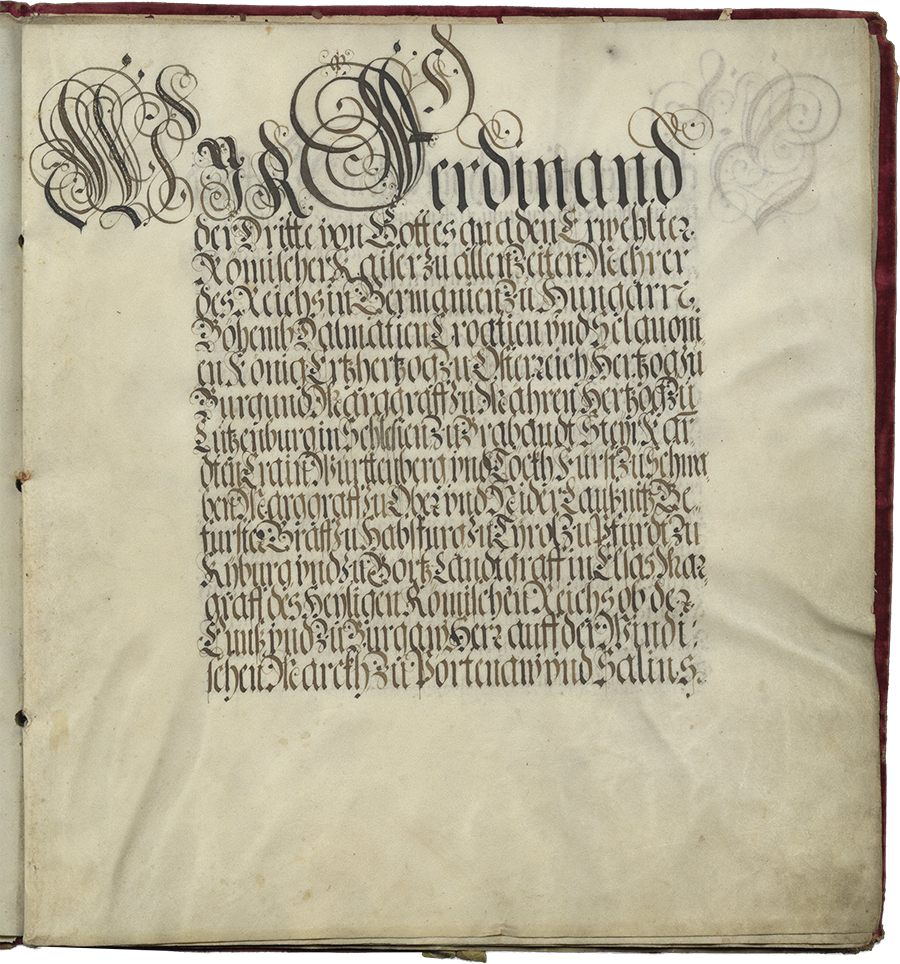
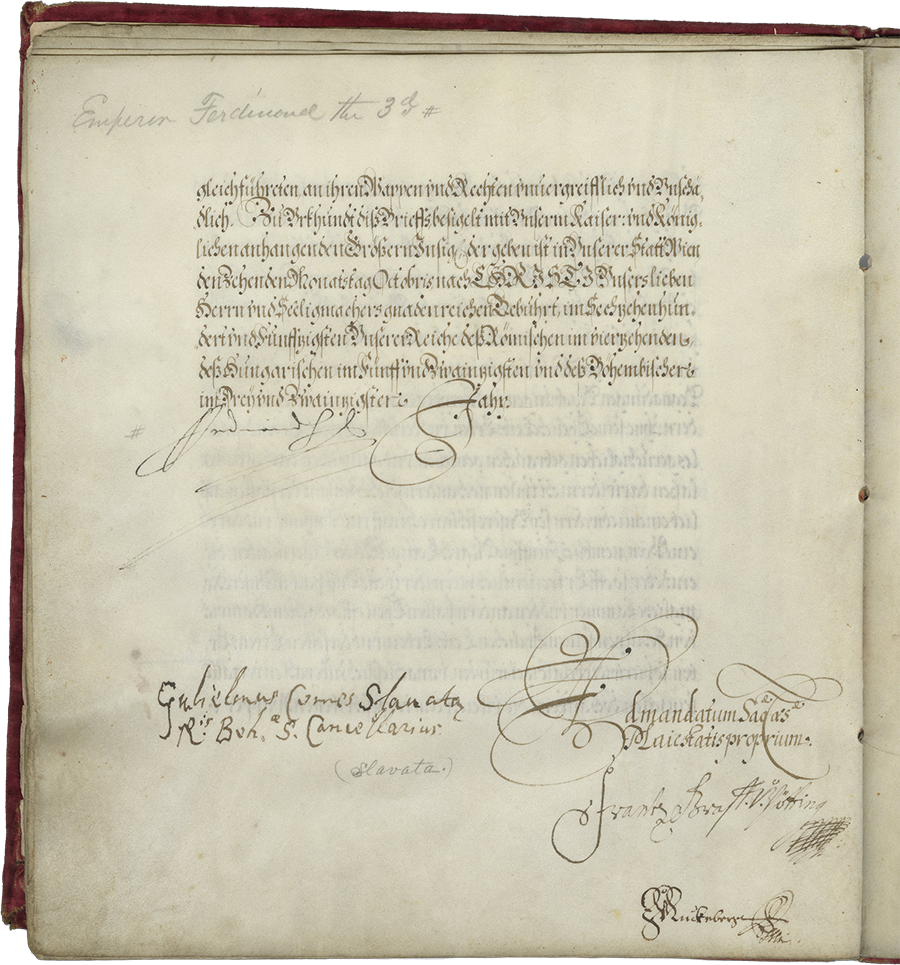
i (paper) + i (parchment) + 6 + i (parchment)+ i (paper) folios, foliated in pencil in upper right corner, (collation: i6), blind-ruled in single column of 18 lines (justification: 168 mm × 180 mm), written in a fine Kanzleischrift in brown ink with some marginal extensions, 1 MINIATURE three-quarters page in gold frame bearing heraldic imagery and allegorical figures. Bound in red velvet over pasteboards, remnants of three yellow ribbon ties, one ribbon extant, wear to velvet where the seal rested and at stress points, with small splits and abrasions to the covering, minor worming to the pastedowns, minimal cockling, and some staining and soiling to the margins, otherwise in good condition. Dimensions 290 × 315 mm.
An elegant, illuminated grant of nobility from Habsburg Poland, signed by the Emperor Ferdinand III, enclosed in velvet, and bearing an impressive American provenance stretching from a Chicago candy-maker to the William Randolph Hearst collection and beyond. Such letters patent survive as important witnesses to the administrative culture of the early modern state, and they also witness the survival of manuscript culture well into the modern era.
1. Heinrich Scholtz, who served as one of the rotating mayors of the city of Schweidnitz (present day Świdnica, Poland) during the critical years of reconstruction following the Thirty Years’ War (c. 1650–1655).
2. Typed paper label in book reads “Acquired from Gunther Sale, thru A.A.A., 11/12/25 [November 12, 1925].” This is Charles F. Gunther (1837-1920), the German-American candy-maker and Chicago politician whose substantial historical collection was acquired by the Chicago Historical Association (today the collection of the Chicago History Museum). The remainder was sold at auction. This manuscript was one of two grants sold as Lot 150, by the American Art Association on 11 November 1925, and the paper slip transcribes the auction listing (Online Resources).
3. William Randolph Hearst (1863-1951), belonging to the International Studio Art Corporation, the company he formed in the 1920s as a wholly owned subsidiary of his holdings, including his art, according to a typed letter dated 1941 describing Lot 1433 from Mr. Peter Fleming of Hammer Galleries, New York, inserted among the rear flyleaves. At that time the present grant remained paired with a second grant it sold alongside in 1925.
4. Collection of Dr. Scott Schwartz, New York, his bookplate and catalog number “MS 6” on front pastedown.
ff. 1v–2v, Imperial Adelsbrief (ennoblement diploma);
ff. 3–5, Wappenverleihung (grant of arms); f. 6, blank with single signature.
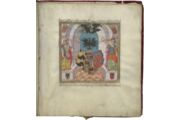
f. 3, a full-page miniature featuring Scholtz’s coat of arms, surmounted by a crowned helmet and an eagle, all set within an architectural niche flanked by allegorical figures of Justice and Victory with additional heraldic elements in shields positioned above and below the figures, and a crowned imperial eagle bearing the orb and sceptre.
This volume marks a rare and historically important letter patent that was signed by Emperor Ferdinand III with his sign manual (in his own handwriting). The grant was issued from the Imperial Chancery at Vienna for Heinrich Scholtz, one of the principal civic and regional officials overseeing the reconstruction of Silesia after the Thirty Years’ War. Combining the ceremonial authority of the imperial chancery with vibrant heraldic display, the document stands as a fascinating case of ennoblement favors granted to subjects in the service of the Habsburg Empire. Scholtz served as one of the rotating mayors of Schweidnitz during the critical years circa 1650–1655, when the city negotiated the construction of the Lutheran Peace Church while Catholic institutions simultaneously reestablished themselves under Habsburg patronage. Beyond his municipal office, he also acted as Regional Governor (Landeshauptmannschaft) and Secretary (Amtmann) for the joint administration of the Duchies of Schweidnitz and Jauer, the highest imperial authority in the region, placing him at the center of legal, fiscal, and administrative affairs during a decisive period of postwar recovery and confessional negotiation.
Governments across medieval and early modern Europe sought to control entry to the nobility, though both the benefits of, and the pathways to, attaining this status varied a bit country by country. Almost invariably, however, from England to Austria, the documents supplicants purchased to record the results of these processes are splendid (and continue to be so to this day), as Spanish cartas ejecutoria híldagua, French and English grants of arms, and the present document all attest (see Online Resources). Also invariably, such documents arise from the highly formalized bureaucracies of these developing nation-states and were drafted according to established legal formulas and copied in formal, elegant scripts on parchment or fine paper. Their authenticity was ensured through either signatures (in legal English literally the “sign manual”) and seals (sometimes both). The imposing layout, decorative lettering, and ceremonial language of grants of arms were carefully designed to project royal and imperial authority. The illumination in this document was likely executed by a local workshop typically employed for such government decoration. As official instruments of governance, such letters patent survive as important witnesses to the administrative culture of the early modern state and in the present case, to the mechanisms through which imperial policy was enacted across postwar Central Europe. They also witness the survival of manuscript culture well into the modern era.
Gross, Lothar. Die Geschichte der deutschen Reichshofkanzlei von 1559 bis 1806, Vienna, 1933.
Tennant, Elaine C. The Habsburg Chancery Language in Perspective, Berkeley, 1985.
Hochedlinger, Michael. Österreichische Archivgeschichte: Vom Spätmittelalter bis zum Ende des Papierzeitalters, Vienna, 2013.
Hiltmann, Torsten, and Laurent Hablot, ed. Heraldic Artists and Painters in the Middle Ages and Early Modern Times, Ostfildern, 2018.
Williams, Megan. “‘Zu Notdurfft der Schreiberey’: Die Einrichtung der frühneuzeitlichen Kanzlei,” in Diskurse – Körper – Artefakte: Historische Praxeologie, ed. Dagmar Freist, Berlin, 2016, pp. 167–86.
American Art Association, “Selections from the Charles F. Gunther Collection,” 12 November, 1925. https://archive.org/details/selectionsfromch00amer
Blanchard, Jean-Christophe. “Ennoblement and the Control of Grants of Arms in Sixteenth-Century Lorraine,” Virtus 29 (2022) https://virtusjournal.org/article/view/40779
English Heritage, “A Beginner’s Guide to Heraldry,” https://www.english-heritage.org.uk/guide-to-heraldry
Hansen, Kelli, and Mariana Guzman, “Cartas Ejecutorias: Nobility and Power in Early Modern Spain,” https://library.missouri.edu/specialcollections/exhibits/show/cartas-ejecutorias/home
Royal College of Arms, “Granting of Arms,” https://www.college-of-arms.gov.uk/services/granting-arms
TM 1531