

SIGUNA STIBICHIN (or STÜBICHIN), Arzneypuech (Book of Medicine)
In German, manuscript on paper
Styria (?), Austria, 1577-79
TM 1151
sold
 Textmanuscripts - Les Enluminures
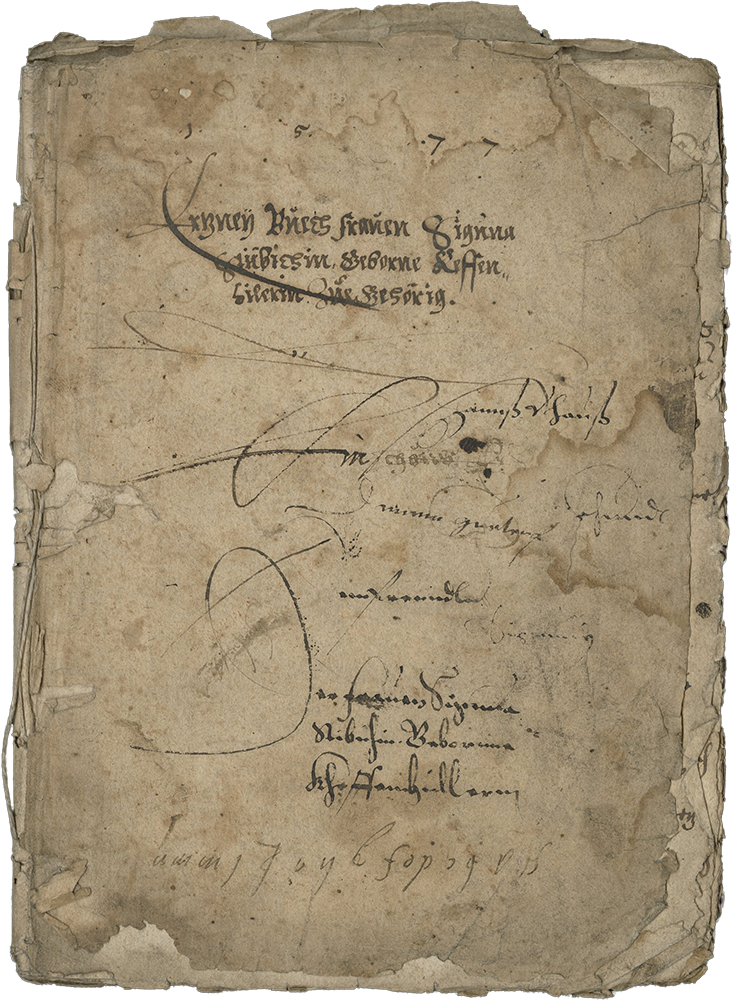
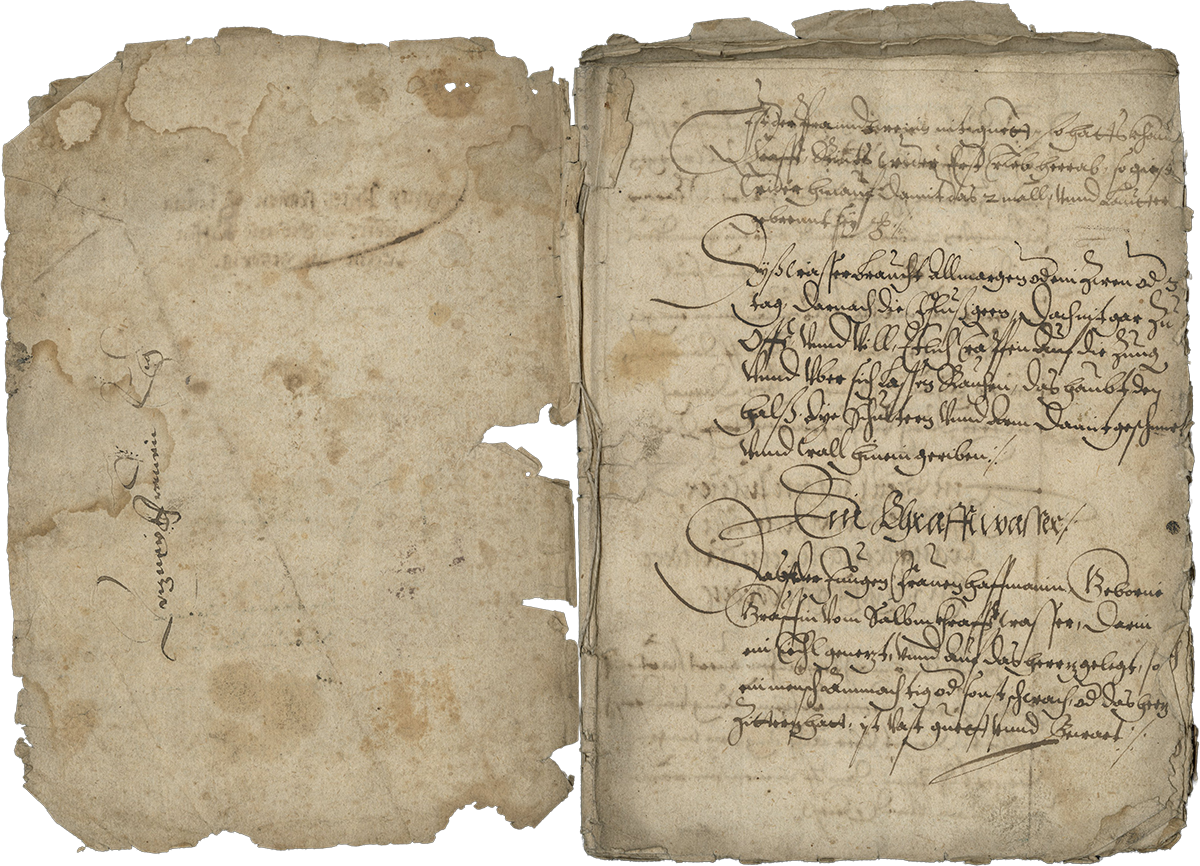
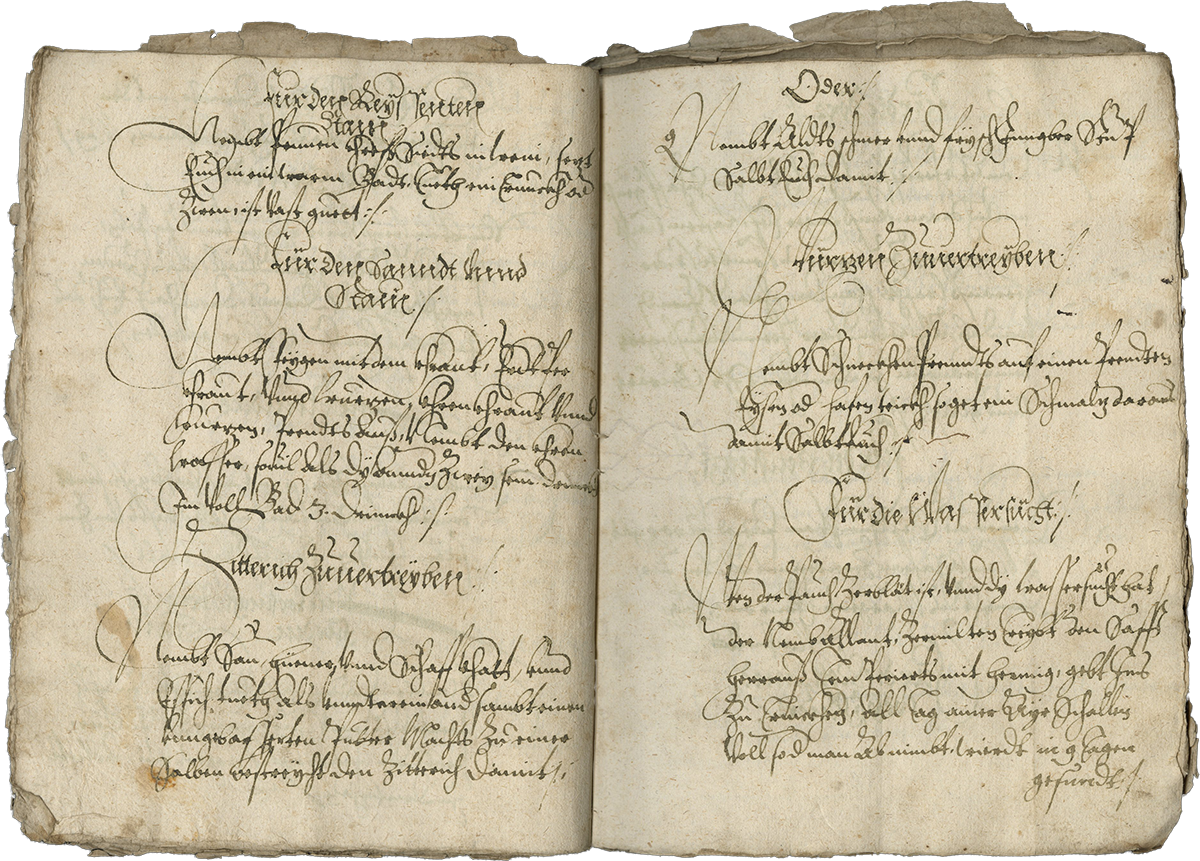
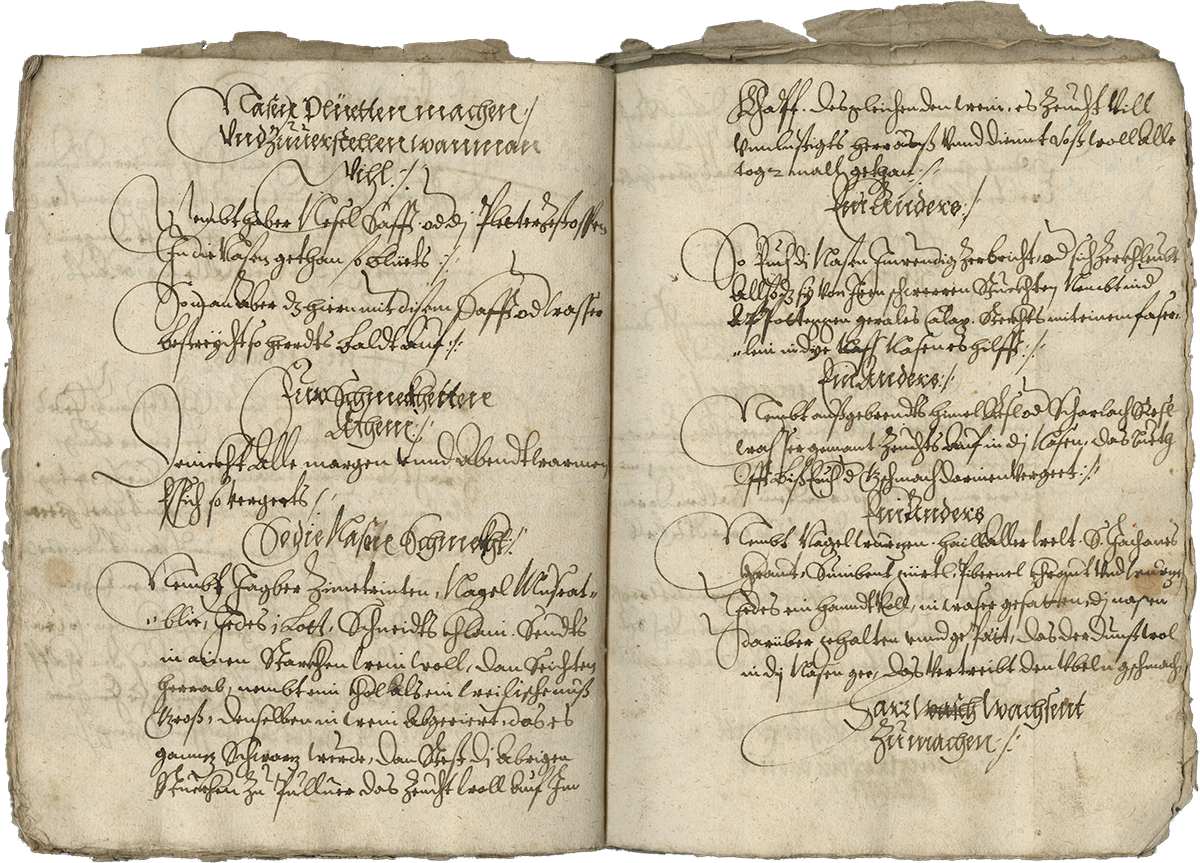
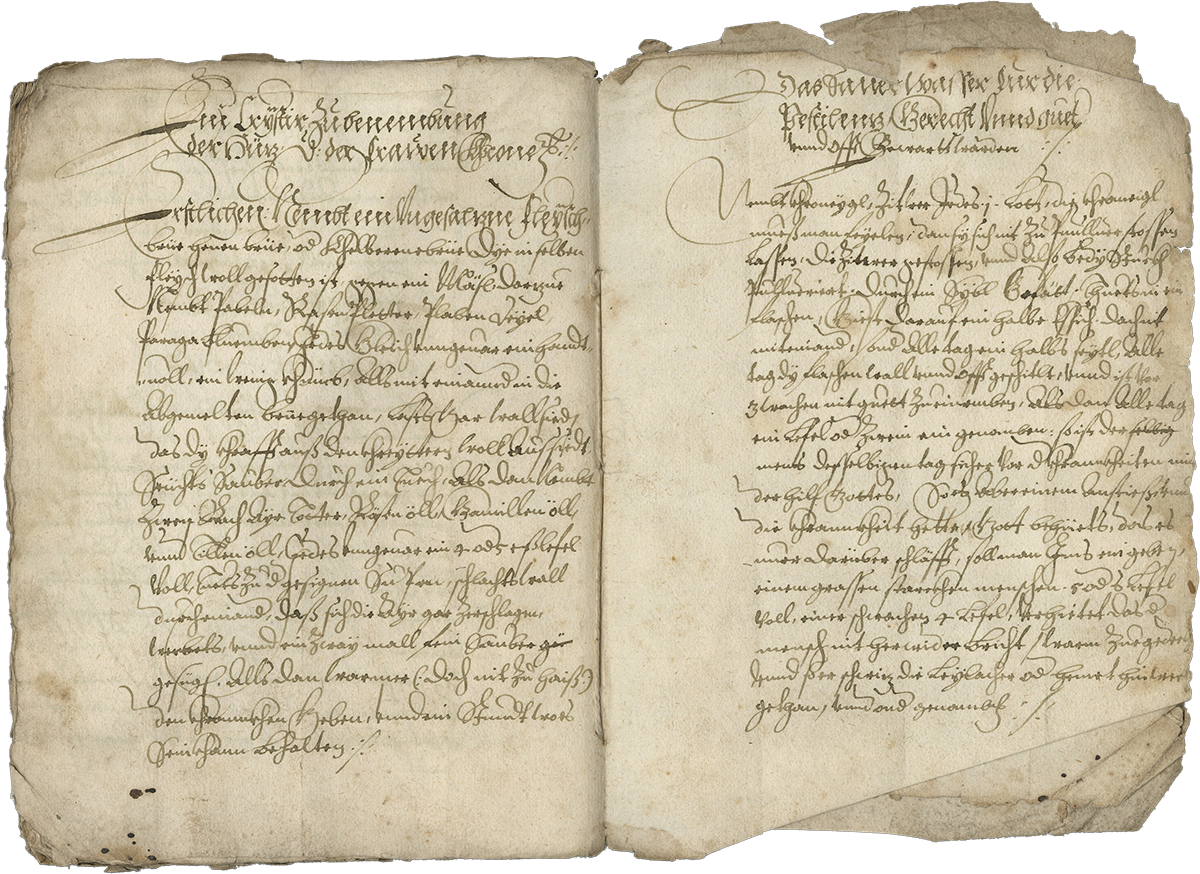
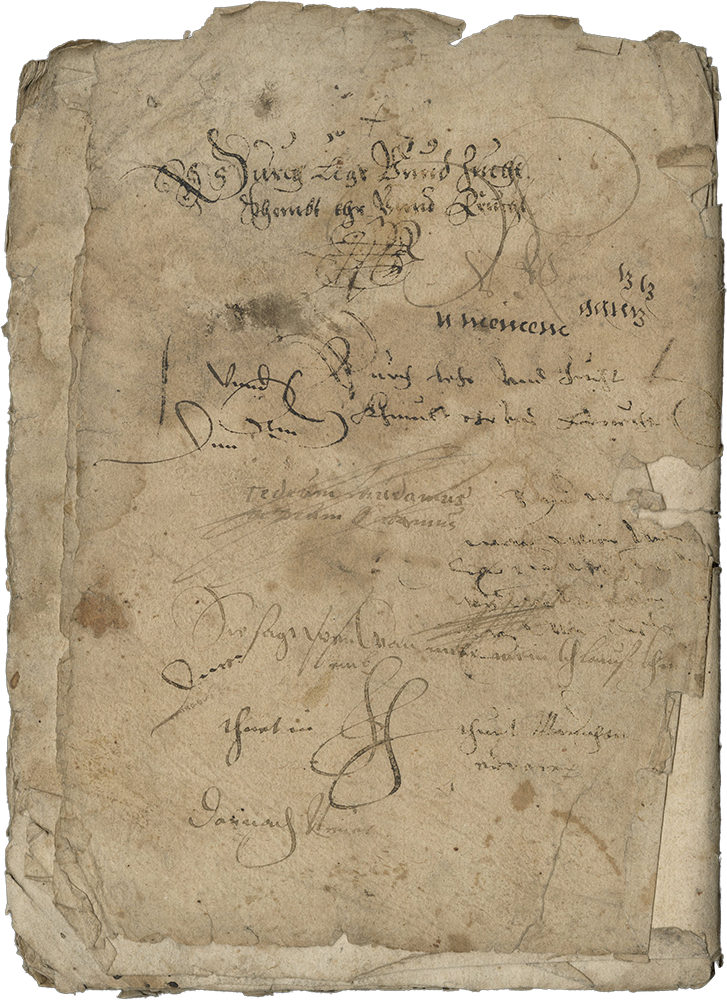
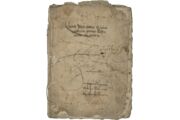
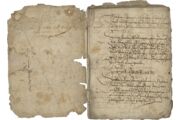
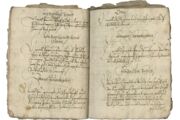
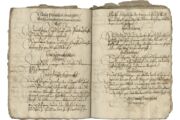
25 folios, paper, two fragmentary watermarks, complete, bifolium used as ff. 1 and 25 [25 blank], (collation: i20 ii4 [-4, no loss of text]), no catchwords, single column, unruled, 16-20 lines, (justification 172 x 120 mm), two hands, the main hand writing in an elaborately looped Kurrentschrift in brown ink, recipe titles written in a larger, angular Gothic cursive, a second hand writing only at ff. 13v-14 in a simpler, vertically compressed Kurrentschrift, folding at the corners, slight staining at the margins, tear at the top of f. 24 with minimal loss of text. Bound in a contemporary paper bifolium, dated 1577 on the front and 1579 on the back, several different hands have entered phrases and pen trials, binding very loose at the spine, moderately stained, fair condition. Dimensions 208 x 159 mm.
This manuscript survives as an important document to the role of women in the practice of early modern medicine. It is an extremely rare copy of a holograph medical recipe collection owned and likely lent out by a woman pharmacist containing around 80 recipes for common ailments of the eyes, ears, and throat, for an aqua vitae, and remedies against the “plague.” The tattered state of the binding is a material witness to the travels of this little book, and the numerous pen trials by different hands are like passport stamps from other users of the manuscript. Other extant collections of recipes are usually much larger and professionally copied, suggesting that this portable manuscript was Siguna’s personal copy, intended eventually to be copied into a larger collection of recipes.
1. Two inscriptions on the front cover of the manuscript identify “Siguna Stibichin [or Stübichin] geborene Kheffenhilerin” as the owner of this manuscript with a date of 1577. The back cover contains the date 1579 over another inscription “Durch Lehr und Zucht / kombt Ehr und Tucht” (Through learning and discipline comes honor and virtue). The Khevenhüller family was one of the most wealthy and powerful in Austria. The family had deep roots in Carinthia and governed the province throughout much of the sixteenth century. Siguna, however, only appears in Gabriel Buchelin’s Germania topochronostemmatographica sacra et profana (pars tertia, p. 226) under the entry “Iohannes Stibich de Spielfeldt & Marnberg, uxor Siguna Keuenhillera”.
2. The pen trials of several different hands are indicative of several users of this manuscript. It is likely that this manuscript was lent to other women healers within Siguna’s noble, medical circle.
3. Munich, Zisska & Lacher Buch- und Kunstauktionshaus, Auction 74/75, July 13, 2020, lot 8.
ff. 1-24, [Collection of medical recipes], ff. 24v-25v blank.
This manuscript contains eighty recipes and their variations to produce medicines for various ailments. There are a number of recipes for medicaments for the ears, throat, and eyes; for edema (f. 8, Für die Wassersucht); and a few recipes to help treat the “plague” (e.g. f. 9v, Ein drankh für die Pestillennz). There is also a long recipe for the preparation of an aqua vitae (“Eine geistlich aqua vitta”) on ff. 4r-6r, a popular medicine of distilled alcohol and herbs. The recipes must have been gathered sometime before the compilation was put together from 1577 to 1579. However, the dates on the cover of the manuscript may actually be markers of when the manuscript was lent or received by Siguna. Some of the recipes belong to Siguna Stübichin, while others are credited to other women apothecaries, e.g. a “Frau Hoffmannin” on f. 1 and “von der Eichstetterin” on f. 14. In the sixteenth century, vast epistolary networks developed between noblewomen, who shared recipes and medical knowledge (see Rankin, 2013, pp. 25-60). Siguna was very likely an active participant in this network, testing recipes received from other noblewomen and sharing her own. This manuscript is the fruit of these cooperative labors.
Several other recipe collections of differing size and quality have been preserved in the Codices Palatini germanici collection in the Universitätsbibliothek at Heidelberg. Most notably, the recipe collections of Regina David Zangenmeister (ca. 1533-1597), whose husband was the Heidelberg merchant, David Zangenmeister, have been preserved in Cod. Pal. germ. 227, 248, 251, and 277 (see Die Codices Palatini germanici and ONLINE RESOURCES for detailed descriptions and facsimiles). These Heidelberg collections contain several hundred to well over one thousand recipes. In Cod. Pal. germ. 227, written sometime after 1580, but containing Regina’s preface to the collection written in 1567, Regina remarks that she “owned several little handwritten books of medicine, or books of art,” which she compiled at the request of Claudia of Oettingen (d. 1582). Regina emphasized further in her dedicatory letter to Claudia that “her recipes had not been taken or copied from printed books, of which everyone can obtain an exemplar for money” (Rankin, 2013, p. 61).
The production of large recipe collections typically began with smaller books. Two noblewomen in the sixteenth century, Anna of Saxony (1532-1585) and Dorothea of Mansfeld (1493-1578), exchanged recipes and letters. In one letter Dorothea “asked Anna to return a well-worn recipe collection she had borrowed previously, which Dorothea referred to as her ‘ugly little old book’. She stated: ‘I want to copy something from it that I have not written down anywhere else’” (Rankin, 2013, pp. 78-79). While unfortunately the “ugly little old book” does not survive, Siguna’s recipe collection in TM 1151 could be a similar booklet intended for sharing recipes with other pharmacists.
The epistolary manuscript culture of Early Modern medical writing also reflected women’s adoption of empiricism as a new locus of authority. Whereas medical faculties within universities privileged classical authorities, like Galen, and deductive reasoning, many lay individuals championed nature and the observation of nature as the ultimate authority (Toellner, 1984, pp. 169-78). Women medical practitioners relied upon their own observations and based their authority on the efficacy of their medicines. As Alisha Rankin notes, “firsthand knowledge could be a powerful form of evidence in vouching for medical remedies” (Rankin, 2013, p. 39). These recipe collections not only provided an “outlet” for “women’s pharmaceutical knowledge” but also highlighted “women’s prominence as healers” in the early modern era in a distinctly written medium (Rankin, 2013, pp. 69-71).
This manuscript is an exquisite work of cursive penmanship and a rare instance of a working copy of a recipe collection. Even more remarkable are the signs that the manuscript was lent to other members of Siguna Stibichin’s circle. Further study into the textual relations of the recipes in the manuscript with other contemporary collections and archival work to uncover the social relations of noblewomen and male medical practitioners will surely reveal much about the practice of pharmacology in the sixteenth century.
Büchi, Jakob. Die Entwicklung der Rezept- und Arzneibuchliteratur, 2. Teil: Die Autoren, ihre Werke und die Fortschritte im 16. Jahrhundert, Zürich, 1984.
Die Codices Palatini germanici in der Universitätsbibliothek Heidelberg (Cod. Pal. germ. 1-181), ed. Karin Zimmermann, Wiesbaden, 2003.
Die Codices Palatini germanici in der Universitätsbibliothek Heidelberg (Cod. Pal. germ. 182-303), ed. Matthias Miller and Karin Zimmermann, Wiesbaden, 2005.
Eis, Gerhard. Medizinische Fachprosa des späten Mittelalters und der frühen Neuzeit, Amsterdam, 1982.
Murphy, Hannah. A New Order of Medicine: The Rise of Physicians in Reformation Nuremberg, Pittsburgh, 2019.
Rankin, Alisha. Panaceia’s Daughters: Noblewomen as Healers in Early Modern Germany, Chicago, 2013.
Schönfeld, Walther. Frauen in der abendländischen Heilkunde, Stuttgart, 1947.
Toellner, Richard. “Zum Begriff der Autorität in der Medizin der Renaissance,” in Humanismus und Medizin, ed. Rudolf Schmitz and Gundolf Keil, Weinheim, 1984: pp. 159-179.
Buchelin, Gabriel. Germania topochronostemmatographica sacra et profana. Pars tertia. Frankfurt, 1672. (https://archive.org/details/bub_gb_g7w-AAAAcAAJ_2/page/n363/mode/1up)
Heidelberg, Universitätsbibliothek Heidelberg, Cod. Pal. germ. 227 (https://digi.ub.uni-heidelberg.de/diglit/cpg227_v2/)
Heidelberg, Universitätsbibliothek Heidelberg, Cod. Pal. germ. 248 (https://digi.ub.uni-heidelberg.de/diglit/cpg248)
Heidelberg, Universitätsbibliothek Heidelberg, Cod. Pal. germ. 251 (https://digi.ub.uni-heidelberg.de/diglit/cpg251)
Heidelberg, Universitätsbibliothek Heidelberg, Cod. Pal. germ. 277 (https://digi.ub.uni-heidelberg.de/diglit/cpg277)
Peball, Kurt. “Khevenhüller (Khevenhüller-Frankenburg, Khevenhüller-Metsch), von.” Neue Deutsche Biographie, 1977. (https://www.deutsche-biographie.de/sfz42037.html#ndbcontent)