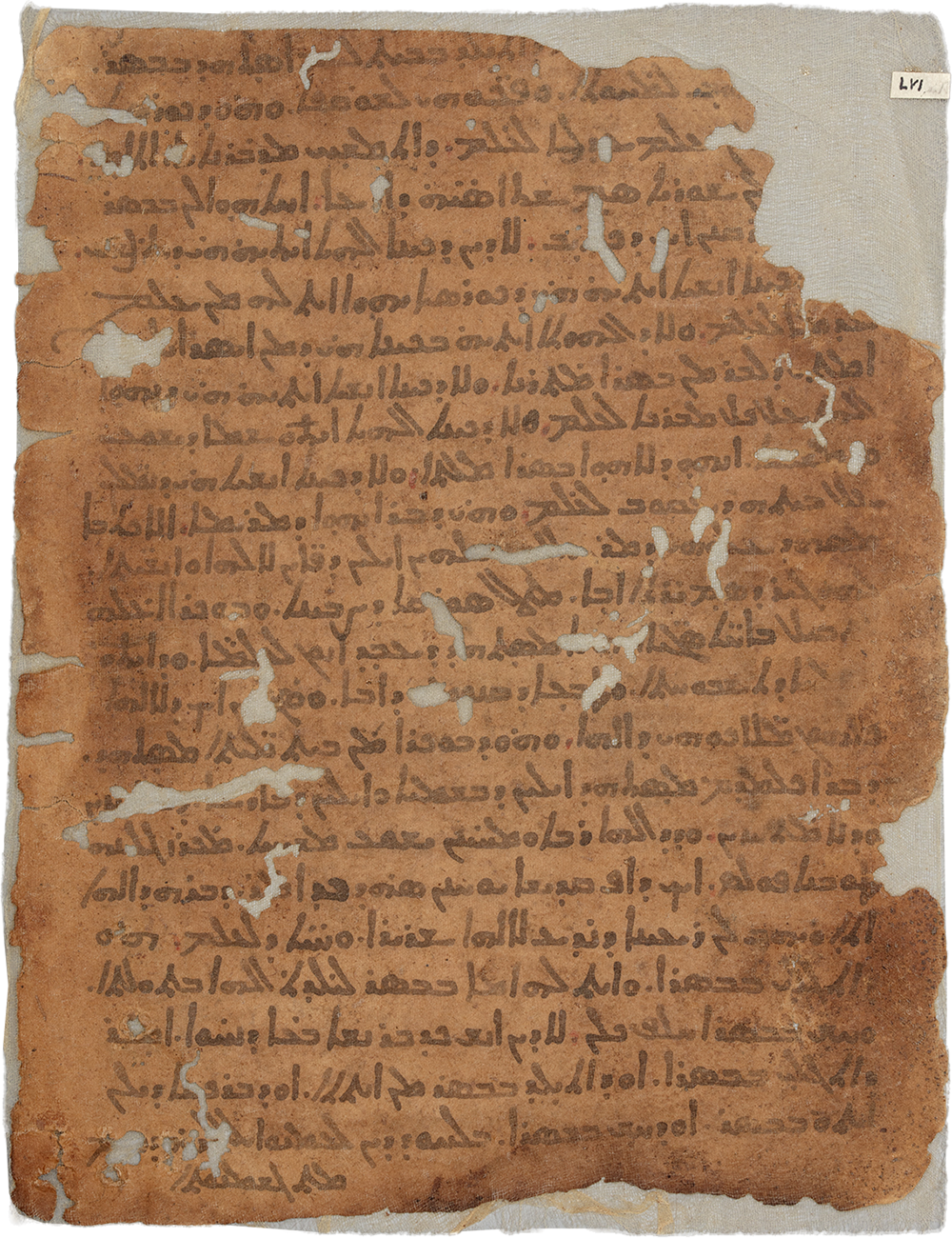
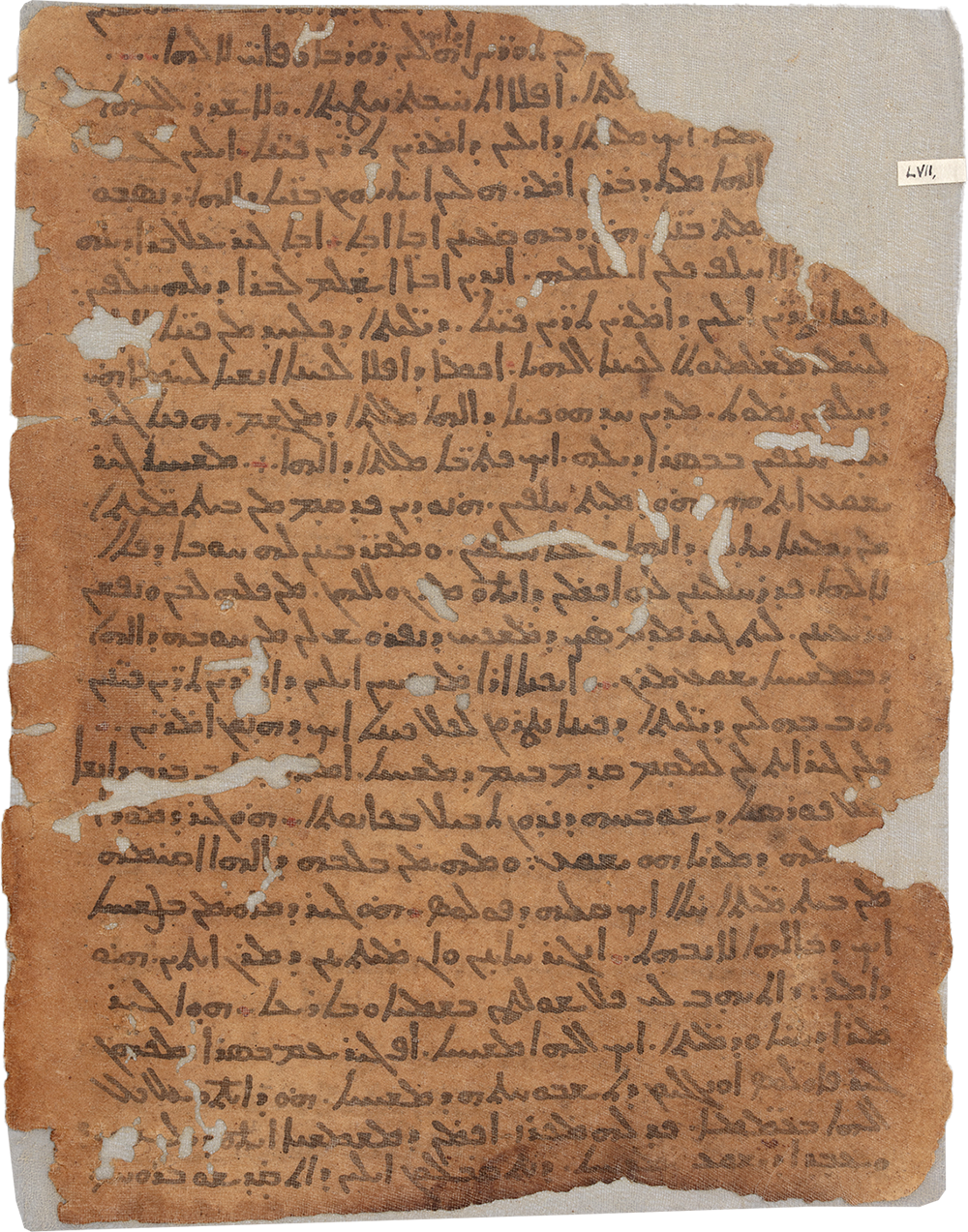
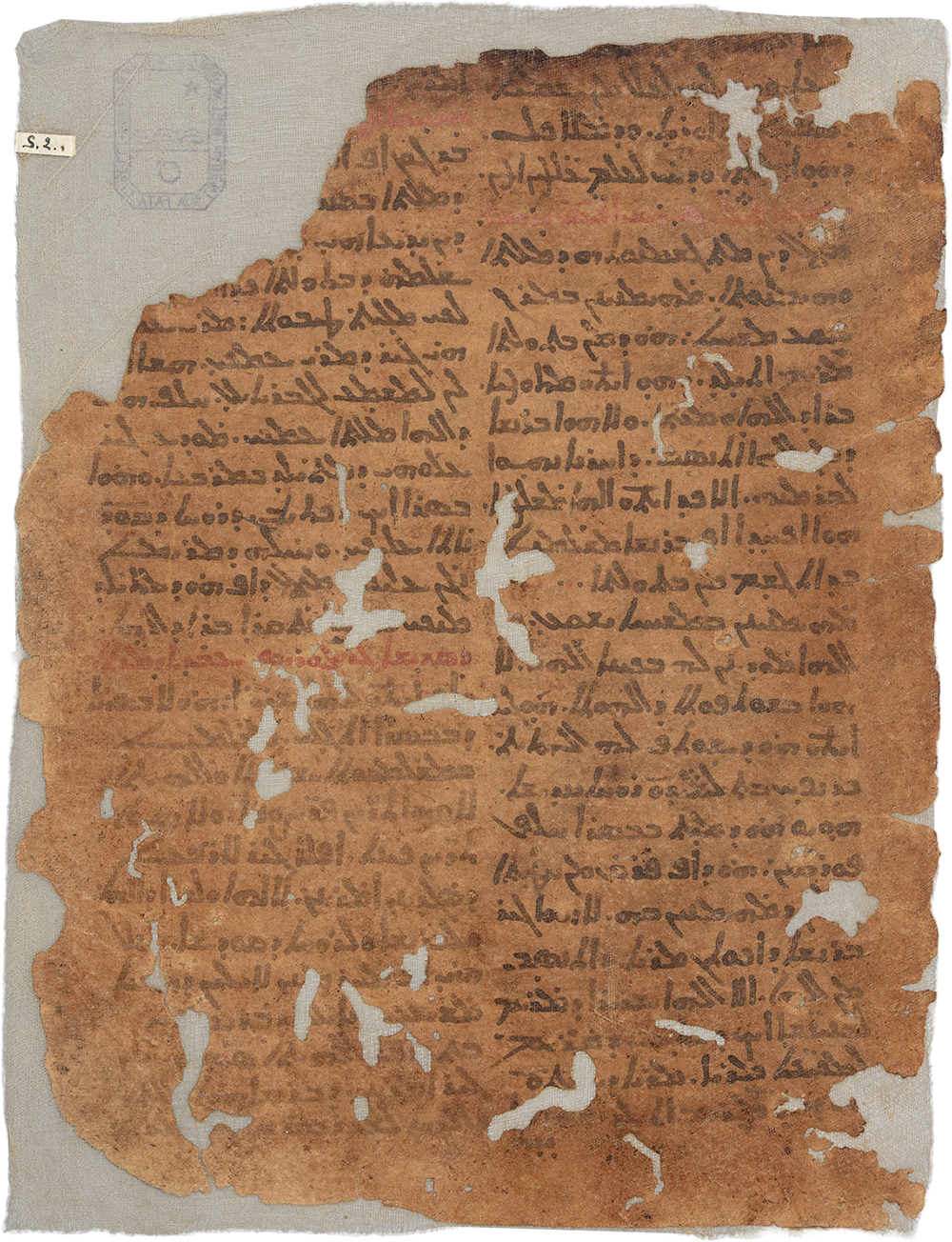
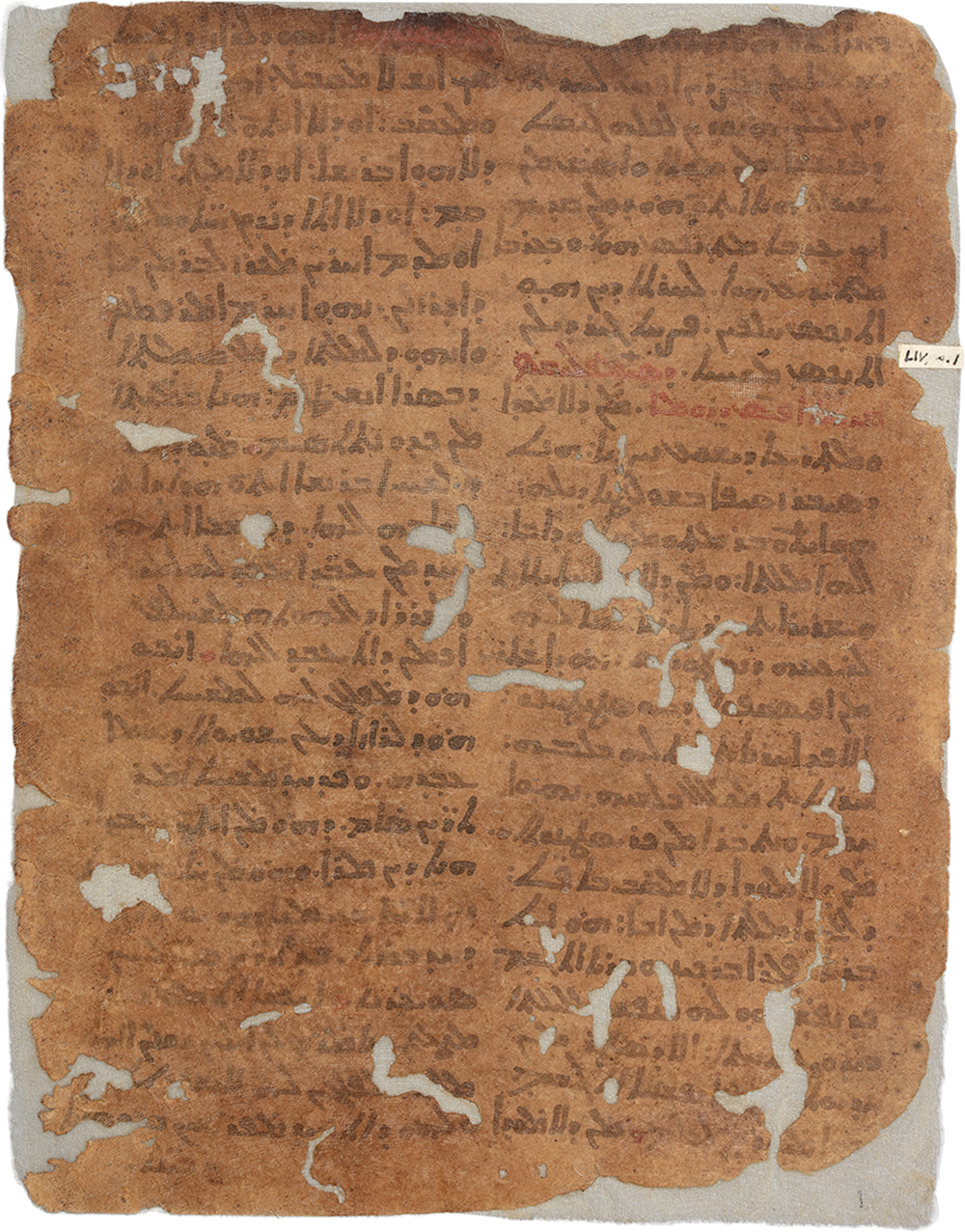
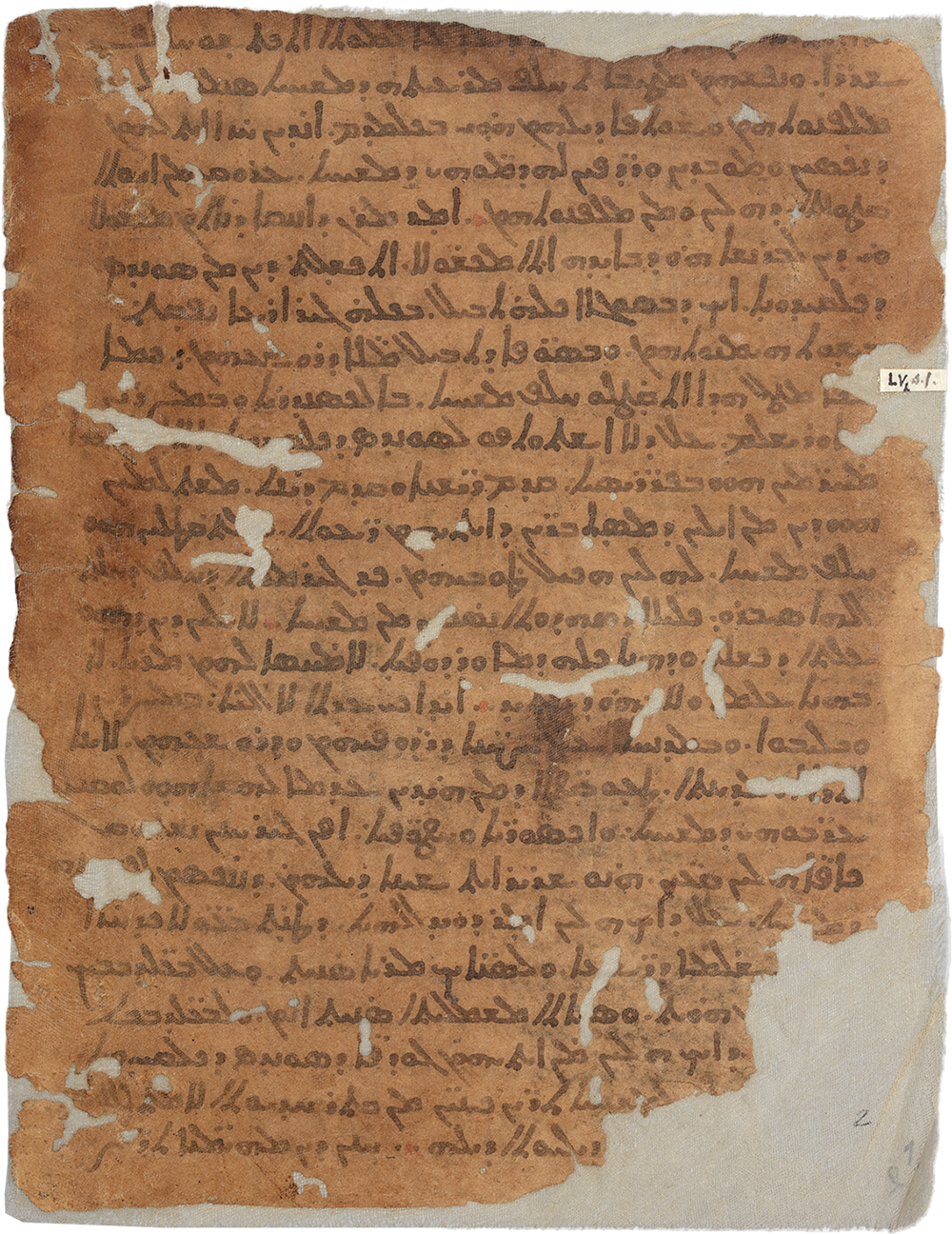
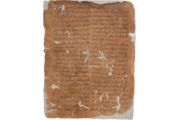
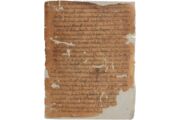
5 folios, on paper, disbound, written in black ink on 16 lines per page (a few lines missing occasionally at the tops of the pages), the columns vary in width from 55 x 70 mm. to 62 x 65 mm. with very little space between then, justification incalculable, ruling not visible, en Syriac language and serto script, with the following characteristics beth (sometimes) and quph still with sharp angles; gomal: high right arm; lunate mim (LIIIv col. 1, three examples); flat topped shin, several abbreviations: ܕܩܘܕ ܩܕ ܐܦܝ̈ܣ ܐܦܝ̈ܣܩܘ ܐܝܬܘ. In one or two columns (2 columns folios: LIIIr, LIIIv. LIVr; 1 column folios: LIVv, LVr, LVv, LVIr, LVIv, LVIIr, LVIIv), rubrics in red as follows on LIIIv (col. 1: Felix bish(op) of Ro[me]; col. 2: Of the holy Gregory the Wonder-Worker); LIVr (col. 1: Simplicius, holy bish(op) of Rome; LIVv mid page: the letter yud = 10, faint traces of some further rubrics, leaves trimmed, some with holes and slight loss of script, and restored, held in place by silk crepeline or chiffon, sometimes called silking. Dimensions 210 x 160 mm.
A fragment of the earliest dated Syriac manuscript on paper. A sister folio is signed and localized by the 10th-century scribe, and the group bears an unbroken provenance in the West extending from the late 19th-early 20th century to the present day. The fragments contain two early Christian texts, originally written in Greek but no longer extant in that language; rather they exist solely in an incomplete earlier Syriac manuscript found today in the British Library. They are written in serto, a cursive West Syriac writing system that became prominent after the eighth century and was used extensively in West Syriac Christian communities.
Provenance
1. The manuscript is signed, dated, and localized on another fragment from the same group (Moberg Fragment f. LXXXr [location unknown]. On f. LXXXr, it is stated that the manuscript was written by a certain Stephanos son of Matta (Mathew) in the Church of St. Thomas, Qaryatein, Syria on Tuesday, Nisan (April) 1243 of the (Seleucid) Greek era (= CE 932). This church is a historic Syrian Christian sanctuary, located in an oasis in the Homas desert in central Syria surrounded by archaeological evidence from many other churches ad monasteries attesting to centuries of Christian heritage.
2. Erik Vilhelm Virén (1895 - 1971), Sweden, an orientalist, professor Univeresity of Lund.
3. Private Swedish Collection (most likely the heirs of Erik Vilhelm Virén).
4. Sold Stockholm Aukionswerk, 12 June 2006 to Sam Fogg.
5. Sold to the Assad Family, London, Collection of the son of Malke, Elias Malke Assad, published Assad, 2015, no. 9, pp. 32-33. Elias Malke Assad studied at the University of London School of Oriental and African Studies and amassed a significant art collection, parts of which were exhibited at different times at SOAS.
Text
Five detached folios (traditionally identified as Fragments LIII-LVII) belonging to a manuscript dated 932, containing the anonymous Book of the Himyarites and Timothy Ailuros’s Against the Synod of Chalcedon (four of the folios contain the latter).
The manuscript to which the five folios belong consists of fragments extracted from the binding of a later Syriac manuscript (containing Anaphoras, dated 1469-70). The two works incorporated into the binding were published by A. Moberg in two separate publications: (1924; on the sixth-century martyrs of Himyarites, where he gives the text of Fragments, L-LII, and 1928, where he discusses primarily Timothy Ailuros’s work Against the Synod of Chalcedon and publishes facsimiles of the text of Fragment XXX). The five folios are part of a dogmatic florilegium (also preserved in Syriac in London, British Library Add. MS 12156, dated CE 562, containing short excerpts from Patristic authorities (these are identified in Moberg 1928, pp.7-8; on the BL manuscript see Wright, pp.639-648).
1.
The first folio and a half contain excepts from patristic sources from the Book of Himyrates, written in double columns and as follow:
Fragm. LIIIr-LIIIv, Irenaeus;
Fragm. LIIIv, Felix of Rome;
Fragm. LIIIv, Peter of Alexandria;
Fragm. LIIIv-LIVr Gregorius Thaumaturgus;
Fragm. LIVr, Simplicius of Rome;
Fragm. LIVr, Dionysius of Alexandria;
Fragm. LIVr Julius of Rome;
Fragm. LIVr Theodotos of Ancyra
The Book of the Himyarites is an anonymous Syriac account that describes the persecution and martyrdom of the Christian community in Najran by the Jewish king Dhu Nuwas around 523 AD. Recently transcribed and translated into English from the sole known manuscript, the text is an important source for the traditions of the expansion of Christianity into Arabia and the interactions of Christians with Jews, told from both Christian and Muslim sources.
2.
The core of the present group, not divided into columns, consists of the last four folios, Fragm. LIVv-LVII, which contain a section of Timothy Ailuros’s polemical work Against the Synod of Chalcedon.
Of an unknown birth date, Timothy Ailuros (died July 31, 477) was a prominent theologian in his day. He was Patriarch of Alexandria in 457, expelled and banished in 1460, and then restored in 1475 serving until his death in 1477. He led the intellectual opposition to the chief tenets of the Council of Chalcedon (451), which held that Christ existed in two natures after the Incarnation, Human and Divine. This was in direct contraction to the established orthodoxy of the First Council of Ephesus (431), which formally declared that Jesus Christ is one single, undivided person who is simultaneously fully God and fully man. Timothy’s writings and theology, including the present work, exercised a profound lasting impact on Syria. They directly shaped the anti-Chalcedonian movement that eventually led to the formation of the Syriac Orthodox Church.
Literature
Assad, Elias Malke. Pearls from Heaven: The Assad collection of Syriac Manuscripts and Works of Art, London, 2015, no. 9, pp. 32-33 (publishing this manuscript).
Moberg, Axel. The Book of the Himyarites, Lund, 1924
Moberg, Axel. On some Syriac Fragments of the Book of Timotheos Ailuros against the Synod of Chalcedon, Lund, 1928
Moberg, Axel. The Book of the Himyarites, Fragments of a Hitherto Unknown Syriac Work, Syriac Studies Library, 18, Gorgias Press, NJ, 2012.
Wright, W. Catalogue of Syriac MSS. in the British Museum, pp. 639-648. (on Add. MS 12156).
TM 1346