

Exchequer Tally Stick
In Latin, manuscript on wood
England, 29 September 1293 (21 Edward I)
TM 1521
sold
 Textmanuscripts - Les Enluminures
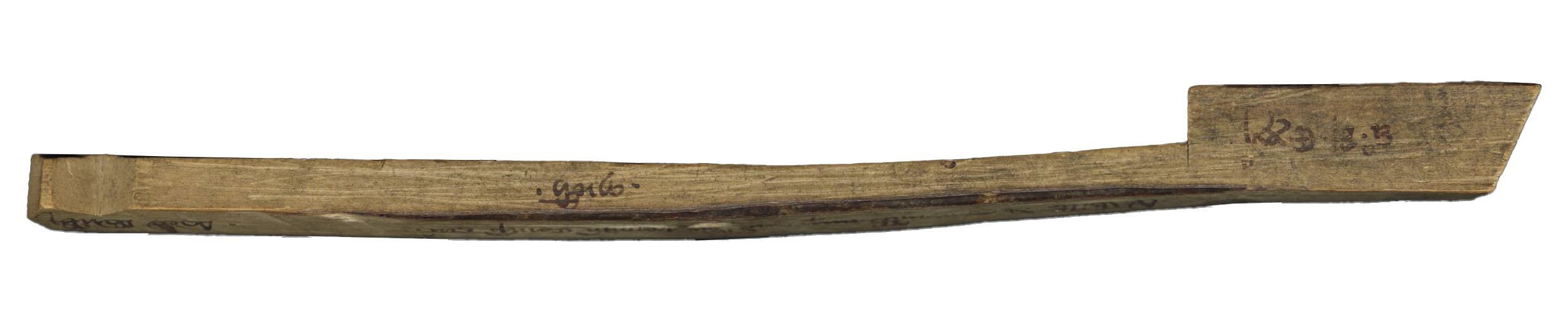
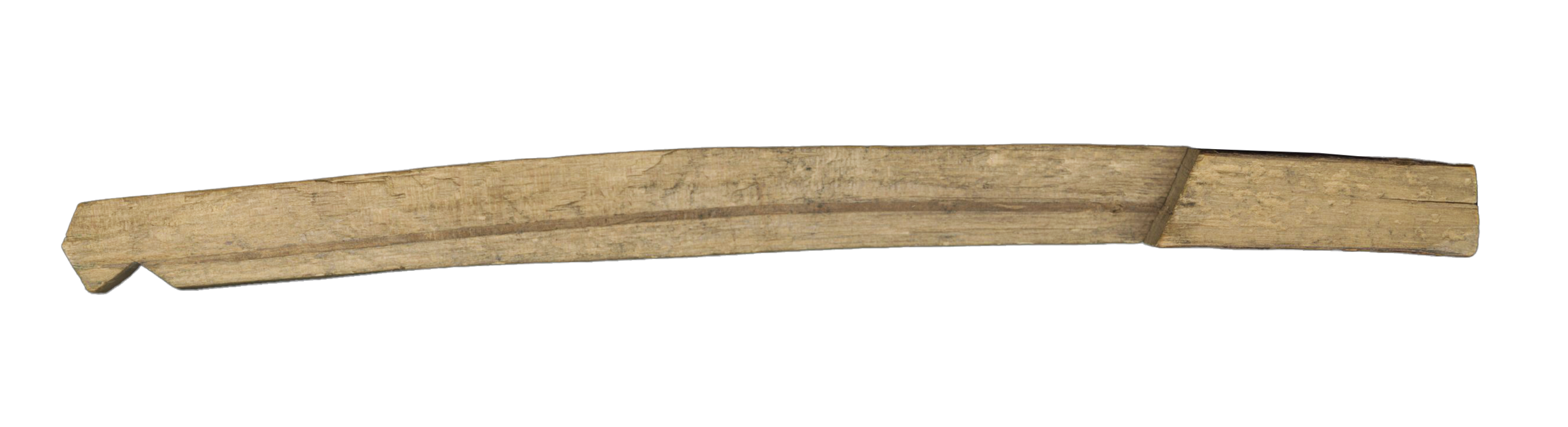

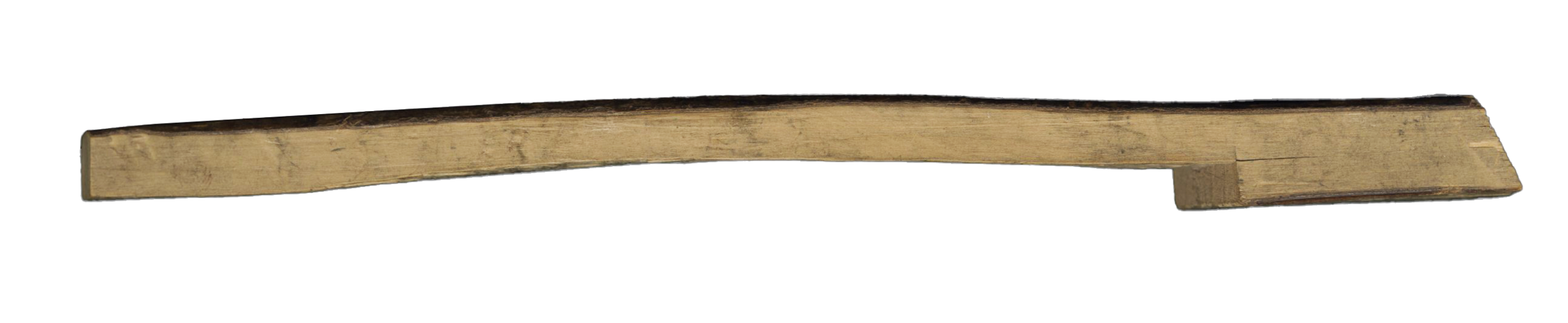
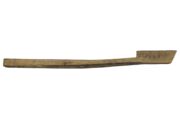
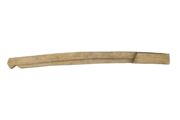
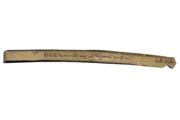
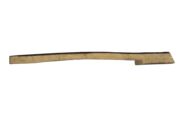
Hazel wood branch, brown ink inscription in anglicana on two faces, edges roughly cut, bark remains in places, inscription and notching well preserved and legible. Dimensions 240 x 14 x 15 mm (at largest points).
Medieval account tools, tally sticks stand as iconic traces of early English administration, as a government decision in the early nineteenth century destroyed almost all extant government tallies. This tally thus provides an extremely rare example of a documentary format that continued in use from the Middle Ages into the nineteenth century. Dating to the administratively pivotal reign of Edward I, this tally displays the final form of the Exchequer tally stick, complete with account, amount, county, and date, developed only three years prior, all in excellent, legible condition.
1. Carved and copied in Westminster in September, 1293, as a government record of the amount that the outgoing sheriff of Bedfordshire and Buckinghamshire, William de Turville, paid in the audit clearing his account (though the actual payment may have occurred as late as the following summer). Unique government records, tally sticks are infamous for being burned when they ceased to be legal records in 1834, a fire which spread and destroyed not only the tallies, but also the houses of Parliament. Nevertheless, there were many reasons that Exchequer tallies might have been spared this conflagration, and the likelihood in this present case is that William was handing over duties to his kinsman Nicholas, and so he may have used the tally as a sort of check, leaving Nicholas with the receipt (Clanchy, 1993, p. 124; Jenkinson, 1911, p. 367, 370; List of Sheriffs, p. 1).
2. Keith Fawkes (Flask Walk Bookshop, Hampstead Village), sold early 1980s.
3. Gareth Harris (Smith & Harris, bespoke jewellers).
4. Sam Fogg, London, book dealer.
5. European Private Collection.
Face A, the account, “De William de Turville nup[er] vic[ecomite] de reman[enti] comp[oti] sui” followed at the end of the stick by the counties he served, “Bed[fordshire]” and “Buk[inghamshire]” (From William de Turville, recent sheriff, for the remainder of his account. Bedfordshire and Buckinghamshire).
Face B, the date, rubbed from being gripped, “A[nn]o R[eg]i,” and then clearly “Exxi” (the regnal year, 21 Edward I, 1292/3) and then “Mich” for “Michaelmas” (29 September).
Employed by the English government’s financial arm, the Office of the Exchequer, from the twelfth century into the nineteenth, tally sticks served as elegant solutions to the problem of managing accounting for amounts due in a format that was both durable and secure. Rather than replace or precede written records in some way, then, tallies functioned in concert with written documentation. Made from branches of coppiced hazel, tallies were famously split, with the foil (the short piece) and the stock (the longer piece, like the present tally) handled by each party and compared to ensure validity. The amounts were symbolized by carved notches in the tally and the single, wide notch on Face A of this tally shows that de Turville’s account (submitted at Easter) was found in arrears by twenty pounds at Michaelmas, when the audits were done. Meanwhile the date, account, and county were all copied onto the stick in ink according to the formulas for which medieval English law is famous. A drawback of the tally format was the size of the stick—this ensured that script had to be kept to a minimum, and we can see that as a result the text is heavily abbreviated. Yet, we rarely read our receipts today—they exist simply to record a transaction, should it ever be challenged in the future.
The Turvilles gained lordship over the manor of Weston Turville, Buckinghamshire in the early thirteenth century (Page, 1908, see Online Resources). Typically, in this era, members of the locally prominent families like William’s, served as sheriffs. William died in 1296, and thus his passing on the shrievalty to his younger kinsman was also a normal part of the administrative duties of his class (Page, 1908; PRO, 1963, see Online Resources). Remarkably, more than one of William de Turville’s tallies seems to remain extant. A second tally associated with “William de Turville vicecomites” appears in a plate published in 1911, and further research should be able to link it with its current individual classmark among the E/402 tallies at the National Archives (Jenkinson, 1911, Plate XLIX no. 12).
Occasionally groups of English tallies are rediscovered: in 1911, Jenkinson wrote about one such find. Sotheby’s sold a cache from a private collection in the 1990s, and that group went to the hammer again at Heritage in 2012. Sotheby’s offered a smaller group in 1985 that was resold by Kraus in 1988 (see Literature, Online Resources). Individual tallies also occasionally turn up at auction. Nevertheless, it must be said that compared to their original numbers, few tally sticks survive and they rarely appear on the market. Those that have been offered are mostly older, and few reflect the improvements of Edward I’s reign that resulted in the format that endured, unchanged, for the next 500 years, as does the present tally. In addition, it is almost unheard of to find a heretofore unrecorded, second tally from a single sheriff’s career, and this makes the present offering truly unique. The last tally we have been able to find in public sale (and it is the older version) was sold at London, Christie’s, 9 July 2025, lot 1, for 50,400 GBP.
Clanchy, Michael T. From Memory to Written Record, England 1066-1307, 2nd edn. Oxford, 1993.
Sotheby’s, London “A Collection of 21 Original Wooden Tally Sticks,” Lot 43, Western Manuscripts and Miniatures, 23 June 1992.
Sotheby’s, London. “A Collection of Six Original Wooden Tally Sticks, and For Medieval Documents,” Lot 31, Western Manuscripts and Miniatures, 26 November 1985.
Heritage Auctions, “Medieval Tally Sticks, A Collection of 21 Original Wooden Tally Sticks,” https://historical.ha.com/itm/miscellaneous/medieval-tally-sticks-a-collection-of-21-original-wooden-tally-sticks-westminster-c-1250-60-/a/997004-1151.s
Jenkinson, Hilary. “Exchequer Tallies,” Archaeologia 62 (1911), pp. 367-80. https://archive.org/details/archaeologiaormi0062vari/page/n49/mode/2up
Jenkinson, Hilary. “Medieval Tallies, Public and Private,” Archaeologia 74 (1925), pp. 289-353. https://archive.org/details/archaeologia-tracts-relating-to-antiquity_1925_74/page/n373/mode/2up
Kew, The National Archives, E/402 https://discovery.nationalarchives.gov.uk/details/r/C6768
Moore, Tony. “'Score it upon my Taille': The Use (and Abuse) of Tallies by the Exchequer,” Reading Medieval Studies 39 (2013), pp. 1-24. https://www.reading.ac.uk/gcms/-/media/project/functions/research/graduate-centre-for-medieval-studies/documents/rms201301-t-moore-score-it-upon-my-taille.pdf
Page, William, ed. “Parishes: Weston Turville.” A History of the County of Buckingham: Volume 2. (London, 1908), British History Online. Web. 23 July 2026. https://www.british-history.ac.uk/vch/bucks/vol2/pp365-372.
Public Record Office, List of Sheriffs for England and Wales, Reprint, New York, 1963. https://archive.org/details/listofsheriffsfo00newy/page/n3/mode/2up
Roger, Euan. (video) Introduction to Tally Sticks, https://www.nationalarchives.gov.uk/education/resources/unboxing-the-archive/tally-sticks/
Skambraks, Tanja. “Chapter Tally Sticks as Media of Knowledge in the Contexts of Medieval Economic and Administrative History,” in L’economia della conoscenza: innovazione, produttività e crescita economica nei secoli XIII-XVIII, ed. Giampiero Nigro, Florence, 2023, pp. 137-158. https://library.oapen.org//handle/20.500.12657/74822
York Wildlife Trust, Coppicing https://www.ywt.org.uk/blog/coppicing-ancient-method-looking-after-our-trees
TM 1521