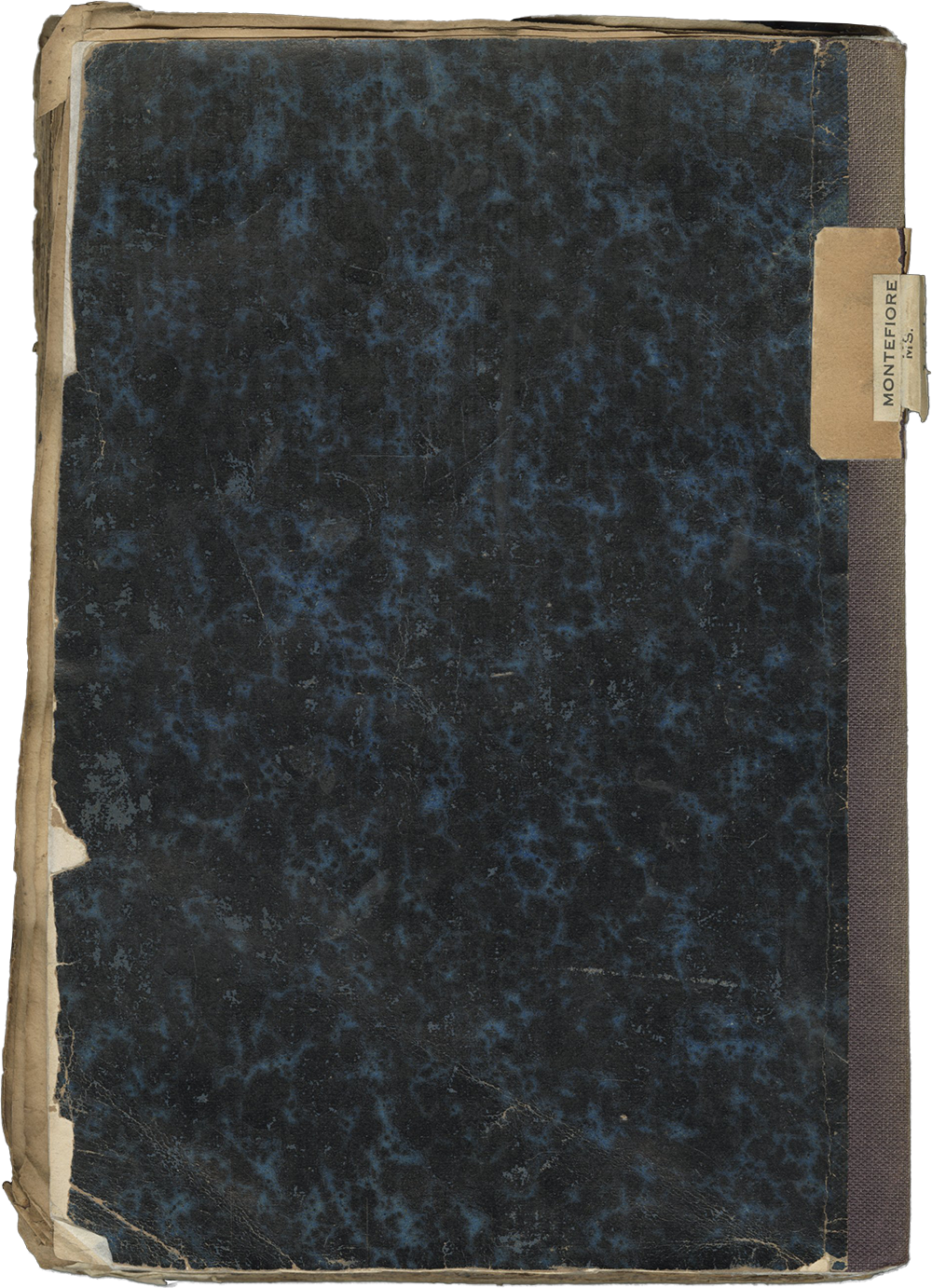
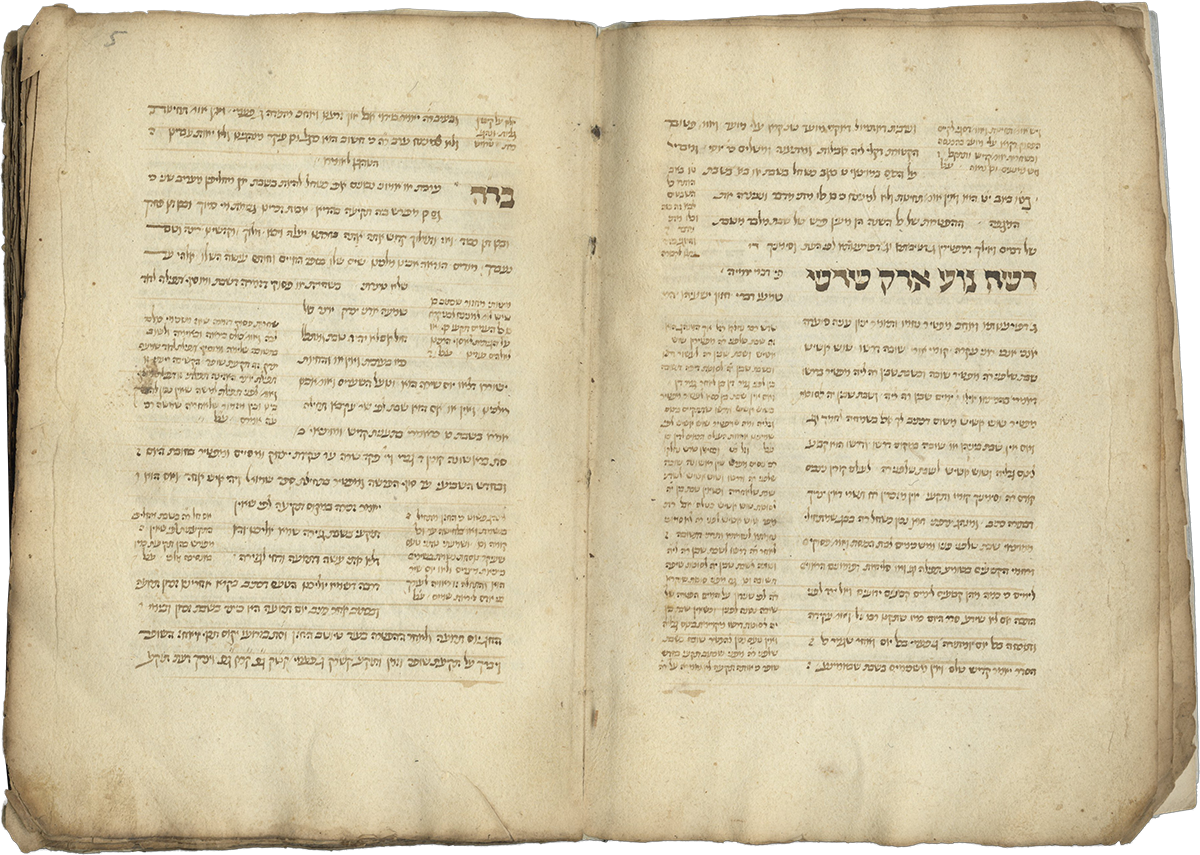
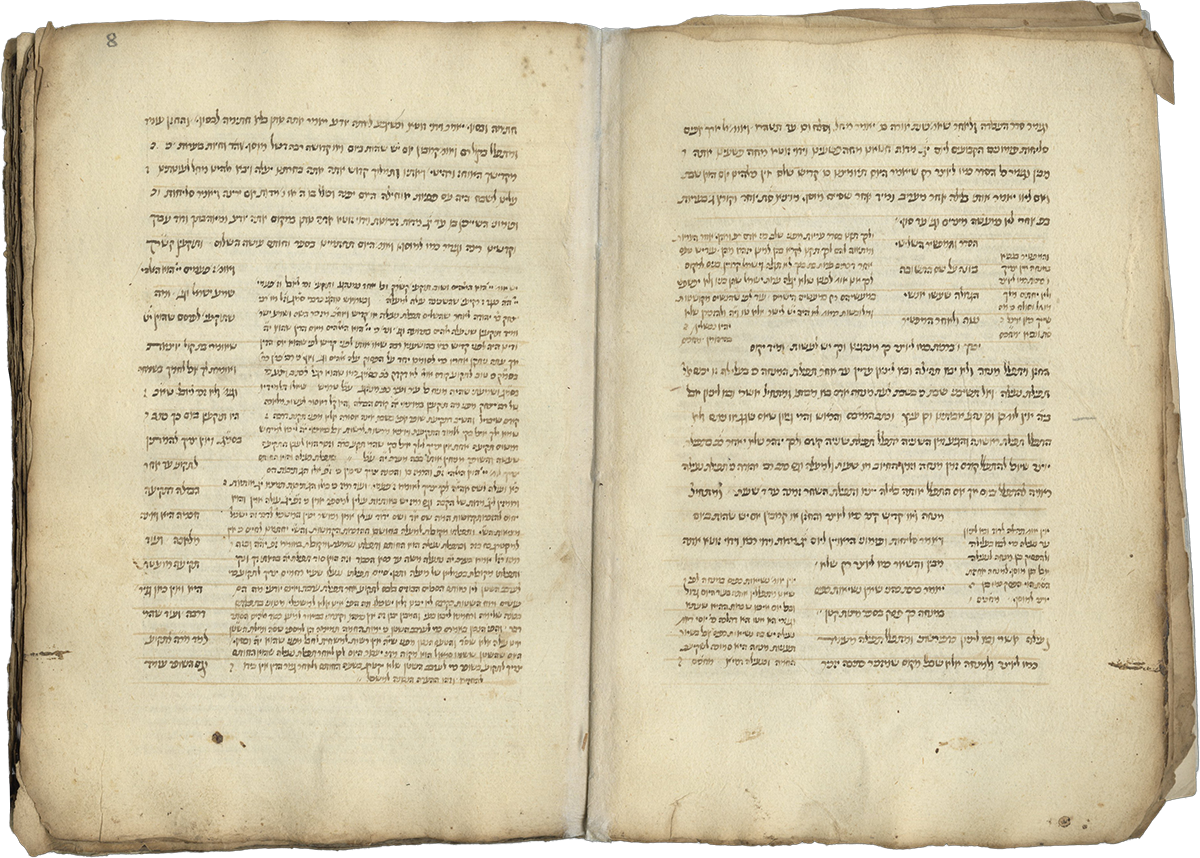
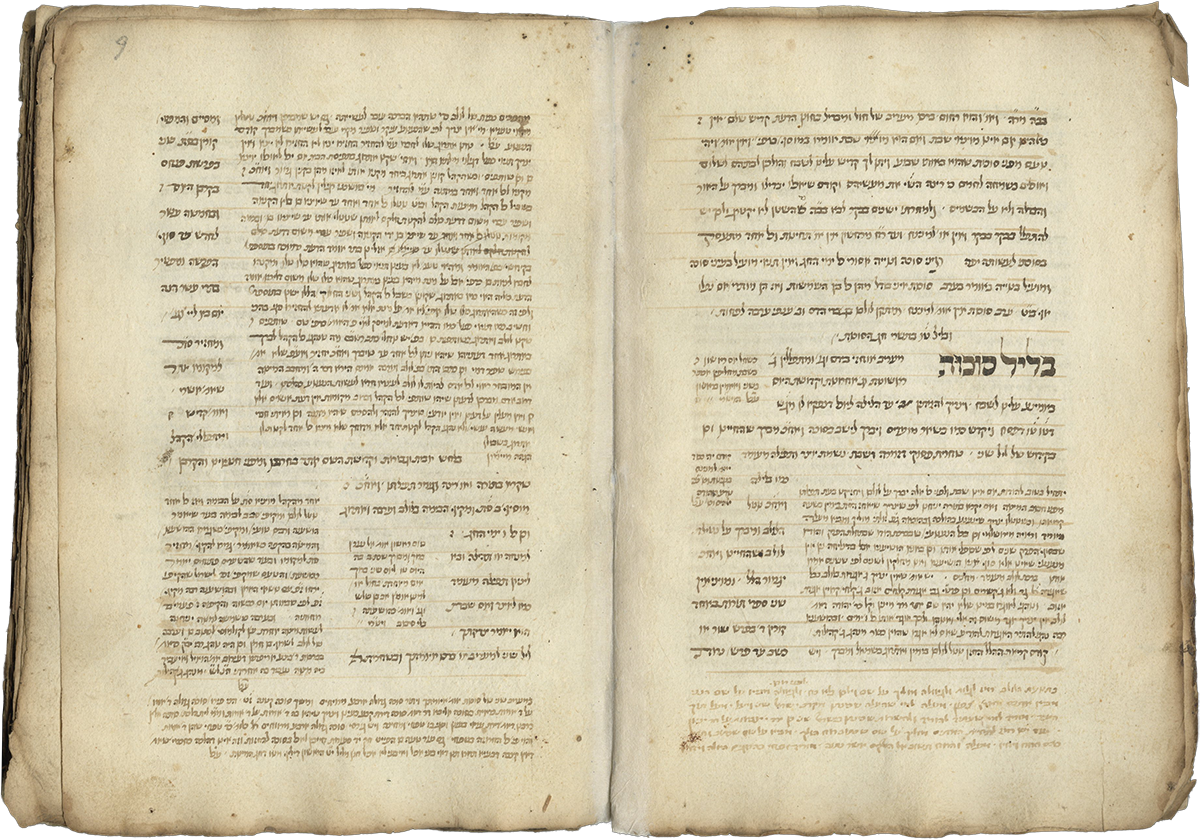
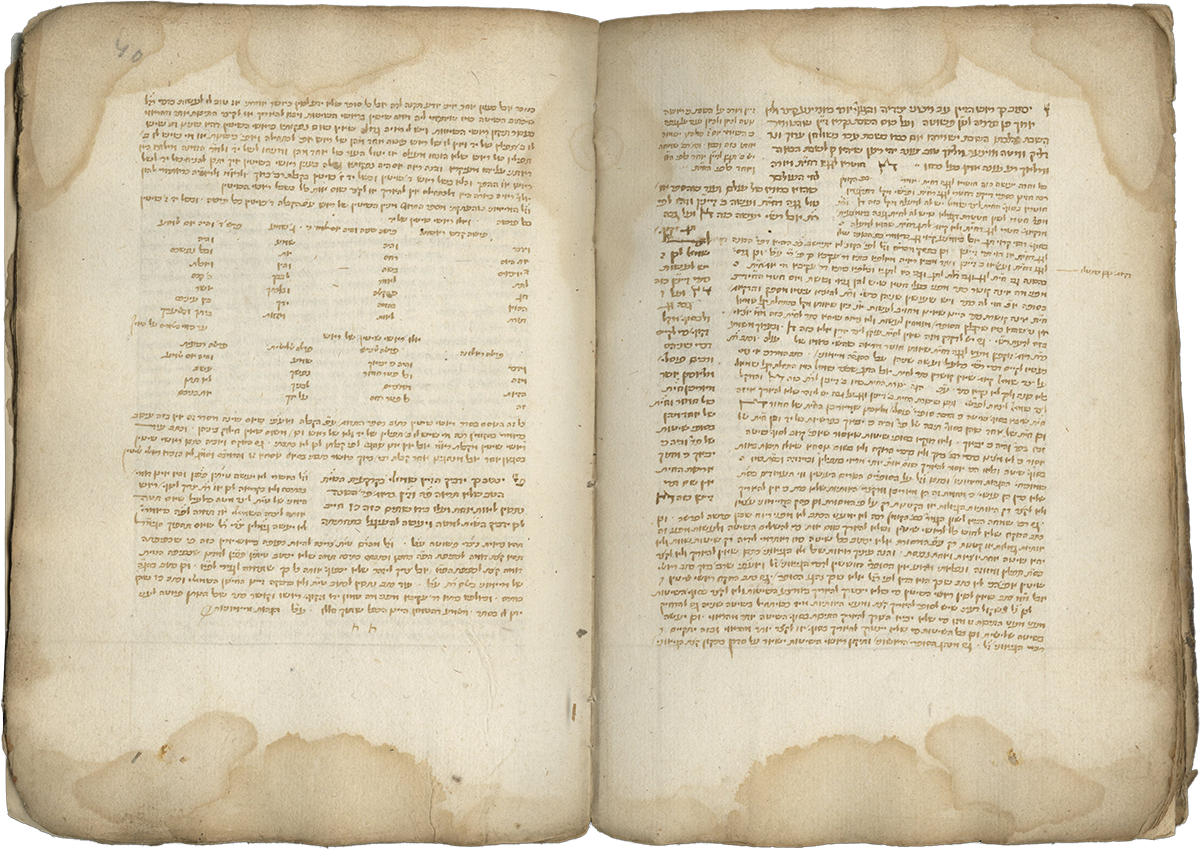
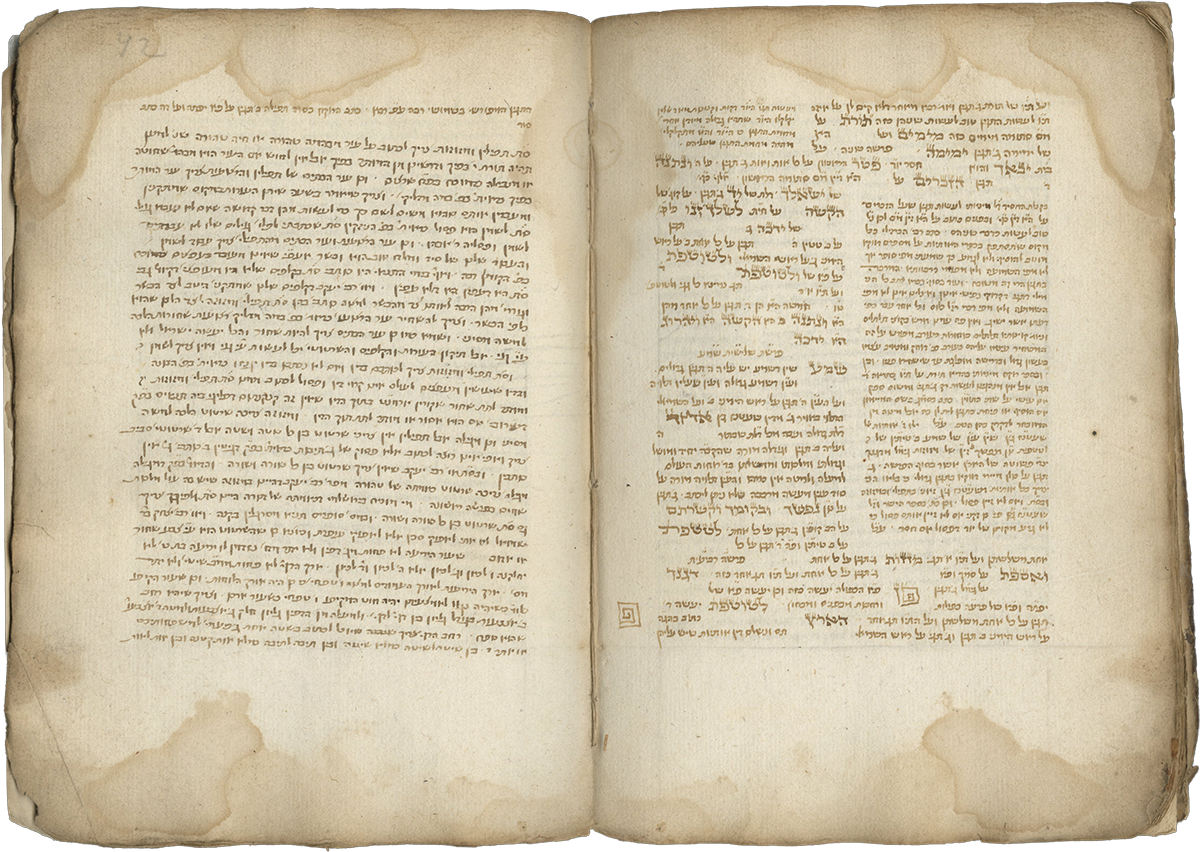
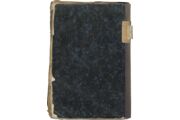
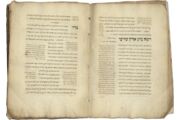
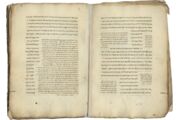
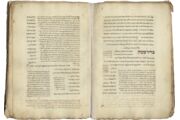
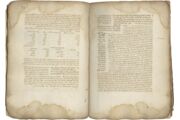
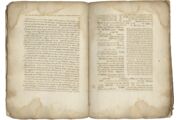
i + 50 + i folios on paper (ff. 1-34 similar to Briquet 6498, “fleur,” Milan, 1462, Vercelli, 1468, Lodi, 1480, and ff. 35-48 similar to Briquet 11154, “main,” Palermo, 1479-1482, Catania, 1480), modern foliation (1-16, 16a-37, 37a-48) in pencil in Arabic numerals in upper-outer corner of rectos, complete (collation i10 ii7 [ii8 cancelled] iii6 iv8 v4 vi15 [vi16 canceled]), horizontal catchwords on ff. 18v, 22v, 30v, lightly ruled in ink on ff. 1-34 and in plummet on ff. 35-48 (justification approximately 140-144 x 96-102 mm.), generally single-column text, at times with glosses, written in at least five Italian Ashkenazic semi-cursive scripts in brown ink in 23 (ff. 1-34) or 36-40 (ff. 35-48) lines, enlarged square-script incipits on ff. 1-13v, justification via insertion of space fillers, abbreviation, use of anticipatory letters, and dilation or contraction of final letters, episodic marginalia, strikethroughs, and corrections in primary and secondary hands, illustrations of scribal letter-forms on ff. 38-45v, table on f. 40, slight scattered staining, more extensive on f. 1r-v, dampstaining more prominent toward rear and obscuring some text on f. 46, dog-earing, frayed outer edges, ff. 2-9 loose, ff. 2-4, 7-9, 12-13 strengthened along their gutters, f. 10 loose at head, short tears in lower edges of ff. 11, 18, ff. 16-16a uncut at head, minor rodent(?) damage in lower-outer corners of ff. 41-48. Nineteenth-century marbled paper wrappers, somewhat creased, worn, and torn, upper wrapper entirely detached from text block after f. 1, buckram spine, paper ticket with Halberstam and Montefiore shelf marks adhering to spine but split in half, nineteenth-century paper pastedowns and flyleaves. Dimensions 212 x 147 mm.
In a period characterized by rupture, upheaval, and discontinuity due to expulsion and persecution, Jewish scholars and scribes compiled practical guidebooks meant to educate popular audiences in the finer points of Jewish liturgical and ritual law. The present miscellany includes several such works, two of them—the Sefer ha-minhagim and Sefer al ha-kol—exceedingly rare. These copies and those of a different manuscript are the only ones known to be held privately at present.
Provenance
1. While the manuscript has no colophon, it is possible to approximately date and localize it based on the paper used. The first treatise (ff. 1-34) was likely copied by a series of Ashkenazic scribes in Northern Italy of the second half of the fifteenth century, while the second (ff. 35-48), written on apparently Sicilian-watermarked paper, was produced only a short while later. It is important to note that Ashkenazim did not constitute a large portion of the Jewish community in late medieval Sicily, suggesting that, in this case, paper manufactured there was likely imported to mainland Italy. At some unknown point, the two treatises were joined into the present miscellany.
2. Some time later, Moses ben Isaac Cohen Rapa, scion of a prominent Ashkenazic family that had fled from Germany to Northern Italy in the fifteenth century (Carmoly, 1861), purchased the book and signed his name on f. 1. Rapa may be identical with a person of the same name, living at the time in Romano di Lombardia, for whom a magical-medical volume was copied in the sixteenth or seventeenth century (Frankfurt am Main, University Library Johann Christian Senckenberg, Ms. Oct. 131, f. 3).
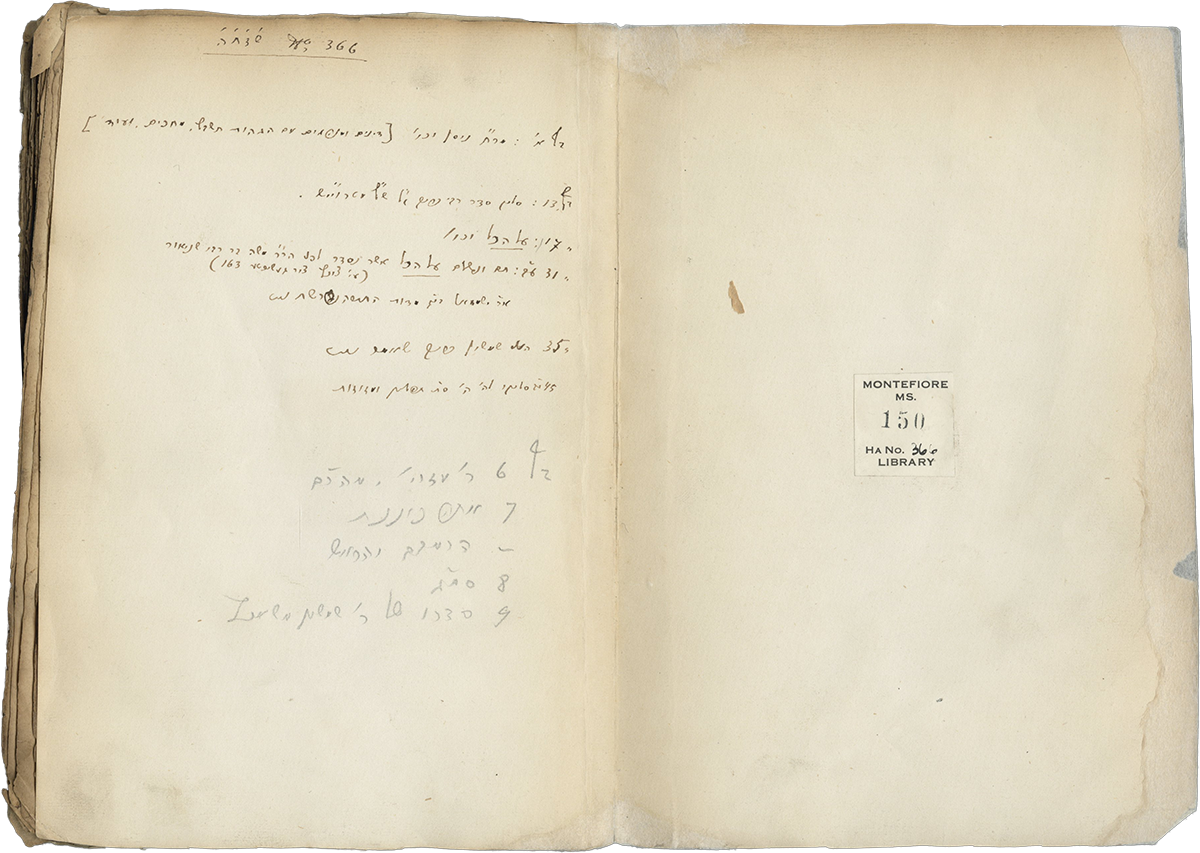
3. In Kislev 5642 (November-December 1881), Solomon Joachim Halberstam (1832-1900), a wealthy Polish Jewish scholar and bibliophile, bought this codex from the Frankfurt bookseller Hayyim Meir Horowitz ha-Levi (1855-1904) (New York, The Library of the Jewish Theological Seminary of America, Ms. 2823, f. 40). Halberstam inscribed the manuscript’s shelf mark (366) in pen on the upper flyleaf and f. 1 and provided a brief overview of its contents both on that flyleaf and when he printed the catalog of his collection in 1890.
4. The Judith Lady Montefiore College in Ramsgate, England, purchased 412 manuscripts from Halberstam’s collection, including the present one. The transaction was carried out by Rabbi Moses Gaster (1856-1939), principal of the college between 1891 and 1896. The codex bears the library stamp of the institution, known in Hebrew as Yeshivat Ohel Mosheh vi-Yehudit, on ff. 1, 47v, as well as paper tickets with the Halberstam (366) and Montefiore (150) shelf marks on the spine and upper pastedown (Hirschfeld, 1904).
5. Between 1898 and 2001, most of the Montefiore manuscripts, including ours, were placed on permanent loan at Jews’ College in London. In 2001, they were returned to the Montefiore Endowment Committee.
6. The volume was offered at Sotheby’s New York on October 27, 2004 (lot 140), without result.
Text
ff. 1-13, Rabbi Baruch of Troyes’ Sefer ha-minhagim, incipit, “me-r[osh] h[odesh] nisan ad ahar r[osh] h[odesh] iyyar ein omeri[m]… selik seder rabb[einu] barukh z[ikhrono] l[i-berakhah] sh[eliah] ts[ibbur] mi-troyes”;
ff. 13-14, a collection of laws and explanations concerning the reading of the kaddish, the performance of a circumcision, and the recitation of the penitential prayers on Mondays and Thursdays, incipit, “mi-kaddish av va-em she-hu bi-mekom kaddish katsar… ve-hoshivem ha-melekh be-meitav artso va-yirbu bah bi-me’od me’od va-timmalle ha-arets otam hazak,” followed by a brief anecdote; [ff. 14v-16a blank];
ff. 17-31v, the anonymously authored Sefer al ha-kol, incipit, “al ha-kol yitgaddel ve-yitkaddesh ve-yishtabbah ve-yit‘alleh ve-yitromam ve-yitnasse shemo shel melekh malkhei ha-melakhim… tam ve-nishlam al ha-kol asher nisdar lifnei ha-r[av] r[abbeinu] mosheh bar rabb[einu] shenei’ur”;
ff. 31v-32, Rabbi Solomon ben Isaac’s Commentary on the Thirteen Principles of Rabbi Ishmael, incipit, “a[mar] r[abbi] yishma‘el be-13 middot ha-torah nidreshet… ba ha-katuv ha-shelishi ve-hikhria beinehen kol helev shor va-kesev va-ez lo tokhelu”; [ff. 32v-34v blank];
ff. 35-42, Rabbis Abraham ben Moses of Sinzheim and Samson ben Eliezer Barukh she-Amar’s Sefer barukh she-amar, incipit, “hineni shimshon barukh she-amar hetsikatni ruhi ve-heshivuni se‘ippai… katav ha-rokeah be-sod tefillah 2 tagin al pe yifteh ve-al zeh katav sod”;
ff. 42-45v, a collection of laws about the production of Torah scrolls, phylacteries, and mezuzot, incipit, “s[ifrei] t[orah] tefillin u-mezuzot tsarikh li-ketov al or mi-behemah tehorah o hayyah tehorah… selik lehu hilkhot s[ifrei] t[orah] tefillin u-mezuzot”;
ff. 45v, another such collection, incipit, “kakh shanu r[abboteinu] z[ikhronam] l[i-berakhah] mezuzah she-yesh bah mahak o tosefet ot… ve-ka-asher yikhtov ha-ot ya‘aseh ha-ziyyunin le-tsad semol kodem she-yikhtov ha-aheret”;
ff. 45v-46v, excerpts of comments by Rabbi Bahya ben Asher on Ex. 13:16, Deut. 6:4, and Lev. 23:24, incipit, “u-lefi she-lo hizkir malkhut bikhlal 3 shemot… u-lefi zeh yom teru‘ah yom ha-din kemo shofar teru‘ah”; [f. 47 blank];
f. 47v, excerpts of comments by Rabbi Bahya ben Asher on Deut. 33:8, incipit, “da ki yesh 4 madregot hen ba-nevu’ah… lefi she-hu ha-makor she-kol ha-ma‘alot mishtalleshelot me-hen ve-haven zeh”; [f. 48r-v blank].
In the period immediately preceding and following the Black Death and the accompanying persecutions and expulsions of the mid-fourteenth century, Ashkenazic Jewry witnessed a steep decline in halakhic (Jewish legal) literacy and creativity and a parallel sharp rise in the need for halakhic handbooks on topics ranging from ritual slaughter to circumcision to tefillin (phylacteries) manufacture to daily liturgical practice. The authors who arose to fill the gap composed clear, concise, comprehensive compilations that presented their material authoritatively, without extensively quoting the positions and arguments of their predecessors (Mincer, 2017). These works further played an important role in recording for posterity the customs of local communities that might have otherwise been lost to history. With the advent of the age of print, incorporation of their prescriptions into widely distributed halakhic codes solidified their influence on communities far and wide, down to the present day.
The present manuscript comprises a collection of such halakhic manuals, apparently produced for an Ashkenazic audience residing in Northern Italy in the latter half of the fifteenth century. The first treatise (ff. 1-34) focuses largely on liturgical law and custom, while the second (ff. 35-48) mostly treats the rules governing the production of ritual objects.
The first text, the rarest of the group, was compiled by Rabbi Baruch, cantor of Troyes in Northern France, sometime between the late thirteenth and late fourteenth centuries. The work surveys the liturgical practice of high medieval France, especially in the region of Troyes and Orléans (Sirat, 1964-1965 and 2015), beginning with the month of Nisan, the start of the liturgical year, and concluding with the month of Adar. Our copy features glosses to the text comprising quotations from other French and German halakhic sources, including Mahzor vitry, Sefer mahkim, Seder troyes, and Orah hayyim. Rabbi Baruch’s Sefer ha-minhagim survives in only two other known copies, one in a public collection (New York, The Library of the Jewish Theological Seminary of America, Ms. 8227) and the other held privately (formerly Berlin, Jewish Community Library), and only one chapter has been published so far (Stal, 2017). The text is followed in our manuscript by material of a similar nature, presumably collected by the scribe from other works devoted to Ashkenazic custom.
The next significant composition, Sefer al ha-kol, is another French liturgical tract treating ritual topics related to the three-times daily prayer services, as well as mealtime prayers and other occasional blessings. The book takes its name from its opening words, a paean to the Divine, although its earlier title was apparently Seder ha-ram, a reference to Rabbi Moses ben Senior of Évreux. Rabbi Moses was co-dean of an important yeshiva in Évreux, Normandy, in the first half of the thirteenth century, and Sefer al ha-kol was, as attested by the present manuscript (f. 31v) , compiled by an anonymous student of his—who may or may not be identified with Rabbi Moses ben Menahem of Marseilles (Epstein, 1983-1984)—under his supervision. It survives in seven known copies, all of which, except the present one and the aforementioned manuscript from Berlin, are in public institutions. Sefer al ha-kol has been published three times (Weisz, 1907; Eliyahu, 2022; Bitton and Gal-Ezer, 2026), the latter two editions based in part on our manuscript, which seems to represent an earlier stage in the evolution of the text.
Rabbi Solomon ben Isaac (Rashi; 1040-1105) was undoubtedly the most significant Ashkenazic rabbinic scholar. His known oeuvre includes foundational commentaries on much of the Bible and Babylonian Talmud, a commentary on Pirkei avot, responsa on halakhic matters, and liturgical poetry. Far less well known is that he also wrote a commentary on a chapter of rabbinic literature known as The Thirteen Principles of Rabbi Ishmael that lists the hermeneutical tools used by the Talmud and other rabbinic texts in expounding Jewish law. This chapter appears to have entered the standard daily liturgy already by the ninth century, and it was subsequently glossed by numerous rabbinic authorities, including Rashi (Shoshana, 2014). Despite his wide renown and eminence, Rashi’s commentary was first published by Joseph Isaac Kobak in 1868, and although it has been reprinted since, no critical edition exists. The work survives in at least nine copies, all of them, aside from ours, housed in public collections in Europe and the United Kingdom. There is no other copy in a North American collection.
The last major text included here is a portion of Sefer barukh she-amar, a composite work comprising the Tikkun tefillin of Rabbi Abraham ben Moses of Sinzheim (late thirteenth-early fourteenth century) and the glosses thereto and explanations thereof compiled by Rabbi Samson ben Eliezer Barukh she-Amar (b. c. 1330). The book discusses at length the laws of tefillin manufacture, from the preparation of the parchment to the formation of the letters to the sewing of the boxes. It became very popular as a halakhic manual for tefillin makers and survives today in more than thirty-five copies dating from 1383 to the nineteenth-twentieth century, the vast majority of them in public institutions. Sefer barukh she-amar first appeared in Dubno in 1796, then again (based on a different manuscript) in Shklov in 1804, and was thereafter reprinted at least twice using the Shklov edition. It was first critically edited in 1970 using eight manuscripts, including ours, which Menahem Mendel Meshi-Zahav, like Solomon Joachim Halberstam before him (1890), characterized as very different from the other copies that have come down to us.
The last portion of this codex includes two short collections of laws relating to Torah scrolls, tefillin, and mezuzot (ff. 42-45v), followed by extracts from the famous, kabbalistically inclined Torah commentary of Rabbi Bahya ben Asher (c. 1255-c. 1340) (ff. 45v-47v), two of these loosely linked to the same theme. The first tract may have parallels in two Cambridge University Library manuscripts (Ms. Add. 2580 and Ms. Or. 71) copied at the end of the fourteenth century. The excerpts from Rabbi Bahya are remarkable in that no other manuscripts of his Torah commentary written in Ashkenazic script are known to survive (although an Ashkenazic supercommentary dating from 1628 is preserved in Halle an der Saale, University and State Library of Saxony-Anhalt, Ms. Yb Qu. 4).
Literature
Bitton, Avraham and Shlomo Yair Gal-Ezer, eds. Sefer al ha-kol ve-hu seder ha-ram… le-rabbi mosheh be-r[abbi] shenei’ur me-evreux, Sha’alvim, 2026.
Carmoly, Eliakim. Ha-orevim u-benei yonah, Rödelheim, 1861.
Eliyahu, Israel, ed. Sefer al ha-kol le-talmid rabbeinu mosheh me-evreux z[ekher] ts[addik] l[i-berakhah], Tel Zion, 2022.
Epstein, Jacob N. “Al ha-kol,” Sinai 94:3-4 (Kislev-Tevet 1983-1984), pp. 123-136.
Halberstam, Solomon Joachim. Kohelet shelomoh, p. 94 (no. 366), Vienna, 1890.
Hirschfeld, Hartwig. Descriptive Catalogue of the Hebrew MSS. of the Montefiore Library, p. 43 (no. 150), London and New York, 1904.
Kobak, Joseph Isaac. “Peirush al midrashi r. yishma‘el be-13 middot she-ha-torah nidreshet ba-hen le-ha-r. shelomoh yitshaki z[ikhrono] l[i-berakhah],” Jeschurun 6 (1868), pp. 38-44 (Hebrew section).
Meshi-Zahav, Menahem Mendel, ed. Kovets sifrei setam, vol. 1, Jerusalem, 1970.
Mincer, Rachel Zohn. “The Increasing Reliance on Ritual Handbooks in Pre-Print Era Ashkenaz,” Jewish History 31:1-2 (December 2017), pp. 103-128.
Shoshana, Avraham. Baraita de-rabbi yishma‘el… be-tseiruf massoret ve-tsiyyunim, shinnuyyei nusseha’ot, ve-he‘arot girsa ve-lashon, 2nd ed., Wickliffe and Jerusalem, 2014.
Sirat, Colette. “Manuscrits hébraïques de rite français dans les bibliothèques d’Angleterre,” Revue d’Histoire des Textes 13 (1964-1965), pp. 93-94.
Sirat, Colette. “Les manuscrits liturgiques des juifs en France médiévale,” Revue des études juives 174:3-4 (2015), pp. 325-357.
Stal, Jacob Israel. “Sefer minhagim le-rabbi barukh sheliah tsibbur mi-troyes: tei’ur rishoni shel ha-hibbur ve-hahadarat ha-perek al sukkot, shemini atseret ve-simhat torah,” Yeshurun 37 (2017), pp. 99-167.
Weisz, Max (Miksa). “Sefer al ha-kol,” Ha-goren 7 (1907), pp. 76-111.
Online Resources
Our MS
https://www.nli.org.il/he/manuscripts/NNL_ALEPH990000583510205171/NLI#$FL30151533
Sotheby’s New York sale, October 27, 2004 (lot 140)
https://www.sothebys.com/en/auctions/ecatalogue/2004/important-hebrew-manuscripts-from-the-montefiore-endowment-n08040/lot.140.html
Offprint of Berdychiv, 1907 edition of Sefer al ha-kol
https://www.nli.org.il/he/books/NNL_ALEPH990012980640205171/NLI
Dubno, 1796 edition of Sefer barukh she-amar
https://www.hebrewbooks.org/24775
TM 1437