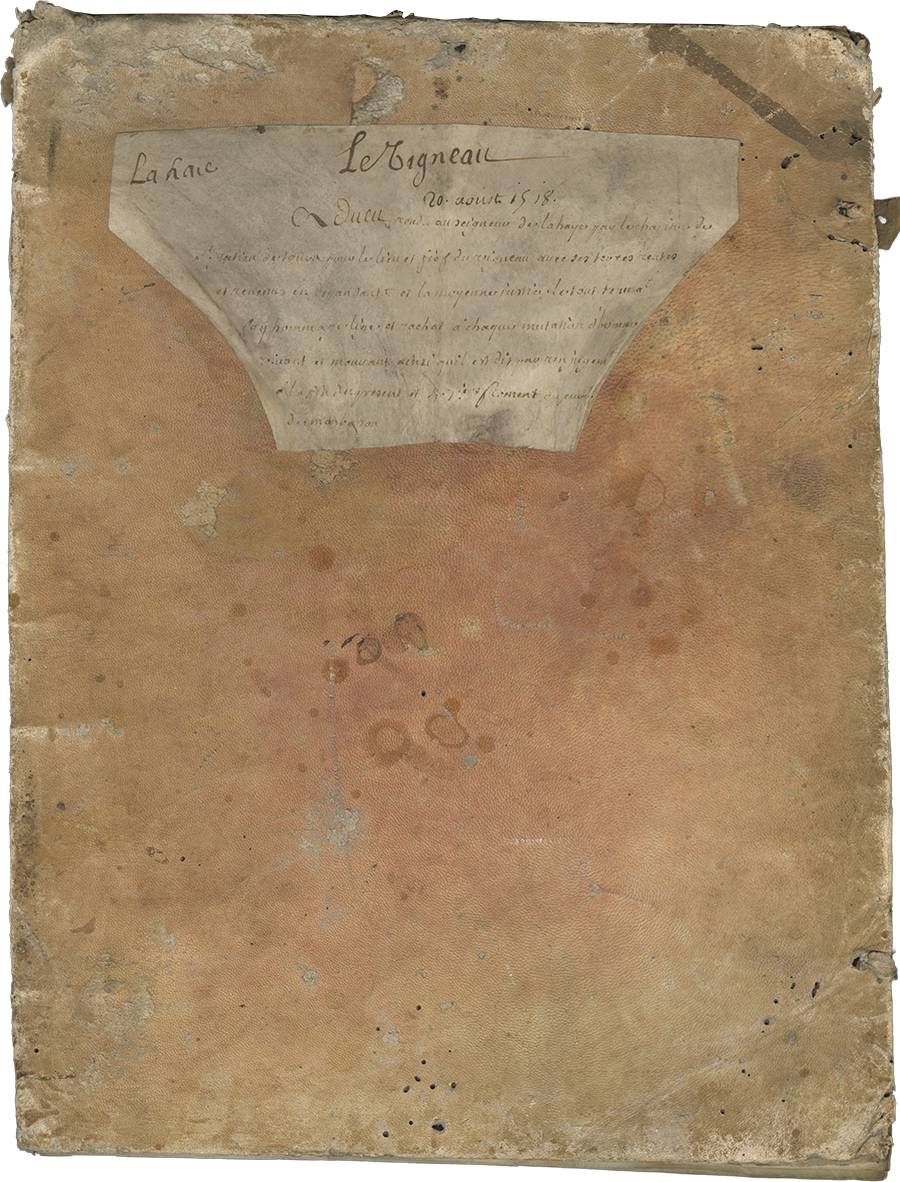
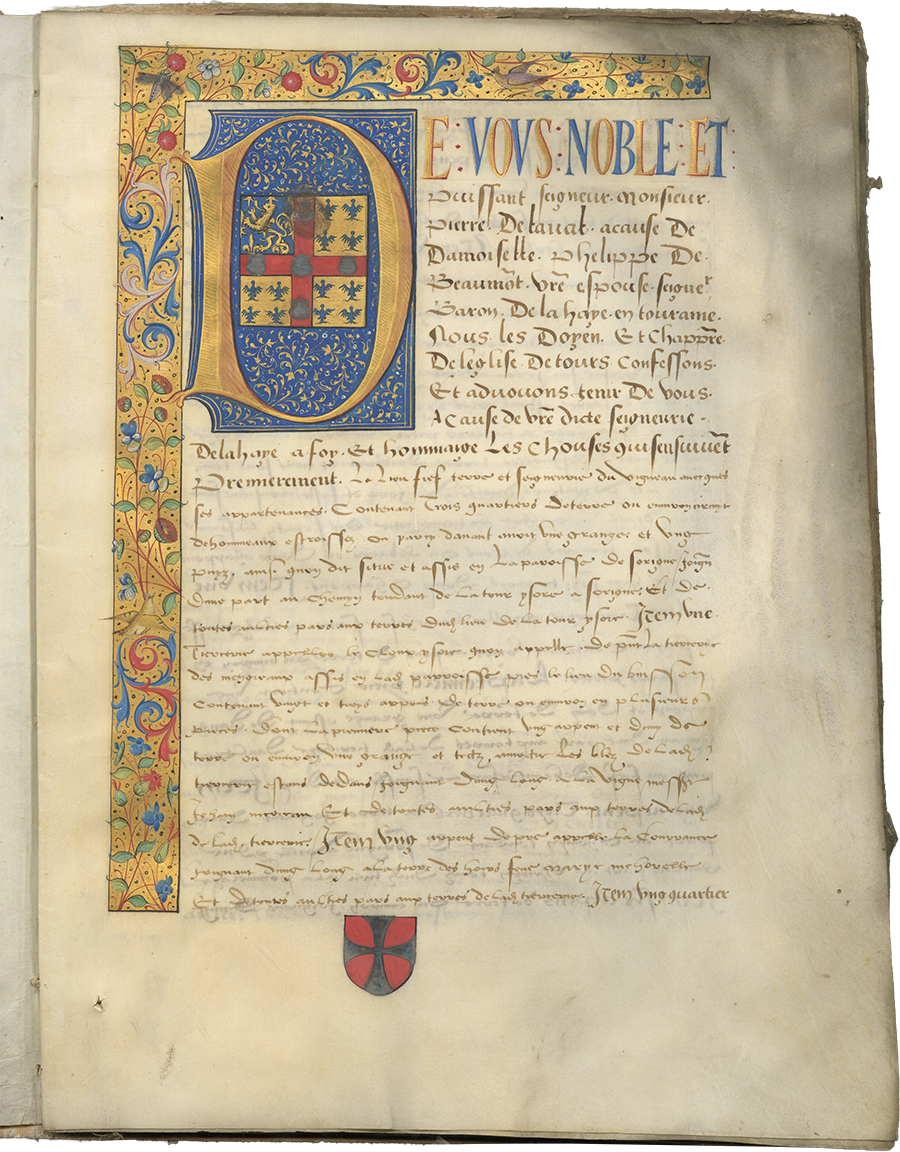
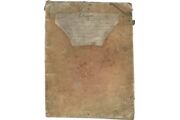
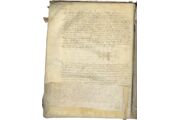
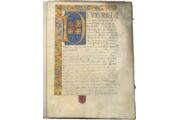
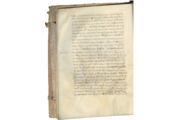
18 parchment folios, foliated in modern pencil in upper right (used here), and i-xvi in scribal ink in lower right, complete, no catchwords, (collation: i18), ruled in drypoint (justification 280 x 180mm) in a single column of 29 lines in a secretary hand, 11-line illuminated initial historiated with Laval-Montmorency arms and a two-sided illuminated border, other arms (gules a croix d’argent), perhaps added later, decorate the lower margin (f. 2), edges of parchment sometimes darkened, but otherwise good condition. Probably eighteenth-century parchment binding over pasteboards, possibly once rose-colored, some worming to both front and back boards, remains of two parchment ties, front board bears a parchment off-cut label reading “La Haie” and “Le Vigneau” and the date, together with a brief summary of the contents. Dimensions 290 x 380 mm.
A fine and exhaustive example of a legal document that captures the medieval heart of ancien regime society. While this document class is not rare, each example is unique. Each preserves not only distinctive descriptions of property, but also the financial and legal relationships of a range of parties in provincial life. This specific example is exceptional in being richly illuminated on its opening folio and seems to have been retained and used until nearly the Revolution itself.
Provenance
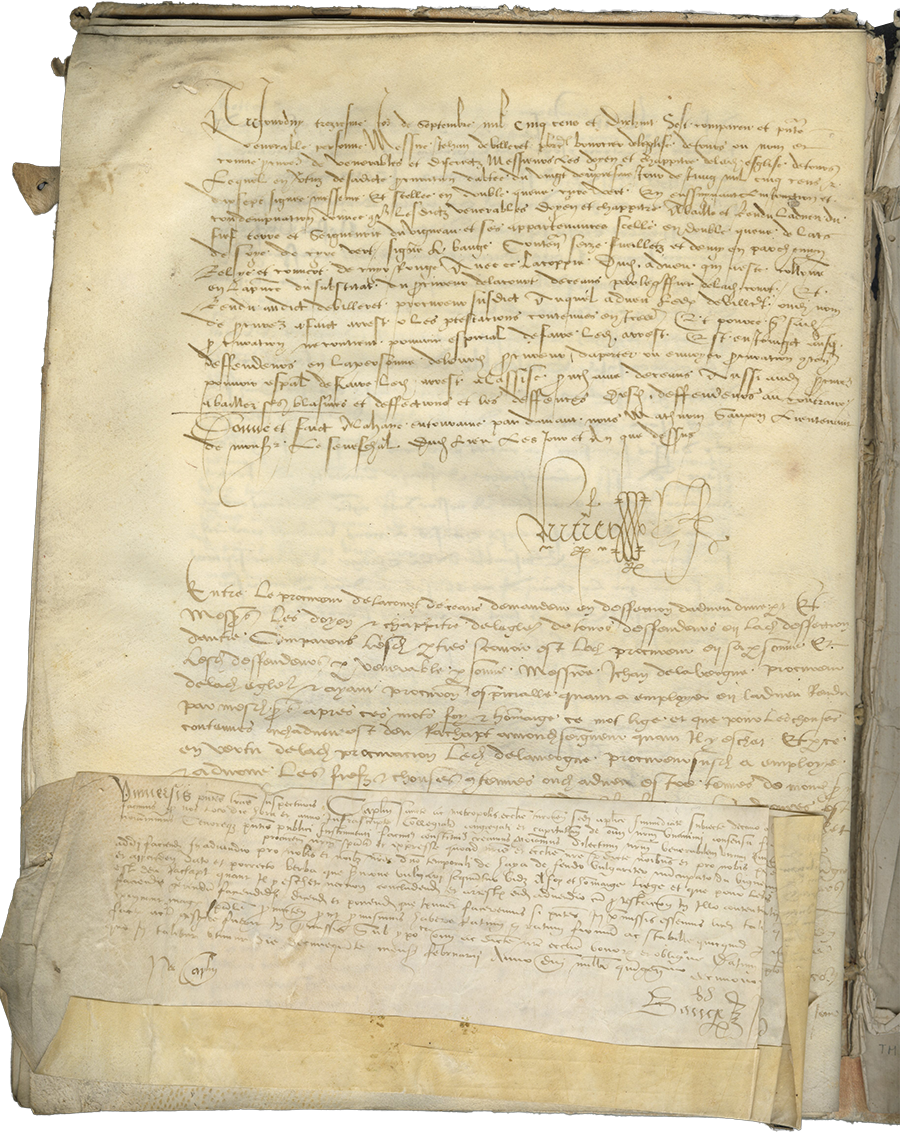
1. Like many archival documents, the document itself is dated 20 August 1518 with clear evidence of local production in Tours (f. 18). Three addendums on the verso (f. 18v) and attached to the verso are dated 13 September 1518; 5 November1520, and a brief Latin document, cut to bear a seal and attached to the folio with a parchment staple, dated 11 February, and the year possibly reading 1542.
2. Single sheet of paper interleaved inside the front board with a brief list of updated taxes due, dated 1687 and 1709.
3. Marginal notes date into the 1750s, suggesting that the document continued to be consulted almost up to the eve of the Revolution (see for example, f. 14v).
Text
ff. 2-18, Homage from the canons of the Cathedral of St. Gatien to Lord de la Haye for Vigneau,
incipit, “De vous noble et puissant seigneur monsieur pierre de laval....le vingtiesme jour daoust lan mil cinq cens dix huyt.”
Though today we might associate doing homage with knights and kings of the Middle Ages, the legal institutionalization of the process persisted through the Ancien Regime, and the institution very much included clergy as well as laity, as we see in this sixteenth-century document. While most modern definitions of collegiate churches emphasize that they are not episcopal seats, this was far from the case in the Middle Ages, when many cathedrals were, in fact, served by colleges of canons. This explains how Tours Cathedral, the church of St. Gatien, housed a college of canons who would have to do homage to their seigneural lord as a corporate body as we see in this document.
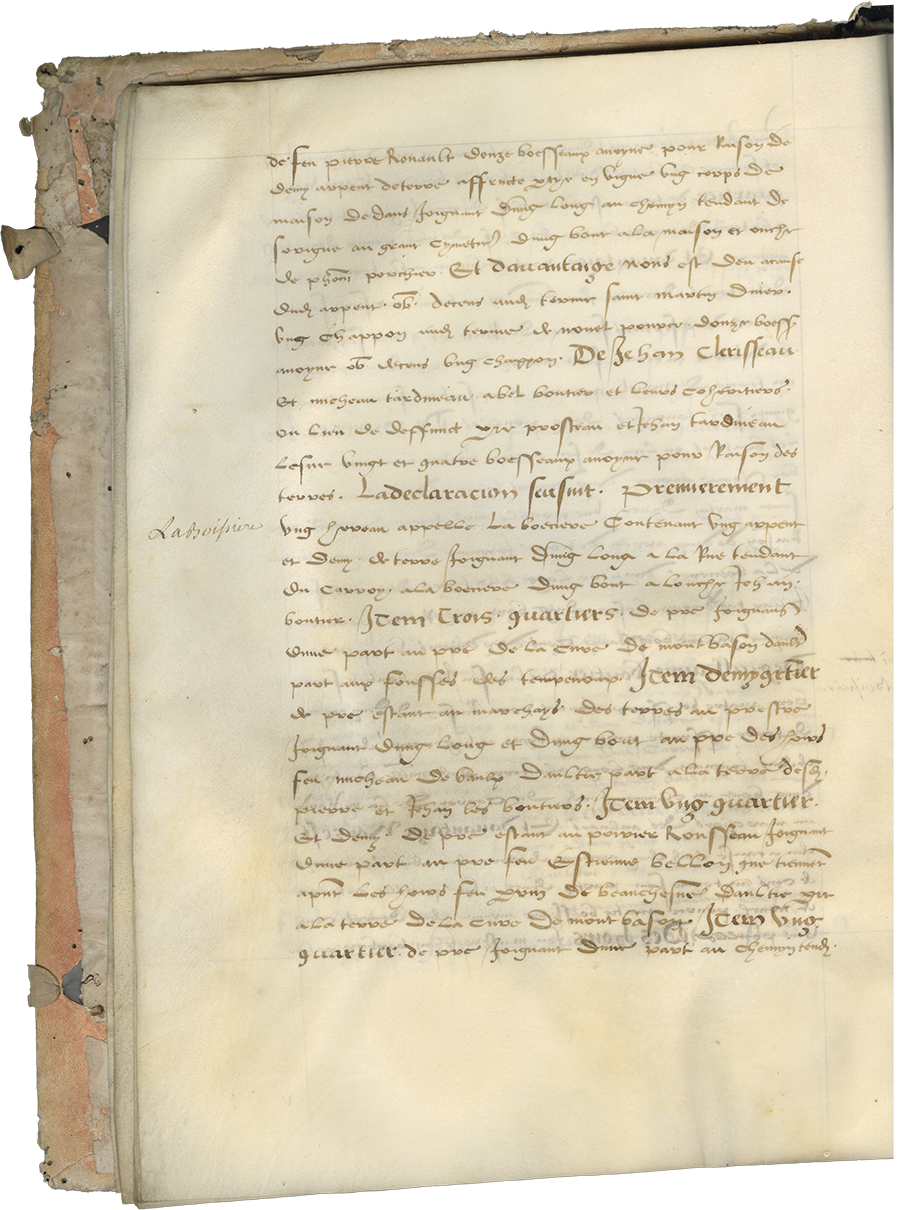
Manors were not tightly centralized blocks of property as we tend to think today, but often widely dispersed pieces of property stitched together through custom and law—when mapped they can make even US voting districts look compact in comparison. This fact, together with the medieval lack of latitude and longitude, meant that even simply describing the extent of the various pieces of property for which the canons would be responsible took many folios. Moreover, each of these pieces might have other rights-holders, whose claims also needed to be acknowledged in the document, so that neither canons nor tenants, nor anyone else, would be left unclear about rights and responsibilities. Moreover, legal jurisdictions also had to be clarified, as the right to hold the manorial court, and retain some of the fees from that court, was a source of income just as real as direct agriculture and rents were.
Surprisingly little research exists on the fine style of the illumination, despite this decorative style developing in the 1480s and by the 1500s appearing widely across central and northwestern France, from the court into the provinces (for one study that touches on this design in a different regional context, see Chenu, 2018, for examples painted in Tours in the 1480s and around 1520, see Villa and Gras, 2025, and for other examples made for use in Tours in the early sixteenth century, see Online Resources). The initial highlights the arms of the seigneur, Pierre de Laval-Montmorency (d. 1528), Lord de la Haye, who, in the place of his wife, retained the traditional feudal right to exchange the use of property for taxes and labor. Laval-Montmorency succeeded his father as heir when his elder brother went into the church—both his father and his father-in-law had served Charles VII, Louis XI, and René of Anjou, but Pierre did not follow their footsteps into court positions. Instead, this document provides a glimpse of the more workaday tasks that local nobility undertook in their lands. These eighteen folios exhaustively detail both the rights that the canons would obtain and their responsibilities to the land and people of Vigneau and to de la Haye, and all of these stipulations continued to be updated and employed for reference for the next two centuries.
Literature
Gras, Samuel, “Tours 1440-1480,” in Peindre en France: Trente ans de recherce sur les manuscrits à peintures (1440-1520), Frédéric Elsig, Samuel Gras, Dominique Vanwijnsberghe, eds. Milan, 2025, pp.175-195.
Reynolds, Susan. Fiefs and Vassals: The Medieval Evidence Reinterpreted, Oxford, 1994.
Villa, Rafaël, “Tours 1480-1520,” in Peindre en France: Trente ans de recherche sur les manuscrits à peintures (1440-1520), Frédéric Elsig, Samuel Gras, Dominique Vanwijnsberghe, eds. Milan, 2025, pp. 197-217.
Online Resources
Chenu, Rachel. Le Maître de Bayeux, émule du Maître de l’Échevinage de Rouen,” Memini 24 (2018), https://doi.org/10.4000/memini.1142
Pierre de Laval-Montmorency https://fr.wikipedia.org/wiki/Pierre_de_Laval-Montmorency
Saint-Gatien Cathedral https://www.cloitre-de-la-psalette.fr/en/discover/saint-gatien-cathedral
Tours, Bibliothèque municipale, MS 152, Breviary for use in Tours, https://arca.irht.cnrs.fr/ark:/63955/md49g445f69c
Tours, Bibliothèque municipale, MS 190, Missal for use in Tours, https://arca.irht.cnrs.fr/ark:/63955/md01bk12b194
TM 1507