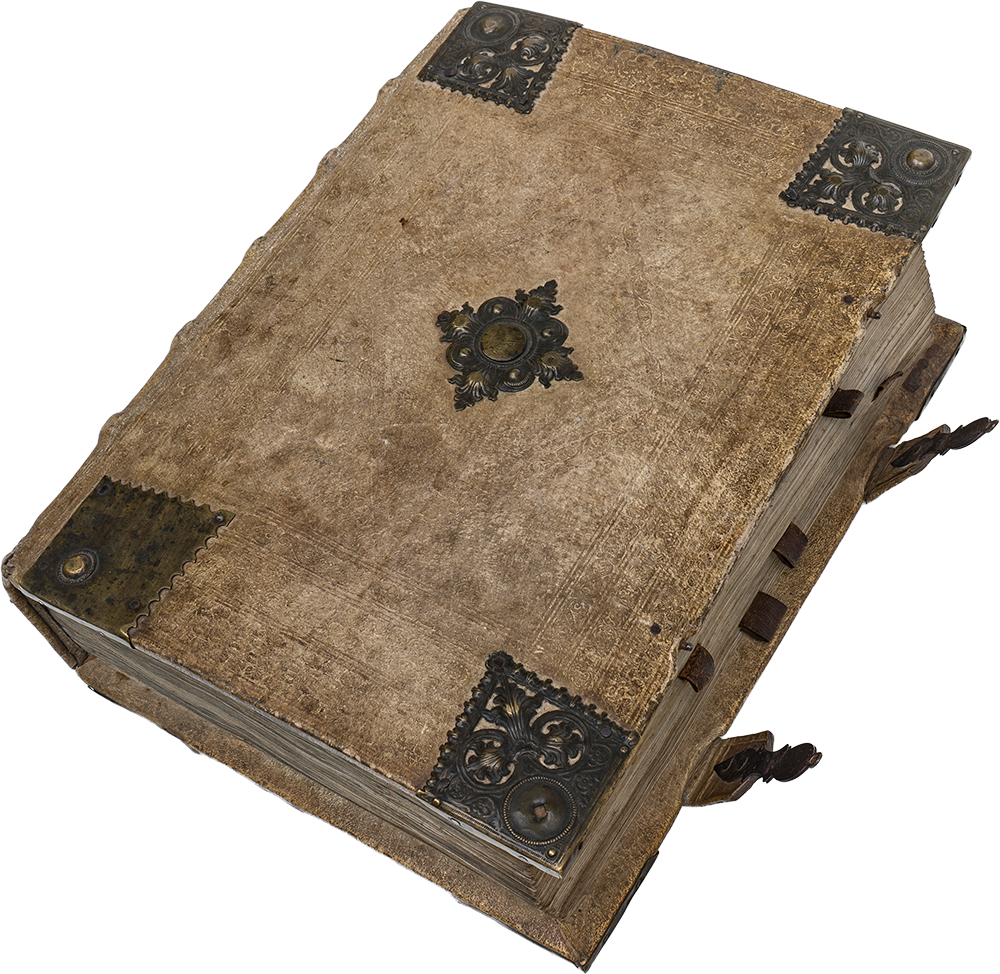
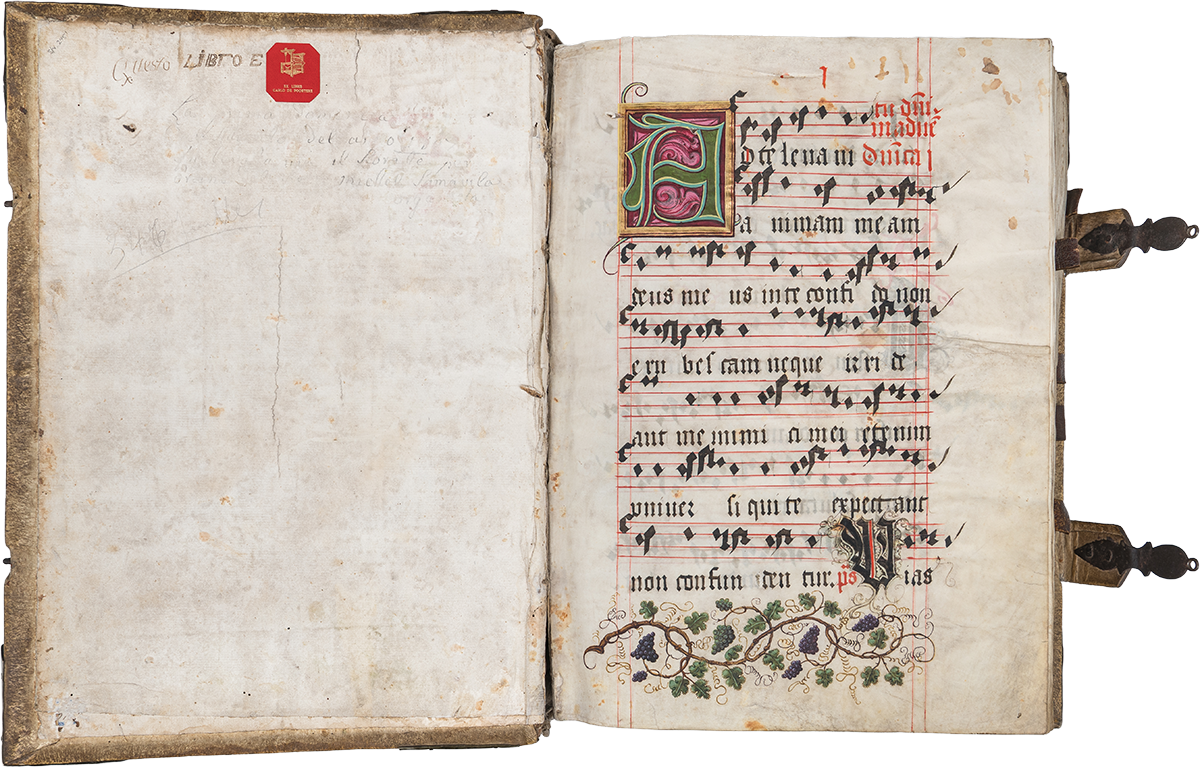
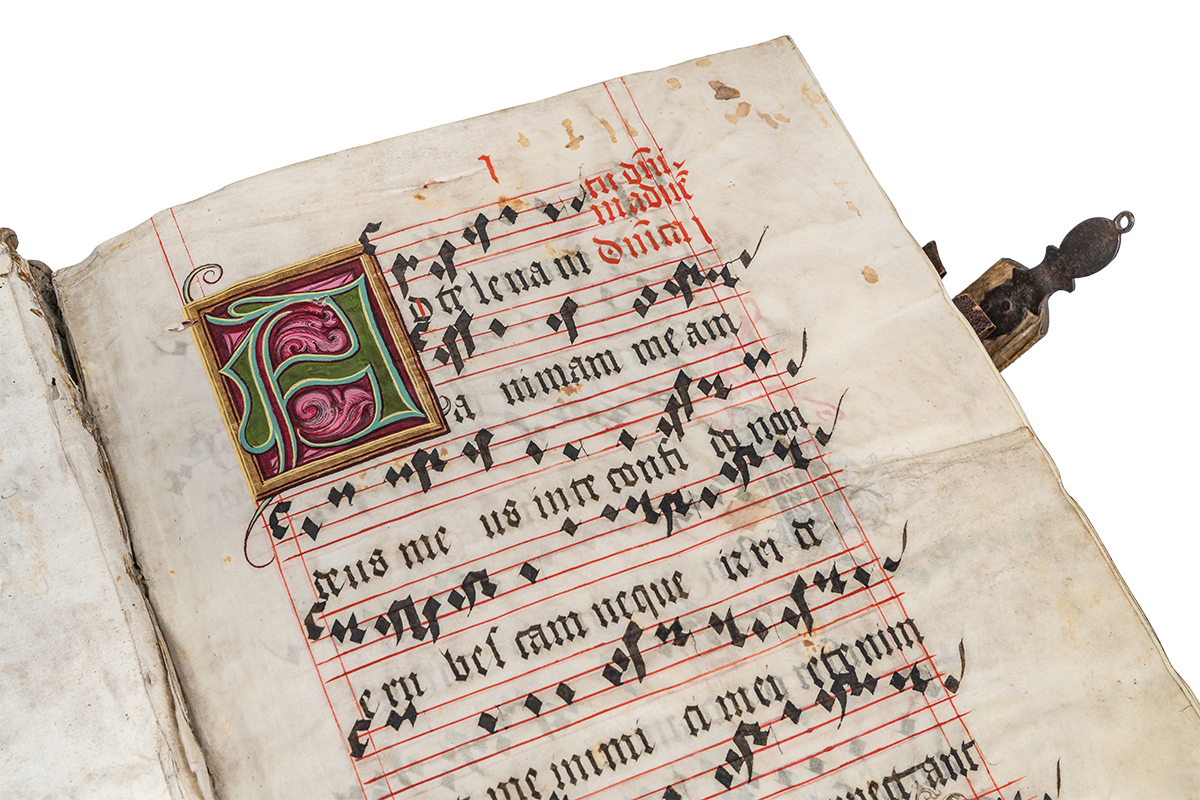
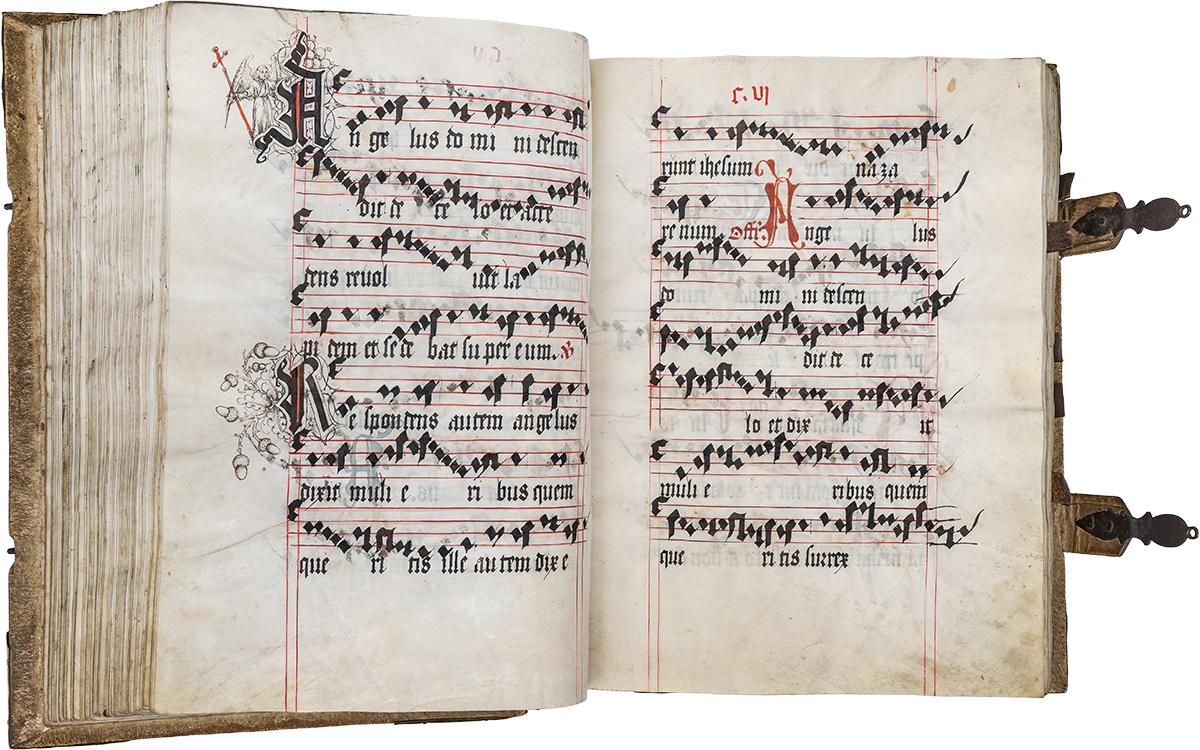
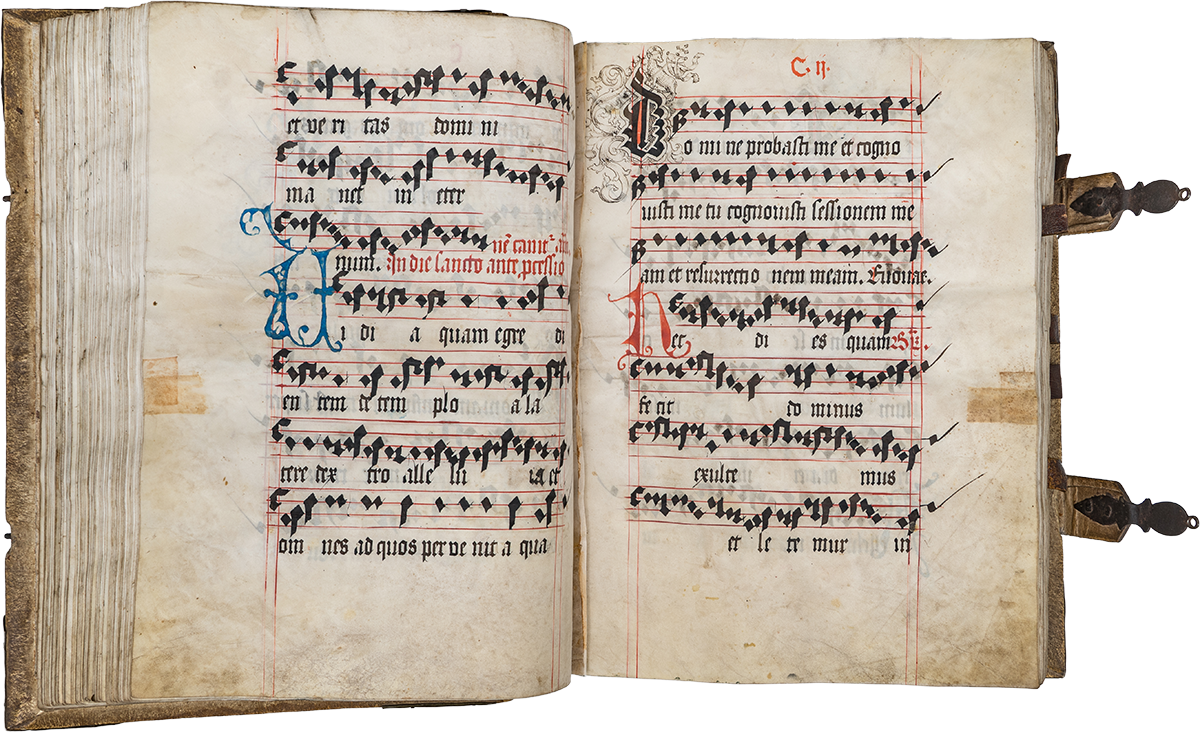
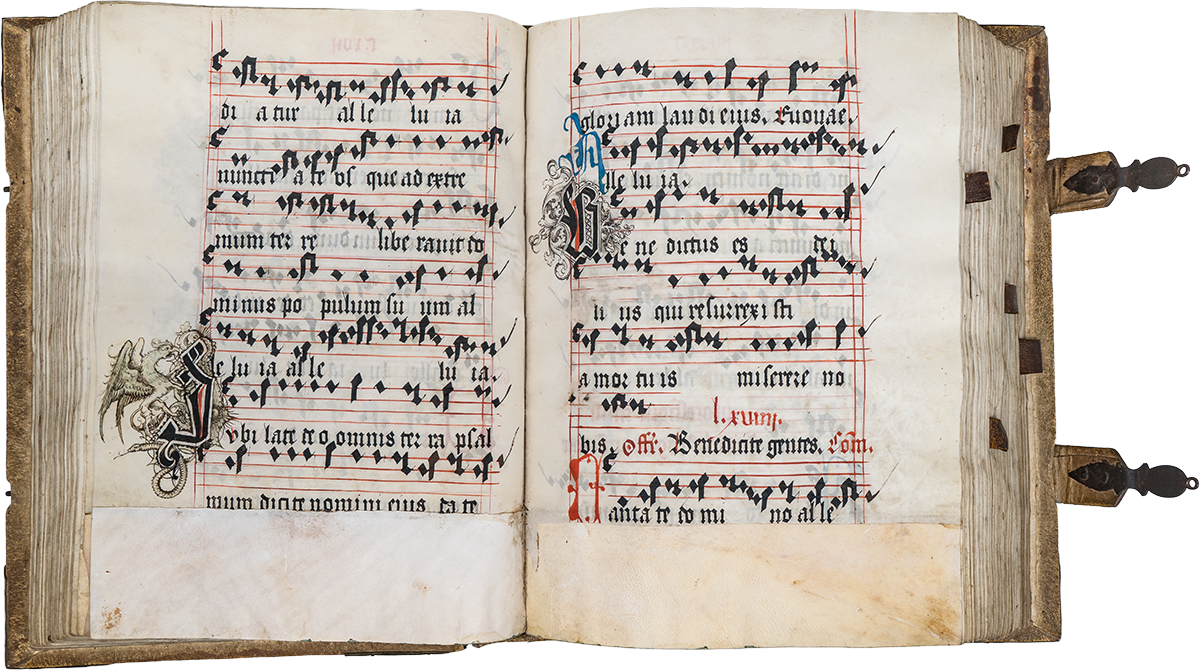
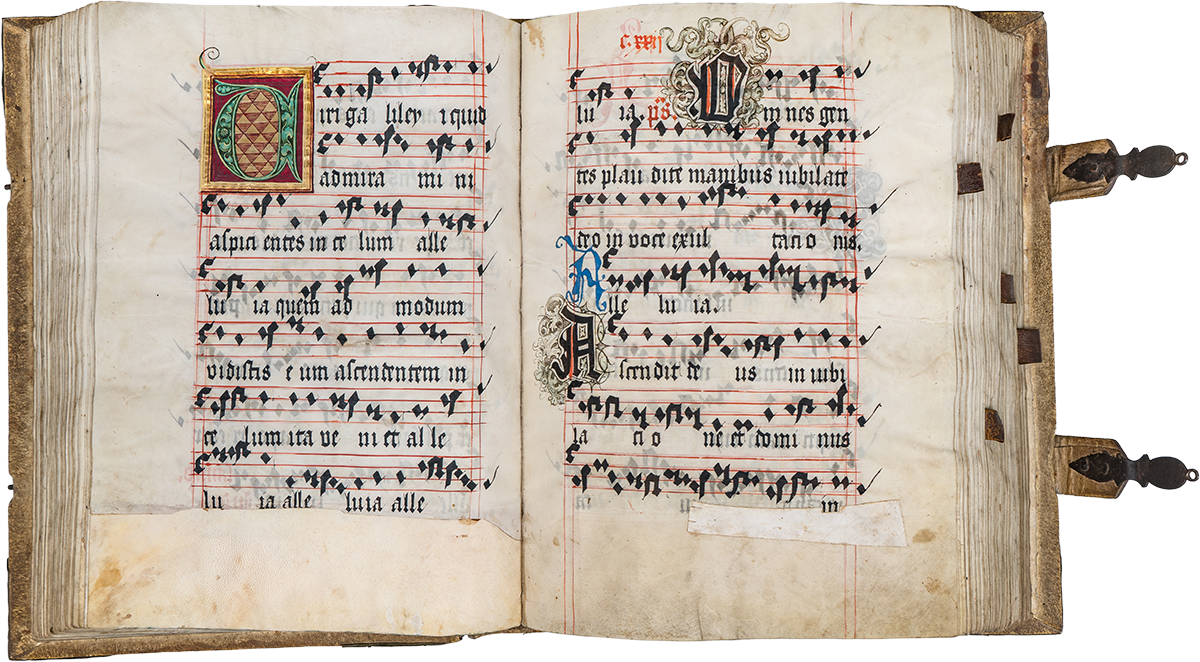
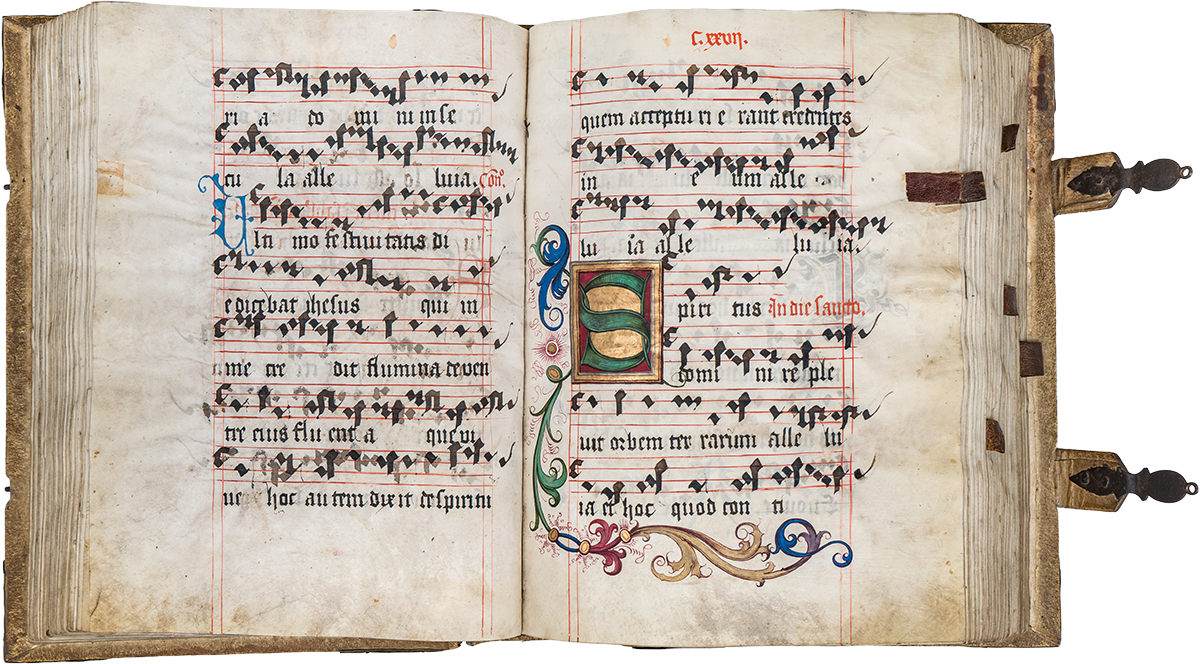
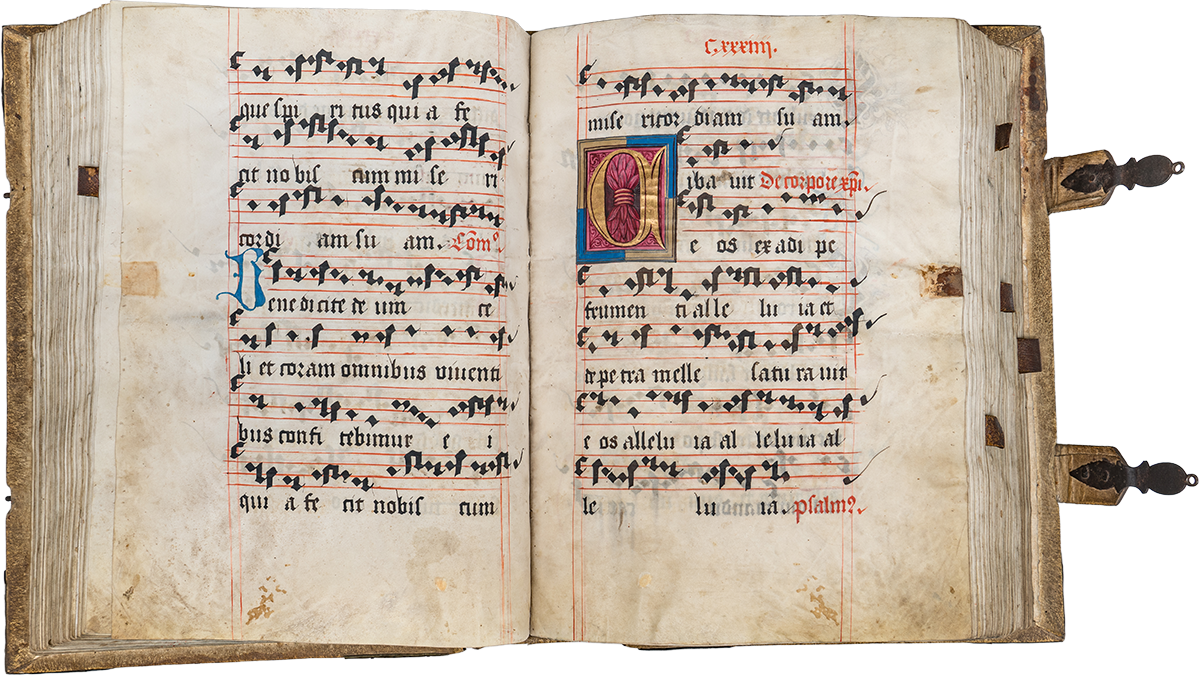
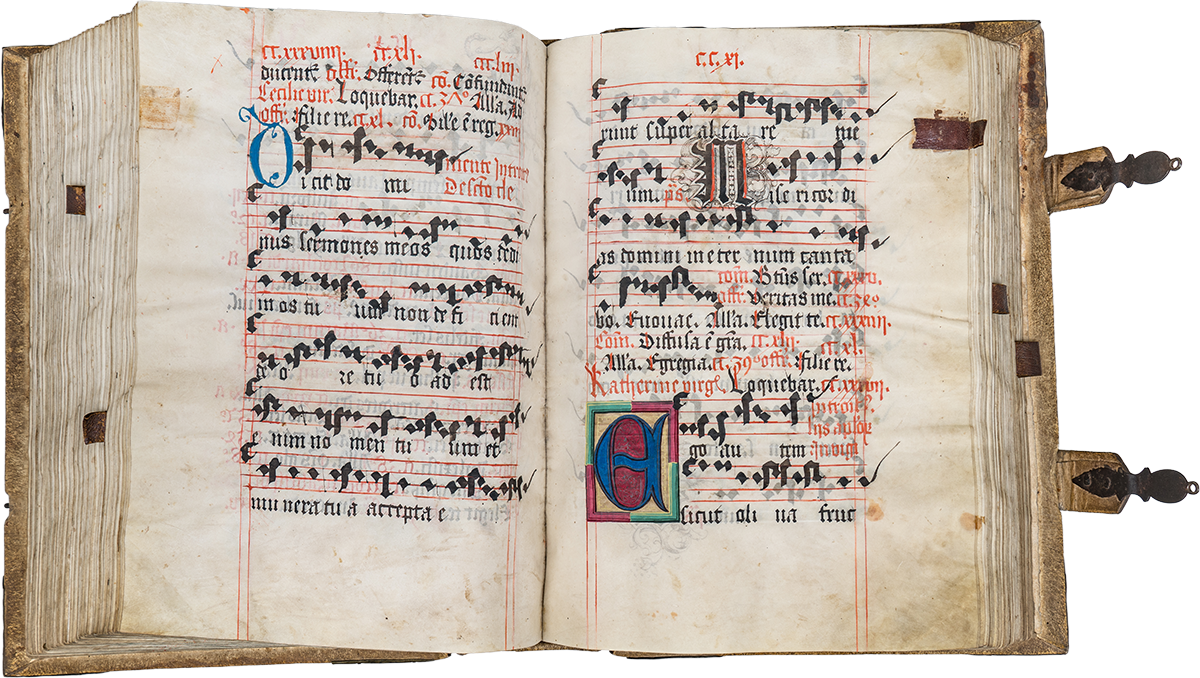
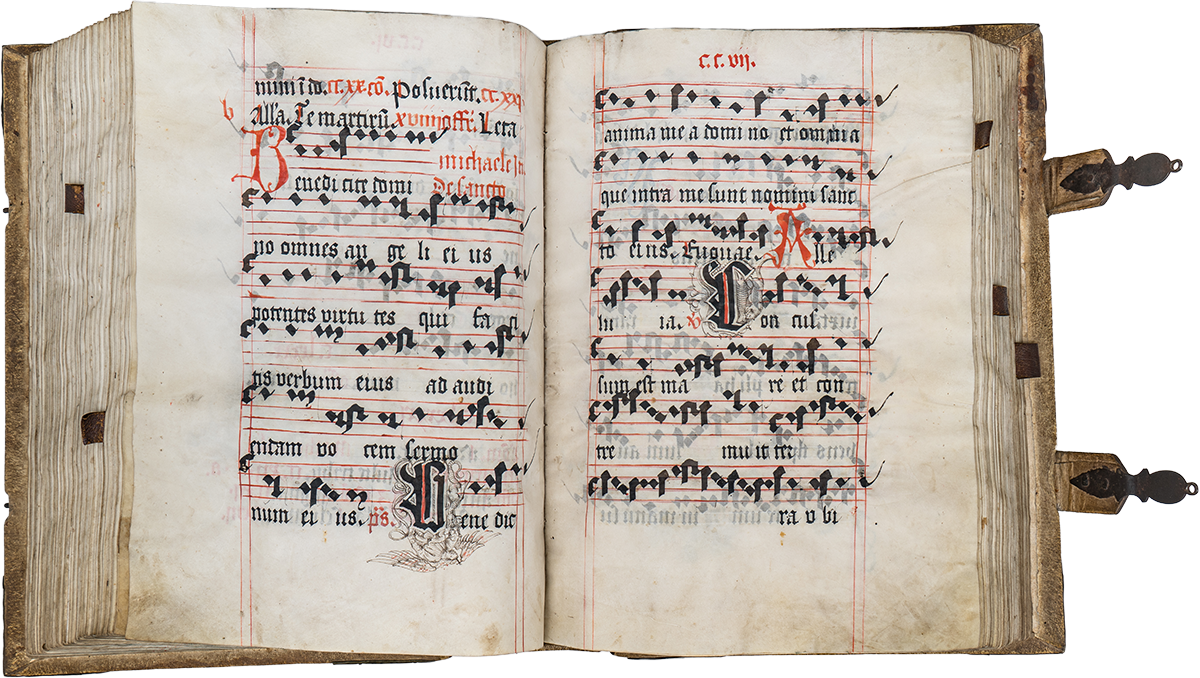
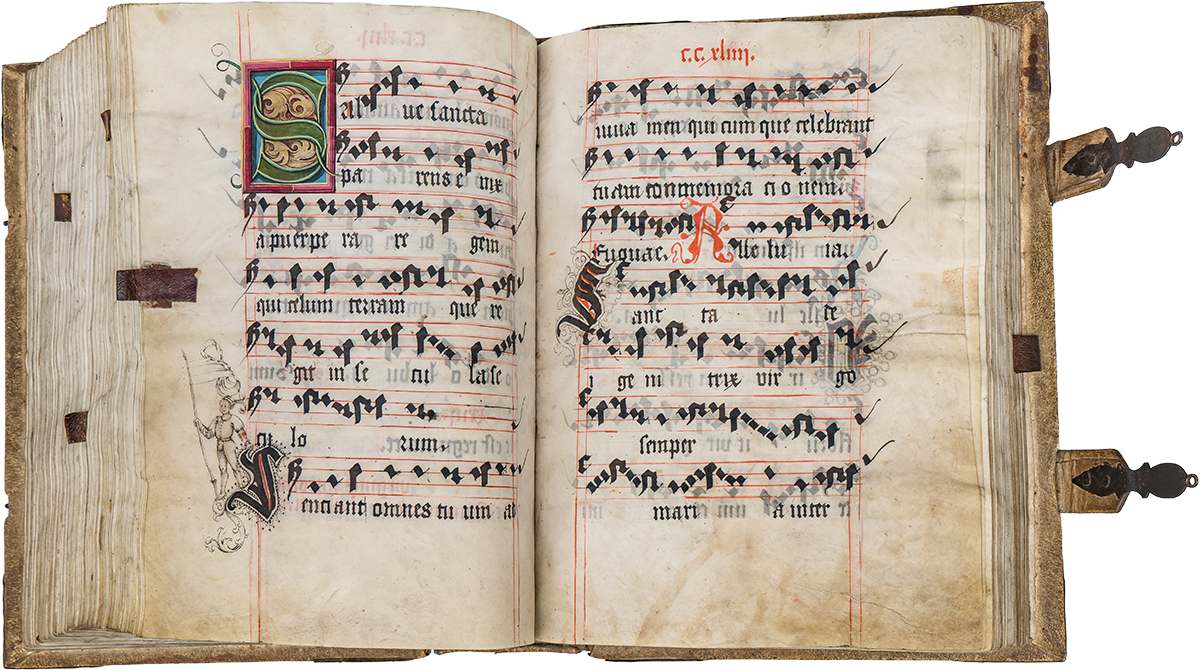
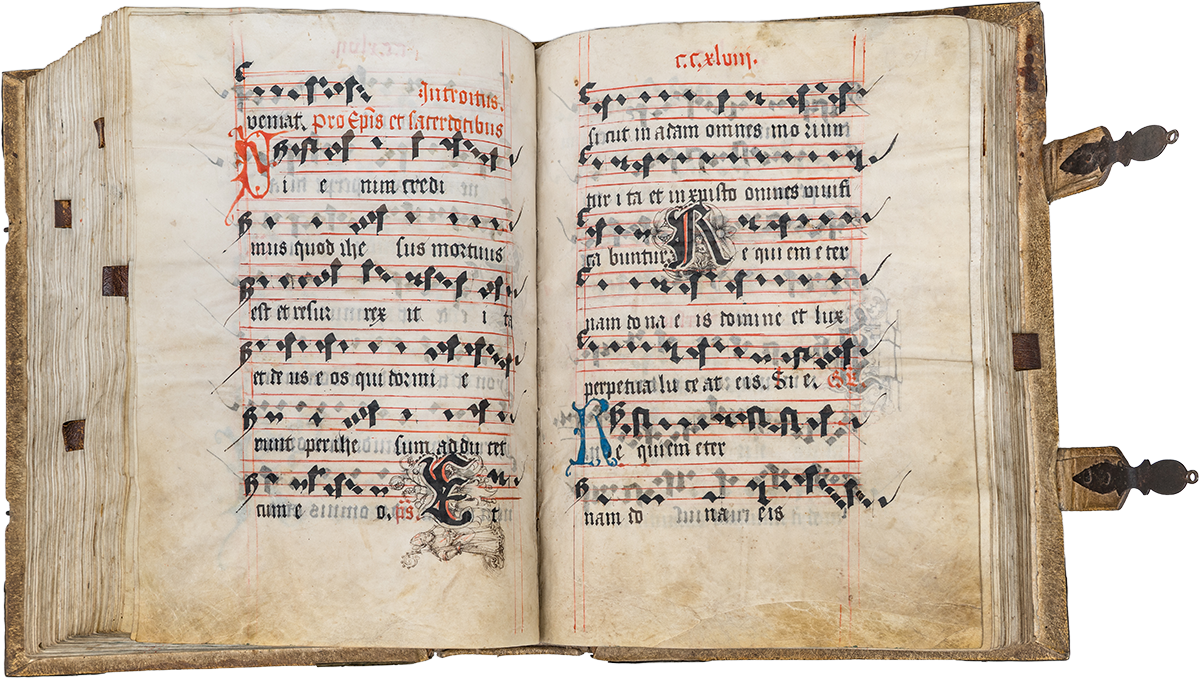
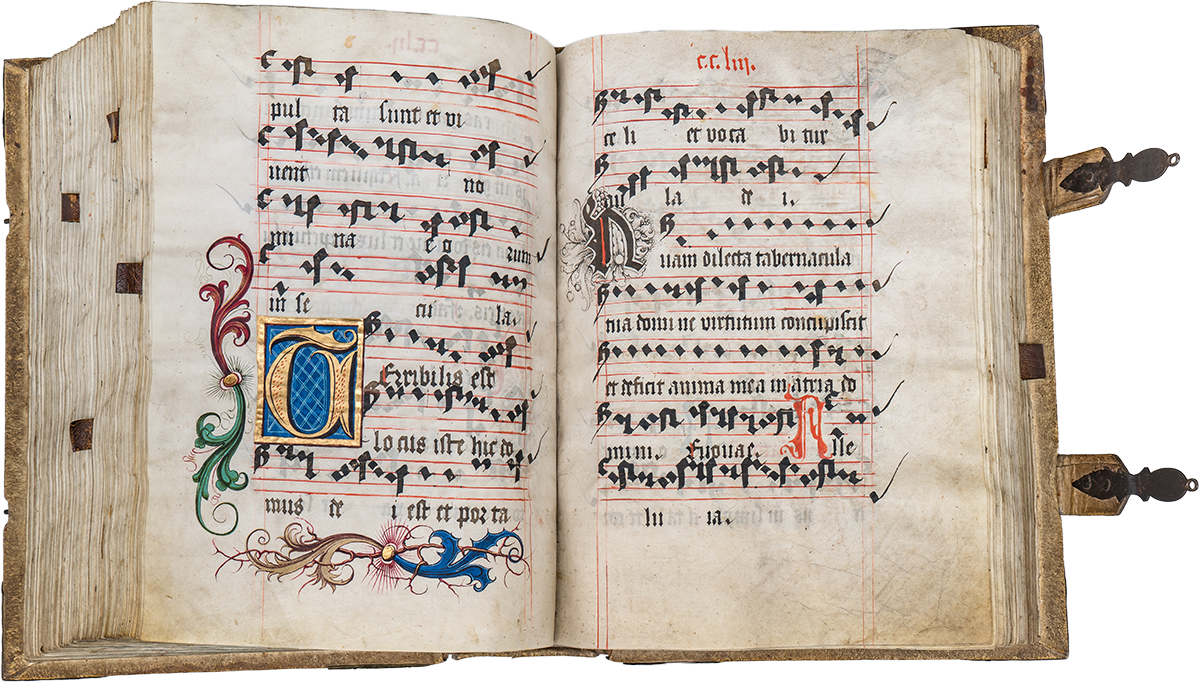
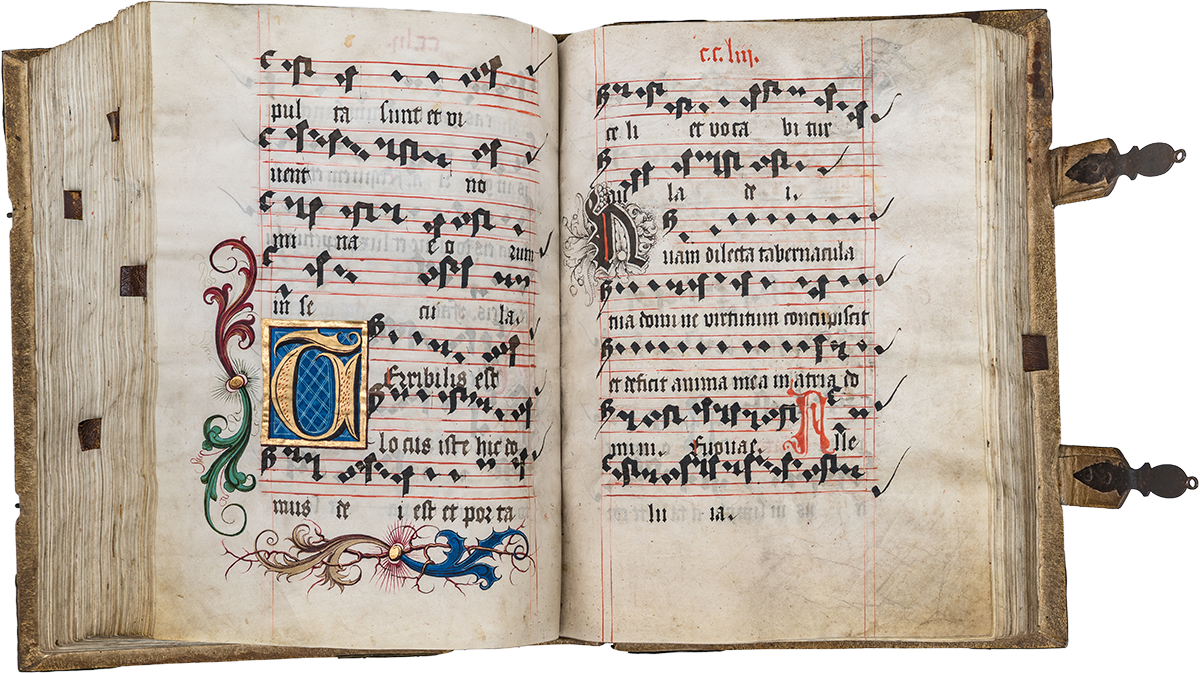
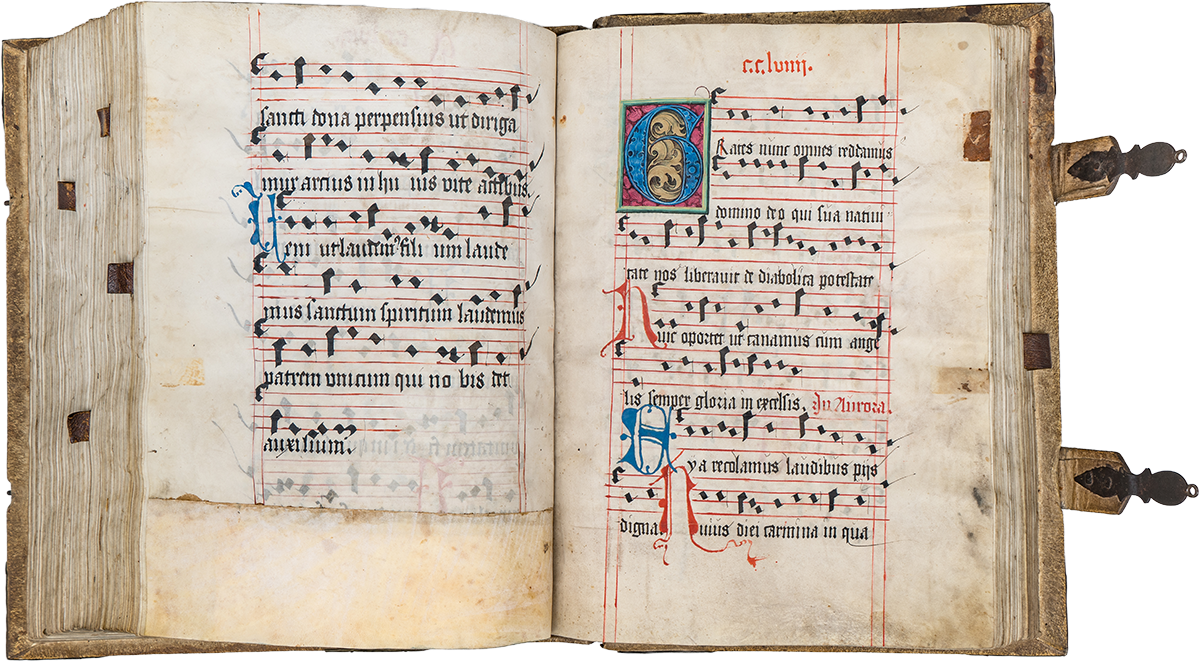
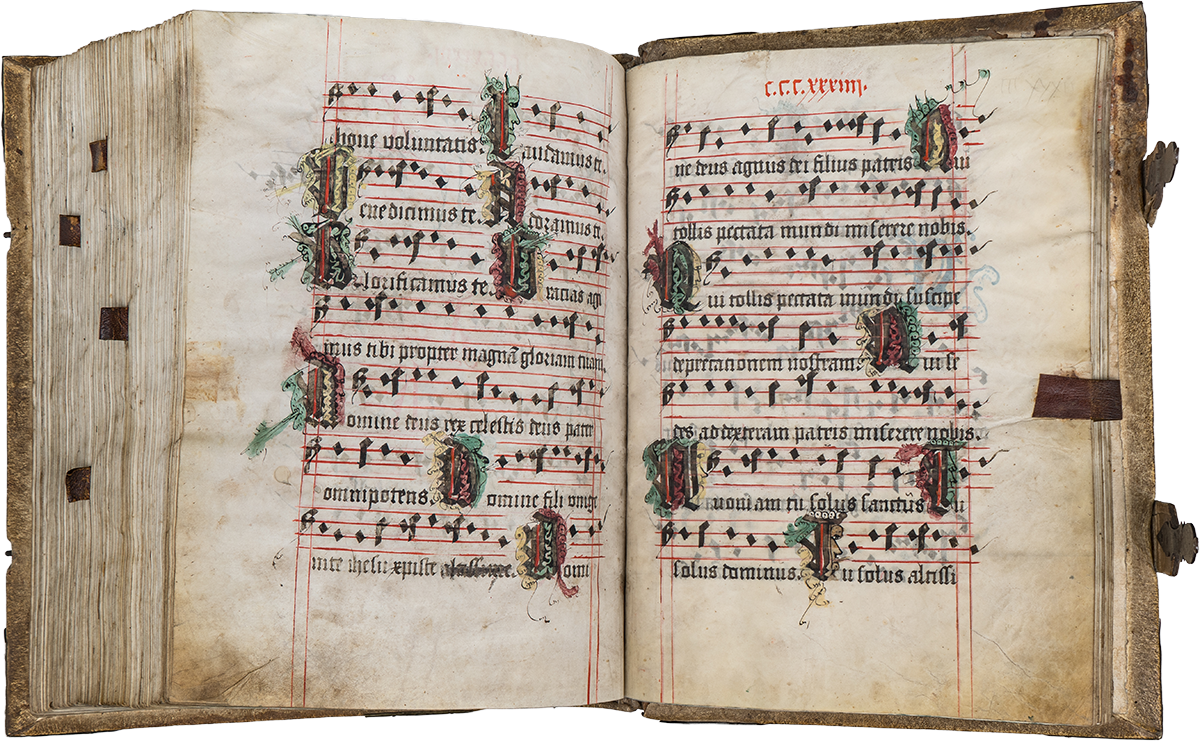
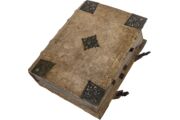
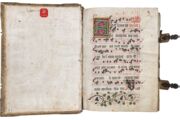
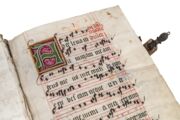
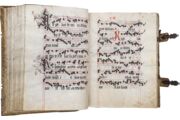
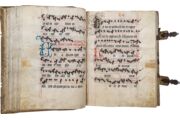
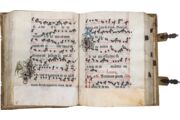
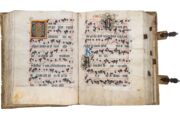
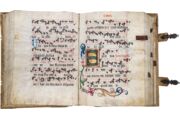
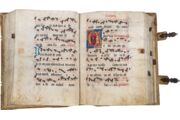
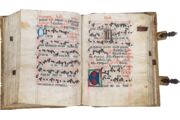
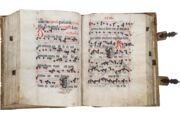
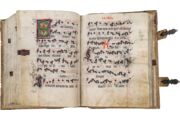
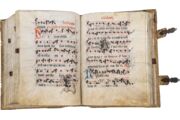
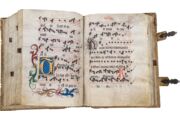
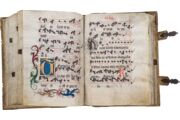
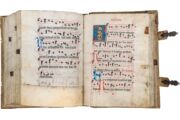
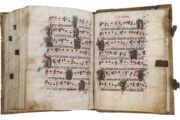
339 parchment folios, original foliation in red in center upper right margin (used here), most catchwords trimmed, some quire signatures remain in far lower right, (collation: i8-2 ii8-5 iii8-7 iv8 v8-7 vi-x8 xi8-6 xii8 xiii10-1, 5 xiv8 xv10 xvi8 xvii8-5, 8, xviii8-1 xix8 xx8-6 xxi8 xxii8-1, 2 xxiii-xxxi8 xxxii6 xxxiii-xxxvii8 xxxviii8+9 xxxix6-7+7, 8 xl-xlii8 xliv8-6, 7, 8), ruled in red, 4-line staves in red, (justification 320 x 205mm), written in textualis quadrata and square notation, 5-8 line red and blue alternating ink initials, 5-8 line black and red ink initials, lavishly flourished, often including anthro- and zoomorphs, birds, or flowers, fifteen 10-12-line illuminated initials, three with sprays (ff. 1, 127, 252v), fully tabbed with leather tabs, some tabs now missing, some blurred lettering, parchment stained and torn in places, with old repairs occasionally obscuring text, but overall condition is good. Early (original?) blind-stamped pigskin binding over wooden boards, sewn on five bands, decorated with brass bosses and two intact clasps all showing normal wear. Dimensions 470 x 320 mm.
This lovely, massive Gradual full of colorful illuminated initials preserves a rare liturgical use from the Tyrolian Alps in the early sixteenth century. Extraordinarily inventive ink drawings enliven dozens of the initials throughout the volume, providing delightful glimpses into the flora, fauna, and daily life of this period, as well as dramatic mythical beasts such as dragons and gryphons. Only one other Gradual from this area is housed in North America, and few remain in Europe.
Provenance
1. Script and clothing style within the ink drawings suggest a date in the first quarter of the sixteenth century. The presence of the feast of the patron saints Albuinus and Ingenuinus (f. 181v) suggests the Diocese of Brixen, and the feast of the translation of Albuinus (f. 192) may point to the cathedral itself, where the relics were housed. Nevertheless, f. 22, and possibly the landsknecht’s banner on f. 243v, bears the arms (argent a fess gules) of Georg von Neideck, bishop of the neighboring diocese, Trento (1505-1514). Yet the Prince-Bishops of Trento and Brixen worked closely together in this period, and so either von Neideck or the following Prince-Bishop of Trento, Gerhard von Cles (1515-1539), or the Coadjutor and later Prince-Bishop of Brixen, Christoph von Schrofenstein (1509-1521) might equally have commissioned the book in von Neideck’s memory shortly after the older man’s death. Both are known for their interest in books and remodeling their dioceses: von Schrofenstein commissioned a printed Missal, and von Cles engaged in a range of major architectural projects and substantially developed the episcopal library (see Online Resources).
2. Many faded pencil notes in Latin and Italian on both front and rear pastedowns. The most legible of these describe the contents of the volume. One may be an ownership or donation inscription and seems to be dated “del anno 1807,” but the remainder is now too faint to decode.
3. Remnants of a small blue and white nineteenth-century library sticker with now illegible shelfmark on lower left front pastedown, but no direct matches to the pattern on this sticker have been found.
4. Front pastedown exlibris sticker of Carlo de Poortere (1917–2002), Belgian carpet manufacturer and bibliophile. Poortere’s collection began to be dispersed in the 1990s.
5. Lot 22 in Heribert Tenschert, No. 41: Leuchtendes Mittelalter. Neue Folge II, dreiunndreissig mittelalterliche Handschriften aus Byzanz, Italien, Frankreich, Deutschland, Flandern, and den Niederlanden vom 11. bis zum Frühen 16. Jahrhundert, Passau 1998, see also Schoenberg Database of Manuscripts, SDBM11849.
6. Private (“renowned”) Swiss Collection.
Text
ff. 1-175v, Temporale, from Advent to twenty-third Sunday after Pentecost;
ff. 176-210v, Sanctorale from Andrew (f. 176, rubric on f. 175v, 30 Nov), to St. Katherine (25 Nov.), including St. Gall (f. 208v, 16 Oct.), Albuinus and Ingenuinus (f. 181v, patron saints of Brixen), Translation of Albuinus (f. 192, patron of Brixen, relics at Brixen), Henry (f. 199v, 13 July, patron of Basel), among many more;
ff. 211- 243, Common of the Saints;
ff. 243v-258v, Votive masses, including Mary (f. 243v), Office of the Dead (f. 246v), Memorial mass for bishops and priests (f. 247v), f. 252v Dedication of a Church;
ff. 259-318v, Sequentiar, sequences for Temporale, Sanctorale, and Common of the Saints intermixed, including Christmas (f. 259), Stephen (f. 263), Corpus Christi (f. 278), Decollation of John the Baptist (f. 291v), Michael (f. 296), Dedication of a Church (f. 304), all apostles (f. 305v), among many others;
ff. 319-353v, Kyriale, ending imperfectly, with Kyries followed by Sanctus, Benedictus, and Agnus dei. The Kyriales’ ink initials are executed by a second, rougher hand than the rest, and may be by the main scribe.
Illustration
In addition to skillfully painted, often highly inventive decorative initials, many rich with gold leaf, and some with lavish border decoration (e.g., f. 252v), a great many elaborately decorated ink initials feature large anthromorphs, and either fantastic or naturalistic flora and fauna, as well as ecclesiastical iconography such as:
f. 91, Good Friday, a cleric praying at the foot of a crucifix;
f. 102, Easter, haloed lamb carrying the vexillum, a design also employed on the arms of Brixen;
f. 128, Pentecost, Radiant Dove;
f. 206v, Feast of St. Michael, St. Michael slaying the dragon;
f. 243v, a knight holding a banner;
f. 247v, Memorial mass for bishops and priests, a bishop, a choice that may suggest this was made for the cathedral at Brixen, and possibly commissioned as a memorial for von Neideck, rather than by von Neideck himself. Further, f. 248v includes a drawing of a bier, drawing further attention to this Mass.
Moreover, the clothing on human figures is detailed enough to help date the volume to the first quarter of the century (see for example, a hat, f. 59; codpiece, f. 46v; doublet, hose, and hat, f. 243v). Whilst the pigment illumination is colorful and professional but rote, and the script and notation rather rough, these penwork initials are vigorous and inventive, depicting animals, plants, and people with creative verve. These initials offer a rare glimpse into the material world of early sixteenth-century Alpine life.
Graduals include the sung portions of the Mass; these include texts that are proper to the Feast (the Introit, Gradual, Alleluia, which is replaced by the Tract during penitential seasons, Offertory and Communion), as well as Ordinary chants, that are included in every Mass (Kyrie, Gloria, Credo, Sanctus, Agnus Dei and Ite Missa est). The text of Ordinary chants did not vary, although the music did, so noted Graduals such as this one were vital in ensuring liturgical quality.
This volume is a fascinating study in contrasts. Massive and liturgically compendius, it marks a major undertaking, for which not only was an illuminator paid, but also a truly top-tier artist who worked in ink was employed. Whilst earlier cataloguing suggested that this might be by the artist and polymath Vigil Raber, he has been securely associated with only a single extant work, a heraldic anthology, and therefore no comparison can be made with this Gradual. Moreover, the volume is well organized, including folio numbers in the original hand. Yet, the rubrisher and scribe of both text and music was quite rough. This may well be a local product, limited by which artisans currently resided in Brixen (or Trento). It is entirely possible that the scribe included a colophon, as was done in other Brixen choirbooks of this period, but the loss of the final three leaves preserves that mystery.
Choir Books from the diocese are quite rare. According to the Schoenberg Manuscript Database, North American collections house only a pontifical dated 1540 and a fourteenth-century gradual (see Online Resources). Abroad, Ker identified a single noted liturgical book in the UK (1983, v. 3, p. 256). The Mittelalterliche Handschriften in Österreich database lists only three Graduals and an Antiphonal from Brixen (see Literature and Online Resources), and the Cantus Network has identified another Gradual. The MHO lists no liturgical books from the Diocese of Trento, though of course, its coverage of Italian libraries is less thorough than of Austrian libraries, so this count may not be comprehensive. The present volume offers important evidence of liturgical music as well as line-drawing in the early sixteenth-century Alps.
Literature
Bressanone, Priesterseminar/Seminario Maggiore, Cod. F 5 (olim 117), gradual
Bressanone, Priesterseminar/Seminario Maggiore, Cod. F 7 (olim 119), gradual
Bressanone, Priesterseminar/Seminario Maggiore, Cod. K 7 (olim 173), antiphonal
Harper, John. The Forms and Orders of Western Liturgy from the Tenth to the Eighteenth Century, Oxford, 1991.
Hiley, D. Western Plainchant: A Handbook, Oxford, 1993.
Hughes, A. Medieval Manuscripts for Mass and Office: A Guide to Their Organization and Terminology, Toronto, 1982.
Huglo, M. Les livres de chant liturgiques,Turhout, 1988.
Ker, N. R. Medieval Manuscripts in British Libraries, vol. 3, Oxford, 1983.
Palazzo, Eric. A History of Liturgical Books from the Beginning to the Thirteenth Century, tr. Madeleine Beaumont, Collegeville, Minnesota, 1998.
Online Resources
Bressanone, Priesterseminar/Seminario Maggiore, Cod. A 17 (olim 17), gradual
https://manuscripta.at/hs_detail.php?ID=35044
Cambridge, MA, Harvard University Library, MS Typ 309, pontifical, samples here
https://viewer.lib.harvard.edu/viewer/URN-3:FHCL.HOUGH:823240
Cantus Network: Librii ordinarii of the Salzburg Metropolitan Province, https://gams.uni-graz.at/context:cantus/sdef:Context/get?locale=en
Catholic Hierarchy. https://www.catholic-hierarchy.org/bishop/bneideck.html
Hermann, Hermann Julius. Die illuminierten Handschriften in Tirol, Leipzig, 1905
https://archive.org/details/DieIlluminiertenHandschriftenInTirol/page/n3/mode/2up
Innichen, Kollegiatstift, Cod. VII a 7 (Nr. 60), gradual
https://gams.uni-graz.at/o:cantus.brixen/sdef:IIIF/getMirador?manifest=https://iiifp-mufo.oeaw.ac.at/mahss/I-SCAccVII_a_7/manifest&view=ThumbnailsView
Miranda, Salvador. Cardinals of the Holy Roman Church https://cardinals.fiu.edu/bios1530.htm#Cles
Missale secundum ritum ecclesie Brixinensis (Basel, 1511) digitized copies linked here https://www.ustc.ac.uk/editions/676193
Philadelphia, University of Pennsylvania Library, MS Codex 1572, gradual
https://bibliophilly.library.upenn.edu/viewer.php?id=Ms.%20Codex%201572#page/1/mode/2up
Wikipedia. https://de.wikipedia.org/wiki/Christoph_von_Schroffenstein
TM1301