

Missal
In Latin, illuminated manuscript on parchment
Poland, Wrocław?, c. 1475-1500
TM 1510
- $59,000.00
 Textmanuscripts - Les Enluminures
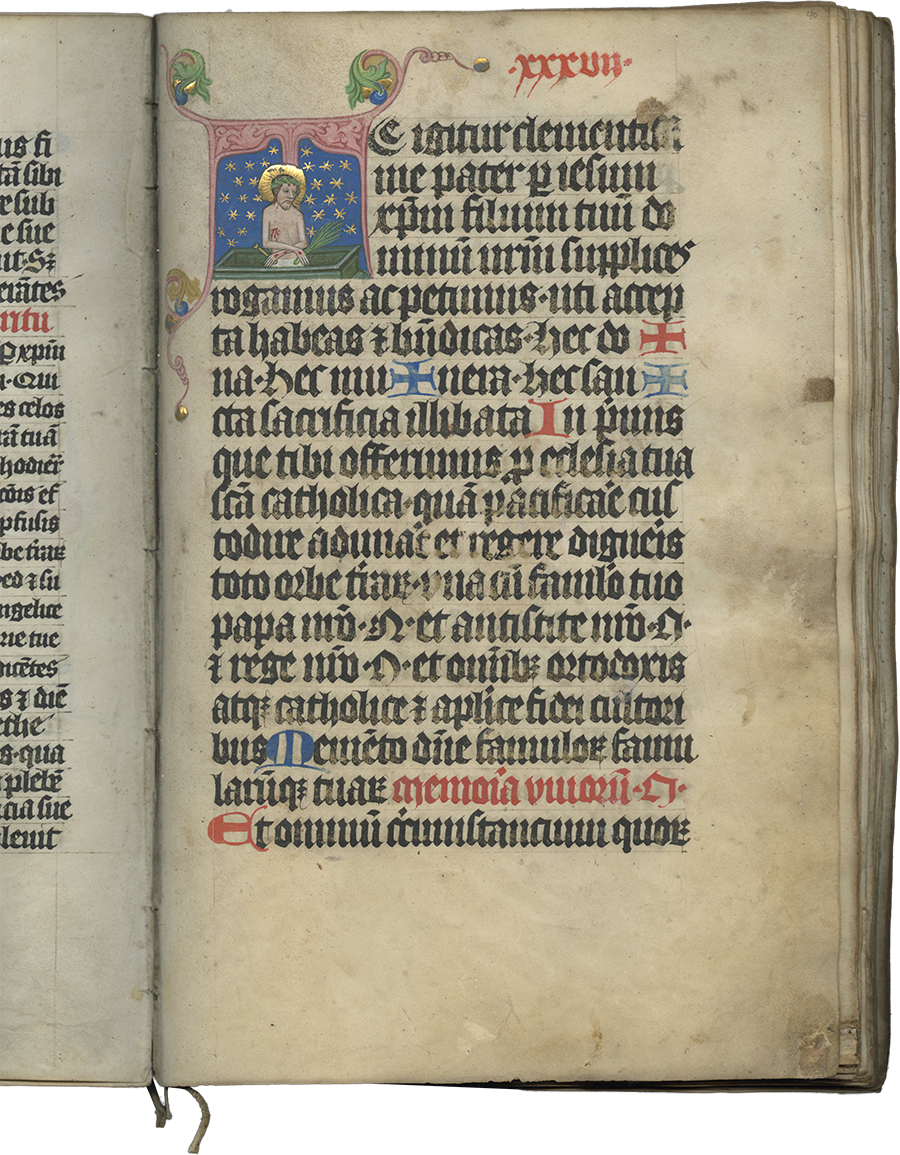
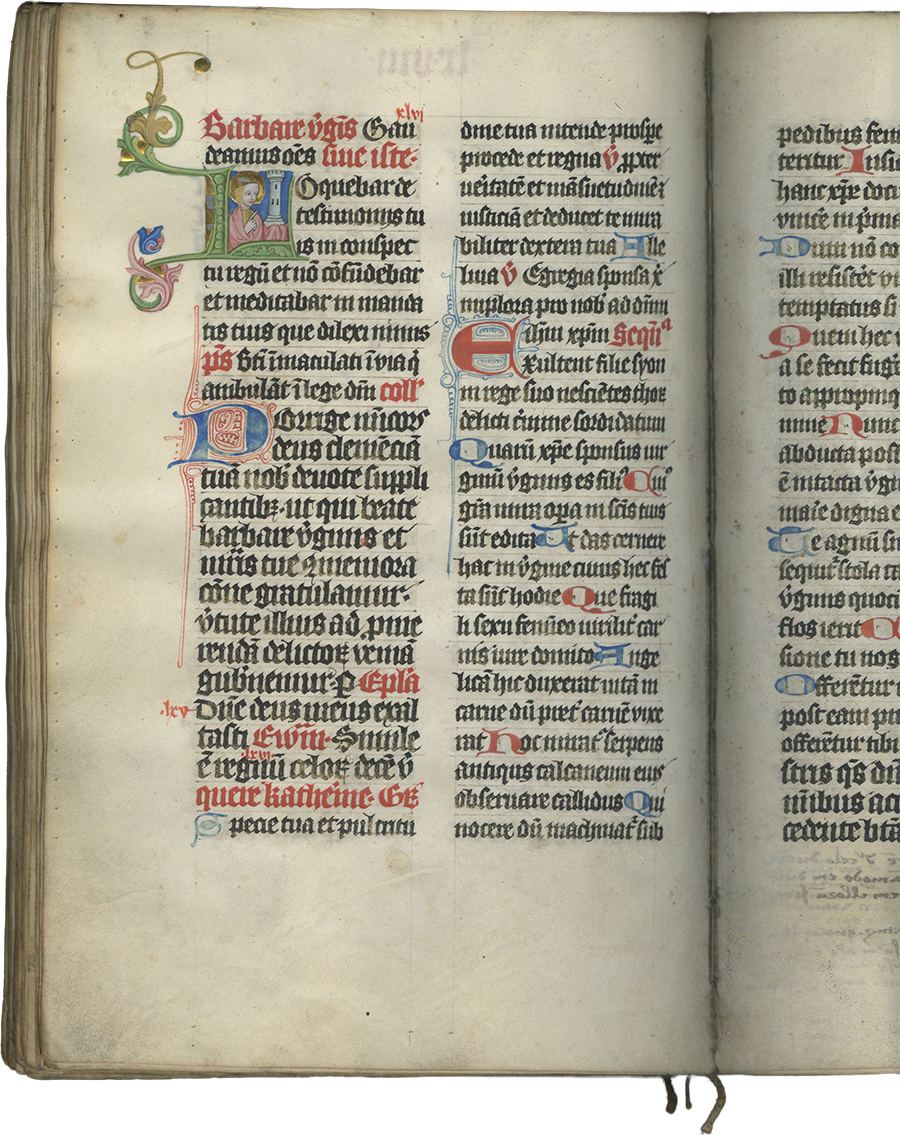
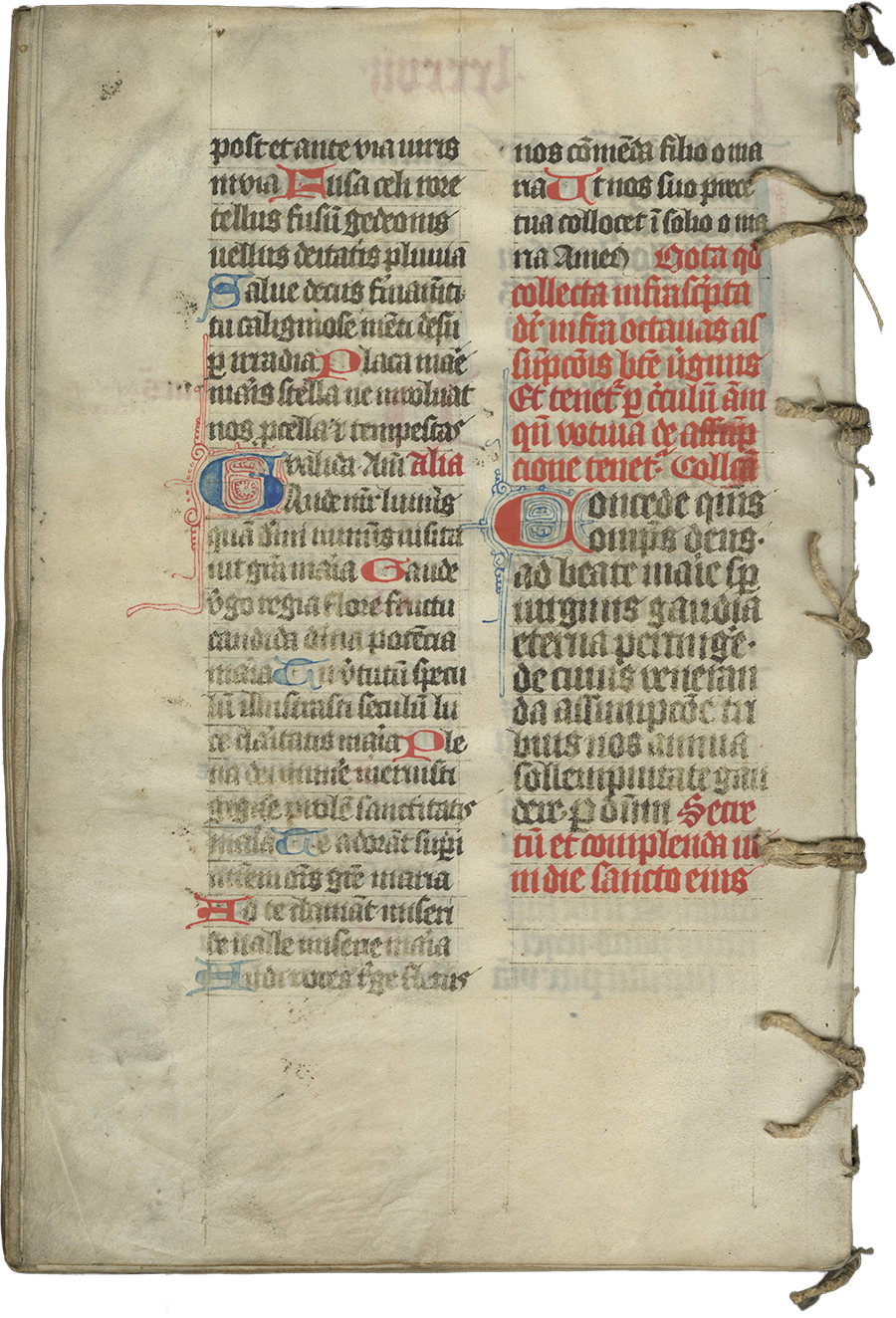
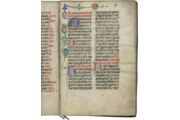
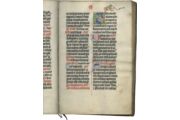
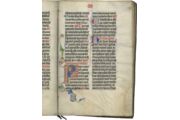
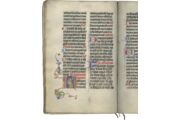
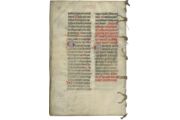
90 parchment leaves, incomplete, contemporary foliation in red at head of rectos ci-cii, i-lxxxvii, missing some number of quires at the end, together with the Crucifixion miniature page and most of quire 8, some quire signatures in lower right, some quires signed numerically in place of catchwords, (collation: i2 ii6+7 iii-v8 vi8-7 vii8 viii8-2,-3,-4,-5,-6,-7 ix-xii8 xiii6), ruled in ink, Canon of the Mass in 18 lines, single column, (justification 220 x140 mm), rest is double column 25 lines (justification 210 x 140 mm), written in a good textualis formata, majuscules touched with yellow, red rubrics, one-line initials in red or blue, 2-line initials in same with flourishing in alternate color, sixteen 3-5 line foliate initials in green, rose, blue, violet, orange, and gold, most with marginal sprays, ONE MARGINAL MINIATURE (f. 44v), ELEVEN HISTORIATED INITIALS, 3-6 line, formerly tabbed with red leather tabs, now all removed, parchment darkened with use around edges, some light ink scuffing, bottom outer corner of first leaf wanting, the volume overall in good condition. Disbound, quires sewn on six cords, with cords showing extent of missing quires at end. Dimensions 310 x 210 mm.
This lovely late medieval Missal displays some of the very best eastern European manuscript art from the late fifteenth century. The text offers evidence of a Silesian provenance, and perhaps the illuminated initials Both historiated and decorative initials demonstrate the bright, active illumination style characteristic of eastern Europe, while the text offers evidence for a Silesian provenance, specifically.
1. Whilst the inclusion of the Feast of the Immaculate Conception, the illumination style, and script make it clear that this Missal was made in the later fifteenth century, localizing it further is challenging due to its lack of binding, calendar and litany. Nevertheless, the inclusion of Hedwig’s feast is notable, as Hedwig was the patron saint of Silesia, and her feast appears in calendars from Poland south to Hungary and west to Nuremberg. Whilst all masses for Hedwig share similarities, the text given in the present manuscript is closest, nearly identical, to that known from Missals made for use in Wrocław, Poland (Online Resources). The style of the illumination suits a band from Augsburg to Prague to Wrocław itself, and if the manuscript was not made in Wrocław, and it may well have been, then it may have come from either of these other centers of manuscript production.
2. In the Feast of St. Martin, f. 66 bears three inscriptions in extremely small script hidden inside ink and pigment initial letters. A red ink initial reads “1832. J Reinert.” A blue ink initial reads “Mousel 1832.” An illuminated initial reads “Kaul. 1832.” Therefore, it seems likely that the manuscript had moved into a German collection by the early nineteenth century.
3. Brunk Auctions, Asheville, NC, US, September 24, 2011, lot 341.
ff. 1-2, Mass for the Invention of the Holy Cross, likely reused from another Missal, with f. 2v originally ruled but blank;
The ruling matches the body of the volume, but the script is different and given the cords on the binding and the evident completeness of the early portion of the Missal, it seems likely that these leaves were reused from another Missal, rather than representing the last two leaves of a missing hundred folios.
f. 2v, Foliated Table of Contents for the Missal;
Although its ruling and foliation matches the present volume, the table does not include the final materials at the end of even this incomplete book block, and it may therefore represent the table of contents for an earlier volume. Most churches owned several Missals, and it is entirely possible that this first quire represents the cannibalizing of a copytext to replace a worn volume. Missals received such heavy use that they frequently wore to tatters.
ff. 3-35, Temporale from Christmas to Corpus Christi;
ff. 35-37, Votive masses, including Dedication of a Church, and the Virgin Mary;
ff. 37-47, Prefatory material and Canon of the Mass;
ff. 47-52, Marian Votive Masses, quire missing its middle, currently includes Purification, part of Holy Family, Assumption, Nativity, Immaculate Conception;
ff. 52-72, selected Masses from the Sanctorale, including John the Baptist, Peter and Paul, Mary Magdalene, Lawrence, Bartholomew, Michael, Hedwig, the 11,000 Virgins (Ursula is not mentioned), All Saints, Martin, Katherine, Andrew, Nicholas, Barbara;
ff. 72-74v, Mass for the Dead;
ff. 74v-76v, selected Special Masses, including for Peace and Cosmas and Damian;
ff. 77-80, Accessus altaris, a collection of prayers and rituals before the Canon;
ff. 80-90v, Sequentiary containing sequences and other materials for a selection of saints’ feasts, including Lucy, Bartholomew, Martin, and Hedwig, among others, and from the Common of the Saints.
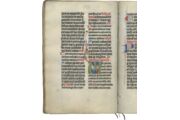
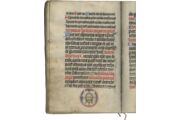
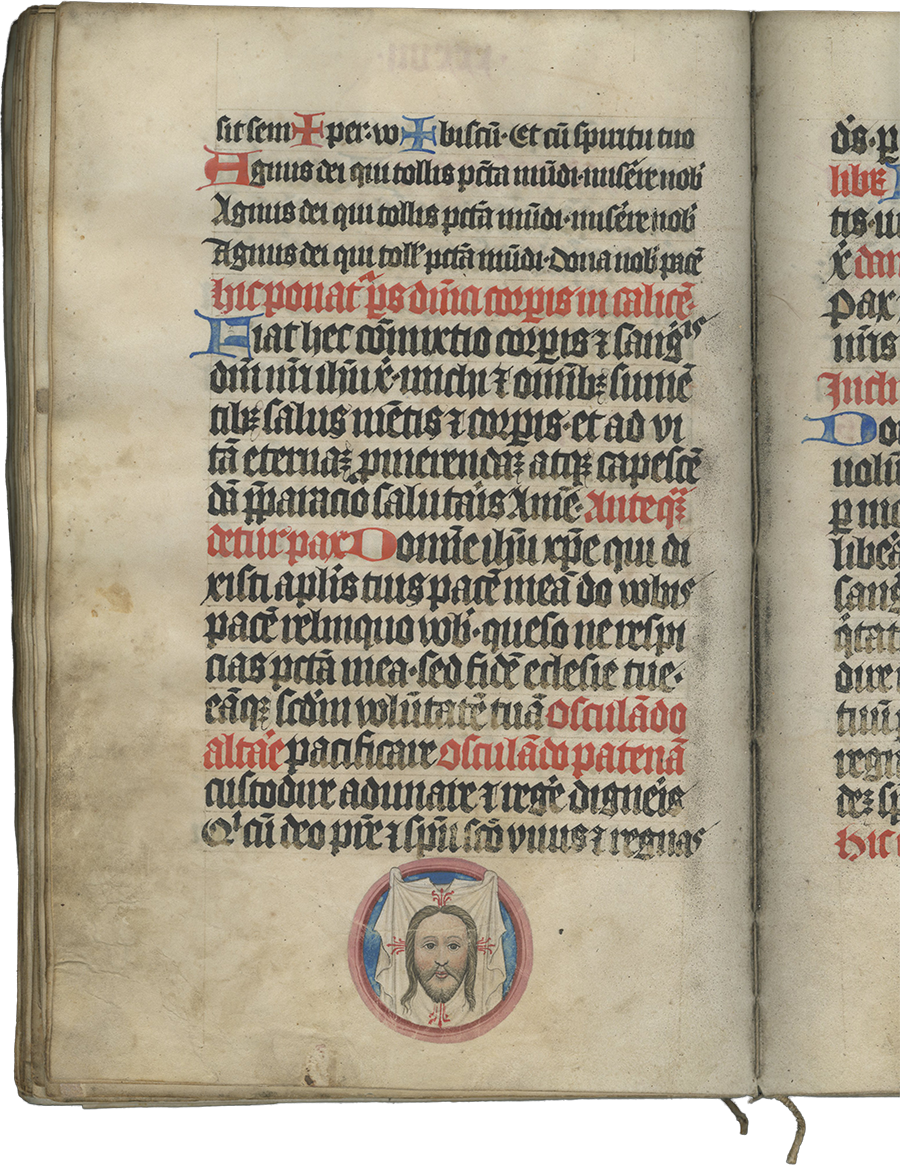
f. 44v, 55mm diameter, Holy Face of Christ on Veronica’s Veil against a blue ground in a rose roundel in the lower margin of a folio of the Canon of the Mass;
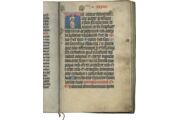
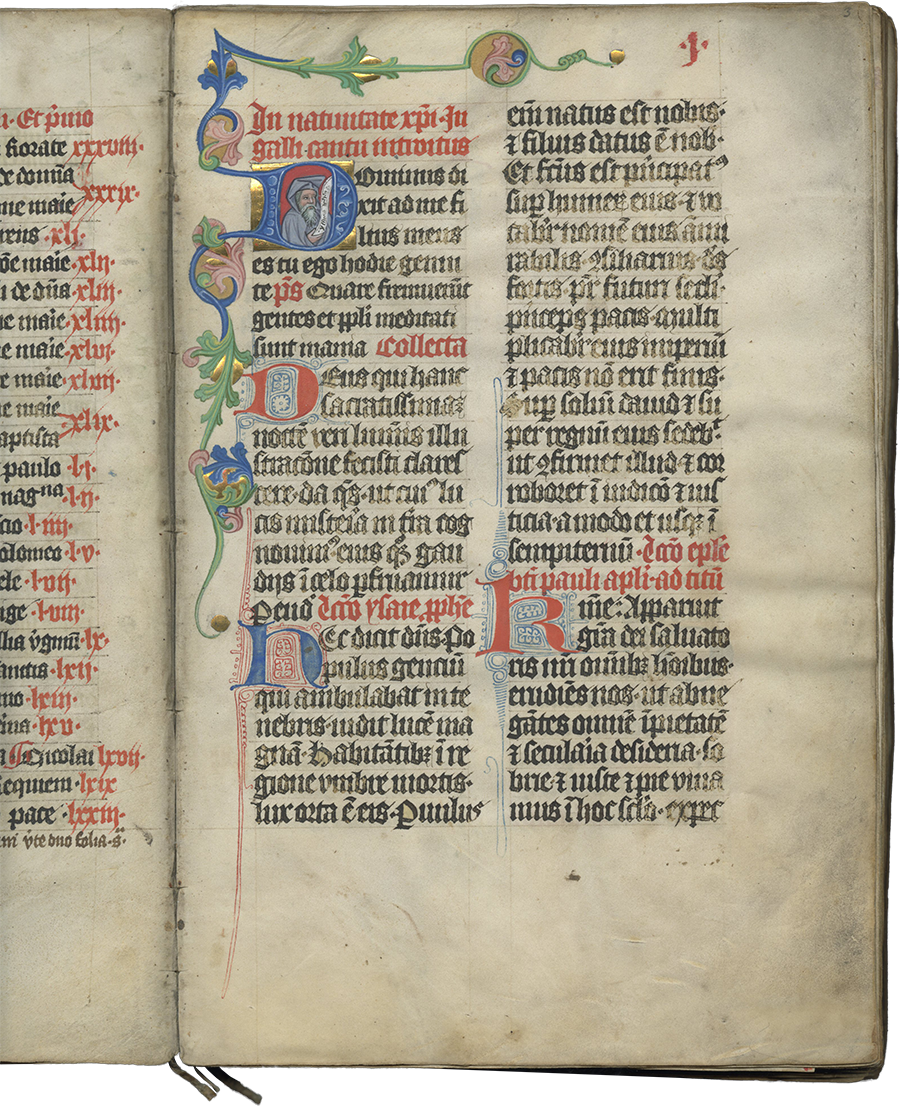
f. 3, 3-line historiated initial showing Isaiah holding a scroll, beginning the feast of the Nativity;
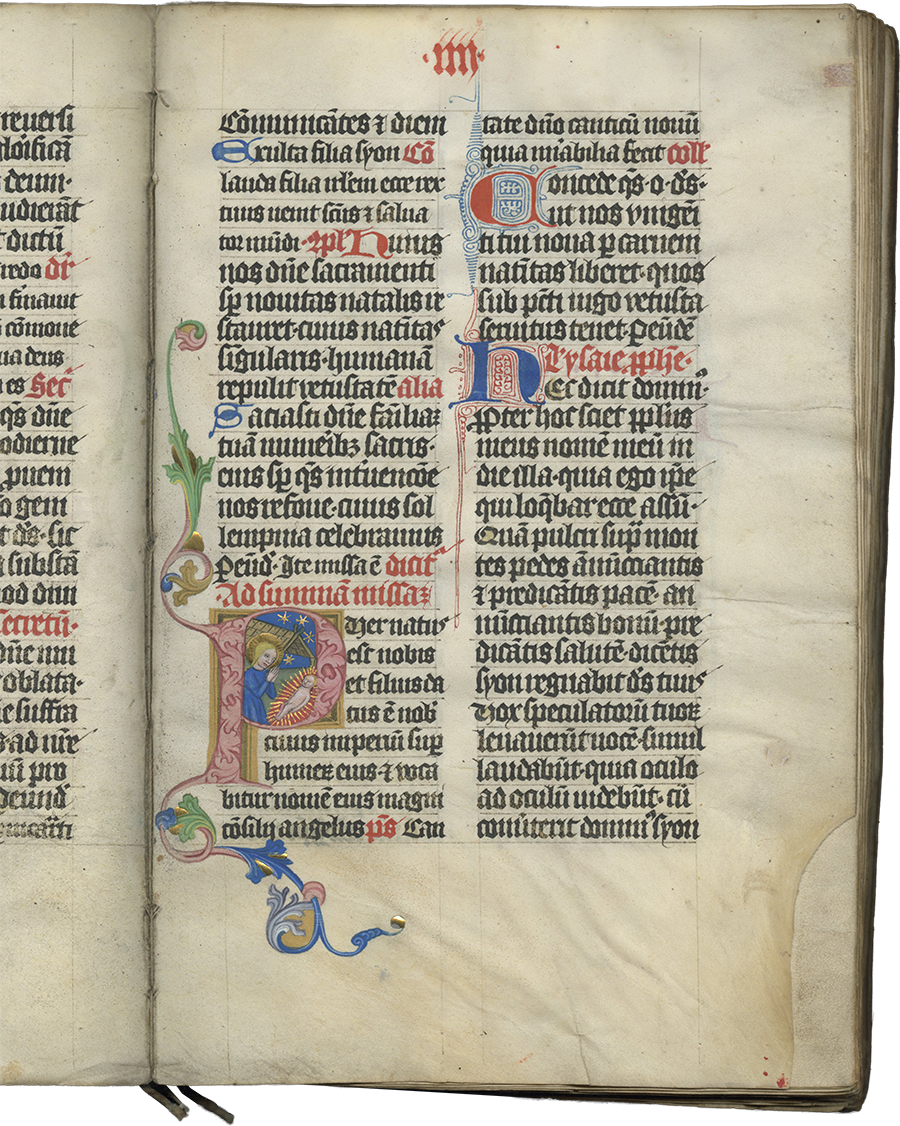
f. 6, 6-line historiated initial of the Nativity, showing Mary adoring the radiant Child laying in a manger under a starry sky beginning the high mass for Christmas;
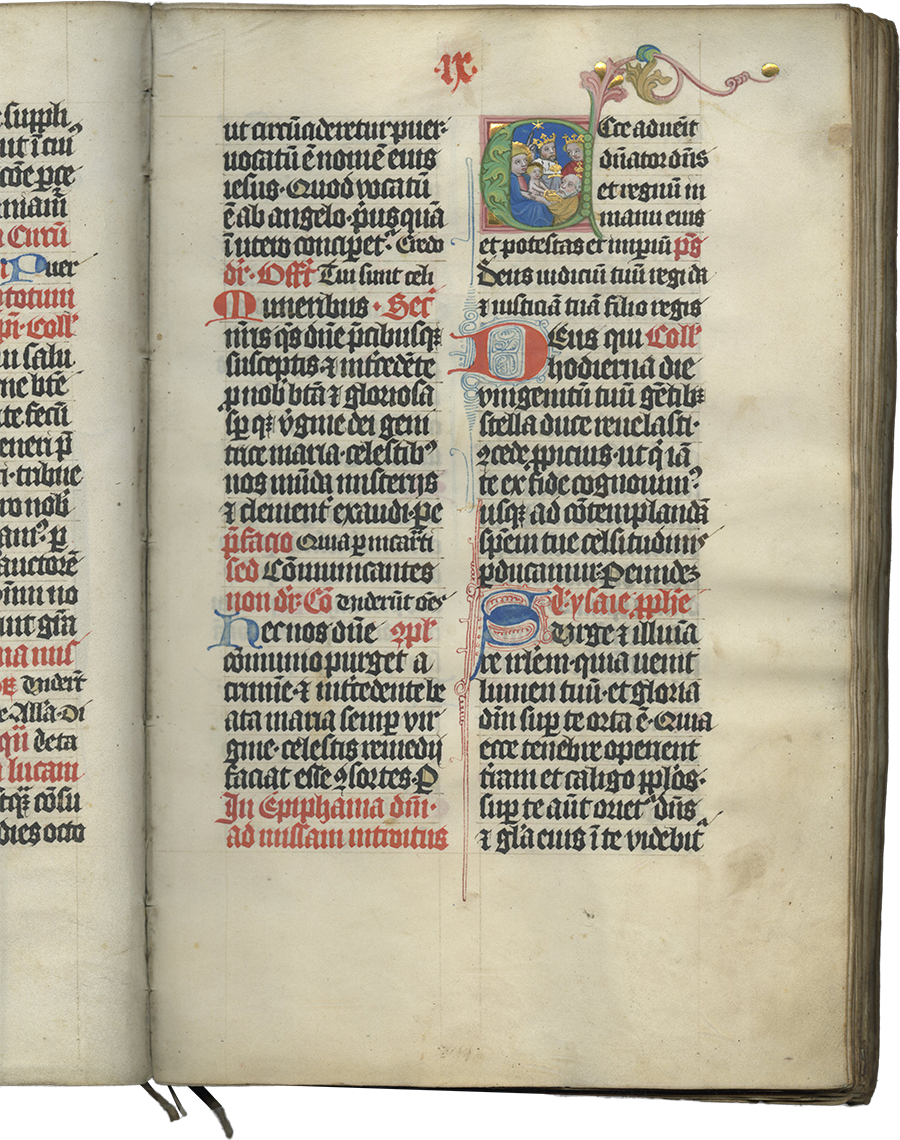
f. 11, 4-line historiated initial of the three Kings adoring the Child, beginning the feast of Epiphany;
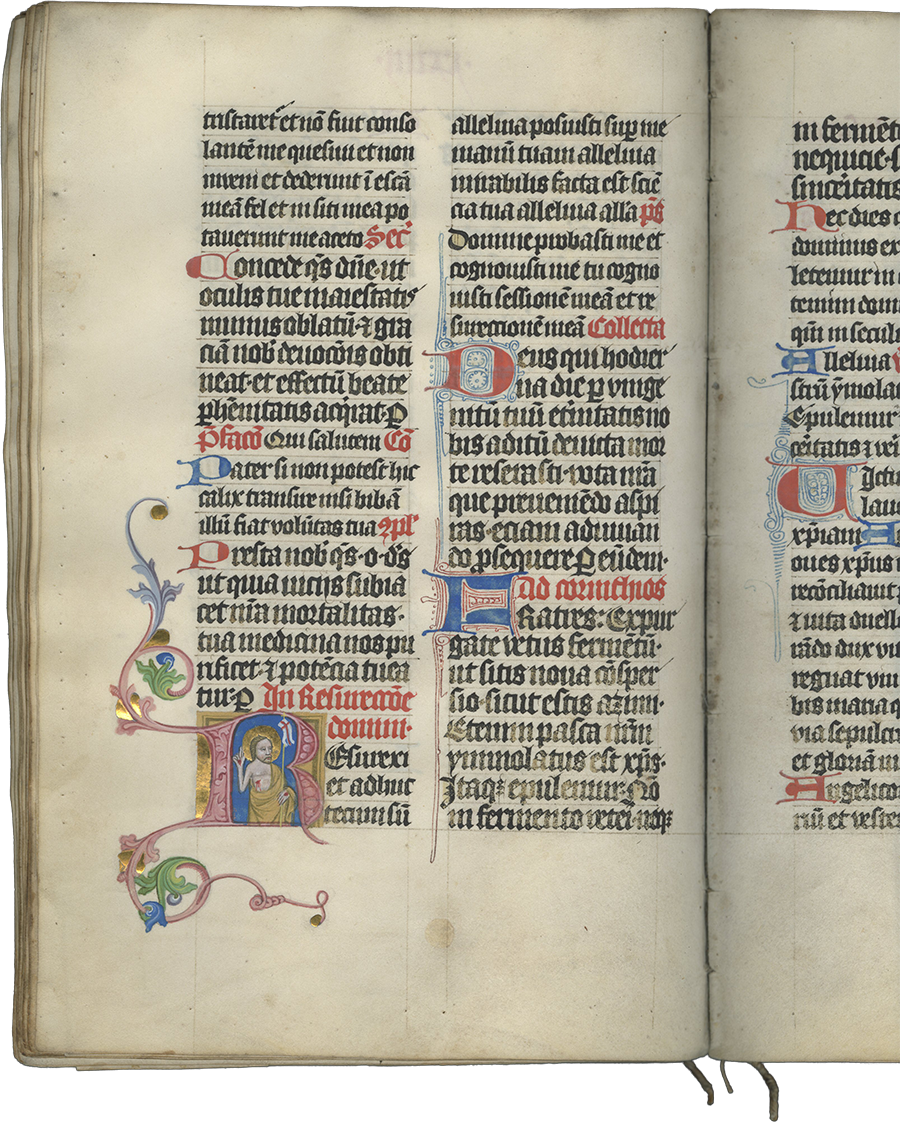
f. 26v, 4-line historiated initial of the Man of Sorrows holding the Vexillum, beginning the feast of Easter
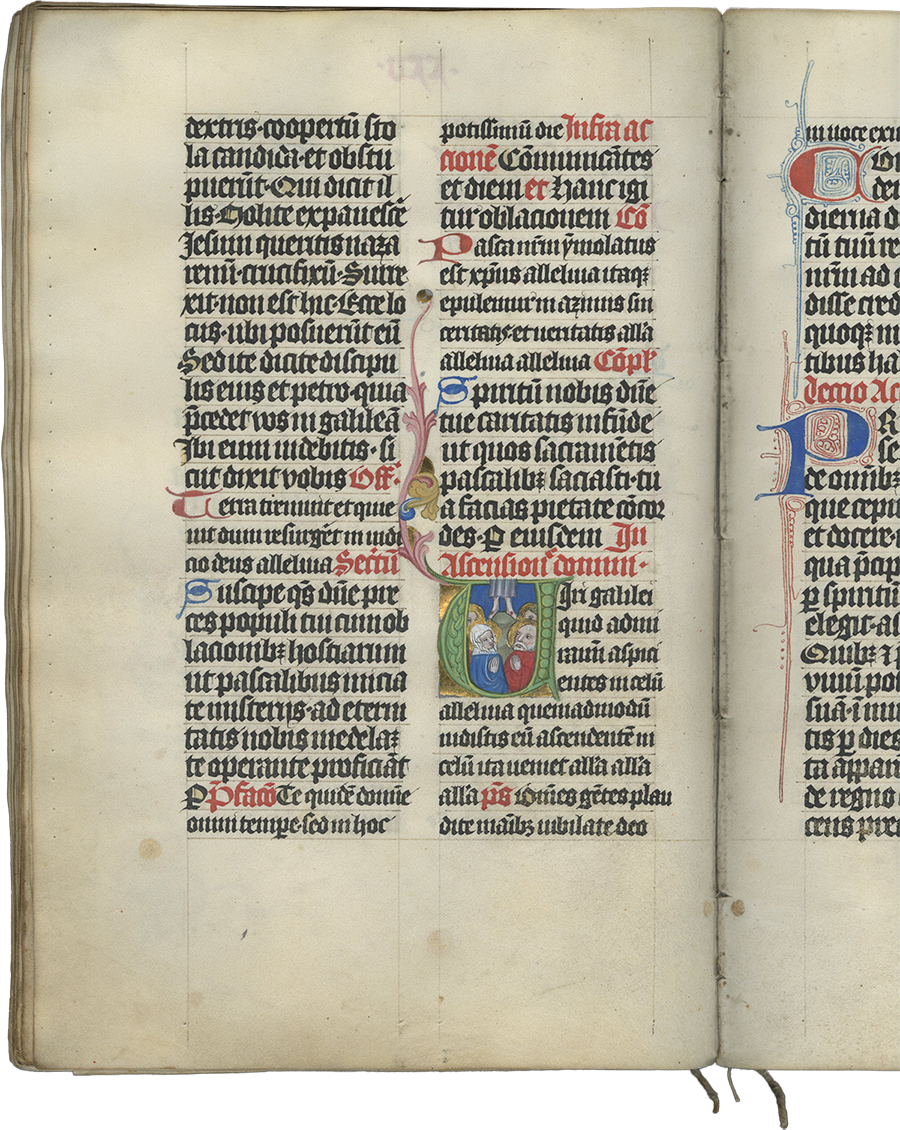
f. 27v, 4-line historiated initial of Christ’s feet ascending upwards away from his disciples, beginning the feast of the Ascension;
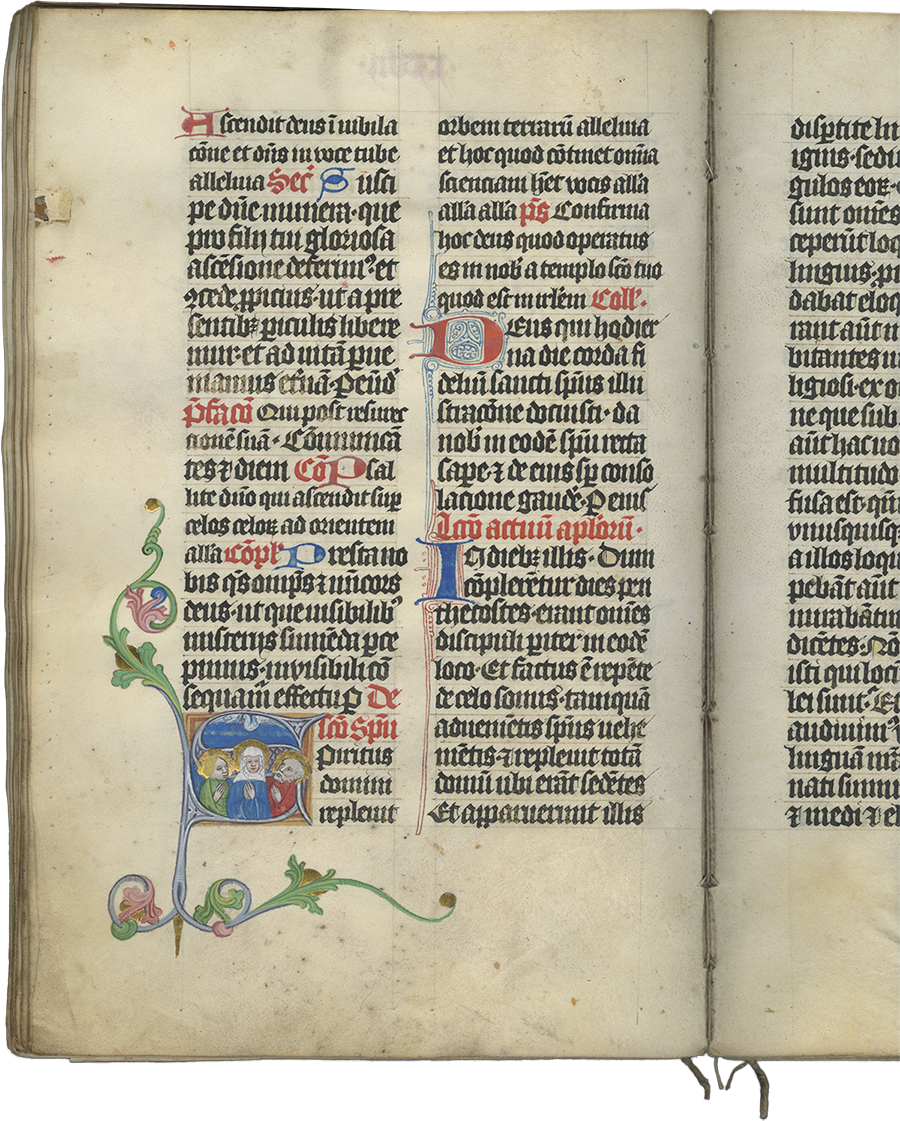
f. 29v, 4-line historiated initial of the Dove above the Apostles beginning the feast of Pentecost;
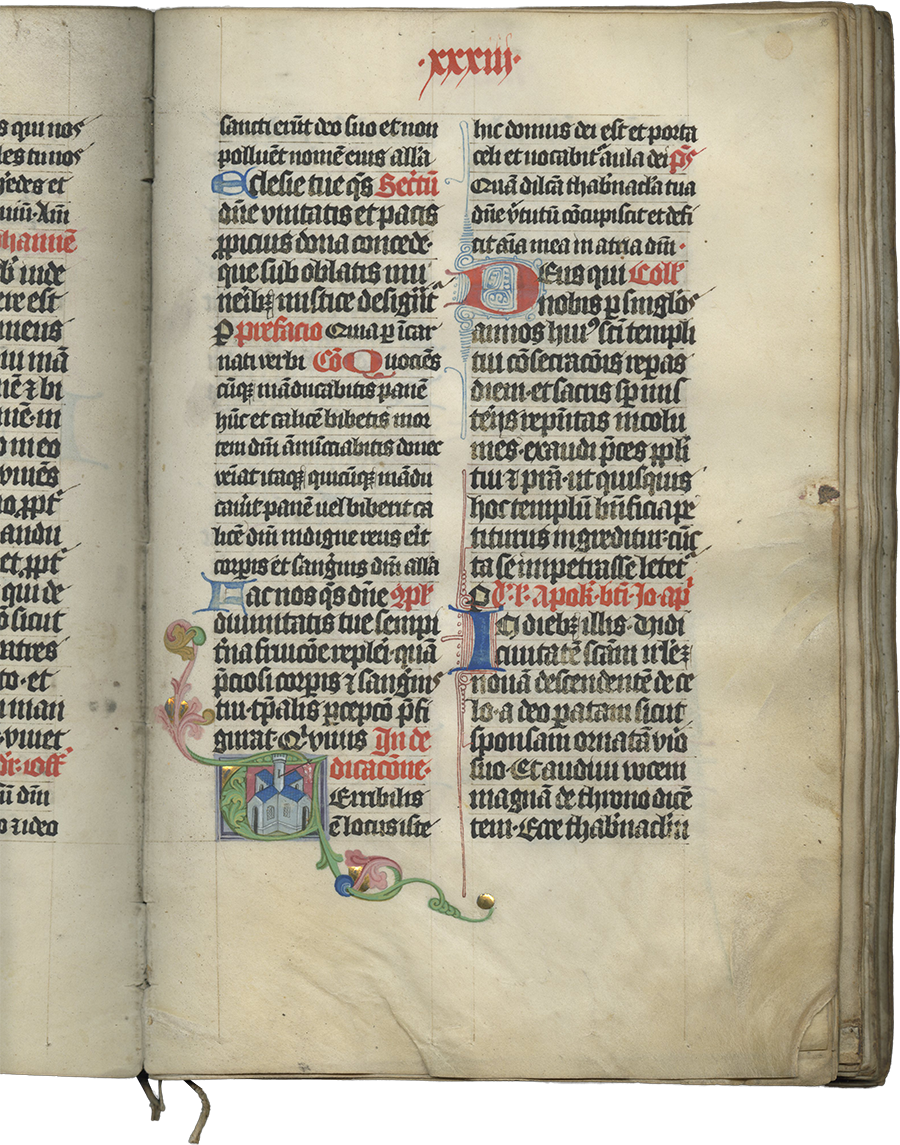
f. 35r, 3-line historiated initial of a church with the Vexillum hanging from a long pole extending from one window beginning the Mass for the Dedication of a Church;
f. 40, 4-line historiated initial of the Man of Sorrows rising from the Tomb against a starry blue ground beginning the Canon of the Mass;
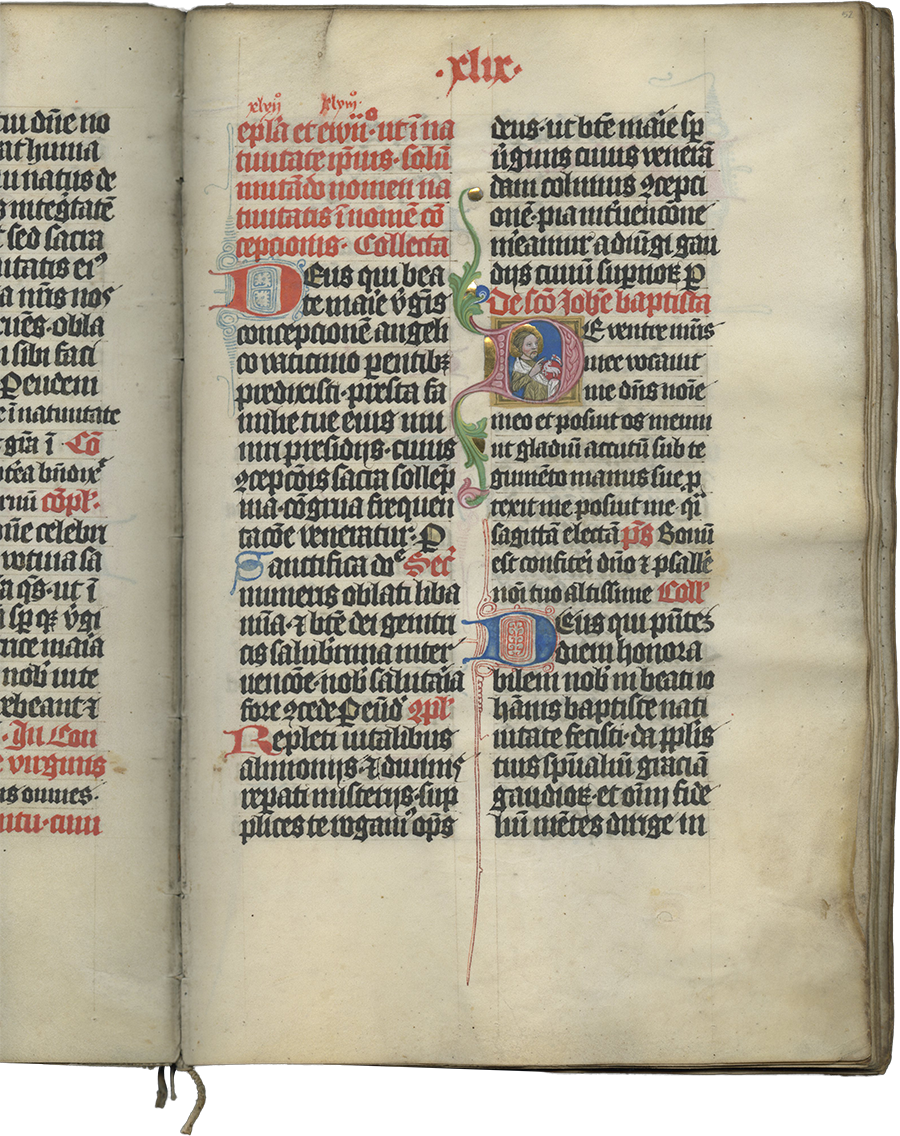
f. 52, 3-line historiated initial of John the Baptist wearing a sheepskin while holding an orb on which stands a lamb who is holding the Vexillum, beginning the Feast of St. John the Baptist;
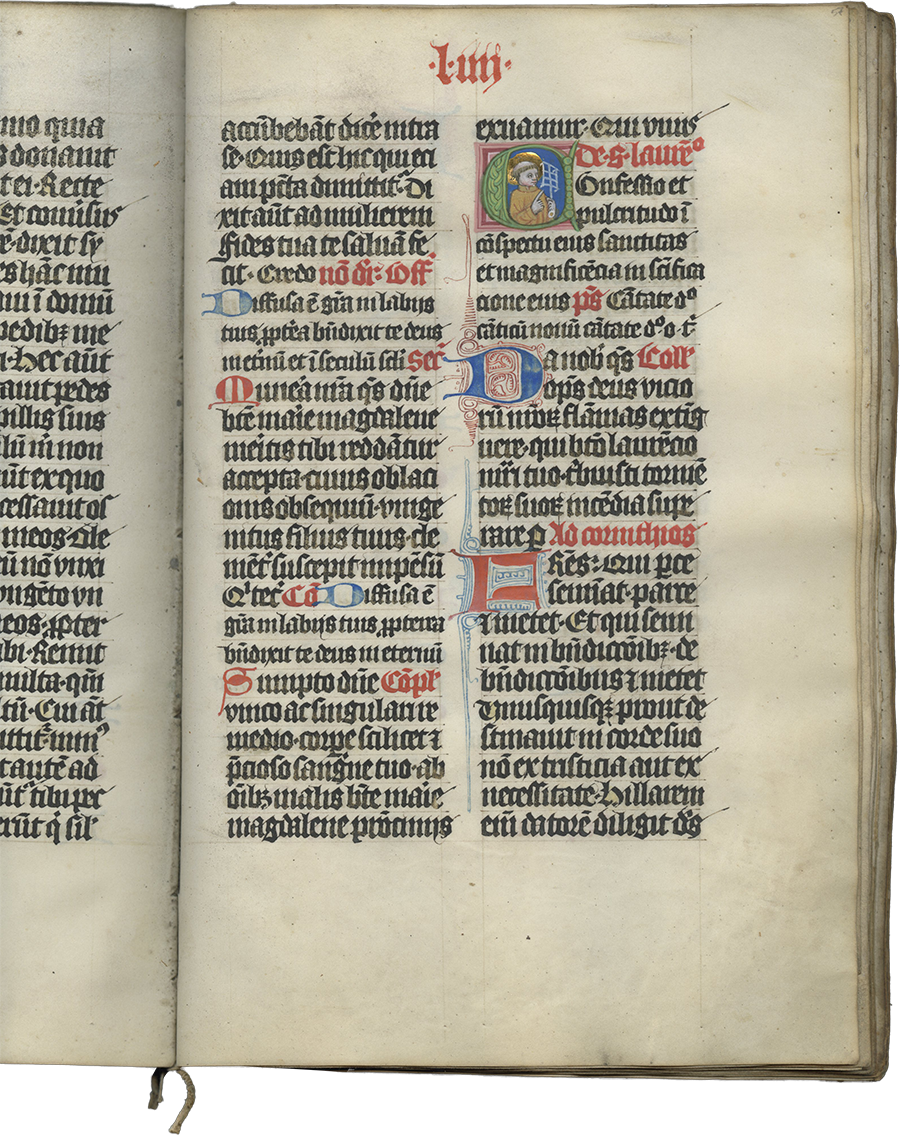
f. 57, 3-line historiated initial of Lawrence holding his grill beginning the Feast of St. Lawrence;
f. 71v, 3-line historiated initial of Barbara holding her tower beginning the Feast of St. Barbara.
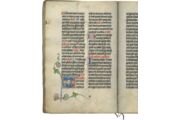
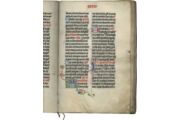
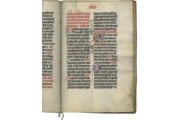
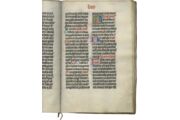
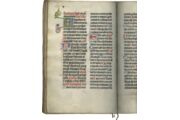
The illumination in this Missal is delightful, with dozens of illuminated and historiated initials in beautiful condition and bearing the jewel-bright tones and sinuous acanthus sprays punctuated by gold bezants characteristic of eastern Germany, Bohemia, and Silesia. The gold lobes between stem and leaf also help to guide a regional identification. Indeed, further research may be able to identify a workshop, as the usual dimensionally-shaded acanthus and spiraling ribbon within letterforms are here joined by inventive dimensional braiding (ff. 19v, 27v, 52), and the letterforms themselves sometimes knot and twist together (ff. 49v, 70), both idiosyncratic decisions that should assist localization. Very similar decorative illumination, albeit lacking the braided motifs, can be found in another Missal, made in Wrocław in 1473 (f. 238v, Wrocław, Biblioteka Cyfrowa Uniwersytetu Wrocławskiego, MS M 1130, see Online Resources). The Holy Face marginal miniature in the Canon is also a common feature of Silesian manuscript Missals, depicted as on the Holy Vernicle or alone (see digitized examples in Online Resources). As libraries in Poland begin to catalogue and digitize systematically their collections, identification of local schools of illumination will become possible; in the meantime, there is little concrete research available.
The Mass remains the central ritual (and miracle) at the heart of modern-day Catholicism, and it was equally the core of medieval Latin Christianity. Missals contain the words that a priest said during all the regular masses of the liturgical year, all the special saints’ feasts celebrated in any given location, and many other special kinds of masses, together with instructions about the gestures he was to make during the ritual. Famously, Missals were so frequently used that they often wore out, and we have records from across Europe of Missals being replaced when they could no longer be repaired. The present Missal seems to bear some evidence of such practice, beginning with a fragment of an earlier volume that may have served as the copytext for the present manuscript. If this was the case, that church was trading up, as the script in the present Missal is quite excellent for this late in the fifteenth century and its decoration in both ink and illumination fine indeed. The illumination may suggest a provenance in Wrocław, Poland, and indeed, so too does the text of the Feast of St. Hedwig included here, which nearly perfectly matches Wrocław’s use. Though clearly a deluxe production, this Missal bears many signs of updating and use in fifteenth- and sixteenth-century scripts, suggesting that its working life extended until at least the Tridentine liturgical reforms of the 1570s.
Hughes, Andrews. Medieval Manuscripts for Mass and Office, Toronto, 1982.
Jungmann, Joseph. The Mass of the Roman Rite: Origins and Development, tr. F.A. Brunner, New York, 1950.
Palazzo, Eric. A History of Liturgical Books from the Beginning to the Thirteenth Century, translated by Madeline Beaumont, Collegeville, Minnesota, 1998.
Missale Cracoviensis, Nuremberg, c. 1493, ff. 284r-v. https://daten.digitale-sammlungen.de/~db/0003/bsb00032898/images/index.html
Missale Merszburgensis, Leipzig, 1502, ff. 134 r-v. https://digital.ub.uni-leipzig.de/mirador/index.php?ns=viewid&id=0000030869
Missale Pataviense, Augsburg, 1494, ff. 214r-v. https://www.digitale-sammlungen.de/en/view/bsb00032951
Missale Nurembergense, Nuremberg, 1501, ff. 258 r-v. https://www.digitale-sammlungen.de/en/view/bsb00001943
Missale Pataviense, Passau, 1491, ff. 291v-292. https://www.digitale-sammlungen.de/en/view/bsb00032993
Wrocław, Biblioteka Cyfrowa Uniwersytetu Wrocławskiego, MS M 1130, https://bibliotekacyfrowa.pl/dlibra/publication/22729
Wrocław, Biblioteka Cyfrowa Uniwersytetu Wrocławskiego, MS M 1150, f. 192v,
https://bibliotekacyfrowa.pl/dlibra/publication/22731
Wrocław, Biblioteka Cyfrowa Uniwersytetu Wrocławskiego, MS M 1154, f. 205r-v,
https://bibliotekacyfrowa.pl/dlibra/publication/18058
Wrocław, Biblioteka Cyfrowa Uniwersytetu Wrocławskiego, MS Miss. 8377, f. 227r-v
https://bibliotekacyfrowa.pl/dlibra/publication/19057
TM 1510